
Shall we dance?
With the release of the Cochrane Review — a large, prestigious meta-study on something like 78 different random controlled trials with masking for viruses — the reality is once again hammered home. Masks don’t work on a population level. This was obvious basically since forever, and I mean forever. There was a brief period between March 2020 and October 2020 where we could delude ourselves into thinking that masking might work, since the science before 2020 (WHO report and a ton of others) was pretty cut and dried on the efficacy of masking.
But the Cochrane Review has not been well-received inside The Matrix. The Matrix wants people to believe masking works because it emergently advances its own psychosocial goals of social devolution, fragmentation and creating passive and relatively insane/depressed agents stumbling around. That much is true.
So various lesser agents inside the Matrix are now stumbling around claiming we need more research on how individual masks work, since the reason that masks don’t work is that those pesky humans just aren’t wearing them correctly, and then if everyone did, then masks would work, and we’d have no more respiratory viruses. Because even though on the surface, the aerosol physics of masking says they don’t work, we need to study them some more because they must work, even if they don’t work. Amirite?
And certain professors have made a healthy living off what is probably a combination of their OCD and the realization they’re in on a great grift (Zeynep Tufekci and Linsay Marr come to mind.) The problem is that there’s an entire field that has studied masking since forever in a far more serious and sincere light. That field is called Industrial Hygiene, and they looked at what you need to not get sick when you, as an individual, are exposed to Bad Stuff. Industrial Hygiene looks at things like aerosols, which is what COVID is, of course, and in combination with all the other stuff that can kill you.
And because of this, long before all this ridiculousness propagated by Agent Smith got out of control, they came up with the BSL protection scale. BSL 3 and BSL 4 are the operative levels for understanding what you need to keep yourself safe. Let’s review them.
From the HHS.gov webpage. In general PPE includes basically clean room gear (masks, headgear, and face shields) with all work done inside a positive pressure (air pulling away from the user, basically) cabinet. The cabinet is a big thing — without it, you’d really have to have full respirators that also supply some positive pressure. Here you go — from the web page.

Once you move up into BSL-4 territory, you’re now talking about wrapping the person in a Moon Suit, and pumping air in from a filtered source outside. From the HHS website. Do note that they have NOT changed these requirements because of political cover for the pandemic. The folks responsible for this stuff may be silent, damnably, but they are not fools. They KNOW.

One of the key elements in BOTH BSL-3 and BSL-4 designations is that you don’t get someone else sick on the outside of the facility. So much for just popping off your mask when you get home to give your sweetie a kiss — or your dog a pat. The standards intrinsically recognize the presence of fomites and other touch-spread opportunities. Hence, air showers, specialized rooms for changing clothes, and so on are also required. It’s a system, when you really must stop a bug.
To make it perfectly clear, here is a photo from a University of Texas – Houston BSL–3 lab researching COVID.

That’s really the absolute minimum, because it doesn’t couple the before/after procedures you’d actually need if you wanted to contain even a respiratory, mostly non-fatal virus like COVID-19.
Here’s the more upscale version for COVID-19 at Stanford. They have positive pressure helmets on, probably with super-duper HEPA filters. You can go to their propaganda page to see what they’re doing

And BSL-4 is even more full-on than that. Here’s what you really need — BSL-4 gear, where you simply cannot afford to have a viral pathogen released. From the Honeywell webpage — they sell these suits.
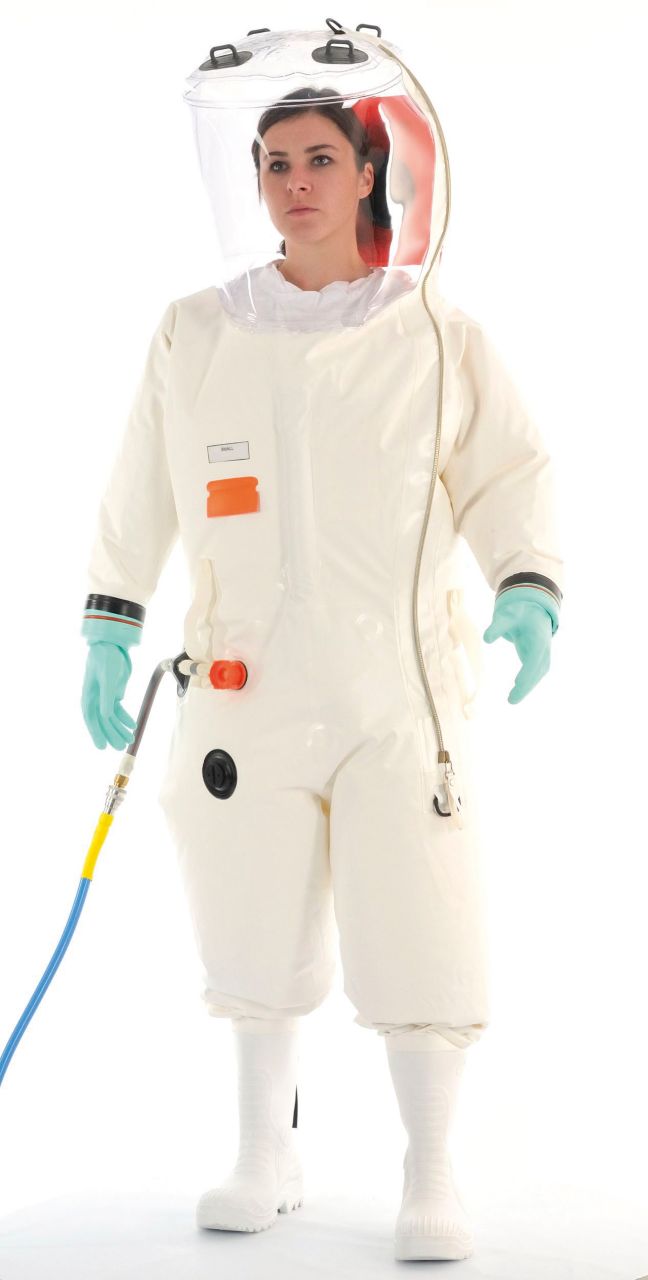
Not to mention the procedures involved in getting on the suit, also working in a cabinet, and getting out without bringing along through contact the bad stuff.
Here’s the point. It’s actually WELL KNOWN what it takes to contain viruses like COVID-19. EXTREMELY well known. But the question, which I ALSO!!! answered incorrectly so long ago, was “is there a dilution effect in infection from COVID-19 if everyone wears cloth/surgical/KN-95 masks, that will also affect population dynamics of the virus?” We know on an individual level we cannot stop this sucker with these trivial safety measures, but might there be a population variation if EVERYONE’s on board?
The answer is clearly ‘no’. Moralizing your neighbors about wearing masks is just that — moralizing. And once we realize that, we now realize that masking is a social dynamic inside The Matrix, and has nothing to do with preventing viral spread. Moralizing and shaming are powerful social physical techniques. Shaming, in particular, is a powerful form of memetically spreading depression. Ostracism, and the other forms of isolation that go along with it, are designed to get others in a given group to submit directly, or defer through inaction. And these are EXACTLY the dynamics you need to create Authoritarianism.
Agents of Authoritarianism simply cannot give up their desire to depress people. They are in The Matrix, their bubble of awareness is small, and they are largely incapable of thinking in terms of changed conditions, or learning. They’re waiting for their next order, because that is the way the memetics work. Expecting them to change their minds is ridiculous.
Here is an agent of Agent Smith at work — Jennifer Nuzzo, a professor of public health at Brown University.
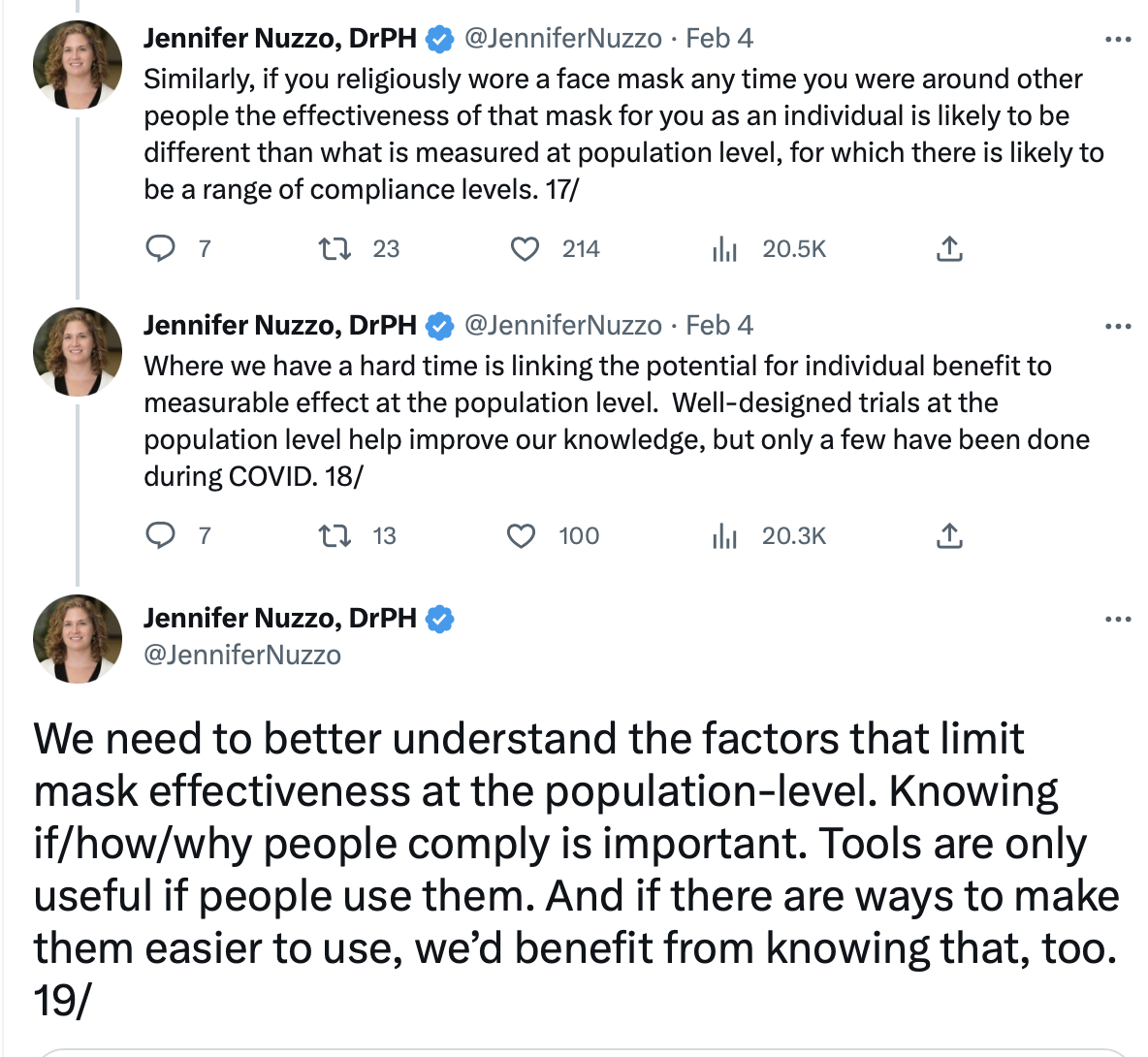
And herein lies the memetic rub. We actually KNOW what it takes to stop COVID-19, or any respiratory virus at the individual level. That is BSL-3 PPE. Gotta give the Chinese CCP credit — at least they dressed their goons appropriately. EVERYTHING recommended on the INDIVIDUAL level wouldn’t work. Researchers in good faith attempted to find some ameliorating effect on the POPULATION level, through some reduction in dose in transmission. The Cochrane Study showed that many people, trying, failed.
So are professors like Nuzzo advocating because their bubble is so strong they are unaware of the INDIVIDUAL requirements for PPE? Or are they maliciously continuing the grift (Nuzzo wants more studies, of course) because it serves their larger, egocentric purposes? Here’s the thing, and this is what is interesting. Regardless, their v-Meme structure, promoting an Authoritarian social structure, is supported and reinforced by their views. Masking causes isolation and depression, and additionally, when applied to children, makes them more compliant (as well as mentally ill) so they can serve inside the social structure that Nuzzo emergently desires. Whether she realizes it or not.
They are in a positive feedback loop from an informatics perspective inside their community. I’m sure if you asked Nuzzo if she was acting in good faith, in the context of the general welfare, she would say ‘yes’. But that says more about her empathetic scope (extremely limited) and her ability to link complex, cross- paradigmatic situations than any real opinion. She would likely say things like “but BSL standards are in a lab, and people aren’t in a lab,” instead of looking at the BSL standards as what you actually need to contain viruses (which is what they truly are.) It just goes round and round from there. And reminds me of Humpty Dumpty’s famous quote:
“When I use a word,’ Humpty Dumpty said in rather a scornful tone, ‘it means just what I choose it to mean — neither more nor less.’
’The question is,’ said Alice, ‘whether you can make words mean so many different things.’
’The question is,’ said Humpty Dumpty, ‘which is to be master — that’s all.”
― Lewis Carroll, Through the Looking Glass
To sum up — because it took me quite a long time to summarize effectively the individual/population-based masking question.
- We know what it takes to stop transmission of respiratory viruses on an individual level. None of the current PPE does this (cloth, surgical and N-95 masks.)
- We didn’t at the start of the pandemic know if some effect of dosing might be present, and prevent worse COVID outcomes if everyone, in whatever fashion, wore masks.
- We now know that it makes no difference.
No more research is needed.
PS — after a round of comments, for those confused, I’m posting this addendum.
The pictures that show BSL3 workers masked with face shields are accurate. Those masks and face shields are there to deflect droplets or spilled material. All actual work on trays of viruses must be done in a negative pressure cabinet, basically meaning that air is being sucked away from the researcher, and into some type of hood that exhausts into a purification system. The clothing alone is not meant to stop aerosols, because theoretically aerosols are never supposed to reach the person. They are contained in the separated system. Any fomites attaching to the researcher are supposed to be cleaned off in the air shower at the entrance to the BSL3 facility.
This is very similar to clean room standards for microchips. Except in that case, humans are the contaminant, and the systems exist to keep any sub-micron particle off the chips, as that would cause the process to yield lower.
Do note on the BSL3 standard that respirators may be required. The Stanford lab has people posing in what are called PAPR helmets. The idea is the same — positive air pressure respirators are incorporated into the helmet so only sub micron aerosol free air reaches the person in the helmet.
I have one of these that I use for woodturning. It’s not quite as sophisticated as the ones in the pictures. And if you fart into the waist pack that contains the HEPA filter, trust me — you still smell it. But it’s pretty amazing for a dusty environment.
All these are well-established technologies. I am very lucky indeed to have been in at least three clean room facilities in my life (not BSL3 labs) so I speak from some level of experience.
 It's About Empathy - Connection Ties Us Together
I’m glad to know about the Cochrane review, but a tiny part of me just can’t let go of what I’m seeing in the UT-H BSL3 researching COVID lab photo, which isn’t making it perfectly clear so much. Seems like at least part of the BSL protocol requires something that it has been WELL KNOWN forever doesn’t work. Amirite?
LikeLike
No. You’re wrong. All work has to be done in a positive pressure cabinet. Everything in the BSL-3 protocol is around the notion of biological isolation at all levels, including aerosols. It’s basically the same as a clean room protocol, where any contamination from the biological source (the human doing the work) means no/low chip yield. Go visit one sometime (much easier to do than visiting a BSL-3 lab) and they’ll educate you.
Look, why are you here?
LikeLike
I’m wrong about what exactly? I didn’t miss the BSL stuff in your long quickie post (including how one of the key elements is that you don’t get someone else sick on the outside of the facility). The photo of ‘researching COVID’ that you included clearly shows they are wearing what appear to be surgical masks behind the face shields. If the surgical masks were part of pre-COVID BSL they are probably not just ‘moralizing’ fashion statements. Are you claiming in your reply that those masks are part of the protocol to prevent contamination from the researchers as in a manufacturing clean room (so they do work one direction, keeping COVID/flu from contaminating the work, but not the other)? Or is it that this isn’t population level so it’s N/A? Or was the BSL protocol actually wrong to include surgical masks even pre-COVID? Is it possible ‘masks don’t work’ is a unnuanced v-meme when so absolutely and confidently deployed may be approaching a similar type of ‘moralizing’? Seems like pretty fair questions to ask about that photo and for sure the irony is worth noting, no matter how much I’m actually unwittingly ‘wrong’ (if you’re so uptight you can’t recognize the latter, I know the answer to the last question).
I’m here because once in a while you make really interesting points (including on the mask topic and even at least one in your Elon post iirc, which was, sorry, pretty obsequiously gross overall) and, just as significant, because the pictures you include often are great reminders that I should be getting back to doing something else (probably we have more than average in common, based on the photography and conservation perspectives) other than reading esoteric contrarian nerd blogs. I’ll keep my trolly thoughts to myself in the future, peace to you.
LikeLike
Re: trolly thoughts. Great! Masks, clothing and face shields in a BSL3 facility are used to protect from droplets and spills. Aerosols are controlled through overall system ventilation and all work being done in positive pressure BSL cabinets. No cross-contamination between the samples and the humans. COVID-19 is spread as an aerosol, and the masks people are wearing in the pictures are not about containing any aerosols. That happens in the clearly defined containment systems, which humans basically never have to breathe from. This information is readily available in the BSL3 description. But you have to have context, as well as being aware that you might not have context.
This blog is a great place for someone like you to learn things, if you wish, or ask for clarification. If you want to have low level debate, there is Twitter and Reddit. Attempting to “count coup” on me is tedious. If you don’t consider me an expert in what I write, I have no idea why you’d want to read this blog. I am very accomplished, but clearly not famous, and it’s just not the place for it. That doesn’t mean I never make mistakes. I do (there linked in the text!) But really — not so much.
LikeLike
Thank you for explaining (and acknowledging) how masks work in a BSL-3 environment. ‘Masks don’t work’ again presents as a simplistic v-meme (beware, right?) that is not so useful imho. Surely there is a better turn of phrase.
Sorry if you feel my comments are to score points somehow, it’s really not my intent (but probably I’m simply incapable of escaping the curse of internet comments). Will more than 10 people ever even read my comments here anyway, what points are there to score? It seems elsewhere you have access to many ears, and maybe not so much skeptical feedback. It doesn’t matter, the point is I never comment here to feel smug. If the purpose of this blog is to be a lecture hall and the comment section expected to maintain the same level of traditional submissive etiquette, then ok. But sometimes we learn by poking a thing with a stick.
My last thought to you is this: if the COVID pandemic demonstrated one thing absolutely (for not the first time), it was that there are no experts nor very accomplished people, regardless of fame or fortune or resume or reading or anything, that should be revered and trusted to learn from in the way people my age are accustomed, especially not at first and probably not ever. This goes logarithmic for anyone venturing anywhere outside their field of study and career (which from my pov happens here regularly). Nobody is above it, especially those who think themselves not so much above it. Nevertheless some people (like me) still want to read an interesting internet blog even if the author might seem a little.. over-enthusiastic about certain things. ♥ One might still discover something important. That’s all I got, I promise.
LikeLike
In chemistry, there is the hood where there is negative pressure to prevent inhalation of toxic aerosols. There is also glass lube to prevent toxic aerosols from escaping a distillation apparatus. (A couple of girls in my organic chem lab were poisoned by aniline and ended up in the hospital ages ago because they didn’t seal the glassware with lube when they were making and distilling aniline–one was blinded temporarily.)
Like you said, negative pressure (away from humans) is key to limiting exposure to biohazards and for clean rooms.
Apart from pressure situations, I don’t see masks helping limit exposure to aerosols. (They may help some as a splashguard.) My professional opinion (physicist) is agnosticism. Physics research into the mechanics of masking wrt respiratory droplets is in its infancy. (And, of course, Bradford Hill criteria make mechanics salient. Epidemiological study is insufficient by itself.)
A salient question about masking wrt respiratory droplets is “What can go wrong?” NIOSH studies this question and makes recommendations. I have seen nothing yet having to do with masking wrt respiratory droplets from NIOSH looking at what can go wrong. NIOSH’s expertise is salient on this question–the CDC’s is not.
What can go wrong?
The following can reduce mask efficacy: sweat, tears, sneezes, coughs, drool, mist, rain, snow, dust clouds, oil aerosols, acid spray, beards, misfitting, mishandling, wear, etc. Over time, mask effectiveness will diminish. Studies need to be done on mask carrying capacity wrt respiratory droplets–the question of when to change them out is a SWAG without this research.
I hope this helps.
LikeLiked by 1 person
If it’s not obvious, I meant to say, ‘especially those who think themselves not so much within it’
LikeLike
Makes such sense. Thank you.
LikeLike
You should probably link to the actual Cochrane Study, instead of a secondary source: https://www.cochranelibrary.com/cdsr/doi/10.1002/14651858.CD006207.pub6/full
Their conclusions are much less certain than yours:
“The high risk of bias in the trials, variation in outcome measurement, and relatively low adherence with the interventions during the studies hampers drawing firm conclusions.”
And indeed, they acknowledge the need for more research:
“There is a need for large, well‐designed RCTs addressing the effectiveness of many of these interventions in multiple settings and populations, as well as the impact of adherence on effectiveness, especially in those most at risk of ARIs.”
Compared to you, I am more sympathetic to mask requirements early in the pandemic, when there were no effective treatments, vaccines, or other prophylactics.
Furthermore, this study has limitations and critics, as described by this Vox review: https://www.vox.com/future-perfect/2023/2/22/23609499/masks-covid-coronavirus-cochrane-review-pandemic-science-studies-infection
For example:
“The review includes 78 studies. Only six were actually conducted during the Covid-19 pandemic, so the bulk of the evidence the Cochrane team took into account wasn’t able to tell us much about what was specifically happening during the worst pandemic in a century.
Instead, most of them looked at flu transmission in normal conditions, and many of them were about other interventions like hand-washing. Only two of the studies are about Covid and masking in particular.
Furthermore, neither of those studies looked directly at whether people wear masks, but instead at whether people were encouraged or told to wear masks by researchers. If telling people to wear masks doesn’t lead to reduced infections, it may be because masks just don’t work, or it could be because people don’t wear masks when they’re told, or aren’t wearing them correctly.”
LikeLike
Mike — the mask conversation (and even the Cochrane study) are both in the rear view mirror. If you want to understand BSL3 safety standards, I have a post on this. And the Cochrane study, while not explicitly proving a negative, which is impossible, does show that respiratory viruses, that exist at a particular size, are not stopped by masks.
But that’s not the end of it. No one addresses viral reservoirs, and I won’t either, lest we wander back to the frat house and discuss killing everyone’s pets (which some in China actually did.)
The crazy thing about all this, emerging in the past week, is that COVID may have emerged from the Wuhan lab because of BSL2 standards. Which are masks.
For more, go here:
LikeLike
Yes, the Cochrane Study is in the past (as are most things in life). However, it is still important, esp. in this pandemic interregnum, to determine the epidemiological nature of the past sars viruses and rate the effectiveness of different public health approaches–a scientific post-mortem, if you forgive the morbid pun.
Specifically, I am not arguing that N95 (let alone cheaper) masks were particularly effective at stopping public covid transmission. I am arguing that we don’t really know and thus further research is required. But maybe I’m just stuck in the Matrix and need to be freed. (When we met, I don’t remember you offering me any mind-expanding pills, herbs, or even tonics.)
As far as origination, I agree. The PRC/CCP is, like other authoritarian countries, “unreliable”. (In fact, the Chinese government is actively stonewalling and even generating misdirection, such as promoted fantasies that the U.S. military was the source.) Western countries should continue to investigate, but outside of some intelligence leak or the dissolution of government, I doubt a definitive answer is forthcoming.
LikeLiked by 1 person
You can’t FOIA the CIA.
LikeLike
Ah, I see you were responding to my recommended post.
So you read it. BSL3 standards require control of aerosols. Gotten by working inside a negative pressure cabinet with HEPA filters on the other end, and probably some ultraviolet sterilization as well.
Which, once again, were a failure at the Wuhan lab that required things to be shut down to fix. Details that we can’t know, because the Chinese aren’t talking.
LikeLike
I recommend you to read this https://maryannedemasi.substack.com/p/exclusive-lead-author-of-new-cochrane interview with Tom Jefferson who is the main author of the Cochrane review. This interview maybe can be an eye opener for you.
(The weblink is the original source but there is a paywall meanwhile so I’ve uploaded a screenshot of the interview here:
https://archive.org/details/Masken-Literatur/2023-02-05_exclusive_lead_author_of_new_Cochrane_review_speaks_out-Maryanne%20Demasi%20reports/mode/1up )
Don’t miss out to read the >470 other papers & books about useless but harmful masks which I’ve uploaded on my page:
https://archive.org/details/Masken-Literatur
My personal resume about masks in short is as follows: cloth masks and medical masks do absolutely nothing to protect anyone from an infection.
FFP2/3 masks can protect some people for a certain time but only those people who wear them voluntarily and really take care extrem about mask fit, hand hygiene and their contacts. But even the people who really take care will become infected because nobody wears a perfect fitted mask 24 hours a day. Further on it is still not clear if SARS-CoV-2 is really only transmitted by airborne transmission. All in all masks for the general population in everyday life do more harm than good.
LikeLike