Turning Correlation into Causation – How Deeper Knowledge and Insight is Generated

My chief writing partner – Mac

Correlation implying causation — as we’ve heard it 1000 times, don’t believe it. And it’s true — DON’T believe it. Well, at first glance. It’s so easy to come up with funny examples — all you really have to do is match one upward (or downward) trend with another, and if the rate of change/slope/timescale for the change is the same, ta-da! Instant high correlation! Buzzfeed walks through some funny ones in that link above, like the increase in global average temperature being indexed to an increasing pirate shortage.

You can lay these examples out at your next round of drinking games and speculate exactly WHY decreasing numbers of pirates might be behind Anthropogenic Global Warming (not enough shipping sunk?) but hopefully, you’ll maintain some healthy level of skepticism and scrutiny.

Before we sink into the deeper knowledge AND empathy structure analysis here is the most basic rule-of-thumb behind deciding if correlation actually IMPLIES causation — identifying a physical mechanism or dynamic that involves both topics. You’ve got to at least get to Legalistic/Algorithmic value set to have a hope of understanding a real connection. Is one of these really what mathematicians call an independent variable of another?

This is really an offshoot of the fun parlor game I just recommended above. But it does involve synthesizing knowledge from outside the field, and really takes apart the conspiratorial thinking relatively quickly. Does organic food cause autism? Can you link a mechanism in the brain that causes autism to some lack of pesticide consumption? Or can you draw two or three causal links that takes you from your incipient need to eat pesticides to protect your unborn children from autism? If you can’t, well, you have to STFU.

There’s a deeper way to understand correlation vs. causation, though, and it gets us back to the Knowledge Structure stack, and one of the core concepts of this blog — Reliability vs. Validity. Pure correlation consists of taking two different data streams, with attached temporal/spatial scales (or some other independent index — look, gang, don’t ‘gotcha’ an old digital signal processing expert with that shit!) and then, well, correlating them.

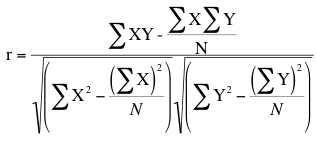
If you need the math to feel comfortable, well, start here! Do not be denied!

But that’s the end of the math for us. Let’s get down to business.

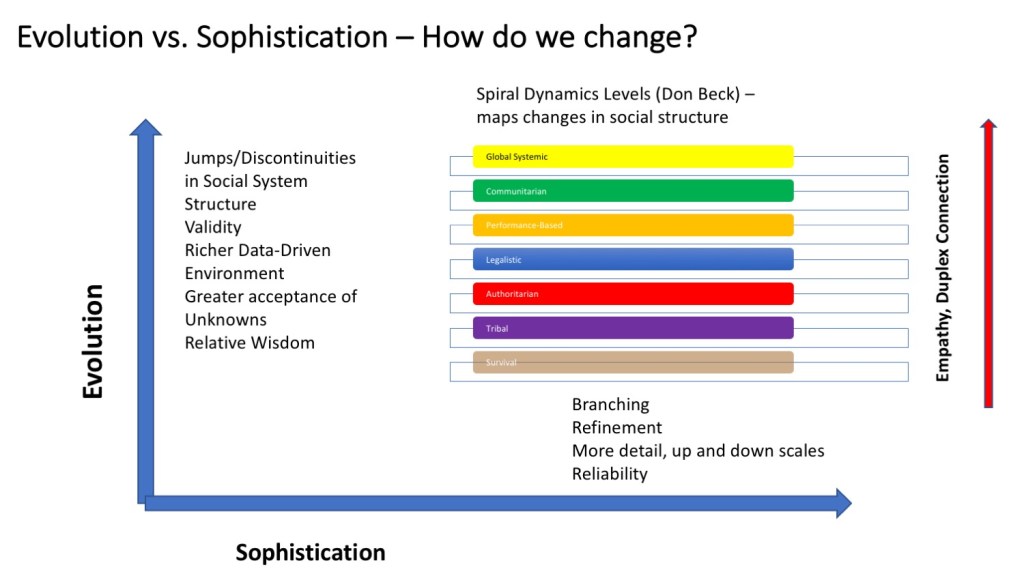
Correlation, as expressed above, is itself an algorithm that poops out a number that shows how well two data streams match. Let’s just post the Knowledge Structure understanding that flows from social structure below so you can remind yourself of where all this flows from, empathy- and human interaction-wise.

Basic Social Structure/Knowledge Structure Diagram

Someone walks into your office with two columns of numbers. You have no idea where those two columns came from — they’re just two columns.

So… you accept the Authority of the person trotting into your life with these two columns of numbers that they actually mean something. Susie says “I’ve been doing research on pirates and Anthropogenic global warming (AGW), and there’s some extremely disturbing trends I’ve observed in the data. From my vantage point, we better start recruiting pirates stat!”

You don’t really know Susie very well. She seems nice enough, and she DOES have the official title of Data Collection Master, given to her (ostensibly) after a long process of certification/education. So, you take that AGW and Pirate data and feed it into your Excel spreadsheet Algorithm— you ARE, after all, titled Data Analyst Master — and poop out a near perfect correlation of the two streams. All this “makes sense” to you. After all, Susie has an impressive title. And so do you.

You have no reason to believe that Susie has fudged the data (let’s get rid of the psychopathic distortion angle here.) She’s acting in good faith, and so are you. If she walks in with the same data, and asks you to analyze it, you’ll get the same answer. Both of you know how to create a data set, and analyze it.

What this means is that the analysis is REPEATABLE — as well as RELIABLE. That sounds pretty good. But that’s what both social structures are known for. REPEATABLE and RELIABLE sounds good to scientists. They don’t want to hear that the data can change its mind. This knowledge structure maps well to their social structures, and as such, everything makes sense.

But the problem with the social structures producing the data (as we’ve represented it) is that they are CLOSED systems. You’re inside the organization making/recording the data, or you aren’t. Someone can’t just walk through the door and start handing you Pirate population numbers, or records of AGW temperature. Which means, in our theoretical example, the data is not GROUNDED outside the implied experience of either Susie or yourself. It’s subject to your beliefs (Pirates are a GREAT solution for AGW!) and really not much else. And like as not, both the data streams were also collected INDEPENDENTLY. The Pirate Census organization went out and counted pirates. The AGW recorded ocean temperature equally separately.

What that means is someone can walk through the door and potentially influence you (they might show some pirate atrocity that might cause you to re-think your earlier support of increasing the number of pirates!) and it might gross you out enough to change the result. Or something else — you might see the data and remember your Correlation Organization binds you to a code of honor that says you’ll just push the buttons and give Susie back the magic number. There are many potential scenarios.

But if we want CAUSATION, we’re going to have to walk up the Knowledge Structures, that emerge from Relational Structures that are also valid. Above our heads are four relevant Knowledge Structures, all of which might complicate things, but in the process of doing that complexifying, will increase (or decrease) the VALIDITY of the conclusion.

Causation might be established by a high Performance observer in the field, noting that when a pirate ship sails through a bay, the ocean temperature drops. Such an observer would be more believable if they were trained, say, in pirate identification and census, or in ocean temperature measurement. They would be more believable because, once again, they would be a more RELIABLE observer. The process of pirate observation certification would certainly help — even as it comes from the lower Value Sets/Relational Structures. But it’s the boots on the ground and watching the connected phenomena happen that would lend to better appreciation of causation. That observer would use their own judgment (hence the need for agency, and a functional heuristic) on how to interpret various data streams to position their Pirate Observation Ship (POS!) and their temperature probes to establish a meaningful connection.

And if there were a larger Community of POS-s , they could increase both reliability and validity. Or they could blend a different set of perspectives to lend credence to the correlation.

If there’s a takeaway here, it’s that additive perspectives matter. When you go out and interview people, you have to integrate their personal experience into our larger understanding of how pirates and ocean temperature function. When I think about Nora Bateson’s “Warm Data” construct, these two levels fall into that category. Often we can’t get to a generalized equation relating overall ocean temperature to lack of pirate passage. But we can combine the testimonials of lots of people to get at some aggregate sense of the truth. (“Arrr, we were just hoisting’ the Jolly Roger when the temperature in the ocean dropped 5 degrees!”)

What the next two levels of social structure offer — Global Systemic, and Global Holistic — are Knowledge Structure constructions that are now far more overarching than Warm Data, or anything we’re collecting from grounded heuristics of varying validity, with different observers. We’re either getting a methodical system laid out to actually validate our correlation (Global Systemic) or an overarching set of mathematical equations (like Einstein’s Theory of Relativity) that can tell us what ocean temperature and pirate density is around the globe — and matches the data – true Global Holistic thinking. The Holy Grail of Pirate effects on climate.

——————————–

Let’s do a more simple comparison (that’s real!) to show how all this actually matters. Let’s say I have three scientists together at a conference. They’re all specialists in measuring the force of gravity. But let’s pretend they haven’t figured out anything BUT how to measure downward force on an object falling to the Earth. No Newton’s Law – which is pretty close to Global Holistic — we use it to calculate spacecraft trajectories to Jupiter, after all!

All our scientists are in Legalistic Hierarchies, which means that they have access to methodically collecting data as part of their core knowledge structure. They all belong to the Downward Force Measuring Society, and have been trained to follow exquisite procedures to come up with their results. No agency required! And no relational trust either. So no empathy.

Scientist #1 stands up, and says “We’ve been doing a fine job measuring this downward force on balls in our lab in East Skeezix, NY! Our test objects are accelerating toward the ground at 9.81 m/s2 consistently!”

Scientist #2 stands up, and says “We ALSO have been doing a tremendous job measuring gravity in West Windy, OK! We as well have been dropping small balls, and have recorded an acceleration of 9.81 M/s2 consistently!”

Scientist #3 stands up, and says “I’ll bet if you drop a ball over in the Walmart parking lot on the other side of town, you’ll record an acceleration of 9.81 m/s2 as well!”

What do the other scientists say? Stuck in the lower value sets/social structures, they pronounce “You CAN’T say that. You DIDN’T make the measurement!”

Reductionist science at its finest.

The series ‘Genius’ in the first season covers the life of Albert Einstein, and the episodes I watched actually cover the various conflicts in the Value Sets pretty well. The German empiricists were not so far off from the gravity scientists above when Einstein announced his Theory of Relativity. Compounding the hatred was the fact that Einstein was Jewish, and the Nazis were coming to power. That certainly didn’t help.

And it was none other than Einstein’s mentor, Max Planck, that said, science advances one funeral at a time. Mostly — or from large, connected communities, or the vanishingly rare heads of singular geniuses. And, let’s face it. Most of us are not Einsteins.


What’s the takeaway? We establish RELIABILITY with the lower social structures. We establish VALIDITY through grounding with the outside world with the higher social structures. And we had better have a method that supplants our innate tendency to jump to a conclusion that supports our beliefs. Understanding the role of case studies, as well as larger deep theory helps us to make sure we fill in the blanks in both arenas.

And the core of valid case studies, or trusting the right people? Empathetic development. It always comes back to that.

What’s the potential for future peril that we might see, if we can’t get this lesson? The disconnected example I used above – pirates and AGW seems pretty silly. The problem is that AI is moving rapidly into the space where seemingly distant outcomes can be supported convincingly by pretty sophisticated analyses. Advanced biometric analyses of faces (which are heavily race-dependent!) are now possible. Similar correlative mechanisms are being used to identify potential shop-lifters and such. One can see relatively quickly that a deeper understanding of this whole correlation vs. causation is going to be at the root of a lot of ground wars in lots of our society. There’s no guarantee that we’re going to evolve a deeper understanding of how faces work before we identify the superficial characteristics associated with race and ethnicity.

Uggh!

Understanding College Students’ Mental Health — Dr. Gregg Henriques

Howler Monkey Family Meeting, Pantanal, Brazil

I’m on a list serve, founded by friend and author, Daniel Goertz, of The Listening Society and Nordic Ideology. For the most part, the posts are esoterica from philosophers mostly outside the academy — which makes it somewhat interesting, in that Integral domains are covered. But every now and then, some material gets posted that I think really gives deep insight into the problems the world is facing. This guest blog post is one of those posts. Written by Dr. Gregg Henriques, who also writes on ‘Theory of Everything’ kinds of subject matter (he’s the author of the Tree of Knowledge framework for attempting to unify psychology) drilling down into how our young people’s minds are changing is vital as we course-correct through this deeply turbulent societal time. Gregg’s work is somewhere between more surface-level psychology and my own deep, system-y stuff.

So… without further ado — here’s Gregg’s piece.


Understanding College Student Mental Health

Given my writings on the college student mental health crisis (see here, here, and here), I am often asked, “What is really going on with the increases in demands for services and reports of serious mental health challenges?” and “If it is a real problem, what can we do about it?”

Here is the short story, at least for the USA:

We are seeing a dramatic increase in demand for services on college campuses. A big portion of this increase is almost certainly a function of a change in attitude about the meaning of therapy and being in distress. That is, it used to be that folks were much more reticent about acknowledging distress and seeking therapy, and now they are much more open about both. Indeed, I think this is a major change that is driving the increases in demand. In other words, in the past many people did have lots of emotional trauma that was basically denied, crushed, avoided, etc. Over the past 20 years, the mental health industry and culture have opened their hearts so to speak to this pain.

That is the good news. Unfortunately, there is more to the story. I think the data are clear that definitely are seeing real increases in mental health problems, most significantly in the area of anxiety, depression, and self-harm/suicidality. My view is that our society went from being unhealthily repressed 50 years ago to opening up sensitivity to injury and negative feelings. However, we opened up those doors without also cultivating anti-fragile, stoic, character building virtues. In other words, we fostered much greater access of vulnerable feelings, but did not help foster adaptive regulation. Instead, we have tended to simply validate the experience of threat and victimization and assert that everyone had a “right” to be protected without being clear about how to be a responsible adult who was adaptively regulated in a mature way. Not only that, but as Jonathan Haidt and others note, we have become obsessed with safety (what they call “safetyism”) in a way that cultivates a sensitivity to injury that leaves folks who have neurotic temperaments to be essentially “raw nerves”. I have heard a number of people claim that millennials are “spoiled.” I think it is more that they are overprotected by helicopter and snowplow parents and an unspoken philosophy of safetyism. In such parenting contexts, the victimized response of the child is reinforced, which can breed a toxic sensitivity. 

Finally, it must be acknowledged that parenting philosophy is only a piece of the puzzle. A strong case can be made that our fractured society, broken educational system, information overload, screen addictions, and disconnect from nature is breeding a massive feeling of alienation, perhaps especially in this generation. I view the “mental health crisis” as one of the great meta-crises facing us in the 21st Century.

Given that, let’s move to the second question: “What can be done to address this issue?” First, I believe that society needs some significant evolution in terms of both what we value and how we relate to each other. As this blog notes, I think we are facing a “meaning crisis” and are deeply confused about shared notions of what is good and true. In terms of college students, this means that education should be more focused on developing depth and character virtues and philosophies of the good life. Consistent with this blog’s mission, I believe that we should also be fostering empathy and values clarification across multiple levels of analysis.

More specifically for college students, I believe we need to raise awareness about mental health challenges in general and foster accessible narratives for dealing with them. For example, see this blog that provides an overview and this follow-up blog on addressing the issues and maintaining mental health. I also think colleges should cultivate the development of well-being centers, like this one found at George Mason University. And, I think psychologists should be working on assessment protocols that provide students a coherent map of their well-being and offer them guided interventions that foster healthy emotional and character development. For example, I developed an integrated approach to psychological mindfulness called CALM MO, that teaches individuals to become more reflective and responsive rather than reactive, and how to cultivate a “Metacognitive Observer (the MO; also stands for “modus operandi) that is Curious, Accepting, Loving-Compassionate, and Motivated toward Valued States of Being. A recent dissertation showed this was an effective 90 minute workshop. In addition, I have been involved in courses on well-being and adjustment that empirically demonstrated improvement in key domains.

The bottom line is that the world is changing. Fast. We need to be aware of the impact changes are having on our mental health and perhaps especially the mental health of our youth and we need integrative and empathetic models that foster emotional and relational health, optimal identity development, and a growth toward virtue attitude.

Dr. Gregg Henriques is Professor of Graduate Psychology at James Madison University in the APA-Accredited Combined-Integrated Doctoral Program in Clinical and School Psychology, where he formerly served as program director. Dr. Henriques received his Ph.D. in Clinical Psychology from the University of Vermont and did his post-doctoral training at the University of Pennsylvania, working with Dr. Aaron T. Beck. He teaches courses in psychotherapy integration, personality theory, personality assessment, social psychology, cognitive psychology, and engages in clinical supervision. Dr. Henriques’ primary area of scholarly interest is in theory development, having authored many professional publications on theory and practice and the book, A New Unified Theory of Psychology. He regularly shares his ideas about philosophy, psychological theory, psychotherapy, and politics in a popular Psychology Today blog called Theory of Knowledge, and he has started a Theory of Knowledge Society. He also studies depression, personality disorders, character functioning and well-being, and is working to develop a more unified approach to psychotherapy. He is an APA Fellow (Division 24; Theoretical and Philosophical Psychology) and a licensed clinical psychologist in Virginia.

Understanding The Deep Value of Values

Four years ago…in the Tuscan Countryside

Lately, I’ve been trying to explain the core concepts of this blog in more easily understood terms.

One of the most important concepts I talk about are the v-Memes from Spiral Dynamics, which I’ve started referring to as Value Sets. I think I’ve seen the master himself, Don Beck, refer to them as value sets as well, so I’m happy to attribute the term to him.

People see the ‘meme’ word, and basically can’t get a picture of Kermit staring out a window in the rain out of their head. Memes are a whole lot more than this, but just so everyone’s clear on all this, this is what MOST people think about when I say ‘meme’.

I’ve started using the term Value Set to characterize a list of values associated with a given social structure. Values are drivers of behaviors, and that’s super-important to understand. They are not the behaviors themselves. Individual behaviors, because they arise from a combination of both values and context — cannot always be attributed to a specific Value Set. Different contexts and different values can lead to identical behavior — which means that behavior is not a very good indicator of deep motivation. Think about it this way — there’s a hundred different reasons why you’d give someone a gift, from the deeply charitable to the positively Machiavellian. And every different reason might be driven by a different set of values.

A simple way to understand this — a given value or values are a person’s internal/emergent driver to a given behavior. Context is the external set of conditions that drive a person/agent to do something.

OK — so here we go. A Value Set is a coherent group of values that work together to create a social structure. Since we’ve been bathed in Authoritarian sadness lately, it’s always easy to come up with examples in that space. Two values that create the social structure —

  • The person above you is “righter” than you
  • If there is a conflict, you must defer to the information above you

Consider the situation of a military unit in battle. Your commanding officer orders you to charge up a hill. You say “hey, that’s gonna get me killed!” He says “No, it won’t. You’ll save the day!” Because you’re in a Authority-driven hierarchy, you charge up the hill, regardless of the data stream your own eyes and ears are taking in. The social structure counts on the value of him having a greater spatial and temporal range than you, and therefore more accurate information. It also counts on your deference to authority. You have to suppress your obvious fear and, well, run up the hill. Even if potentially it could kill you.

Coherence is what makes values powerful. When values are interlocking, the result is emergent social behavior, which manifests itself in some sort of social structure. If you believe, for example, that you can score people’s performance through some algorithm, it should be no surprise that you end up with some version of a hierarchy that emerges from the application of a scoring metric and a set of accompanying rules. My son’s tennis team embodied this perfectly. There were a set of rules regarding activities that added or subtracted points that determined order of play, or seeding — definite status activity.

These value sets generate greater complexity of potential outcomes as individuals in a given social structure evolve. Evolution, and its primary vectors — training and experience — mean more independence and awareness. The combination of these creates agency in the people in the social structure — the ability to act thoughtfully and consider more factors over an increasing span of time and space.

And now — agency, and its amount, feeds back into social structure, in how it must function in order to create both information coherence and coordinated action.

And finally, empathy itself is directly related to the value set in the operative social structure. Should information move up and down the chain-of-command? Is the only thing you need to be interested in is someone else’s pain? How about following along with the exercises? Value sets are going to cue you in on the work you need to do on developing empathy with, and within your team.

The theory I use for categorization of Value Sets is called Spiral Dynamics, invented by Clare Graves and his student Don Beck, and augmented by others — notably Chris Cowan, who was Beck’s partner for many years. Spiral Dynamics recognizes eight canonical Value Sets, each nested evolutionarily, increasing in complexity, as one moves up the Spiral.

OK — let’s back up and review.

  1. Value sets are groups of values that generate social structures. Canonical value sets are given by theories like Spiral Dynamics, that recognize eight different types.
  2. Social structures are stable human network configurations that create relationships so humans can find coherent meaning and coordinate action.
  3. The type of supportable social structure is dependent on a.) the agency of the individual (whether they act independently at the scale demanded) and the level of empathy between those individuals. This varies — ever heard the expression ‘that person doesn’t have the ability to be friends’?

Value sets also work outside our group, instead of just internally. Just as shared value sets coordinate actions and provide information coherence inside a closed group of individuals, those powerful signals DO NOT STOP at the group boundary. Similar abilities for understanding and coordination are created between groups if they share the same value set. Or between individuals from different groups. When you meet someone that shares your value set, it is far easier to develop a friendship. Misunderstandings fall away. Gauging intent becomes automatic.

Value sets also serve as containers for generating shared, specific knowledge. As I’ve grown older, I’ve also come to realize the incredible power of shared, coherent value sets. Why? Because I forget specific things. I used to have a near-photographic memory (I could replay scenes from my life in my head, and never forgot appointments and such) and actually developed quite a few bad habits around that capability. Why write things down when I could just push the button in my brain that would deliver recall?

What value sets do, and the social structures that evolve from them, as covered extensively on this blog in other places, is create similarly configured KNOWLEDGE STRUCTURES in the brain. And here’s the thing — those knowledge structures act like multi-faceted, often fractal containers/spreadsheets. All a person has to do to regenerate forgotten knowledge is take a couple of pieces, drop it into the container/spreadsheet, and then the value set supplies the connecting information to regenerate the surface-level knowledge that we need to navigate our world.

On a more immediate action level, we do this all the time on a superficial level with our good friends. If it’s a Friday night after work, all you have to do is say “Weekend beers — 5:30?” and everyone ends up at the same watering hole with a beer in their hand. Value sets are more meta- and do functionally the same thing with larger mental models and worldviews. A couple of points (“Brexit, anyone?”) and you know you have intellectual coherence, safety, and a path forward — which in the case of Brexit, may well lead you to the pub!

What’s interesting is that such value set matching works even between adversaries. I’ve written previously about Trump and Kim Jung-Oon (or any other dictator out there.) Trump and Kim, even if they have conflicting superficial positions, deeply understand what is important to both. Trump’s quotes on the status of North Korea, a country that diverts so much money to its military that its people undergo regular famines. “He’s the head of a country, and I mean, he’s the strong head, don’t let anyone think anything different,” Trump said during an interview on Fox & Friends. “He speaks and his people sit up at attention. I want my people to do the same.” (Trump later walked back his comment, attributing them to sarcasm. You decide.)

This matters more and more as complexity increases. Complexity means that there are more colors, details, actions and such to remember. Matching value sets trigger shared meaning of limited signals, increasing the likelihood that two people communicating with each other will capture the essence of each other’s circumstance. That limits misunderstanding, and once again, enables coherent and coordinated activity.

Consider you’re attempting to hit a set of production goals across a larger organization. The goals have been well-defined by leadership, and you’ve developed good relationships, where you deeply understand the perspectives of other co-leaders who may be upstream or downstream from your operation. Because you all share a performance value set, you’re confident that those players are also working to hit shared targets. Those shared targets, likely enshrined as metrics, mean all you really need to know you can communicate in a couple of numbers across the system boundary of your unit.

But it’s more than that. If you know them, you’ll also be familiar with their lower-level scaffolding value sets. You have some level of trust that besides wanting to hit the same goals, you also are following the same ethical and safety rules (Legalistic/Absolutistic value set one level below,) there’s appropriate authority distributed through the organization to get things done (Authority value set,) and you all have a larger scale identity (Tribal/Magical) on what it means to be part of your organization. Like a complex watch meshing gears, it will all work together. And maybe, all that is required is a couple of cues passed across your unit’s boundary upstream and downstream.

Value Set Conflict is a big deal — when we attempt to work with others with whom we don’t share the same Value Set. I’ve written a whole sequence of posts starting here on what happens when value sets/v-Memes collide. So I won’t repeat that information — just remember that v-Meme and value set mean the same thing!

In conclusion — here are the basics for you, moving forward.

Understand the different Value Sets and what they entail.

Think about how those values generate social structure, and through that, knowledge structure.

Think about how limited data will activate coordinated activity for people with the same Value Set.

Realize the work that must be done to elevate the empathy in your people inside that social structure so they can play to more evolved Value Sets.

Quickie Post — Republicans and Trump’s Impeachment

Outside Huangshan, Anhui Province, China

I’ve avoided writing about Donald Trump’s antics for a while, mostly because they’re predictable IF you accept the fact that Trump is a relational disruptor extraordinaire, and a narcissistic psychopath.

What people seem to be stumbling on is the behavior of Republican senators, and why they haven’t united to throw Donald into the wood chipper yet. If you ask me, it’s coming, and soon. At the same time, their behavior is a classic example of how the Authoritarian v-Meme works.

Let’s review. Social structures, created by shared values aggregated into a Value Set/v-Meme, using a brain-wired set of common Knowledge Structures, create coherence of information, and the potential for coherent action in a group of people. That’s how you get people to work together. There’s a shared, emergent behavior that comes when people’s brains line up not just in specific information, but also in time and space.

And all these things are governed by the level of empathy.

So.. if I had to arrange these things in a line…

Value Set=>Social Structure<=>Knowledge Structure=>Information Coherence=>Coherent Action

So… let’s review the Authoritarian v-Meme, which few would disagree is a.) running Trump’s Brain, and b.) most of the Republican party at the current moment.

  1. Authoritarians sit in a hierarchy/power structure.
  2. Truth in that power structure is decided by the person above you in that structure, and moves downward.
  3. In-group/out-group dynamics are dominant.
  4. If you’re in the In-group, you believe! (core value)
  5. If you’re in the Out-group, you don’t believe — but become depressed. (core dynamic)
  6. If you’re depressed, you’re easy to control. (core dynamic)
  7. The group moves together in the same direction pretty much from external forcing. Your beliefs are installed from the outside, causing you to move. Or you’re depressed, and you shuffle along with everyone else.
  8. Agency is low. You don’t suddenly get to decide you DON’T get to go with the crowd.
  9. Culture (which can come from any of the value sets, but with origin unknown) creates modest sidebars for constraint of behavior.

With this in mind, let’s consider former Senator Jeff Flake’s comments yesterday. Flake said that “at least 35 Republican senators would vote for impeachment if it were a secret ballot.” This is totally consistent with the value structure of the Republican party. Inside the social structure, those senators’ actions are constrained, as Trump is the apex of the Authoritarian pyramid. BUT — these senators also exist in the broader culture. If they could mask the effect of social structure, 35 would vote against Donald Trump. That’s what Flake is really saying.

The aggregated total system of their shared brain wiring is creating some serious cognitive dissonance about now. What WILL happen is, as the momentum builds for impeachment (modes and ways) this group will move en masse, over a very short time toward impeachment, as other leaders in the Republican party abandon Trump’s authority. There are signs that this is already happening far up the Authoritarian pyramid, with Senate Majority Leader Mitch McConnell siding with Minority Leader Chuck Schumer on release of various parts of the intelligence portfolio.

What’s the takeaway? The actual social system is working according to its driving physics. Once one understands and analyzes the information flow, everything is going, well, according to plan. The emergent plan. And how else would 35 Republican senators be expected to act? All this isn’t a bug. It’s a feature.

When will they flip is anyone’s guess. Why? It’s a collective limbic/basal ganglia decision point. That means it’s an impulsive switch — either on or off. And when it turns to ‘Off’, it will be because the threat of inherent trauma (massive losses in the next elections) will create the Survival v-Meme neuroplasticity to remove Trump from office.

My guess is most of them, in the trauma space, are in fright, freeze and fight. But before long, we’re going to see this turn to flight.

Stay tuned.

Why Humans Aren’t Getting Climate Change — Part 2

In the townships — Cape Town, SA

In this previous piece on climate change here, I discussed how humans have a difficult time, considering average value set/v-Meme evolution, scaling climate change and Anthropogenic Global Warming (AGW) to understandable mental dimensions. Climate change happens around the world, and the natural ways that average folks understand things is going to be anchored down in the lower v-Memes — meaning long-term narratives and episodic anecdotes are going to have to line up with the message regarding doing something about AGW now.

This is not easy — climate isn’t weather, and there’s a ton of noise around any given hurricane whether it’s a function of climate change or not. I introduced the idea that the way climate change WOULD work up front would be episodic — biasing extreme events and creating thicker probability distribution tails on the right side of the probability density function. This interpretation is actually turning out to be correct. Hurricane Dorian essentially erased Grand Bahama only a month ago, just as Mexican Beach, FL was erased by Hurricane Michael in 2018. My best guess is that this pattern will continue, until various ecosystem boundaries (ecotones) move to the point to create different actual weather patterns. Naturally, we have no idea when that is — which is why it is imperative to act quickly.

But empathetic evolution DOES take time. It doesn’t mean we shouldn’t start the process, as the larger issues of global coordination are going to require those more evolved people.

And at the same time, I DO realize that this all sounds very elitist. If “those people” were just “more like me” then the world would be a better place. Uggh.

Just so you know, I’m not backing off the deeper empathetic evolution/education/bildung message. But at the same time, it’s also important to understand the role of Authority in providing external forcing and mirroring models to large sectors of the population. Who the Authority is, and where they speak from — be it a moral authority, a practical authority, a problem-solving authority, a deeply-held belief/tribal authority — matters.

Fascinatingly, no one has demonstrated this more than Donald Trump. Having a narcissistic psychopath in the White House has brought out profound v-Meme devolutionary changes on both Left and Right. As I write this today, evangelicals are exultant that Trump is talking about religious persecution at the UN — the same day the UN has reserved for discussing the Climate Crisis, where my personal hero, Greta Thunberg, is excoriating the nation-states with inaction. And while, at the beginning of Trump’s term, I would have argued against inherent racism in American society, today, I’m not so sure. It could be that I am influenced by external messaging (no man is an island! – and my politics of course bend to the Left ) but I actually think that Trump’s chronic divisive messaging pumps energy into those darker Tribal/Magical impulses on both Right and Left.

As I’ve said earlier, though — the Bad Guys are supposed to be bad. There’s not much to be done with that. Empathy-disordered relational disruptors gonna disrupt. It’s what they do. No one’s figured out how to fix ’em yet. What’s more pernicious about the Climate Crisis is that the Good Guys really aren’t very good. They just don’t get it, and are ensconced in enough privilege of whatever stripe you need to call it that they just go on their merry way.

I attended the students’ Climate Strike on Friday, in Moscow, ID. For those familiar with my bio, I’ve honestly been fighting for the environment for the last 30 years. Mostly forest, river and salmon protection, and mostly with a regional focus. I always felt that my backyard was my problem. And there’s no question it is an incredible backyard, and worthy of protection — the Clearwater Country of N. Idaho is part of the last great expanse of forested wilderness in the Lower 48. I only reluctantly would allow myself to be pulled into larger rainforest and biodiversity issues, mostly because I maintain a philosophy of ‘boots on the ground’ and keeping it real. Which is a whole lot easier to do when reality is only 2 hours drive away.

Selway-Bitterroot Wilderness — Grave Peak
North Idaho

Short version — I drove to Moscow, looked at the rapidly aging hippie population, talked to a woman-hippie-gun nut-supporter (we get all kinds out here!) and bided my time. Then the Moscow High School kids showed up, and I started crying. It’s been pretty lonely out here fighting for the big picture, and to say that it’s not been alienating would be a lie. Persisting for so many years on an issue, to many, instead of being viewed as a positive attribute, in a post-modern society — especially a Northern European one, is viewed as a character disorder. Pile on the only interpretation available to most people — narcissism and a desire to prove oneself better than others – and a background culture based on sklavenmoral — a Swedish word I just picked up from friends’ Daniel Goertz and Emil Ejner Friis’ book Nordic Ideology (highly recommended) about the Scandinavian predilection to never act like you’re superior than your peers (think of every Garrison Keillor Tales of Lake Wobegon story you’ve ever heard) and I’ve pretty much ended up alone in my proximate community.

So when the students came walking up, with their signs, I hugged an old friend, and cried. And, through the tears, the old activist wiring started kicking in, and I started snapping pictures. First, with my micro-camera. And then, in full activist brain, with my iPhone.

Moscow, ID Fridays for the Future Climate March

And then I Tweeted out about four pictures, with short bursts of emotive argument. And one went viral. They were my first live Tweets, and I literally had no expectation.

410K impressions, and 15K engagements with the Tweet, and my picture of the Moscow students, with the tagline — ‘Moscow, ID — the whole school’.

The photo that went round the world

Virality is an interesting phenomenon. I didn’t really understand it until I watched the numbers in my Twitter profile start ratcheting up. And, naturally (well, for me) I started discussing the structural and complex systems aspects with Mel Conway, the inventor of Conway’s Law and one of my primary Twitter buddies.

Uh, naturally. Just a quick insight — yes, some of the ‘Influencer/Authority’ insights that have come out of folks like the MIT group on Collective Intelligence by Sandy Pentland appeared to map to some of the observed behavior. But as interesting was the anecdotally observed effects of non-major influencers — people with 500-1000 followers. These kept things going.

Look — I’m not going to call that a scientific analysis. It was me watching the Twitter feed. But it appeared far more egalitarian than one might think. Which, of course, would map with the social structure of the current Climate Strike movement. And politicians, just so you know — LOTS of young women. At least 2:1 over men and boys. At least. Mel suggested getting the JSON tags and examining them. Good idea.

For those that know me, I don’t cry easily. In fact, I don’t cry at all. Well, once a decade. It doesn’t take me long to shove those feelings down in my gut and get back to work. I went home. Out of the 4 or 5 photos (can’t remember) I tweeted out, only one went viral. I was left attempting to unpack why that was the case. Short version — appropriate synergistic differentiation, with a message that fed into what people need to believe — that everyone, even in small-town America, cares about AGW.

The next day (Saturday) I got up, and decided to see what the half-life of 4M+ young people marching all over the globe was. The answer? Maybe about Andy Warhol’s 15 minutes of fame. By Saturday, CNN had cleared ALL mention of the Climate Strike off their front page, with one small entry down below a page scroll. By afternoon, even that was gone, subsumed by drone videos of sharks shadowing sea kayaks, and a death of a N. Korean defector woman in South Korea from starvation. In July. Along with 24/7 ‘Trump’.

That was CNN, though. So I dialed it over to MSNBC. There, Chris Hayes was interviewing a Native American teen activist, Tokata Iron Eyes, asking her why she was protesting AGW, when oil country workers could lose their jobs. She set him straight about the size of the crisis. But I was left shaking my head. This is the leading “liberal” media?

I didn’t even bother to go over to Fox News. But I thought I’d check in that ostensibly liberal bastion, NPR. Below is the web content from NPR around 1:30 PM on Saturday.

Top of the page
One swipe down
Keep going…
Keep going…
Keep going…
Finally — 10 or so clicks down!

What to think of this? The old activist in my head ALWAYS immediately starts the conversion equation. X level of interest transfers into Y amount of media. 400K Twitter Impressions means 15K ‘Likes’, means ’20 follows.’ But think about the implication of this. In the one ‘objective’ news source, 4 million people in the streets deserve essentially no recognition or analysis of movement dynamics less than 24 hours later?

And the MOST IMPORTANT stories is the obituary of a classic Washington insider who died on Tuesday? Including multiple hours of lionization and eulogy? Look — I’ve listened to Cokie, who took off for the greener salaried fields of ABC from NPR for the last 30 years of her career, making bank. Yes, Cokie was smart. But she was no war zone journalist, engaging in acts of transcendent heroism in desperate circumstances.

She was the consummate player — and maybe that was needed to get more women into journalist positions. But top-of-the-fold after 4 million (mostly) children scream about the potential lack of a future and cataclysmic destruction that awaits their adult life? The mind, and the v-Memes — all low empathy, Insider/Outsider dynamics — the NPR staff desperate to ‘be like Cokie’ did what their value set had programmed them to do.

OK — and we might want to give NPR a pass — a momentary lapse of reason. But are AGW and 4M kids in the streets less important than obesity problems with your cat? NPR’s story placement makes the mind reel. It’s not that the ordinary folk always get it right — I do believe in the wisdom of crowds, FWIW. But when the Good Guys create noisy spaces for focus, and in this case, supercilious hero worship, it’s no wonder that those temporal and spatial scales of the less privileged stagger along. And we wonder how Trump can be so successful appealing to populist trigger themes and dog whistles.

By today, NPR had recovered, at least a bit. Greta was top of the fold, after the best Global Holistic/Childhood Egocentric pieces of messaging I have ever heard.

“This is all wrong. I shouldn’t be standing here. I should be back in school on the other side of the ocean. Yet you all come to me for hope? How dare you! You have stolen my dreams and my childhood with your empty words. And yet I’m one of the lucky ones. People are suffering. People are dying. Entire ecosystems are collapsing. We are in the beginning of a mass extinction. And all you can talk about is money and fairytales of eternal economic growth. How dare you!

For more than 30 years the science has been crystal clear. How dare you continue to look away, and come here saying that you are doing enough, when the politics and solutions needed are still nowhere in sight.”

Stunning. Of course, the rest of the media (well, except for Fox News) were leading with Greta. Independent leadership can win out. You have stolen my dreams and my childhood with your empty words. (Egocentric) Coupled with Entire ecosystems are collapsing. We are in the beginning of a mass extinction. And all you can talk about is money and fairytales of eternal economic growth. How dare you! (Global Holistic — large scale grounding.) Wow. Just wow.

What’s the point of all this? As Lene’ Andersen and Tomas Bjorkman explain in their book, The Nordic Secret, bildung and the path to a larger, responsible authority has to start with those that have it. The Nordic Secret started because, in the days of their shrinking empires, the leaders decreed that it would. The Bernadottes, who were there at the beginning of the transformation of Sweden into a constitutional monarchy, are still there as the royal family. Yes, we have to focus on development at the bottom. That need never goes away. But the elites have to realize that sublimation of their own need for status and narcissistic supply is what is required to create the world that must be born. Because, especially in the U.S., they’re the ones giving the marching orders.

Short version? Our Good Guys need to be better Good Guys (and Gals). And they’re not. My message to them? Level up. Authority matters. External definition and mirroring empathy is still a real thing, and you’ve been granted this moment in the sun. The planetary clock is ticking.

Insights on Knowledge Structures, Malcolm Gladwell, and 10K hours

From the Sept. 20 Climate Strike, Moscow, ID

For those that totally get the idea of Knowledge Structures that I’ve written about here, this post might seem a bit redundant. But I find that this deep nugget of meta-systematic understanding is one of the most elusive things I write about. Which is saying something. So — let’s go at this from a couple of different angles, and hopefully we’ll all be wise after the event.

To start: we, as ALL species, have a brain and nervous system that controls our activities. Not one creature on this planet that moves does it without some combination of neurons, arranged in myriad ways, that lets it do what it does. This true for jellyfish, squid, octopi, ground squirrels, crows and humans.

We all have a brain.

Depending on the species, and the requirements that really split into two camps — evolutionary success as an individual, and evolutionary success as a collective (there is NO species that survives solely by parthenogenesis!) our brains wire themselves through EVOLUTIONARY ADAPTATION. This evolutionary adaptation, especially in group organization, functions on principles of convergent evolution. No matter what brain you start with, when it comes to group organizational dynamics, the requirements are the same.

AND dependent on the species, that brain is split up into two meta-parts — hardware and firmware (which is easily studied) and software (not so easily studied.) Animals like fish are pretty much all hardware and firmware — they swim in schools, and if you’re something like an angelfish, you have a couple of tricks to avoid getting eaten by bigger fish.

The more complex behaviors you have access to, the more software matters. Dogs have far more software than yellow jackets. Or mice. My dog can recognize when we’re going over to a particular friend’s house by the fact I’m carrying a bottle of wine, and he likes that friend. He immediately goes to the door. When he sees me dress in my bike clothes, he gets up on the couch. He knows he’s not going anywhere.

That’s SOFTWARE. He did not inherit that ability from his parents. Or his genes. He inherited the SUBSTRATE, of course. But his complexity of thought evolved through his relationship with me. And the other friend — who he honestly likes.

We have preconceptualized ideas of hardware in the brain. Lots of brains have been taken out of lots of skulls, and weighed, and dissected and whatnot. fMRI techniques also tell us quite a bit about how those parts are wired together. Scientists can run experiments over and over, creating reliability of information on the hardware. We still don’t know everything about the hardware. But we’ve made a ton of progress. Empirical research can tell us much that we need to know.

But when it comes to software, we’ve started with some extremely bad paradigms. Those paradigms made sense, before we evolved our own software for understanding our own software!

The worst paradigm we have for meta-understanding is CULTURE. CULTURE is, by definition, characterizable to everyone in a large, connected-somehow group. There is no ‘independent specificity’ in the cultural paradigm. If you are in a culture, you do certain things — even if you don’t! You alternately eat pork/don’t eat pork, wrap things around your head/don’t wrap things around your head, and on and on. Many of things that we do in the context of culture come from ‘somewhere’. But the problem with ‘somewhere’ is that no one’s quite sure where it is. I’ve said previously on this blog that culture is the result of arbitrary mores mixed with Survival v-Meme information, specific to past trauma a group has experienced. Culture can work for or against long-term survival of a group. There is no way of telling a priori.

But one thing is for sure — most culture (with the exception of epigenetic bias) is in the software. We didn’t inherit a predilection to worship cats, for example (toxoplasmosis notwithstanding! 🙂 yet, we, as humans, have had subgroups that for a time, worshiped cats.

We also have other ways of characterizing brain software. One of our favorites (which is just impossible to bust!) is professional discipline. As an engineer, sometimes when people read my stuff, the first thing out of their mouth is “Oh — you’re an engineer. That’s why you thought of all this stuff.” If they only could see my colleague’s faces when I start talking about this stuff…

OK — here’s the moment of realization.

If you look out at the vast array of computer software out there, you might see a piece of accounting software. You might see a computer drafting package. You might see a video game like Civilization. You might see a piece of software that enables you to lay out a quilt. There are literally a BAZILLION different types of software out there.

But you’d have to be a fool to assume that how the software is structured in each of these applications is fundamentally, irrevocably different. You’d assume (correctly) that there were some set of reproducible, underlying patterns that the surface-level application would sit on. And if you were a software coder, you would learn these core patterns, and implement them REGARDLESS of what the surface-level application was. You’d work with a domain expert to assemble the code. You’d use things like linked lists, matrices, etc. to get the result you wanted.

OK. Here’s the punchline. HUMANS DO EXACTLY THE SAME THING IN THEIR BRAINS. With reproducible patterns — what we call a basis set. This basis set is given by our Knowledge Structures. Depending on how evolved the person is, they use that basis set of knowledge structures to lay their SPECIFIC knowledge on top of.

And where do these very SPECIFIC structures come from? Because we are a collective animal, they come from the different relational modes we use with each other. We reserve the deep patterns of our relationships, which serve as a master template, as templates for other knowledge.

Canonical Knowledge Structures

Why do we do this? Now we get Malcolm Gladwell to enter, stage left. This is what we practice. For what it’s worth, I’m not a believer in the 10K hours rule he has that says dictates mastery. But if you understand 10K hours as about five-ten years, it IS interesting how we move up developmentally to the higher stages (after that, all bets are off!) in about 10 year increments. SUPER-rough. But still interesting. We practice relating all the time. We use our full stack of neural function to do it. We even have a background processor that sorts everything for coherence (read up on the Default Mode Network here) focusing on social working memory or autobiographical tasks (same cite).

OK, pause. Take a deep breath. We spend TONS of time relating to other people, and reviewing how we relate to other people. We BURN these meta-patterns into our brains. So, it should come as no surprise that those things we practice far more than 10K hours, serve as the template for how we pick up other knowledge. Those are the fundamental knowledge structures that we plug the specifics into. We may become a computer aided drafting expert, but it should come as no surprise that if we’re organized as a rule-based hierarchy that dictates treatment of the different levels, we look for rules that govern HOW we execute our craft. The specific knowledge fragments (like CTRL-F moving the model out) end up as ritualized routines that our brains are used to practicing.

It also should come as no surprise that if we don’t practice changing our minds, we would lose that ability. And how do we do that? By being receptive to others’ moods, and thoughts. EMPATHY.

And how, you might ask, can we make that practice meaningful? Through self- separation — realizing that if your partner is having a bad day, it’s not YOUR bad day. That critical objectification and attention to the data stream from your partner is EXACTLY the same practice as being aware of confirmation bias in other areas of thought.


OK, now get ready to take a BIG LEAP!

While individual species may have unique problems (a snake might have to figure out how to swallow an egg, for example) when it comes to species that function as a collective, the problems of inter-agent coordination are THE SAME. The problems frame out as the species gets higher density and greater numbers, in more varied environments and so on. But they are the same meta-problems. Ensuring individual survival, fairness in large groups, who leads the way — all these value sets are shared in coordinated groups. So — by function of convergent evolution, sentience MUST be the same. That doesn’t mean that there aren’t problems — bandwidth, processor speed, efficiency, all the things we see when wiring up different computers together — all matter. But the larger patterns remain the same.

And IF those larger patterns of social coordination remain the same, then the same KNOWLEDGE STRUCTURE TOOLKIT also remains the same! Of course, the individual answers will vary, dependent on, and limited by the individual characteristics of the animal (or human!) A snake may swallow an egg differently than an MBA account might swallow an egg. Individual characteristics will matter. But the same problems of inter-agent exchange will remain the same, depending on what the collective is attempting to do.


Now get ready to take another BIG LEAP. We can now see that, while an individual may have a bazillion arbitrary ways to peel an egg themselves (or swallow it!) when it comes to coordinating sharing the egg, there is a profound subset of classifiable actions. And these all map to the canonical knowledge structure set. Survival? Swallow the whole thing instantly! Performance/Goal? What’s the right way to get the most done?

One can also see that without more complex, empathy-driven social structures, the level of complex knowledge is also PROFOUNDLY limited. In academia, if you’re stuck in a status-based social structure, if someone tells you that you’re wrong, you SIMPLY CAN’T HEAR IT. At least immediately. Or — you have to follow an externally imposed rule set that says how you’re supposed to buffer that kind of input. (We call that ‘collegiality’, which kind of works.)

What you CAN’T do (or hopefully, reluctantly do) is forfeit status, admit you’re wrong, and incorporate a new understanding into your own. UNLESS — it’s a Survival level crisis. The world isn’t flat, and the Earth isn’t in the center of the solar system, and if you persist, you’ll be driven out of the academy at a tribal level.

So empathy rewards complexity, and couples it both inside a social structure, as well as the concomitant knowledge structure. You might discover complex thoughts ginned up by others, but it’s going to be very difficult for you to generate your own if you don’t have a little empathy inside your own head.

These things are intrinsically coupled.

So — the quick takeaway? Knowledge structures are the deep meta-patterns that all our surface-level knowledge comes from. The structure arises from how we relate socially, which is what we practice for thousands of hours, and then transfer those burned-in brain patterns. And the complexity of those knowledge structures comes from empathy in the social structure, which, when evolved, grants us agency to think our own thoughts, as well as fluxes our brains with a data stream of input from others.

AND because the problems of inter-agent coordination in a group, are the same for birds, as well as humans, yet dependent on the core processing capacity of our different, respective brains, our ability to execute coordinated behavior is directly dependent on that hardware/software combo every animal has.

AND since most of what humans do is in the software, it becomes VITALLY important to develop that software. And if we want that software to handle complexity — we have to develop empathy and agency (self-empathy). It is inescapable.

As we relate, so we think (think/thank Malcolm Gladwell for that, if you must!)

We will not be smart enough without the wisdom of an aware crowd. Tip of the hat to Ryan M. for that encapsulation!

Postscript — while Gladwell and others’ 10K hrs. estimation actually rocks it for the knowledge structures for all the lower v-Memes up to Legalistic/absolutistic (think of a mastered tennis stroke as an algorithm executed endlessly by someone working on mastery of a movement) a new book out, David Epstein’s Range: Why Generalists Triumph in a Specialized World explains mastery of scaffolded heuristics — the next KS up the ladder above algorithmic thought, just above the Trust Boundary.

I did write Epstein, hoping to help him see the larger pattern. He did not write back. I did have a great exchange with one of the people in his book, though — so I’m going to always bet on empathy as the long-term path, regardless of the frustration associated with connection.

The Nordic Secret — Book Review

Beautiful, genius-level insight — from The Nordic Secret

From the Eskaret powerhouse, Lene Rachel Andersen and Tomas Björkman come an awesome new contribution to the meta modern literature — The Nordic Secret A European Story of Truth and Beauty. Similar to Nordic Ideology, it is a comprehensive tome on its subject matter — how the feudal monarchies of the Nordic countries managed to evolve out of the state everyone else was wallowing around in the 16th and 17th century, and make progress toward a modern state.

The answer to all this is bildung – a philosophy of elevated education that included character building as part of personal development. The book combines both a deep historical perspective with the personal development philosophy of Robert Kegan’s stage theories to explain where we’re at, and where we need to go. Kegan’s stage theories, like many others, like Piaget, Kohlberg, and others are deeply insightful and useful, as I’ve said in the past — even if many people don’t follow the exact path of these theories. (The Deep OS reason, for those into the deeper concepts in this blog, is meta-linear progression emerges from academic social structures, which typically don’t handle meta-nonlinear development, or punctuated anything… but I digress.) This stuff is useful, and Andersen and Björkman have done a great job of not just showing HOW it is useful, but compiling an extraordinary set of diagrams that folks can use to spread the word. Here’s hoping they make these figures available for Creative Commons usage on a website somewhere!

For those that love philosophy and the personal development literature, Parts I and II are great primers on everyone from Kant to Kegan, laid out in a historical perspective. Also, importantly, Lene and Tomas show the overlap between the German philosophy of bildung — the prevailing philosophy at the time — and our current understanding from developmental philosophy. Here is a list from the book to ground yourself in bildung:

  • Sense of belonging
  • Enculturation
  • Education
  • Allgemeinbildung (general knowledge about the world)
  • Search for purpose
  • Lore & heritage
  • Poetry & aesthetics
  • Religion & spirituality
  • Connection with nature
  • Says something about who you are.

Parts III and IV are a deep dive into the history, not just of Scandinavian bildung, but German bildung as well. And at the end, both Lene and Tomas do an excellent job of analyzing what exactly went wrong with German bildung that gave the world Hitler. The short version? German bildung was focused only on the elites. And similar to my criticism of Nordic Ideology, they leave out the larger ideas of empathy as major drivers in their work. You educate the elites so that they are better, it’s never too far from the sophisticated intellectual mind that everyone else doesn’t deserve to live. That’s what profound In-group/Out-group separation will do for you. You have to consider the connected (or not!) system as a society builds transferable values.

One other point — bildung didn’t take off until the elites in the Scandinavian societies got behind it. If anything, this is a beacon of reckoning for our own elites. Jeff Bezos, the founder of Amazon, has said he can’t think of anything to spend all Amazon’s money on other than Moonbase Alpha. Here’s a message to Bezos — the folks you need to create any sustainable version of Moonbase Alpha have to be created first with bildung. The crazy debates in Silicon Valley show this better than anything.

One thing the authors point out is how a healthy nationalism (as opposed to the toxic version we’re seeing in far too many places in the world) is part of the elevated process of getting people to look beyond nationalism. This is a concept that deserves a better discussion on the Left of our current political spectrum. My opinion is that this is where a confluence of falling living standards and toxic rhetoric once again drives anti-empathetic dynamics, and gives psychopaths the upper hand. Fix the first, the second becomes far less attractive. The pie is big enough to share with those that appear different.

Lene and Tomas do not let themselves off the hook with the ‘how to’ section, and I thoroughly enjoyed the last part of the book. But once again, similar to Hanzi and Nordic Ideology, they somewhat magically assume the availability of high development people to be placed where they are needed. An example of this might be their recommendation for recruiting teachers from Kegan Level 5 individuals (self-transforming) to teach at lower levels. This might be possible in the Scandinavian milieu. But I have a hard time even understanding how to get started with the U.S. education system. That’s not to say we shouldn’t listen to Lene and Tomas. They’re right. But every time there’s a desired status, we need to also have a concomitant discussion on path dynamics, as well as how to shorten the time for the various stages along the path.

It also might have been nice to see an example of an implemented bildung curriculum, maybe in an appendix. But I think it’s also fair to say no book can be everything. And this book does enough, by far.

In conclusion, I unreservedly recommend reading this book. It is readable, accessible and (at least for me) extremely enjoyable. The authors write with a wry sense of humor, and little sturm und drang. Having read some of Kegan’s work, I’d argue it’s a better place to learn about Kegan than from the original source!

The real challenge, though, is going to be getting this book shared with friends, so we finally have some base of discussion on how to change our school systems and the world.

The Nordic Ideology — Book Review

The Buddha, dressed in rash guard, contemplating Nordic Ideology
Kelly Creek, Clearwater Country, Idaho

I’ve been meaning to review Nordic Ideology for some time now. Written by Hanzi Freinacht, a made-up character, in a villa in Switzerland, it’s an awesome compilation of theoretical and actionable (well, sort of) metamodernism. The actual authors are two young men, both of whom I consider spiritual traveling partners, Daniel Görtz, and Emil Ejner Friis, and one whom I’ve met and hung out with — Daniel.

And what exactly is it? It’s an awesome compilation of theoretical and actionable (well, sort of) metamodernism.

What is metamodernism? It’s an intended evolution of post-modernism, where instead of breaking down everyone into smaller and smaller intersectional boxes, each with their own truth, it allows for those different diverse perspectives, while attempting to get people to synthesize and integrate those views to create a society that shares a common vision.

And though Daniel and I may disagree exactly on what I’ll say next — that metamodernism is actually a societal level evolution of empathetic development — I’d also argue that we agree on much. And that is written in this awesome book.

First off, the book itself is a comprehensive attempt to create cross-societal coherence on how to create a world where not only can we all get along, but we all can flourish. Hanzi does this by providing a platform for taking apart all the negative arguments against the notion a better world is possible. He starts off with a definitional chapter, which he gets very close to the true mathematical spirit of attractors. This is not a small feat — philosophers and pundits are fond of pulling terms from a variety of literatures — especially math and science — and using them incorrectly. Hanzi gets a ‘A’ for his execution. He then leads into a comprehensive discussion of societal Games — how different advocates for different worldviews argue that they alone are the keepers to pure human nature (which is usually negative.) He disrupts those arguments by discussing Game Change evolution — how to make things more fair, and inclusive. He does a great job in wrapping up Part One by explicitly discussing norms as the primary mode of moving a society forward. This section on cultural evolution is a must-read for any social architect.

Part Two is Hanzi’s attempt at actually defining what that better society might look like. He proposes a six-point interactive view of politics — the Politics of Democratization, Theory, Empiricity, Emancipation, Existence and Gemeinschaft. One can see the joint minds of Friis and Goetz at work here, in the way they have labored under the shared aegis of Hanzi to really beat the incoherence out of their system. If the shared Hanzi misses one thing, though, it’s my own work on how knowledge is created on actually making their utopian improvement project work. It’s my biggest criticism of the work, but their views are not unexpected, considering where Hanzi is at in his combined life. They argue for Ministries dedicated to each of the Politics, with a mission to move things forward. But how exactly to create these benevolent bureaucracies is something that even in the best circumstances in the world, we’ve not done such a great job at. Hanzi is a fan of personal development, but at times misses that creation paths for the institutions he desires may not lead them to the place he wants them to go – precisely because the people involved won’t be evolved enough. Understanding how empathetic development drives emergent behavior would go a long way here.

The book itself builds on Hanzi’s earlier book — The Listening Society — and having read both through twice, I highly recommend both. If you’re immersed in this hopey-changey-systemy stuff like I am, you can jump to Nordic Ideology. If not, you’re going to have to go back to The Listening Society and bone up on what a ‘dividual’ is (hint — very close to how I talk about external definition and independent agency development) as well as some of the other verbiage.

For a book like this, I found The Nordic Ideology from a readability perspective as positively delightful. For as complex as this book is, while I did need quiet to read it (I read it literally in the middle of the wilderness, and earned my ‘read’ by carrying the damn thing 28 miles on my back!) it is really something else. I’m too old to achieve this level of true proficiency in both of their non-native language. But I can admire it.

So, great job, lads/Hanzi! I’m looking forward to the discussion around the next book. Once more into the breach!

Hong Kong and the Deep Memetic Evolution of Protest

Hong Kong Waterfront

I don’t need to tell you that it’s a great time on the planet if you’re into upheaval. Yeah, it’s hard to tell what’s really going on — old news sources are not as reliable as they used to be, and the new ones were never very reliable to begin with. Before we get going on the main subject, I’ll give you a Jedi Master tip on how I read the news. 1. Read widely. 2. Never believe (at least a priori) the main premise of any article. 3. Store secondary information (it’s probably with far less bias than the primary point of the story) and use it to construct your own narratives as history rolls on. This is challenging — I used to have an extremely sharp memory (almost eidetic — I could play back whole vision sequences in my mind) but as I age, it DOES get harder. Still, the point is valid. Reading widely and storing secondary information will help you decide if you can trust any given journalist or source.

Lots of news out of Hong Kong is giving me renewed hope that the dystopian Authoritarian views propagated by so many science fiction authors are simply wrong. Empathetic development can, and does recede and build in the context of history. But barring large scale catastrophe, our species keeps evolving ever upward.

The short version — China imposed a new maxim regarding extradition of criminals from Hong Kong, which operates as part of the People’s Republic of China (PRC) under its own, more democratic system. For those that have forgotten, Hong Kong is also differentiated from mainland China through language (Hong Kong people speak Cantonese) as well as a separated colonial history. This backgrounder from the BBC is useful. Hong Kong also has a long history of protest, so suffice to say, they’re well-scaffolded as far as a separate Tribal identity in the context of Chinese politics.

In the last round of pro-democracy protests, in 2014, China came in, cracked down, arrested protestors as well as protest leadership. Though protestors managed to occupy major infrastructure in Hong Kong for over 79 days, in the end, holding ground became too costly, and China broke up the protests. Still, Hong Kong people were inventive, even then. The protests became known as the Umbrella Movement protests, as protesters would deploy yellow umbrellas to deflect the pepper spray doused on them by Chinese riot police.

For the current round, the Hong Kong protesters realized holding ground was too costly — besides not getting the job done. In this excellent piece by Anthony Dapiran, he profiles seven ways the protests changed from the 2014 events. These are:

  1. No more Occupying — “Be Water!” After the famous Bruce Lee quote, protestors would hold a given site only until Chinese officials would show up. Then they would uniformly flee to fight another day.
  2. Open Source Protests — Communication was organized on low-fi bulletin boards similar to Reddit. At a protest site, more senior individuals might have a megaphone. But for the most part, individuals were encouraged to have agency and act on their own, in the circumstance.
  3. Airdrop, the feature on the iPhone that allows point to point transfer of files and other information, was used en masse in the protests for coordination. Unlike posting instructions on a generic website, which can be subject to denial of service, Airdrop is truly distributed, and people would use it on subways to the protest to understand exactly what logistics would be.
  4. Supply lines and hand signals. From past experience with the protests in 2014, protesters learned exactly the kind of supplies would be needed at the front lines of conflict with the police. As such, they invented an elaborate set of hand signals that could be used to ripple backward to supplies in the rear of a crowd so they could be deployed quickly at the front.
Photo of sign by Anthony Dapiran

5, 6, and 7 — Neutralizing tear gas methodologies; avoiding a stampede; and crowdfunding advertisements around the world for the G20 summit were all techniques you can read about in Dapiran’s article. Of particular interest from an empathy perspective is ‘avoiding stampedes’ . Chinese ‘Raptor Battalions’ would often charge at crowds of protestors. Instead of responding by fleeing and potentially causing a devastating stampede, protestors would start chanting “One, Two, One, Two!” to stage an orderly retreat.

From an empathetic evolutionary perspective, all these change in tactics constitute a major evolution in protest dynamics. Moving communication in a noisy crowd to empathetic relays of signals, realizing that a failure of status-based assertion of holding ground was counter-productive toward the goal of system disruption, using low-tech, appropriate communication modes, instead of more complicated modalities – all of these are great examples of memetic empathetic evolution. The result was that the Hong Kong government, in synchrony with the Chinese government, had to suspend the extradition change.

What was also interesting, because of these Performance/Goal-based changes, more people of different abilities were able to plug into the protests. Old people could be part of the supply chains, holding up the rear, while the younger and more fleet of foot could be on the front lines. And with the disavowing holding ground — China would have no moral problem putting anyone in jail, so the standard principle of using civil disobedience to make your oppressor feel guilty because of moral violation just doesn’t work — working class people who simply could not afford to be sent to a Chinese prison camp could participate. As a result, protests numbered close to 1.7M people. Considering that Hong Kong has nominally 7M people, that means 1 in 3/4 people who lived in Hong Kong was involved. Amazing.

As my collaborator, Ryan and I have said before, we’re not going to be smart enough without the wisdom of an aware crowd. You can’t get a better example. Leveling up protest from a status-based hierarchy to a flowing, Reflective, Performance-based Community means that Authoritarianism, down at least 3 v-Meme steps, can at least be held to a stand-off, if not defeated.

Before I finish this, besides tagging the power of Empathetic Evolution yet again, there are two important things to ponder.

  1. Hong Kong is an evolved, creative society. I’ve been to Hong Kong once, for four days. It’s as modern a city as any I’ve ever been to, and I always found Hong Kong people to be nice and friendly. I had been expecting an overcrowded, colonial-themed backwater. Nothing could be further from reality. I’m glad I went. As such, they have access to their own independent creativity and agency. I’ve participated in organizing a large Civil Disobedience campaign, and I have to tell you, they’ve got me totally rethinking the tactics we used.
  2. What happens if you’re not as evolved as Hong Kong? Unfortunately, over 2000 miles away, in Xinjiang Province, we’re seeing the result. The Chinese government is rounding up Uyghurs, about 1M of them, and putting them in re-education camps. Yes, there are differences in outside scrutiny of this crime, and raw authoritarianism operates far more easily without global scrutiny. But the base fact is that a modern Authoritarian state is going to have a far easier time dealing on a primarily Tribal society. The Uyghurs simply don’t have the information processing in the value system to adapt quickly to the challenge posed by the Communists. If they survive, they will also evolve — long-term occupation has never worked very well, and spawns all sorts of long-term violence. But there’s also no question many more people will die, and the human misery will be multiplied.

The protests have been really forcing me to rethink some of my own old biases, and push my own evolution. I’ll keep writing — and thinking. There’s a whole Arab Spring tie-in (which was defeated) that I’ll have to do some more reading on. Stay tuned.

Why Must Academia Evolve?

My favorite Life in Hell cartoon – you can guess which Swami I am.
This hung on Wayne Miller’s and my graduate student office door back in 1984

For those that didn’t bother to read my ‘About’ page, I’ve been a professor at Washington State University for the last 31 years. I arrived in 1988, a young lad of 25, and came for the whitewater kayaking, and stayed. And stayed. And for those that think this piece is about WSU, you’re wrong. WSU certainly has influenced my worldview — it’s impossible not to be influenced by some place you’ve spent most of your life at. But I’ve traveled around the world, once even giving a speech to most of the Deans of China’s engineering colleges. I’ve talked from Budapest to Copenhagen, and even given talks in South Africa. I worked, at the behest of a large corporate software supplier, in organizing eco design and sustainability education across Europe. And I’ve traveled and presented in Latin America as well.

So it’s safe to say I’ve kinda seen it all, at least academically. Because I pretty much have.

Academia is not truly identical the world over. There are better and worse universities out there, doing what they do. From an engineering perspective, the very best? TU Delft, and the German ones. The worst are scattered across the globe, and their manifestation largely relies on how much money they have. I’ve been in labs at Egyptian universities that were supported by USAID that were awesome, next to classrooms with broken furniture and no windows. I’ll never forget the scene I witnessed of the departmental chair doling out semi-worthless Egyptian pounds as salary to his faculty. And yet I’m not sure he was any more corrupt than any of the more modern schemes I’ve seen.

But as crazy as it may seem, they all have the same social structure. And as such, they nominally behave the same way. Sure, the European universities elect their presidents and rectors, or whatever. And they ARE a little more progressive. But most of the lot functions exactly the same, the world over.

The spotlight has re-focused on corruption in academia because of the recently revealed scandal regarding billionaire pedophile Jeff Epstein giving cash to the MIT Media Lab. Specifically, Joi Ito, professor and director, started taking money from Epstein, partially on the advice of the former Media Lab’s director and co-founder, Nicholas Negroponte. And yeah, in case you’re wondering, Nick’s brother John was the one who gave us Iran-Contra, as well as the veritable collapse of Iraq. These folks get around. Considering the cast of characters, it’s easy to lapse into ‘blame the individual’, non-systemy-goodness thinking. The Negroponte boys — a pair of consiglieres if there ever were a pair.

Far better investigative reporters can highlight how everything went down. Various women in the Media Lab thought it was more than odd that Epstein was accompanied everywhere he went by a pair of super-models. One development associate ( for those not in the academy, that’s a fundraising solicitor) name of Signe Swensen, wondered and asked the entourage if they had been kidnapped and if she could help. I’m not surprised. Development folks often have the most developed empathy of most people inside a university, because they’re constantly reading cues from donors on whether they’ll give money. So good on her that she saw what looked like a distressed situation and attempted to help. And that empathy thing again — with what she knew about Epstein, her conscience couldn’t take it, and she finally resigned.

Ito himself waffled around about Epstein’s money. But once you mainline that hardcore crack — “repeat donor” money — it’s hard to say ‘no’ to it, regardless of who gives. Repeat donor money allows an institution to institutionalize, and that’s what the v-Memes want to do – self perpetuate. Even in my own paltry little program, I’m constantly looking for supporters that will do multi-year support of my Industrial Design Clinic. One industry in the bag, that keeps giving and giving, takes part of the workload off me and allows me to cultivate new experiences for more students.

But the real problem isn’t the people. The system attracts the kinds of people it needs. It fills in the blanks. Negroponte and Ito ended up in those positions because they could do the Performance-driven, Authoritarian high status, social structure shakedown racket better than anyone else. It’s not surprising that once they built the brand, they worked to rake in the cash. The system veritably demanded it. Like Dolly Parton once allegedly said, “if they weren’t natural, I woulda had ’em made.”


Let me pause for a minute and explain a little bit about what is actually happening in America’s university landscape. Universities, more than probably anyone else, have been affected by tax law and tax cuts for the rich. What that means is the rich have more money to do with what they want. And after you buy one or two or five yachts, well, you don’t get the Jones you used to get off the smell of salt water. People will take that extra cash and spend it aspirationally. What that means is that they’ll look over their heads, v-Meme/value set-wise, and give money. If you’re an Authoritarian, you want to give one level up to Legalistic/Absolutistic. If you’re Performance-driven, you’ll turn into a Communitarian. It’s the surest way of actually determining how empathetically evolved a person is — who do they give money to, and why.

And while you have to know the ‘why’, usually it’s pretty obvious. The most successful private universities were funded by the most wretched industrialists. They wanted the increase in status that would come from funding, or naming a university. My own alma mater, Duke University, was founded by tobacco money from James Buchanan Duke. Our sister university, Wake Forest, was started by Baptists, but moved and grew because of Reynolds tobacco money. Clerical organizations have started many a university — a parallel cross-value-set move, and also pragmatic. Preachers need to be trained. But other universities of more secular bent have prospered from the mostly Authoritarian v-Meme money beneath them. Look at the list the Rockefeller family has funded over the years.

(And if you’re wondering, yes, note that Bill Gates hasn’t started a university. As a Performance-driven Authoritarian, aside from a building here and there, Bill’s evolved a Communitarian foundation with global reach. You can run, but you can’t hide from the v-Memes.)

But back to the tax cuts. What the tax cuts did, besides depleting the Treasury, and causing all sorts of political Kabuki theatre around how money gets spent in this country, is give the rich people a whole lot more money. Some, like Charles and David Koch, took those dollars and built a conservative political machine that has effectively seized the majority of state legislatures in this country. They’ve sprinkled some garden-variety acceptable-cause donations (like MOMA) around as well. Jane Mayer profiles this in her book ‘Dark Money‘. (Long, but good, if you’re interested.)

But the natural tendency is to just assume that rich people are evil, and they’re going to do things like the Koch brothers. Here’s news — not all of them. A lot of them are deeply concerned about whether there’s going to be a world around or not. But they’re still subject to the same laws of v-Meme evolution as every human. Except they have a ton of money, and they’re looking for someplace to invest it. Many are authoritarians — you don’t get to be a billionaire without a little of that. So that’s constraining.

And where do you think they want to invest it? Why not in the equivalent of the stock market — America’s university system? If you’re gonna do that, wouldn’t you rather invest in Blue Chip stocks, like Stanford, Harvard, or Yale? Some of the rich come from these places, and have legacies. But there’s a whole class of people who have arisen as well with the rise of tech. Not all of them are white folks. Various ethnic minorities — Chinese, Indians, and so on — have all been very successful. They want to give aspirationally as well. They earned the money. And so they, too give — to places like Stanford and such.

The problem is that those same universities start echoing/parroting back to those same rich people the messages they want to hear. Once you get over a certain funding level, the In-group bubble extends around the university, or the university system, and it becomes an echo chamber for a given group of rich folks. Stanford serves Silicon Valley. The Ivies have fed our defective foreign policy mechanism in D.C. and Wall Street forever.

So, with university fundraising, and budgets in general, you’ve got a very mixed picture out there. On the one hand, you have rich folks of all stripes ploughing money into the Blue Chips, and those Blue Chips are looking for new things to do. But at the same time, you’re seeing a parallel de-funding of institutions that used to depend on tax dollars for revenue. Places like my university — WSU. When I was involved with university governance about 15 years ago, our state-funded share of the budget was around 23%. Now it’s down to 14%.

I don’t know the actual numbers associated with private universities. But I can look around the landscape and see what’s happening. The Blue Chips have tons of dough. They’re doing things like starting campuses in odd places — Northeastern, for example, has a Seattle campus on the shores of S. Lake Union. At WSU, we’re relying more and more on student tuition to pay for everything. So we increase enrollment, have bigger classes, and recruit more kids from China through a variety of programs. Oh yeah — and teach more classes with temporary/clinical/adjunct faculty members. They’re cheaper.

But fundamentally, we don’t change. Or rather, our social structure doesn’t change. We’re still an Authoritarian stack, modestly Legalistic at best. We have a Faculty Senate, for example. I couldn’t tell you what they’re up to. They’re mostly giving in to faculty’s inherent desire to pick policy nits, and it’s painful to watch. You’re not a Chaucer scholar your whole life if you don’t have at least a little OCD. And most every successful faculty member has a little of that in ’em.

That low empathy, Authoritarian stack still prevails, whether you’re at MIT, with their Performance-based v-Meme sidebars (MIT is famous for having professors start companies, for example) or at WSU, where we’re playing Johnny-Come-Lately with all things like that.

Since both are an Authoritarian/Legalistic stack, they still run off status. And what is status? Status is exactly what you think it is. It’s “who’s better”, arbitrarily decided. For universities, it’s a Cool Kids Competition. Status in universities, for the most part, is run via research rankings (whose Cool Kids are the smartest — we are universities after all!) But WHAT we do is almost never invented, nor entertained by profs. themselves. That would require individual agency. You’re supposed to get out and hustle bucks. Which means someone else has a major say in what you’re doing with your academic freedom. There are precious few faculty like me, kinda out doing what I want, especially in engineering and the sciences. Because that takes not just money. But free money, as in money you can direct.

On top of that, the need to hustle bucks, and not completely die of exhaustion, means you start feeding into the dynamic of the social structure. You specialize. You’re given a home department (I’m in Mechanical and Materials Engineering.) But anyone that knows anything about engineering knows that is about as broad a department as you could get. I happened to specialize in Design about 25 years ago, and education, which has quite a few different demands than ordinary analytical engineering.

And the arbiter of that aggregated coolness? The Big Picture ranking system that everyone cares about — the US News and World Report issue — is intractable, opaque bullshit. The damage done to the American university system by U.S. News and World Report and their infernal college issue is really incalculable. I wrote a newspaper column on the issue, riffing off Tim O’Reilly’s notion of what Skynet was — the AI app. that destroyed the world in the Schwarzenegger Terminator movies. US News and World Report IS Skynet for universities. Yet every university president knows exactly where she/he is in the rankings.


Back to ‘specialize’. You find one thing that you’re an expert in, and double down. Your community gets smaller. Hair on a frog’s back turns into hair on a flea’s back on the hair on a frog’s back. I’m being a little supercilious here, but you get the idea. You do this maybe because that’s where your interests lie. But you’re also doing it because it’s easier to get money. Funders get to know you as the ‘hair on xxx back’ guy. And you tune your request to be just a bit ahead of the curve. And before you know it, you’re validating my ‘meta-linear theory of knowledge aggregation.’ Breakthroughs aren’t going to happen. Hairs are gonna get smaller, on the backs of smaller and smaller critters.

This fine-scaling in sophistication happens naturally inside our social structure. Sophistication CAN require money (if you’re in engineering, you’ve got to have a bigger Scanning Electron Microscope, or better controllers, or something.) But if you’re in the Liberal Arts, it often doesn’t. Either you reduce your scale of analysis (to a subset of a neighborhood of San Francisco) or you get more pure. We’ve seen this happen with cultural studies. I am absolutely a supporter of things like intersectionality studies. But when do the boxes get so small that they don’t matter? When do you come up with methodologies dealing with individuals across larger cultural groups? It’s not in the v-Meme, so we don’t do that. It’s not in our value set. And it’s rare to even find people willing to admit this.

And what about paradigm-changing voices that are outside your main milieu? You shut them out. Like this blog. The last thing you want is some idiot nonlinear dynamicist/aerospace engineer talking about psychology or sociology. Who’s got time for his nonsense? When was the last time he did a neighborhood survey? Or crowded a bunch of Psychology 101 students in a lab for a weird experiment?

And now we start to understand the other huge problem with the social structure. How would the vast majority of individuals inside ever develop to the point where they might talk to a meta-nonlinear paradigm shifter like me? What do you do with a dude that’s decided he’s an expert in multiple fields? We better just ignore him. Let alone synergize with him. In fact, by even writing that, I’ve committed a grave, status-based sin. I’ve said my work is paradigm shifting. How dare I? So people like me (there aren’t many of us anyway) are just ignored.

And naturally, it all fits into the university landscape of 2019. The Blue Chips have a profound interest in controlling the debate in every field they decide to play. But they can’t be too far out there, because if they are, they can’t raise the money necessary, from the government funders as well as the private donors, to keep their expensive operations going. But they still have to establish themselves as the smartest kids on the block. They have to stay nominally fresh, with increasing amount of stuff fed to the popular media.

And the media feeds all of this. Journalists, who used to be grounded, working-class gumshoe equivalents, are now raised in the same kind of status-centered professional colleges. When you couple that narrowed worldview with the collapse of mainstream media funding, you get a cascade of collapse, as less-experienced journalists who know less and less of history, are looking for sources. And where would you rather find your source from? Harvard or Yale? Or some southern-state land grant? Personally, it all starts going Catch-22 on all of this. With the current corruption crisis at MIT, who would the press rather quote? A detailed systemic analysis by a systems prof. from a land grant university? Or someone (anyone!) from MIT? And no, I’m not butt-hurt. But it gets wild after a while.

That feedback loop makes the situation even worse, of course.

And what about the land-grant institutions? They’re still competing in the insane status game. But it’s a game they can’t really win. Government grants are flat, and those bureaucracies suffer regarding generating ideas for funding that any bureaucracy does. It’s all meta-linear Johnny-Come-Lately shit all over again. So they do what poor folks do — they buy a lottery ticket, in the guise of athletics, put their money on Red, and spin. Silly rabbit — the house always wins. Your number is NOT going to come in.

In the case of the poorer universities, not enough grant money to actually support research means tuition has to be used to shore up research infrastructure. Which means more kids in larger classes. Which creates more Authoritarian v-Memey badness, increasingly from First Generation minority students, who have been told the good life awaits them after they take out $100K of debt that they really don’t understand, and likely will struggle to pay back. Who have already been locked in a high school classroom for the last four years because we can’t pass gun control legislation. You get the idea.

But those students still have to be taught. So bring on the adjuncts/clinicals/etc. Who are far cheaper, and can be chronically overworked — which many are.

Now add in administrative bloat — more recruiting, more services for kids that are likely to fail out, and on and on — and you can see the flywheel spin up, making it even harder to change course.


But I go on. The reality is that both rich and poor schools are largely chasing the same thing — status. And neither of them is developing any empathy along the way. And once one starts any institution of size, that lack of empathy, especially when money is tight, which it ends up so inevitably, with bureaucracies expanding to their budget — it’s just a matter of who takes it in the shorts. Most of the time, in large universities, it’s the students. They’re at the bottom of the pyramid.

But in the Blue Chips, they’re still going to need more money to live their cash-inflated lifestyles, and attract the very smartest of the Cool Kids, that have the ability to toe that fine line between staying ahead of the advancing wave, while not shifting any paradigm that would upset the apple cart and be too far ahead of normative values. Look at the never-ending philosophical support provided by the Ivies for both Wall Street and Endless War. Someone’s got to write those screeds that justify that most recent tax cut, or advocate for bombing Syria one more time.

And that means you’ll take your money from whoever gives it. Jeffrey Epstein’s sins are modest, compared to Mohammed Bin Sultan’s. Hell, he can look out his palace window onto Chop Chop Square and watch a decapitation if he chooses.


Why should you, as an ordinary person, care about any of this? Universities have an enormous job to do that affects all of us — whether you’re a fan (or a professor at one) of the Blue Chips or not. Whether they should or not, people look to the entire university system to find answers for the future, and educate their children for a modern society — something we are increasingly failing to do.

While you might expect to hear some familiar-sounding argument about teaching vs. research, that’s really not it at all. You have to have profs. do research or their brains rapidly turn to mush. Teach a class three times in a row without new information, and bad stuff happens to you. I don’t know how the Calculus I instructors keep from going insane. (But who cares, right? They’re very likely adjuncts.)

It’s actually the quality of all of it that goes down without empathy. When you create a system that basically works on destroying agency of the people inside of it, and creating a sub-class of Ph.Ds that do the dirty work of education, then you actually create a system that doesn’t make the researchers flourish either. You need empathetic development in order to form interesting and positive collaborations with people from other disciplines. Plus, you need it in your own brain to reconceptualize old material in new ways that allow folding in of new information, and complexity. You actually screw the main focus of what you think you had — research productivity. It IS terrible when some sex-slave trader like Jeffrey Epstein gives someone blood money. The problem is that, in the overall scheme of things, it’s one of more modest.

And the things that build empathy — like connecting with external constituencies (it’s built my career) — are also what you need, especially in the applied sciences like engineering, to make sure you’re on the right track. You need to make sure you’re not repeating your standard memetic patterns ( like looking at everything where there’s a boss in the middle, and everyone hanging out on the nodes) are actually correct. When you don’t, you end up with crazy bullshit, like the One Laptop per Child project, courtesy of the MIT Media Lab, that spent a bazillion dollars and failed miserably. You can decipher the misery from the Wikipedia article here.

The short answer is we in the academy have to do some serious soul-searching regarding how we manage personal and relational development in the context of everything we do. We have to change our fundamental social structure. We’ve grown far too attached to our medieval feudalism, and it’s killing us. Empathy is the thread that runs through all of it – or rather a lack of it. More empathy would make people like Epstein reprehensible from the start. More empathy would increase synergistic research. More empathy would make it intolerable to have a slave class working to do most of our teaching and not being able to live anything resembling a normal life. These things are NOT bugs. They are FEATURES.

Why must academia evolve? Big change is coming. Hell, it’s happening in front of us, and it’s bigger than the chronic diversity wars going on on university campuses. Managing complexity with coherence always has to be our goal if we want to evolve. We better figure it out fast, though. The boat’s leaking faster than we can pump it out. I can smell the salt water, getting stronger. And it’s not because I’m rich, and have five yachts. It’s because the ship is sinking.