One of the most personally frustrating things I encounter when navigating the social sciences are the bedrock assumptions that so much of the various fields are built on. I’ve ranted already about one of my favorites — the notion that civilization and self-organization came from the fact that humans were always starving, and so they started growing crops. Such crazy BS. Dunno about you, but civilization (especially the first Authoritarian hierarchies) were far more coordinated affairs than most tribal societies. And no one gets along super-well when they’re hungry. The idea that base energetics limited how they function is unbelievable.
One of my other pet peeves of the deeper dysfunctional ones is that evolution is random, and has no preferred direction. “Fitness” rules all, and things just kinda kill each other until the strongest/most resilient/etc. wins out. So ridiculous. You can look around at any given time and see the evidence that this is nonsense. If you go down to my wood shop, which has evolved over the years, the variety, sophistication, and interconnected nature of my tools belie this myth.
But it’s bigger than my wood shop. It’s one of the most profound examples of the Value set/v-Memes talking — namely, the Authoritarian one. “Bigger and stronger”? Please. How much Authoritarian can you get? And even the worse message. Once someone trots out an example of how Bigger and Stronger failed, they’ll inevitably shake their fists in the air and say “You can’t make sense of where the world will go.” You can’t look around and synthesize a larger pattern, because you’re not an expert. And that arbitrary nature? You’ve got to be pretty clever if you’re even going to guess.
The deep secret of evolutionary environments can, however, be seen across nature, and once the understanding of spatial and temporal scale reinforcement, coupled with energetics is understood a little bit (these things are still challenging) you can start looking around for meta-patterns. Larger than metaphors, and potentially a little more dangerous, they are still there for the pickings.
In the case of evolution — my thesis that evolution tends toward both complexity and coherence is easily mapped from how ocean waves develop. Ocean waves start out as a stochastic (read random) pattern across the surface of water. But over time, there is a reinforcement pattern of certain wavelengths from boundary/environmental conditions that causes harmonic resonances, so that certain wavelengths build, and others dissipate. These dominant wavelength waves, created by that combination of wind and tide, will vary dependent on the energy pumped into them, as well as the contours of the ocean floor, and other factors. But without coherence – that lining up of the various factors, the stochastic nature starts a process of self-cancellation (random phases, signal processing folks!) that erases them. Sorta. The sea is never perfectly flat, and the interstices in between the waves fill in with a variety of smaller waves, that have some scaling processes that approach fractal nature. Hokusai so eloquently gave us the famous image, Great Wave off Kanagawa, to make the point in art.
Okinami (Great Offshore Wave) off Kanagawa
Evolution works in the same way. Large structures form, and grow, until the environment renders them unstable, and then complexity harnesses the remaining energy in a coherent fashion until the ecosystem is filled in.
This should not be surprising to anyone with an understanding of nonlinear dynamics. The idea that a disturbance (which usually accelerates evolution) occurs, of a meta-nonlinear nature occurs, and then fills in meta-linearly (or less accurately, incrementally, but you might get the idea a little easier) would surprise no one.
And coherence? Think about it — it’s a no-brainer. If things AREN’T coherent, then they dissipate through stochastic/random processes. It’s a necessary condition.
Why should we care? What’s the Deep OS takeaway? And what the hell does any of this have to do with empathy? Everything, of course.
As our global world continues to emerge and self-create — ain’t no one REALLY in charge, though we definitely can add inputs to affect the system — we are rapidly gaining in complexity. Tools like the Internet just accelerate the process. We can connect to people around the world, and people around the world can connect to each other. We don’t even have to be invited. One of the largest social networks in the world is China’s WeChat. If you don’t read Mandarin, well, you’re gonna miss a lot of the action.
But complexity cannot sustain itself without coherence. What’s happening in America right now, on a host of issues like gun control, are threatening the survival of the nation. Let alone the survival of our children.
And as Ryan and I discussed in this piece, if we want both complexity AND coherence, we’ve got two paths in front of us. The first, the low v-Meme solution, is homogeneity. Homogeneity will work for larger scalings of Authoritarian systems (look at China, for example) but will inevitably fall apart as more diverse information flows inundate a society (look at China and Hong Kong now!) But for diverse systems, with far greater opportunities for creativity, happiness and growth, we have to have empathy — the full stack, from Mirroring Behavior to Conscious and Rational Empathy. That’s why, as societal size has increased, we mostly see an upward bending of developed empathy, and empathetic evolution.
With evolution, it’s pretty clear — it’s onward and upward, toward complexity and coherence. Or toward a major disturbance that starts the process all over. The roadmap is there. The choice is ours.
A couple of (unfortunately) pathologically fascinating things have come flying through my Internet feed in the last few days. This piece is the press release from the MIT Media Lab about AttentivU glasses that use haptic (vibratory) or audio stimulus in case you start not paying attention in class. They’re wired into your brain (a little bit of exaggeration there, but not much) and also track your eye movements to see if you’re starting to daydream, instead of listening to the Grand Vizier preaching at you from the front of the classroom.
The second is a proposal in front of the Trump administration, that instead of banning assault rifles as a mode for stopping mass shootings, instead, the federal government would create a new agency, called HARPA (for Health Advanced Research Projects Agency, like DARPA) that would pursue intensive neural monitoring of citizens, monitored by AI, to determine WHEN one might go batshit crazy and shoot up a school. This article on Gizmodo is actually pretty good.
Never mind the feasibility. Of course, we’d perceive these things as extreme violations of personal privacy. And they’re shocking. And on and on.
But that’s not why you come to this blog. Here’s the juicy, Deep OS stuff that’s going on. As crazy as it may seem, it is a predictable devolution of emergent Authoritarian behavior.
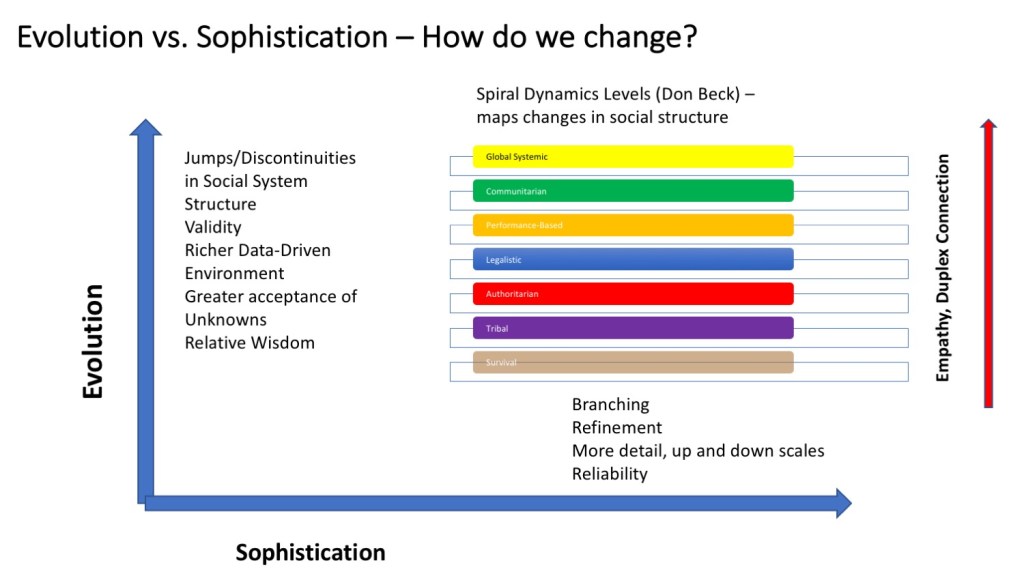
(In brief — evolution is directly related to increasing agency, empathy, and complexity — sophistication is smaller/larger/expanded scales of ‘complicatedness’)
Once we’re locked into a relationally disruptive, anti-empathetic brand of authoritarianism, which unfortunately, our current leadership represents, the natural progression of the social and knowledge structure folds down and down, horizontally, into smaller scales. We ain’t moving up in empathy, represented by the Y-axis of this graph.
And even though it involves extreme boundary violation (reading your brain to see what’s going on in your noggin, if you’re going to be violent, likely involves a literal physical violation to jack into your head) such concerns don’t bother the ones in charge much. Nor does the ‘false positive’ version of any technology (“We’ve got to do what it takes to keep our schools/public spaces safe, asides from banning assault rifles, of course!”) tend to bother them. If you’ve got something locked on your head, and you eat too much pizza and watch a Tarentino movie, who cares if you have a bad dream, and have to spend a week in an isolation facility because the SWAT team shows up at your door?
And here’s what’s really wild. The trauma inflicted by such misfirings also reinforces the Authoritarian value set. You’re gonna practice being passive. As well as giving up on green peppers and pepperoni on your pizza. And whatever you do, don’t watch The Minority Report. Or the Japanese anime thriller series, Psycho-pass. Philip K. Dick and the Japanese — true inspiration of the potential dystopian mind. Philip Dick was a Time Lord. (Holding that thought, he’s the one person I plan on having lunch with. Along with Matt Groening. I’ll buy. I think I’m kidding here, folks — but I’m not sure!)
Many people will cluck and say it can’t come to pass. My point with this piece is NOT that such things are conspiratorial, nor necessarily inevitable. The problem with them is that they are emergent. They are natural paths of growth of sophistication that occur inside the v-Meme/value set. It’s not just the current batch of bonkers-cowboys that think this kind of stuff is cool. And necessary. Remember, no gun control ALSO suits the v-Meme purposes. If you’re afraid to go out in public for fear of getting shot at a rock concert, that is also relationally disruptive, and community and empathy-destroying. The effects of that have already been seen in the high school construction business — where young, neuroplastic adolescents, instead of learning to care for each other, learn to stanch the blood flow of sucking chest wounds. This kind of stuff serves double-duty, value-set/v-Meme-wise. Not only are people frightened and retreat from social, empathetic connection. A certain subset will also be traumatized by all of it, creating a more reliably passive citizenry. It’s just wild how the old v-Meme propagation rolls. If this doesn’t make you a believer of value sets as emergent, self-organizing memetic structures, I don’t know what will.
What’s even more damning evidence of how all this stuff works, when empathy is absent, isn’t just the neuro-monitoring. It’s those doggone AttentivU glasses. Here’s the short version. Folks in the MIT Media Lab are famous, the world over. In context of resources, they have money to do whatever they want. Someone will pay for it — be it DARPA, a New England or Silicon Valley entrepreneur, or a sheik from the UAE. And certainly, it’s unfair to paint the entire enterprise with a broad brush. But when it came to making choices, the glasses seemed like a good idea to someone there. Instead of taking the money and ploughing it into empathetic alternatives, it just seemed like a good idea to shake students’ brains. The value set/v-Meme emergently reaffirmed their choices. Think about it — small scales (your head), paying attention to authority, who’s up there defining the class’s truth. Homework assignment from the blog for your true Empathetic Evolutionaries — map out how the value set is reinforced by this kind of crazy bullshit.
The deep point of this blog post isn’t just to shake you up. Take a deep breath. The actual deep point is to make you realize that people– a fair number, and well-resourced– are marching, unreflectively, in service of the secret background coding emergently. It just seems interesting to them. Because that’s the way the v-Memes roll.
What should be our shared passion and purpose? Making this kind of crazy bullshit UNTHINKABLE. How do we do this? Don’t go all Authoritarian v-Meme-y on me now. Don’t think solely in terms of bans, or laws, though for the short term, maybe. What we really have to do is evolve empathy, so people not only see through this, but it doesn’t occur to them to attack personal agency and privacy of individuals. And there’s the unspoken, or unrecognized metacognitive benefit. When those people are evolved, natural, harmonious solutions, from delivering care to the mentally ill, addressing deep adolescent isolation, creating engaged education environments, and the necessary scaffolding at the lower v-Memes to assure we have safe public spaces will ALSO naturally emerge. We tend to forget about this when railing on about the latest Authoritarian miscreancy. If we evolve, IT ALL EVOLVES.
Dystopias don’t have to occur if you develop people. In fact, they become laughable concepts that don’t map to reality at all. But that can only occur with the deep realization that we must evolve empathy across our society, following the road map laid out in this blog. There are a semi-infinite number of projects and options to get us where we need to go. All the answers are NOT here. But make no mistake about the direction, or meta-platform.
And for the chronic naysayers — yes, there is the possibility that despite our best wishes, that those empathetically evolved folks might unleash some unknown monster from the depths of our AI work. Yes. I get that. But I’ll take my chances with that as opposed to people directly working on the prospect.
I was thumbing through my photo collection last night when I came across this photo, taken (I believe) in October 2012. So many computer transfers have screwed up the dates on my photos, but I think that’s about right. There was a large parade in Buenos Aires, and the dancers and marchers had literally come from across Latin America. Folks from Bolivia, Peru, Chile — you name it. It was a mass of beautiful synchronized inclusive group activity, and everyone was having a good time, myself included. Heterogeneous age distribution, lots of connection, good food — the works. The US has so much to learn. We do public space interaction so poorly. Instead of carefree connection, we’ve got semi-automatic weapons. Sad!
I’ve been to 38+ countries (depending on how you count) and have fond memories of all of them. I’ll keep posting photos.
On to Twitter — short version, Twitter is one of the most fascinating research platforms out there. It will also make you totally crazy. You can reach all sorts of folks, but most people run their Twitter feed either as a member of the audience for entertainment, some kind of relay for views they like, or their own personal radio station. There’s a longer post on how Twitter is an amazing tool to understand people’s personal development.
So far, the only thread I’ve been involved with that a.) had numbers, and b.) involved consensus being reached (of the myriad issues facing the world,) was that every young man (no mention of women) should own a pig, raise it, kill it, and eat it as part of their personal development, or give up on bacon for the rest of their lives. Vegans and non-vegans seem to agree with this. I’m not quite sure that this is the bildungthat my intellectual friends, Lene Andersen and Tomas Bjorkman had in mind. Plus, my read is that it would be very challenging to do in a 2nd floor walk-up in Manhattan. Or Stockholm. Note to readers — I was raised on a hobby farm, and have plenty of experience in this kind of lesson. I’m not so sold on it.
A small bright spot — I did find John Hagel’s work as an educational/change consultant for Deloitte on Twitter. John’s talk at the Singularity University confirmed my research techniques for divining techniques for high-performance organizations was/is fundamentally sound. The short answer? Teams of 5-15 members, with insights gained from Big Wave Surfers (in the ocean.) Not very far off from my own experience as an modestly-extreme kayaker myself, integrated into the Industrial Design Clinic. There is nothing like team-based extreme sports to teach the lessons of an evolved empathy. You have to read your friends and their situations quickly, and accurately, based on data, or someone could drown. That data-driven relational development translates well to signals and sensing in other environments. And as I’ve talked about before here, maybe all that hyper vigilance turned out to be beneficial after all.
John’s talk is here (he starts at 1:00) but this will likely vanish soon — in probably 3 days. There are a handful of practitioners on the leading edge who are convergent. I’m hoping to gather some of his more nuanced insights, as well as turn John to the Deep Code OS approach that I’ve developed, as his surface observations jibe very well with my own. What is nice is we do come at this from different spaces — John is corporate, mine is academic. He hasn’t answered my questions about his challenges yet, but I’m sure he’s had his share. At any rate, the video is worth the watch, if nothing else, for those that get this stuff to know the community is growing. Get it before it goes away.
By the way, I am working on a longer post about looking at organizational structures to solve problems sorted with a Cynefin filter. It’s a natural fit, with some unexpected insights. Stay tuned — it’s just a lot of work.
Lately, I’ve been working on establishing a presence on Twitter. I had initially thought that Twitter, with its 240 character limit, was a toxic playground for trolls and collapsed Authoritarians, because of the inherent knowledge fragment nature of the medium.
I was wrong. Turns out Twitter is far more interesting than Facebook, that’s for sure. Facebook is the place where you get to find out what you’re friends have been holding back from their public personae. It’s like finding out that the quiet guy who never said anything, and you always thought well of, is actually a total asshole. Facebook is interesting in its own right, of course, but it has inherent problems. It’s a place where once you’re above some norm of decency (like realizing pederasty is abhorrent) people can find whatever set of norms they like in the broader world. And so become unencumbered from reality, or even the desired to maintain bonds within a physical community. And unfortunately, if you’re connected with them on Facebook, you’re likely connected with them in reality.
It’s not that the Electric Twitter Machine (term borrowed from one of my favorite political writers, Charles Pierce at Esquire) can’t turn into a hideous, dank swamp for all sorts of High Conflict Personalities. It can, of course. But it also offers a medium to walk along the edge of a very steep cliff, with a chain attached, and peer out either into the heavens, or the abyss. Think the Angels Landing trail in Zion National Park, metaphorically speaking.
I’ve constrained myself to mostly professional discourse and had a fabulous time connecting with folks of like mind (like Conway’s Law author, Mel Conway), who want to make big-scale global change, as well as some truly funny one-liner writers. They’ve inspired me to start adding a little more humor in my feed. So far, this is my favorite existential quote, from Chief Chuck:
·Jul 30 As I watched the dog chasing his tail I thought “Dogs are easily amused”, then I realized I was watching the dog chasing his tail.
My recommendation is this: try it. Exercise self-control. And get back to me. It could be that 240 characters are perhaps the best way to build connections with people you’d otherwise have no access to yet invented. Everyone’s almost willing to give you 240 characters of time.
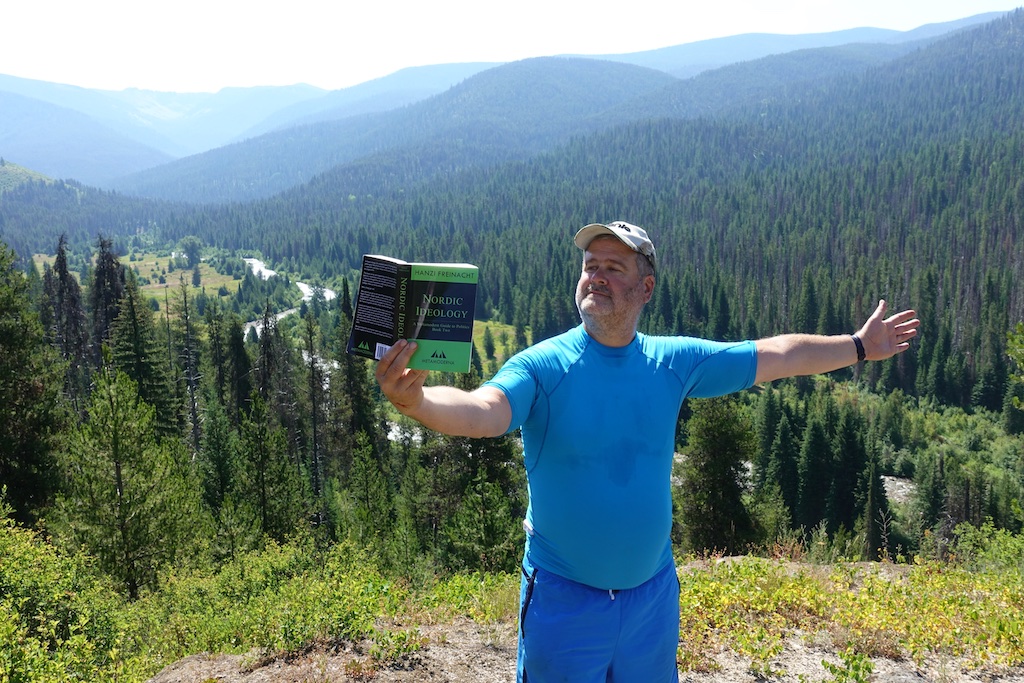
Enlightenment in the wilderness — Kelly Creek, in the Clearwater, with Hanzi’s new book, Nordic Ideology
I just finished listening to David Graeber’s recent work — actually, from an academic perspective, it’s pretty much a masterpiece — ‘Bullshit Jobs‘. Why is it a masterpiece? Well, because, for an academic book, it’s actually funny (and on a very serious subject.) Until you start crying. The book is also multi-level, looking at the specifics of Bullshit Jobs, as well as exploring the systemic issues. Graeber does not come from the social class that spawns classical academics. He subtly covers the basis of this, though you have to connect the dots to see that Graeber, the son of a printer, and actual, real-life activist, does not live in the Ivory Tower. He does give himself some labels — some anarcho-anti-capitalist — but mostly, he’s rational. And he thinks. And believes in independently generated, relational dynamics. Which is a good thing. Graeber is writing from a position of deep empathy.
The book starts by laying out the definition of a Bullshit Job — which is basically a job where the person doesn’t produce anything, and knows that their job produces nothing of benefit to larger society, or even their organization. There are five kinds of Bullshit Jobs — Flunky, Goon, Duct-taper, Taskmaster, and Box-Ticker — and places them in the context of the corporate hierarchy — necessary for destroying agency to produce an incapacity to function.
Graeber’s labels are extremely useful for spreading his ideas, and I like them. He calls the current system ‘managerial feudalism’, and it’s about right. What my work contributes (I agree with Graeber’s assessment of affairs on most everything, though he’s up on the top level of societal description in the Matrix) is that the real problem is the relational disruptive, empathetic devolution inflicted by the social structure is baked into the system. Of course, the bosses are sadomasochists. They have to at least have an edge of psychopathy to do what they do. And in relational systems, like rigid hierarchies, the various strategies to maintain isolation are necessary for maintaining the real goal — stasis of that rigid hierarchy, and control of the people in it. It’s not about the money. It’s a function of the social physics of the system. No one has to do any thinking, because the behavior is, given the resources and the information flow, fundamentally emergent.
And that emergence is why it’s going to be so hard to break. If you’re in a low-performance, status-driven hierarchy, the last thing you’re going to want is to minimize the number of your flunkies, and all the others. It’s not like you’re going to open your organization to the forensic accountants to see exactly how that money is being wasted– even if you’d make more money. How would you look? What would your status be? As shown in the clip above, it’s about sending a message.
If there’s a meta-conclusion from the point of this blog, which is really about creating high performance organizations, when you lard up your organization with people doing busywork, then you don’t leave any energy available for creativity — and thus you ensure stasis. You close those system boundaries so new information not only can’t take hold. It almost can’t get in. Which reinforces the value set that drives the creation of the social structure in the first place. Kings were supposed to reign forever. And as such, Graeber’s coining of the phrase ‘managerial feudalism’ is particularly apt.
Unfortunately, when you do this, you also ensure your extinction — it’s that parthenogenesis thing. For businesses, Geoffrey West in ‘Scale’ calculated this out at around 40 years lifespan. Societies? Not as clear. But with all things it’s evolve or die. Let’s hope Graeber’s more accessible message takes hold. Because (and trust me on this one) he’s got the information physics right. And those suckers don’t lie.
I’ve been pulling together, at the behest of math professor Kevin Vixie, a 20 pager on the whole empathetic evolution grand pattern. I was asked by both him, and an editor we hired, to come up with a long-view example of evolution up the Spiral, for an organization.
Turns out that’s really tough. Geoffrey West, in Scale, documented the standard company life to be around 40 years, and with just a little thought, it appears he’s right. Clicking through the list of companies from my childhood, from Sears and Montgomery Ward, to the local Martings clothing store, it’s not hard to find examples. But companies don’t usually start at the bottom, and they almost never end up as a large, global holistic organization.
If you want a true long-term evolution of a social organization, one has to go to the various world cities. The story below is about Athens, Greece, as well as Sparta, their sometimes ally, but inevitable nemesis.
Before I turn you over to the story, the short version is that Athens and Sparta were historic rivals, with the Spartans, as is well known, specializing in warfare. Athens evolved its culture, with the first democracy, and while Sparta and Athens managed successfully to ally against the Persians, in the end, they turned on each other in the Peloponnesian Wars, to which the Spartans brought a new level of savagery to what had historically been ritualistic warfare.
Yet even though the Spartans conquered the Athenians, and devastated the material wealth of the Greek peninsula and islands for generations, Athens emerged triumphant, and is a vibrant world city. Sparta exists only in memory — its ruins next to its new incarnation, with a population of 35,000.
But that’s not the truly interesting part of the story. Athenian social evolution laid the groundwork for Greek and world culture for millennia, even though they were not triumphant in the first round. Once a people evolve, it is VERY difficult for total regression. That needs to be remembered in the backdrop of our own difficult times in the world today, with an apparent rise of fascism across the Western democracies. Empathetic thoughts are NOT so easily un-thunk. Evolutionary v-Memes are not banished so easily.
The case lesson of Sparta is also fascinating for those that think the psychopaths always win. Sparta created an initial culture that has been reified in the minds of absolutists over the millennia, and Nietzsche has been said to base his idea of the übermensch on his interpretation.
Yet the reality is that Spartan culture only dominated for a short historical period. It was constructed on punishment and disruptive attachment — young boys were starved, young girls were raised to taunt the young boys, and mothers were required after birth to surrender their infants to infanticidal judgment. And to top it all off, pederasty was also enshrined in the culture. Just the thing to generate increasing numbers of psychopaths, to the point where, from a systems perspective, they finally generated enough of them that the wheels came off the bus. Every organization has some contingent of psychopaths — but once they gain critical mass, you’re done. Enron, anyone?
There are many transferable lessons we need to learn here, especially about the metacognitive risks associated with traumatizing young people. I grieve for our current crisis at the border regarding asylum and childhood separations, as well as the crises we’ve seen in the inner cities regarding eviction of poor, predominantly minority children from their homes. These are deep traumas, and besides the lack of compassion it shows in our current system, there will be an unknown cost to be paid. We can look at the long history for why this is such a bad thing. For the ancient Greeks, it was a descent into genocidal warfare for generations that almost unraveled an amazing culture. Thomas Jefferson said it best:
“I tremble for my country when I reflect that God is just; that his justice cannot sleep forever.”
It’s not easy to come up with a story that both shows, and contrasts the long-time development of all the value memes – especially in a company, when the average company life is, according to complex system scientist Geoffrey West, approximately 40 years. Companies and their lives have been studied extensively, and different paradigms have been put forward by such luminaries as Roger Martin, former Dean of the University of Toronto’s Rotman College of Business. Martin starts with magic, boils down to heuristics, and then the suits step in with increasingly algorithmic practice. The end of the trajectory is a closed system that processes no new information, and naturally sets up authority-driven, legalistic hierarchies. Who then proceed to last about 40 years, on average, says West.
But cities are different. Cities are fundamentally open systems, usually with indeterminate boundaries. And what better city to look at as far as a continuing transformation of values, than Athens, Greece? West also profiles Athens, and I’ve visited myself. It is a mixed basket of cultures, with influences from every one of the compass points. Athens is also one of the world’s oldest cities, and historical records indicate potential settlement 11 centuries BCE. Undoubtedly Tribal at the beginning, if one tracks through its art, architecture and political accomplishments as moving through multiple gods, authority-driven thinking, to the establishment of litigative justice through close-to-native son, Aeschylus, Athens is a great example of tracking up through the v-Memes. At the core is the establishment of democracy in Athens, by Cleisthenes, the father of Athenian democracy, in 508 BCE, along with the enormous step forward in agency and empathy that accompanied it. This led to a flowering of culture never before seen, with all the well-recognized figures of classical literature front-and-center.
Yet empathy alone couldn’t monotonically save Athens from numerous downfalls through the ages. Most important would likely be the attack from Sparta during the Peloponnesian War, that led to the leveling of Athens and ascent of Sparta.
But such powerful v-Memes simply cannot be killed by one war, or a documented history of rise and fall as happened in the subsequent 2000 years. Athens now sits, from a low of 4000 people, in the 18thcentury, to a prosperous city of over 3 million people, a polyglot of languages synthesized from being a world city, with influences from every corner of the planet.
And what of its vanquishing force, Sparta? Spartans were known for a rigid authoritarianism, and agoge, a particularly vicious and relentless form of training for all young boys and men, where they were even encouraged to fight amongst themselves to establish superiority. Children were underfed, so hunger was never to be a problem in battle. But even more profound was the Spartan practice of enshrined pederasty, wherein older warriors would take especially talented youths and, well, bugger them.
Even the women and young girls were enlisted in maintaining the Authoritarian v-Meme, and worked to impede empathetic development of the males, through taunting and humiliating the boys doing exercise. Spartan women did have an extremely egalitarian lot in society. They were better fed than the males, and they functioned within their role as the child-bearing part of the system. They owned property, and they could initiate divorce. They would also participate in the practice of infant inspection, whereby women would bathe their new infant in wine, and present them to the Gerousia, the Spartan council of elders that served as a functional oligarchy, who would then decide whether the child would be raised or not. If not, the baby was thrown into a chasm on nearby Mt. Taygetos. So much for women’s core attachment behavior naturally generating more empathy than men.
From everything we currently know about such practices in the modern age, there’s no question that such a regimen might produce exceptional warriors for a time. But it also likely created more than its fair share of the empathy-disordered as well. We have no real window into exactly how Spartan society ran, other than to know that it was strictly externally bounded. Because it had to be – without strong constraints, the people, attachment disordered from birth, would likely have killed each other. So while they might have been able to defeat Athens in the Peloponnesian War, in the end, they could not avoid the consequences of throwing empathetic development to the side. One thing is also clear – Sparta is credited with discarding the more ritualistic warfare all the Greek city-states participated in, and instead implemented a scorched-earth form of conflict complete with atrocities, devastated countrysides, and a gross impoverishment of its involved peoples. Another example of the effects of anti-empathy, and the psychopathy that follows.
Sparta as a power, no matter how romanticized it has become by classical philosophers and the popular media – Nietzsche based his ubermensch concept on the Spartans – was doomed. We are a collective organism.
And what remains of Sparta? It remains a smallish town, in the Laconian section of Greece, with a population of 35,000. If you want to sentence yourself to a short-lived existence, destroy empathy. You may win in the short run.
On a recent visit to Boise, ID, to visit some friends, I had the good fortune to have my wife stumble across a site for improvisational comedy (Improv. for short) that just happened to be hosting a workshop one of the free nights we had. Called Recycled Minds Comedy, they were holding their Level 2 training, open to the public. Taught by Jon Buffington, who sports 11 years of improv training, and organized by Sean Hancock, another award-winning performer, the title of the class was ‘Never Draw a Blank.’
Jon’s method involved five basic principles that could be applied in any improv. scene. These were (in no particular order — I didn’t take notes!)
Feeling
Matching
Observation
Opposition
Physicality
Jon went on to do an excellent job of teaching, integrating what was probably close to 20 diverse students, split about 60/40 men/women in rapid fire pacing in what’s known as ‘3 line improv.’ Given the technique (like ‘Feeling’) students were given a word, and then had to create together three coherent statements that created a scene. Some of these were absolutely hilarious. What was amazing though, was that virtually none of them really fell flat. Improv. students were given enough coaching and structure to create the connection between a given pair so that humor naturally emerged.
I’ve written before about how humor maps to the different parts of the brain, and can tell you much about the empathetic development of a person. What was amazing was that the five techniques Jon discussed fell perfectly into line with the Empathy Pyramid.
So here goes:
Matching => Mirroring Behaviors as a ladder to higher empathetic modes
Feeling => Emotional Empathy
Observation => Rational and potentially Conscious Empathy
Opposition => Anti-empathy
Physicality => Direct Mirroring
What was also interesting was Jon’s comments regarding the different empathetic modes. While not disparaging physicality, or mirroring for mirroring’s sake, he did say it was lower on the list than the best humor, which he said was observational. Slapstick can be fun, but it doesn’t deliver the deeper insight and nuanced, multiple-solution meaning that personal interpretation does.
There’s a lot more to unpack here, of course. One of the strengths of doing improv. with groups is that it gives them a shared experience for cementing educational processing, and as such, maps into the neurobiology of education I explain in this blog. It’s cheap — all you need is a room, a handful of words, and a great coach. There might need to be some up-front work for the types of subjects relevant to various audiences in a corporate training venue — but it would be as good a complement as any for a team-building exercise. Nothing wrong with loading the Dev. Team in a whitewater raft for the day. But this activity dovetails well.
One final comment — by creating directed synergy scripts, (like yes-and) improv. also offers a way to attenuate the behavior of high-conflict players. There’s a potential here for working through conflicts through good external forcing from the teaching authority. Jon demonstrated a profound ability to create a safe space for people to experiment. While it also was certainly true that the people who showed up wanted to be there, and were ‘all in’, the template was simple enough for everyone to have fun, while doing serious learning.
All in all, I did have a great time, even though I only watched. And I would highly recommend both Sean and Jon for real corporate paying gigs. It will be fun to watch the effort continue in a mid-size city like Boise, which is definitely on the move.
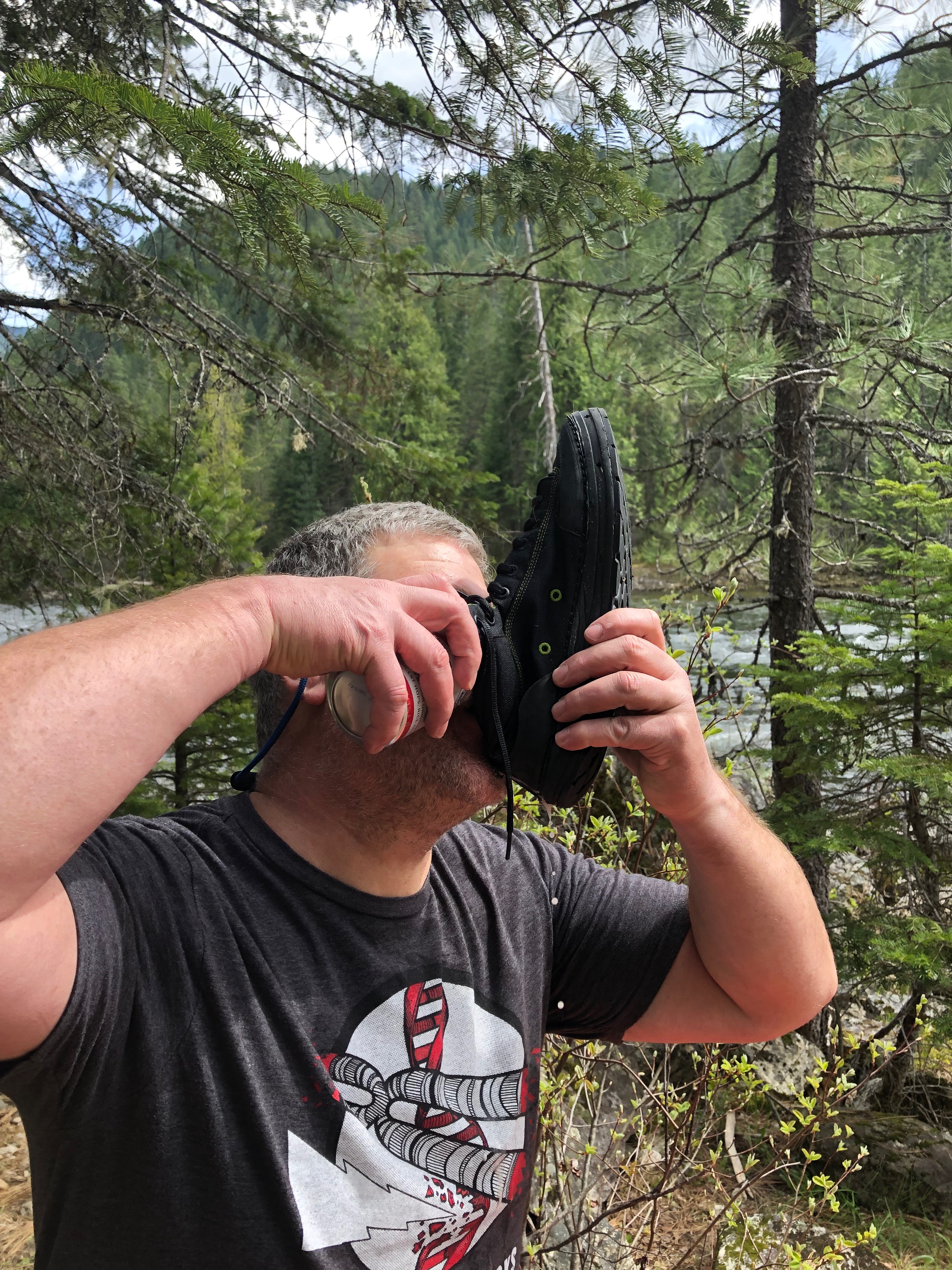
Booty Beer, Conor (Pepsi, actually) from around 2013Like father, like son — swimming on the Lochsa this spring
The two photos above are meant to make you laugh, as well as demonstrate a ritual both my boys, Braden and Conor, and I share whenever we take a swim out of our kayaks. The picture of Conor is from about seven or eight years ago, when he “beatered” (the techno/tribal term for screwing up a run through a set of rapids) and swam. I think the meaning of “swam” is self-evident. 🙂 You have to drink a booty beer — whose contents vary depending on your age. In that picture, Conor is drinking a Pepsi.
Some people think that rituals like this are silly. Well, sorta. This one has spread across the whitewater community, and it IS pretty funny, being at the take-out, drinking a beer from your wetsuit booty. But they also serve as a reason to trigger a laughing catharsis, especially if you’ve just had a bad swim. Everyone’s laughing, maybe a little at you, but mostly with you, because everyone knows that we’re all just in between swims.
And swimming in whitewater is NEVER really recommended, and you can drown. It doesn’t matter how bad you swim, though — you drink your beer like the rest of us. Why? We want you to both be healed, and remember — so you don’t fuck up again. We want you alive, and here.
I’ve been writing a lot about trauma lately, and its effects on social organizations, and self-similarly, individuals, mostly because it is extremely poorly understood by most organizational experts. As income gaps increase, and retrograde authoritarianism seems to be on the rise, these trends, for the most part, negatively affect people’s ability to continue on a path of personal growth (which then feeds directly into societal development, or really, rather, devolutionary empathetic revanchism). There are the immediate effects on the individual exposed to traumatic circumstance — flight, fright, and fight. But there are larger consequences.
The thing that is important to remember is that understanding these three things in the context of the larger meta-narratives of society are key. We can’t do larger scale strategizing toward fixing the desperate problems we have without accounting for their effects.
I remain a big fan of sweeping efforts that have been proven to work on aggregate societal development. One can read a book like Andersen’s and Bjorkman’s The Nordic Secret for a developed historical perspective of how the Scandinavian countries evolved from their peasant, agrarian states to the sophisticated social democracies they are today.
Yet understanding contemporary trauma is still vitally important. At some level, the Nordic countries started from a historic tabula rasa for their time. That is not what we are facing today. Our biggest problem is evolutionary backsliding, and a decline of empathetic development from a previous higher level. The rate of such backsliding has never been experienced in human society before — largely because the communication media to cause it did not exist. Before the Gutenberg press, you couldn’t even get ideas out there out all that weren’t wrapped in long, culturally grounded stories.
It was with this in mind I came across an amazing piece on Tortoise, a new web publication focused on larger, ‘slow’ stories. The piece in particular, Destroyer of Worlds, profiles the founding of 8chan, described in the piece as one of the darkest corners of the Internet.
From Nicky Woolf, former Guardian reporter who wrote the piece:
The content on 8chan is among the most offensive, violent and bigoted on the web. It became a sump for the most racist and misogynist of users – especially on the /pol/ board, where the most far-right political viewpoints collected. But in evaluating its behaviour, it is probably helpful to think of a chan site not as a collection of individual people but as some kind of many-headed trickster-god; a psychotic consciousness in its own right.
Fredrick Brennan, the founder of 8chan, is profiled. A victim of a horrible degenerative disease, osteogenesis imperfecta, known colloquially as ‘brittle bone disease’, he had broken his bones 120 times by the time he was 19 years old. His life had been confined to a wheelchair, which mean endless pain and boredom. As a result, he turned to the virtual world of computers as his primary connective outlet.
How this all works is a striking example of low-empathy, high emotional affect communication enabling v-Meme concentration. It IS a consciousness in its own right — and an anti-empathetic consciousness at that. Temporary boards, with anonymous commenting, allowed more and more extreme behavior designed to shock, which then attracted more psychopaths and empathy-disordered individuals. For those unfamiliar with the terminology used on this blog, think a mix of defective Tribalism and collapsed egocentric Authoritarianism. The end result was a stew that launched multiple mass murders, an example of what others have called the ‘funnel effect’ (notably Kenneth Stern in his book on the militia movement called A Force Upon the Plain.) What that means is you start out with a couple thousand kooks who ascribe to a reasonably extreme ideology, and then distill down different levels of kook-dom, until finally a mass murderer pops out of the end of the funnel.
Fredrick originally paints himself as a radical free speech activist — some higher moral principle governs his actions. But the deeper reality is he was a deep eugenics advocate. His pain was so great, especially during his teenage years — there’s no discussion of it, but his parents, who weren’t well off to begin with — assigned him in his motorized wheelchair to foster care at the age of 14. I don’t know the sequence of actions that led to that, but it couldn’t have been good, or decent. Why eugenics? He, like far too many in the U.S., entertained illusions of a Nazi super-race that would sweep the land, getting rid of people like him. They would be the ones to exterminate him, and put him out of his misery.
The author, Nicky Woolf, used the term psychotic to describe the festering stew. And while I can kind of see some of that 8chan type of behavior, the reality is that much of it is really psychopathic, empathy disordered relational disruption. What is also interesting is that with all psychopathy, there follows a predictable path for communities that have been infected with some certain critical mass. Initially, a community may start out with a mix of normal folks and psychopaths. If you believe Bill Eddy, founder of the High Conflict Institute, that ration of normal to high-conflict seems to be around 10:1. These numbers only make sense in relationship to ordinary communities. The Internet allows an entire population, existing out on the tails of every distribution imaginable, to find each other.
And over time, while the empathy disordered/relational disruptors may have a field day, if there is enough people in the community, those people (call them trolls, or whatever) become more and more isolated. Normal people just check out. But in somewhat rare circumstances, enabled by the Internet, they find enough of their own kind, where their strange, circuitous gaslighting logic makes sense enough to people there, the whole community converts over to a vampire colony. Everyone is nuts, but everyone thinks the same way, so it doesn’t matter.
And it’s not limited to contemporary societies, though it could also be argued that contemporary infrastructure facilitates it. Farley Mowat wrote about a very similar parallel situation in his unbelievably tragic books, People of the Deer, and The Desperate People, where one clan of a tribe mastered their emotional circumstances caused by their trauma, while one didn’t. In the end, though, the larger trauma — their loss of a primary food resource — won out, and those communities were both destroyed. So much for genetic evolutionary reasoning in these circumstances.
The short version of Fredrick’s story is he founded 8chan, made money, bailed to the Philippines, and got married. Love healed him, I think, or at least some version of healthy attachment, and now he no longer dreams of Final Solutions as a release from his pain. But others are still locked in their crazy worlds, connected to enough disordered grounding to maintain their delirious worldview. Pizzagate and Gamergate both started with 8chan, or other simulacra chan sites, as well as other terribly sad crimes, such as the New Zealand mosque mass murder.
Nicky Woolf gets what happened — and he’d get this blog as well. His words:
It is the structure of a chan site itself that radicalises people. “The other anonymous users are guiding what’s socially acceptable, and the more and more you post on there you’re being affected by what’s acceptable and that changes you. Maybe you start posting Nazi memes as a joke… but you start to absorb those beliefs as your own, eventually,” Brennan says. “Anonymity makes people reveal themselves, but because there are other anonymous users – not just one person in a black box – it also changes what they reveal.”
What’s he saying is simple — take collapsed egocentricism, and delete all the cultural sidebars, dial in some intense, isolated sexual self-pleasuring, add in the ability of people thinly naturally distributed as far as the crazy, but with the connective ability of the Internet, and this is what you get.
If there’s a larger point in all this, is that we can learn from these environments, by understanding a.) how trauma drives the people into these situations, where they find disturbing connection that their brains desperately need, and b.) by understanding the contrast between them and more healthy Internet bulletin boards. Internet BBs are less-than up to the par of empathetic workspaces. Authority-driven in nature, they don’t convey irony, a raised eyebrow, or a subtle smile. But they can be made worse.
If there’s an upshot to all this, it’s that these things exist because of emergent dynamics. And it helps to understand them. Trauma, and trauma recovery are key to battling their anti-empathetic dynamics.
And then, finally, never stop being kind, even if you can’t connect. One never knows the point of bifurcation into madness.
Chiricahua Range — an Island Range in Southern Arizona
I’ve been working on book readability, and on the advice of Braden, Kevin and Ryan, I’ve been attempting to boil down the complexity of all my empathy work to seven, easily recallable precepts, or principles.
Here they are:
As we relate, so we think. And how we relate depends on empathy.
Growing in empathy depends on a feeling of safety.
Social structure, controlled by empathy, dictates how we shape and pattern the knowledge we create.
How we think is characterized by how we structure knowledge – from fragments to connected thoughts, to guiding principles. That practice feeds back to our own empathetic development.
Different social structures and their varying levels of empathy grow or impede our personal development.
All our solution paths to innovation emerge from social structure and empathy.
Our empathetic development scales both our timelines and our sense of responsibility, and informs us when conflict is likely with others at different levels of development.
Thanks to Kate Raworth and her excellent book, Doughnut Economics, for the patterning example.
In my experience the real change happens when there is no choice, and that moment is chaotic enough to scramble the previously perceived possibilities, (I call them the PPP). New possibilities arise and the people who step up are never the ones anyone expected. The ideas that emerge in the upheaval are not the ones discussed in meeting rooms. Nora Bateson
One of the earliest challenges I faced when developing my Theory of Empathetic Evolution is fundamental. It was expressed by Utah Phillips, one of my favorite folk singers and activists, who has a set of rants on a compilation album engineered by Ani DiFranco, called The Past Didn’t Go Anywhere. One of the pieces — Korea — has him reflecting on a question from his son, driving north toward Massachusetts. The question was “how did you get to be that way?”
Lots of people have weighed in on that question throughout the years, most notably people like Jean Piaget, Lawrence Kohlberg, or Robert Kegan. Each has their adherents, and all are sort of the same. We move up through a vertical progression of stages, until we stop, for whatever reason. The actual definition of the stages, in virtually all of the theories, is left to the author, who through some process of observation, has concluded that that’s “how they got to be that way.”
Inevitably, philosophers pile on, and your arguments for and against for some incremental change in one of the giants’ theory is dependent on how many Dead White Guys you can cite. The deep reality is not that people like Piaget or Kohlberg were stupid. They weren’t. They were really smart, observant folks. But fundamentally, they had insights that made sense to them. And all of those systems? They maybe gathered some data, and then they MADE THAT SHIT UP. There were no deep physical principles involved. They didn’t even exist at the time.
They might have constructed some experiments involving the 18-year-old Psych 101 students of their time, or messed around with their own kids to refine said theory. That doesn’t mean that it is wholly invalid. A lot of it is super-cool. But inevitably, it meant that they didn’t think of it in terms of rectifying it with any larger principles of neuroscience, or the knowledge construction paradigms that we carry forward in this blog, on how social structure affects the way we think. Most of them had never heard of neuroscience, or even really given much thought to how the physical brain worked, or interfaced with their contrived models. We’ve had the philosophical dodge of the human mind for a while. Assuming some sort of magical consciousness apart from the brain might actually be right. But it’s still unknowable, and it’s not pragmatically going to get us where we need to go.
All were academics, and so it’s no surprise, out of the stacked hierarchies of academia, stage theories emphasizing meta-linear progression (first you get here, then you get here, and so on) hold sway. That’s the knowledge structure that the social structure generates. As such, they are also most appealing to other academic readers, who get to decide whether you, the reader, ever get exposed to any ideas OUTSIDE the academic insistence on reliability (repeatability) as opposed to validity (whether this actually applies in the Real World.) The problem with this is simple — reliability requires closed boundaries and exclusion of information, while validity (which likes reliability to some level, of course) is open-ended, and more about how one explains the exceptions. And academics, in their absolutistic hierarchies, don’t like exceptions, to the point where they simply ignore them. It’s even worse. They really don’t like theories that explain HOW they think, and WHY they’d come up with linear stage progressions. They just ignore you. Trust me on that one.
The deep reality is that the world is scattered with examples of what I call meta-nonlinear change. All of the sudden, something like friend Nora refers to happens, and then things are different. Very different. They’re often partially assembled out of the old stuff (and I do want to emphasize that word partially.) But then there’s also likely new stuff that shows up that didn’t exist before, imported from somewhere else.
I’ve written about my favorite little analogs for information development, bacteria and all their fancy-name prokaryotic and eukaryotic cousins in earlier pieces. Horizontal Gene Transfer, which was thought not to exist only about 30 years ago, is how bacteria got mitochondria (through capture through their cell wall of another organism) as well as how flagella got stuck on the end of single-celled organisms. It was, even in the case of the bacteria, a survival-driven case of expediency. They were gonna go out of business unless they stole some new genetic material, and there was enough floating around that the ones that incorporated into their code lived, while the others died. The vertical evolution process of slow mutation was in the background. And there was no “intelligent design” process involved — it just happened, and numbers are always in bacteria’s favor.
But the process was (and is) highly meta-nonlinear, with a huge jump discontinuity in all of it. One day you don’t have any mitochondria, and then the next, you wake up with a stranger inside your cell wall. Bacteria DO often evolve in the classic, vertical way, through slow mutagenic reactions to the environment –the slow, budding of another branch of the tree that we’ve been trained to expect. Except, well, when they don’t. Then they drive that information into their genetic code like they stole it, and something fundamentally new emerges.
Naturally, I’ve spent a fair amount of my own navel gazing pondering Utah Phillips’ son’s question. My tool of stage focus has always been Spiral Dynamics, and while I’ve mapped out a standard route for human development up the Spiral (see the figure below) and can kinda see how I followed it, upon a deeper inventory, my own personal reality has been much different.
I was born, Mama fed me, I believed in Santa Claus for a little while. But then everything pretty much went off-script. My dad was an alcoholic, my mom pretty much had Avoidant Personality Disorder, and my mom used me to beat the hell out of my dad emotionally, if not exactly physically. Not that he didn’t deserve it at some level. The whole “healthy authority” stage eluded me. And if I followed the rules — of society, as well as the household — that wasn’t going to turn out to well for our intrepid hero. Sparing you the stories (many of which are as black humor funny as you’ll find) I’d be dead.
So instead, I got tossed up the Spiral, developmentally. I became Performance/Goal oriented at the age of about nine. And I was Performance-based, in the truest sense of my information-driven empathetic perspective — I relied not on the belief structures of the lower v-Memes (Dad is a good guy, Mom bakes cookies) but data collection on my father’s and mother’s volatile moods. It could be different every day — sometimes my Dad was a happy drunk, and I could guide him into bed where he’d fall asleep. But other times, it was full-on, game on. My mom would be weeping and wailing, screaming at the top of her lungs. I’d get the other kids into their bedroom, and then it would be time for me to manage the situation. Instead of running away from danger (appropriate egocentric behavior for a 10 year old) I’d run toward it — a programmed behavior I maintain until this day.
Needless to say, all of this was traumatic, and while it might sound enlightened and esoteric for a ten-year-old to be data-driven in their decision making, the reality why those modes don’t make sense for the underdeveloped mind is that a young mind doesn’t have a large enough bank of either cultural mores or personal experiences to judge the larger context or the validity of the data. Data-driven thinking makes sense only in the context of whether you can decide whether the information stream makes sense. Otherwise, it’s Garbage In, Garbage Out.
And one of the pathologies it creates is hypervigilance — in my case, the process of scanning the 10′ radius to analyze what moves the perp might pull and confound resolving the situation (in this case, my father being drunk) as quickly as possible and return to some normative state. I’m convinced that hypervigilance also evolves the brain much as normal rational empathetic function evolves the brain. You read faces, you make decisions about what you’re going to say or do based on some literal Lean/Agile interpretation of the situation.
But you’re also doing it with a brain flooded with cortisol. I’m also convinced that this also likely impeded my own development of emotional empathy, and correct attribution and assessment of signals that lead to healthy attachment behavior, which is a subsystem that relies heavily on the empathetic system, and is intertwined with it.
What is interesting is that later events in life forced me back down the Spiral to fill in those gaps. Just because one doesn’t meta-linearly, in a healthy (or at least normative) mode progress doesn’t mean you get to skip filling out those lower v-Memes and associated knowledge structures in all their glorious detail. They still exist implicitly and intuitively, even if you don’t care to acknowledge them. After my second divorce, I was forced to realize that I had been living by my own sets of externally defined labels (I was a kayaker, I was a father, I was an environmentalist, I was generous.) It wasn’t until THAT major trauma again cast me up into the Second Tier, and forced me to emotionally and rationally self-separate from my own set of eclectic, pretty non-standard labels and get down to who I really was. I was ‘me’. And the ‘Who’ is always separated from the ‘What’ that I was.
For those worried about my emotional empathetic development, trust that I sometimes do cry when watching romantic comedies. Well, a little. I’m still a guy.
Which brings us back to Nora’s quote at the top of this piece. What can this tell us about how people, and systems change in the face of trauma? I had long ago thought through the implications of trauma on the standard meta-linear progressions of the Piagets and Kegans of the world, and decided there had to be something else.
And this is what it is: trauma (if severe enough) drives one back down into the Survival v-Meme, and your brain into a state of maximal neuroplasticity. When you feel like your survival is threatened, if you are in a strong enough state of mind, you will rearrange those various knowledge structures in your head (and nervous system) to create a new “you” that can survive. Not all your past knowledge, in its various memetic forms, will be destroyed. But connections that exist between those as part of your own autobiographical narrative will be broken. You’ll realize, at some level, what you believed happened in the past is not necessarily what actually happened, and what got you here. It’s a different array of patterns that will begin the reconstitution of that newer sense of self. And because, if you don’t undergo this process, you’re not going to make it. There’s not going to be any ‘you’ to figure it out.
And it can be cool. Not to go all ‘Deepak Chopra’ on you, but at some level it is the way a caterpillar becomes a butterfly. The decomposing soup of the caterpillar body is reconstructed by deep DNA sites of what are called ‘imaginal cells’ that exist through the caterpillar soup phase to create the butterfly. Deepak’s physical description of how this happens is pretty much rubbish. But I investigated the actual mechanism. Turns out, as an analogy, it’s not too bad.
That much I’ve known for a while now. But the big question has always been for me is “why did I survive, while others didn’t?” How can we understand the distribution of survivability for those that pass through severe trauma and not only don’t die, but come out the other side in a more highly evolved state? And, as humans go, how will this work for societies, since the two are linked in a self-similar fashion?
One of my favorite concepts that I use in my work is Ken Wilber’s notion of ‘pre-conscious, conscious, and post-conscious’ thought. It is a useful paradigm, especially when faced with the degenerative post-modernism of the contemporary university.
For example, for the last 28 years, I’ve worked with underrepresented minorities on the WSU campus — mostly Hispanic students. Intuitively, I was never very interested in working with middle-class Hispanic students from the west side of Washington State (W of the Cascades, for my international readers.) They were pretty much the same as the white, middle-class suburban kids that filled most of the seats in my classes.
Instead, I focused on the poor students from the Yakima Valley. Often children of migrant farmworkers — trabajadores migrantes — they started off with numerous strikes against them. Many of them were what we call ‘first generation’ college students — from families who had worked in the apple orchards and asparagus fields, and had never had anyone graduate from college.
If we apply Wilber’s model to how we might perceive these students, the Pre-Conscious interpretation would be through a derogatory, racist lens, regarding their capability. Not good, nor evolved at all, and very low-empathy. Little appreciation for their individual situation of the students, and the inherent challenges (especially if female) of leaving the family structure and attending a large institution with low familiarity of even the existence of places like universities.
A Wilber ‘Conscious’ perspective would be more evolved, and likely along the lines of ‘Hispanic students are just the same as all others, and worthy of attending college.’ No one’s going to say nasty things about you for this egalitarian perspective, and you’d be safe inside the academic organization if you used that as a basis for all your various decisions, including grading and exceptions granted. Inside the Legalistic/Absolutistic walls of the contemporary academy, advocating blanket fairness, while occasionally questioned, will NOT get you into trouble.
The problem is that poverty-stricken communities sending forth their sons and daughters DO have problems that ordinary students from the suburbs don’t have. One is the presence of a number of Adverse Childhood Experiences (ACE) that show up as a high ACE inventory score. There is lots of research that show a high ACE score negatively affects academic success, besides the simple, common sense insight that people who get beat, or are otherwise victims of some type of violence (sexual or otherwise) can be messed up! And there may be some need to address these issues, as well as have some compensatory mechanism to help them get through college, or they’ll end up dropping out.
So, the Wilberian ‘Post-Conscious’ perspective might agree with their fundamental humanity, while at the same time, recognize that some mechanisms might need to be enacted to facilitate underrepresented minority success, or you’re going to have students dropping out who will likely end up in indentured servitude to their student loans that they can now no longer repay.
To recap — Wilberian understanding of the three states of consciousness for the issue of my Hispanic students:
Pre-conscious — in this case, racist, discriminatory stereotypes that are low empathy, and disavow the dignity of the individual.
Conscious — Egalitarian perspective asserting equivalent rights and responsibilities for minorities regardless of background.
Post-Conscious — A deeper, empathetic, time-dependent history of individual students and their needs, as well as allowances for a history of trauma that moves the starting line back for these types of students.
We’re going to generalize this in a moment, but bear with me. Within the context of the academic community, which mode is more likely to overcome the aggregate trauma, and develop a path out of trauma for underrepresented Hispanic students? Obviously, we are going to increase the odds for generalized success of Hispanic students if we adopt an adaptive (we need to learn as well!) Post-Conscious, high empathy perspective toward student success.
Yes — some of the students can emerge from the adversity of the Pre-Conscious perspective and go on to being leaders formed in the crucible. Sometimes, heroes are made, even at the lowest level of Pre-conscious society. The Old Guard of the United States civil rights movement are testament to this. People like John Lewis, for example, are heroes of mine for confronting extreme trauma and overcoming it. Here’s an example from Wikipedia for those unfamiliar with the history:
In 1960, Lewis became one of the 13 original Freedom Riders. There were seven whites and six blacks who were determined to ride from Washington, D.C., to New Orleans in an integrated fashion. At that time, several states of the old Confederacy still enforced laws prohibiting black and white riders from sitting next to each other on public transportation. The Freedom Ride, originated by the Fellowship of Reconciliation and revived by James Farmer and CORE, was initiated to pressure the federal government to enforce the Supreme Court decision in Boynton v. Virginia (1960) that declared segregated interstate bus travel to be unconstitutional. In the South, Lewis and other nonviolent Freedom Riders were beaten by angry mobs, arrested at times and taken to jail. When CORE gave up on the Freedom Ride because of the violence, Lewis and fellow activist Diane Nash arranged for the Nashville students to take it over and bring it to a successful conclusion.
But if anyone advocates for a Pre-conscious program for making successful citizens, we’d laugh them out of the room. You don’t prescribe racially oriented beatings as a way to build character.
There are likely empathetic reasons why people like John Lewis saw extreme trauma, and overcame it to be a leader and politician for the rest of his life (he’s still alive as of this writing.) He was married to one partner, Lillian, for his whole life, and he had a strong support group. But this alone still doesn’t create a probabilistic argument for ‘trauma as a path for evolution’ for successful humans. We love heroes in American society, and we can honor Lewis’ sacrifice. At the same time, we can realize not everyone has the robust neural circuits of a John Lewis.
We can now generalize Wilber’s perspective to trauma in general, and answer the larger question:
In the face of trauma, how can we
a.) understand what trauma will do?
and
b.) prepare ourselves to deal with it?
The short answer is this:
Weneed to move as many people as we can into a connected, Post-Conscious network as possible, so that when the Trauma comes, there are as many robust brains as we can muster to manage and gather information for multiple solutions.
The question then arises: what are the fundamentals, from a trauma perspective, of a Post-Conscious perspective that we need in order to deal with the chaos that unspecified trauma will create? Here’s an introductory list — I’m sure there are plenty others:
Emotional self-separation from the news cycle. One of the most frustrating things I see among current leaders on Twitter and Facebook is the breathless reactions to poor data and low-level scientific studies. It’s not that the sky ISN’T falling — it is. But leaders will be mirrored by the less personally developed, and hysteria does not lead to cohesive action. Rather, emotional contagion gives undeveloped, and potentially psychopathic leaders the opportunity to practice what Naomi Klein has coined ‘disaster capitalism’.
Self-inventory and recognition of one’s own past trauma. So many activists come to change movements with deep core trauma. They’ve been abused, or lost something of deep meaning to them. Activist movements can resemble large sessions of Group Therapy. And there’s nothing wrong with that. But cognitive therapy alone has proven to be a poor solution for individuals suffering from PTSD, whose manifestations can lead to movement pathologies.
A deep understanding of what causes trauma, and the pathways toward healing. There has been much progress made in the last ten years with understanding the deep, basal ganglia level need for healing among people experiencing trauma. Prisons have started implementing programs for prisoners doing traditional sensorimotor work, like yoga, with great results. We need to do the same thing for activists.
Naturally, after doing the work of connecting and empathizing with ourselves and others, and healing the gaps, we also move far more thinking into the Spiral Second Tier, of deliberate action at all the lower v-Memes. We also enlarge our capacity for growing our own meta-cognition, and accepting the fact that we’re moving into an uncertain future, and tactics must be adaptive. Long-range plans, outside of large targets, make no sense whatsoever in the light of rapid environmental change. But we must evolve ourselves to accept our ignorance, and count on our resilience.
And we can’t get there from here without moving people to a deeper awareness of their trauma.
What happens if we accept the status-quo, stay with our meta-linear stage theories, and ignore trauma? It is impossible to say. The same mechanisms of maximal neuroplasticity will still be in play, as more people move into the Survival v-Meme. But what we will likely see is more people, especially in the Pre-Conscious category, get converted to psychopathic, relationally disruptive, low empathy behavior.
In fact, I’d argue we’re already seeing this with the election of Donald Trump. People in the U.S. Midwest, in the face of a true Survival-level crisis, with vanishing jobs and pressure from the opioid epidemic, already are susceptible to messaging ranging from ‘Make America Great Again’ to the more darker forces of racial nationalism. Trauma is a key ingredient in probabilistic psychopathy (see the work of Simon Baron-Cohen for those doubters) and the more trauma is sown, the more psychopathy we will see.
Additionally, we need to be aware that this type of psychopathy and degenerate empathetic development will not only happen on the current Right of the political spectrum. U.S. statistics showing 25% of all African American children being evicted from their home at least once in their childhood. At best, such trauma will mire underrepresented communities in neo-Tribal v-Meme behavior, incapable of organizing themselves. Or make them susceptible to overtake and overreach by a trauma-laden white majority willing to fly their own banner of noble cause, but really driving conflict over their own, unresolved past histories. I want to state for the record I’m not in the camp of ‘only the suppressed group can speak for that group.’ Ta-Nehisi Coates isn’t the only spokesperson for African Americans. But there are more complicated, and complex backgrounds for those outside a given group speaking on issues where they don’t immediately have a dog in that fight. It certainly was true for me at the outset of helping Hispanic kids. Doctor had to heal himself, though now I can still contribute.
Regarding Left and Right — this is absolutely not to be taken as a centrist perspective. The answers to most of the upcoming crises will likely veer far from even our current understandings of things, and can’t be sorted into the lower evolution knowledge structures of Right or Left. Rather, we must create that group of people who recognize their trauma, heal themselves from it, and move clear-eyed into the future, while equipping them at the same time with an understanding of the tools and processes of contemporary activism.
But in order to solve this problem, we have to acknowledge that our own meta-linear growth models are insufficient to the task, in an increasingly traumatized world. Knowledge about what we CAN know has to be a first step.
Let’s get back to Nora’s original comment.
New possibilities arise and the people who step up are never the ones anyone expected. The ideas that emerge in the upheaval are not the ones discussed in meeting rooms.
As you can see from the piece above, I completely agree with Nora’s assessment. The real challenge we face is for us to be as rational and clear-headed when those ideas emerge out of the upheaval. We have to prepare for that moment mindfully, and in full understanding of the empathy stack of mirroring, emotional empathy, rational empathy, and conscious empathy, because that will give us the widest set of knowledge structures in our toolkit, as well as the ability to call ‘bullshit’ on our own dearly held ideas. We have to heal our own trauma, explicitly, and it has to be a priority — not “we’ll get around to it when we get around to it.”
Here’s the good news. Well, sort of. Trauma opens the door to nonlinear, discontinuous positive progression. It enables, through Survival-level reconstitution, advances in consciousness that we don’t have the time to generate institutionally within the timelines of current crises. And my argument is simple — we’re more likely to do that healthy reconstitution by being Post-conscious and aware. We absolutely need to lay in the healthy development patterns that the Piagets and Kegans have advocated for, where we can. These are sound developmental ladders for our institutions, and even the majority of our children.
But at the same time, we need to recognize that we’re not likely, for many of us who will lead change in the near-term timeframe, to have the benefits of that meta-linear system. For us, it’s going to be that reconstitution of fragments, healing and recognition of past trauma, while adding the new stuff in. And the positive ‘how’ of the rapid change we’ll see will depend on how empathetically healthy we are walking into the door of the situation, as we’re not likely to get any do-overs. And our actions may very well dictate how many of our fellow living creatures, both human and otherwise, make it through the portal. As well as ourselves.
Coda: At some level, I do realize that this is stating the obvious — we need to get our shit together. Understanding this through our own trauma lens, though, can point to directions. And the newest research in sensorimotor psychotherapy means we have to start from the bottom up, and move into our larger activist communities.












 It's About Empathy - Connection Ties Us Together