
Thing One and Thing Two — Cute, though…
I’ve been doing some driving lately, across the West, which has given me the opportunity to download and listen to a couple of podcasts. I am a Joe Rogan fan — a lot of his content isn’t so much my cup of tea (I’m not an MMA guy per se) but he manages to haul in a lot of interesting science as well. Some might consider it “fringe” — but it’s fascinating. And what Joe does really well is explore the issues of what the government might be hiding from us. Which as we know from COVID, is likely immense — and critical.
This show, #2365 with Anna Paulina Luna, Representative, US House, Florida District 13, covered the physical evidence existing that Unidentified Aerial Phenomena is convincing regarding the presence of little green men. Here it is:
and the second, with David Kipping, Associate Professor of Astronomy at Columbia University (#2363). David’s show is more speculative across the board, focusing on star travel, aliens and exoplanets. Both are informative and fun, and highly recommended.
And while folks do love to talk about (kinda) meeting aliens, and what kind of tech must exist in order to cross interstellar distances, the room goes quiet when we bring up the conversation of how we’d actually connect, outside the base assumption that aliens are going to speak into some box that makes some croaking facsimile of English.
We did have the movie, Arrival, which was an intellectual puff pastry that implied somehow a professor of linguistics might help us. Maybe. But from what I’ve seen navigating the information structure space over the last 12 or so years, we’re not even on the right meta-paradigm. Even though when we look out on the cosmos, we count on the same laws of physics holding galaxies away, we simply can’t wrap our heads around the idea that there might be some similar set of laws in the information space.
Well, except for this blog. And I’ve named this Structural Memetics. What is the paradigm shift that I evangelize about? It’s the notion that ideas, and creativity, as well as their instantiations, arise from coordination between agents, with specific physical characteristics. Sentience arises anywhere in the universe because of the need for information to share, potentially at the beginning between members of the same species. But over time, as a given species evolves, and weaves itself into any web of life, the notion arises that maybe it might be time to communicate with other instantiations that may not match biologically. Scientists might hate the idea that your dog loves you — but anyone with a dog knows that your dog surely does. Even if you’re an asshole.
And this seems to be true, in some measure, for species as far afield as Tegu lizards. Even if you aren’t convinced, this video will still make you smile.
When you start believing that sentience is evolutionary and self-organizing, then a path gets laid out for how we might decode what aliens are saying — because we’ll realize they have a defined structure that progresses up to higher complexity. And it all depends on how sentient agents connect and transfer that information — which, especially at the more complex levels, is going to have to be more similar. It might be true that at the base hardware level, we cannot instantaneously decode another animal’s hormonal signature. But as we move up in complexity, there is going to be some commonality.
I have my constructed Empathy Pyramid, an expansion of Frans de Waal’s work, for humans. See below.

These correspond to physical scalable phenomena — mirroring is instantaneous signaling, emotional empathy is state matching, rational empathy, some version of functional data matching, and the levels above are keyed to manipulation of lower states, as well as n-dimensional fields. These are certainly true, up to whatever developmental level a given agent operates under, for all creatures on Earth.
And the thing is, since it’s based on physical phenomena, it’s likely, in greater or lesser measure, true for sentient beings elsewhere.
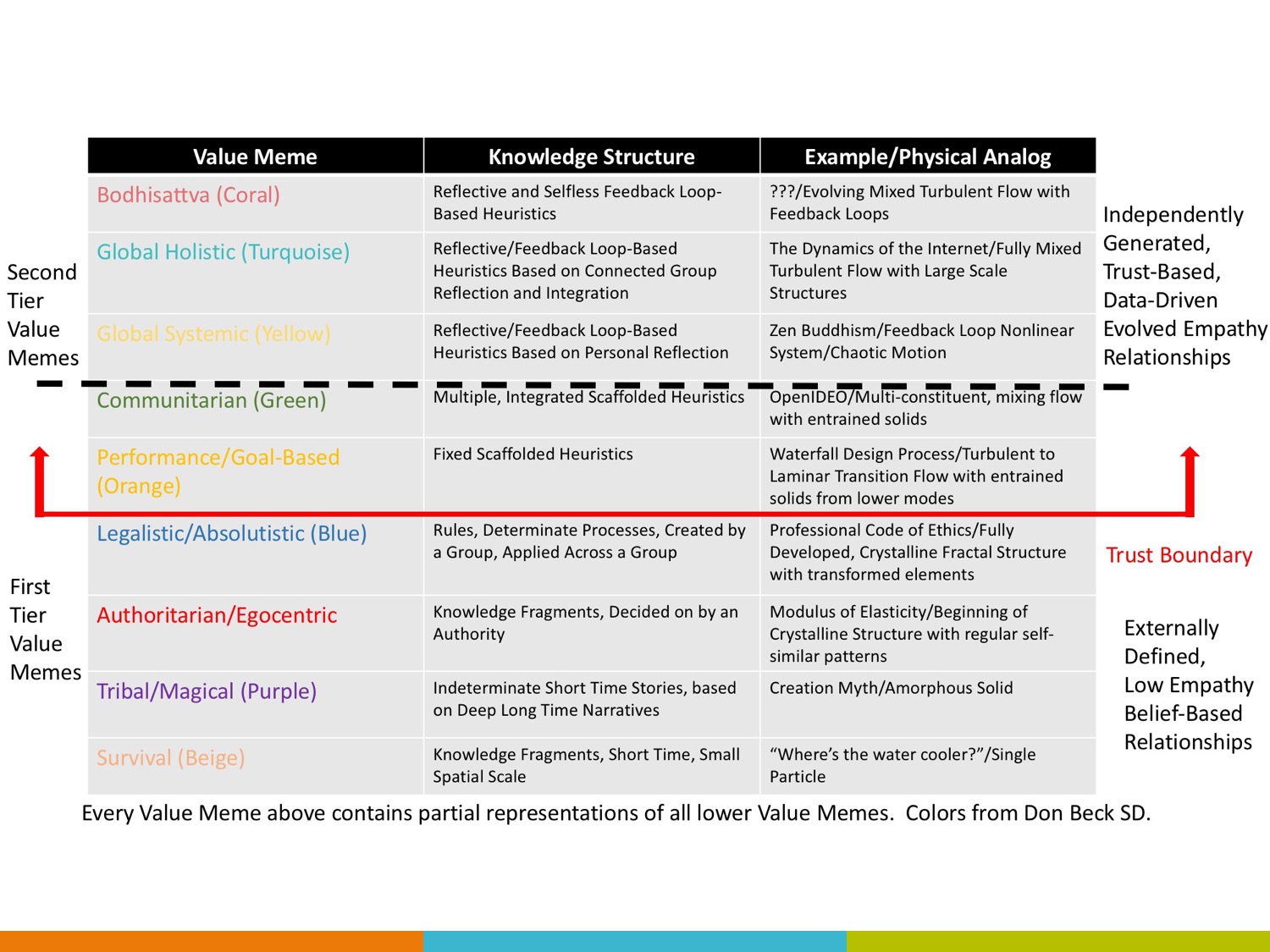
What that means is that given social topologies are ALSO universal — so this set offered up by Don Beck, of Spiral Dynamics fame, are a good roadmap for how other extraterrestrials organize.

The challenge that we have here is that all these social structures are dependent on the level of agency any given sentient agent has. And that, is going to feed forward into a canonical set of knowledge structures. Which then creates various design instantiations, a la Conway’s Law. All that’s here.
But here’s the rub. Though there are lots of hypotheses that aliens want to farm us for food, because in a cosmic sense, we’re so damn dumb, we’re kind of a lousy food species for an extraterrestrial. And the rub that isn’t discussed in talking to our E.T. buddies is that they are likely far above us in thought complexity — unless their figuring out how to cross the cosmos was some kind of weird fluke. Which is unlikely. With all things involving complexity, we are limited in seeing much above our head in what additional complexity might look like.
So THAT means they’re more likely looking down on us like we view dogs, and hoping they can communicate a couple of simple commands to us. They’ll still have the same lower level knowledge structures. But the upper level ones, inaccessible to us, might indeed contain information in other dimensions. Here’s the ones we have access to.
I’m going to wrap this up by saying that I’m one guy. And yes — I do have a lot of background in lots of different things — from engineering design, to languages, to astrophysics. But I’m still one guy.
So let’s pull an analogy from one of my favorite sci-fi trilogies of all time — The Foundation Trilogy, by Isaac Asimov. We’re always all hyped up on the material construction foundation — the First. But aside from some poseurs, we’re really doing a shitty job with the Second, the one in charge of deeply understanding the ‘social’. Currently, the field is an utter disaster. We could use a few rocket scientists working on it.
Feel free to join in!
P.S. I’ve written about a lot of these issues before. Here’s one of my favorites. Searching the blog will yield more insights!

 It's About Empathy - Connection Ties Us Together