
One of the most difficult concepts for people to internalize that I write about is the notion of Independently Generated, Data-Driven relationships vs. Externally Defined, Belief-based relationships. These two archetypes form the core of all human relational systems and social structures, and if you believe me, are the things that create the baseline of our cognitive neural systems. The first is based on agency-driven, data-based empathy (think in terms of simplification as reading the complex mix of verbal and non-verbal communication for building gradated trust.) The second is belief-based, and created outside the individual by the larger social structure in play. These require no agency — the fact that I’m a professor, for example, is defined by my university. Whether you think I’m a nice guy or not, however, is dependent on your own judgment.
The short version is that these belief-based relationships map to the same part of the brain as limbic/emotional states. As such, they’re coupled to very short timescales, as well as immediate reactivity to information. Very different than an independently generated relationship, that depends on interaction, autobiographical narratives, and far more complex and complicated processing in the pre-frontal cortex. Your conscious mind is a powerful thing. But it takes more time and energy.
I’ve often been asked if there’s any set of experiments I could do to validate my various theories, other than trust in my skills of observation. I always laugh, and say “well, if you gave me $10M I could.” I’d have to hire real people in psychometrics, and sort through all of it.
But then this meme started making the rounds of the Internet. And maybe, just maybe, it might not be so impossible. I’m talking about the figure below.
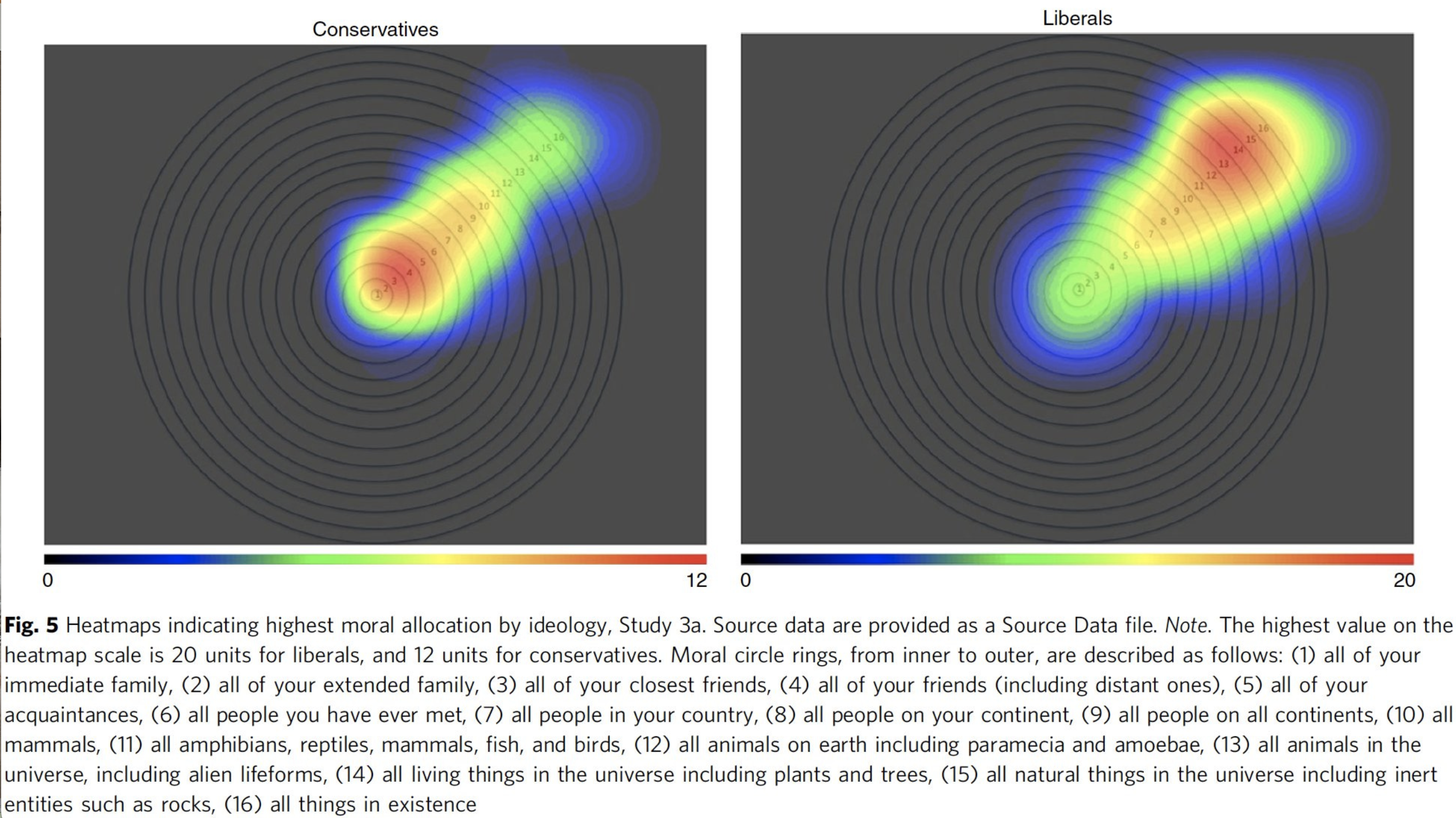
Paper in Nature Communications, Waytz, Iyer, Young and Haidt (Sept. 2019)
My primary critique with Haidt’s work is that he basically just makes up categories with no physical basis, that sound good, and this is no different. But he also is great at intuitive guesses, so at the same time, I do recommend reading him.
What this graph shows is the differentiation between how conservatives and liberals view moral obligation. Conservatives, on average, start closer to home, with more weight placed on people that they know, and then with concern dying out as distance in time and space increases. Liberals are the exact opposite. People adjacent to them accrue no credit for distance minimized, with concerns being projected on people further away, or even things that are often deeply unknowable.
What these folks don’t posit (mostly because they’re academics, and are invested in a low empathy environment, which then conditions their own bias) is that this also clearly demonstrates the potential morality that springs from a combination of independent, empathetic connection, as well as validity grounding — the ability to believe something because you witness it with your own senses. These two things are necessarily confounded (the experiment wasn’t set up to separate them) but you can still see how this plays out.
Short version — some majority of conservatives value a personally collected stream of information more than they do other sources, or experts and their stories. With the exact opposite being true for liberals/progressives. And this creates a profound neural gap between how the two will sort into social structures. Because of this relational divide, conservatives are far more likely to be communitarians than liberals. And liberals are far more likely to sort into elite-governed hierarchies, and be status conscious. You show your level of cool to your liberal pals by being concerned about the politics in West Papua, which you can never really hope to affect. And you can also appreciate how missionaries tend to be conservative. You want people to be saved? You travel and tell them about Jesus.
One can also see how this develops low- and high-responsibility mindsets. You can care about the entire world, but the reality is there’s not much effect you can have on the entire planet. But you can impress others with your virtue, which will then elevate your status in your social hierarchy. Contrast to the conservative viewpoint — you can affect your local environment, let’s say by planting a tree in your downtown, and while the global effect of that action is also unknowable, you can be responsible, and hold yourself accountable for that particular action. You can check on how the tree grows — an exercise in validity grounding –– and then, importantly change your behavior to improve the tree’s thriving. And all the time, you’re really cultivating how your brain processes information.
Since the election of Donald Trump, I’ve had to deal with a spate of attacks and abandonment from many of my liberal friends. This is not pleasant — even for me. Any straying from more and more extreme party orthodoxy means condemnation and alienation. I have picked up some more conservative friends along the way, and honestly enjoyed the development of some very honest and refreshing relationships, often hooked to the social media app X/Twitter. For me at least, these are data-driven — I ‘tweet’ and then people follow me for my ideas. I’m fully aware there is group aggregation in all of this. But as an original content creator, it’s been very refreshing.
The downstream cascade of the isolation the liberal community is actually promulgating is not going to be pretty – for them. Based on purity tests and adherence to orthodoxy, it is inherently relationally disruptive, and as such, prone to being kidnapped by psychopaths, who are far better liars than most of my friends trapped in progressive claques. Because it’s tied to our limbic centers, more people are likely to make snap decisions about which friends to keep or reject. I’ve certainly seen this on Facebook. And worse — if you’re prone to splitting, it ain’t gonna get better.
It’s also disorienting for those same progressives. As more fantastic crimes get dreamt up, the more the liberal mind loses its grip on a more adjacent reality, and the more we see projection of this mindset on conservatives. And that adjacent reality is the thing that creates the world we navigate.
As I’ve noted before, psychopaths always make a big splash up front. But over time, the system manages to find a way to isolate its relational vampires.
Or the whole system collapses. Stay tuned.
 It's About Empathy - Connection Ties Us Together