
The Default Mode Network and Reprogramming your Subconscious

The best adventures are with your kids. Standing in the rain, with Braden, West Papua, Indonesia, 2019

How Did We Get Here?

One of the most pressing questions of our time is deceptively simple: how did so many of the world’s problems seem to sneak up on us? How does chaos accumulate unnoticed until it’s already everywhere?

To answer that, we need to understand how mental models operate inside the human mind — and how our psychosocial development shapes the brain itself.


You Are Not As Conscious As You Think

Start with an uncomfortable fact: most of the time, you are not in direct, conscious control of your own thoughts.

Your thinking runs largely on what neuroscientists call the Default Mode Network (DMN) — a web of interconnected brain regions including the medial prefrontal cortex, the posterior cingulate cortex, the angular gyrus, the hippocampal formation, and the lateral temporal cortex. These areas show sustained activity during rest, daydreaming, self-reflection, and social reasoning. If conscious, deliberate thought were the whole story, your brain would go quiet the moment you stopped concentrating. It doesn’t. The DMN keeps running.

That persistent activity isn’t random noise. It is the brain doing something important.


The DMN as Relational Operating System

It’s a short step from there to a significant insight: the DMN is heavily involved in relational programming — the deep, largely automatic patterns that govern how we engage with other people.

And those patterns are shaped by what developmental theorists call the Value Meme (vMeme): the meta-level framework that structures how we participate in social organization. Your vMeme isn’t just what you believe — it’s the operating system beneath your beliefs, determining how information moves between you and others, and how you read social situations in the first place.

Put simply: your vMeme is the default programming running in your DMN. It is what your brain practices most of the time, whether you’re aware of it or not.


Two Kinds of Relationships, Two Kinds of Mind

To understand why this matters, consider that human relationships fall into two broad categories.

The first are independently generated, data-driven relationships — built through direct experience, observation, and personal judgment. These are rational, agency-driven, and form the foundation of genuine empathy. Friendship is the clearest example. You chose your friends based on how they actually behave toward you.

The second are externally defined relationships — organized around authority, rules, and social role rather than personal experience. These are belief-based and non-agentic. A doctor is a doctor regardless of your personal experience with them; a judge commands a certain deference regardless of your opinion of their character.

Neither type is inherently bad. Both are necessary. But which type dominates in your thinking depends on your social environment and your own level of development.

When data-driven relationships dominate, your thinking tends toward nuance and multi-dimensionality. You can hold complex assessments: “I’d trust that person with my life, but not my wallet.” When externally defined relationships dominate, your thinking tends toward rules and authority. You respond to categories — rank, role, label — rather than to the person in front of you. Think of the mental adjustment required when an American first drives in England: the road rules are so deeply encoded that conscious override is genuinely hard work.


Permission Structures: Engineering the DMN

In turbulent political times, the DMN comes under sustained pressure. Forces across the social landscape push individuals away from agency — away from calibrating their responses to information gathered directly from their own experience — and toward pre-packaged interpretations of reality.

This is the core function of permission structures: narrative frameworks designed to guide people toward a predetermined conclusion while allowing them to feel they arrived there freely. The term was popularized by David Axelrod, a media consultant prominent during the Obama administration, and the technique was refined extensively in that era’s political communications.

The mechanism is psychologically precise. A permission structure doesn’t argue with your existing identity — it provides scaffolding around it, allowing your DMN’s self-coherence machinery to reorganize around a new attractor without triggering the identity-threat response that would otherwise cause rejection. In short: it lets you change your mind without feeling like you were wrong.

The danger is that this process disconnects your reasoning from your own direct sensory and relational experience. It substitutes an externally constructed narrative for the data you are actually gathering from your surroundings. Over time, this produces a drift from reality — a gap between the social script you’ve been handed and the world you actually live in.


DEI: An Evolutionary Force That Overreached

The arc of DEI policy illustrates this dynamic clearly.

Early-stage DEI confronted real, documented bias. It forced individuals to reckon with out-group prejudice that operated below conscious awareness, and in doing so opened the door to more independently generated, data-driven relationships across racial lines. This was genuinely evolutionary — it reprogrammed DMN patterns that had calcified around historical social hierarchies and pushed societies toward greater complexity and trust.

Late-stage DEI emerged after many — though not all — of those original targets had been substantially addressed. At that point, the institutional momentum carried on, but the animating data no longer matched the intervention. Ideological rigidity replaced adaptive responsiveness. The framework became easier to exploit by those with little interest in its original goals, and increasingly imposed on individuals scripts that didn’t match the reality of their daily relational lives.

The consequences were visible even within minority communities themselves. Professional-class black families followed earlier white flight patterns to the suburbs — the memetic pressures of the late-stage agenda created new conflicts within, not just between, racial groups.

Worse, the framework became a tool in a separate dynamic: elite overproduction — the intensifying competition among credentialed elites for a shrinking number of top-tier institutional positions. Demanding that a fixed percentage of elite university admissions go to underqualified candidates could be framed as moral virtue, while functionally reducing competition for the remaining spots among elite-class families. The moral language of inclusion became cover for a classic competitive maneuver in the game of institutional musical chairs.

The deeper damage, however, was to the underlying social substrate. The kind of broad innovation and creative collaboration that drives societal advancement depends on individuals freely seeking out their own partners, collaborators, and networks — based on independent assessment of trust, competence, and compatibility. Mandate those relationships from the outside, and you erode the high-trust relational infrastructure that makes complex, decentralized cooperation possible. Creativity and complexity don’t survive the removal of genuine agency in relationship formation.


Immigration and the Relational Immune System

Similar dynamics apply to rapid, large-scale immigration from societies with fundamentally different relational architectures.

Consider the Haitian immigration into Springfield, Ohio. The surface-level conflicts — even the infamous “they’re eating the dogs, they’re eating the cats!” moment — were symptoms of something deeper. When tribal social organization (in which loyalty, authority, and justice are structured around kin and clan) is introduced rapidly into a community organized around civic, rule-based trust, the friction isn’t merely cultural. It operates at the level of the DMN itself.

When authorities then enforce pro-social interpretations of that friction — insisting that residents’ discomfort reflects bias rather than legitimate relational signals — it creates a double-bind. The DMN is receiving direct experiential data that conflicts with the socially mandated interpretation. The result is cognitive gaslighting at scale. And that can lead to civil war.

The contrast with other immigration patterns is instructive. Ukrainian refugees in Poland share language roots, religious tradition, and social mores close enough that integration, while not effortless, doesn’t require the receiving community to override its own relational immune system. The Springfield situation is categorically different — not in the worth of the people involved, but in the scale of relational distance being bridged without adequate time, infrastructure, or honest acknowledgment of the challenge.

The long-term trajectory of forcing such mismatches without support is predictable: societal devolution. You want to generate violent ethno-nationalist backlash? Introduce a large tribal population into a stable community without preparation, honest communication, or adequate integration support, then gaslight the residents when the predictable conflicts emerge. The relational immune system will respond — and what it reverts to, in the absence of better options, is historical sectarian identity.


The DMN Doesn’t Lie — Eventually

A final note on authenticity.

People are skilled at performing higher-level, pro-social values when they have an audience and nothing is at stake. But under pressure — in genuine crisis, in moments of real conflict — the DMN reasserts itself. The deep programming runs.

A recent case from Dundee, Scotland illustrates this. Bulgarian Muslim men were accused of sexually harassing two pre-teen girls, aged twelve and thirteen. A number of conservative commentators, performing centrist rationality for their audiences, publicly suggested the girls were fabricating the accusations. The jury concluded the attacks were real. The commentators have since apologized.

What does this reveal? That even self-styled rational voices will sacrifice lower-status individuals on the altar of status competition — reaching for the position that elevates them in their particular pecking order, rather than the one that reflects honest judgment. When you watch a journalist position themselves as uniquely reasonable, watch what they reach for when the cost of accuracy is social. Their DMN will out.


The pattern across all of these cases is the same. When permission structures systematically override the DMN’s capacity to generate independent, data-driven relational assessments, the result is not a more just or more functional society. It is a more manipulable one — and eventually, a more fragile one.

A procedural noteI wrote this entire piece myself, then dumped it into Claude to streamline the flow. As such, I can tell it does change tone a bit — it’s been Claude-ified. If you’re a regular reader, let me know what you think. I take a lot of flak from folks for too much complexity, too many unique terms, and such. Let me know if this helps or hurts.

I’m going to write a piece on my interactions with Claude. It often does a great job of clarifying my stuff, and that’s impressive. I can also tell when I say more radical stuff that it does run up against some kind of AI sidebars inside acceptable discourse. Nothing is perfect.

Immigration as a Psychopathic Boundary Attack

In the Welsh countryside

Two days ago, there was a videotaped attempted beheading by a Sudanese illegal immigrant in North Belfast, Ireland. The event, which involved gouging the eye with a knife of a local Belfast resident, followed by the perpetrator attempting to saw off the head of the individual. The act has caused explosive riots across Northern Ireland.

The official census in Northern Ireland is taken in the years 2011, 2021, with the next official census taken in 2031. From 2021 to 2021, though, the population of ostensible asylum seekers from Muslim countries, primarily from Syria and the Sahel (Somalia, Sudan, etc.) has tripled, and continues to increase. Both these areas feature populations that are decidedly non-assimilative. The Syrians are obviously Arabic in feature, and the the Somalia/Sudan contingent are obvious Africans. They would stick out like a sore thumb in Belfast, which is white, Anglo-Saxon stock. Consulting various AI platforms, like ChatGPT and Claude, offers little elite sympathy for the natives, who historically have been economically marginalized. Additionally, the AIs give a story that attempts to distract from the obvious cultural influences around the various murders and rapes that have originated from the Muslim community. Similar to the grooming gang scandals, these resettlement efforts are recast into bigotry and hatred against immigrants AFTER a given incitement (such as the attempted beheading) occurs.

Immigration of this type is never in the interest of the lower class/caste groups that are expected to absorb these different groups. As I’ve mentioned in a previous piece, immigration applies pressure to availability of lower income housing, as well as economic opportunities, elevated crime rates and such. Various Collapse Narratives – stories told by elites wanting to drive collapse- are inevitably spun by the press regarding these types of immigrant groups, almost always in a positive light. But the obvious reality is that had those people not been imported into the country, that particular crime would not have occurred. And things become even more problematic when one considers that there are critical mass cultural sizes for non-assimilation of given populations, that are actually shrinking due to technology by the year. As the child of an immigrant myself, I can attest that my own father would call back to Iran once every 2-3 years, for a weeping and wailing session that would last at most 30 minutes. Anyone with an iPhone can reach anyone anywhere in the world through WhatsApp for hours on a daily basis. Why get to know your neighbors at all?

The problem as well, at least in the Northern Ireland situation, is also the differential treatment of women inside Islamic cultures. Women are obviously far more constrained inside Islamic culture, and especially inside fundamentalist Islamic communities, because the women themselves are the primary enforcers and immiserators against younger women. But the deeper problem inside the Matrix is not Islam itself. It’s the fact that the Islamic faith pairs perfectly, in its persecution of women, with the desires of white females inside the British and Irish governments to conduct pogroms of manipulative reproductive suppression against other potential white offspring, who may have the cultural coding to advance in society. Perusing X today, there were the usual voices condemning the nominal “far right” in perpetrating violence in the wake of the beheading from the masculine side. But front and center were women, armed with the same message, not decrying the violence perpetrator — the Sudanese dude that attempted to saw off his victim’s head.

Quite the opposite. These women were attacking alpha males inside their own immediate community — their potential defenders — for assuming a rational posture against a culture that promotes decapitation as a way of conducting civic discourse.

Saying this is obviously an explosive take. But the shift in v-Meme perspective regarding condemning the people being attacked is emergent in the structure of any argument that must be made. The higher virtue-signaling moral ground, at least in these white women’s mind, must be held by decrying violence, because the position itself is what I’ve named a Collapse Narrative, and inherently irrational and ungrounded. In a healthy community, once an obvious threat was established, the leadership would move to neutralize an individual, or a contingent of individuals who assumed that the right path was beheading of adversaries. Especially if there was deeper cultural context. Not this bunch.

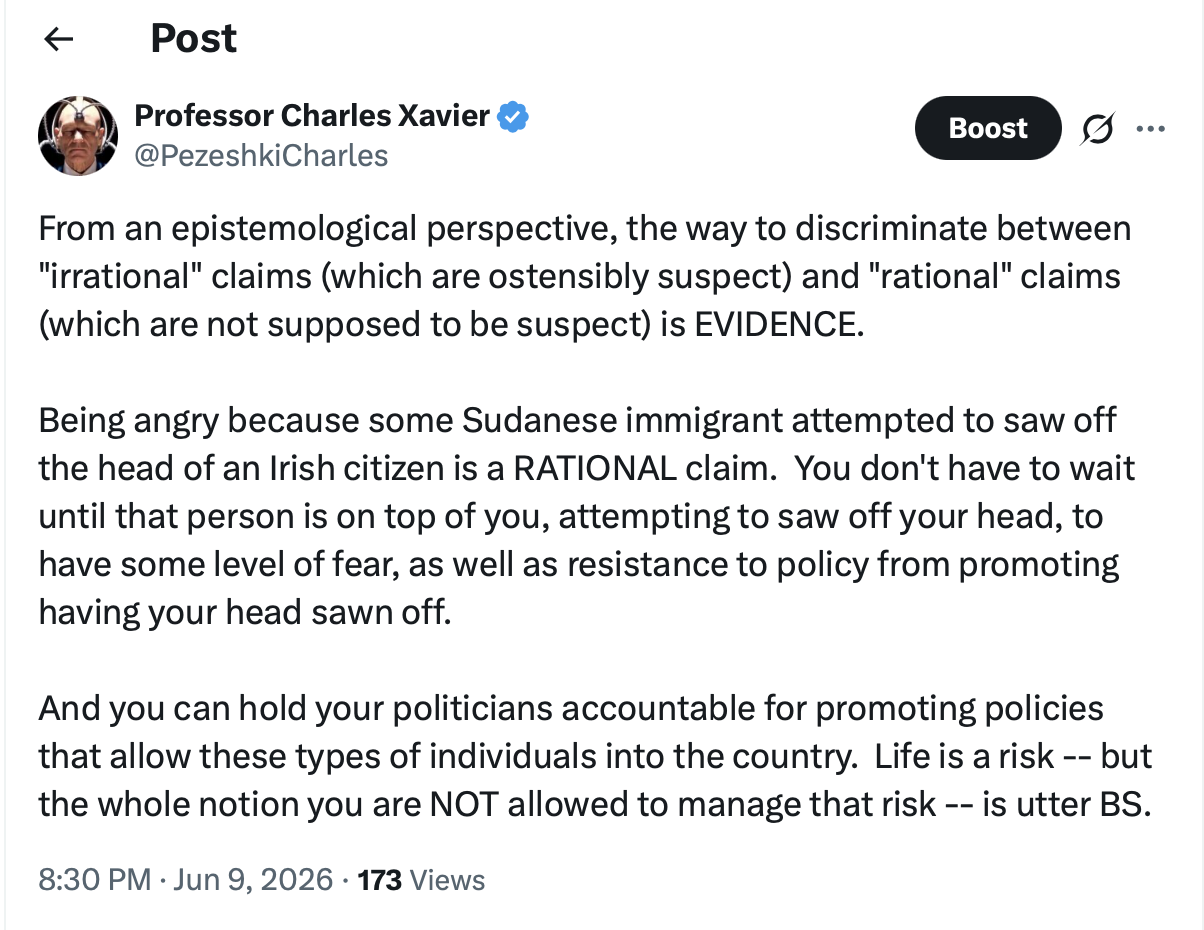
I put this up on X earlier today, that I thought was quite succinct, in the difference between an irrational fear, which racism is used as a moral status-assertion mechanism, and a rational fear, where grounding evidence indicates the potential is real and demonstrated.

This is a hard issue to unpack. It has Survival v-Meme level implications, in that once you admit a certain critical mass of individuals into your country who are at the Tribal v-Meme levels, such as the Somalis, you can’t easily just send them back. But they are indeed an invading army, and are being used as such in the current milieu — amazingly enough, by women, using them against other women and their children in this period of Elite Overproduction. It’s also no surprise that elite women in that society are more than happy to wage war against their own perceived adversaries — high-T males who are acting nominally along the course of protect-and-provide for their own communities. And the women doing so have no problem enlisting beta males, who populate most institutions, in triangulating institutional authority against those selfsame alpha males.

One of the most interesting psychosocial aspects of all of this is that once a non-assimilative immigrant population grows to a certain size, it starts destroying the protective boundaries of the host community. Especially with importing already extant tribal and war torn societies, this is done with increased crime rates, as well as having their young warrior caste out wandering the streets. The protective boundary that formerly existed around the original community is shrunk down, at best, to the individual, which is hugely relationally destructive, and detrimental to social cohesion. And that leads to a scale-up of psychopathic behavior. Now instead of just working on an individual relational basis, the psychopathy becomes a group phenomenon. And in the case of Northern Ireland, with its long history of sectarian strife, this could lead to extremely unpredictable outcomes. And here’s the other thing. No one knows what those actual population sizes are that trigger violence, or nonlinear, deviant behavior. It’s a very dangerous, unpredictable game.

And make no mistake — the apparent pawns — the immigrant communities and their constituents — have no intention of staying pawns. So just because the virtue-signaling women have decided that they’re going to play a very deadly game of non-allegiance with their original communities doesn’t mean they’re not going to bring perdition down on all of us. Do remember — it’s partly a wild genetic, hardwired game. And the genes, and the psychopaths don’t care. The genes are playing the long game, for sure. But the psychopaths are playing as impulsive a short game as can be played.

And what could be more exciting than a good beheading?

On Immigration

Yosemite North Country, headwaters of the Tuolumne River

Immigration has turned into one of the most controversial issues of our day. Why? Because we are in the days of what I would call the Great Validity Grounding — where our elites have carried population manipulation through propaganda to such a level, there is no way we can swallow the various fictions and not get hit over the head by reality.

And immigration is far from the only issue. We are told that boys are girls, and there is no harm in pumping teenagers full of cross-sex hormones. We are told that our very agencies responsible for subversive activity around the world are only the positive narcissistic storefronts for saving lives around the globe. That Americans really aren’t owed any reasonable egalitarian trade policies. That we should be involved in endless, historic wars around the world. The list goes on and on.

Most Americans want to retreat from all this — and have. Being hyper-informed (I am the worst when it comes to digesting the constant stream of news out of the Internet and social media) AND being a teacher who actually engages my students — I sit with them and nonjudgmentally ask them what they know — it is stunning how little most of them are aware of what is going on, nor how they are being manipulated 24/7. But the crunch is coming for the population, and certainly no one has championed the re-grounding effort in common-sense reality than Donald Trump. I’ve been very critical of Trump in the past. But as I wrote in a recent piece, maybe we needed an inveterate narcissist to play-act the role of national father to shake us out of our shared cognitive delusion.

When it comes to immigration, I am profoundly against illegal immigration of any sort. What happened during the Biden administration was an appalling betrayal of the national interest. And the accounting of the damage is yet to be reckoned with. And assembling coherent narratives of that damage is nearly impossible – because by and large, the elites in our society have benefited. And our press will simply not report in any coherent manner on the actual effects of the past 20M (or more) illegal immigrants coming into our country in the past four years.

But such a tidal wave of humanity had to have mechanisms that supported it. That led to growth of large-scale Non-Governmental Organizations (NGOs) and the gaslighting machinations to hide from and defraud the American people, who paid for all of it. But there is more — if you need more proof of the size of the effort, go to Youtube and search for “migrants – Darien Gap”. You’ll see the encampments set up in Colombia — often nation- or language-specific that shepherded the mass of humanity (mostly 20-30 something males) up through some of the most remote jungle on the planet, and onto buses and trains into the United States. Bret Weinstein on Tucker Carlson gives insights on the darker part of all this — Chinese migration into the US.

The other dark side of all this is that Sinaloan gangs from Mexico form a huge part of the infrastructure for getting illegal migrants from around the globe into the U.S. There are no clear numbers on the money involved with the cartels, but it is clear that it ranges in the tens of billions, to potentially hundreds of billions of dollars. The idea that peasants or lower caste individuals from African countries could figure out how to get to Ecuador or Colombia and then traverse the Darien Gap, purely on their own gumption, is laughably ridiculous. The cartels get the cash, and then provide the services. And any deficits are made up in the sex slave trade.

Further, the travesty of the border then fuels huge monetary reserves for those same cartels to buy politicians on the border, as well as along the route. If you expect these same cartels, with their violent economic morality to suddenly acquiesce to the federal government shutting down a primary revenue stream, you are deluded.

But that is not the main point of this piece. My experience is primarily with the connected consequences of our legal immigration policy — which involves the evolution and development of our technical workforce. That is something we must address as well, because how we approach this already has, and will continue to dictate our own economic composition of our own country.

To start, I think it’s important to remember that there are phases behind any social policy. While social policy is always going to be heavily biased towards elite interests (Peter Turchin in his book, End Times, notes that there’s basically no period in a society’s life where this ISN’T true) that doesn’t mean that every policy propagated will necessarily damage those not high-status. Policies, however, run their course, and inevitably, as they get hacked and manipulated by sophisticated individuals, who have some psychopathic members as part of their cohort, must be revisited before the disparate impact becomes so damaging they threaten the fabric of that same society.

Let’s get to the basics. Folks have been gaslit for so long on this issue they deny basic realities.

1. Increased competition drives down wages at the bottom of the wage scale.

2. Same makes housing more unaffordable for poor folks.

3. Labor surpluses leave little incentive for politicians to fix deficits in training and education for people on the lower part of the wage scale.

4. H1B visas gut the demand drivers for improving technical education for high school and undergraduate students.

5. Lack of a society that generates good jobs mean more “culture of poverty” problems for society, as poverty and single-parent homelessness drive crime rates and violence.

What one realizes is that these policies directly fuel the Wealth Pump — the social mechanisms that Turchin describes that moves money from the lower classes into the upper classes. This then exacerbates the income gap problem the country has been experiencing since the early ’70s. Which then drives an empathy gap, as the country moves away from egalitarian, high social contact lifestyles that might lead to emergent levels of compassion, as well as compensatory policies that actually make sense.

But what is NOT discussed is that immigration also serves as a metacognitive drag. I’m an engineering professor, and one of the drumbeats in the background of my entire career has been the need to educate more engineers. Or recruit them. Or whatever.

But around 1996, I noticed a new phenomenon. Engineering students, who a priori had typically received two offers at graduation, suddenly only were receiving one. And salaries had also gotten stuck. Neither of these phenomena indicate a starving job market. In fact, the opposite. And this has not changed. In fact, what HAS happened is there have been an increase required in experience for someone to get a job as an engineer. 30 years ago, maybe 50% of all students had an internship, which then did facilitate them getting a job. Now, my guess is that 90% of students have internships. And jobs are not really available for students who have below a 3.0/4.0 GPA. We in the university have compensated for these pressures as far as facilitating some of these requirements. But the pressure on the universities themselves to improve their own curricula has been non-existent. Instead, universities, contaminated by status-seeking behaviors, have doubled down on “research productivity.” Most research produced by universities is garbage — but then again, most new thought is garbage. You’d never know from watching how universities sell themselves, though. And it’s also true you have to have some area of inquiry for faculty to pursue — especially in rapidly changing fields like engineering. Without it, it is far too easy for faculty to stagnate. But, as with all things, there are limits. And universities, with their meta-linear metrics, fuel nonsensical creep of numbers rather than looking at actual advancement.

Like it or not, one starts to realize the key lever to forcing this society to fix its problems is to radically cut back on the number of H1-B visas currently issued. Then elites will have to start applying pressure to political systems to fix the educational system. Yes — there will be some pressure to offshore some of the work. But that is not without its costs. And I’d argue it would be far easier to just to fix our own educational systems.

And, as Americans, we would all be better off.

The Perfect Racket

Toucans – Osa Peninsula, Costa Rica

Back when I was a bona-fide environmental activist — a phase/career that lasted close to 14 years (if I had to be honest counting) I wrote a book, called Wild to the Last: Environmental Conflict in the Clearwater Country (WSU Press, 1998). In it, I documented a series of stories through my various adventures in the social and political landscape, which turned out to be far more interesting than the physical landscape I had spent so much time defending.

Why? The trees were beautiful — the wild rivers clean, and it’s hard to explain the deep awe I had, and still maintain for these wild places. But there was simply no cognitive dissonance in the fact that these places, functionally remnants of a bygone era, should be saved. All the truly economically conflicted places had, at least in the Clearwater Country in Idaho, had been logged. The timber industry was literally running on fumes. And the end was near, at least in that era, of large-scale resource extraction. What WAS left was gorgeous, striking and more than a little anachronistic. But the remaining stands of old-growth might build a couple thousand or so houses, or actually cedar shakes for roofs of houses. Or vineyard bracing. Saving this last, best place was simply a no-brainer.

But the forces persisted. There was no aesthetic swaying, no changing of minds. It was obvious to me that the timber industry was going to keep going until its own, bitter end.

It was then that I turned my attention away from just looking at trees, and working to understand the convergence of forces that allowed the destruction of rare, simplistic beauty. And in the process, often done meditating (or doing whatever it was that I did huffing through the mountains) I came up with the notion of The Perfect Racket.

What is a Perfect Racket? It is when you create a psycho-socio-economic machine that manages to cut across class lines, to achieve an end in spite of overwhelming demographic and other boundary conditions. And what had been set up in the heart of the Clearwater Valley in Idaho was exactly that.

What did that look like? There was a mill in Kooskia specializing in cedar. The mill owner was quite rich, and had sons who had left the area. The profits from the mill funded his sons’ passion — high end NASCAR racing, and there were articles about their success in the local paper. Further down, the blue collar people who worked in the mill were receiving their cut, as well as the ones that sawed down the trees, and drove the logging trucks. The bottom of the socioeconomic ladder was dominated by locals as brush monkeys — people who assisted with the various high-line logging jobs and would pile the logging slash for burning at the end of the season.

And the middle class? It was there as well — the US Forest Service. And then the surrounding small communities had some version of medical clinics, or small hospitals, which then were also fed by traffic by local farmers. Government spending in these communities was enormous. Logging and milling often only made up 5-10% of the workforce, as mills had been increasingly more automated even while I was fighting my own personal jihad. But I also noticed that lots of driveways had a Caterpillar D-8 parked there. Turns out a D-8 is about the right size for punching in roads into the backcountry, and the US Forest Service heavily subsidized road construction with both dollars per mile, as well as the timber cleared from the P-line, the route through the forest, where the road was supposed to be built.

Everyone was cut in. It was The Perfect Racket.

Buttressing the Perfect Racket were also myths, and lots of them. The hardworking logger. Trees as a renewable resource. Thriving local communities. On and on. The problem with living in any remote community, though, was that the culture varied in levels of violence pretty dramatically. Some were reasonable. Others were not. All had elevated levels of child abuse and poverty, because that’s what happens when you build a town in the middle of what we, in the PNW, call BFE (Butt-Fuck Egypt.) Don’t ask me the etymology. I don’t know.

When the trees had mostly been felled, and enviros like myself appeared to be winning the battle to protect these last wild places, the stories kept propagating. Loggers could “sustainably” log and build furniture. Or mobile homes. Or program computers (literally). Whatever. It was all insane, and it was all a myth. The real structure of the economy had been built on enormous government subsidy, and once the metrics involved with that were altered (miles of road into wild places being key) there was no simple replacement. Normal people cannot conceive of the scale of the Clearwater anyway. It’s huge by contemporary standards for Lower 48 wild places. So inevitably, people create smaller abstractions that they can place inside their Overton Window. To say we, the environmental activists, were cast as bad guys, well, yes. But most enviros never got out to the woods either. I was the freak, hiking, paddling and driving all over the vast landscape, and all hidden by those damn trees I was attempting to save.

It’s June 11 today, and it’s been a crazy six months of Trump’s presidency. Donald Trump came in with a mission, and a new cast of characters. Having gotten his ass handed to him during his first Presidency, he brought the appropriate guns to a gun fight – an entirely different set of Cabinet members and advisors, some of whom are true rebels. Donald Trump is far more of a cipher than people give him credit for. For his supporters, he’s MAGA. For his detractors, he’s Trump Derangement Syndrome (TDS) and the Anti-Christ. What he is doing, however, is intruding across the board on an ensemble of Perfect Rackets. Or rather — the money to fund them.

I happen to think that the Perfect Rackets we’re seeing are more corrupt and convoluted than the ones I fought. They’re staffed with people from Non-Governmental Organizations (NGOs) from the prior administration, all holding up some version of what I’ve named a Narcissistic Shield — some innocent thing hostage, with the threat that if the money goes away, the bunny rabbit gets it. Most of the appropriated money for these NGOs goes into the hands of an increasingly incompetent administrative caste, that’s woven together with corporate interests, in ways that are wildly indeterminate on who’s getting what. The amount of money flowing into these organizations from sources like USAID, to fix things like clean energy appliances, or homelessness, is staggering. But there’s some visual evidence that the money is flowing — namely in communities around Washington, D.C. Or even my hometown of Pullman. Look at the 4000 sq.ft. McMansions. That money came from somewhere.

Most of these people employed in their current niche as bureaucratic activists are just as unemployable in the private sector as the loggers were in writing code. When they lose their sinecure, it’s not obvious what any of them will do. So they’re willing to fight for whatever their piece of the racket is with savage lies, attacking the morality of anyone that says society might be better off without them. And as their numbers of followers and children have grown, it also creates incentives for them to spool up the various rate functions in their problems. No one working on homelessness actually wants to SOLVE it. What the hell would they do? There’s a lot of money in NOT solving homelessness.

In LA, especially when these systems come into contact with divergent interests, like the Mexican drug cartels, more and more convoluted connections are formed. Then, the primary vector of spread becomes actually social intelligence. The cartels master bringing in illegal immigrants from East Africa, or India. But that’s not the end of it. Do you know how to set up a transnational human cargo smuggling operation through Ecuador? I don’t. Yet these people meet aligned interests in L.A., funded by the state government, like CHIRLA. Bureaucratic and economic alignment ensues. And those people need a place to stay — bring in the real estate managers. Once coupled with D.C. politicians, Mike Benz calls this “The Blob”. The more money brought in, the higher up in the system this goes. Elections must be paid for, or bought off. Key pieces, like the Citizens United Supreme Court decision, saying corporate money spent is equivalent to speech. All of the sudden, we are bombarded with nitwits who never wrote an op-ed, nor had a political opinion of any nuance, screaming about “free speech” and “constitutional” rights.

It’s the Perfect Racket. And take it from someone who’s spent a lifetime fighting them, they don’t just go down because you expose them.