One of the craziest things to happen in the past week is the shooting of Alex Pretti, a protester/obstructionist in the current insurrection occurring around ICE operations in Minneapolis, MN. The actual micro-facts of exactly how Pretti ended up getting shot by ICE agents are in dispute, which are where arguments occur nowadays.
But we can learn a lot about where our country’s memetics are by listening to the arguments around his killing. We know for example:
He had a pistol — a 9 mm Sig Sauer.
He had been involved in prior protests, and apparently had broken a rib.
He had a concealed carry permit for his handgun.
He was reacting to a woman in an altercation with ICE agents.
He was part of a Signal app text network that sent individuals to ICE arrest scenarios.
He’s dead.
What follows is more fascinating than just his death. What is interesting to me is HOW people discuss it.
The biggest element is his legality in carrying a gun into such a situation. The lower complexity discussion centers around whether he had a Second Amendment right to carry a pistol in that situation. I believe he absolutely did. Various people have argued that he didn’t have his papers on him. OK. Another correct, but ungrounded, low responsibility argument. Having papers stuffed in his pocket would not have prevented him from getting shot.
But what is completely ignored is whether he SHOULD have carried a gun.
When someone argues he had the right, what they’re really telling you is that the person speaking understands relationships as externally defined. He had the right to carry the gun. Society gave him that right. But what it doesn’t consider is his level of personal agency and independent responsibility in carrying it. It was lethally stupid to decontextualize his decision making into some kind of absolute right. And now he’s dead.
When I was involved in a lengthy Civil Disobedience campaign regarding protection of native wildlands in Idaho, we had a rule for the encampment I helped construct. NO GUNS. We had that rule because it was a good rule — that guns and the chaos inherent in protest, civil or illegal, don’t mix. And that guns far too often give law enforcement a reason to shoot you. And while the legal part may grind on, if you’re on the receiving end of a bullet, you’re still likely to be dead. Activists involved in the campaign did all sorts of crazy stuff — from living in trees, to extended blockades of roads. But NO activists were killed.
And the cops had guns. You better believe it. As the campaign dragged on, US Forest Service law enforcement even upped their training/recruitment, and produced essentially Special Forces, trained to go into the forest after activists, who were pulling all sorts of shenanigans to slow down logging activities. These guys had machine guns, the whole bit. Yet not one activist was shot in the whole crazy shitshow that were the latter years of the Cove-Mallard campaign.
The reason that we did not carry guns was because we were GROUNDED in reality. It wasn’t that hard to figure out someone would get shot in the context of the largely peaceful protests (there was vandalism, make no mistake about it.). But we were independently thoughtful. And the structure of the campaign promoted agency. Anyone wanting to do “night work” was people the rest of us did NOT want to hear about. People organized themselves into Affinity Groups of 2-3 people, and no one wanted to hear about anyone’s plans, unless it was a formal public action that was intended to be a demonstration, for media consumption. In fact, the way our brains were wired at the time, if SOMEONE wanted to hear, that probably meant they were a fed. And we had a few.
What Alex Pretti’s shooting shows, more than anything else, is not how ICE has changed. It shows the principles I’ve discussed in this piece — that the Left has become ungrounded from the actual reality of their actions. If you’re rushing a cop, and you are wearing a weapon, and you DON’T get shot, that’s a miracle. What is fascinating is to see how the Left is papering over the shooting, somehow trying to re-write rules of engagement with law enforcement, that now cops must delay action in an altercation if they see someone with a gun. The only thing that LEOs will do in that situation is exactly what they did to Alex Pretti. Unload a clip into him.
Attempting to have the system take revenge on itself is a more than cynical maneuver by leadership to create martyrs.
I’ve got some bad news. Ain’t gonna happen. And Pretti paid the price.
One of my favorite pieces of mental work that I figured out in the old noggin is this piece here — the origins of memetic conflict that happens when different value systems collide. In order to completely grok it, you’re going to have to read a little about v-Memes — it’s not that hard. But the short answer is that when different societies, based on different social structures, run into each other over contested ground, how evolved those systems are will definitely decide the outcome.
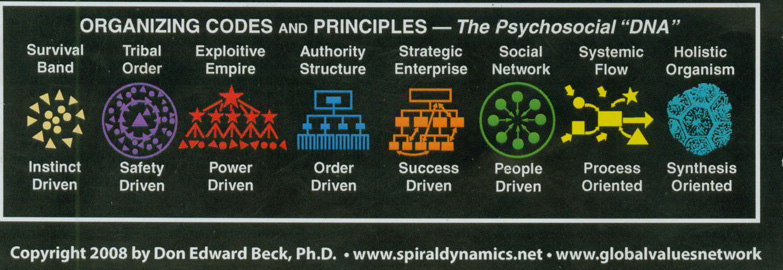
The short version is that in the classic Spiral Dynamics progression of societies — Survival, Tribal, Authoritarian, Legalistic, Performance-Based, Communitarian and on into the Second Tier — misunderstanding and conflict will depend on the memetic spacing of levels between the two conflicting social structures. Two levels (e.g. between Tribal and Legalistic) will result in Incomprehension — the two systems cannot understand each other. Three levels? What I describe as the Insanity/Barbarism conflict, which is what is happening currently in the conflict over ICE in Minnesota.
Here’s the social structures from Don Beck as a refresher.
Through a complicated path, mostly committed by psychopaths seizing control of dominant foundational myths in the Lefty Noosphere, the current Democratic Party has reverted primarily to Tribal knowledge structures. That drives emergent focus on Donald Trump as some version of The Great Satan, and a pathology across Lefties of all stripes, but especially their intellectual caste, with what is called Trump Derangement Syndrome (TDS). The justification for TDS is honestly monotonous, and is an exemplar of how higher knowledge structures that may have been present in individuals, necessarily simplify and rigidify when downconverted into Tribal forms. Trump is evil, Trump is corrupt, Trump is buddies with Epstein and a pedophile, and so on. No amount of context can derail this myth structure, other than the Left being forced to recognize that Trump is still President.
This is powerful when coded into some form of exchangeable morality — numerous folks don’t have to know much to “virtue signal” — communicate to others in the tribe their status through ostensible piety, of these foundational myths. It IS true that most of these Tribal myths are all centered around “Trump as a dishonorable, evil man.” The problem is that the world is a more complex place than whether you hate Donald Trump or not. And to some extent, the Republicans aren’t helping much, either. The current Republican administration is hardcore Performance/Goal-Based thinking. The one thing that matters is getting done whatever the governing item is. And Trump engages in constant negotiations with his adversaries, obviously due to his background as a New York real estate mogul.
This comes off as absolutely insane to the Lefty In-group/Out-group Tribalists, who, with poor consequential thinking, cannot perceive how they’ve been co-opted by their parasitic psychopath class, who had prior to Trump and Elon Musk showing up, had established a rich vein of revenue through exploitation of face-value virtue-laden topics that the majority of their base had lapped right up. “USAID is saving starving kids in Africa!” is one of my favorites. Why? I worked for USAID in Egypt, and had the surreal opportunity of seeing how they actually worked. I was window dressing for some competing ruling faction in Egypt at the time, supposedly working on a fertilizer plant control system, which then was one of the projects providing cover for the deep political machinations going on, facilitated by political US meddling. The end result of which was the Arab Spring, one of the original Color Revolutions, which did not quite go the way we planned.
The larger Republican Party is not completely Performance-based. There are still components that have strong Authoritarian bents (the Christian Right) as well as a large institutional caste of actors, named along with their Democratic counterparts, the Deep State, occupying the Legalistic v-Meme. If the Republicans seem diffuse as far as worldview, it’s because they are. While the Democrats are spiraling out of control on pure Tribalism, the Republicans face a queasy coalition centered around less government and traditional government favors to corporations and businesses. Which is problematic, because while the Democrats can coalesce around absolutely insane myths, like gender identity is only determined by how a person feels today. And because of their simplicity, these information structures are truncated, based on emotional appeal and very viral.
And so we end up in the current disaster in Minneapolis. In the last few weeks, two “activists” have been shot and killed. Theoretically, these “activists” are somehow nonviolent Legal Observers and merely traveling around after ICE and documenting arrests made by ICE. The videos of what actually is happening, and other recent disclosures regarding their organization, do, in no way shape or form, support any of this. The activists are extremely well-organized and coordinated in a network where individuals are dispatched via the messaging app Signal to tail ICE vehicles, and upon arriving on the scene, disrupt ICE arrests of illegal immigrants. When they arrive, they act literally like insane monkeys on meth, often closing distance with ICE agents face-to-face, while blowing whistles and horns. With the recent information regarding Signal app organizing, it is my belief that they could actually be considered a criminal conspiracy, subject to Racketeering Influence and Corrupt Organizations Act (RICO) sanctions.
Of course, the PROBLEM is within the context of their Tribal situation, sprinkled with fragmented myths about Constitutional function, is that they don’t perceive themselves as a criminal operation. Self awareness is pathetically low. And that is deeply problematic when dealing with the outside world. The second person shot, Alex Pretti, a 37 year old ER nurse — far past the age to rationalize this kind of behavior with youthful ignorance, showed up for his round in the “chase the ICE agents and harass them” sporting a handgun — a Sig Sauer 9mm. One of the unbreakable rules in my world, when I was helping run a large civil disobedience campaign, was NO GUNS. You don’t have guns at a protest, because if things go south, and sometimes they do, LEOs can kill you legally. And then you’re dead.
This particular type of Sig Sauer also has a handling misfire problem, and if dropped, can go off. It’s also no surprise to me that it was an ER nurse who made such a bad judgment call. ER staff were the worst of the COVID alarmist crowd, and there’s also no question that trauma can stack up and cause erratic reactions in stressful situations. Immediately, the propaganda side on the Left seized on the notion that Alex had a legal concealed carry permit, and in the classic distortion of thought that is haunting the Left nowadays, put that in the blender and came out with “ICE needs to adapt their tactics to support Legal Observers’ Second Amendment rights to carry hand guns into violent situations and conflicts with ICE officers.” Are you kidding me?
Even while they’re acting like meth-crazed monkeys. I watched the videos involving the incident where the gun went off (my guess is likely a misfire) and then what happened is what can happen in any LEO arrest scenario. Once the cop thinks either he or his buddy is under threat from a firearm, the cop will proceed to empty their clip into the suspect. Which usually means a dead perp. Much was also made in this Lefty propaganda round about how he was defending a woman “activist/Legal observer.” The clip I saw didn’t include the prior where she got into it with the ICE agents. But I’ve been in enough situations to know that a certain subset of women will fly off the handle, and believe they are the reincarnation of an invincible Valkyrie, and aggressively attack even LEOs. Call it the Mama Bear Social Control response. I even trained my two sons, now ages 25 and 27, when they were 16 and 18, what to do in a situation with potential law enforcement involvement (say a fight at a party.). They are both strapping young lads, and they both know that they are supposed to grab their girlfriends and run like hell, preferably before the cops show up. And if the girlfriend is dancing on his arm, screaming about her honor, and won’t leave — then ditch her. Cops will always threat-assess, and my two sons are 6’3″ and 6’5″. Which means one is going on the bumper with the bracelets, and the other is going in the backseat of the cruiser. The cop is not going to care about any dancing fairy princess.
Once again, the arguments from the Left to support their position are the result of projection and supposition — perceived moral order. Not validity grounding with anything resembling reality. I think it’s hard to understand this completely. I think a lot of the people involved in the obstruction of ICE in MN are likely middle-class, and have little to no experience with law enforcement. So they view themselves as White Knights, endorsed by their communities, and encouraged by local and state leadership in these actions. They view that because these various state and local officials have endorsed their moral position, and said they are brave and courageous, that somehow these ostensibly powerful people will rescue them. Little do they realize that their distorted sense of morality has no real power in a federal courtroom. And the other key fact is that they also are patsies ripe for disavowal by exactly those same individuals.
And what to think of the state and other government officials encouraging the insurrection? They’re locked in a deal with utter personal destruction once all is revealed. There’s tons of Somali daycare and medical service fraud that it is simply impossible to believe local and state officials either ignored, or were directly on the take. Fraud in Blue States is going to be an emergent issue in the coming New Year. While the Minnesota cabal, including Tim Walz and his lieutenant governor, Peggy Flanagan, seem to be mostly passively raking in the cash, and NOT involving the crazy gangland violence on the US southern border, it still means that this will be certainly the end of their political careers and inflated standard of living (Walz has already stepped down from running in the next election.)
But there are larger implications nationally. It’s through a glass darkly on what has been going on in our western southern tier, whose political caste is thoroughly intertwined with far more malevolent actors than the displaced Somali pirates in Ohio and Minnesota. You don’t have to stretch the Overton Window too far to see how the CIA facilitated Somali immigration, starting in the ’90s. But most of what came across the southern border during Joe Biden’s disastrous presidency came courtesy of the Sinaloan and other cartels. Walz and his crooked cohort may just end their lives in the big house. But that’s not the same for the various political forces across California, Arizona, New Mexico and Texas. The cartels are fond of torture and execution. And the Pandora’s box of inflated human trafficking revenue that happened through the betrayal of the Biden administration, and in particular Alejandro Mayorkas, has collapsed. No real natural born killer is going to take that lying down. The cockroaches are going to eat themselves.
Getting back to the primary point of this piece — the Left has left itself open to destruction in the context of memetic understanding by viewing the current administration as insane. They’re not. The problem is the flip side of the memetic conflict is that the Right views them as barbarians, which is decidedly not how the Left views themselves. The Left better get over its fascination with its self-generated moral order, and quick. The federal government, as well as most of the country, is nowhere near the point of collapse. And while the Left may not view themselves that way, the Trump administration, especially in the context of its goal-oriented focus of clearing out illegal aliens doesn’t give a shit about their moral order. They possess the reins of law and order on their side. And in the end, law and order are popular with the general population.
And as the effects of brainwashing using permission structures, started by David Axelrod and Barack Obama, wash off, my bet is no one is going to give a damn about the ginned up Lefty moral order that was potentially not created, but certainly accelerated, during the fractured COVID years. And grounding back to reality is brutal. It involves arcing.
And that means someone is going to get severely burned.
Tool Cabinet, 2026. In case you’re wondering, I use ~ 5 of these for 95% of my woodworking.
I am writing this on Sunday, January 4, functionally the day after US Delta Force troops seized the head of the Venezuelan government, Nicholas Maduro, from the Presidential Palace in Caracas. To call it audacious would be an understatement. A coordinated force, launched primarily from an offshore fleet, mobilized helicopters, a slew of different aircraft types, including a B1-B!, and successfully evaded detection by Chinese radar long enough to destroy the entire Chinese armament Venezuela had imported. It is unclear, at least to me, the extent that the Iranians had constructed drone factories inside Venezuela, but I suspect these were hit as well. Talk about a bad investment.
If you had to pick a scenario to illustrate the complexity crisis in memetics, you couldn’t pick a more profound example. The Left immediately condemned snatching Maduro, a mass murderer by anyone’s yardstick, under the worn-out aegis of colonialism, while Venezuelans themselves were dancing in the street. Immediately, the anti-colonial propaganda machine spun up the usual condemnations of the invasion, saying it was oil for Trump’s buddies as the primary reason for the war — a claim they have been pre-bunking for a while, in an attempt to discredit the sinking of drug running boats and submersibles out of the Venezuelan ports as being in the interest of the United States. As their lede goes, there can be no legitimate external or internal action to preserve the United States — as the most hegemonic, evil state in history, we’ve gotta go down.
Fortunately, not everyone in the current government agrees with them. The information flows in the country, increasingly complicated, and not supportable by the sophistication of the previous bureaucracy, was going to simplify and decentralize. Those are the memetic physics, and you cannot run from that. But the how of that transition matters a great deal to those of us that live here. MAGA has attempted to be turned into a slur by the Democrats — but for those of us that live here, and are not planning on exiting to a Riviera, Mexican, French or otherwise, has widespread support as a guiding principle. That doesn’t mean that the lumpenproletariat has any clue what actions this actually entails, other than not giving away a ton of foreign aid to other countries. But certainly, allowing Russia and China to build up a military force on the other side of the Gulf of America isn’t such a hot idea. That is definitely not in the national interest.
And so a realignment of the Venezuela junta, that spent a good hunk of time publicly declaring its hatred for America, was really inevitable. Those in power, and in the know, who do NOT want to leverage collapse to add to their personal family fortunes, were sooner or later going to be all in. It’s one thing to have a socialist/communist government in our hemisphere down at the tail of South America. It’s quite another to have one on your doorstep.
What’s amazing is that Venezuela, as a failed narco-state, is such an obvious one. Here’s a hint how you can tell. Any failed state will be accompanied by refugee outflows of the middle and upper classes before the peasantry starts hoofing it for the border. If you can get out, you get out. I got a window into that last year when I visited Costa Rica. Conversations with locals indicated that Venezuelan teachers, doctors and whatnot were showing up quite a while ago. What WAS interesting was that in places like El Salvador, who experienced their mass migration before President Nayeb Bukele took office, the Venezuelans merely showed up into empty slots that were waiting for them. So maybe, just maybe, the signal that should have been heeded was lost on the rest of the world — the bourgeoisie simply were too busy re-settling in their new environs.
But any country hemorrhaging its people is a failed state. People don’t leave until they have to. The semi-official number of people fleeing is in the neighborhood of 8 million, out of a country of approximately 28 million. That’s gotta be up there with Cambodia at the end of the US Vietnam period.
It should be said that any narco-state does not have the interests of the U.S. at heart. The drug war has metastasized into a full-on tool of internal destruction inside the U.S. Once again, numbers are hard to come by (amazingly). But at least 1/2 million Americans have died in the last ten years. What is even more tragic is the number of children — I deep-dove this figure and came up with about 5000 in the last ten years. That means 500 kids/year are dying from fentanyl poisoning. Because drug overdose is often self-administered, the old mental models get spun up in varying ways about the responsibility for the deaths. But kids are kids — and even if they’re 17, they mostly get a break regarding total accountability for their actions.
Why are we so stuck in the current situation? We’ve got the mass death at our door. But we simply cannot change our mental models on what non-kinetic warfare really looks like. In a best case scenario, we should sort allies from adversaries on whether they are cracking down on production of fentanyl and associated chemicals inside their borders. Yet the fentanyl still streams from China, as well as Venezuela, and especially Mexico. If you cannot control production of chemicals inside your own country, if you’re not registered as a failed state, you’re damn close. Or if not a failed state, a true adversary.
And at a minimum, those states and their justifications are the last thing we should be listening to. It’s a war, folks, like it or not. You pay attention to your adversaries. But you don’t suck up their propaganda.
Understanding the Venezuela crisis also requires shattering of old models of how we perceive how we operate in our own hemisphere. Whether we exercised the Monroe Doctrine or not, we believed it to be true. But that’s not what has been happening Everyone from non-state actors like Hezbollah, to the usual suspects of Russia and China, have been operating in Venezuela. And their actions are profoundly not in our interests. But the American public can’t even conceive that Lebanese terrorists could be running around in our literal backyard. It never comes up in any discussions I read. And the fact that it took Trump drawing that hard line against them is more a sign of past managerial neglect towards the American empire than anything else. Once you get your government filled with enough globalists and collapse advocates, this kind of thing was inevitable. We are the world. Indeed.
And the connections between Iran and Venezuela are indisputable. Iranian drones were being manufactured in Venezuela. Do people really think that they were going to be used against Trinidad? But it’s all so fantastic, and requires a knowledge of geography elusive to the modern American, we end up back with the notion that it’s another war for oil. Look folks, oil is fungible — and what that means is that oil from Texas looks like oil from Venezuela like oil from Saudi Arabia, once you mess around a little with the chemistry and sulfur content. The per-barrel price is the only thing that dictates who gets it. But who gets the money FROM it does change. And that’s the North Star of how to understand any oil-related crisis.
What’s more interesting is tracking the stuff that is scarce. This piece by Tracy ShuChart (on Substack) is a must-read for all Illuminati wannabes. Venezuela turns out to be a much bigger play than oil. And as China attempts to use its various rare earth surpluses as a political tool to bring the US to heel — not too much, because if we stop buying their junk, their own middle class will revolt — Venezuela shows up there, conveniently, as a potential proxy supplier. If we had a news media that had some sense (we don’t — they are mostly composed of traitorous, whining fools) these folks would be getting out a global map and the red yarn to tie together the network China is using to corner the market on all the stuff, like tantalum and coltan, that makes all our new spooky devices actually work. So if you were China, why wouldn’t you reach out to an ally with no scruples, who could in combo form, kill off your adversary’s children with fentanyl, while destroying their supply chain for all their high tech? And why wouldn’t you help that same partner stock up on suicide bombers, still smarting from all the US action in the Middle East? It’s one helluva play — but if it went off, the chaos generated would be spectacular.
And the United States Lefty corps will be there to pre-bunk everything, and keep us in a state of paralytic senescence. We deserved it after all. Black Lives Mattered — until they became inconvenient as well.
If there’s a lesson here, it’s that any functional state needs a national interest. And that national interest needs to be grounded and real. And the US is allowed to have one.It gets back to the whole Collapse Narrative thing I’ve been writing about. The short form for the cheap seats in the back — you can always tell a Collapse Narrative by its lack of anything other than babbling moral principles. It’s not that principles don’t matter. But if you can’t measure it, you can’t manage it.
One of the most preposterous Collapse Narratives is that by snatching Maduro, somehow China and Russia are emboldened in their own personal territorial quests. “If they did that, we can do what WE want.” So far, Russia and China have proved to be far more rational, self-interested actors than that. They ain’t out there for world peace, folks. And any nation that would help create the chemicals for fentanyl production is no real friend of ours. When they see us grab Maduro, they know the marble game is for keeps. And only seditious traitors like Mark Kelley, the Senator from Arizona, are going to try to spin it differently. China and Russia aren’t going to feel like the door is more open for their own territorial adventurism. They’re going to know that if we say something is important to us, we mean it. That’s the way functional hegemons work. And ALL nation-states are their own little hedgehogs. Don’t fool yourself.
None of this means that the runway to a bright future for Venezuela is free and clear. Left in place are the various junta members that helped Maduro do the bad stuff he did. But they are a bunch of rats — that’s what happens to your soul when you justify killing your own people. Trump has announced that we’re going to run Venezuela (Marco Rubio must be rubbing his brow), and I’m sure part of that message was that he was gonna kill them if they didn’t do what he asked them to do. Sometimes, the way you approach societal evolution is to have your leadership order it. And then hope that it takes. To a far lesser degree, it’s what I do in my own classes in design.
But success in Venezuela is going to be hinged on one thing — remigration of its professional class. Our job has to be giving Venezuelans enough hope for a new society that those people will come back. Because societies fundamentally run on information and information complexity. But in order to have information complexity, you’ve got to first have information.
I’m saying a prayer for Venezuela. And crossing my fingers as well. We could use a little luck about now.
And don’t forget — sometimes you go the Great Game. But sometimes, the Great Game comes to you.
The Parthenon — One of the interesting things about it is how small it is — Athens, Greece
On a personal note, it’s super-depressing to be writing about the events of the past week on the day before Thanksgiving. Hoping these simply pass means that when you unearth this post a couple of years from now, you won’t know what I’m talking about.
Last week, six Democratic senators decided to make a large-scale announcement on X, telling the troops of the US Military that they didn’t have to obey “illegal” orders. They didn’t give any examples of illegal orders, doing nothing but admonishing the rank-and-file with the implication that Trump has in the past given them illegal orders, and that at a minimum, they need to be insubordinate to these. As I said, there are no examples — just a broad brush telling them of the oath to the Constitution. The Constitution itself is notoriously sparse when it comes to telling the military exactly how to run itself, other than members of the Army and Navy (that’s all there was at the time) should obey the orders of the Commander in Chief, and the Commander in Chief was the President of the United States. I don’t think our Founding Fathers quite anticipated the psychopathic information wars (they were not totally naive to the ways of manipulation, but still) we are encountering today. I kinda think they wouldn’t have imagined senators and congress-critters as using gross stupidity as a defense, or the notion that language should be parsed without any implication.
But here we are — where we’ve had the Democratic Party shrieking that the current President is a fascist (once again, total Humpty Dumpty with this word.). For those that need a Humpty Dumpty refresher, showing psychopathic manipulation was alive and well even during Lewis Carroll’s day, here’s the famous quote from Through the Looking Glass —
“When I use a word,’ Humpty Dumpty said in rather a scornful tone, ‘it means just what I choose it to mean — neither more nor less.’
’The question is,’ said Alice, ‘whether you can make words mean so many different things.’
’The question is,’ said Humpty Dumpty, ‘which is to be master — that’s all.”
What is fascinating, if you follow this blog, is the memetic tricks being played by the various actors — in particular Mark Kelly, D-AZ. While he admonishes the military rank-and-file (he is a decorated veteran and Space Shuttle pilot) in a tone that implies they’re being given illegal orders, he beats feet away from this position in subsequent interviews. He poses his comments as some kind of avuncular reminder to the troops as a post-statement interpretation. It’s totally whack, of course. But decide for yourself. (Youtube has problems embedding in WordPress pages, but the link should work.)
Arguing against the original posting by the Six is a fools errand, and I won’t do it here. But what is fascinating is the Six surf the wave of memetic understanding, arguing that what is obviously a context-laden message, full of insinuation, should be taken literally and completely fragmented, and out of context. The perpetrators use memetic simplicity, along with a follow-on message of assertion of the First Amendment as their escape hatch. They have the right to say anything they want, of course, and they get to pull the Humpty Dumpty.
When Trump responded on X and Truth Social by angrily reminding them that basically what they have done could be considered an act of sedition, punishable by hanging, there’s a cascade of angry pearl-clutching in unison across the entire Left. What’s wild is that they all ran Trump’s statement of fact into “Trump wants to hang all of us.” Well, he might, but Trump didn’t say that at all. They are counting on psychopathic manipulation — clever deletion of a few words, while counting on the Neo-tribal politics I discuss in this piece to hold sway. The Left has spent the last nine or so years demonizing Trump — certainly the public must realize he is an illegitimate President, disposable by violence.
What is wild is that the Left continues to lay ground for what is known as a Color Revolution. And what is a Color Revolution? From ChatGPT –
Large-scale public demonstrations calling for political reform or resignation of leaders.
Unified branding (e.g., a color, flower, or simple symbol on clothing, banners, etc.).
Civil resistance tactics such as marches, strikes, and occupation of public spaces.
Rapid mobilization often sparked by disputed elections, corruption, or economic crises.
Focus on nonviolent action, although violence may occur around the edges.
This Color Revolution is focused on Trump, obviously, in attempts to brand him as a fascist and some kind of ersatz King. Even considering the argument a year into Trump’s Presidency is exhausting. The force of the current Color Revolution derives from endless haranguing using generic terms that the general public really can’t define. If Trump was a real fascist, the various operatives on the Left would at a minimum be in jail, and likely have already been executed. But the drumbeat of social media repetition goes on. The immiseration process never stops.
And the people doing this are pros. One of the Seditious Six, Senator Elissa Slotkin (D-MI) is a former CIA officer. Her bio is incomplete, but it doesn’t take much reading in between the lines that she helped subvert active organizations for a living. The others are trading on their service records in a “how could I possibly want to subvert the government” sleight of hand.
As of tonight, November 26, there have two National Guard members critically injured by an illegal immigrant from Afghanistan. There’s no question that the constant direct emboldening by specific members of the Seditious Six contributed to the atmosphere allowing these killings. Slotkin herself was warning that National Guard members were likely to start shooting US citizens in the various cities that they’ve been deployed to only last week, which translates to legitimacy of various aggrieved parties taking shots of their own. It’s going to be a wild week seeing how this latest development gets spun.
One of the craziest things that’s happened in the last six or so years is the blatant injection of speech control by the Left in all aspects of what I’ve called Collapse Narratives. What is a Collapse Narrative? It is the story and framing of a “moral racket” to bully others into silence, and that if you follow the narrative thread, your society will collapse. “If you say that, not only are you evil, but we will ostracize you from society AND kill the baby panda. And it will be ALL YOUR OWN FAULT.”
The technique works best when utilizing sexual taboos, which the psychopaths are allowed to discuss in celebration. But if you protest, you are (pick one or all) a bigot, a racist, and so on. And you better shut up.
No better example could be found than when Sam Brinton, former undersecretary in the Department of Energy, in charge of nuclear waste disposal went on various tours promoting his kink, which I can’t quite characterize. It involves being surrounded by other men dressed up in leather dog costumes, complete with butt plug tails inserted into their poopers.
Brinton was later dismissed for a particularly pernicious habit he had of stealing other people’s luggage off airport baggage carousels, then going home and wearing the dresses in public.
But while Brinton was in play, we, the public, were subjected to what I’d call “Walsh’s Progression” (credit to Matt Walsh at the Daily Wire) regarding all this psychopathic nonsense. We were supposed to Tolerate this reprehensible behavior, followed by Accept this as normative, then forced to Celebrate this as somehow adding to the modern cultural zeitgeist, leading to Normalization, and ending, of course, in Coercion and Punishment if you can’t follow the script.
All these types of manipulations depend on the psychopathic entity violating taboos and norms in society, followed by a pronouncement that only they are allowed to discuss this. The only allowable response across society is sycophancy. What they are promoting is usually, by their standards, some ostensibly necessary sexual deviancy. Why does it have to center around that deviancy, in the larger psychosocial picture? Because it mainstreams a channel for sexual abuse, mostly directed at children, who once traumatized, will then increase the odds of them developing a personality disorder and joining the ranks. It’s a combo psychosocial control/memetic reproductive act.
And that’s why it’s necessary to be done in public, especially publics containing children. It simply doesn’t work behind closed doors.
To repeat — psychopaths take taboo subjects, self-identify, demand acceptance and then use these to shut down broader debate. And because these subjects are ALREADY taboo in the larger cultural zeitgeist (call it polite society), it’s not that hard a task.
Let’s take another example — illegal immigration. While LEGAL immigration policy is a debatable good, illegal immigration is truly a consolidated blight on society. They are not the same. Illegal immigration often involves human trafficking. And human trafficking is inordinately profitable, both for the Mexican cartels that pipeline people into the US, as well as the various entities in the US exploiting the labor.
How does this work? Let’s say you are a contractor bidding a federal contract. You must bid this contract at prevailing wage rates, or it will be rejected. But if you fill your workforce with illegal aliens, you can likely pay these people half or less that same wage rate, resulting in a windfall for you. This becomes money that both you and the cartels can pump into the political machine to “look the other way” in whatever regional market you occupy.
Now pour on the psychopathic messaging. “These are hardworking families (growing dope in Ventura County.) “If you don’t support them, you’re a racist!” and so on. One pours on the messaging because there is an extensive web of government support services that are also profiting off the existence of these people, with housing, food and medical assistance, all part of the associated moral racket. “They are only looking for a better life, you monster!” And unless you’re made of sterner stuff (like me) you’re going to wilt.
Folks on the other side can’t even open their mouths regarding the very immediate impact to their own circumstance — especially in adjacent, poor communities. In the Scandinavian countries, rapes increased some 50% from baseline with the importation of migrants from Africa. And heaven forbid if you actually discuss the demographics of the illegal migrants — mostly young men in their 20s and 30s, and the inevitable characteristics of letting in an uneducated army into your country, while housing and feeding them. It’s all booby-trapped with psychopathic taboos designed to make you keep your mouth shut.
It’s even difficult for me, writing in the abstract, to imagine using the very real argument that my friends’ daughters will increase the chance of them being raped by allowing this illegal wave in.
That’s the power of psychopathic taboos.
One can also see the extreme reaction from the Left on this issue against Donald Trump. Tom Homan, Trump’s deportation czar, attacks the psychopaths head on. Instead of deferring to their manipulation of taboos, he confronts them with stories of direct experience. But because the majority of our mainstream media has abandoned their own ethics, or are willingly supporting the psychopaths, there is no amplification.
And, as with all things psychopathic, in the v-Meme space, the psychopaths take any dissent, as well as detail, and shove it down into the macerator of reality. The only “appropriate” response is conformity. And that requires relational disruption and loss of agency — THE key psychopathic identifiers — for all adjacent actors. And so the folks responding to the use of these psychopathic taboos march down into Tribal v-Meme knowledge structures of myths about past immigration. Nuance or reasonable policy is not acceptable.
Do the psychopaths know they’re doing this? I think the ones at the top do. But much of this turns into an emergent cascade — once the masters at the top, interested in some strange brew of anarchy, chaos and low level control, set the tune, the local dynamics of relationships comes into play. Understanding the complex web of both illegal actors, and legal institutions in perpetuation of all this strains the brains of all but a few of us.
Diabolical.
What’s the remedy? The modest thing is resist the psychopath’s efforts to rename pathological behaviors into more palatable forms. Don’t use the language of the psychopath. Call illegal immigration “illegal immigration” — not undocumented workers. Do not use the phrase “children’s gender affirming care.” Call it child castration. You’ll see an immediate revulsion for describing these various things as they are. But if we cannot reclaim the language, we will see the psychopaths carry the day on the field.
Charlie Kirk at WSU, April 2025 — picture from the Moscow-Pullman Daily News
Charlie Kirk, Turning Point USA ED and conservative influencer, was assassinated yesterday, September 10, in Orem, Utah, while doing an event at Utah Valley University. There are lots better sources of Charlie’s life trajectory than this blog, and I’m not going to repeat all the various details of his activism, his life, nor his demise.
What was interesting about Charlie was that his events consisted of direct engagement with students. Opinions will differ on his intellectual veracity, or his demagoguery. I’m not really interested in that, either, because so much of one’s take on Charlie’s opinion directly depends on your own position in the v-Meme stack. But you cannot argue — there is simply too much evidence — of his relational style. He would get out there, meet people, and talk to them. It didn’t matter in the least what your title was, or what your take on an issue was either. He would debate you, bringing his perspective and facts, against your facts and arguments. Some might say it was his schtick — and maybe it was. But it was straightforward. It was how he built relationships.
If one were categorizing Charlie with my work, it would fall into someone passionately committed to independently generated, data-driven, trust-based relationships. He would look people in the eye, and construct his argument based on what you said. It is the way that empathetic relationships start, even if these conversations were only 5 minutes long. For those that need a translation, here’s the short version. He was interested in authentic friendships.
People are asking today “why Charlie?” I would argue that his relational construction mode made him a primary target in The Matrix. Whether you loved or hated his opinions, he was firmly on the side of rational, data-driven relationships. Yes, he did have status — he knew Presidents and such. But that was not the card he played. He leant heavily into his argument.
And that made him a key target in the Memetic War we find ourselves in. The vast majority of the population do not understand this, nor acknowledge it. The media prefers old labels — Left/Right, liberal/conservative. On and on. But that is really not what is going on. What is going on is a memetic conflict — two different primary pathways people’s brains work — belief vs. reason. And that is not so easily remediated. It is deeply structural, buried in our subconscious, both locally and across the Matrix. I discuss its downstream outcomes in this piece. It’s one of my best.
Rest in peace, Charlie. I appreciated what you were attempting to do. Let’s hope more folks wake up and realize that it’s not just the top level that matters. Independently generated, trust-based relationships built the world we enjoy today. You were a champion of this. The old externally defined, status-based relationships simply cannot maintain it. And we are, as a society, under massive attack from psychopaths and elites attempting to herd us back down that devolutionary trail. I weep for your children, who will never know you and your genius. And I am sorry you are gone.
One of the most difficult concepts for people to internalize that I write about is the notion of Independently Generated, Data-Driven relationships vs. Externally Defined, Belief-based relationships. These two archetypes form the core of all human relational systems and social structures, and if you believe me, are the things that create the baseline of our cognitive neural systems. The first is based on agency-driven, data-based empathy (think in terms of simplification as reading the complex mix of verbal and non-verbal communication for building gradated trust.) The second is belief-based, and created outside the individual by the larger social structure in play. These require no agency — the fact that I’m a professor, for example, is defined by my university. Whether you think I’m a nice guy or not, however, is dependent on your own judgment.
The short version is that these belief-based relationships map to the same part of the brain as limbic/emotional states. As such, they’re coupled to very short timescales, as well as immediate reactivity to information. Very different than an independently generated relationship, that depends on interaction, autobiographical narratives, and far more complex and complicated processing in the pre-frontal cortex. Your conscious mind is a powerful thing. But it takes more time and energy.
I’ve often been asked if there’s any set of experiments I could do to validate my various theories, other than trust in my skills of observation. I always laugh, and say “well, if you gave me $10M I could.” I’d have to hire real people in psychometrics, and sort through all of it.
But then this meme started making the rounds of the Internet. And maybe, just maybe, it might not be so impossible. I’m talking about the figure below.
Paper in Nature Communications, Waytz, Iyer, Young and Haidt (Sept. 2019)
My primary critique with Haidt’s work is that he basically just makes up categories with no physical basis, that sound good, and this is no different. But he also is great at intuitive guesses, so at the same time, I do recommend reading him.
What this graph shows is the differentiation between how conservatives and liberals view moral obligation. Conservatives, on average, start closer to home, with more weight placed on people that they know, and then with concern dying out as distance in time and space increases. Liberals are the exact opposite. People adjacent to them accrue no credit for distance minimized, with concerns being projected on people further away, or even things that are often deeply unknowable.
What these folks don’t posit (mostly because they’re academics, and are invested in a low empathy environment, which then conditions their own bias) is that this also clearly demonstrates the potential morality that springs from a combination of independent, empathetic connection, as well as validity grounding — the ability to believe something because you witness it with your own senses. These two things are necessarily confounded (the experiment wasn’t set up to separate them) but you can still see how this plays out.
Short version — some majority of conservatives value a personally collected stream of information more than they do other sources, or experts and their stories. With the exact opposite being true for liberals/progressives. And this creates a profound neural gap between how the two will sort into social structures. Because of this relational divide, conservatives are far more likely to be communitarians than liberals. And liberals are far more likely to sort into elite-governed hierarchies, and be status conscious. You show your level of cool to your liberal pals by being concerned about the politics in West Papua, which you can never really hope to affect. And you can also appreciate how missionaries tend to be conservative. You want people to be saved? You travel and tell them about Jesus.
One can also see how this develops low- and high-responsibility mindsets. You can care about the entire world, but the reality is there’s not much effect you can have on the entire planet. But you can impress others with your virtue, which will then elevate your status in your social hierarchy. Contrast to the conservative viewpoint — you can affect your local environment, let’s say by planting a tree in your downtown, and while the global effect of that action is also unknowable, you can be responsible, and hold yourself accountable for that particular action. You can check on how the tree grows — an exercise in validity grounding –– and then, importantly change your behavior to improve the tree’s thriving. And all the time, you’re really cultivating how your brain processes information.
Since the election of Donald Trump, I’ve had to deal with a spate of attacks and abandonment from many of my liberal friends. This is not pleasant — even for me. Any straying from more and more extreme party orthodoxy means condemnation and alienation. I have picked up some more conservative friends along the way, and honestly enjoyed the development of some very honest and refreshing relationships, often hooked to the social media app X/Twitter. For me at least, these are data-driven — I ‘tweet’ and then people follow me for my ideas. I’m fully aware there is group aggregation in all of this. But as an original content creator, it’s been very refreshing.
The downstream cascade of the isolation the liberal community is actually promulgating is not going to be pretty – for them. Based on purity tests and adherence to orthodoxy, it is inherently relationally disruptive, and as such, prone to being kidnapped by psychopaths, who are far better liars than most of my friends trapped in progressive claques. Because it’s tied to our limbic centers, more people are likely to make snap decisions about which friends to keep or reject. I’ve certainly seen this on Facebook. And worse — if you’re prone to splitting, it ain’t gonna get better.
It’s also disorienting for those same progressives. As more fantastic crimes get dreamt up, the more the liberal mind loses its grip on a more adjacent reality, and the more we see projection of this mindset on conservatives. And that adjacent reality is the thing that creates the world we navigate.
As I’ve noted before, psychopaths always make a big splash up front. But over time, the system manages to find a way to isolate its relational vampires.
Yosemite North Country, headwaters of the Tuolumne River
Immigration has turned into one of the most controversial issues of our day. Why? Because we are in the days of what I would call the Great Validity Grounding — where our elites have carried population manipulation through propaganda to such a level, there is no way we can swallow the various fictions and not get hit over the head by reality.
And immigration is far from the only issue. We are told that boys are girls, and there is no harm in pumping teenagers full of cross-sex hormones. We are told that our very agencies responsible for subversive activity around the world are only the positive narcissistic storefronts for saving lives around the globe. That Americans really aren’t owed any reasonable egalitarian trade policies. That we should be involved in endless, historic wars around the world. The list goes on and on.
Most Americans want to retreat from all this — and have. Being hyper-informed (I am the worst when it comes to digesting the constant stream of news out of the Internet and social media) AND being a teacher who actually engages my students — I sit with them and nonjudgmentally ask them what they know — it is stunning how little most of them are aware of what is going on, nor how they are being manipulated 24/7. But the crunch is coming for the population, and certainly no one has championed the re-grounding effort in common-sense reality than Donald Trump. I’ve been very critical of Trump in the past. But as I wrote in a recent piece, maybe we needed an inveterate narcissist to play-act the role of national father to shake us out of our shared cognitive delusion.
When it comes to immigration, I am profoundly against illegal immigration of any sort. What happened during the Biden administration was an appalling betrayal of the national interest. And the accounting of the damage is yet to be reckoned with. And assembling coherent narratives of that damage is nearly impossible – because by and large, the elites in our society have benefited. And our press will simply not report in any coherent manner on the actual effects of the past 20M (or more) illegal immigrants coming into our country in the past four years.
But such a tidal wave of humanity had to have mechanisms that supported it. That led to growth of large-scale Non-Governmental Organizations (NGOs) and the gaslighting machinations to hide from and defraud the American people, who paid for all of it. But there is more — if you need more proof of the size of the effort, go to Youtube and search for “migrants – Darien Gap”. You’ll see the encampments set up in Colombia — often nation- or language-specific that shepherded the mass of humanity (mostly 20-30 something males) up through some of the most remote jungle on the planet, and onto buses and trains into the United States. Bret Weinstein on Tucker Carlson gives insights on the darker part of all this — Chinese migration into the US.
The other dark side of all this is that Sinaloan gangs from Mexico form a huge part of the infrastructure for getting illegal migrants from around the globe into the U.S. There are no clear numbers on the money involved with the cartels, but it is clear that it ranges in the tens of billions, to potentially hundreds of billions of dollars. The idea that peasants or lower caste individuals from African countries could figure out how to get to Ecuador or Colombia and then traverse the Darien Gap, purely on their own gumption, is laughably ridiculous. The cartels get the cash, and then provide the services. And any deficits are made up in the sex slave trade.
Further, the travesty of the border then fuels huge monetary reserves for those same cartels to buy politicians on the border, as well as along the route. If you expect these same cartels, with their violent economic morality to suddenly acquiesce to the federal government shutting down a primary revenue stream, you are deluded.
But that is not the main point of this piece. My experience is primarily with the connected consequences of our legal immigration policy — which involves the evolution and development of our technical workforce. That is something we must address as well, because how we approach this already has, and will continue to dictate our own economic composition of our own country.
To start, I think it’s important to remember that there are phases behind any social policy. While social policy is always going to be heavily biased towards elite interests (Peter Turchin in his book, End Times, notes that there’s basically no period in a society’s life where this ISN’T true) that doesn’t mean that every policy propagated will necessarily damage those not high-status. Policies, however, run their course, and inevitably, as they get hacked and manipulated by sophisticated individuals, who have some psychopathic members as part of their cohort, must be revisited before the disparate impact becomes so damaging they threaten the fabric of that same society.
Let’s get to the basics. Folks have been gaslit for so long on this issue they deny basic realities.
1. Increased competition drives down wages at the bottom of the wage scale.
2. Same makes housing more unaffordable for poor folks.
3. Labor surpluses leave little incentive for politicians to fix deficits in training and education for people on the lower part of the wage scale.
4. H1B visas gut the demand drivers for improving technical education for high school and undergraduate students.
5. Lack of a society that generates good jobs mean more “culture of poverty” problems for society, as poverty and single-parent homelessness drive crime rates and violence.
What one realizes is that these policies directly fuel the Wealth Pump — the social mechanisms that Turchin describes that moves money from the lower classes into the upper classes. This then exacerbates the income gap problem the country has been experiencing since the early ’70s. Which then drives an empathy gap, as the country moves away from egalitarian, high social contact lifestyles that might lead to emergent levels of compassion, as well as compensatory policies that actually make sense.
But what is NOT discussed is that immigration also serves as a metacognitive drag. I’m an engineering professor, and one of the drumbeats in the background of my entire career has been the need to educate more engineers. Or recruit them. Or whatever.
But around 1996, I noticed a new phenomenon. Engineering students, who a priori had typically received two offers at graduation, suddenly only were receiving one. And salaries had also gotten stuck. Neither of these phenomena indicate a starving job market. In fact, the opposite. And this has not changed. In fact, what HAS happened is there have been an increase required in experience for someone to get a job as an engineer. 30 years ago, maybe 50% of all students had an internship, which then did facilitate them getting a job. Now, my guess is that 90% of students have internships. And jobs are not really available for students who have below a 3.0/4.0 GPA. We in the university have compensated for these pressures as far as facilitating some of these requirements. But the pressure on the universities themselves to improve their own curricula has been non-existent. Instead, universities, contaminated by status-seeking behaviors, have doubled down on “research productivity.” Most research produced by universities is garbage — but then again, most new thought is garbage. You’d never know from watching how universities sell themselves, though. And it’s also true you have to have some area of inquiry for faculty to pursue — especially in rapidly changing fields like engineering. Without it, it is far too easy for faculty to stagnate. But, as with all things, there are limits. And universities, with their meta-linear metrics, fuel nonsensical creep of numbers rather than looking at actual advancement.
Like it or not, one starts to realize the key lever to forcing this society to fix its problems is to radically cut back on the number of H1-B visas currently issued. Then elites will have to start applying pressure to political systems to fix the educational system. Yes — there will be some pressure to offshore some of the work. But that is not without its costs. And I’d argue it would be far easier to just to fix our own educational systems.
Friends are where you find them –Ginger and Mike, Costa Rica
One of the biggest problems I’ve seen, in my long career as a university profession, is the total ungrounding in time and space that happens in university decision making. One of the most prized possessions inside any given department is space inside buildings, and this is only modestly divided rationally. Seniority matters, and as such, if you’ve occupied a given space for a really long time, it really is your kingdom — regardless if your kingdom is coming apart, or came apart years ago. As a professor, you literally get to hold onto this until you retire or die. A further extension of this is the constant construction cycle that also happens on university campuses. Find me a campus where a new building is not being built, and I’ll show you a campus on the edge of collapse.
To be fair, universities must be modernized regularly, and lots have been around for over 100 years. But a lot of this is memetic construction of mindset that the entire social system feeds into. “Pharaohs need pyramids” is what I’ve told every person puzzled by the phenomenon. It’s deeply baked into the incentive structure as well. You’re not going to become a provost (head of many deans) from being a dean if you haven’t supervised a large-scale construction project.
And when it comes to making timely decisions, or having any sense of rationality in that decision making, good luck with that. You’d think in a fast-paced field like engineering, we’d be constantly updating our course curriculum. Not so fast. Even if we wanted to revise our curriculum in engineering, there are myriad committees that are university-wide that exist to review and approve various changes. Certainly, some review is warranted. Though every University president alive lies through their teeth about this, the university actually sells reliability — not innovation. But there are days when we fall increasingly behind, and for those of us attempting to stop the plane from crashing, it feels like we’re out on the wing of the B-29 with a wrench, desperately cranking away to fix an engine, and hoping we can hang on and not get blown into the propellor.
I’ve been attempting to put into words what this affects — to name something is to at least start to tame it. I came up with the term “Decision Tempo”. How long do we take to make a decision of particular scale? There is no official formula for any of it. Inside an academic department issues are topically assigned to various committees, who are supposed to ruminate on them and then bring them back to a faculty meeting for a vote. Faculty meetings are the butt of every joke in academia for reasons. They allow nit-pickers to, well, nit-pick. From a memetic perspective, what this means in a Legalistic v-Meme organization, where status matters, individuals can argue endless exceptions to generalized rules, to fix smaller and smaller problems, in the pursuit of completeness. What’s more interesting is that history in most of these decisions is only contained in an oral tradition – a true Tribal/Mythical v-Meme flex. We’ve cycled back, even in my department, which is modestly functional, to various overall curriculum changes multiple times. As now one of the two most senior faculty, I’m often the only person that can even remember where we were 20 years ago.
With Decision Tempo, the term, I can at least start the conversation with younger faculty about what theirs might be. Swimming in a static world without time, there isn’t even any consideration of how long most decisions take. There are tons of decision-making frameworks (of course) and if you can’t come up with your own, you can always use Strengths, Weaknesses, Opportunities and Threats (SWOT). Google it.
If there’s a larger lesson, the first step of transitioning out of emergent, v-Meme, unconscious strategies is to name and make conscious something you’re attempting to optimize. As with Decision Tempo, you’ll find others have thought about it. Then you’re at least part way towards changing the memetic structure of our organization. Because once you confront Decision Tempo, you can then have a discussion on how you view trying new things, and the cost of failure. Which is THEN the root cause of innovation. As discussed in this article on SpaceX and the Boeing Starliner.
One of the things we don’t discuss much, when deciding what courses students should take, is the selection of core university requirements that our students are subjected to. The quality of these courses varies wildly, primarily dependent on their age since inception.
What does that mean? Having spent so much time in the academy (37 years as a professor at WSU) I’ve had more than one chance to witness the cycles of course development. The short version is that new courses roughly follow the demographics of Rogers’ Theory of Innovation. The Pioneers and Early Adopters show up and invent the courses. But, not surprisingly, they move on, becoming bored over time with any repetition in teaching. Early Majority does OK, but it’s not too long until any course, created with the best of intentions, ends up being taught by Late Majority or Laggards, with all the problems you might imagine as far as creativity goes. The worst classes are in the required core, which the Liberal Arts faculty largely have shifted to the contingent workforce, which are literally slaves on the plantation.
I hate to criticize the slaves directly, because some of them are obviously paying for bad karma in a past life they had no control over. And there is nothing more saintly than doing a reasonable job teaching Freshman English Composition. Students aren’t taught really how to write in high school, and they show up needing their papers bled red upon. It’s really a historic problem that’s gotten worse, and is likely to continue to decline. I owe my ability (or at least the trajectory) to write on my first community college professor, who taught the science fiction literature class I took. He had both the grace and temerity to tell me frankly that I sucked. And I am forever in his debt for that. Because I did.
I have far less sympathy for the other courses (various history, sociology and psychology courses) students are forced to take. Many of these are “woke”, and my white male students in particular suffer. They supposedly exist to teach students critical thinking, but it’s of the Cool Hand Luke variety. If the students don’t get their mind right, they are treated harshly until they do. To be fair, I have not gone up to these classes, and sat through them. But the students complain. And the advice I give the students also hasn’t wavered much. Sit tight, it’ll be over soon. Kind of like a root canal.
But it’s deeply problematic, as more and more students show up ungrounded with any sense of engineering outside of assembling a Lego kit. Fair or not, becoming an engineer comes with a pretty heavy set of ethical obligations. Most students have no idea, for example, that they are getting a professional degree, and that they have to take their studies seriously or they could get someone killed.
Getting changes in the core curriculum is also not easy. Major changes have to go to the Faculty Senate, which I used to preside over. In tightening budget circles, I guarantee you that there will be fights over any change in core, because core provides the biggest buck for the bang of all the classes. The contingent slave class of graduate students and clinical professors are paid poorly, but tuition per credit hour is the same. You do the math. And the faculty in those departments wear their victim cards on their sleeves. Outside a handful of them, what they’re doing inside those classrooms is not for polite company.
If we wanted to improve our engineering students, we’d teach two history classes dedicated to the History of Technology. The use of mathematics inside the class itself would be primarily disallowed, with the goal of students understanding the larger narrative structure of the history of science and technology as being the takeaway. I was recently at the Technical University in Munich, and the Germans do a great job with this. The halls of the Metro stop are painted with murals discussing all the greats that contributed to the march of both science and technology. Even as an American, I was inspired by thinking I was walking the same grounds as the German pioneers of engine and aviation science. Our students literally know nothing –even about our space program.
I would also reinstitute the language requirement, with a twist. Most language classes at the university focus heavily on grammar. The result is that students emerge with no knowledge of anything. All classes would be required to focus on conversation, so that students could actually relationally expand outside their limited circle.
All of this would displace the toxic narrative of despair that has replaced any actually critical analysis of history, or useful liberal arts-based skills. As it is, the university system exists primarily to depress our students. It’s got to stop. And the place to start is in the narrative structure of the modern liberal arts, earnestly dedicated as it is to collapse of Western civilization.
P.S. Needless to say, I’d have little problem expanding great books and classics. I refer to the Iliad and Odyssey all the time in my classroom. These classes have to be well-taught to be useful, though. An eye toward providing a foundation of Western moral principles would be key — with the expectation that professors could count on those concepts themselves in later classes. FWIW — I have few students that have even heard of great books. But the few that have actually are affected by them.








 It's About Empathy - Connection Ties Us Together