One of the most difficult concepts for people to internalize that I write about is the notion of Independently Generated, Data-Driven relationships vs. Externally Defined, Belief-based relationships. These two archetypes form the core of all human relational systems and social structures, and if you believe me, are the things that create the baseline of our cognitive neural systems. The first is based on agency-driven, data-based empathy (think in terms of simplification as reading the complex mix of verbal and non-verbal communication for building gradated trust.) The second is belief-based, and created outside the individual by the larger social structure in play. These require no agency — the fact that I’m a professor, for example, is defined by my university. Whether you think I’m a nice guy or not, however, is dependent on your own judgment.
The short version is that these belief-based relationships map to the same part of the brain as limbic/emotional states. As such, they’re coupled to very short timescales, as well as immediate reactivity to information. Very different than an independently generated relationship, that depends on interaction, autobiographical narratives, and far more complex and complicated processing in the pre-frontal cortex. Your conscious mind is a powerful thing. But it takes more time and energy.
I’ve often been asked if there’s any set of experiments I could do to validate my various theories, other than trust in my skills of observation. I always laugh, and say “well, if you gave me $10M I could.” I’d have to hire real people in psychometrics, and sort through all of it.
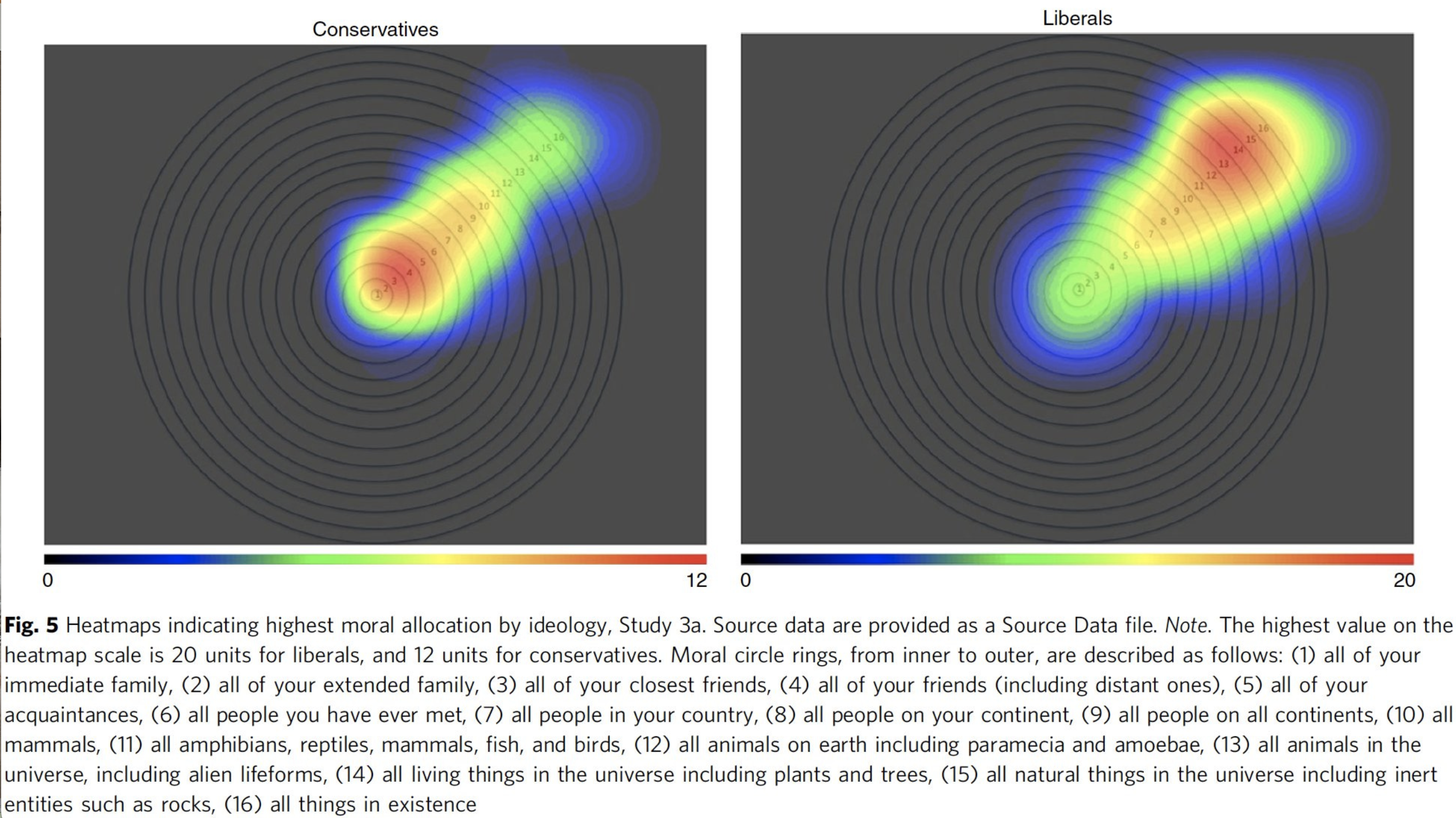
But then this meme started making the rounds of the Internet. And maybe, just maybe, it might not be so impossible. I’m talking about the figure below.
Paper in Nature Communications, Waytz, Iyer, Young and Haidt (Sept. 2019)
My primary critique with Haidt’s work is that he basically just makes up categories with no physical basis, that sound good, and this is no different. But he also is great at intuitive guesses, so at the same time, I do recommend reading him.
What this graph shows is the differentiation between how conservatives and liberals view moral obligation. Conservatives, on average, start closer to home, with more weight placed on people that they know, and then with concern dying out as distance in time and space increases. Liberals are the exact opposite. People adjacent to them accrue no credit for distance minimized, with concerns being projected on people further away, or even things that are often deeply unknowable.
What these folks don’t posit (mostly because they’re academics, and are invested in a low empathy environment, which then conditions their own bias) is that this also clearly demonstrates the potential morality that springs from a combination of independent, empathetic connection, as well as validity grounding — the ability to believe something because you witness it with your own senses. These two things are necessarily confounded (the experiment wasn’t set up to separate them) but you can still see how this plays out.
Short version — some majority of conservatives value a personally collected stream of information more than they do other sources, or experts and their stories. With the exact opposite being true for liberals/progressives. And this creates a profound neural gap between how the two will sort into social structures. Because of this relational divide, conservatives are far more likely to be communitarians than liberals. And liberals are far more likely to sort into elite-governed hierarchies, and be status conscious. You show your level of cool to your liberal pals by being concerned about the politics in West Papua, which you can never really hope to affect. And you can also appreciate how missionaries tend to be conservative. You want people to be saved? You travel and tell them about Jesus.
One can also see how this develops low- and high-responsibility mindsets. You can care about the entire world, but the reality is there’s not much effect you can have on the entire planet. But you can impress others with your virtue, which will then elevate your status in your social hierarchy. Contrast to the conservative viewpoint — you can affect your local environment, let’s say by planting a tree in your downtown, and while the global effect of that action is also unknowable, you can be responsible, and hold yourself accountable for that particular action. You can check on how the tree grows — an exercise in validity grounding –– and then, importantly change your behavior to improve the tree’s thriving. And all the time, you’re really cultivating how your brain processes information.
Since the election of Donald Trump, I’ve had to deal with a spate of attacks and abandonment from many of my liberal friends. This is not pleasant — even for me. Any straying from more and more extreme party orthodoxy means condemnation and alienation. I have picked up some more conservative friends along the way, and honestly enjoyed the development of some very honest and refreshing relationships, often hooked to the social media app X/Twitter. For me at least, these are data-driven — I ‘tweet’ and then people follow me for my ideas. I’m fully aware there is group aggregation in all of this. But as an original content creator, it’s been very refreshing.
The downstream cascade of the isolation the liberal community is actually promulgating is not going to be pretty – for them. Based on purity tests and adherence to orthodoxy, it is inherently relationally disruptive, and as such, prone to being kidnapped by psychopaths, who are far better liars than most of my friends trapped in progressive claques. Because it’s tied to our limbic centers, more people are likely to make snap decisions about which friends to keep or reject. I’ve certainly seen this on Facebook. And worse — if you’re prone to splitting, it ain’t gonna get better.
It’s also disorienting for those same progressives. As more fantastic crimes get dreamt up, the more the liberal mind loses its grip on a more adjacent reality, and the more we see projection of this mindset on conservatives. And that adjacent reality is the thing that creates the world we navigate.
As I’ve noted before, psychopaths always make a big splash up front. But over time, the system manages to find a way to isolate its relational vampires.
Punta Marenco, Costa Rica — Corcovado National Park
I haven’t really written much about the Trump administration since the election. Most of it, quite frankly, because of the derangement of the Left, and unfortunately, in particular, my age cohort (I’m 62.) Upon being told that I voted for Donald Trump, I’ve dealt with long-time friends basically disowning me. And even though I live the life of an oddly functional hermit, I still find it disturbing.
There is an axis of civilization that runs N/S through society, with independently generated, empathy-driven relationships on the north end, and with externally defined, belief-based, and title-driven relationships on the south end. One of the reasons that you make so many friends when you’re young is your neuroplasticity is high, and you have few ingratiated experiences leaving isolated biased tags in your hippocampus, causing you to have limbic withdrawal for nonspecific reasons. As people age, though, most folks do not continue to proceed upward along the path of wisdom, acceptance of metacognition, and a more conscious, questioning and data-driven perspective toward life’s circumstances. Instead, biases become even more rigid, and if you’re not in an environment where you’re encouraged to keep a flexible perspective, mental decline is inevitable.
And so it’s happened with my friend cohort. I have yet to be asked by almost anyone exactly “why” I voted for Trump, among anyone that I’ve known over 10 years. I have my reasons. The Democrats kept a man with a pudding brain in office for four years, and offered up a combo cipher/alcoholic as the replacement, in a midnight coup that turned out to be disastrous for their political fortunes. I voted for the counter-elites I describe in this piece.
But worse were the narratives that the Ds rallied behind. Almost all of these, outside of the typical bland “we’re going to fix the economy” non-specifics, were what I call Collapse Narratives. What is a Collapse Narrative? It’s a governing story that can be detected by a series of factors:
No absolute metrics of any particular policy issue. Everything is relative, and explained in relative terms.
Expectation of the national interest to forfeit any larger sense of self-survival.
Demonization if one protests the myth, instead of consideration of personal interest of any constituency.
Boundary collapse across the psycho-social landscape of a society.
It’s not hard to dissect any of the policies of the Democratic Party along these four lines. Take open-border immigration, and the flood of illegal immigrants into our country. While there were vague discussions of immigration (we need more LEGAL immigration, whatever that meant!) there were never any numbers discussed (#1). Additionally arguments were constantly generated along the lines of allowing more people in, regardless of national origin, because relative to the general population, suspicious figures were floated saying “any immigrants are just better people than the people already here.” Things like the fact that more people add a quantum to your chance of being murdered, raped, or robbed simply didn’t matter. If they weren’t here, your numbers wouldn’t go up.
And subsequent to that is the current war over deportation of various gang members and criminals that are already here. Look folks — if you entered the country illegally, then you are a criminal by definition. But there is quite a gradient even among that crew. The recent procedural doubling down on Juan Abrego Garcia, a domestic violence perpetrator and likely gang member, shows that the Democrats aren’t really interested in having a functional country. All the various cries about “due process” are largely irrelevant, as “due process” as a term means, a la Humpty Dumpty, whatever we want it to mean.
The Democratic goal is derailment of society, building on the efforts already started by the non-functional Biden regime. What is especially laughable is that currently, in our legal system, what is known as “prosecutorial justice” — where a perp strikes a deal with the prosecutor — dominates some 97% of all criminal justice. That means “due process” means someone accusing you, with a modest basis, and then you figure out how you’re going to give in to avoid time in the Big House. It only involves an investigation by police, with the prosecutor’s assent. And that’s for citizens — which is NOT required in immigration law. “Due process” is another Collapse Narrative.
That leads us to #2, which then gets back to some needed sense of cultural homogeneity. Countries can be diverse — but you get to the point where societies have no assimilative power whatsoever. That is inevitably going to lead to conflict among parties, in unexpected ways. I was raised as a Catholic, with a Muslim background (my father was Iranian, but an avowed atheist) — but I have no desire to live in a predominantly Muslim country. Islam has lots of problems that I’m directly familiar with, that I haven’t written about because it would distort a lot of the other information I’m transmitting on this blog. And I can tell you there are reasons that various Islamic countries are societal backwaters.
To even voice these types of observations — that there is a scale we can measure cultures on regarding being better or worse for human flourishing — can rapidly lead to demonization (#3) of the writer. Post-modernism has led us to the point where we see LGBTQ people protesting FOR Palestine as some kind of Promised Land. I can guarantee the idiocy of this level of affinity of self-interest is appalling. I view the current Israeli/Palestinian War as a profound tragedy, for both sides, which is also why I haven’t written about it. But it’s also true that the same constituency screaming against Israel would be rounded up and exterminated by those same people they’re ostensibly attempting to save. It’s just a fact.
I also view the outcome as historically predictable. You fly a bunch of males organized by a neo-medieval government in motorized parawings into a country, who then kill, rape and kidnap 1400 or some odd women and men, you’re asking for total war. The only parallel I can come up with is Arthur “Bomber” Harris in World War II, head of RAF bomber command. Given the job of stopping the Nazis, he was paramount in making a Nazi surrender irrelevant. He did this by functionally leveling literally every German city of a particular size, by fire-bombing them. I absolutely do not condone genocide — but patterns of history repeat themselves.
And getting back to the point — it’s a profound Collapse Narrative when you advocate for people who, given the chance would kill and enslave you.
Finally, looking at #4, boundary collapse is written all over the various Collapse Narratives the Left ascribes to. Men in women’s sports, or bathrooms — talk about a historic removal of sex boundaries. The war in Ukraine — we have nothing to gain by continuing the war, other than loss of national treasure as part of a perverse globalist enterprise. Yet I have many acquaintances that would demonize me if they knew my views. That’s a crazy Collapse Narrative — that our friendship is more worthless to them than a particular In-group view, on a conflict with no geographic resonance, that has absolutely no bearing on our actual relationship.
Organisms, including nations, collapse if they cannot maintain homeostasis and intact boundaries. Every organism alive exists with some combination of flux of nutrients and influences from the outside world, along with the ability to modulate those same inputs. A human being is itself only a modestly 3 dimensional prospect, with a mouth, fractal structures called alveoli in one’s lungs, and an alimentary system for absorbing food. Too much stuff comes in over the boundaries and a person dies. Collapse Narratives demand exceeding those boundary limitations, both biological and psychic.
What’s even worse is that we have an entire elite class championing obvious Collapse Narratives as virtuous. None of the dominant myths used to signal virtue by our elites have any practical benefit to the majority of the population. And they’re directly fraudulent. When Trump’s immigration crackdown commenced, all the major news outlets binged on the notion that vegetables would rot in the fields, and a famine would ensue across the land. Yet every day, going to the grocery store, there was nothing but the usual fresh vegetables available for sale.
On the issue of Trump’s tariffs — an attempted re-balancing of trade, at least with the intention of moving us back from the heavy financialization of our work sector to more manufacturing, the elite class screamed bloody murder. I’d like to think that at least a little of this screaming was rational — tariffs and global trade are an evolutionary system, and interconnections are many, and hidden. But it turned into more screaming that an international order that had benefitted elites was actually what was at stake. The isolation of the professional class from the needs of the working class had been thorough before 2020, and certainly exacerbated by COVID. Populism had been mapped to Nazism in the press. And the resistance toward this was another example of a Collapse Narrative.
One of the most pervasive of the Collapse Narratives has been the very real societal war around mainstreaming transgenderism — especially in youth. California and other Blue states have been famous for going so far to hide childrens’ depression and gender dysphoria away from parents with legitimate guardianship rights. Destroying families is directly advocating for collapse. Families are far from perfect as support mechanisms for individuals. But I can tell you, as someone who only has my immediate children and wife, they’re far better than nothing.
And then there is the issue of men in women’s sports. Democrats, even in the face or realizing how divisive this issue is to the public, constant dissemble on it. “It’s only a few kids,” is the classic riposte. If it’s only a few kids, then why die on that hill? The more I dig into this, the more obvious it becomes that there is a ton of psychopathy behind many of the transgender champions, as well as the champions of the champions. Giving in would mean giving away a powerful tool of disruption of society. And so another Collapse Narrative is born.
Societies are oriented, North/South, along a line that maps to the v-Memes I talk extensively about on this blog. The north end of societies are predicated on cultures that support individual choice, and develop people who are actually capable of handling those individual choices in a responsible, connected fashion. Down at the bottom are non-differentiated Tribal societies, where everyone inside the dominant group are “the people”, and everyone outside is worse than disposable.
You cannot have the current complexity of society without a well-scaffolded stack, because without that, your society has no hope in hell of generating the complex web of information such a society needs to exist. And that stack is based on data-driven, trust based relationships. You have to have scaffolded trust not just for moral values. You actually need it or you can’t support the number of transactions, information and otherwise, to make it happen. Transaction velocity matters, and translates to sophistication of products, as well as diversity and quantity of goods on the shelf.
And the core of that is development of the individual, as what my friend Daniel Goertz calls the “dividual” — the person in context of themselves, and the society.
Collapse Narratives are crafted by psychopaths to undermine that concept — through an advocacy of self- and societally destructive myths that break down an individual and their boundaries and turn them into an organic soup, not unlike what happens to a caterpillar in a chrysalis. But it’s highly unlikely, after the mass killing that actual collapse will entail, that much of a butterfly will pop out.
Ladle Rapid on the Selway River, from another life
One of the things that is exquisitely irritating to me is when people go on about “the truth”. Why? Because the person talking about it usually isn’t in possession of it anyway, and anyone that knows much about a given subject realizes that, for the most part, it’s a scaling problem, in both time and space. Truth at a small scale is too often an inadequate descriptor with truth at a large scale, and if you don’t have any real sense of epistemology (at least if you’re here on this blog, you might be looking for one) you won’t even get there.
And to make things worse, seems like the primary reason anyone brings up “the truth”, as opposed to making the argument, is to gain power and control over someone else. It’s not like they’re really looking to share.
That doesn’t mean that objective truth doesn’t exist. It’s just powerfully difficult to get to, and really depends on how you bound the problem, as well as possess access to the different change processes extant in any given observation. I wrote a whole piece on “truth in information” if you’re interested. Short version of that piece — “truth” is what you use, from an information perspective, to coordinate with your homies. If you take that concept, and meld it to the latest meme — FAFO (fuck around and find out) — you’ve probably got most of what you need. What FAFO really is for those that read my stuff is FAFO is the same as “grounding validity” — some set of experiences that you either create, or get tossed into and endure — that then shows whether your notion of the truth maps to anything in your larger world.
Scientists have all sorts of fancy schemes for FAFO, with lots of other acronyms, like RCTs (random control trials) which are more reliable ways of determining if you found out. Whole fields won’t even permit you to FA (theorize) because inherently, that’s going to replace some old dude’s theory that a certain group is ferociously fond of. So you can’t even get to the FO part of everything, not because you might be wrong. Rather, because you might be right. My favorite example of this was portrayed in the National Geographic series “Genius”, in the sub-series on Albert Einstein. Philipp Lenard, an experimental physicist in Germany (and famous Hitler supporter) was one of the people who condemned Einstein’s various theories as “Jew Physics” and was in part responsible for Einstein leaving Germany and coming to the U.S. where he persuaded Roosevelt to build a nuclear bomb based on his theories. Talk about FO indeed.
OK — I could go on. But let’s do a simple example to understand this truth thing a little. Hopefully, this will show you how it works a little better.
Let’s say we have three scientists at a conference, standing around, drinking the bad coffee one drinks at conferences. These three scientists study gravity. They are typical scientists in The Matrix— not a single hell-raiser like me in the bunch. They exist in a classical Legalistic v-Meme social hierarchy, and as such, they follow rules with their experiments to come to conclusions. What THAT means is they set up complicated, ever-more-precise experiments to study this phenomenon.
How do they do this? Let’s just assume they are highly sophisticated ball-droppers. They drop a ball in one place, and they measure the acceleration of the ball as it speeds toward the ground. The first scientist says to the other two: “Hey, I’ve been studying this phenomena where when we drop a ball, it speeds toward the ground. We’re very diligent and precise in our measurements, and at that place, it seems that the ball accelerates at about 9.8 m/sec*2!”
The other scientist chimes in “well, we’ve been running similar experiments. We carefully calibrated EVERY part of OUR experiment, even buying a bowling ball polisher, and we’ve dropped our balls, and it turns out when we measure the acceleration it’s 9.81 meters/sec*2!”
The third scientist takes a swig of that nasty conference coffee, and says “I’ll bet that if you two stepped outside of your labs, and measured the acceleration of this so-called ‘gravity’ in the downtowns of your respective cities, you’d find out the acceleration of those dropped balls would also be 9.81 meters/sec*2.”
OK. What do the other two scientists, locked in their Legalistic v-Meme social structures say?
“If you want us to believe that, you’re going to have to run another experiment and prove it!”
Of course, we all know that when it comes to gravity, we’re far past that particular point in how physicists understand all of this. There are a host of reasons why (math being one) that this is a kinda-silly example. But it illustrates how an empiricist/experimentalist might approach this situation.
And here’s the point. The knowledge structures that you have access to come out of the social structure where you operate. Legalistic social structures are title- and process-driven, and such, the relationships inside them are low empathy. You are supposed to follow the rules in dealing with someone inside them – that’s the knowledge structure tool you have access to. And that’s going to be dependent on their position in the hierarchy. They MUST know what they’re talking about if they have the title and position they have, and there is a rule-based order to things. And metacognition? Knowing what they don’t know? And especially guessing? That’s an agency-driven ability. You certainly don’t have that. You’re supposed to color within the lines. It’s all spelled out for you on what their rights and privileges are. (Note — anyone wondering why Ketanji Brown Jackson, our most recent Supreme Court Justice, refused to say what a woman is during her confirmation hearing has their answer in her portrayal of a person lacking agency for even basic information. She was stating loud and clear that she was not a legal constructionist. Sheesh, though.)
If you doubt this, listen to any university president conferring degrees on students during this graduation season. “Rights and privileges, rights and privileges” blah blah blah. It’s how the social system operates. Hand over a big wad of cash, and you never have to think again. Except maybe what kind of donut you get to eat. That’s the limits of YOUR agency outside your rights and privileges.
Now here is the devastating insight. Even THESE systems can, through a process of convergence, get to a global truth. In our case (let’s keep it simple) that gravity across the planet pulls toward the center of mass of the Earth, and it accelerates things at ~ 9.81 m/s2. But absent some guiding/binding principle of mathematical physics (if you go back up and look at the knowledge structure necessary for that, it’s all the way up in the Yellow/Turquoise Global Holistic level) the way you’re going to get there is 2-D area covering. In short, you’re gonna unroll the map of the globe, charter a sailing ship and an ATV to take you to a ton of places all around the globe, where you’re going to run your measurement OVER AND OVER.
If you know about fractals, what you’re attempting to do is in the fractal space, you’re using a one-dimensional covering space (a single point gravity measurement) to map a 2D phenomenon – the surface of the Earth (as you’ve defined it.) And for those that know a little about this, is you are NOT using anything resembling a multi-fractal, with different covering capacities, to make your life easier. You’re not throwing a higher-dimensional blanket over the entire globe. You’re plodding along, point by point, at whatever temporal and spatial scale your community lets you. Or you get denied that bad coffee at the next conference, you pariah!
And THOSE scales are directly tied to the social structure (how big of a circle that your gravity measurement applies) and enforced by the membership. You break the rules and say something like “this is an obviously generalizable phenomenon” and people ain’t gonna like it. And now you can bring in all the other structural forcing functions that exist in your social structure that are used. There might be a large contingent of researchers whose sole job it is to traverse the planet, measuring the gravitational constant. They’ve got mouths to feed. This guiding principle shit you might be proposing is moving their cheese. And on and on.
Maybe someone’s concerned that the constant will change over TIME — it’s not just space that matters. What does that do to the measuring business? Might be great! Folks can keep doing this for their ENTIRE career, in more and more sophisticated modalities, adding significant digits along the way. And once you’re locked into a given social structure, where the real incentives are rising in status in the social hierarchy, as opposed to really figuring out what the gravitational constant is (that’s just a bus you’re riding) then supposed boredom really isn’t the issue.
So if you’re a Guiding Principles guy like me (phone home, ET!) what we now have is a way of viewing exactly how a given truth is found — and if it’s a good mechanism. We can look to see if we can construct a model that will provide “covering” for reality in the space. We could ask the researchers if they would create what we call a Concept Map to describe their research in their field. And then we could examine that Concept Map to determine exactly how their brains are working to cover information in their field, and how they’re building truth.
Here’s an example of a low v-Meme, low sophistication concept map. Just FYI — the example I’m going to use to explain this is gonna be simple, because it takes TIME to make these pictures! Let’s start with an airplane.
Top-Level Concept Map for an Airplane
Let’s say we wanted to ground this particular concept map more to reality — we might use photos of a real plane, serving up an example that the author would choose to illustrate the point. That now also tells you about the author of the concept map’s perspective. If someone, for example, worked in Boeing’s structures division, their concept map of an airplane might likely include a dissected Boeing 737. And on and on.
One can also infer how higher order v-Memes might generate increasingly complex concept maps, and start including multidimensional information inside that space. The 2D map tells you precious little about how a plane flies (obviously, we’re all familiar enough with airplanes to know wings are involved) but increased evolution of perspective, as well as sophistication of the person drawing the map, will cover the n-dimensional aspect of the “truth” of an airplane more than the simplistic block diagram above. Around the wings might be air! Or Bernoulli’s equation – the governing physical principle that creates lift, that allows the wings to work. Someone might need to add how an airplane works in the different seasons of the year — hauling holiday travelers during Christmastime, or business travelers during the week. A spatial representation of the globe might be included. And on and on.
What is interesting is doing this with an unprepared audience and seeing what the implicit functioning of that person’s thought process is. I originally did this with students in my mechatronics class a long time (25 or so years ago!) and had them draw a block diagram of a military jet attempting to launch a missile. As impossible as it may seem to be, students would draw some version of a block diagram, maybe giving a block to wings, and a pilot, and a missile. But then they would draw arbitrary connections between the blocks, with what were obviously erroneous connections between the parts. It was one of the “ah-ha” moments when I started understanding that people have to be evolved to consequentiality and higher level coherent thought. I wish I had saved some of the originals. What was fascinating was that students did remember, almost perfectly, little sing-songy stories (one could call them a mnemonic device) on almost everything we covered. Hello, Tribal v-Meme. Once you see how people actually think, v-Meme-wise, you can’t unsee it.
One can also start seeing the need for all the different knowledge structures — and the people that think in them. A highly sophisticated observer might have the ability to sketch an airplane seen on a runway, as part of a spy operation, and then return with that sketch for analysis of the constituent parts. Someone process-oriented might track larger aircraft patterns, and then assign a given agent to show up at the right time to see the aircraft in question. On and on.
But back to the Truth. If there’s a lesson to be learned here, it’s that our brains are going to frame up whatever question we’re asked with the models that are spawned out of the value sets we’re programmed with. That doesn’t mean with the addition of appropriate process, we can’t overcome our perspective. We certainly can. But it behooves us to understand our own minds as we navigate through the world, attempting to find a given truth. It could be hidden in plain sight — but our unlovely minds just might not be able to see it.
One of the terms I bat around occasionally is the concept of ‘memetic war’. But what, exactly, is a memetic war? It’s a great buzzword, for sure. But it’s actually a complicated idea.
A memetic war is a war that occurs in an information space, between information generated by different v-Memes, or meta-value systems that then in turn generate real life social structures — and conflict. Memetic wars can turn into actual wars, when the information generated in the meme-space boils over and grounds itself in reality. The reverse is also true. Real wars can give rise to memetic wars, that then feed back in consequences on the real world battlefield. Information, and its virality can influence who provides real-world materiel and support for the folks actually shooting each other in the trenches.
The memetic war, whose boundaries exist only in the noosphere/information sphere, functions on very different statistical principles and speeds than the real world, because spatial separation is NOT the primary decelerator in it. In fact, the ability of like-minded/like-valued others to find each other in the information sphere allows allies who may have absolutely NO physical connection or grounding (or even specific knowledge!) to join in a conflict. I would remark that the modern age is NOT the first to generate societies that have participated in memetic war. I’d guess that the Crusades might have been the first, with the Children’s Crusade being the best example. But the comment on spatial deceleration still stands.
The first time I used the term was to describe what my now-pals, Jay Bhattacharya and the other Great Barrington Declaration authors were facing from all sides when they proposed focused protection as a strategy to minimize the damage from COVID. I remarked back then (it was October 2020) that they were very likely unprepared for the fall-out, being high-status, extremely intelligent professors from famous universities, used to the power of persuasive argument built on reason. That turned out to be true, but all of them also were quick studies, and are still leading the charge on the information war front for public health to this day.
Since memetic wars run on information, the structure of that information, and the social structure that generates that information, matters greatly. A memetic war based on complex informational structures will have a hard time propagating its ideas. That’s bad news for reason- and evidentiary arguments. They require both the ideas, and the people that transmit them, to be highly developed and robust, as well as operating in their conscious minds. No bueno!
Contrast that to dichotomous emotional appeals. In a world full of strife, these easily map across the minds of people/agents with access to the same communication network. Exactly for this reason, the PRC’s CCP has the Great Firewall across their Internet, and stringent constraints on internal chat systems like WeChat. The leaders of the CCP might have eugenicist tendencies, but they are acutely and intuitively aware of the stage of development of their population, and what an angry mob of Chinese nationals can do. As well as how the Internet can spread this
We are witnessing both a real war, and a memetic war in both Ukraine AND Gaza right now. In the case of Gaza, Hamas regulars staged a real attack, reflecting the pre-medieval value system/v-Memes of fundamentalist Muslims, involving rape, kidnapping and hostage-taking, even going so far as to circulate video of the atrocities. This ran directly counter to more Western v-Meme states, but also due to some belief of decorum as well as obscenity and violence standards, and the video logs of their actions did not virally propagate in any convincing fashion. There’s a crazy-ass lesson there, if you think about it.
Instead, disillusioned Leftist youth, hearing only the top level of the conflict (sans details, folks) and traumatized by their own prophets of apocalyptic despair, turned into the willing memetic receptacles of some belief and longing for a concept of a utopian independent life. Armed with simplistic messages of “From the river to the sea, Palestine must be free!” these memes rapidly propagated across the information space, and turned into real protests, shutting down traffic and airports across the world.
The actual memetic generation functions of the conflict are still intact. Fundamentalist Jewish factions are in part to blame for actions in the real space — I can remember Jewish colonists building kibbutzim INSIDE Gaza, and Benjamin Netanyahu talks about the destruction of his Arab opponents constantly. That meme-plex complements and empowers the high-conflict meme-plex on the Arab side of the aisle. Money matters to reality — both sides have billionaires with essentially medieval v-Meme sets that are more than happy to fund the ideas that have led to the current precipice. And when you add on the almost certain embezzlement of international aid funds into the Hamas treasury from weaponized empathetic fundraising campaigns for refugees, well, you get what we’ve got in that part of the world. It’s just a field day for the psychopathic jet-setting caste. They can eat their caviar, and participate in the craziest LARP they could imagine. All in the name of Allah. Or something.