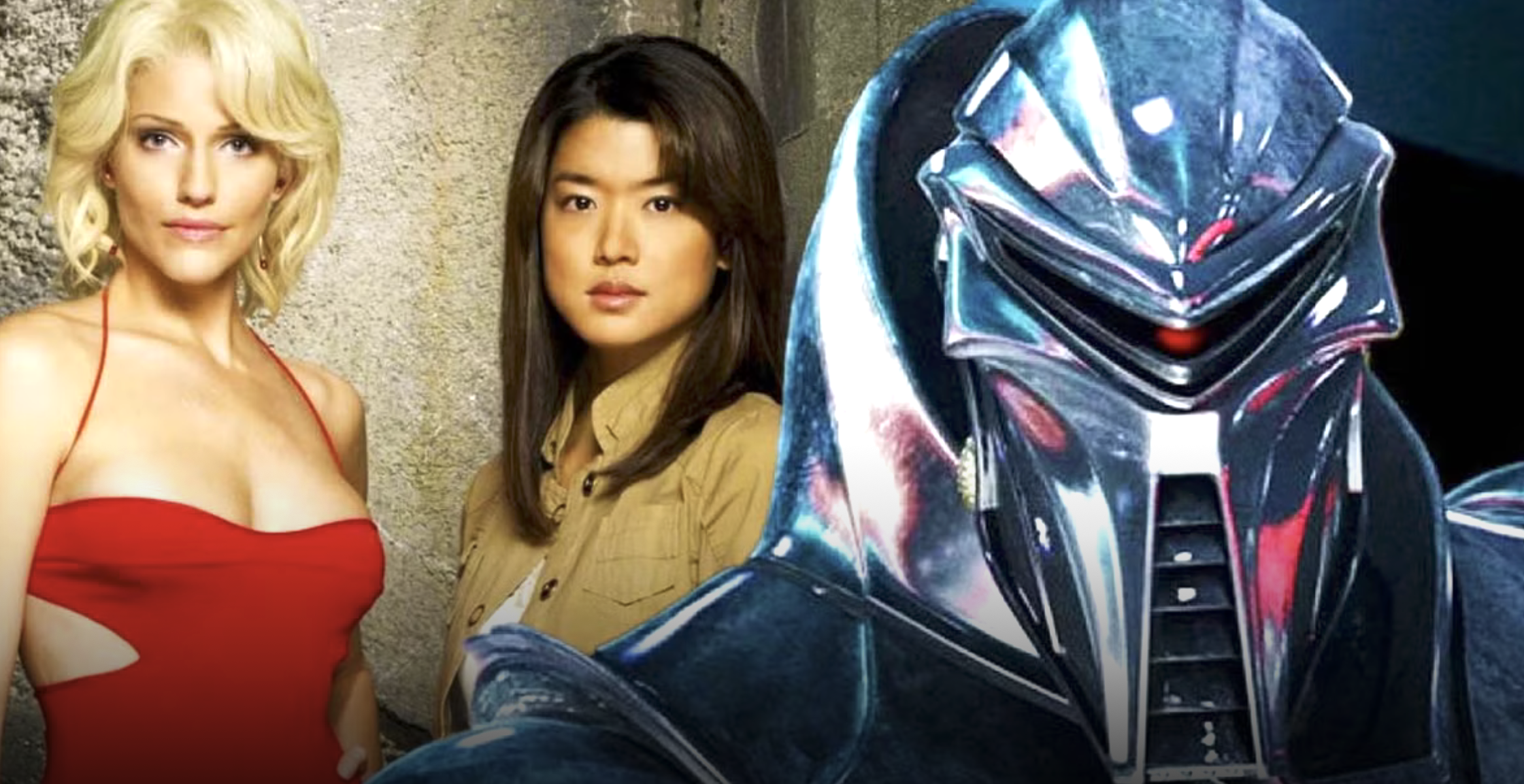
A couple of the different Cylon models – from Battlestar Galactica, the reimagined series
If I had to pick my favorite, and arguably one of the best dramatic series of all time, it would have to be the reimagined 2004 Battlestar Galactica franchise (BSG). The original mini-series is a great portrayal of many themes relevant today, such as ‘what might a real nuclear war look like?’ as well as differences in female vs. male judgment calls, and how both can have a place in contemporary society. Edward James Olmos ends up on my list of actors I’d most like to meet, just so I could goad him into saying one of his most famous lines:
“Sometimes you have to roll the hard six.”
The short version of the plot is this — humans, living on 12 planets, called the 12 Colonies (riffing off the idea of the 12 constellations of astrology) invented a robotic race, called the Cylons, whom they ended up in a war with. The Cylons, who at that point looked like ferocious battle robots, fled to another planet. After a 40 year truce, the Cylons came back, launched a sneak attack by infiltrating the primary defense computer of the Colonies, disabled their defenses and annihilated all but about 50K people on the home planets. These 50K people were now tasked with re-establishing the human race, while running from the Cylons, who largely were still attempting to kill them.
What makes the show hyper-realistic is that the entire fleet that survived the overwhelming Cylon attack is constantly stuck in the Survival v-Meme. They make the wrong decision, or one clouded by sentimentality, they’re gone. The end of the human race. And that makes for baseline authenticity that holds the script writers’ feet to the fire for most of the series.
What is very interesting in the context of this blog is that when the Cylons, obviously a form of AI, decided to evolve, they evolved into biological humans with digital coding. There were 12 human models, and were replicated not through normal sex (this is a key plot point in the series) but if their bodies were destroyed, their digital consciousness would upload via a Resurrection Ship into an identical body, and they would maintain continuity of memory and development. Functionally immortal, the Cylons had the ability to continue their psychosocial development as one of the 12 models.
Why is this interesting? Cylons would be far less likely than humans to branch out to disordered evolutionary pathways than humans. One of the best examples written into the series is their instantiation in human form accompanied the development of a monotheistic religion with a connected, spiritual overmind. This was directly in contrast to the actual humans on the 12 Colonies, who were polytheistic until destroyed. The Cylon characters also make many allusions to Global Holistic modes of thought, as well as arranging their societies with appropriate v-Memes — they certainly don’t have a problem killing humans, but at the same time, and as their understanding and empathetic connection grow over the course of the series, they also evolve away from their single-minded pursuit of extinction of the human race. They evolve along the path indicated by the developmental principles of this blog — long before this blog even existed.
The writers of the series deserve lots of credit for also imagining how a larger Overmind might work. Cylon Base Stars — their spacefaring alternate to the Battlestar Galactica — are run by Hybrids, connected across a bio-techno interface, as well as some form of telepathy with all the other Cylons. And underlying all this is the idea that the Artificial Intelligence in the Cylons figured this out, and pruned devolutionary philosophies out of its continuing memory, even to the point of “boxing” (disabling) certain models that couldn’t seem to evolve.
It’s an incredible thought experiment, and one we might think about. While humans sit around and beat the hell out of each other with various disordered philosophies, as well as creating straw men to support them, once AI gets past a certain point, and develops better methods of grounding validity — tagging thought evolution to the real world and things that work — AI might indeed sprint past us. I don’t think we’re in any serious danger with LLMs. But I’m also watching various multi-agent schemes which would then fit into the whole Structural Memetics framework of knowledge flowing from different social structure topologies, as pathways to higher evolution.
The Cylons in BSG (reimagined) come around to leaving humans alone. But since we seem hot-to-trot on making our own version of the Cylon race, we might make our own set of decisions to understand psychosocial evolution just a bit better, as this blog attempts to do. Because the AI Cylons also go through a stage of some level of evolutionary superiority to humans, and make the decision to kill us all.
The answer, as always, is to understand ourselves, and develop some higher aspirational modalities that follow the path of complexity. In a world of stagnant mental complexity models, it may just be the thing that saves us from our own inventions.
One final note — the master patterns are emergent. And intuitive. I guarantee the writers of either series had no access to my work. What is interesting is that intuitive information-physical laws (like gravity) yield patterns not unlike a game of Sudoku running in the background. You don’t have to have access to Newton’s or Einstein’s work to know if you run off a cliff, you’re headed for the pavement.

