
Note — in this piece, when I use the term “mask” — I’m advocating for homemade masks. I absolutely believe that we should save surgical masks for our health care providers. I’ll make the point below that homemade masks are really good enough for any social distancing situations that Americans will encounter. And as our tech gets better, my bet is that our cloth masks will be almost as good as the disposable varieties. I’m on Rev. 4 of my own mask design, and it’s way better than Rev. 1. I am a design prof., after all.
One of the things I’ve been advocating recently, with the idea of getting back to a New Normal after the COVID-19 pandemic has passed, is the idea that all of us are going to have to wear masks in public — at least until we have some vaccine that works and is widespread. To me, this seems obvious. At the same time, I thought it might help to demonstrate how people “make sense” of things, so you can straighten out your own thoughts.
One of the ways that this debate has NOT been framed is understanding this from a scaling (in time/space) perspective. All our information is based on scales, that we more or less incorporate into our judgments. So let’s start at the bottom.
Back when the HIV/AIDS epidemic was a big deal, there was a large contingent on the Religious Right that was saying, among other things that AIDS was a divine punishment, and that the virus was so small, it could easily fit in the little spaces (interstices) in the rubber in a condom. So… because it fit their moral agenda, they went screaming around saying “condoms won’t protect you!” much in the way we now hear “masks won’t protect you!” Of course, condoms are waterproof, and the vehicle where the virus effectively floated, barring failure, couldn’t get through the impermeable barrier. The argument put forth by the “virus is too small” crowd was a canard.
So let’s slow down and understand this — the fundamental scale argument of virus transmission.
#1 principle of all virus transmission. Viruses live in stuff, and usually that stuff is wet. It may not all be water, but it will contain a good hunk of water. And water comes in lots of different forms. The smallest are called aerosols. Aerosols are typically sized at or under 1 micron (micro-meter). That’s really small, and when something is aerosolized (and viruses can be contained in aerosols) that’s super-fine. Viruses — the coronavirus is sized at something like 125 nano-meters. That means that the coronavirus, being somewhere between 10-100 times smaller can definitely fit in an aerosol particle.
But the fact that you can fit a bunch of viruses inside an aerosol particle doesn’t mean much. Because that particle that’s carrying the virus basically evaporates pretty quickly. And you can run this experiment yourself. Go pull out a can of aerosol-something out of your cupboard and spray it. The finer particles do fly — but they dissipate quickly. So no water. And no medium for viral transmission. Yeah, they can “Kinda” get spread around. But run the experiment with a can of air freshener. And another point –since they are aerosolized, they have less virus in them. That turns out to matter.
Super-small particles can indeed be breathed through something like a cloth facemask — that’s the reason behind the whole N95/N100 rating, which is really about how many particles under about .3 micron they’re guaranteed to remove (if the mask is fitted correctly.) You can see now why the rating exists — if aerosol particles are down there around 1 micron, you ideally would like to have a mask that blocks at about the third the diameter (.3 micron) to be perfectly safe.
But the particle has to also be floating around, or sprayed in your general direction. It’s prone to evaporation. And most of what people cough up ISN’T an aerosol.
It’s droplets. Droplets are more easily formed out of, well, snot, because of a lot of different reasons. Water has a certain “viscosity” (stickiness as a function of density) and snot is, well stickier. What this means is you’re likely to have bigger particles. And now another important factor comes into play.
That factor is called surface tension. Surface tension is the internal fluid static force that makes a drop round. Or kinda round when sticking to a surface. The minute a droplet comes flying across the atmosphere, headed toward your mouth, and hits the surface of your mask, it’s going to have a hard time. It’s not going to have a hard time going through the interstices of the fabric just because of droplet size — that’s part of it. The other part of it is that surface tension comes into play and starts slowing stuff down with the fabric itself. Just like when a droplet lands on a surface and turns into a little semi-bubble, the same physics happen with the snot-droplet that hits the cotton of a mask.
So let’s walk through this. A droplet of snot flies through the atmosphere, headed toward your mask. Viruses are in that droplet, and those little suckers are counting on using that droplet like their own little landing capsule. But it hits the cloth, and the droplet spreads out, and it may be kinda gross, but at least the droplet is not headed down into your respiratory tract, where the virus would like to get to.
What if your homemade mask is kind of open at the top? Well, it is absolutely true, once again, using a simplistic analysis, that the virus, and maybe even the snot droplet is smaller than that little gap in the top of the mask. Your mask will NOT be as effective as a fitted respirator. But the droplet has to hit in exactly the right place on your face to bounce down and get into your mouth. You’ve improved your odds with a facemask. A lot.
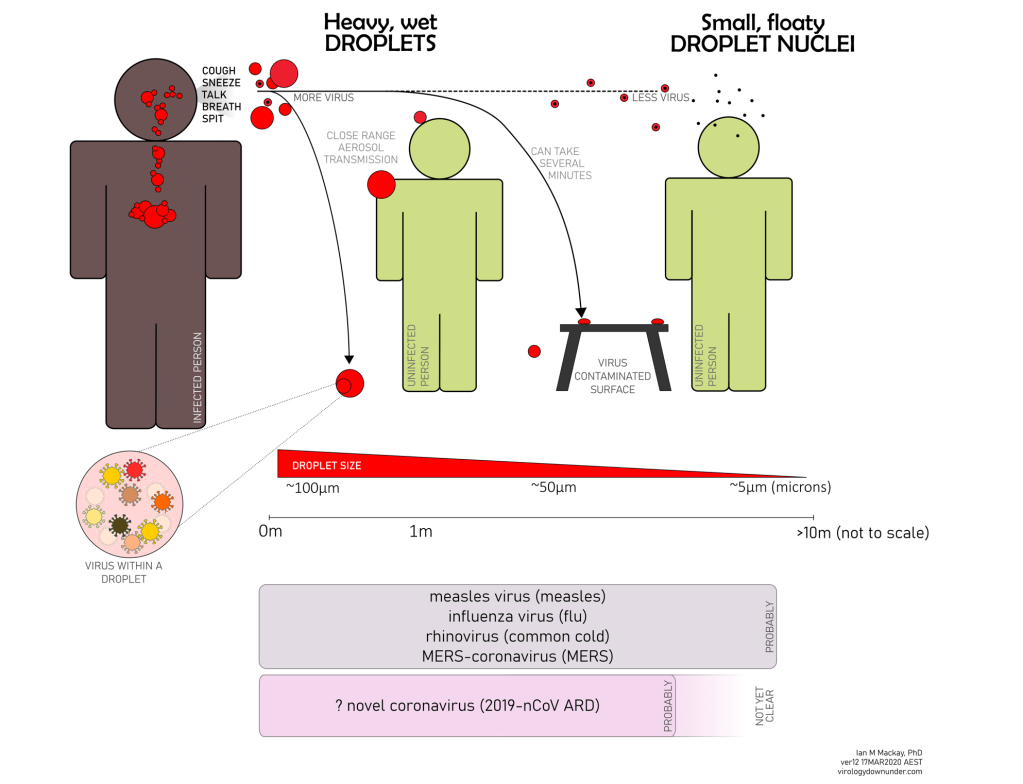
Since the volume of a droplet increases a WHOLE LOT as it gets bigger, (by a cubic power law, since a droplet is essentially a sphere) a droplet can contain a whole lot more viruses than an aerosolized particle. Regardless, if a droplet hits your mask, it may be gross. But it won’t go far. And yes — droplets are persistent, especially when compared to aerosols. But they’re not going to get thrown as far, as fast.
Now we come to what some may find a controversial part of my analysis. It may seem obvious, but how much of the virus gets in you, by my guess, is going to matter. Dose matters. If you get a lot of virus in you — if the dose is large, you’re far more likely to get sick than if you just get a little. This reasoning comes out of my observations of health care providers, who are getting far sicker than many people with exposure. Health care providers seem to be succumbing to the virus at some 2x – 4x the rate of the general population. No one really knows the answer to this question yet, but the short version is that DOSE MATTERS.
This isn’t true with all viruses, but it is with this one, and one that gives us an operative principle that we should follow. LIMIT THE DOSE.
Is there a situation where dose doesn’t matter? Some stuff is so bad-ass, that even if you get a little in you, you’re done. It’s easier seen with toxic substances. Plutonium is a great example. There is no amount of plutonium you can get in your lungs and not get cancer. Polonium seems to be close, and is used in spy vs. spy poison games.
But that’s not COVID-19. COVID-19 seems to be handled just fine by the vast majority of immune systems. Even if the death rate for the actually infected is only 1% (which is millions of victims — I’m not minimizing here!) the reality is that most folks’ immune systems can handle the virus just fine. Or rather, can handle a more standard DOSE of the virus just fine. How that all works is that your immune system can spin up faster than the virus can replicate.
Once again, masks help minimize the dose that someone might get walking around, practicing the 6′ distance recommended for social distancing.
The immediate physics are in the favor of masks. That’s the bottom line.
But humans are fallible creatures. They make mistakes. They pull their masks down. They fiddle. That’s what things with fingers do. How can we understand that?
For that, we have to draw a bigger circle — one that now contains the statistics of an entire population, and then decide if there’s something different between one population and another.
That’s this picture, which is making the rounds.
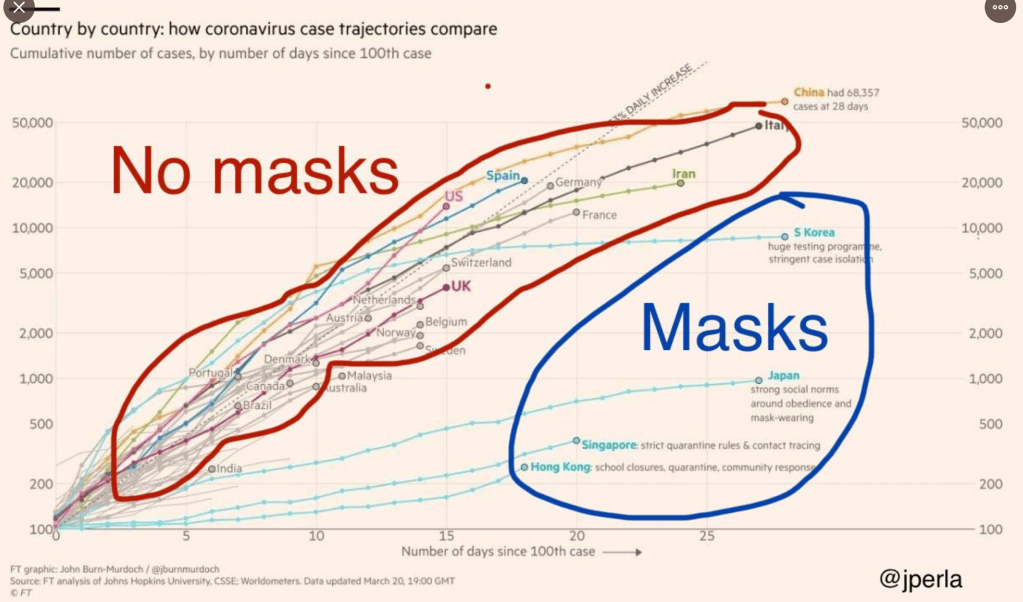
The data plotted on this graph come from an official tabulation of data from Johns Hopkins, by a staff member of the Financial Times, John Burn-Murdoch. He’s their visualization person.
And who is @jperla? From his Twitter page, he’s a former founder and CTO, and an expert in launching and landing UAVs, and a software dude. He drew the circles.
The process that Joseph followed to draw his circles is somewhat unknowable — in my circle, we call this “sensemaking.” He has friends that are epidemiologists, he obviously knows something about the mitigation processes in the different countries. He took all that knowledge, along with past experience and drew those circles.
And unlocked a torrent of action. Some of that action was profound — the President of the Philippines saw that graph and decreed that the whole country should mask up. Other scientists saw that graph, and immediately started arguing for the various exceptions saying that we don’t know FOR SURE that masks were the cause of the success of the reduction in cases.
OK.
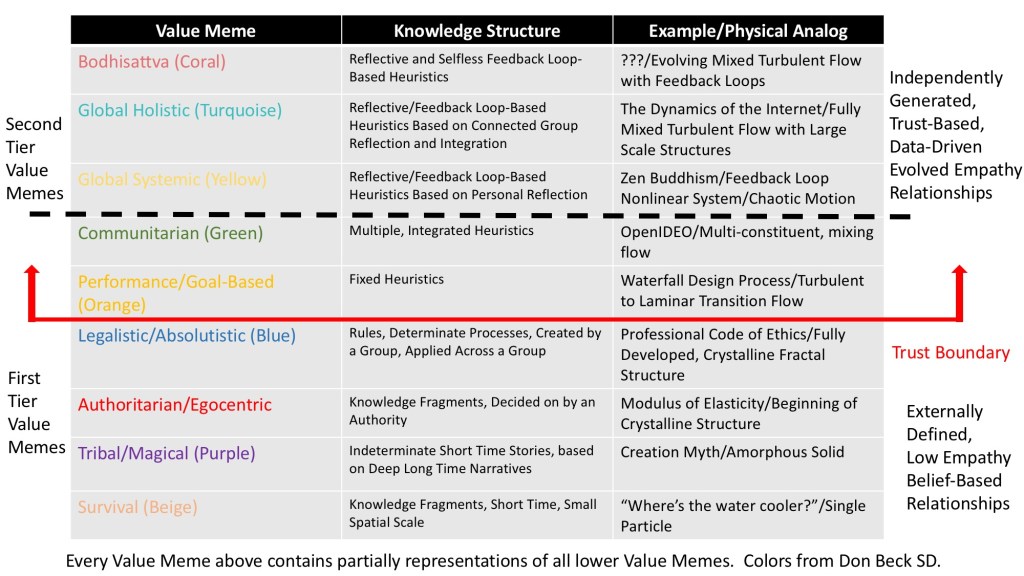
Since this is an explainer, I’m going to hold back on explaining why the various parties think the way they do. There’s much to learn from this particular example on that, how they lock into their various v-Memes and knowledge structures. But I digress.
Why do I believe the figure, and how did I come to the conclusion that we should start wearing masks about the same time as this picture? I honestly didn’t have access to this picture (it came out 10/15) before it went viral.
Here’s why — it is a classic example of a piece of evidence that’s SCAFFOLDED by information on a number of scales. Here we go:
- It “makes sense” for the smallest physics. That’s the lowest scale in play — in the context of interpersonal distance and the basic physics of how membranes/cloth/masks work. It reduces viral dose at that level.
- It makes sense for the physics of human interaction. At 6′, even a cloth mask is going to have a lot easier time cutting down on the mucus someone is spraying from their nose and mouth.
- It makes sense from what I know about societies that have successfully contained COVID-19. I first dialed into the cloth mask argument from my experience with my wife’s original Taiwanese culture, along with what is happening in Japan.
- It makes sense from what we don’t know. It is prudent. Though there are potential downsides from wearing a mask (let’s say you never wash it — it could become a virus sponge over time!) these can, in a public health arena be compensated for with education. We know that dosing matters, but honestly have no idea what specific dosing causes, with variation in immune systems, one to become afflicted. But it follows the Hippocratic Oath — do no harm.
One last thing. Any scientist, if they so desire, can tear apart empirical science like the Masks for All plot. Why? Because empirical, data driven science works best on closed systems, where one can run one system with the hypothesis to be tested, while another system can be run with what we call the “Null Hypothesis”. This is always NOT the case with open systems, like entire societies. And there are literally a bazillion examples where one can argue correlation (what we are doing with the mask plot — looking at two similar trends without experimentally confirming the link) vs. causation.
But scaffolding in causation can be present at smaller scales, and is a good start toward understanding larger, wicked problems — like the COVID-19 outbreak. And the primary thing I look for when deciding to believe any larger epidemiological study. Explain the mechanism, and the scaffolding physics.
And then finally, does it satisfy, in the case of public health, the Hippocratic Oath? I think the answer to that is also “yes”, with appropriate education. So I’m all in. I’m wearing my mask.
Finally — if I’ve made a mistake here — leave a comment, and I’ll fix it. I would love it if my multi-phase flow colleagues would give a more eloquent description of coughing than I do. Multi-phase flow is the engineering term for considering the droplets in air and how they move. My intuition tells me there’s some trade-off between body forces and aerodynamic drag linked to particle size that would actually create an inflection point on particle distance traveled dependent on that nominal size. I’m comfortable with the rest of it (surface tension as a dominant force in diffusion.)
























 It's About Empathy - Connection Ties Us Together