One of the things that I’ve discussed in the context of the COVID-19 epidemic is that it is primarily a disease of our immunosuppressed. That tells you a lot about how we need to view the disease in terms of how it actually works, and how we need to frame our discussion going forward. I’ve been Tweeting about this all week — that viral DOSE matters. Why? Two populations are getting hit pretty hard. One, of course, is the immunosuppressed. But the second is our health care providers. And believe it or not, the physics of what is happening to both groups is remarkably similar.
What matters in the context of viruses like COVID-19 is the viral replication rate, as well as the immune response rate — how fast viruses manage to make themselves (modeled, once again, by the ever-popular exponential curve) and how fast the immune system scales up the various antibodies and white blood cells that form the main line of defense. The fact that multi-celled organisms exist is a sign that we’re better at this in the long run than single-celled organisms, like bacteria, or those super-small strands of encapsulated DNA that make up viruses.
But that’s cold comfort to someone suffering from COVID-19, in a major way.
So let’s break this up into the three cases, and take the broader view of what’s happening.
Case 1 – viral replication rate >> immune response rate
In this case, the body doesn’t stand a chance. You get infected, you’re the perfect petri dish, the virus overwhelms your immune system, and you die. Viruses like Ebola, with potential death rates of 90%, operate under these principles.
Why aren’t there more of these? Well, viruses that do this kill off their host. And unless they can survive living in a buzzard’s gastrointestinal tract, you rot on the ground and that virus is not successful. Humans encounter these types of viruses, they flare up, and then an outbreak ends relatively quickly, because the transmitter is, well, dead.
Case 2 — viral replication rate << immune response rate
In this case the virus doesn’t stand a chance. The poor, hapless virus floats into your system, tries to grab on, and then the immune system reacts/overreacts and pulverizes the virus. Dosage — how much of the virus you get into your system — matters. If you don’t get any kind of dose, you won’t see any kind of symptoms at all, as your mean immune response will likely take care of this in no time at all. This is the kind of thing we see with a common cold, typically a rhinovirus. A few symptoms, followed by a cessation in a day or two. And if the cold isn’t particularly virulent, or you don’t get a big dose, you likely will never know that the virus entered your body.
This kind of virus isn’t a whole lot more successful than the first, as it gets wiped out relatively quickly. It has to have someplace to go hang out until conditions (temps./humidity) are ripe for it to come out again.
Case 3 — viral replication rate ~= immune response rate
This is where things get interesting, and COVID-19 seems to fall into this category. Are there signs (without an intensive study) that this points to? Absolutely. A 5-14 day incubation period, before symptoms are shown, are a sign that the virus is slow to warm up to virile levels. The fact the disease itself runs some equivalent 14 day period is more evidence that there is a triggering that occurs. The fact (as we know it) that the virus kills 1% of its patients (terrible, but not so terrible) or the fact that you can even beat back the virus if you’ve got pneumonia is more evidence.
What this means also is that immunosuppressed people have more of a sliding window of rate with respect to their immune systems, that diminish the immune systems’ rate constant (the exponential factor) and make the infection worse if your immune system is indeed impaired. Not good.
What it also shows it that viral dose matters — how big a hunk of the virus you get into your system from exposure in the first place. That’s why masks matter. And experts are starting to chime in — see this opinion piece in the New York Times by Rabinowitz and Bartman from Princeton, who coincidentally happen to be in chemistry and genomics — not infectious diseases. I’m sure they’re using similar logic. A larger dose means that the virus, in this sliding window world, gets a bigger head start, and so can get to the point in more cases where it can overwhelm health care providers’ immune systems. So if they had some smaller weak point, even if they were younger, they could get knocked out of the fight. Or even die.
Understanding this mental model, though, is still in our favor. Instead of being afraid of sub-microscopic invaders, we can now start using more macroscopic notions, and cross-disciplinary ideas. Radiation and how people handle dosing says “shield the user” and it doesn’t always mean wearing lead-lined clothes. Placing appropriate barriers between people also helps, especially because we know that the virus is droplet-spread. Different jigs in high traffic situations will make a statistical difference. Here’s a great piece on a simple acrylic box that doctors in Taiwan are using during intubation. You can imagine how messy that is, if someone has pneumonia in both lungs.
The other thing that can really help is understanding the need to cycle various health care providers out of front-line exposure roles. There is a whole new playbook that we can use. And we should use it — especially in convincing health care professionals who have not yet been hit at epidemic levels. We need to understand that these populations are people under stress, and likely to be reaching for familiar solutions — “More PPE” which really means “more of what I’m familiar with.” But if those gowns aren’t available, or are even rationed, we need to introduce a deeper understanding, with hopefully some collaborative problem-solving. And as dissemination of novel techniques starts bearing fruit, more will clamor for these different approaches. And we need to be ready to help.
Note — in this piece, when I use the term “mask” — I’m advocating for homemade masks. I absolutely believe that we should save surgical masks for our health care providers. I’ll make the point below that homemade masks are really good enough for any social distancing situations that Americans will encounter. And as our tech gets better, my bet is that our cloth masks will be almost as good as the disposable varieties. I’m on Rev. 4 of my own mask design, and it’s way better than Rev. 1. I am a design prof., after all.
One of the things I’ve been advocating recently, with the idea of getting back to a New Normal after the COVID-19 pandemic has passed, is the idea that all of us are going to have to wear masks in public — at least until we have some vaccine that works and is widespread. To me, this seems obvious. At the same time, I thought it might help to demonstrate how people “make sense” of things, so you can straighten out your own thoughts.
One of the ways that this debate has NOT been framed is understanding this from a scaling (in time/space) perspective. All our information is based on scales, that we more or less incorporate into our judgments. So let’s start at the bottom.
Back when the HIV/AIDS epidemic was a big deal, there was a large contingent on the Religious Right that was saying, among other things that AIDS was a divine punishment, and that the virus was so small, it could easily fit in the little spaces (interstices) in the rubber in a condom. So… because it fit their moral agenda, they went screaming around saying “condoms won’t protect you!” much in the way we now hear “masks won’t protect you!” Of course, condoms are waterproof, and the vehicle where the virus effectively floated, barring failure, couldn’t get through the impermeable barrier. The argument put forth by the “virus is too small” crowd was a canard.
So let’s slow down and understand this — the fundamental scale argument of virus transmission.
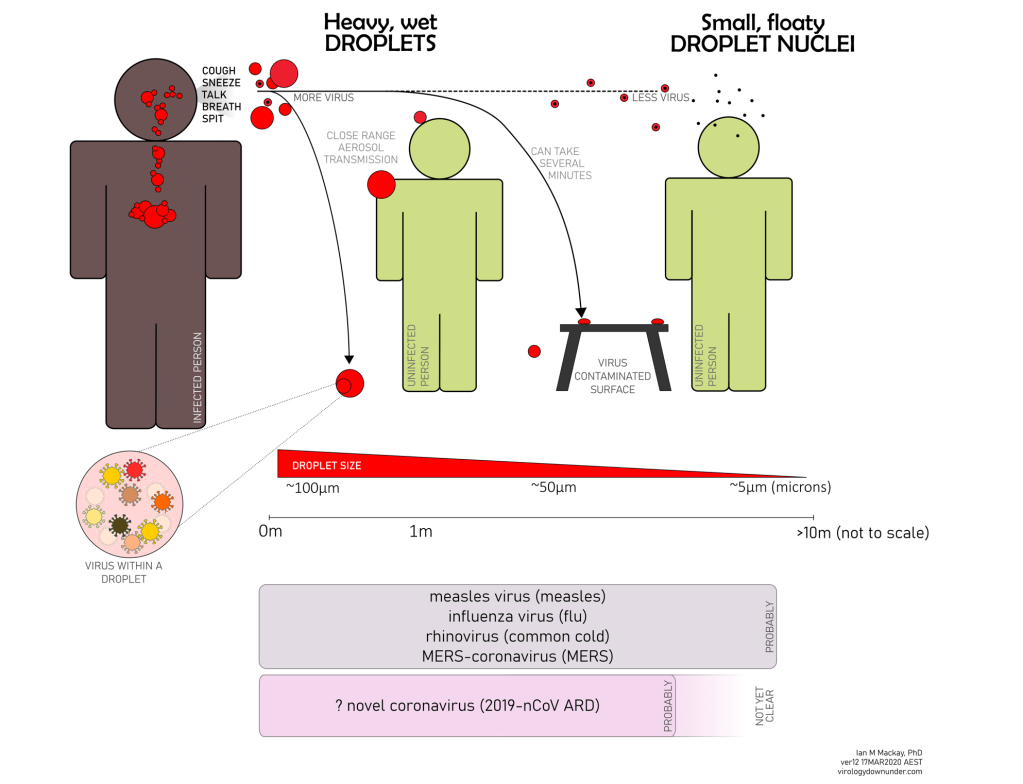
#1 principle of all virus transmission. Viruses live in stuff, and usually that stuff is wet. It may not all be water, but it will contain a good hunk of water. And water comes in lots of different forms. The smallest are called aerosols. Aerosols are typically sized at or under 1 micron (micro-meter). That’s really small, and when something is aerosolized (and viruses can be contained in aerosols) that’s super-fine. Viruses — the coronavirus is sized at something like 125 nano-meters. That means that the coronavirus, being somewhere between 10-100 times smaller can definitely fit in an aerosol particle.
But the fact that you can fit a bunch of viruses inside an aerosol particle doesn’t mean much. Because that particle that’s carrying the virus basically evaporates pretty quickly. And you can run this experiment yourself. Go pull out a can of aerosol-something out of your cupboard and spray it. The finer particles do fly — but they dissipate quickly. So no water. And no medium for viral transmission. Yeah, they can “Kinda” get spread around. But run the experiment with a can of air freshener. And another point –since they are aerosolized, they have less virus in them. That turns out to matter.
Super-small particles can indeed be breathed through something like a cloth facemask — that’s the reason behind the whole N95/N100 rating, which is really about how many particles under about .3 micron they’re guaranteed to remove (if the mask is fitted correctly.) You can see now why the rating exists — if aerosol particles are down there around 1 micron, you ideally would like to have a mask that blocks at about the third the diameter (.3 micron) to be perfectly safe.
But the particle has to also be floating around, or sprayed in your general direction. It’s prone to evaporation. And most of what people cough up ISN’T an aerosol.
It’s droplets. Droplets are more easily formed out of, well, snot, because of a lot of different reasons. Water has a certain “viscosity” (stickiness as a function of density) and snot is, well stickier. What this means is you’re likely to have bigger particles. And now another important factor comes into play.
That factor is called surface tension. Surface tension is the internal fluid static force that makes a drop round. Or kinda round when sticking to a surface. The minute a droplet comes flying across the atmosphere, headed toward your mouth, and hits the surface of your mask, it’s going to have a hard time. It’s not going to have a hard time going through the interstices of the fabric just because of droplet size — that’s part of it. The other part of it is that surface tension comes into play and starts slowing stuff down with the fabric itself. Just like when a droplet lands on a surface and turns into a little semi-bubble, the same physics happen with the snot-droplet that hits the cotton of a mask.
So let’s walk through this. A droplet of snot flies through the atmosphere, headed toward your mask. Viruses are in that droplet, and those little suckers are counting on using that droplet like their own little landing capsule. But it hits the cloth, and the droplet spreads out, and it may be kinda gross, but at least the droplet is not headed down into your respiratory tract, where the virus would like to get to.
What if your homemade mask is kind of open at the top? Well, it is absolutely true, once again, using a simplistic analysis, that the virus, and maybe even the snot droplet is smaller than that little gap in the top of the mask. Your mask will NOT be as effective as a fitted respirator. But the droplet has to hit in exactly the right place on your face to bounce down and get into your mouth. You’ve improved your odds with a facemask. A lot.
Since the volume of a droplet increases a WHOLE LOT as it gets bigger, (by a cubic power law, since a droplet is essentially a sphere) a droplet can contain a whole lot more viruses than an aerosolized particle. Regardless, if a droplet hits your mask, it may be gross. But it won’t go far. And yes — droplets are persistent, especially when compared to aerosols. But they’re not going to get thrown as far, as fast.
Now we come to what some may find a controversial part of my analysis. It may seem obvious, but how much of the virus gets in you, by my guess, is going to matter. Dose matters. If you get a lot of virus in you — if the dose is large, you’re far more likely to get sick than if you just get a little. This reasoning comes out of my observations of health care providers, who are getting far sicker than many people with exposure. Health care providers seem to be succumbing to the virus at some 2x – 4x the rate of the general population. No one really knows the answer to this question yet, but the short version is that DOSE MATTERS.
This isn’t true with all viruses, but it is with this one, and one that gives us an operative principle that we should follow. LIMIT THE DOSE.
Is there a situation where dose doesn’t matter? Some stuff is so bad-ass, that even if you get a little in you, you’re done. It’s easier seen with toxic substances. Plutonium is a great example. There is no amount of plutonium you can get in your lungs and not get cancer. Polonium seems to be close, and is used in spy vs. spy poison games.
But that’s not COVID-19. COVID-19 seems to be handled just fine by the vast majority of immune systems. Even if the death rate for the actually infected is only 1% (which is millions of victims — I’m not minimizing here!) the reality is that most folks’ immune systems can handle the virus just fine. Or rather, can handle a more standard DOSE of the virus just fine. How that all works is that your immune system can spin up faster than the virus can replicate.
Once again, masks help minimize the dose that someone might get walking around, practicing the 6′ distance recommended for social distancing.
The immediate physics are in the favor of masks. That’s the bottom line.
But humans are fallible creatures. They make mistakes. They pull their masks down. They fiddle. That’s what things with fingers do. How can we understand that?
For that, we have to draw a bigger circle — one that now contains the statistics of an entire population, and then decide if there’s something different between one population and another.
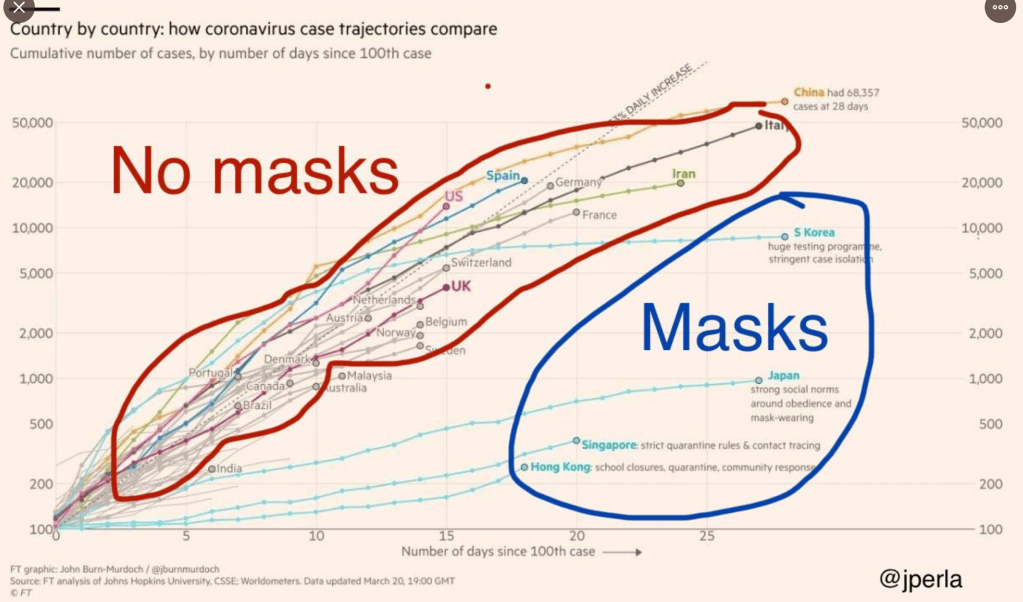
That’s this picture, which is making the rounds.
The data is from Johns Hopkins, the circles are from @jperla
The data plotted on this graph come from an official tabulation of data from Johns Hopkins, by a staff member of the Financial Times, John Burn-Murdoch. He’s their visualization person.
And who is @jperla? From his Twitter page, he’s a former founder and CTO, and an expert in launching and landing UAVs, and a software dude. He drew the circles.
The process that Joseph followed to draw his circles is somewhat unknowable — in my circle, we call this “sensemaking.” He has friends that are epidemiologists, he obviously knows something about the mitigation processes in the different countries. He took all that knowledge, along with past experience and drew those circles.
And unlocked a torrent of action. Some of that action was profound — the President of the Philippines saw that graph and decreed that the whole country should mask up. Other scientists saw that graph, and immediately started arguing for the various exceptions saying that we don’t know FOR SURE that masks were the cause of the success of the reduction in cases.
OK.
Since this is an explainer, I’m going to hold back on explaining why the various parties think the way they do. There’s much to learn from this particular example on that, how they lock into their various v-Memes and knowledge structures. But I digress.
Why do I believe the figure, and how did I come to the conclusion that we should start wearing masks about the same time as this picture? I honestly didn’t have access to this picture (it came out 10/15) before it went viral.
Here’s why — it is a classic example of a piece of evidence that’s SCAFFOLDED by information on a number of scales. Here we go:
It “makes sense” for the smallest physics. That’s the lowest scale in play — in the context of interpersonal distance and the basic physics of how membranes/cloth/masks work. It reduces viral dose at that level.
It makes sense for the physics of human interaction. At 6′, even a cloth mask is going to have a lot easier time cutting down on the mucus someone is spraying from their nose and mouth.
It makes sense from what I know about societies that have successfully contained COVID-19. I first dialed into the cloth mask argument from my experience with my wife’s original Taiwanese culture, along with what is happening in Japan.
It makes sense from what we don’t know. It is prudent. Though there are potential downsides from wearing a mask (let’s say you never wash it — it could become a virus sponge over time!) these can, in a public health arena be compensated for with education. We know that dosing matters, but honestly have no idea what specific dosing causes, with variation in immune systems, one to become afflicted. But it follows the Hippocratic Oath — do no harm.
One last thing. Any scientist, if they so desire, can tear apart empirical science like the Masks for All plot. Why? Because empirical, data driven science works best on closed systems, where one can run one system with the hypothesis to be tested, while another system can be run with what we call the “Null Hypothesis”. This is always NOT the case with open systems, like entire societies. And there are literally a bazillion examples where one can argue correlation (what we are doing with the mask plot — looking at two similar trends without experimentally confirming the link) vs. causation.
But scaffolding in causation can be present at smaller scales, and is a good start toward understanding larger, wicked problems — like the COVID-19 outbreak. And the primary thing I look for when deciding to believe any larger epidemiological study. Explain the mechanism, and the scaffolding physics.
And then finally, does it satisfy, in the case of public health, the Hippocratic Oath? I think the answer to that is also “yes”, with appropriate education. So I’m all in. I’m wearing my mask.
Finally — if I’ve made a mistake here — leave a comment, and I’ll fix it. I would love it if my multi-phase flow colleagues would give a more eloquent description of coughing than I do. Multi-phase flow is the engineering term for considering the droplets in air and how they move. My intuition tells me there’s some trade-off between body forces and aerodynamic drag linked to particle size that would actually create an inflection point on particle distance traveled dependent on that nominal size. I’m comfortable with the rest of it (surface tension as a dominant force in diffusion.)
One of the fascinating (sometimes pathologically) things about the COVID-19 epidemic is that because it demands information exchange among superficially diverse (but v-memetically similar) population groups, one gets to see the information dynamics of various societies (which are actually far more homogeneous) in play. There’s also some element of hypervigilance in all of this, as everyone in a given society, at this point, is aware that there is a virus out there, and it might affect them. What THAT does is eliminate sloppy adherence to cultural sidebars that may come from value sets/v-Memes. You show your true value set hand because crisis creates focus.
So it is in the small community I occupy as well. From a material perspective (Pullman is a college town) we really aren’t suffering much during this pandemic. There are still sales on steak in the Safeway, and aside from the toilet paper craziness (and paper towel craziness — I still can’t buy a napkin!) you’d never know we were even in a crisis. Sure, the streets are a little more deserted. The students, by and large, are not here. But that happens every summer, and for someone that’s lived in this community for 32 years, it’s amazing to live in a city with infrastructure for 35K people, and only have 10K people show up. No dystopian nightmares for me.
The local folks that live here year-round are not stupid. But they are mostly conservative. All college towns like to think of themselves as “liberal” — and it’s not like political alignment means a ton in the land of value sets/v-Memes. But our town has, depending on how you count them, at least three Christian mega-churches. Moscow, ID, next door, once again dependent on how you count them, has at least three, as well as a medium-size Full Bible Christian college, founded by a champion of the revival of the Confederacy and slavery.
Even the liberals are mostly lower v-Meme actors. Professors and various technical staff, enshrined in the two state universities, are pretty Legalistic v-Meme in their processing. The natural tendency of my Spiral Dynamics community would be to call them Communitarians, and some, even from a knowledge structure position, are. But it’s probably more fair to call them Legalistic Hippies. There’s a tight dress code, and set of political views most ascribe to. We might be a pretty politically correct community. But we’re still low empathy.
So it’s been super-interesting to watch people in the community’s response just to my moving about. When I go out, I wear a mask all the time now. I do this because, as I’ve written before, I believe in exercising the Precautionary Principle, which is, in short, analyze the situation and maintain a positive outlook, but act as if catastrophe is at your door.
In the face of actual data, it’s the prudent thing to do. COVID-19 testing has been nothing short of embarrassing in our community. And I live under the flight path of Alaska Airline’s five continuing flights from Seattle, which is a declared hotspot. Seattle was definitely one of the entry points for the virus, and students, even though it’s a five hour drive away, have always had a subset that went home and returned on the weekend. My belief, as I taught my classes and watched students slowly drop out, as well as stare at me dumbfounded as I taught them social distancing, is that this community was likely a saturated community, at least at the university level at the beginning of the pandemic.
It may be true that there will be a second wave of infections — just like the Spring Break crowd in Florida, our students evacuated en masse at both the start and end of Spring break, taking whatever they picked up here, with their exuberant conviviality, back to the Puget Sound. That probably has put a huge damper on the number of severe cases, and as such, lowered the level of awareness in this community. But old people in the Safeway, even though they have access to special shopping hours, go through their daily routines, as well as the cashiers, like nothing is amiss. It’s just life as usual.
Until I show up with my mask. Wearing a mask, in their minds, doesn’t label me as prudent. It labels me as infected. No other normal white folks are wearing masks — at all. So people look away. I had a mother with a teenage daughter point at me in the grocery yesterday, and sidle and move quickly past the mushrooms, as I held my 6′ social distancing. I stopped by our local building supply store, and the clerks, always affable, are more than happy to let me bag my own products. After an initial set of rumblings toward our Asian students, who largely started wearing masks at the beginning of all this — WSU-Pullman has a large Chinese student population, both graduate and undergraduate (around 1300 IIRC) — their garb is now considered culturally appropriate. But not so much for a big White Guy.
What it does is illustrate the Authority-driven mindset of the community. From a knowledge structure perspective, there’s a one-one knowledge fragment mapping that happens when they see me wearing a mask. It goes like this: he’s wearing a mask; so therefore, he must be sick. The Precautionary Principle is a higher level of complexity, inherently an inverse transformation, with time-dependent consequentiality, and as such, requires a higher active, automatic v-Meme. “I’m wearing a mask because I don’t want to get sick,” or even higher “I’m wearing a mask so others, especially old people don’t get sick” is just meaningless.
Even when explained, people can’t get over it — because of the fear factor of a Big White Guy wearing a mask in the first place. Trust me — no one comes up and pays me a compliment for my foresight, or modeling what is actually prosocial behavior. Because foresight, in my position in the community, is not particularly appreciated. William Gibson, who famously said “The future is already here — it’s just unevenly distributed,” would not be welcomed in Pullman. At least in the context of me and my mask.
This type of one-one thinking isn’t constrained just to the working folks. One can look at testing strategies for COVID-19 in this community, and the authority-driven nature of the protocols pop out. Though, once again, we likely have a high probability of exposure to asymptomatic cases (young people are not showing symptoms, especially severe ones, nearly as often as immunosuppressed and older populations), so tests are reserved for people showing dramatic symptoms. Though, as the storm advances, we’re seeing a rapid evolution in our health care community, this is also authority-driven behavior. We have had no vaccine, nor medication, for treating the disease.
So inherently, we treat the symptoms. Knowing whether or not someone has COVID-19 really only benefits the authority system – or deeper into the reality of it all, is arbitrary. I ABSOLUTELY DO NOT accuse our health care providers of any malfeasance. I think they’re in a very tight spot. But what it does show is how they think. It’s that one-one mapping thing. If symptoms are already severe, there’s a very limited benefit to consequential planning for the larger community from testing someone. On the other hand, their options are severely proscribed. And there’s nothing like the wolf at your door to rapidly evolve your connected thinking. Here’s hoping that it does.
Unfortunately, the authority-driven mindset reduces our ability to get ahead of the pandemic. The notion that we might mirror communities or nations around the globe never crosses our mind. Japan, with halting steps, and imperfect culture itself, is getting back to normal with people wearing masks, though without the wide-scale testing many epidemiologists think is really necessary. Taiwan and Singapore, with their en pointe quarantine strategies, are, through a combination of individual tracking and visitor quarantine staying ahead of the pandemic. In Taiwan, you have to wait two weeks self-quarantined in a hotel room before you’re allowed to circulate. And if you go outside with your GPS-mandatory cell phone in your pocket, the alarms go off and the Taiwanese police will chase you down.
What’s interesting is that COVID-19 is actually giving a lesson to the world in Complex Thinking 101. We know the source of our illness — it’s a microscopic virus, whose entire identity has been sourced and DNA mapped. It’s one little crack in a world that took advantage of a vast transmission system — our air transport network — to spread maximally to every corner of the globe, in a little over a month. The fact that there are both big and small ripples from that initial hijacking should cause us to shift our mindsets. We can do that by drawing larger system boundaries around all our various loci of contact — hospitals for sure, but grocery stores, gas stations, and the like — and ask how one might affect the other. And how that might affect something else. We have to practice the thinking we need.
But first, we have to realize the thinking we actually have — which, sadly, is poorly consequential, fragmented, and mostly egocentric. Like Donald Rumsfeld so infamously said, “You go to war with the Army you have — not the Army you might wish you have.” And the condition of that Army is shown not just by the heroes and heroines on the medical front lines. It’s also shown by the couple in their 60s eating fish tank cleaner, because they saw it contained chloroquine in it, which Donald Trump had endorsed as a new cure in a press conference. An extreme example of authority-driven mindset for sure — and the husband in the pair paid the ultimate price. But also a signal to consider, especially when this crisis passes. If COVID-19 is an opportunity for Complex Systems 101, fixing Anthropogenic Global Warming is an advanced degree. And we’re going to need that kind of thinking going forward. Because Authority-driven knowledge structures are not even up to snuff for the novel coronavirus. And there are a whole lot more courses, even besides AGM, for which the universe has scheduled us up.
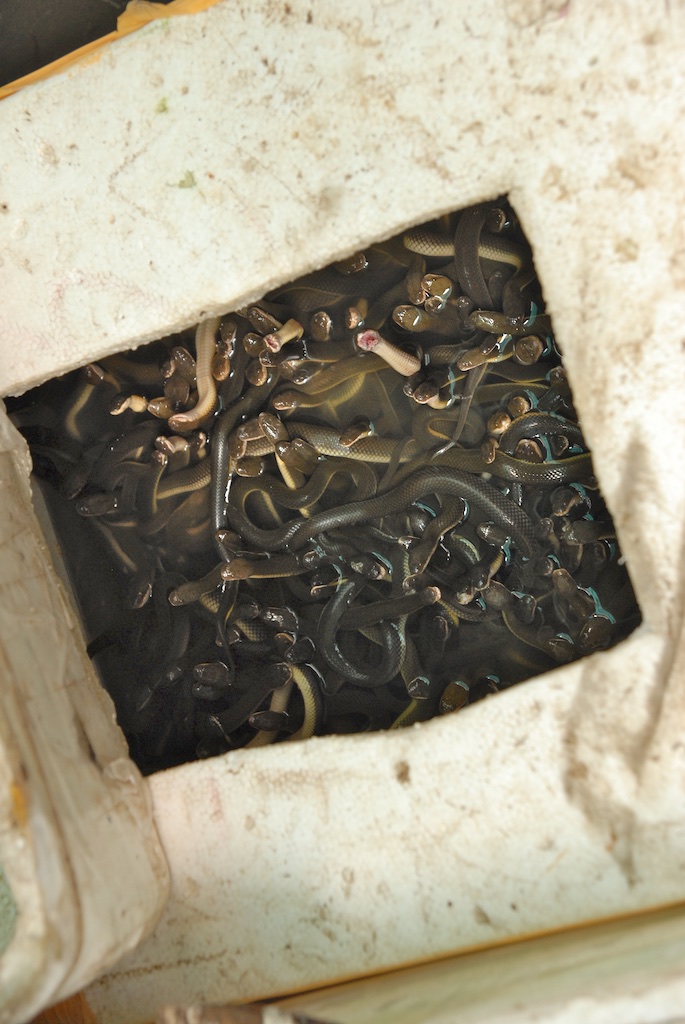
One of my favorite signs – Yangshuo, CN — no cobras, dynamite, or sulfuric acid on the bus!
As I’ve covered in my past posts on COVID-19, the main thing governing cumulative mortality at the current time is lack of ventilator (and to a lesser extent, bed) capacity IF you get admitted to the hospital. We don’t have a vaccine, we have no (as of today) effective treatments, though news reports are now coming in of anti-viral medications that might work. So ventilator capacity, and not having hospitals overwhelmed, is how we have to manage this pandemic.
America does have a tool to rapidly gear up production of equipment in the case of a national emergency — it’s called the Defense Production Act. It was passed during the Korean War, and gives the President a broad array of powers to require manufacturers to pivot to supplying critical materiel in the interest of national security. It does what you’d think it does — makes it so people can’t hoard critical materials, and allows the government to direct companies to make stuff.
Yet as of this date and time, while Trump has talked about this, he hasn’t invoked it. This is mystifying a lot of people on social media (Twitter and Facebook) — why wouldn’t he do that?
As a narcissistic psychopath/collapsed egocentric, Trump lives in his own fuzzy bubble, where his belief system defines reality. To the extent that reality interferes in his belief system, what I call validity grounding, which is the thing that inevitably gets all Authoritarians, Trump operates inside his own mind — because his pathologies don’t allow distinct boundaries between his own mind and the outside world. It’s all about him, after all. Others only exist in a magical framework.
Trump, instead, has asked various companies to pivot and step up with supplies – and insists that they are. As of this date and time, I have heard that various companies are going to start making ventilator parts, and some people have started 3D printing parts. In Italy, Ferrari and Fiat have said they will start making parts. But making ventilators, or even gowns is not simple on such a short timescale. And a lack of directed efforts wastes time.
But nothing matters to Trump, until some critical mass of an ever-shrinking pool of influencers manage to ground him. And if he did implement the act proactively, it would be a damning condemnation to his inner ethos. He simply can’t — it’s a law, after all, and Trump has been insisting that laws are the problem. It’s only when his own survival is threaten that he will borrow from that higher v-Meme/value set to accomplish his ends.
The problem with all of this is that Trump’s mind exists largely in a time-invariant world. Nothing changes in the external world until his mind changes. And that is always a jump, followed by an erasure of history of the other mindset.
But this challenge is inherently dependent on varying timescales. Notions like Flattening the Curve require the population to, at least a little, comprehend temporal variation. Yes, there is a part of the population that requires do/do not mandates — but others can start the process of comprehension of the mechanism for these edicts.
The upshot? Trump will change his mind — when his own survival is threatened. Days will be lost in the process, and it will affect the outcomes in hospitals if the pandemic doesn’t slow down. But don’t hold your breath. Wait for an event.
The Creek – Dubai – loading the dhow for the transit across the Persian Gulf to Iran
One of the most interesting things about thinking through the COVID-19 epidemic is understanding the statistics, and what is the deep meaning they are attempting to tell us. Information comes, of course, in the form of data — testing (which doesn’t tell us much for most countries,) fatalities, which sadly tell us more. Hospital overwhelm, of course, tells us something profound about our medical facilities capacity for this epidemic, but is largely inconclusive as well.
Still statistics don’t sit alone. The world works in a coherent fashion, regardless if it’s in our favor or not. There is a larger coherence present in understanding how eating a bat in Wuhan may generate chaos across the globe, when coupled with a highly efficient air transport system and a 5 day incubation period.
So it is VERY interesting to realize that some of the estimates of asymptomatic COVID-19 are around 18%. These people can be then responsible for close to 50% of infections. There’s also no good numbers on mild infections. This piece says 66%. When you add those two super-rough guesses together, you get around 85% of folks whose immune systems are more than up to the task of handling this bug.
What this says, though, is that 15% of the population’s immune systems are NOT up to handling the bug. And the laundry list of folks with the problems are diabetics, the elderly and whatnot.
Why does this matter? A disease like Ebola ranges from 25%-90% mortality. That means there is far less ability for our immune system to handle the disease. You get it, you die, though there is much to mine in the overall wellbeing of the African countries where Ebola has appeared. Contrast that with the 1% COVID-19 estimated fatality rate.
What this tells me is that this is a killer disease of the immunosuppressed. And a good hunk of that is driven by a combo of diet and aging. That ought to be something that we study in the future. Are we compromising our long-term health with our crummy diet? I surely think so. There will always be overlap in distributions, but when we have an obesity/overweight ratio hovering around 66%, we need to start asking ourselves what the concentrated effects of sugar and refined carbs is doing to wrecking our health. And preparing us for the next pandemic.
PS (3/21/2020) This article popped up on Buzzfeed re: Iceland. Iceland is (not surprisingly) testing 50% asymptomatic cases, and they have a whole island to run a fascinating experiment on. Which means more evidence that people who are immunocompromised, from air pollution, or diet, or illness, are really the ones we need to worry about. This will be a crazy Big Data study for the coming years.
PPS (3/23/2020) This article popped up about advocacy from the American Diabetes Association advocating special consideration from the federal government for diabetes sufferers.
What’s great about this is that a group like this can serve as a future demographic sensor when figuring out in the medium term what groups were truly affected by the virus. Diabetes is well-known as a metabolic and immunosuppressive source. I’ll be watching.
I’ve written about understanding the Asymptomatic cases here, but since we can’t have any real data on actual infection rates considering the generalized population for a while, I think it is important to understand how to make decisions with the data that we have in the short term. Insofar as what can be done, I’m all about “flattening the curve” and such. Whether one understands it completely or not, trust me — it’s the right thing to do. Let’s understand why, with the information we know.
COVID-19 is a new disease. There are no treatments for it. The body must live or die in producing its own immunity.
There currently is no vaccine for COVID-19. Any prior immunity is poorly understood, and information is starting to just emerge on long-term immunity. Evidence coming in shows typical virus immunity does indeed occur. This matters in the long run, and can affect the decisions we make now, but not by much.
The way people die from COVID-19 is respiratory failure. It is a SARS virus (Severe Acute Respiratory Syndrome).
The main reason for respiratory failure (not completely preventable) is poor treatment, and hospital’s overrun in ventilator capacity.
The pandemic will continue until treatments and a vaccine come into play, or until herd immunity takes hold. The time to do that depends on the degree of localization we can successfully practice. Localization ranges in scale from things like lockdowns, to individual detection. This lengthens the timescale of the pandemic, lessening the short-term impact, and giving the society time to find a vaccine or effective treatments.
So what we can now understand is that in the short-term, the main reason for deaths is, and will continue to be, a lack of pandemic preparedness signified mostly by a lack of ventilators. It may be that the actual death rate from the disease is < 1% in the long run, which is still 10X the flu. But the real problem IN THE PRESENT is that our hospital system, instead of preparing for the potentials of outbreak viruses, has optimized medical care around two factors. These are:
Winning the Medical Arms Race with other facilities — more treatments, often offered competitively, that are high-status and make the hospital look better relative to its peers (buying another PET scanner instead of coordinating use with another hospital close by.)
Minimizing extraneous costs (like managing Just-In-Time supply dynamics) for a better bottom line, in part because of pressure from insurers. This McKinsey-esque crunch across our entire economy is driven by the need to return ever-higher returns to shareholders in the short term, and among other things, has killed innovation.
I’m not really into the blame game, as much as I am into understanding the structural memetic dynamics of the current situation. What we are seeing, however, is an expression of the lack of empathetic development of many of our core systems. And the deeper problem with that is the ancillary collapse of consequential thinking because of that lack of development. Authority/Status-driven systems suck at thinking in terms of long-term consequences — we’re seeing the effects of that right now — because status is whatever the equivalent Louis Vuitton handbag equivalent is in the medical profession. And it is intrinsically coupled to following the crowd, or whoever the highest-status institution/person is in the crowd. It is IRRATIONAL — based on limited data, and insulated from grounding consequences in the surrounding environment.
What happens when you take an Authoritarian/Legalistic social structure, and you starve it is exactly what we’re seeing in our hospital system right now. You have shortages of key items necessary for care above any legally mandated baseline. You have no reserve capacity for anything resembling an epidemic. You have no training for people to anticipate these kinds of things. It’s unsexy to have a container full of masks that you may never use. But, as we can see, that’s exactly the kind of thinking that would prevent a higher death rate from the current crisis.
And smaller countries, like Taiwan, are showing that having that “crisis insurance” mentality, saves lives and money. Taiwan knew something was up the minute a cluster of pneumonia cases showed up in Wuhan. They kicked into high gear immediately and sent a team there. 99% of Taiwanese covered by health insurance shows an empathetic foundation for a society — I covered the success of Taiwan in this piece. It shows how empathetic, geeky, non-narcissistic leadership actually had the correct consequential thinking that managed the initial outbreak, and will now contain the small resurgence that is coming as the Taiwanese elite (also high-status, low empathy) fled the island, and then started returning home.
And because their relational network was large — many Taiwanese work in China, and have no illusions about their narcissistic Authoritarian neighbor — they knew they’d be connected. That’s the deep power of empathetic development. The Wuhan outbreak was NOT a Black Swan for them. It was an event that happened. Read this piece to understand the dynamics.
What does all this mean? It is time to understand and modify the DeepOS of our hospital system. And the only way to do this is to understand that the current Authoritarian/Legalistic hierarchy that drives administrations, as well as physicians’ personal development has to change. If we don’t change, we shouldn’t expect any different long-term outcomes. We have to create a new medical system focused on wellness, and getting people OFF of drugs — that part is easily said. Understanding that it will require a re-thinking of social structure to create the thinkers we need will be the challenging part. Why? Because to understand the demands of complexity requires complexity in thinking to start. It’s a killer chicken-and-egg problem.
We can start at the bottom. When was the last time you knew that doctors and nurses engaged in an empathy circle? Or doctors and patients? What about understanding how nutrition affects health, and the development of support groups for people of all stripes? What about more forgiveness of student loans for nurses, and doctors, so they don’t have the pressure to move so many people through the system? There are other avenues and decisions to be made. They must be made, though, in maximizing the empathy development of the people involved — because those rewired brains, along with a radically different social network, will be the things that actually figure out the right thing to do.
I’ll wrap it up here. Here is a key point. We SHOULD have national health insurance. It is a necessary first step. But national health insurance/single payer did not stop this epidemic in countries that had it, and some of those countries (like Great Britain) are literally hurtling into the abyss through a series of Pollyanna thinking, and the same lack of consequential thinking present in our own system. The social structure may be somewhat different, but obviously is NOT different enough.
By doing this — realizing our problems, working on top-level solutions, like stockpiling medical supplies and developing individual identification, along with focusing on activities that develop empathy in the health care system, we will create the people to anticipate uncertainty. By evolving the people, we will create the pretext for the emergent future that will stop these pandemics. You have to trust in the social physics. We can’t know what we don’t know. But we can create the people, out there on the front lines, to be our early warning system.
And yeah — it’s all about empathy.
Postscript — there is a whole post to be written about very specific target areas in people’s bodies around the idea of loosely coupled/tightly coupled physical systems inside our bodies, and how management of pandemics needs to be centered around the tightly coupled systems. Respiratory systems are prone to causing mortality through failure because they are, intrinsically, tightly coupled inside our bodies. Gastrointestinal failure is less tightly coupled. If this intrinsically makes sense to you, then enjoy the brain candy!
There’s a story associated with the above picture that is insightful and funny, and interestingly relevant in these times.
I was in China, spending time in the Pearl River Delta, where I was visiting various factories in Shenzhen and Dongguan, in an attempt to understand manufacturing changes in China. I decided I also wanted to visit rural China, so I could better understand the demographic changes happening across the country, to understand why people would move to the Pearl River Delta. I had a talk to give in Guilin, which is famous for the upright karst formations and the Lijiang River.
Countryside outside GuilinLijiang River — note construction cranes on the edge of this scene
So my guide and I went to Guilin, and planned a side trip to Longji (The Dragon’s Back), in the mountains, famous for its terraced rice paddies. Longji is also in the heart of the Zhuang ethnic minority, people who do not identify as Han Chinese, the dominant ethnic group in China.
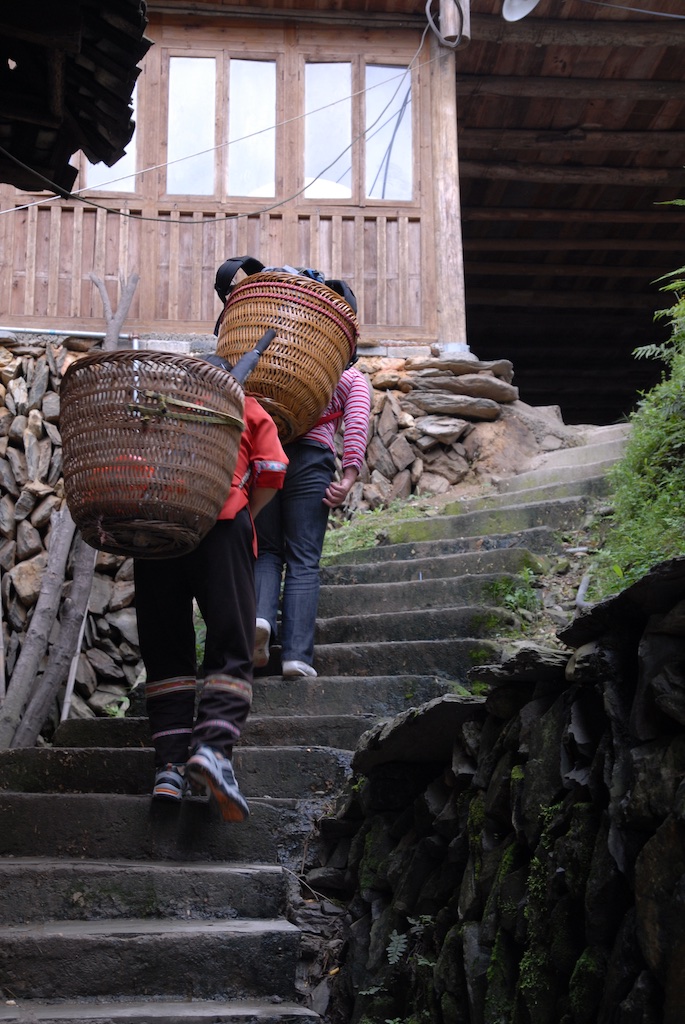
Stairs — always stairs
We stayed in a broken down hotel with little water, and the infamous hard Chinese beds. After we checked into the guesthouse, it was time for a stroll up and down the mountainside. Anyone who’s been to China will tell you that mountainous regions are famous for steps, and Longji was no different.
Longji rice terraces
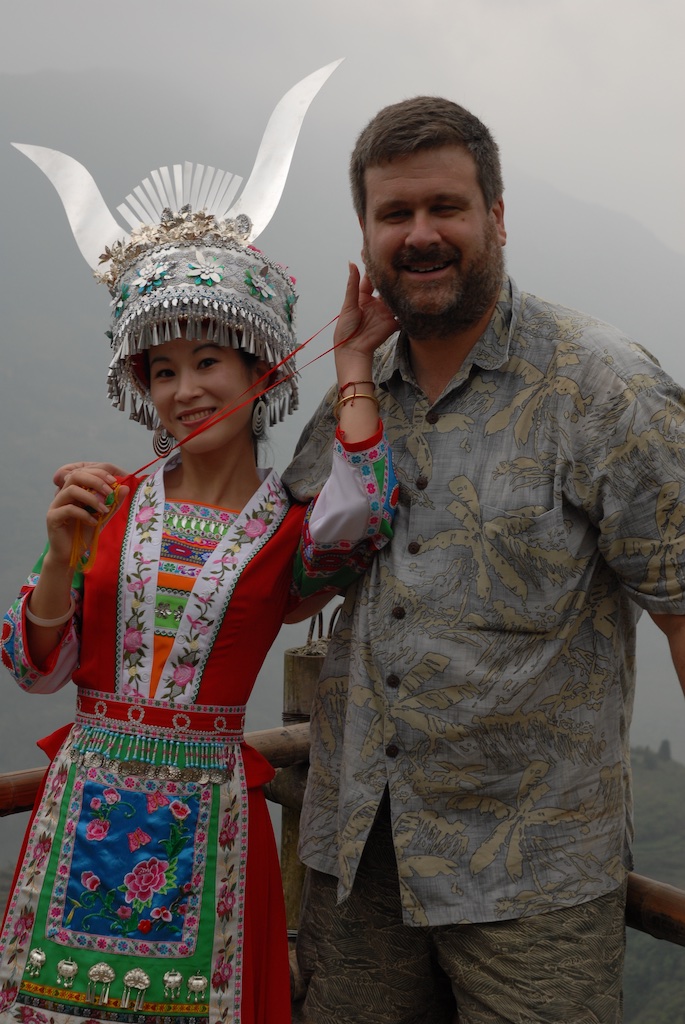
At various places, there were overlooks. And on those overlooks were young women dressed in native costumes. For a fee (something like $2 US) they would pose with you. There were three on this particular overlook, and two were being pushy. The young woman in this picture, though was holding her peace off to the side.
So I selected her. We had a very fun 10 minute situation where we posed in the standard poses. I bowed and gave her a quick peck on the cheek. She smiled.
I then continued around the rest of the loop, using my bad Mandarin to raise hell with the old women who occupied a different town square up the mountain. “Why are you not wearing a wedding ring?” they asked. “Because I’m not married,” I replied. “But you should be married,” they said. I replied “But I have no money!” They started laughing. “Well that’s why maybe you shouldn’t be married!”
Some humor is truly transcultural.
After the remaining walk, I trundled down to the small bar in the village, ordered up a Tsingtao, and sat down. There was Wifi, and I turned on my computer.
After about five minutes, a beautiful young woman came walking directly toward me, in modern dress (she had a Tommy Hilfiger sweater on,) literally making a beeline. It startled me a bit, as she stuck her hand out. Of course, she was the young woman earlier up on the hill, in the costume.
With the aid of Google Translate, we spent a delightful hour of conversation. She explained to me her life. “1/3 of the season, I am getting a B.A. in Accounting in Guilin where I go to school. 1/3 of the time, I am in the costume, making money for my family and to help pay for school. And 1/3 of the time, I am helping my father behind the Shui-Nyu (the water buffalo) planting rice.”
Lots of shui-nyus everywhere
What she had offered was a view into a transitional society — one moving from Tribal value sets, that were obviously still very strong, to a future where Performance/Goal-based thinking and Legalistic/Algorithmic rule processing would dominate.
Understanding this is vital in communicating with people about the virus. Different Value Sets will be receptive to different messaging, with different complexity. I am writing for the top of the complexity stack in my posts. But if you want to communicate down the stack, you have to realize people can only understand what they are developed to understand.
An example. If I were coaching her on what to tell her grandmother, this is what I’d say. “Nǎinai/Ama, I love you. And now, to honor you, I will take care of you as you stay in this corner of the house and do not go out. One day, you will play with my grandchildren.”
It’s not that hard.
A prosperous historic village outside Guilin – Not Longji
________________________________
Closer to the Western milieu, for all those that are authorities, I would recommend remember the Little Prince — especially, when the Little Prince visited the planet where the King had set up shop.
For what the king fundamentally insisted upon was that his authority should be respected. He tolerated no disobedience. He was an absolute monarch. But, because he was a very good man, he made his orders reasonable.
“If I ordered a general,” he would say, by way of example, “if I ordered a general to change himself into a sea bird, and if the general did not obey me, that would not be the fault of the general. It would be my fault.”
“May I sit down?” came now a timid inquiry from the little prince.
“I order you to do so,” the king answered him, and majestically gathered in a fold of his ermine mantle.
But the little prince was wondering… The planet was tiny. Over what could this king really rule?
“Sire,” he said to him, “I beg that you will excuse my asking you a question−−” “I order you to ask me a question,” the king hastened to assure him. “Sire−− over what do you rule?” “Over everything,” said the king, with magnificent simplicity.
“Over everything?”
The king made a gesture, which took in his planet, the other planets, and all the stars.
“Over all that?” asked the little prince.
“Over all that,” the king answered.
For his rule was not only absolute: it was also universal.
“And the stars obey you?”
“Certainly they do,” the king said. “They obey instantly. I do not permit insubordination.”
Such power was a thing for the little prince to marvel at. If he had been master of such complete authority, he would have been able to watch the sunset, not forty−four times in one day, but seventy−two, or even a hundred, or even two hundred times, with out ever having to move his chair. And because he felt a bit sad as he remembered his little planet which he had forsaken, he plucked up his courage to ask the king a favor:
“I should like to see a sunset… do me that kindness… Order the sun to set…”
“If I ordered a general to fly from one flower to another like a butterfly, or to write a tragic drama, or to change himself into a sea bird, and if the general did not carry
out the order that he had received, which one of us would be in the wrong?” the king demanded. “The general, or myself?”
“You,” said the little prince firmly.
“Exactly. One much require from each one the duty which each one can perform,” the king went on. “Accepted authority rests first of all on reason. If you ordered your people to go and throw themselves into the sea, they would rise up in revolution. I have the right to require obedience because my orders are reasonable.”
Here is hoping that our authorities remember that their subjects are under stress, and ask what is reasonable. Empathy is the cornerstone.
Note — for those new to my writing, here’s a couple of things to know.
I write about how the full stack of empathy — from mirroring all the way to conscious prediction — connects us as humans.
That leads to important insights on how humans, or more specifically, how human networks create knowing and knowledge. It doesn’t all come from Dead or Alive White Guys. This COVID-19 epidemic, and how we understand it, is really about how our society is connected together and forms understanding of how the epidemic is proceeding.
Synergy in knowledge comes from empathy in exchange of information between actors. If you can’t empathize, you’re unlikely to synthesize your understanding between you and other people. As true for scientists as it is for others.
Empathy (which does include the more familiar “feeling empathy” people recognize) is the information coherence function between two people. This leads to all sorts of interesting phenomena, such as predictable (canonical) knowledge structures we all use. Specific knowledge may be different, but the structure of the knowledge can match — especially if we come out of the same social structure (hierarchy, tribe, social net, etc.) When you deeply connect, odds are, you’ll walk away from the exchange with the same message.
Two punchlines : 1.) As we relate, so we think — if we practice rational relationships, we’ll likely be rational people; 2.) We aren’t going to solve complex problems without the wisdom of an aware crowd. Everyone has to be a sensor and a contributor.
OK — here we go. This is the good stuff that people who come to this blog expect in times like this. This post will cover “how can we gauge a priori the efficacy of any given action to control the virus?” If we understand this post, then we can also understand what we likely, or not likely can pull off. Things that work in China may or may not work in the U.S. Things that work in Taiwan may or may not work in the U.S. Regardless of country, though, there are tons of lessons out there. And this pandemic is providing a palette of actions and responses that we will be learning from for a long time in the future. Because there WILL be a future.
To start, here is the maxim that I will discuss:
Societies will maximize their efficacy in confronting the virus if a.) they understand their stage of development they are at, and tailor realistically their strategies for the stage of development they are at, and the matching average v-Meme of the population they’re attempting to manage. Their stage of development will dictate what messages can be received and understood. Less evolved individuals will have to be told/forced into doing given preventative activities. More evolved individuals can handle greater complexity in strategies, tactics, and immediate actions.
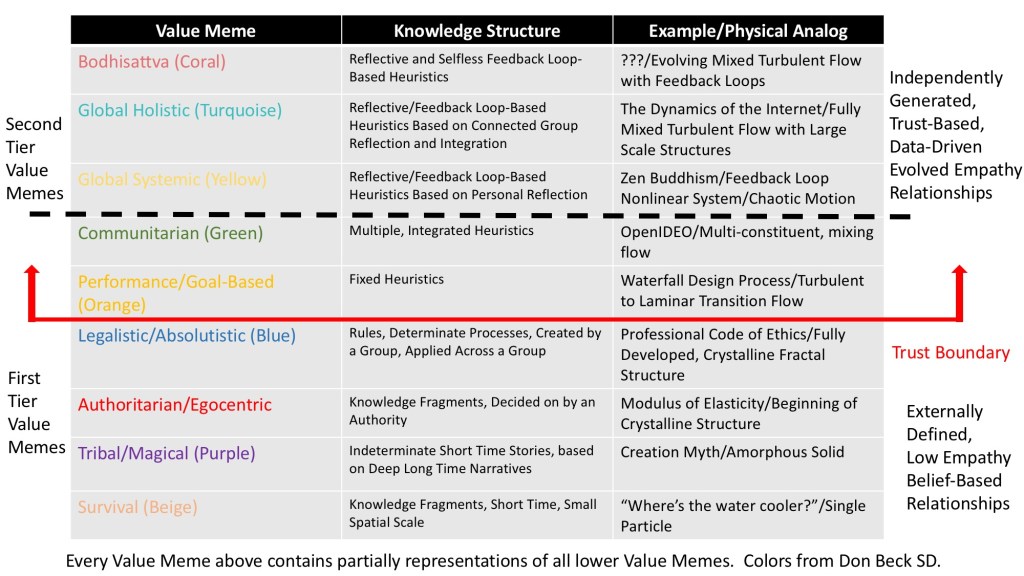
Here’s a start at the developmental values stack, along with their concurrent knowledge structures. You don’t have to read the fine print if you don’t want — here’s the gist.
Authoritarian societies are going to do best being told what to do, and forcing individuals to do it.
Legalistic societies are going to do best creating rules for people to follow, communicating why, and enforcing rules.
Performance/Goal-based societies will use the the two above strategies, along with clearly identified goals, and some notion of data tracking (whatever that is — we’ll explore.)
Communitarian societies will have access to everything above, as well as customizing response based on the individuals involved, and synthesizing advice from different fields to create specific locale/crafted strategies.
Here’s the unvarnished Knowledge Structures slide:
The knowledgestructure stack
So, let’s pull apart a couple of strategies, and understand them in the context of societal and empathetic personal development – their ability to utilize in a society both self-identify (agency/self-empathy) and connect with others (traditional empathy.) My wife, a trauma psychologist who is also Taiwanese, wrote up these five points for Taiwan, that adopted an immediate border closing and test policy. Here are her comments:
5 reasons relevant for understanding Taiwan’s experiences —
1. The majority of people in Taiwan are a homogeneous group with similar Legalistic and Authoritarian Value-Memes (e.g., Willingness to follow the rules even though they bring you inconvenience. Consideration to others rather than just taking care of self. Effective top-down hierarchical crisis management). Even though there was a heated presidential election in November 2019, there is actually no major diversity of life style to split this island.
2. “Nerdy” professionals are valued in Taiwan and are leading the policies & actions of fighting COVID-19 based on professional medical knowledge with advanced-technical support.
3. There are not enough “otherness” groups in Taiwan to become a significant “target of blame.” Don’t imagine that there is no discrimination or micro-aggression in Taiwan, it’s just that there are not enough diversity to create diversion.
4. Even though Taiwanese people know that COVID-19 mostly targets physically vulnerable population, they are willing to take actions to protect the elders. Senior citizens are valued and respected because of the traditional Asian culture.
5. As an island living through so much trauma and disasters, Taiwanese have a lot of resilience from the chronic adaptation to Traumatic Stress.
My wife’s analysis illustrates exactly the background societal dynamics that explains Taiwan’s success. Taiwan is largely a Legalistic society, with some Communitarian tendencies. They tend to be rule-followers, there is still lots of stress and emphasis on young people to sort with entrance exams, and to accept one’s fate if one doesn’t cut the mustard.
There is also a strong Authoritarian bent in Taiwanese v-Meme make-up. Being a professor, even in a very capitalist economy (Taiwanese are extremely entrepreneurial!) is a high-status, sought-after position, even though the pay is mediocre. The virtue associated with the position means that their best and brightest aspire to becoming a scholar. That helps in times like this, when you actually need experts with a strong sense of national identity to help out.
Taiwanese universities also have legitimate shared governance. The couple that I’ve visited had elected Rectors/Provosts/Heads of the Academic Food Chain, as opposed to the appointed system of Presidents/Provosts/Deans in the U.S. This matters in the bigger picture. While status matters, there is far more emphasis on your responsibility to larger society than in U.S. universities — at least that I observed. All the professors also have served time in the military, because EVERYONE has to. Most have shot a gun, and the older faculty I’ve talked to were part of the largely symbolic artillery barrage directed against China. This has stopped, but is interesting in how people form “We” group identity.
Finally, the last interesting part is that Taiwanese, by virtue of their national history, are trauma survivors. This goes back a long way. Taiwan was occupied by Japan during WWII, and when the Kuomintang fled mainland China, needless to say, they had no illusions what the CCP would like to do to them. What this means from a psycho-social perspective is this: they know they can die, and are easily triggered to act. They don’t assume any kind of exceptionalism, like we do in the U.S., regarding their ultimate fate if they don’t prepare. Taiwan is a reasonably religious country — Buddhist shrines are everywhere, and there is a large Christian presence – 6% of the population. But they aren’t like the U.S., sitting around whispering “thoughts and prayers.”
And this epidemic is NOT their first rodeo. They got a bit surprised by the SARS epidemic of 2003. But it is mostly definitely “never again”.
One of the interesting things about Taiwan is the diversity puzzle. Taiwan consists of three main ethnic groups — Hoklo/Han Chinese, the original Taiwanese people, and Hakka people, also of Han Chinese descent from southern Taiwan. They DO differentiate — but their differentiation is not so great as to cause major conflict. A huge part of the problem with racism in the United States is a lack of basic life services, so discrimination matters in one’s ability to survive. Taiwan has essentially 99% coverage of the population with health services, and economically, everyone can work who wants to work — a combination of national safety nets, as well as a strong work ethic.
All these things form powerful forces for social coherence. You do have an internationalist class that feels some obligation to the country’s survival as a whole, and has the opportunity for greater intellectual sophistication (which is prized) and empathetic evolution. Yet since even the peasants are taken care of (and there are many people in Taiwan at the tribal level) everyone shares a reasonably strong national identity, which is super-important regarding cooperation in levels Legalistic and below. In a national crisis like a pandemic, they know most all of them are going to be fine. So they’ll do what the authorities tell them to do.
So what exactly did Taiwan do, that mapped into their truth-based self-awareness development? This timeline is taken from this piece, but also maps well to how my wife and I followed the handling of the pandemic, with information from her father and mother.
When China reported out a cluster of pneumonia cases on Dec. 31, they started watching, monitoring people visiting from Wuhan, CN.
They backtracked shortly thereafter, monitoring everyone from the area who had arrived at or before Dec. 20.
Mid-January, a team from Taiwan visited Wuhan and gathered even more information.
By late January, they had established a centralized Epidemic Control, and banned flights from Wuhan.
They cracked down on mask and sanitizer hoarding almost immediately thereafter, and made sure that everyone had a supply of masks (2/day) to use. They distributed some 6.5 million masks to schools and after-school institutions.
They had already installed an infrastructure of broad-scope temperature testing of individuals at airports and other points-of-entry.
They tracked people who were tested once, parents reported their own children’s fevers, and they re-tested as necessary. They did not engage in cordons or lockdowns, other than control at the borders.
Public service announcements regarding prevention and containment were played on the hour, mandated on radio and television statements. I don’t have information on what they did with dissenting voices, if there were any — but they certainly didn’t allow any of this kind of crazy bullshit.
Effective prevention of the COVID-19 outbreak took advantage of Taiwan’s culture and social structures. Individuals were treated individually (Communitarian v-Meme) when appropriate. Individuals were also supposed to bear responsibility for not infecting others, and did not assume that they would be discriminated against. There were lots of rules (Legalistic v-Meme) for everyone — but the government, through pretty radical transparency, made sure that people understood the “why” of the rules.
And finally, the government had a larger coherent narrative that was consistently broadcast, and not allowed to be corrupted by disruptive forces. I don’t know the amount of histrionic media in Taiwan, but I’ll bet there wasn’t a lot. It wasn’t their first rodeo, and so the idea that this was some kind of plot by the government to “seize control” was just not a popular lede. And because everyone in the society would be taken care of, people were invested, regardless of their education or social standing, in following the rules, with stories told to them so that everyone could understand what was demanded of them.
Contrast that to the situation in the U.S. currently. The mind reels.
Now let’s look at what China did to contain the coronavirus.
A couple of things before we dig in. China is, without a doubt, an authoritarian society. My old Chinese girlfriend, when we discussed the “We” nature, a popular lede in U.S. cultural studies, laughed. She said “Oh, it’s a ‘We’ society for sure. One guy, the leader, runs in one direction, and everyone follows him!” If you’re differentiated outside the dominant group, and happen not to be an external, high status sub-group (trust me — as a White Male Professor, I have SERIOUS white privilege when I visit China) you’re in a world of hurt. I don’t want to get into the whole Uighur situation right now, but the West has a very distorted view — both positive and negative — of how China actually operates.
Some 95% of Chinese society is Han Chinese. There are ethnic minority groups, and the ones closer to the population centers are less differentiated from the larger body than they might admit. Here’s a picture of me with a Zhuang tribeswoman, who I had a lovely fascinating experience with in Guangxi Province.
Zhuang Woman (and BS accounting major) Longji, Guangxi Province
So what did China do to manage COVID-19 when the outbreak occurred in Wuhan?
Initially, when the outbreak occurred, local city and provincial governors lied about the extent. That quickly changed, however, and the Beijing government ordered a lockdown on 60 million people in Hubei province. At the same time, they started building hospitals to treat the inevitable overflow of capacity. Severe travel restrictions were implemented.
And while China did develop testing capacity, in no way could they pursue individuals like Taiwan did. Statistics from China may be large compared to other areas, but there are a lot of people in Wuhan. Travel bans stopped the flow of cars, and universities and industry were shut down. Simple messages/ classic Authoritarian fragments were repeated over and over (wash your hands!) But some residents were also nailed/welded inside their apartments to control the virus, and discontent from the measures is widespread.
Since I’ve pretty much relied on my own experience in China, along with Western media, I think I have a reasonable grasp of actual events. But it’s still hard to figure out the extent and severity of dissent in China. That said, what China’s response shows is what an Authoritarian system would do in this circumstance, when it can’t rely on individual responsibility and agency because it simply hasn’t been cultivated. The overall grounding dynamics of illness and death forced the hand of first the regional authority, and then the national government — they couldn’t deny that people were dying. Dr. Li Wenliang, the Wuhan doctor who was the persecuted whistleblower on the epidemic, died, and served as a turning point in information on the epidemic. If they wanted to maintain order, they had to be truthful with their population.
But you can also see that Authoritarian societies have very limited toolkits to deal with this kind of situation. People already half-assume the government is lying to them, so soft means of control have to be implemented. I’m also willing to bet (and time will tell) that people held a dichotomous perspective on the situation. First, they thought the government was likely underestimating the damage, to maintain the air of authority. But secondly, because Authoritarian systems are built on cultivating a depressed, low responsibility underclass, people realized their survival was up to them, and fell little or no allegiance to higher Authority in the crisis. They had never been responsible — and they weren’t going to start feeling that way now, when their immediate family was threatened. And China most definitely value family. The entire background culture is built on it.
Contrast Taiwan to China — and now one can see the advantage of higher social evolution in effectively containing and controlling spread of something like COVID-19. Empathetic Taiwan still has the same risks of spread since they controlled their outbreak, and didn’t let the virus create herd immunity. And here’s the Deep Empathy angle — by utilizing every individual as a sensor, Taiwan stands a far better chance of holding COVID-19 at bay until a vaccine and related campaign (which is actually an Authority-driven solution — everyone is subject to it!) can be developed.
What about the U.S.? Unfortunately, the U.S. response is essentially a mess, and the sign of a country under relational collapse. It’s so crazy-quilt out there as of this writing, I don’t feel like I can say much of anything. Ostensibly a Performance-focused Communitarian society, we have none of the lower v-Meme scaffolding to support an advanced empathetic culture. We have recognition of individuals as different, yet we have no common origination stories any more that would bind us together in a crisis. As a result, people are out in the streets celebrating St. Patrick’s Day. A huge hunk of the country south of the Mason-Dixon line celebrates an insurrection that killed more people than any external war. And both sides of the news cycle (though Fox is by far the worse) drives either false or hysterical narratives. Our information coherence functions in the society have been hacked by a deeply disruptive memetic virus — the result of no federal safety net, including public health care, as significant regional economies collapsed over the last 40 years.
As of this writing, there is marginal ability to impose even location restrictions to contain spread — let alone implement a more Communitarian program where people might phone in health conditions so we could both contain potential virus spreaders, while also offering services that will assure their health. There aren’t really any significant testing resources of this date, so everyone with a brain knows the actual infection rate is grossly underreported. Either this thing is contagious or not, and if it is, far more people have it than have been tested, which as I wrote in an earlier piece is oddly good news in the places that have been infected for a while, like Pullman. I have no hope of getting anything like a surgical mask, and I’ve been getting ready to get on my sewing machine and make some.
Practice makes perfect
And there is precious interest at the top of the Federal Government in doing anything except attempting to prop up the stock market. We are a complex information system with severely broken complexity links. We’ve let a Performance-based, nominally Communitarian society decay up and down the class scale. And that’s exacerbated problems with racial and gender equality already extant in our society. Even our school kids attend grade and high schools that resemble prisons, with buzzing doors and search, so they won’t get shot up by the next mass shooter. When you live in fear of your child being shot on a daily basis, how can you generate a functional society?
Our ability to generate individual wealth is still unparalleled in the world. But it has come at tremendous social cost. I have seen no other photos of other societies rushing stores to clean out shelves like in the U.S. The problem is that it is a rational response to our current predicament. When you can expect nothing from your neighbors except viral spread, in a hyper-individualized society, it’s stock up or die. Money is the hammer, and every problem we have is a nail.
The problem is that it reduces the temporal and spatial horizons of the thinking parties — independent of party affiliation. All of us sink – and become more stupid. I know, for myself, that I have been calculating probabilities of stores running out of goods and services that I might need. Fortunately for me, I have an expansive understanding of supply chain dynamics, and know that certain items (like food) are unlikely to run out. But if you’re not me, and can’t just pick up the phone and talk to the head of R&D at the major food manufacturing equipment company, it is certainly terrifying. I think I’m going to be sitting in this chair for a while typing, so I’m pondering buying a new accordion. Others are obviously not so lucky.
There are some hopeful stories around the world, about people coming together, empathizing, and creating shared solutions. Long-term, that bodes well in creating people capable of handling different problems of complexity. Our empathy muscle is only as good as we practice. But in the short run, we’re in a tight spot. Stay tuned. There’s more to this story. As for me, I’m thanking the Universe this bug is only 10x as lethal as the flu.
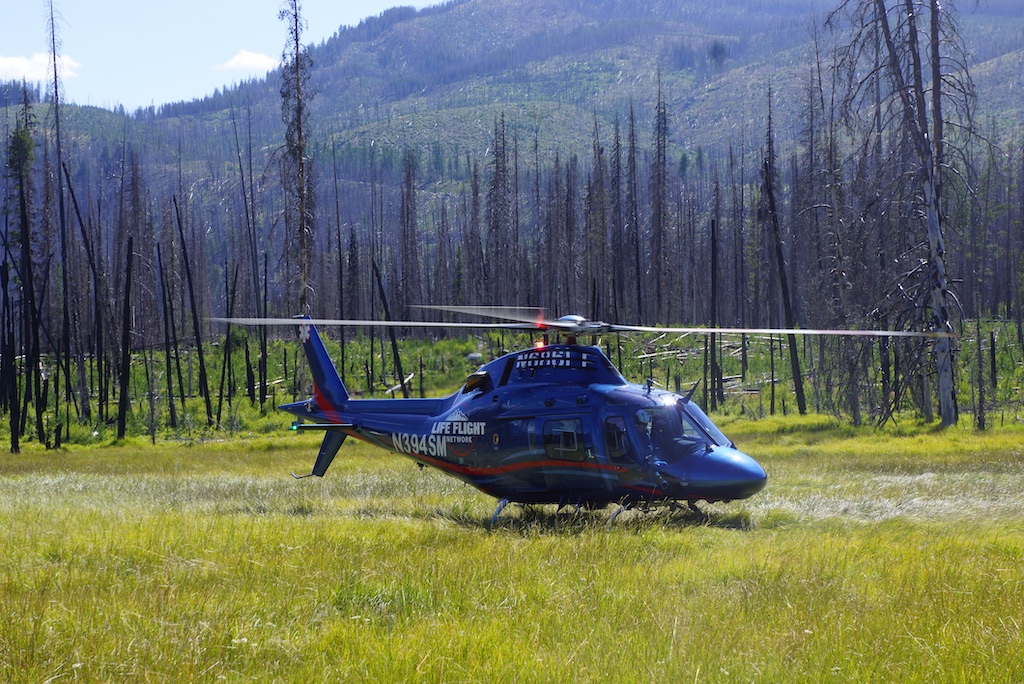
Blue Helicopter Jesus — on the edge of the Frank Church/River of No Return Wilderness, after arranging a successful heli-vac
This is a geek post, and if you’re familiar with my work, you might love it. If you’re not, well, good luck. You’ve been warned.
Why do we have such a hard time knowing at this time what the real rate of COVID-19 deaths are, as well as what the real infection rate is? NOTE — it looks from preliminary evidence to be 10x the flu, and if you get the disease with complicating factors, a terrible way to die — that we DO know. So don’t take this post as some odd minimization. It’s not. DO the right things!
The problem is that at the current time, we are attempting to understand this using people in hierarchical social structures (in this case, academic and industry virologists) whose main tool in the arsenal is algorithmic rule processing, which turns into our well-known empirical science. What that means is that they’re going to do some tabulation, a little data analysis, maybe plot things on an axis and make some guesses. That’s what folks have pretty much done. Work is improving — I liked this piece, and you can check this out. Make no mistake — while I talk about some of the science with questions, I HONOR our uber-geeks who are pouring themselves into this crisis. That’s one of the vectors to get to answers.
The truth is that this kind of thing works GREAT with what I call “closed systems” — where you can isolate a given population, subject them to a clinical trial of some sort, where you control the inputs, the population is also homogeneous, and there’s a start-and-end date that makes sense.
None of those things are present in the current problem. What we have here is an Open Systems problem — a society is infected from an unlikely source — a virus that has jumped from bats (we think) to humans (I actually think the evidence for this is reasonable) and is now exploding. We can’t draw any meaningful system boundaries YET on this, because we don’t really understand the system. We can guess on vagaries (animal -> human transmission, consumption of the virus through purchase at a wet market, etc.) but we just don’t know. And when I talk about system boundaries, I’m not just talking about the obvious ones — Wuhan city limits, Hubei province boundaries, etc. I’m talking about all the potential inputs and feedback loops present.
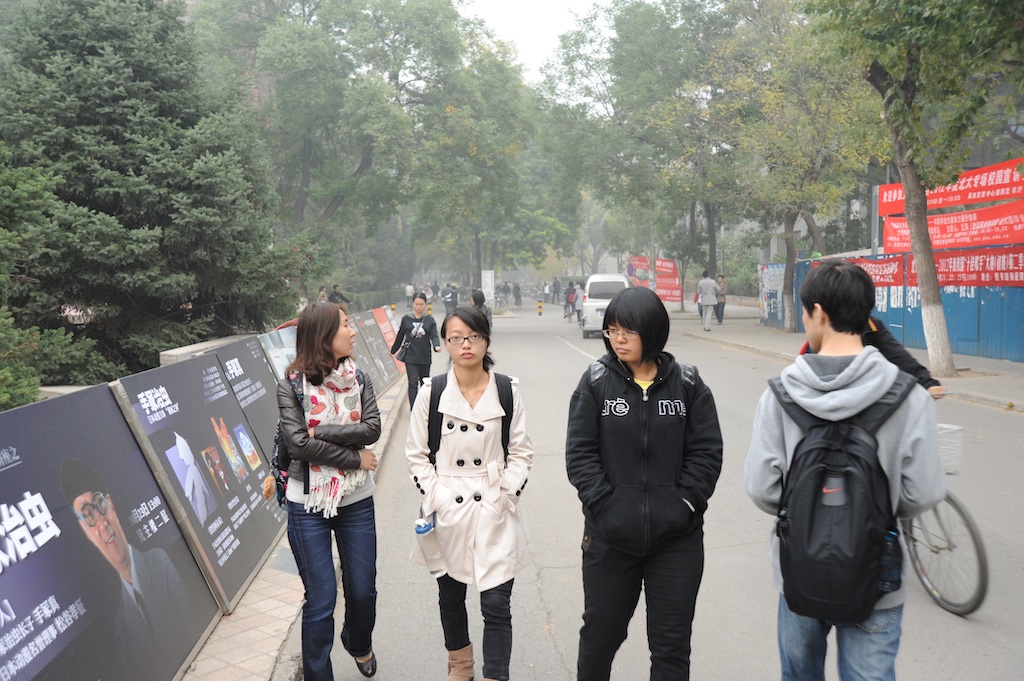
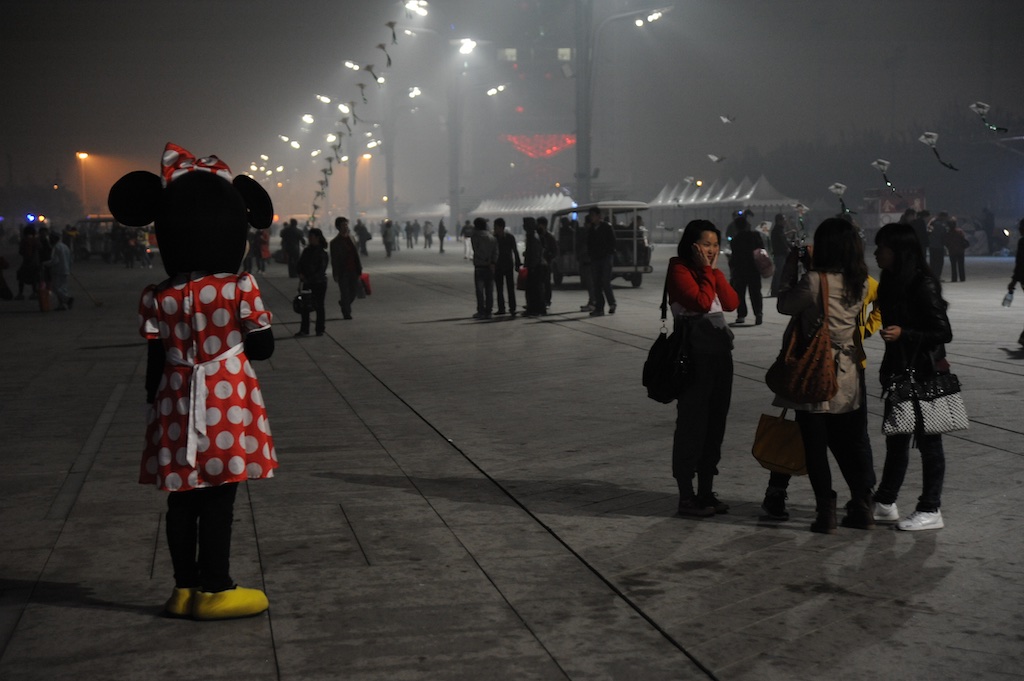
For example, we also don’t know a ton of other stuff about the impact to human health of people regarding their environment to resiliency against this virus. China’s air is absolutely execrable in most of the big cities. I have been in Beijing where the pollution fog is as thick as the dense fog that sometimes settles in on the Palouse — except ours is water vapor. And there are other open system factors that no one knows about. Chinese people smoke cigarettes. And they also have adopted about half of our own awful, sugar-based diet. I maintain, as a lone voice in the wilderness, that many of our problems are inflammatory-diet-related as far as overall health, psycho-social shift, etc. Especially in an epidemic. Here are a couple of pix — the daytime one is not so great showing the air — visibility was low, but trust me that the nighttime one is just air pollution, and you can see this through the lights. People had on masks and such.
On the Bei-Da CampusNext to the Olympic Stadium. Yep, that’s Pirate Minnie.
What that means is we have a respiratory-handicapped, immune-compromised population who have watched this sweep through their population. And we have statistics associated with the virus, functioning under a combination of these exacerbating factors, along with age-related mortality. These things, at this time, are impossible to uncouple. Scientists may come up with a vaccine in a few months. But they will take years to untangle this mess.
What this means is virologists are observing a new phenomena with few guiding principles (up there in the Knowledge Structure stack) and a poor ability to guess at how exactly the virus messes you up. It is true that one can see the dynamics of transmission, and we can do things like count patients and symptoms, and make guesses based on intuition that vary on the guesser’s and their field’s past practice. Interestingly enough, it’s the virologists’ past experience with epidemics that really drives insights. Experience assembles tons of multi-dimensional data into complex narratives, and gives insights that are simply impossible to extract from a standardized data set. The brain’s demands for coherence from an expert lens can often drive insights that would be normally unavailable.
But it’s a tricky business (confirmation bias and all!), and as amenable to hunches as anything. It’s not that I don’t trust the virologists — actually, I do. But the public, and especially the media, like certainty. And we just aren’t going to have that for a while. As I said in the previous piece, you should act like this is the Big One. And hope that it isn’t.
Most important to understanding this whole deal are the people who got the virus and didn’t get sick at all, or only got moderately sick. But those people can’t meaningfully AT THIS POINT be included in any of the analysis. (This piece is an early attempt.) Later, down the pike, we might be able to do this with certain populations. Wuhan, China, has a population of 8.5M people, and Hubei province, where Wuhan is, is up around 58M! The different cordons that were drawn around these areas will, with intensive research, show the permeability of these boundaries and how it all works, as well as who actually likely got infected. Rapid contagion and fatality can go hand in hand. But there are also reasons why viruses like Ebola burn out quickly, and don’t go on to devastate countries.
But for now — with the knowledge structures we have — we just can’t know. And the best thing we can do is follow the precautionary principle (especially with the potential for hospital overload) and DO YOUR PART . But also realize that outcomes as far as pandemic deaths will likely be less than the straight multiplicative estimates we are seeing. That means your odds of surviving this pandemic, especially if you are in one of the low-impact groups, are extremely high. And the best course of action is to calm down, and think about how you might help others. That’s the empathy thing. We are all in this together.
Looking out over Hells Backbone, Utah, Grand Staircase/Escalante NP
I haven’t written much on the blog in the last couple of weeks — but I have been writing for the local paper, and thinking of messages that needed to get said. I started preparing my classes for online work about four weeks ago now, and making sure all my students could finish the semester. Being a senior is a big deal, and while they might miss graduation, I don’t think they’ll care as much about that as being thrown out of their apartments (they’re all seniors) without a degree.
But, of course, on a blog about empathy and how people know, there’s a ton of stuff to write about something like the current pandemic. Mostly because we still don’t know, as of this writing, much about it, and the lenses we’ll use to look at the social, psychological and anthropological aspects of it are so weak. How can we reasonably expect to understand our reactions to everything that is happening when we cannot meaningfully understand ourselves?
For what it’s worth, I do believe most of what I read coming from the microbiologists and epidemiological communities. It’s tough to exactly KNOW what they’re saying, however, because so much of their uncertainty tends to get passed through the media’s set of v-Meme filters, and sadly filtered out. It thus turns into mostly catastrophe, because the media is into catastrophe, and to be fair, they’ve been really traumatized by almost four years of Donald Trump. There’s nothing like a good, old-fashioned relational disrupting, narcissistic psychopath to use a crisis like this to view this as both an attack on his version of the truth, as well as an opportunity to take down other potential power structures to consolidate his worldview. Damn everyone else to Hell, of course.
But I digress. I’ll give you some reasonable advice, and then I’ll talk about what I don’t know. You can stop with the reasonable advice — if you’re unfamiliar with my work, I’d almost be happy if you did, because it’s the result of spooling up the Hyperdrive for the last four weeks. But if you can handle uncertainty, then read through the rest.
First off, use the precautionary principle in everything that you do. Or better, use the probabilistic precautionary principle. You can’t avoid all social contact or public places, so dole out your grocery store chits a little more sanguinely. Odds are, you’ll be as alright as you can be.
Act as if bad stuff would happen — that’s fundamentally the precautionary principle. But at the same time, do be reasonably positive with those around you. In a crisis, you may indeed die. But odds are EXTREMELY LOW that you’re going to be a victim in this latest pandemic. Even if you’re old. At the same time, like it or not, death is part of the price of being part of this bizarre divine accident of the universe that led to Earth in the first place. But don’t go running around telling everyone that. It means that your last experiences will suck, and let’s face it — experiences are all we really have.
Do ask yourself what your meaningful locus of control is, and act within it. If all you can do is wash your hands to prevent the virus, then wash your damn hands. If you can help others, then help others. Me, I write messages for people to act upon, and lay the groundwork for long-term change. That’s what I’m doing. I also understand that I have the background and cultural/v-Meme filter for understanding global events, because I’ve been damn near everywhere, and can validly ground various theories about different cultures with my real experience.
That’s helpful in many different ways, but mostly now because it helps me relay information from trusted sources around the globe. As an example, I reconnected with a talented reporter from Lewiston who used to cover my timber protection antics over 20 years ago. She happens to be working in Italy now, and is married. She’s writing on the hospital crisis. Bingo — I now have a meaningful, ringside seat to interpret activities in Italy. For this on Twitter, follow @andreavogt. When it comes to China, I’ve spent a lot of time in China, from mountain villages to industrial districts. I know what I can actually believe, as well as understanding how people actually live. I’ve honestly been to wet markets. Here’s some pictures.
Snake-y! Fish, turtles, and frogs
(While I’m hopeful for curtailing the endangered species trade, anyone that thinks that wet markets are going to get banned from SE Asia is smoking crack.)
Do not spread information that you don’t believe is accurate. Now is not the time for your bizarre 5G -turning on virus conspiracy theories. Anyone involved with any engineering effort knows how hard it is to get two pieces of equipment to line up, let alone an entire global network to just “turn on.” Just stop it.
Oh yeah — pat your dog. He or she is very cute. And that’s important. Here’s my pup.
Mac — and yes, he’s very soft.
————————————————
OK, so now let’s dig into a couple of big questions, that I’ll likely flesh out in a couple more posts.
There is a bunch of stuff that is unknown about the coronavirus. Since posts on this blog hang around forever, my hope is that three months from now, we have hard answers. But we don’t have them now, and so all we’re left with is our ability to take information, and reason through this.
First off is that we DO know that cases of coronavirus can be asymptomatic, or have mild symptoms. Coronaviruses are pretty close to the common cold, and they’re super-common in animal diseases like “insert-your-animal-name-here” diarrhea. The pronounced incubation period is 5.5 days. But I have yet to see any convincing data on how long asymptomatic coronavirus takes to build immunity before receding. We just can’t know that — we haven’t done any wide-scale testing (maybe China will figure this out, since they definitely have had it longer!) and testing has also been limited to people that are pretty sick. If you had just a common cold, you wouldn’t have been tested for it at all.
We do know that it is contagious — very contagious. But what does that mean? If it’s really contagious, then odds are a large number of people will have the virus present in their system, but only a certain percentage will be tested because of the shortage of testing kits, and, well, the whole asymptomatic problem I talked about above — which ALSO may be difficult to capture with the current tests. Some asymptomatic people who have the virus may have a heavy viral load — that happens! But others may just have a little, which will then create the problem of false negatives — having it, but not showing up on the test. Sigh…
But if it is contagious, then where I live — Pullman, WA — may be the place to do the study. Five commercial airplanes from Seattle (as well as a number of business jets) land at the Pullman Regional Airport every day. That means, for the last four weeks, we’ve been dumping a vectored number of carriers from Seattle into our population, and then serving it up among likely asymptomatic, strong-immune-system college students who are famous for crowding together in bars and smooching. Even yesterday, AFTER all the closures, I was outside one of our local coffee shops. Graduate students from my department were hugging and kissing their goodbyes.
The other problem is that we don’t have any data on diseases like Influenza-A in our small community. I found this graph from New York City, posted by Chris Hayes from MSNBC. I’m not a huge Chris Hayes fan, FWIW — but this kind of information (supposedly gathered from NYC Emergency Rooms) is likely reliable and valid.
ER Data from NYC
Information like this is super-valuable, because that second peak is likely not from the flu. I’m betting it’s from the coronavirus. It’s similar (well, meta-similar) to the work that Abraham Wald did, on what you don’t know might be what is killing you. Wald was famous for his work on B-17 bomber survival in WWII. He figured out examining the planes that came back to see who made it was equally important to understand what planes DIDN’T come back. Short version — don’t put more armor on the bullet holes you can see. Put more on the clean spots on the returnees — because the planes that didn’t come back likely had bullet holes there.
Notice the second peak. I can easily easily believe that’s when coronavirus started becoming more widespread – March 1. I’m writing this 15 days into this from Seattle, which has been called the “Wuhan” of the US. So it obviously makes me exposed even before that March 1 peak in NYC.
Why is this a great example of a plot you can believe, without all those false positives, OR negatives? Symptoms recorded in an ER are awesome. Doctors and PAs can see them, and odds are the hypochondriacs just get booted out of the system. But when we rely on hastily constructed tests (not that we shouldn’t use the “best we’ve got”) we also struggle with statistics. I don’t want to go down the rabbit hole of all of this, but look at this article for an idea about false positives. It doesn’t talk about the whole issue of false negatives, but these numbers are not encouraging.
Why does this matter? Every localized epidemic is going to transition from exponential growth, to logistic growth after a while, as basically everyone in the population gets it. This is an awesome video that explains this concept. Basically, if a population is constrained, the virus saturates in that population, and then goes away as immunity of everyone in the system builds. That’s one of the things the Chinese government did in Wuhan — prevented the spread of the virus to other, untouched provinces. That will be hard to do in the U.S., where anyone and everyone flies all the time.
The problem about sussing all this stuff out for a new (novel) coronavirus is that the first round is likely to be the worst as far as spread. No one has any immunity for sure, and so it’s game on from the minute the virus shows up. But because we’re humans, and have some ethics, we can’t run the experiment over and over on different populations and intensively watch. We have to guess, and go from there.
——————————————
Understanding the virus by spreading the peak, through ‘social distancing’ and such, is something that other people have written about, like this piece. I understand it intrinsically, and support it, but don’t need to write about it. Read this for more detail.
——————————————-
One of the things that has not been examined in too much detail is the existence and extent of mutation variability in the coronavirus. DO correct me in the comments if I’m wrong. I’ve often wondered if, like cowpox and smallpox, there are two differentiated varieties in play here, and if you draw the short straw, you get the bad one. For those that have forgotten their smallpox history lesson, the smallpox vaccine came from observing that milkmaids got ‘smallpox-like’ pustules on their hands, but never came down with the disease. Edward Jenner became famous for taking this insight and creating the first smallpox vaccine. Cowpox is annoying. Smallpox kills, in the most terrible way possible.
Finally, while there’s more to write, I’d caution people against assuming the next mutation is going to be more deadly to humans than the current strain, which we really don’t know much about. Viruses aren’t on some path to extinguish us — unlike how we feel about viruses! The next mutation might be worse. But it might not affect us at all, in which case we wouldn’t notice. Viruses that kill their hosts are NOT very successful viruses over the long haul. I have a number of friends who are veterinarians, and they’ll be pleased to tell you that animal diarrhea is often caused by the coronavirus. One of the large animal vets I work out with at the gym, after having his hands immersed in calf poop his whole life, feels he’s likely immune.
Of course, he can’t know, and that’s the problem — he doesn’t want to get shot up with the latest viral version to find out. But diseases have been jumping around from animals to people, and likely back again for as long as humans and animals hang out together. It was, as Jared Diamond informed us in Guns, Germs and Steel, the thing that enabled us to extinct off most of the Native American tribes in the New World during the Columbian Exchange.
If there’s a deep complexity/empathy message here, it’s this. We have to embrace metacognitive uncertainty, while still picking paths that bring us closer to keeping most of us alive. And those are social actions, keyed to the extent of the development of the people around us. That’s the next thing I’ll be writing about. What won’t work is assuming we know and dismissing the threat, or throwing up our hands and saying we should do nothing. Neither of those paths will work well in the current situation.
It’s a personal/empathetic development problem. Our collective organism will survive to the extent we maximize grounded/truthful information flows, regardless of what level of development we’re at.