Conflict — Understanding, Avoiding and Healing it — Inter- v-Meme Conflict (Part III)

steamboatbend

Steamboat Bend, Yampa River, Utah in Dinosaur National Monument

——————————————————————–

“If you want epiphanies, you have to put them in the schedule.”  Phil Brick, Politics Professor, Whitman College, on his Semester in the West program

I’ve been short on solutions in the last three posts — namely, because there honestly aren’t any simple ones.  When you have two people in conflict, and the way they structure knowledge is fundamentally different, meta-structures are not easily reconciled — let alone fundamental beliefs and precepts.  Those that argue folks just need to sit down and talk it out?  Well, it’s not that it never works.  But often it’s not just a failure to communicate.  It’s a failure to truly connect.

One of the things that I have seen work in resolving conflict is the creation of opportunity by leadership for shared epiphanies between warring parties.  Note that this will NOT work with relational disruptors.  But for those involved in Healthy Evolutionary Conflict, the elevation in empathetic connection that can occur with shared experience should not be underestimated.

In my youth, I used to be a hard-core whitewater kayaker.  I originally moved out to the West because of my obsession with the sport.  Running hard whitewater was still in its infancy when I started (1979), and basically, you had to paddle with whoever was available who could paddle at that level.

When I moved to Pullman, WA, in 1988, I also became intensively involved with the environmental/old-growth protection movement.  I went on to write a book on the larger issues involving my home watershed — the Clearwater River in North-Central Idaho, called Wild to the Last:  Environmental Conflict in the Clearwater (WSU Press, 1998).

While working on the book, I had more than one logger who was my kayaking buddy.  I am still friends with these people now.  I am convinced that what bound us together was shared experience.  Loggers like being in the woods;  I like being in the woods.  Additionally, we would have to share a Survival v-Meme level interdependence.  If someone went for a swim in some of the rivers we paddled, without a strong cohort to rescue them, that person could drown.  Additionally, there were lots of opportunities to develop shared heuristics — sometimes we’d run particular rapids;  other times we’d have to find ways to carry around them.  The harder rivers were always team efforts.  A particular empathetic ladder practiced by one of my friends was the instilled practice of fetching each other a beer.  If someone asked you to get up and get them a cold one, you did.

At the same time, we were relentless in our taunting of each other if you went for a swim, and failed to roll your boat.  I asked one of the guys one time why we were so hard on each other — his response was simple.  “Dude — keeps you safe.”  You don’t want to be the butt of the next joke.   So you make your roll.

For bridging large gaps, there is nothing like shared, stressful experiences that bring out deep core values in all people.  One finds almost no healthy person on this planet that doesn’t understand the guest/host relationship, or the fact that most people care deeply for at least a few people.  But bringing out these connections requires making time for them.  If you have nothing in your organization except endless work and meetings, you shouldn’t expect anyone to care about anyone else.  Almost every workplace has formal relations and titles.  But independent relationships take time to develop.  And without these, there will be little trust or shared responsibility in an organization — especially when times get tough.

The starting quote at the top of this post was told to me by a friend and another professor, Phil Brick, who teaches at Whitman College.  Whitman is a small, elite school, filled with some of the smartest and self-aware kids I’ve ever gotten to teach.  Phil had launched a pioneering active learning program at Whitman, called Semester in the West, where students would travel around in a van to various sites of environmental conflict all the way from Washington to Arizona and New Mexico.  He had tagged me for explaining forest politics to his kids, on the ground in the Clearwater National Forest.

As a fellow professor and environmental activist, I asked him that evening to show me his schedule for the semester.  It was fall, and I was scheduled early on, and was curious what they would do as the light failed.  Battery-operated LED headlamps had recently come into vogue, so that was one question that was answered.  About 11 or so weeks into it, he had a week in Nevada labeled ‘Epiphany Week’.  I asked him about that.  “How can you expect students to have time to have any realizations if you don’t schedule them in?”

At that point, I had an epiphany.

The best solution for resolving conflict is avoiding it in the first place.  Some conflict is inevitable, but if you have chronic conflict in your organization, it means that leadership has set up a non-viable structure for getting the job done.  As the Star Trek blog post shows, you can have different v-Meme actors in any organization and have them form a functional, high-performance team if their roles are appropriate.  But organizations that do not put some priority on individual growth of their workforce are asking for trouble.  Because people will grow and evolve, regardless.

Since this blog is going to get turned into a book, there’s a little voice in the back of my head that says ‘Create things that are Internet listicles!’  But a better thing to tell you, the reader, is this:  what is the structure of the organization that is causing the conflict?  Have you looked at your scaffolding, and appropriately balanced authority, rules, and the ability to change rules?  Do you provide opportunities for data-driven relationships, or are you obsessed with titles?  If you create irrational environments, you should expect irrational people.  And irrational people get into fights.  If you need a bottom line motivation, fights cost money.  But hopefully, by this point in this whole blog, you should be motivated by more than that.  If you’re not, you’re likely not really needing higher synergies to get the job done.  Though I’d argue that even a lawn service company will benefit from structuring environments and roles to avoid conflict.  Happy employees figure out better ways to make happier customers.  One of the things I also do with my students is have them work through what is commonly known as the Five Whys, or some form of root cause analysis.  Having two warring parties write these kinds of things down separately, and then have them be empathetically reconciled, where both sides have to engage in a more rational empathy, can be useful.  If you practice knowledge structure identification yourself, you can also bring both parties along by serving as a bridge for larger consequentiality of action — the things that people often find are missing.

But there is no substitute for shared experience in empathy construction.  As well as epiphanies.  Make time for them — and the reflective time that is also required.

Conflict — Understanding, Avoiding and Healing it — Inter- v-Meme Conflict (Part II)

Hobo Old-Growth

Hobo Cedar Grove, outside Clarkia, Idaho

————————————————————————-

“Thunderdome’s simple. Get to the weapons, use them any way you can. I know you won’t break the rules, because there aren’t any.”  

“All our lives hang by a thread. Now we got a man waiting for sentence. But ain’t it the truth: you take your chances with the law, justice is only a roll of the dice. A flip of the coin. A turn… of the Wheel.”

Dr. Dealgood, in Mad Max Beyond Thunderdome

In the last post, I talked about what happens when one has 2 levels of v-Meme mismatch — the Incomprehension Gap.  Larger problems start occurring when instead of just 2 levels, one has 3.  I call this gap the Insanity/Barbarism gap, and it occurs up and down the Spiral.

Examples illustrate this better, but I’d argue we have an intuitive sense when this is the case.  The first two quotes, from the movie Mad Max Beyond Thunderdomeis a classic v-Meme scramble that might be found in a collapsed, post-apocalyptic society.  The main premise is the scenario of recovering civilization after a nuclear war, where Max, a former police officer and chief protagonist, has a variety of adventures as we wanders somewhat aimlessly through the post-nuclear landscape.  He ends up in Bartertownafter his camel-drawn wagon is stolen, and ends up in trouble.

Thunderdome, the primary site and source of justice in the town, is where any two conflict-oriented protagonists are sent when there is a problem, to battle it out to the death with a variety of weapons strapped to the walls of the dome-shaped cage.  In a Survival v-Meme environment, the idea of any higher justice is simply insane.  It goes without saying that anyone at a higher level of legalistic nuance would find Thunderdome barbaric.  But at a Survival v-Meme level, Thunderdome makes sense.  Conflicts are terminated quickly, and entertainment is provided for the locals.  What’s not to like?

The Insanity/Barbarism conflict is easily applicable up the Spiral, at any levels most of us are likely to evolve to.  An example of the conflict might be seen between a Tribal society with strong taboos, and a Performance/Goal-Based culture or organization.  Locally, for example, the Nez Perce Indians have a strong taboo against the presence of an owl in any venue.  True Nez Perce are supposed to just go home and take the day off if one is seen in a tree.  Imagine how a conflict might play out on a job site for a time-critical project.

The figure below shows some of these examples:

Slide07

Another great example goes back to the conflict between Communitarians and Authoritarians, and what to do with homeless people.  An Authoritarian wants to put them on a bus to the next town.  The Communitarian wants to help them, clothe them, house them and educate them.  To the Authoritarian, the Communitarian is obviously a kook.  What are they doing attempting to help someone at the bottom of the social ladder?  To the Communitarian, the Authoritarian is a barbarian.  Why can’t they think of anyone but themselves?

Conflict here encompasses multiple knowledge process systems.  Authoritarians, by virtue of their externally defined relationships and low empathy, are belief-driven.  Time scales are also externally defined, and there is no master scale for recovering a homeless person’s life.  Spatial scales are also small — the homeless person, if they weren’t camped out in the Authoritarian’s town, would be someone else’s problem.  Out of sight, out of mind.  We’re all familiar with the intensity of local rivalries as well.  Who cares if those people in the next town over are unhappy?  Back in Southern Ohio, where I grew up in an economically depressed region along the Ohio River, we relentlessly made fun of Kentuckians and how stupid we thought they were.  Reality doesn’t matter — there was little separating the social evolutionary level of either community along the river.

Contrast that to the data-driven Communitarian.  When everyone is different, the implication is that everyone then possesses their own story, their own sentience, and their own humanity.  Each case may fit under larger, generic classification (mental illness, substance abuse, past history of child abuse) but a rational empathetic sense necessary for an evolved Communitarian v-Meme is also going to identify individual characteristics that create an independent personhood.  Additionally, a more developed sense of responsibility (why would we just send our problem to another community?) and a larger sense of consequence (what would I say to a member of that other community if we just shipped them our problem?) are also going to dominate the Communitarian’s action.

Regardless, the Authoritarian perceives the Communitarian as a kook, and the Communitarian perceives the Authoritarian as a barbarian and an agent of chaos.

Many current political debates occupy this particular v-Meme gap.  Social welfare issues, property rights — anything involving a fundamental, egocentric belief vs. a more complex, data-driven landscape ( can we talk about national health care now?) makes this a very difficult chasm to span.  And the problem, which will be covered in future blog posts, is the belief-based manipulation by Psychopathic Devolutionary Conflict instigators that even prevents lower v-Meme evolved individuals from recognizing self-interest.  This gap, and its manipulation through a variety of interests, is the key element preventing evolutionary progress in the American political system today.

Conflict — Understanding, Avoiding and Healing it — Inter- v-Meme Conflict (Part I)

Hallstadt

Hallstatt, Upper Austria, on the Hallstatter See

In my previous post, I talked about what I called Intra v-Meme Conflict.  I didn’t go on much about solutions, because there is an enormous body of accessible literature on conflict resolution, and so many of these people have done much deeper thinking on this than I have.  One of my conversation partners, Tom Tripp, a professor at Washington State University – Vancouver, for example, has written an excellent, encyclopedic book on workplace revenge.  It’s a great book that covers dealing with Authoritarian/Legalistic v-Meme conflict.

What is more interesting to me is how mismatch in temporal and spatial scales that creates information structures inside people’s brains causes larger conflicts.  Egocentric conflict, though widespread, is easily understood.  I want something, you want the same thing, and I’m willing to hit you over the head to get it.  But what happens with major modes of misunderstanding?  Why can’t folks understand global warming, for example?  And why do we have such virulent conflict in our political spaces today?

In this blog post, I am going to cover what I call Healthy Evolutionary Conflict (HEC).  This is opposed to Psychopathic Devolutionary Conflict (PDC) — a different animal altogether.  The difference is simple.  HEC implies an honesty of evolution, where someone possessing the mental models they have come by them through a conflation of formal learning and personal experience.  For example, it is not realistic to statistically expect someone raised in a Full-Bible church their whole life to stand up and support the idea that the a man named Noah never existed, and the world was not, at one time in the past 6000 years, covered with water.

This is VERY different from PDC, where someone with a disordered empathetic sense, borrows from others’ mental models, based on some intuitive reading of THEIR beliefs, in order to manipulate, fool, and control another individual.  The best portrayal of this type of character in recent cinematic history is the Joker, in the movie The Dark Knight — a must-watch for people wanting to understand relational disruption by an individual.  The Joker is worthy of a multiplicity of posts regarding empathy himself, and how anti-empathetic characters cause relational disruption at a variety of v-Meme levels.

Inter v-Meme conflicts arise because of the naturally generated consequences between how different societies and individuals generate worldviews based on their social and knowledge structures.  For example, someone with a performance-based v-Meme likely holds that the most important thing is achievement of a given goal. How much that individual does this in an ethical fashion, with respect to authority, and such is dependent on their lower v-Meme level scaffolding.  As discussed earlier, someone without much Legalistic programming in their background may indeed be Performance-based — but they are likely also corrupt.

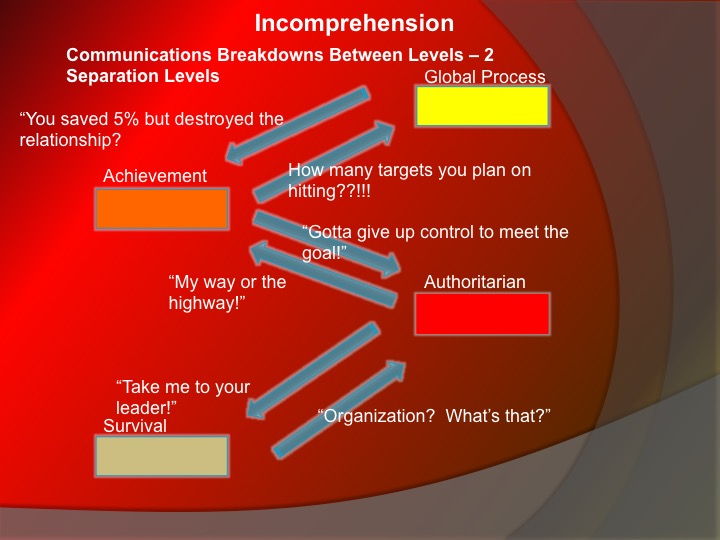
When you put a person with a dominant Performance/Goal-Based v-Meme together with someone who is predominantly an Authoritarian, what arises is what I call the Incomprehension Gap.  An Authoritarian might be able partially to understand why a Performance-based person wants to achieve a given goal — status, or money, for example.  But if achieving that goal means surrendering some level of control in order to achieve it — “to hit our targets this quarter, you’re going to have to let Bill take charge of this key project” — they’re not going to understand.

Likewise, the Performance-based v-Meme actor is going to be confused by the behavior of the Authoritarian.  Don’t they realize that their behavior jeopardizes the larger success of the company?  What about the amount of stock dividend?  What about having to answer to shareholders at the annual meeting?

The reality is that this kind of thinking requires a level of consequential awareness that the Authoritarian does not possess.  This is a very difficult concept for most people to grasp — that social/relational order actually creates the timescales inside people’s heads.  At the same time, it’s not difficult to generate 100 situations that we all have dealt with in our work worlds where this kind of behavior is exhibited.

I call this the Incomprehension Gap, and it is characterized across the v-Memes by a 2 v-Meme gap.  See the figure below.

Slide06

The picture above refers to Incomprehension among all “I” v-Memes in the Spiral. But there are also Incomprehension gaps inside the “We” v-Memes.  Compare the understanding that might exist between someone in an evolved Legalistic v-Meme, vs. a Communitarian.  The Legalistic v-Meme person will be prone to classification, because things are ‘fair’.  The Communitarian, believing that everyone should be treated as an individual, might attempt to explain extenuating circumstances for not including that person in a particular classification scheme.

An example might be this:  in my career as a professor, I’ve worked extensively with the Hispanic population.  Washington State has a large Hispanic underclass, mostly originating in the Yakima Valley (Trabajadores Migrantes — migrant workers) and my primary reason for offering my services was really class-based social justice.  When asked by Legalists why I didn’t do more to recruit middle class Hispanic students to the various labeled social organizations, I told them I didn’t think it was necessary.  Hispanic kids from Seattle, for the most part, were indistinguishable from any other middle-class kids from Seattle.  Often the only way you could tell them apart from the other middle-class kids was because of their surname.  This was met with some consternation.  “They’re Hispanics!” the Legalists would cry.  Never mind that the students themselves didn’t want to participate.

My personal experience with people working across the Incomprehension Gap is that conflict can occur, but mostly results in mystification of both parties.  Their understanding of the other seems so close — yet especially when spanning the gap between Externally Defined relationships and Independently Generated relationships, the distance is still large.  People in the former categories are belief-based thinkers, and messages to them are going to have to be translated into their belief systems.  Independently Generated relational people are going to be data-driven, and more contemporaneous and situational in their thinking.

As might be expected, it is up to the more evolved thinker in the conflict to develop the knowledge structure that the other can understand.  And at the same time, these types of conflicts show why it is so important to continue evolutionary development of everyone in an organization.  People will always settle on a particular v-Meme modus operandi — for example, I almost always settle back to a default Performance/Goal-Based v-Meme.  “Let’s get the job done!” I’ll say.  That sounds good — but in a Power Structure/Hierarchy, jumping levels to upper level decision makers above your main boss can hurt your career.  ‘Nuff said!

But self-awareness on both parties can make all the difference — and lead to negotiated solutions.  More on this later.

Conflict — Understanding, Avoiding and Healing it — Intra- v-Meme Conflict

hmeadows

Hanson Meadows, Kelly Creek Roadless Area, Clearwater National Forest, ID

“What we’ve got here is a failure to communicate.”  The Captain in the movie Cool Hand Luke

One of the interesting things revealed by understanding people and the social structure they inhabit, in terms of the knowledge structures their brains are wired to accept, is when one can expect conflict.  Conflict always boils down to two types — Intra v-Meme conflict (conflict between people or organizations with the same v-Meme sets,) and Inter v-Meme conflict (conflict between different people or organizations with differential v-Meme sets).

Intra – v-Meme conflict is the base lens that most people view conflict through.  Two people, roughly evolved to the same level, can’t agree on surface-level facts or situation.  This expresses itself as a disagreement, and will have to be resolved through whatever the dynamics and tools that are available to the individual or organization inside that v-Meme.  The classic conflict we’re all familiar with is Authority vs. Authority — two authoritarians, each with a different view of the world that they control, that can’t agree.   As history has shown repeatedly, these types of conflict have to end with exhaustion of both sides (essentially a v-Meme devolution to a Survival v-Meme,) or destruction of the other party.

It’s not hard to generate examples from the other v-Memes, as long as the dominant v-Memes are dominated by externally defined relationships, and emotional empathy.  Many have said the main reason Native Americans lost in their struggle against white imperialism was because of fratricidal relationships between the tribes.  Crow Indians hated the Sioux, for example.  The Iroquois Confederacy (more accurately described as a Legalistic Authoritarian system than a Tribal alliance) sided with the British against their ancient enemies, the Hurons, who allied with the French. One might not be so surprised by the chronic rioting after football/soccer games if one considers the tribal/magical allegiances that shape powerful, low empathy in-group/out-group dynamics.  And Survival v-Meme conflicts are also easily understood — if it’s your survival band that needs the watering hole, and without it, you’ll die, one can see how more evolved behavior goes by the wayside.

The costs of intra- v-Meme conflict are interesting generators of higher-level empathetic cultural modifiers themselves.  The tradition of Potlatch among Northwest Native American tribes was a period when classic Authoritarian v-Meme violence between the highly evolved salmon tribes of the coast was set aside for gift-giving between aristocrats in the tribes, that obviously developed relationships that held off chronic inter-tribal war.

Needless to say, a great deal of human history is filled with intra v-Meme conflict — as well as many organizational conflicts inside modern corporations and organizations.  I was previously the Chair of the Faculty Senate at my home university, Washington State University, a large land-grant institution stuck in the middle of the wheat fields of Eastern Washington.  Anyone who wonders whether education structurally changes behavior in social systems — eh, not so much.  One of my favorite quotes was “if you wonder why faculty fight like the gangs in South Central L.A., it’s because they have the same social structure.”  How true that is.

And these types of v-Memes, while ancient, are still prevalent in the minds of leadership.  When asked why he invaded Iraq, aside from all the hoopla over non-existent weapons of mass destruction, George W. Bush said succinctly about Saddam Hussein — “He tried to kill my daddy.”

Takeaways:  Intra v-Meme conflict is something that we are all familiar with, and is almost always confined to the lower v-Memes.  Egocentric projection dominates — who cares about the fate of whoever is in the out-group anyway? — and consequential behavior is minimized.  Lack of multi-solution thinking forces these conflicts in organizations back a devolutionary chain.

What are the Implications of Bad Scaffolding? China and the Last 100 years.

Daluandme

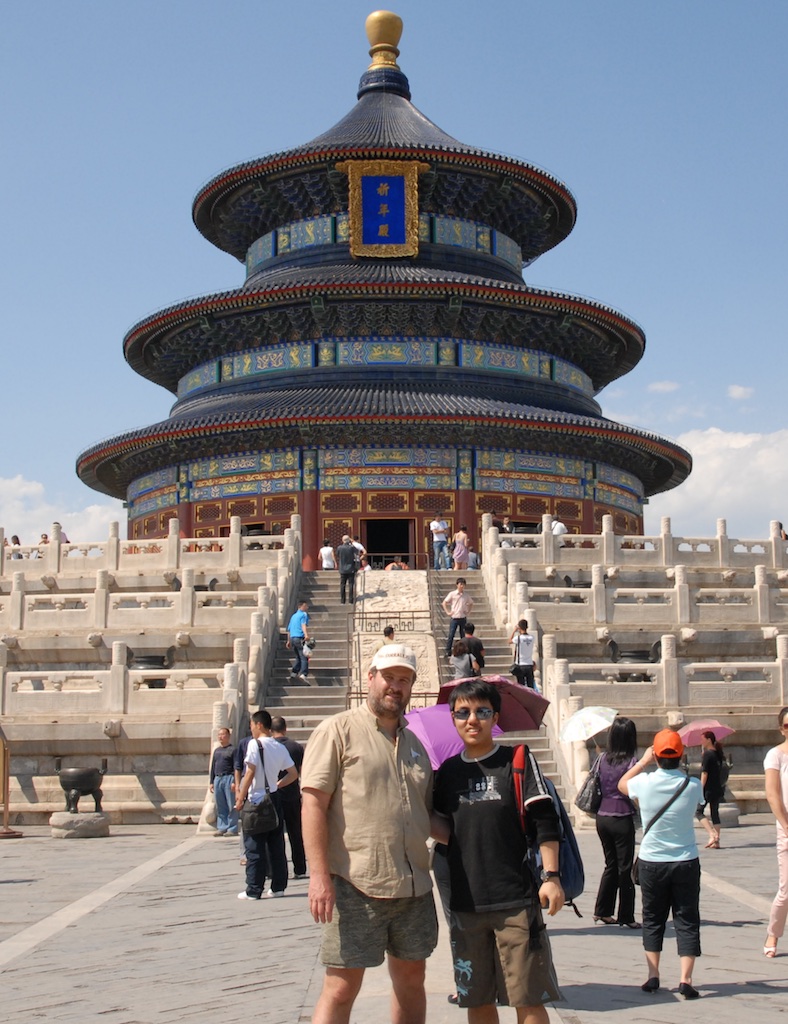
Runlu Li — my Godnephew and me in front of Sky Temple, Beijing

One of the biggest problems, when talking about evolving societies, is the natural critical expectation of an evolved society to get everything right.  Just like there are no perfect people, there are no perfect societies.  We all have our weak points.

Here, Spiral Dynamics can do an excellent job of giving guidelines on how to find the holes, or at a minimum, where to start looking.  A great example might be China in the 20th and 21st Century.

China at the beginning of the 20th Century was a mess.  Its government was really not a government, and regional warlords ran most of the show.  China had never really emerged from its dominant governmental form of narcissistic authoritarianism that made up the majority of its vast history.  The result of 2000+ years of relatively constant v-Meme assertion, however, was one of the most sophisticated forms of arguably empathetic authoritarianism in history.  Chinese culture was, and still is, even post-Cultural Revolution, extraordinarily complex, and I’ve talked about how things like chengyu buffered the population from the excesses of the Emperor, as well as the modifications offered up through Confucianism and Legalism.

WWII led to further fragmentation, rule by the Japanese in the north, and eventually, the collapse of the Kuomintang government, which then led to one of the most destructive and austere forms of authoritarianism on the planet — rule by Mao Zedong, and the reduction of Chinese society into two classes — party members and non-party members.  What is interesting about all this is that it is very difficult to second-guess history.  Would modern China have been possible without the narcissistic psychopathic excesses of Mao?  Without the Great Leap Forward, or the Cultural Revolution?  With China’s chronic problems with overpopulation, there are huge questions in how one gets to a society where individuals might be valued, when there is such an excess number of them.  This is NOT intended as an apologia for a cruel and vicious regime.  But the agricultural reforms implemented by Mao also broke the back of the regressive authoritarianism present from the various warlord periods.  As wild as it may seem, Mao was a strange agent of societal evolution for China.  He established an unstructured sense of a Legalistic v-Meme ‘We Mode’ that elevated the peasant class, while killing a lot of the landed gentry — somewhere between 1-2 million landlords were executed.  This came with enormous informational cost — no question.  But it also dismantled a social structure that had been in stasis for thousands of years.

After Mao’s death, Deng Xiaoping implemented many of the economic reforms (Performance-based v-Meme) that led to China’s current prosperity.  The numbers of Chinese peasants lifted into the middle class in the last twenty years is staggering — it is estimated that the Chinese middle class now composes approximately 68% of the population.

Yet China as a whole still has a relatively undeveloped legal system.  Most of the population do not believe in the courts. IP theft is commonplace (and well-publicized) and the lack of ability (that comes out of a poorly developed Legalistic v-Meme) to develop uniform codes and standards dramatically affected the ability of China to even have a civil airspace.  You can’t have commercial aviation in an Authoritarian v-Meme setting.  What happens when the boss is asleep?  Who gets to land first?

Relationships in China are still primarily externally defined.  I’ve mentioned earlier in this blog that if you see two people fall in love in a Chinese movie, you can be sure that this will result in their death at some later point.  But the effects of increased peer-to-peer communication are changing China.  There is a growing environmental movement.  Some of it is local and independently emergent.  But what is fascinating is that the Chinese government realizes that there is no way to avoid the development of SOME kind of environmental movement, as Chinese pollution problems are so bad.  Keeping with the v-Meme of external relational development, the Chinese government has set up GONGOs — Government Organized Non-Governmental Organizations — whose purpose is to be concerned with various environmental issues that the government may be slightly on the other side.  By setting these up, the government intends to control their activities.

But the reality is you can run, but you can’t hide from the fundamental empathetic physics present in sentient development.  Membership in the GONGOs is self-selected.  Which means like-minded people are going to meet, and start the data-driven evolution out of their former belief systems.  They, by virtue of being involved with each other in that independent, self-selected fashion, will start demanding real laws, and real data-driven solutions.  My bet is that between the One-Child policy, which is going to force an entire generation out to make friends, and the environmental movement in China, we will finally see the backfilling in of the Legalistic v-Meme that was skipped by Deng, and an increased developed empathy across the country — perhaps even to some level of communitarianism.  Sure, it will take 20-30 years.  But it’s on its way.

Further reading:  McKinsey reports are a great research resource for a broad range of issues.  This one is on China’s emergent middle class. And this one is on the Chinese consumer of 2020.  The reports focus mostly on aspirational capitalism and ignore the other trends that accompany an increase in purchase of status-based goods — namely diversity of goods, and the increase in empathetic identification that becomes important as consumer goods become increasingly fractionated — as well as the demand for design thinking (and the creative networks) to make those goods with a Chinese cultural flavor.  But that’s a topic for another blog post.  

Shorty Post — Where is All This Heading? Plugging Someone Else’s Work

fieldofflowers

Indian Paint Brush, Clearwater Country, Idaho

Just got done reading this.  This guy totally gets it, and this entire piece in the Guardian is worth reading.  What this blog is, in part, about, is explaining from First Principles how the planet is growing a nervous system — which is directly connected to the level of empathetic connection we establish with each other.

But more practical readers may appreciate that he talks in real terms, as opposed to more theoretical models.  Click here for Paul Mason’s The End of Capitalism has Begun.  If you’re a capitalist, and want to keep making money, you need to read this.  And if you think it’s some Marxist screed, you’re dead wrong.  And haven’t been doing your homework.  😉

Empathetic Ladders and What People Can Understand — Matching Knowledge Structures for Messaging (Part III)

Braden Montreal

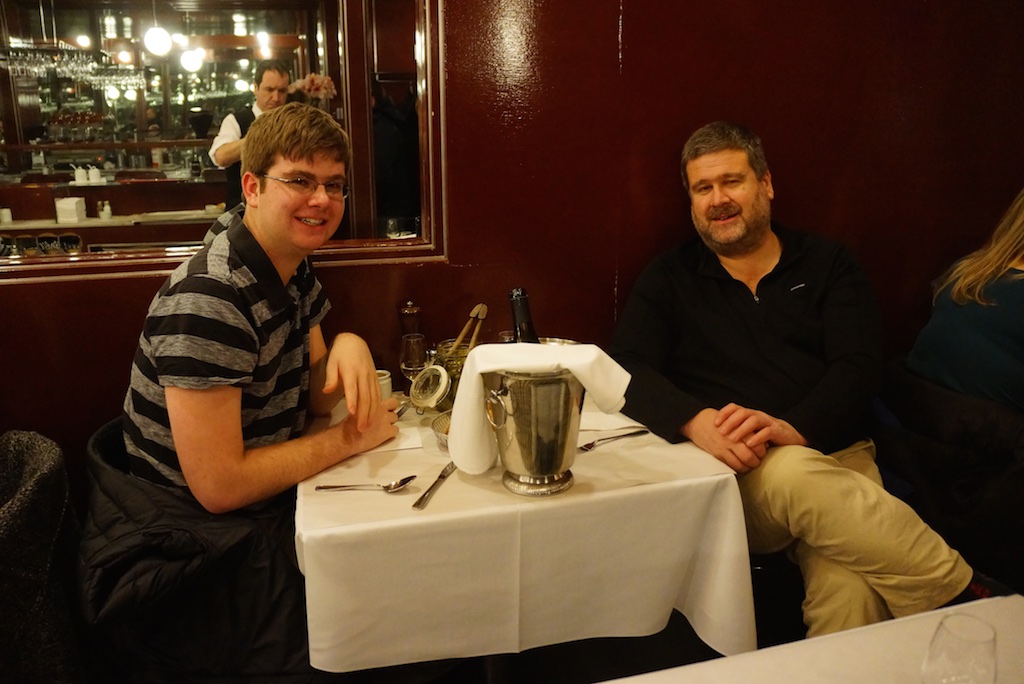
Lovely French food at L’Express in Montreal, Canada,  with Braden

Unless you’ve been thinking about this stuff forever, you might be at the point with this blog where you’re Pee Wee Herman in “Pee Wee’s Big Adventure” — where he’s busy explaining to everyone all the evidence around his bike getting stolen.  Pee Wee has a captive audience of all of his friends, and after going through some 240 different exhibits (where everyone is fast asleep) he stands up and says — “What does this all mean?  I DON’T KNOW!”

But it does mean something.  What I laid out in the previous post is how you have to explain things to people who inhabit given social/relational structures.  If you’re talking in a Survival situation, the answers better be immediately relevant, and only pertain to matters at hand.  If you’re in a burning building, you’re probably not interested in the potential hazards you might be experiencing because of building codes written 20 years ago.  You just want to get out!

Since most business environments fall along the Spiral from Authoritarian to Communitarian (sorry, but there are precious few self-aware business environments out there — I’m hoping you’re reading this so you can create these!), it helps to understand and master the language for the four dominant v-Memes.

Now here’s the kicker — you have to remember that when you address an audience, even if you want to change them, you have to address them where they’re at.  If you have some idea that you’re going to persuade them with a knowledge structure other than the one they own, well, good luck.

If you’re talking to a bunch of Authoritarians, then it helps to be an Authority yourself, and speak mostly in terms of knowledge fragments.  Authoritarians tend to have a terribly developed temporal sense, to the point of a total lack of consequentiality in their thinking.  Why should they think about any future other than their own?  They’re in charge!

How do knowledge fragments represent themselves at that level?  One of the great examples to consider is how different people might recommend dealing with the homeless problem in the U.S.  An Authoritarian would be receptive to hearing “Just buy them a bus ticket to the next town!”  It’s short, sweet, and completely devoid of temporal context.  The Authoritarian assumes, or rather, believes that no change is possible inside the power structure.  And homeless people, being on the bottom, will always be on the bottom.

Once we have this understanding of solution (out of sight, out of mind!) then we can see that there’s little empathetic progress to be made on the issue in a vacuum.    You’re going to hear lots of stuff like ‘they should pull themselves up by their bootstraps!’  It sounds like something they need to do, but who even knows what bootstraps are nowadays?

Legalistic/Absolutistic v-Memes will need to be communicated to with algorithms and processes that historically have generated higher status individuals.  “Education is the answer” might appeal to the standard legalist, along with some version of absolutistic nostrum.  “How can they make progress if they don’t have their G.E.D.?”  We see the emergence of certification of process that starts dominating thinking.

As a professor, of course, I value education, and view it as necessary scaffolding for lots of different types of situations.  But it’s not always the answer.  The hopeful part of the legalistic v-Meme is that in algorithms, we now start to see a developed sense of consequence.  If we dump people into a given algorithm, when they pop out the other side, they will be changed.  The Hands of Time at least have started to move.

At the same time, however, most legalistic/absolutistic v-Meme members are not going to recognize individuals as individuals.  There can be, in evolved legalistic thinking, different sub-classes of populations  (‘rural poor whites have different problems than urban poor blacks’).  And that should be expected — remember that legalistic v-Memes would be dominated still by externally defined relationships.  No one yet gets to achieve individual status, so we’re not yet interested in any person on a case-by-case basis.

Moving up the Spiral to Performance/Goal-based v-Memes, different thinking starts to emerge.  Remember, this is where we start to see heuristic thinking emerge.  How might that look for our example?  “Well, Homeless Bill here used to be a plumber.  Then he took to drink, and fell off the wagon.  We think that the first thing he needs to do is join AA, and get him in a recovery program where he can remember how to braze a pipe joint.  Then he could apprentice with the local union and get a job.”  The steps along the way might follow a general path (another simpler way of saying heuristic!)  of personal health, professional re-training, and financial stability.  But the exact prescription would depend on the individual.

Finally, a quick look at the combined heuristics of a Communitarian v-Meme would add recruitment of larger partners into Homeless Bill’s problem.  “It takes a village to get a homeless person off the street,” some might say.  And then we see the emergence of public-private partnerships, each with a slightly different approach, adaptable to individuals, for solving both the individual and group problem of homelessness.  One can also see the development of a much more complex web of relationships between actors in the solution of the problem.  Government is going to play a role, as well as potential landlords, job training, churches to take away the demon rum, food stamp providers, and a host of other angles.

Different approaches will likely take different amounts of time, and that requires a much greater developed temporal sense than the Authoritarian’s solution of frog-marching any homeless person to the bus station and buying them a ticket to leave town.

One can now see how empathetic development is co-evolutionary with both diverse and complex solutions.  Authoritarians are going to have one quick solution (the bus ride).  Legalists are going to set up a single government program in charge of the homeless.  Performance/Goal-based thinkers are going to support links in a chain.  And Communitarians will start weaving the local web.

That means that you, as a leader and communicator, have to figure out who’s who in the Spiral world.  Because it makes no sense to talk about local webs of relationships to the Authoritarian to deal with the homeless.  The next thing you know, you’ll have a bus ticket out of town in your hand.

Takeaways:  Knowledge structures tell us how we must structure messages to convince audiences.  It’s not enough to be on topic, or on message.  That message has to match the modes of thinking of the people we’re trying to reach — or else it’s just gibberish to the people listening to you.  Not very empathetic.

Future reading/watching:  There’s no better example of wildly funny egocentric projection that Jerzy Kosinski’s novel/movie Being There.  The movie, starring Peter Sellers, is a classic.

Empathetic Ladders and What People Can Understand — Matching Knowledge Structures for Messaging (Part II)

oldmanriver

The Intermediate Corollary is a powerful construct — in the pathway of Social Structure -> Knowledge Structure -> Design Structure, it implies that certain social systems will create knowledge in particular ways, depending on the level of empathetic development.

Why does this matter?  We’re used to thinking of knowledge, for the most part, as a 2-dimensional construct, based on a plane of ‘objective’ knowledge vs. ‘subjective’ knowledge.  Scientists claim the high ground through objectivity.  Religion claims the high ground through channeling the Word of God.

This view of knowledge is a mental model, and not surprisingly, lacks a fair amount of detail or nuance.  Tearing it apart on either side is not particularly productive, either — especially in a blog post.  Every competent scientist knows that objective data is always constrained by the context of the experiment that generated it — the researcher decides what factors to vary, which ones to study and so forth.  Religious experts argue from historic texts and long tradition.  While we’ve grown to accept the debate, when you back up from it, it really is a mess.

There is a better way in understanding knowledge that’s produced.  It’s by understanding Conway’s Law, and the Intermediate Corollary, and then linking this through the emergent social structures given by Spiral Dynamics.  By understanding how people trade information (that is able to be validated or not) we can start creating more of a multi-dimensional knowledge landscape that gives a better perspective on how people structure knowledge neurally — inside their own head.

Understanding that humans operate with three primary variables that govern their social evolution is the basis.  Humans have a temporal (time-based) calibration (this has been discussed before with regards to empathy) , a set of spatial scales (3-D, x, y, z) and some level of energetics — the ability to get from one place to another, in a certain amount of time.

So what’s a summary of these knowledge structures look like, starting from the bottom of the Spiral?  When reading these, it’s important to remember that v-Memes higher up the Spiral include new modes of thinking, as well as all the ones beneath them — like Russian nested (matryoshka) dolls.

Survival v-Meme — knowledge is temporally short-term, spatially small (where do I find food/water), and exists in fragments.

Tribal v-Meme — knowledge is shared inside the tribal band, either temporally long-term (creation myths, coded survival information) or short-term, in stories that reference long-term memory.

Authoritarian v-Meme — knowledge exists primarily in fragments, where the truth/veracity of the given fragment is decided by the authority/boss.  If you are below someone in the power structure, it is expected that you will accept your authority’s definition of reality and truth, unless some cultural sidebar of appeal is offered.

Legalistic v-Meme — knowledge exists in rule sets that apply across a group of people.  Knowledge can be fed into these rule sets and transformed into other information (if THIS is true, then when a given rule is applied, THAT is true.)  Note that this kind of knowledge representation implies a high level of determinism and no tolerance for ambiguity.  There are no multiple solutions possible, nor implicit recognition of unknown factors.

Performance/Goal-based v-Meme — knowledge exists in heuristics (rules of thumb) that allow the individual to pick and choose various pieces of knowledge and rule sets to reach a conclusion.  Goal-based knowledge is the first that recognizes metacognition — knowing that there are unknowns that you can’t predict nor understand in any given decision-making process.  Most contemporary design processes fit inside this v-Meme — a given set of specifications can yield multiple designs, all more or less optimal dependent on a given interpretation of the customer.

Communitarian v-Meme — knowledge exists in combined heuristics of individuals in the community, that may be more or less valid dependent on the aggregate opinion of the community.  In an initial land use determination, where there is no code or body of law to apply, a community may get together and jointly share opinions, based on a variety of arguments, on how a piece of land might be used.  Later on, after a series of decisions are made, these may then be codified in a more legalistic v-Meme set that removes larger ambiguity.

Global Systemic v-Meme — the first of the Tier II v-Memes, there is an explicit self-awareness of the picking and choosing of knowledge structures from the lower Tier I v-Memes.  The primary differentiator in this knowledge structure is an awareness of the individual of personal bias — “I’m trying to reach this goal because of my own past experience, thought process, and feelings regarding this issue.”

Global Holistic v-Meme — fundamental guiding principles.  Guiding principles are very different from simple rule sets in that when applying them, they can generate complex structures of knowledge themselves.  When combined, they can produce a potentially large, or infinite and complex set of behaviors and knowledge, with complex interactions and synergies.  Temporal scales are long (we can understand how the universe started) and prediction can be large (we can guess how planets around other stars revolve) with some accuracy.

A simple example of a guiding principle might be the Law of Gravity.  We don’t have to go run an experiment across town to convince ourselves that if we jump off a building across town, we’ll end up on the pavement.  True guiding principles are hard to come by.

Takeaways:  Knowledge, synergies, spatial and temporal scales increase as we move up the Spiral.  The more empathy in the system, the more complex the synergies available, and the greater number of time and spatial scales.  At the top of our current understanding are Guiding Principles, that are capable of spinning out complex patterns and multiple solutions.

Further reading:  Fractals, a class of geometry present in nature, are a great example of how a given rule, with some simple input, can generate extremely complex behavior.  The Mandelbrot set is a great example, and you can vary simple pictures of your own by going to this NOVA website.

For those that want more, you can start here and keep exploring.

Using the Principle of Reinforcement for Evolving Empathetic Teams (II)

sforkconfluence1

So how does one go about developing more empathetic team members?  The beauty of understanding the empathy pyramid, combined with using the societal/leadership authority present in the Principle of Reinforcement, tell us what is more likely to stick earlier on in the process.

Not surprisingly, enlightened master Mahatma Gandhi said ‘be the change you want to see in the world.’  Directly addressed by mirroring behavior, this statement addresses the first tier of any empathetic transition of an organization.  Leaders have to demonstrate the behavior, and this is a well-known principle of management.

The other levels offer more guidance on behaviors.  Emotional empathy, where leaders honestly feel other people’s successes and pain, can establish the leader as a compassionate individual.  Compassionate leaders are typically held in high regard — which at some level is a status-based response, and is a primary incentive in authoritarian/legalistic organizations.

Rational empathy, best exhibited by place-taking, is where things start to get tricky.  Real rational empathy is challenging for most people.  Fundamental egocentricity has to be overcome — remember when I talked about giving my students a customer as a way of combating this tendency.

But there are other ways.  Great spiritual teachers, divine or not, depending on your belief system, have invented what I call ’empathetic ladders’ –development tools for creation of complex empathetic response in individuals who are not particularly highly evolved.

One of my favorites is Jesus Christ’s  The Golden Rule — “Do unto others as you would have done unto yourself.”  How did this come about?

I can imagine Jesus sitting around one day, pondering his ostensible flock.  “Father, what can I do with these people?  They’re mostly pretty egocentric, thinking only of themselves.  I really would like them to understand their fellow man and woman, and comprehend the individual journey each of us are on in this world.  I’d like them not just to develop rational empathy, but global empathy as well, and realize that we are all connected in our existence.  I’d like them to think not just about what the people individually ask for, but what they honestly need by considering their past, as well as their future.”

And then he said “Nah — they’re never gonna get that.  Do unto others…”

What’s fascinating about the Golden Rule is that it is what I call an empathetic, or Spiral Ladder.  At first blush, everyone will respond to the Golden Rule, especially if one considers the more drastic potential alternatives.  I don’t want to die, so I won’t kill someone.  I don’t want to have my stuff stolen, so I won’t steal someone else’s stuff.

But once you get past the Ten Commandments, things start getting a bit more tricky.  I like chocolate ice cream.  Does that mean I should go out and distribute chocolate ice cream to the lactose-intolerant?  And so on.

Yet if we practice the Golden Rule, it evolves rational empathy.  The first time you bring someone chocolate ice cream to someone who doesn’t like it, you’re cued to pay attention to what that person’s preferences are.  If you can’t provide that preference, then you show a little compassion.  I am never able to bring home for my Taiwanese wife red bean ice cream, so I have to demonstrate sympathy for her deprivation.  She remarked on a picture of a child eating a roasted Japanese yam.  So the next time I was in the Asian grocery store, I made sure to pick one up.

And of course the evolution continues.  So many of our favorite treats are from childhood.  You might like oatmeal cookies because your mom made them.  But what were the childhood treats in Taiwan?  What was childhood like at all?  Was there a whole lot of joy besides studying for tests?  (Hint — not that much!)

Most business development/success books focus on the transition between Authoritarian/Legalistic title-based leadership and Performance-based Communitarianism in evolving corporations because in American business culture, that’s where a lot of the work that needs to be done is.  There is no better example of this than Steven Covey’s Seven Habits of Highly Effective People.

But that landscape is changing.  Now, good leaders work to identify the level of empathetic development of each of their employees, and then construct ladders to help them evolve.  As our workforces gentrify, people in their 50s are looking for different structures of meaning than people in their 20s.  And that’s going to demand a different toolkit of both understanding and pathways.

Takeaways:  Using the Principle of Reinforcement, smart leaders seek to evolve their employees, both by working with them directly and creating environments where ways of being drive empathetic growth. Since all employees are different people, each of them will need something different to help them on their own pathway toward higher meaning.  Empathetic ladders, such as the Golden Rule, offer a way to accelerate development by combining v-Memes where people are in a way that reinforces where the leader would like them to be.

Further reading:  Zen Flesh, Zen Bones, by Paul Reps, is a great collection of accessible stories containing age-old empathetic ladders.