Conor at Satan’s Cesspool, SF American River, the Gorge Run
One of the more interesting things to roll across my desk recently is the announcement of roll-out of the XB-1, the supersonic demonstrator aircraft created by Boom Aero — a startup dedicated to creating the first supersonic transport after the Concorde — literally 60 years later. This is their promotional video around this event.
And it is interesting indeed.
OK — some ground rules here, folks. It is very annoying to me to immediately engage in “gotcha” type thinking. I know it is a promotional video. No, I don’t believe all their claims. Yes, I know that supersonic flight is fraught with many perils, not the least of what it does environmentally to the high stratosphere 60k feet off the ground. Yes, I am deeply familiar with the noise problems of the Concorde. If I had a nickel for every time I had to explain wavefront shock propagation to people that believed planes just went up, “broke” the sound barrier, and that was the end of it, I could have a very nice meal indeed.
But the video is worth the watch. Not because they talk about sustainability, or all sorts of the other selling points they consolidate. For example, they talk about recycling the airplane. Trust me, the problem with supersonic flight is not in the recycling. It’s the lifecycle impacts during the use phase that are the real problems. And those are sticky and harder to address. The engines are designed to optimize performance for biofuels, but those very biofuels require petroleum at this point to grow.
What is more interesting is their discussion of their work practice, and how they apparently structured their high-performance teams. In order to get off the ground (pun intended) with supersonic flight, they required far more synergistic blending of the physics, as well as manufacturing and customer participation. And that requires far more empathetic development of technical teams than in the past.
Additionally, the XB-1 is their prototype aircraft, and there is tons of empathy built into the cockpit design, with massive amounts of feedback from their test pilots. The final plane, named the Overture, and scheduled to fly in 2030, will use the data from the testbed to deal with all the deal-killers associated with Concorde. It is unclear if they might cut the sonic boom problems enough to fly overland — but it is clear that they are taking aim at an economical solution to business travel.
Boom may succeed, or they may fail. I don’t know at this point, and I suspect that there will be many unknowns that emerge that dictate success, not the least competitive meeting technologies, such as holographic projection. But one thing for sure, is that when travel times are literally slashed in half, and jet lag is eliminated, it is going to create a certain sophistication in people who normally jet around, as well as the incumbent negative “bubble” effects. While creating a new, super-empowered global elite (I’m sure Jeff Bezos will have his own aircraft) who CAN know how tightly interconnected the world is, it also has the potential to create even more walls between the rich and the poor.
And more interestingly, the social tech. at Boom needed to develop such an aircraft has the potential to dramatically influence the work practice of super-high, or perhaps hyper-high tech around the world. Promising — but scary. Because that means if we can’t figure out what they’re really doing at Boom memetically, there is huge potential for whole professional work classes to be left behind.
Should we support the focus on a plane primarily aimed at the rich? I’ll tell you this. Projects like this create new groups of people, and sustained supersonic flight, because it is so charismatic, is a complexity magnet. The lessons learned may (and I emphasize ‘may’) bubble over to other problems that will require technical complexity to solve, like fusion research, or AGW. That means the memetic gap between the complexity “haves” and “have-nots” is going to have to be understood. Here’s to reframing our mental models so we really understand how tech. development will really change our brains.
Needless to say, even I am envious of this turtle right now.
Recently, I had the pleasure of doing a video podcast with two very interesting people — Adam Townsend, and John Robb. Adam is a successful stockbroker, and John is a pundit/futurist/analyst with a background in dropping into houses in Iraq and rescuing Americans in bad situations. It was Adam that brought us together, with the tagline of listening to two of the Matrix’s key characters. John was Neo — he has amazing front-line stories. And I was the Keymaster — the person who basically understands how the Matrix is structured. Here is the video.
John has the very interesting, and memetically correct perspective on what is globally happening as far as world organization. As people’s loyalties to nation-states diminishes, and culture recedes as anything resembling a coherent, geographically oriented notion, people are organizing themselves in a myriad of new ways. John calls them Networked Tribes, and that’s all fine and good. But the problem is that in any given tribe, there are no binding ties created. What that implies from a Knowledge Structure perspective is that all these people really have to tie them together are shared, recently generated myths. QAnon is a great example, with superhero Donald Trump battling a secret war against the Deep State, filled with cannibals and pedophiles.
What happens when you have the functional vanishing of national, cultural identities is that people gravitate to other like-minded, or more correctly, similarly brain-wired individuals, now accessible across the country at a minimum, and often overseas. I read recently that Germany, for example, even has a QAnon chapter. There’s also larger movements, like ISIS/Islamic State, that built their movement on mythic foundations of Islam, and justified child rape and slavery in their ranks based on 8th Century precepts.
But while it’s fun to look at extreme examples that are easily rejected in the eyes of modern global culture, is that far less radical, situationally, worldviews also sort out memetically. In the United States, we’ve particularly devolved through the Presidency of Donald Trump. In true Julian-Jaynes-fashion, Trump has managed to install himself in the heads of many of his supporters as an alternative god telling them what to do. Once understood, it’s perfectly in line with how a narcissistic psychopath would operate. Tear down ego boundaries through broad-scale relational destruction, and get everyone to line up in the In-Group around the capricious views of Dear Leader. From the INSIDE of their noggin.
And though I’ve maintained that many Trump voters have not had one of Jaynes’ Old Gods installed in their head — they are voting out of desperation that their legitimate needs might be addressed — the last week has shown exactly how that works. One could find no better example than Trump contracting COVID, and then forcing the Secret Service to drive him around the crowd of his cheering supporters outside of Walter Reed Hospital.
What increases the violence of reaction to all this, which the Left seems to not be able to recognize, is that Trump has installed himself in THEIR heads as well. One need only to open up one of the big memetic/v-memetic amplifiers of our current age — Twitter — to see the wave of nonsense reactions to his crazy behavior. The general theme is “The Republican Party Should Force Trump to Resign!” or some such icks, over everything from Ruth Bader Ginsberg’s replacement, or the potential circumstance that Trump gave everyone he knows COVID. It’s not that I support in any shape or form Trump’s response to his infection. I emphatically DO NOT. Do you really think your caterwauling for Trump to leave office early is going to go anywhere?
One would also be remiss to not note that Trump was literally one of the last leaders in the ostensible Free World to catch COVID. It was literally only a matter of time. The “good guys” got it (Merkel and Trudeau’s wife, who doubtless gave him an immune reaction) as well as the “bad guys” (Johnson and Bolsonaro). That’s because of the literal physics of the situation. The virus is ubiquitous, and these people meet hundreds, if not thousands of people a day. How could they NOT get it? The Left has created a myth around mask-wearing, as if wearing a mask was the equivalent of Captain America’s shield. But the science, which I have written about (positively for those that don’t want to click through) indicate masks as a statistical measure. If you run the experiment 1000 times, sooner or later, your number is going to come in.
But understanding that involves higher-level, complex knowledge structures (Performance-based and up) and there’s no complexity in thought nowadays. Hence, Robb’s “Networked Tribes” remains right on the money.
Moving off of Trump to COVID, I wrote previously about the beginnings of the Memetic Wars between scientists like Michael Levitt, the Nobel Prizewinning cell biologist that took up the cause of investigating COVID after initial predictions of mass death, and the mainstream epidemiological community (such as the group at the University of Washington) the palliative measures, such as lockdown, turned out to be wildly off. It is true that Levitt, like myself in our analyses missed a couple of things. Neither of us predicted the low-latitude Southern US wave (and to a lesser extent, the green-field wave going through the thinly populated High Plains states) but those errors were small compared to the chronically inflated estimates coming out of the University of Washington. They are now predicted doubling of COVID-19 deaths between now and Christmas.
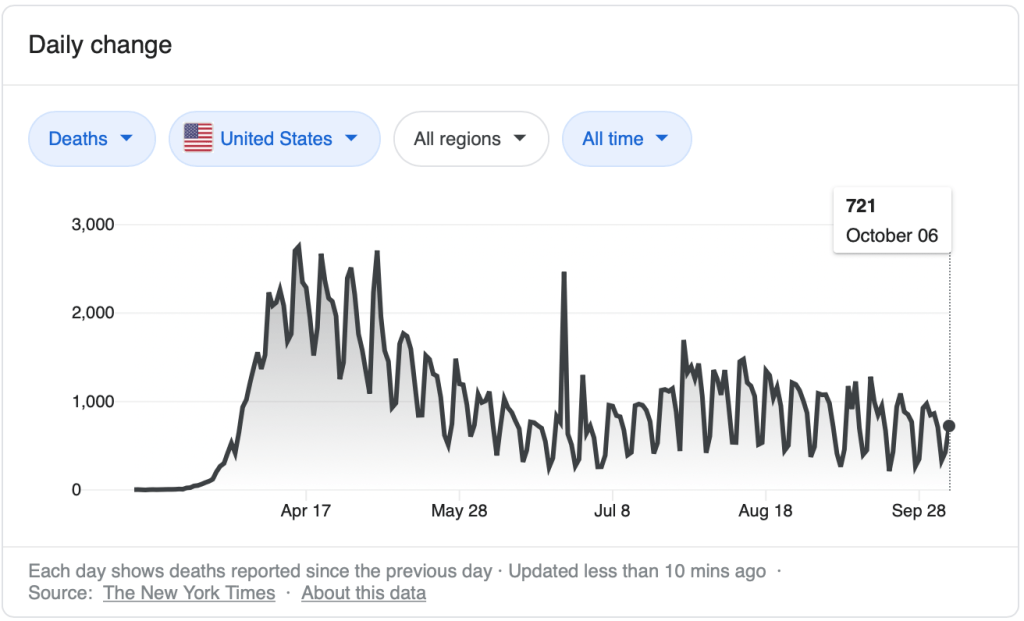
This is utterly mindboggling, and an indication of some bad modeling at a minimum. That means in the US, we’d have to have a couple of peaks in the next two months that would dwarf the well-defined Northern latitude and lower latitude peaks we’ve already seen.
Current COVID death curve for the USA – note the 1 day spike in the middle is probably a statistical reconciliation error
I find myself staring at this, and wanting to ask the UW scientists “how would that even work?” Needless to say, they don’t answer back on Twitter, and I’ve given up. But how would that work? The pandemic didn’t begin yesterday, and there would literally have to be a scene from Monty Python to make it happen. Remember this one?
A classic
How do you double the casualties from the pandemic, in the waning months of the year? Even with accentuation from a flu season?
I think it’s easy to say that perhaps the scientists are politically motivated — making the case that the US response toward even delaying the effects of the pandemic would be an easy one. Since the Republican tribe is running the show, and it is an election year, one could easily level the accusation against those potentially Democratic scientists.
But it’s very likely NOT what’s going on. What’s really going on is that the v-Memetics of the situation are dominant. Scientists exist in Legalistic-Authoritarian hierarchies, and the modelers simply can’t backtrack on their positions, without at least some handwaving toward larger social and societal parameters.
Wearing masks, for one. And how crazy is that? As I’ve said earlier, wearing masks does work as a damper in the larger system. Social distancing as well delays, to some extent, viral spread, especially during the early days of any pandemic. But we’re late season here, folks. And here’s the real rub. I don’t even want to address the dismissal of the pandemic by the Right Wing, who operated with little information or consequentiality. That goes without saying. What’s more distressing is that the Left, under the banner of Science is screaming “these Right Wingers aren’t wearing masks!” Yet, at the same time of the inevitable waning of the virus, they will be the ones screaming “it’s because people wore masks!” I’m reminded of a child screaming at the tide (or Aztecs sacrificing people on pyramids to make the sun come up) as what we’re going to hear instead of Christmas carols.
The retrograde wing of the conservatives in the country are counting on divine providence, and honestly, that kind of belief in Godly interference is incredibly persistent with a poorly understood phenomenon. But the Left is going to have to reconcile to coherence that “we hate you because you won’t wear a mask/we’re saved because everyone wore a mask” when double the numbers of people don’t die by Christmas.
While the United States is mired in truly Networked Tribes/Tribal v-Meme politics, battling to either completely Jaynesian-assimilate into Trump’s mind, or raging to get him out of their heads, the rest of the world staggers forward in fits and starts. One of the interesting meta-phenomena that is occurring in places across Europe is as those nations, like the US, have gotten their testing acts together, is a dramatic increase in positive COVID tests. I haven’t dug deeply into whether these have been the PCR or antibody tests, but they have prompted the memetic wars across the Atlantic. On the one side is the very clear evidence that the pandemic was basically over in June for high latitude countries, and since Europe is fundamentally high latitude, the death curves show classic epidemic shaping. Here’s France.
France COVID death curve
Or even better, Ireland.
Irish mortality
Because of the renewed case counts, though, there is a war going on between the government and National Public Health Emergency Team, (NPHET) their version of the CDC about shutting the entire country down. It’s easy for me to get the inside scoop in Ireland because I follow Ivor Cummins, Twitter handle @Fatemperor, who lives there. The rigid hierarchy inside their advisory group, the NPHET, even in the face of basically no deaths, are calling for Level 5 lockdown — a near-total lockdown of society, for deaths that never come.
Ivor has implemented a hashtag — #WhyAreTheyDoingThis as he doubles down on his far more Global Systemic v-Meme sense making of the pandemic. Ivor — they’re working from their Authority-driven v-memetic structure, which at this point has no interest in the loss of status from admitting they’re wrong. Ain’t gonna happen. And as long as there are no short-term consequences for their profound lack of validity-grounding — the term I use for people being forced to reconcile their v-Memetic narrative to reality — they simply won’t give up. That’s their emergent behavior. They’re NOT thinking about 3 years down the pike. Trust me on that one.
And the problem is – the memetic explanation is the only narrative that explains this circumstance. One of the tropes making the rounds in the more evolved reasoning circles across the West is that the reason epidemiologists are endorsing this is because they hope to be recruited by Big Pharma for a position on one of their boards and make a lot of money. I don’t doubt that there are some bad actors in any community — epidemiology included.
But once again, the old question “how does that work?” can debunk that. Does anyone really believe that an epidemiology graduate student, slaving away in some lab, making models, or shuffling samples, is thinking, “boy, I can’t wait to issue a bunch of bullshit when the next pandemic comes in and make a ton of money!” Really? But the memetics still drive the solution, forming that governing DeepOS that say “in order to gain status, never admit you’re wrong.” Ivor — #WhyAreTheyDoingThis — you’ve got to get a new model for your own understanding. I’m happy to help. But I’ll tell you this — your NPHET committee has never been more important, centered, and receiving narcissistic supply as ostensible “defenders of the people” in their life. And top that off with a large victim complex when people like you emotionally beat them up over their histrionics. The circuits in their brain couldn’t be more happy. And here’s the downside. If they can find a way to get you, they will.
The final part of the Memetic War that is so interesting to me is that, at the beginning, as I’ve said in posts going back to the beginning of March, I was a lockdown/radical action adherent as well. My wife is Taiwanese, and we watched the wave of COVID come out of China — the Taiwanese are always on top of everything in China — and I prepared my own classes.
But things started not adding up, global coherence-wise, pretty quickly. We dealt with Tomas Pueyo’s ‘Hammer and Dance’ nonsense, and as data came in, I started the process of re-sorting all the valid evidence, to come up with the worldview I hold now. And I always thought I was alone. The rest of the epidemiological community doubled down on the simple ‘Andromeda Strain‘ explanation of COVID, and I felt pretty isolated — a true voice in the wilderness, subject to the wrath of some of my peers, screaming at me to “stay in my lane!” as a mechanical engineer — not the complex, multi-dimensional thinker I have become.
Now I’m used to being the proverbial societal leper, so I wasn’t cowed. But I couldn’t figure out the v-Memetic consistency of the epidemiological community. Were they all ungrounded, rigid Authoritarian/Legalists, willing to augur the nation’s death if we didn’t cease all activity to follow their agenda — regardless that consistency of conformance to measures was incredibly poor that I observed, without consequence to infection or death rates? My v-Meme categorizations are statistical, folks — they always have outliers. And there ought to have been more systemically oriented people popping up.
And of course, there were. People like the trio that have started the movement behind the Great Barrington Declaration. Dr./Prof.s, all, Martin Kuldorff of Harvard, Sunetra Gupta of Oxford, and Jay Bhattacharya of Stanford have all started a Global Systemic/Communitarian v-Meme campaign to push back against the Authoritarians. The Declaration is recruiting other scientists to sign and support a plan called Focused Protection, which basically lets the low-vulnerability students get it while those over 60 are protected. In a couple of months, the pandemic will have already run its course (it likely has in many places anyway) and then life can resume.
But naturally, these distinguished scientists/doctors, were not prepared for what is really a memetic backlash against their proposal. The last thing the Authoritarians in the health sciences want to do is let go of the best thing they’ve had going for power and control since the hogs ate grandma. This video of the three is a must-watch.
I had found Dr. Gupta’s work a while ago, and started to feel far less a leper at a cocktail party than usual. I discovered Dr. Kuldorff very recently, and had not attempted to contact Dr. Bhattacharya at all.
All three professors are essentially unaware of anything memetic, and act like they can’t believe the virulence they’ve experienced since they came forward with this plan. They are, of course, as professors from Harvard, Oxford and Stanford, members of a very privileged class and their own elite bubble. Yet they all have maintained a large sense of awareness and empathy, and make no mistake — I want to thank them for it.
It is Dr. Gupta, though, who in the course of this video, starts the process of realization that she’s in The Matrix. You can see it in her face as she starts to push back and describe the toxicity of the debate. As global thinkers, they’re at least three v-Memes apart from their Authoritarian peers, which means they’re suffering from serious v-Meme conflict — in particular, what I call the Insanity/Barbarism conflict. Their lessers think the trio is utterly insane advocating for what is essentially an evolved version of Sweden’s strategy. And they have to view their lesser evolved members of the community as barbarians. Gupta alludes to this, in the same way Jim Carrey in the Truman Show starts pushing back against the walls of his made-up world to find the real world outside. It is WILDLY fascinating. Watch their faces. It’s great empathy practice.
Of course, the reason I hadn’t heard of them wasn’t because they likely had an epiphany on how this pandemic worked and suddenly lined up with my views. They’re all super-intelligent, and potentially came to the same conclusions I came to earlier than myself. The reason once again is memetic. The v-Memes of the press corps sync identically with the short-time-window Authoritarians in this debate, and the palpable fear also stoked the media. That amplified all the fragmented, limbic messages, far beyond anything the deeper thinking crowd could combat.
And when coupled with easy lockdown messages such as Pueyo’s “Hammer and Dance” (resonant information fragments from another Silicon Valley entrepreneur, backed up by impressive graphics) a more complex, higher v-Meme message didn’t stand a chance. I had written earlier about Karl Friston coming up with the same tagline as my own complex messages. But we didn’t stand a chance against the devolutionary, fear-driving fragments. As well as their receptivity in the Tribal politics being engaged across the Western world. Fragments telling you someone else wants to kill you will win every time.
Well, until they collapse your society. Or really, collapse the society for a good portion of your citizenry. There has been a tremendous transfer of wealth during this pandemic upwards, making the wealth gap far more pernicious than ever before. Still maintaining my position in the middle class, I’ve experienced the privilege of sitting at home and doing pretty much what I always do — teach, and write. But others are suffering profoundly.
That doesn’t matter to any low empathy Authoritarians, who are fond of borrowing rules to enforce fear, or manipulate traumatized people deep inside it, and keep kids out of schools and such. They’ve got one piece of empathetic weaponry they’re willing to use — “don’t you care about people dying from COVID?!?” served with a heaping scoop of moral outrage. Talking about other issues with them, and their complex interconnections just isn’t in the cards.
But just because talking about complex interconnections isn’t in the cards, doesn’t mean those linkages still remain. The physical world is a bear. And we better wake up — become more aware, just as the three Good Doctors above are attempting to urge us to become. Because we may act out of our v-Meme sets unawares. But the Real World is still the Real World.
And though I expect I’ll hear nothing from Drs. Gupta, Bhattacharya, and Kuldorff, I’m here to help. And behind you 1000%. Think of me as the Keymaster.
If you’re looking for a podcast to ponder, I just finished Tim Ferriss’ Sept. 14 podcast titled ‘My Healing Journey After Childhood Abuse’. Tim talks honestly and frankly about his dissociative episodes that happened through adulthood until he finally unearthed his trauma using psychedelic medicines. Sharing the episode with his friend and counselor Debbie Millman, host of Design Matterspodcast, they share a synergistic view of their experiences and run through the long list of potential treatments, including pharmaceuticals, talk therapy and friendship.
Tim cites some crazy high statistics regarding abuse, and I think that is well worth pondering. Tim’s sexual abuse was unusually severe, and it’s well worth noting how much of his life it consumed until he came to terms with it. He discusses his near-suicide, which I think is especially noteworthy, where he was barely rescued by his family through a mis-sent postcard on a library book.
As I’ve written about before, there are enormous collective societal impacts in societies that do not prevent child abuse. I’ve discussed some of these in the historical context, from Sparta to the Aztecs . I’m happy that Tim is making a dent in the world through sponsoring empathy-enhancing substances like MDMA. Drugs can indeed be a lifesaver, and we need pharmaceuticals that can really help people unpack their sadness, so they can see a more profound path out of the darkness.
From an empathy/sensorimotor perspective, Tim makes the point in his discussion with Debbie about his feeling of profound isolation and disconnection from others, and mentions books by Peter Levine and Bessel van der Kolk, including The Body Keeps the Score – one of my favorites, as van der Kolk makes the point of the need for sensorimotor retiming, and I extend into the core of mirroring empathy. I think this is especially important to understand from the larger, collective viewpoint on the need for connection. If you, as a cell in the larger collective simply doesn’t have this, your brain programming essentially shuts down, and tells YOU to shut down as well.
This is poorly understood, needless to say. But it sheds deep light on how these collective networks really act as a larger, holobiontic organism. John Donne said famously ‘no man is an island’ — and while Tim doesn’t use this phrase, mostly concentrating on his self-healing with friends, here’s hoping that this shout-out inspires him enough to reach back to me. Childhood trauma is not just an individual trauma — it affects our entire civilization in the people it creates, and their ability to connect. As well as our need to create more individuals that can face the complexity of problems our world has.
Conor at 13, digging in – Snow Hole, Lower Salmon, ID
I’ve been having some interesting dream-driven thoughts about evolution lately, and I thought I’d get them down — consider them thought-problems for your own thinking!
Friend and fellow collaborator Ugo Bardi had an amazing perspective on Darwinian evolution that deserves far wider circulation.
“Evolution is not survival of the fittest. Evolution is non-survival of the unfit.”
What is great about this is that it really is a v-Meme reframe of the very egocentric perspective that’s often the root of Darwinism applied to social theory. Instead of “I’m going to kill everyone and that’s gonna prove that I’m the winner,” we get a far more metacognitive boost to how we think about evolution. If we see something that is indeed surviving, we are forced to think “how does this fit into the broader environment, and how does it utilize/exchange resources with other living creatures and the biosphere in ways that are not intuitive, or prima facie obvious. Of course, this maps well with Ugo’s ongoing fascination with holobiontics, and our conversations on how all this couples with our social systems, and how our own empathetic development frames how we perceive these systems.
It is ALWAYS good (I use that phrase rarely!) to step back and ponder what it is we don’t know, and how our perspective limits what we don’t know.
I’ve been listening to quite a few thinkers over the years about what drives evolution, and there’s the usual litany of ‘tool use’, ‘brain size’ etc. There’s no shortage of theories, and naturally, there is a kernel of truth in each. One can trot out examples that prove any given point.
But most of the examples don’t offer much of a pan-species perspective. Save for one — the generalized subject of this blog.
“Evolution is primarily driven and structured by how a species handles inter-agent coordination.”
What this means is that species that are large tend toward giantism and low-functioning coordination (think bears, which are very solitary, or cows, that practice a simple set of herd behaviors), species in the middle, especially predators, tend to optimize brain size and inter-agent strategy and coordination (that’s the empathy thing) and species that are small accept they’re going to be food for other things and reproduce like, well, rabbits.
Intra-species coordination creates behaviors that are often extremely similar, regardless of a given species, and as such, we end up with my “sentience is sentience is sentience” argument. The same rules are in play, regardless, of goal setting and management of spacing and timing. The same meta-circuits get used, whether one is running, flying or swimming — and looking at the fossil record, it is one of the oldest problems in the book. These Cambrian Eurypterid critters ( from the this website) likely swam in schools. Check out that fossil!
This leads to one of my favorite self-developed pictures, where I borrowed Frans de Waal’s empathy pyramid and created some human-removed insight on how all this works. We move up from mirroring, to state-matching, to sub-conscious/conscious data-driven prediction, to intentionality.
The modified Empathy Pyramid
Natural emergence favors automatic behavior, and a lack of consciousness of action.
This is a big idea — we are unaware of exactly how our stomach works, for example. We don’t ponder digestion, unless something just isn’t working. All the functions that keep us alive are essentially automatic, and can only be modulated through extensive conscious practice. You have to really reach down, for example, to even slow your heart rate. And the ability to throttle past the point of ‘slow’ to ‘stop’ is something only a couple of super-gurus (not me!) can do.
As such, it makes sense that empathy would also serve as one of our final blind spots in self-knowledge. We take for granted the stream of signals coming from other beings as we exist primarily inside the unaware self. And social structures, like rigid hierarchies, that depress or work to eliminate empathy, aren’t particularly keen on driving emergent behavior that recognize its overarching effects.
The challenge we face in today’s society is that we no longer have the luxury of biologically available timescales to evolve to meet the challenges of a rapidly changing world. We have to do it consciously, and rapidly — and we have to do it together. And in order to do it together, we have to have a connected social network with some shared calibration of set points on reality. How we perform what I call “validity grounding” is totally a function of development — whether we need a leader to tell us what reality is, or whether we have enough evolved people to share relatively correct information between themselves and each other and form larger synergistic pictures.
One can see the deep problem that having Donald Trump as President for the past four years is, and the problems with having a President that lies chronically. It’s not Trump’s policies per se that are immediately causing havoc, though many of them are reprehensible to me. The meta-problem is that the larger social system simply can’t ground itself with anything that is a coherent reality. We end up with what Ugo and I call a memetic brain disease (propaganda), which is one of his ten ways the world ends. And when faced with a problem like COVID, the system regards anything where life-and-death matters as an existential threat – whether the numbers support it or not. And thus limits discussion and assembly of a more complex worldview, that we really need to handle the pandemic and minimize its actual effects.
My fervent hope, though, is for our body politic to realize how we ended up with the circumstances that brought us Trump in the first place. Relational disruptors emerge when the institutions that have evolved to support a certain level of societal development and function are breaking down. That level of societal self-awareness seems still to be lacking. As the old Bedouin saying goes “Some people fear the future. But I fear what has already passed.”
Fields of sunflowers — adjacent to the Neusiedlersee, Burgenland, Austria
One of the fascinating elements lacking from the discussion regarding COVID-19 is its obvious seasonality. I think it’s a fair point to say at the beginning of the pandemic, researchers really didn’t have enough information to say much about the coronavirus as a seasonal phenomenon. Plus, it WAS novel, and who knows? It might actually be the Andromeda Strain.
As time has rolled on, it’s certainly proved NOT to be, though there are still lots of government officials in both Europe and the US who are desperately clinging to the notion. Low v-Meme folks gonna low v-Meme, and that means manipulating people into a frothy limbic panic about their loved ones dying, while offering no nuanced, long-term perspective (as well as individual remediation) for the threat posed. As I’ve written earlier, instead of the holistic discussion we really need about how we can come together around an issue of public health, we see instead intense “binning” into Left/Right perspectives, as well both sides playing Tweetle Beetle paddle games with their respective, preferential tools. See diagram below in case your memory needs refreshing on this Dr. Seuss classic.
Self-explanatory — by Dr. Seuss
But there ARE interesting — and important things to understand regarding COVID – namely the effect of the balance between seasonality and sociality in the spread of the bug. Seasonality — well, we can’t do much about that. But sociality definitely can matter, though exactly how much, we can’t be sure. There is no way to run a real, controlled experiment on people with viruses. So we rely on our unintentional “experiments” , like cruise ships and prisons. With regards to appropriate sociality and seasonality, we do know when these two things come together, COVID spreads literally like wildfire — even if the consequences are not as dire as many have portrayed them as.
It’s in that spirit that I offer up this thought experiment — what does this graph of COVID deaths in Nevada tell us?
Nevada COVID deaths history
Nevada’s a fascinating state. First off, it is relatively high elevation — the Great Basin does indeed have some low spots (Nevada is adjacent to Death Valley, which is below sea level!) but most of it is medium-high plains desert. It doesn’t get more empty than the Great Basin’s version of the Big Empty along US 50. At the same time, most of its population is concentrated into urban areas, where the effect of that concentration can create meaningful, significant (but of course, tragic) data.
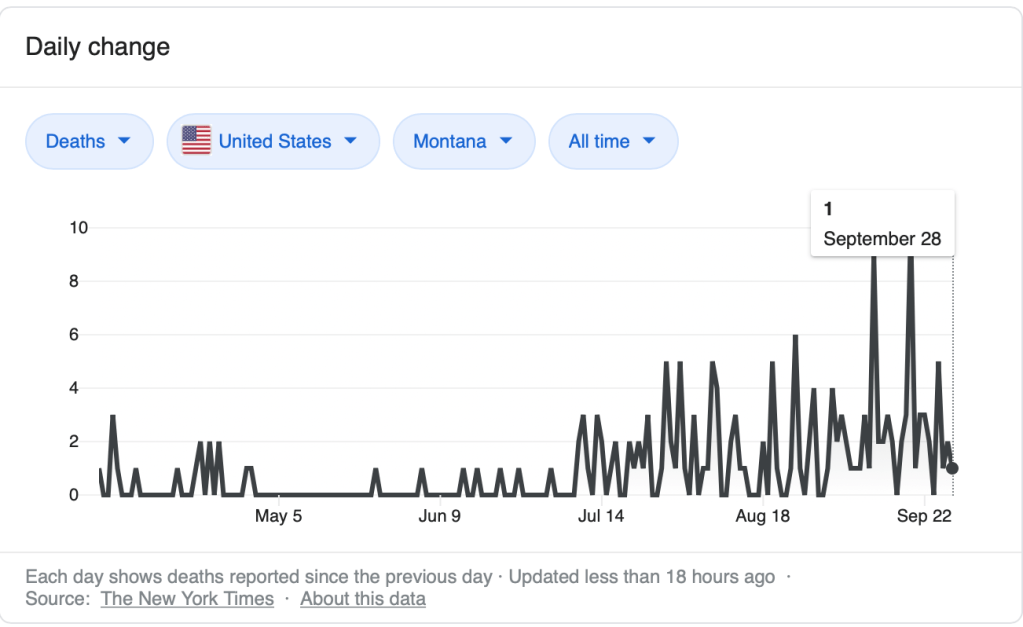
As such, the latter part of its COVID deaths track the shape of other high elevation US locations, like South Dakota and Montana. Starting around the middle of June, we see the classic seasonality shift toward a summer respiratory season that exists in other locations. Here’s Montana, for example. A light, seasonal COVID season — but well-pronounced as far as that High Plains pattern.
Montana COVID deaths
So here’s the thought exercise. I’m guessing that Nevada’s COVID death curves give some representation of a balance of sociality and seasonality of the pandemic. Las Vegas was certainly the start of COVID deaths that led to that hump in March and April. Sociality mattered, and drove heavy, continual dosing of Las Vegas from around the US and gave us that first part — meaning that for a green field pandemic, sociality can matter.
But nothing can really match the power of seasonality. When it’s time for viral spread, you get it. That would be the second hump. High, dry climates aren’t conducive to viral spread anyway, so we see low overall percentages of deaths relative to other parts of the U.S. And Nevada has no super-spreader system like New York City.
It’s worth spending some time with the Google COVID death tool and see how your state, or country is faring — and then apply your own intuition. The results are surprising.
One of the interesting hypotheses that DEFINITELY NEEDS MORE WORK, BUT IS LIKELY TRUE is the idea that, through Conway’s Law, values from the social organization transfer into the products developed by organizations will inherently embody the values that those organizations hold. We can revisit the Intermediate Corollary in these three slides, which say:
There are big implications here — by linking together value sets/v-Memes of social organizations to the instantiations in knowledge and actual design, we are implying that, at least for certain products, that more than just a canonical structure connection, actual values move into the product being created.
Let’s think about a couple of examples that alternately illustrate (or not) this principle.
What if your organization was designing tools that were for the general public, but no one in your organization was left-handed? What would happen if your organization was more focused on refinement of your current brand, and did not engage in customer research? Odds are your organization would certainly have a hard social boundary, regardless of relationships inside that boundary. And if that organization had inherited past product lines, refinement of those products would likely be the primary driver of any R&D efforts. AND, through omission, your organization, having an inherent bias against left-handed people, would only test such tools inside the organization. The products would be refined for right-handed people, and one would transfer that low developed empathy, discriminatory perspective into the product. Sure — it would be plenty safe for right-handed people. But left-handed people? How would you know to care? Check out this publication — for most folks, that handedness/neurodiversity is non-triggering , even though the conclusion is stunning– and that’s the reason I’m using it!
Clearly, it’s not necessarily true for all the parts of larger products. Teams of aerodynamicists have refined wing cross-sections according to the laws of fluid dynamics for the past 100+ years. Highly specialized teams studying Guiding Principles of transonic flow have honed the shapes of airfoils for maximum performance. But note the introduction of Guiding Principles (really a Global Systemic/Holistic v-Meme knowledge structure) into the mix. These principles are well-known, and alternately pull the designers up into a higher space, or compensate for their lack of empathetic development.
Contrast that with the Boeing 737 MAX MCAS disaster, that caused the loss of two airliners due to a runaway control system for stall safety. The flight control system was optimized using the laws of physics, and though flight control is super complicated, it’s likely that when the system was working, and all the sensors were operative, everything would have worked fine.
Except that wasn’t the case. Boeing’s rigid hierarchy outsourced the controls and interfaces to an Indian software vendor for completion. The inherent value assumptions embodied in the MCAS were that, in a potential flight divergence scenario, humans would be far inferior than the algorithms developed by the team. The combo of two rigid hierarchies — Boeing and the Indian software firm decided that humans SHOULD NOT HAVE AGENCY to turn off such a system. So, inherently, those values propagated into the design of the emergency system, which made it almost impossible to disengage, and caused the loss of two aircraft before the 737 MAX fleet was grounded! A direct, implicit (and emergent) value transfer!
One can see, through this example, the perils in developing systems in artificial intelligence and machine learning (ML) with non-diverse teams, as value transfer becomes even more problematic. AI developers may develop a system that follows a fair amount of axiomatic rigor in how a given ML system seeks an optimum. An attitude of “Just the facts, sir” may sound good on the surface. But datasets used to train such systems may inherently have bias written in them as far as collection (e.g. men are better than women doing math — it’s in the data!) And the extension is that such systems, once again, would be low on respecting human agency in the first place. The ML system would be, of course, smarter than the humans in the same problem space. And SHOULD be given authority because of a variety of reasons, including a more unbiased following of rules.
And that’s how you end up with low empathy AI — immediate value transfer from Authoritarian/Legalistic hierarchies into the products that are developed.
The examples above show how inherent bias is actually deeply memetic. But to say it’s unavoidable is also a cop-out. If we look at 2nd Tier, higher Global Systemic v-Meme processes, where deep reflection and “knowing what we might not know/metacognition” is inherent in organizational, cultural practice, we can escape some of the worst of emergent, implicit value transfer. By having diverse teams, we can dodge many a bullet as well explicitly — even if most folks don’t understand the whole idea of values transfer. The simple statement “We just don’t know enough about our users” is also very powerful, if it propels further engagement with larger relational/customer communities.
But for those new to the blog — you can also study up a bit on knowledge structures, and then back-check your work explicitly. That’s the point of the road map I’m laying out.
Last week, I finally ponied up the time to watch ‘The Social Dilemma‘, the show on Netflix where various (mostly) middle 30s men engage in lamentation and plead for expiation for the creation of social media (nominally Facebook) that has made them a.) very rich, and b.) given them a permanent spot on the paid lecture circuit to perform this lamentation in public — and now on TV. There are a couple of professors helping out with the sacred rites, who are obviously Skinnerian behavorists. But most of it is scenes of teenagers being scanned into Facebook’s magic computers and thrashing about in increasing depression as the FaceBorg takes over their brains.
I might be being a little histrionic here (I am, actually, but hey — this is my blog) but what the show does do is show what happens when a group of individuals at a certain v-Meme level get together to do a production with a matched v-Meme group of worried prophets (the creators of the beast) and then project that worldview outwards. In this case, the group is highly status-driven, Legalistic Authoritarians — they do have a moral view about how their creation works, and they’re more than happy to stand up and tell people that now, in hindsight (note the poor consequentiality of their thinking process) they see the error in their ways.
And what is, from their v-Meme perspective, the error in their ways? They unleashed a monster onto the world public where people who have no control over their own agency, can be manipulated over time into buying stuff off of Amazon that other people with their same interests want to buy. And in the process, they might discover that their friends, who might even be suburban housewives, like QAnon.
It’s not that the various folks’ observations are totally incorrect — and that’s a big part of the project with criticizing The Social Dilemma. But the view that social media is somehow only unidirectionally causal is the broken viewpoint here. Like Dolly Parton once (potentially aprocryphally) said, “If I didn’t have ’em, I would have had ’em made.” Like it or not social media is emergent out of the world system that we have now. And the fact that people finally refined it and made it so easy to use AND addictive should surprise no one. Remember Myspace? I’ve read software critique pieces about the real reasons that Myspace failed — and it was mostly poor execution. That’s, for good or bad, how tech. works. Round One may suck. But humans, being the clever monkeys they are, come back around and turn the Wright Flyer into a Boeing 747 — if there’s a market. And there was.
The general premise of The Social Dilemma is that Facebook and Twitter invented these machines that collect your personal data, and then mirror that back to you in a not-subtle, manipulative way. In the process, not only do they sell you bike socks you might like (personal confession — I love cool bike socks) but they start slowly, or maybe not-so-slowy aggregating your beliefs as well, feeding you the toxic sludge of whatever side of the political debate you happen to be on. After a while, though you might have been non-political before, you’ve been migrated into what recent fellow podcast guest sharer John Robb calls “Networked Tribes”. John’s an astute fellow, and I’ll write a bit more about him in another piece. At any rate, this Periscope/podcast below held by Twitter pal Adam Townshend has John and me talking about this very issue:
The thing that is problematic is that the same people that created the various beasts are now, supposedly imbued with both agency and insight — things they didn’t have before — loose on the world carrying what is largely a message that social media is addictive, and all the folks out there in the world have no agency and are succumbing to mind control because of it. And the tag-on message is this: THERE IS NO WAY OUT.
Other than the last part, there is a good hunk of truth that social media is addictive. True story — I consider myself somewhat addicted. But I also know that when I’m away from the computer, in the middle of the wilderness, I’m not addicted. I don’t think about what’s happening on my Twitter feed when I’m on the river. Sometimes for obvious reasons.
Me, on the Main Salmon run, not thinking about my Twitter feed
It’s also true that social media profoundly affects those with low agency — the ability to take information and think for themselves. Especially if the media stream already feeds into their mental models of how the world works. I’ve written a ton, for example, on COVID-19, and I’ve yet to have any professorial colleague come up to me and thank me for my extensive work. Mostly because my work is deep-systemic in nature, and aside from members of the European epidemiological community, the Belief Zeitgeist is that COVID-19 is the Andromeda Strain. And that is decidedly not a view my work supports. I write for our local paper — and yeah, I get a modest amount of hate mail for that viewpoint. From professors.
One of the things that is consistent in this type of criticism is that young people are being programmed to do whatever awful things old people who mostly, in this society, resent young people, can dream up. This kind of projection absolutely drives me nuts. Mostly because a large part of my socialization is with undergraduate college students, who really are, for the most part, decent individuals, though often unruly and poorly raised. And secondly, because I am someone who is paid by society (and young people’s student loans) to engage in that programming. Which mostly doesn’t stick. I’m in year 33 of being a professor at Washington State University, and nothing really works to program young people’s brains with a monolithic worldview. It’s bits and pieces. Life is waiting to take those bits and pieces and consolidate them. And those experiences are largely going to come from the economic system we’ve set up, with its widening income gap and desperate destabilization of folks’ abilities to meet basic needs. That’s the real programming.
No one also seems to be asking what, exactly, does social media provide that gives it an ‘in’ in creating an endless desire for the latest brand of tennis shoe? The answer is obvious — young people use social media for their level of connection, which for many is not deeply meaningful. Yes, young people care about the latest styles of clothes, and trends in music. But many of them care about other things as well — look at things like the Greta Thunberg’s Fridays for the Future, or the Sunrise Movement. A lot of them are not looking forward to a brighter future, and are alternately lashing out, or facing their own depression about their prospects. But the main thing of almost every exchange is still the same. They are looking for others to connect with. We are a social species. And the fact that folks in Silicon Valley have figured out how to both meet, as well as hijack that social need, should surprise no one.
If FaceBorg is not directly causal, as I insist with my argument that young people (as well as all people) have some degree of agency in how they think about things, what exactly is social media? The answer is not simple, but the short version is that for the astute, social media is a sensor network as much as anything that tells us about the state of our society today.
And what does that tell us? It tells us what most of us already know. That we live in a world where our institutions of connection are decaying or collapsing. We live in a world where old modes of social organization that used to supply at least some safety and protection from loneliness are really not doing too well at all. I hesitate to use the standard verbiage “under attack”. It’s not obvious that there is so much an explicit agenda that is causing these problems inasmuch as it is an emergent phenomena, brought on by decaying economies that provide smaller and smaller public spaces, less time for people to connect, and a corrupt body politic that seems to have lost any will for evolving a society for the good of its people.
Social media is not the direct cause of any of this, though it certainly can shine a light on all of it, as well as be used as a tool by the empathy-disordered to create even more of this. The very format of social media — short, poorly empathy informed soundbites — reinforces the Authoritarian Knowledge Structure.
Groups do form that informatically press back against these trends. In a complex society, the emergent power of empathy is always present. In the face of an increasingly status-driven press corps, we see older reporters starting Patreon and Substack accounts for longer form investigative reporting. Complexity and population density demand it.
And social media is what I call a memetic bandwidth amplifier as well. Because of the structure that I discuss in the paragraph above, social media does give the Authoritarians the upper hand. Look at how young the term ‘social media influencer’ is.
But make no mistake — young people, as well as social media, did not create the world we live in. They have simply not had the time to fuck it up. Old people have done that, and they are rigorously averse to assuming responsibilities for their sins, nor using anything resembling acquired wisdom to fix the circumstance. Even a stable school system where kids wouldn’t have to worry about getting shot would be a start, and we can’t even seem to do that. Never mind more advanced concepts of bildung, where we attempt to build integrity, agency and character into our young people – as well as usable life skills and an understanding of history.
What does social media really do? The real victims of The Social Dilemma are not mind-controlled. They are depressed. And that’s what should really worry us. Why are our young people depressed? Could it be because of social media and ad clicks? Or is it due to real things, like imminent poverty, the metabolic syndrome crisis and incumbent problems with obesity, and a lack of meaning and connection? Followers of my blog know I’m solidly in the latter camp. A society that loses the energy of its young people IS in peril of collapse. I have first-hand experience harnessing that energy in my Industrial Design Clinic. When directed with love, it is awesome and awe-inspiring.
Which, unfortunately, the youngish men in The Social Dilemma cannot seem to see. Or at least they never mention it. Their worldview has not fundamentally been changed from their original insulated solipsism. They were responsible for changing the world by inventing social media. And they were the ones that opened the Pandora’s Box. If only they could get the damn thing closed.
But anyone that knows anything about the actual story of Pandora’s Box knows you can’t shut it after all the bad things fly out. And at the end of the story, the only thing left in the box is Hope. Which can be a fine thing. But Hope alone will not suffice. Hope is the desire for change without action. The way the larger mind must deal with the problems exposed both with, and by social media, is to look at the root causes of our problems. And that is something, for a variety of reasons, Silicon Valley is loathe to look at.
Fall day in the Selway-Bitterroot Wilderness, Clearwater NF, Idaho
I’ve been a bit remiss in posting lately, but the squirrels have been super-busy in my head. I’ve been building a chest of drawers in my woodshop as part of a quarantine project, and have kind of been lazy about writing. I have a big post coming on what I call “validity grounding” — how people within the different v-Memes/value sets form the basis for coherent action, that answers major concerns about how we will have to develop people to coordinate as our world becomes more complex.
Here’s a still life from the woodshop.
Yet another set of dovetails for yet another drawer…
A question popped up on Twitter about why the subject of marketing was taught in colleges, but not sales. As one knows, it’s impossible to look at a single concept and pigeonhole it into a given value set. But the cursory answer is that marketing can be taught as a low-empathy science, with algorithmic techniques, whereas sales is heavily dependent on personal interaction — something that the academy does poorly at.
In response, Maggie 美智幸子@MaggieSachiKhoo replied with some doubt (that’s OK!) and linked this wonderful article which is essentially about growing empathy between sales and marketing — but could be used as a blueprint for merging any two areas. It’s pretty basic, but looking at my presumptions I’ve made with recent blog posts, I thought it might be nice to give a simple example that I found really resonant.
One more time — the article title is 10 Lessons from 10 years in marketing and 10 in sales by Nathan Skinner, a former VP for Salesforce. He covers almost the whole knowledge structure stack, from myths (customer stories) to shared goals, to rational empathy development, with great points about walking in others’ shoes.
I’ve just finished Julian Jayne’s masterwork, The Origin of Consciousness in the Breakdown of the Bicameral Mind. As I usually do, I listened to the book on Audible, which makes pulling quotes impossible. But the advantage (I do this while I’m riding my bike) is that I am also able to think concurrently, which I simply can’t do while I’m reading.
The book was published in 1976, and as any text that delves into the neuroscience, Jaynes’ insights were severely proscribed by the neuroscience of his time, as well as the fact that he didn’t have access to any thoughts on evolved empathy.
Jaynes writes primarily about personal development in a collective framework — he did not have the concepts available to him that I have. But the work is stunning in the context of what he does describe — a traversal of human development from Survival bands, up through the Legalistic/Absolutistic societies of the Axial Age. Jaynes was (I believe) the first to really nail down the premise that ancient people, quite literally, didn’t think like us — something I’ve written about extensively in the context of memetic development. His basic premise is that humans started off with environmentally-based, stimulus-developed consciousness, then evolved into the bicameral/split mind, not unlike modern-day schizophrenia, where the gods did most of the talking on the right side in the directing of actions. And then we evolved out of this some 500 years BCE into our more modern forms of thought, where the gods went into remission once again. Twilight of the Idols indeed.
I think part of the reason that Jaynes held this premise (he’s passed away, so we can’t have that discussion) is that Jaynes fundamentally was a sound academic, and as such, wrote from a more empirical viewpoint, consisting of fragmented archaeological evidence and epic poems, to support his hypothesis. He has an extensive litany of facts, strung together, that the more sedate might not like. I particularly liked his descriptions of eyes on statuary as part of their control mechanism. Anyone writing about immediate mirroring behavior or emotional empathy cannot discount the effect of a good stare when it comes to control. So it is no surprise that ancient people made their gods with eyes that mattered.
Jaynes makes much ado, like most, on the effect of language on the ability to generate independent agency. If you want to know yourself, you have be able to have a dialog with yourself. And that path of self-empathy prepares the mind for the higher projective functions of rational empathy. I’ve put up the empathy pyramid below as a refresher for those that need it.
Empathy Pyramid
For what it’s worth, I think language matters. But even placed in Jaynes’ framework, the larger evolutions in dualistic thought came after 0 CE, in particular the Zen Buddhists — it cannot be said with words, it cannot be said without words. It is also noteworthy that we still have a planet populated by people who cannot deal with ambiguity. So maybe Jaynes has a statistical point.
Where Jaynes and I part ways is in the idea that modern man fundamentally thinks differently than primitive man. Yes, I do agree with Jaynes’ premise that it was an evolution in that hardware/software combination that led to the gods and their authority. But Jaynes basically implies that we forfeited that system and kinda/sorta went back to the more data-driven consciousness of Survival v-Meme man. It’s that “went back” thing that I don’t like. We evolved new modes of being data-driven because we trained our brains with empathy, manifested with caring about others, how they might feel, and what they might do, on a larger scale, both temporally and spatially.
And here’s the thing — we never have core-dumped the old systems. So in times like the present, where we are in profound regression of our larger identities (what, for example, does it mean to be an American now?) those old systems, just like Cthulhu, are sitting in our neural depths, waiting to be retrieved. Not surprisingly, they’re obsessed with pederasty (look at QAnon) or extreme, unpredictable violence (look at the Left) in the U.S. Certainly there is some evidence-based thinking, actually on both sides, and I am NOT minimizing rational triggers — we clearly have a problem with police violence and African-Americans in this country. Or Epstein’s island. But the voice of reason is not the loudest voice playing in people’s minds. These things are not scaled statistically in the least in the arguments. The gods didn’t weight things with probabilities. Either you cut out someone’s heart, or the sun didn’t come up.
Considering the depth of the writing in the book, as well as the afterword, Jaynes obviously observed these thoughts around him. I’m betting he was chicken to point his learned finger, because the examples available to him regarding contemporary times were no less front-and-center than they are now. Might be a great example to push back with when people start talking about how full professors can talk about everything. Jaynes was a prof at Princeton — but he didn’t really generalize much of the work in the book into a modern context until his updated Afterword in 1990.
Should you read The Origin of Consciousness in the Breakdown of the Bicameral Mind? Maybe. I think we need more people thinking about the larger issue of social and societal coordination, especially as we see wave after wave of panic regarding COVID. Jaynes very clearly maps out how the lower v-Memes, with special attention to the Tribal/Authoritarian transition works, and how people can quite literally dump their feelings of compassion for folks that don’t agree with them — especially if they feel an existential threat. We place far too much faith on the idea that humans can’t kill other humans in modern times because of feelings. Yet example after example in recent history shows that this behavior exists. For those not quite ready to drink the empathy, DeepOS Kool-aid, yet want a scholarly, surface description of the current video game we seem to be playing, it might be time to sit down with a copy. Or an Audible recording — and come to terms with what is still ingrained in us from past development.
Postscript: There are also some fascinating questions yet to be answered as well as far as role of diet in facilitating these transitions between v-Memes. Are our brains what we eat? How did that system feed back in the construction of huge temples? That’s for another piece. But certainly interesting in the context of our current metabolic health right not.
Hanlon’s Razor — “Never attribute to malice that which is adequately explained by stupidity”
One of things that saturates our information world today, which drives me absolutely nuts, is the proliferation of conspiracy theories on everything from pedophilic pizza parlors to scheming Chinese scientists, making super-germs in labs. It’s not that sexual exploitation of children isn’t a problem — as we devolve into more and more segmented authoritarians, where the rich are easily removed to various sex islands, I become less and less surprised. And I’d never doubt that various powers-that-be wouldn’t think of germ warfare against other humans. That’s historic.
But even in perversion, or destruction, v-memetic rules must be followed, at least if there are people involved. Authoritarian bosses are far more likely to place concubines in the office next door, instead of in some far-off Shangri-la. And germ warfare is also much more likely to take place with some smallpox-laced blankets, seized in desperation by freezing indigenous people trapped on reservations, than the more elaborate schemes of dispensing through hidden microchips triggered by 5G signals.
History is full of the types of horrid excesses that humans liked to (and still do) inflict on other humans, as well as our other fellow travelers in the animal and plant world. But more diabolical means require social organization, and like it or not, they also require empathy development. You simply can’t get to requisite complexity without information coherence. And that comes with growing a conscience. Sure, there might be a few that don’t get there. But statistically, most will.
Even if you consider some of the wilder things we’ve done — the atomic bomb comes to mind — these are things that could not have been developed without long, empathetic supply chains, working synchronously toward a larger, if in the end ignoble goal. Part of the reasons the Nazis lost WWII was not that their armaments were more poorly designed than the Allies. They lost because of reliability issues because they conscripted slave labor forces to build their various airplanes and Panzer tanks. Drop some dirt in that transmission, now, won’t you? Think about THAT supply chain.
It’s also fair to say that all bets are off when technology is captured. Terrorists are far more likely to use a nuclear bomb than a nation-state, because in order to make that bomb requires a higher form of social evolution than a terrorist, stuck in a neo-tribal mindset, is going to possess. We live in a world now where the folks that developed the technology have exited the stage, and darker forces have picked up on its potential.
Examples? We sell F-16 jets to Pakistan, but leave our own Air Force guards to guard against their unauthorized use. An article I read today about selling F-35s to Turkey, which at some level we are contractually bound to do, as Turkey is a NATO country, was puzzling through similar problems. An F-35, imperfect as it is, is a tremendous piece of networked firepower. Do we really want Turkey to have a combined AWACS/super-cruise fighter so close to active Russian military forces? As US hegemony declines, the dangers of war are not so much about people attacking the homeland. They are of rival powers squaring off to fight old, unresolved fights. Escalations between India and China are but a recent example.
But back to conspiracies. One of the ones that has been making the rounds regarding COVID was that Chinese were scheming around germ warfare regarding coronaviruses, and the virus escaped from the lab to give us our contemporary pandemic. Large and monolithic, the CCP was attempting to give itself an ultimate killer weapon, when things went awry in the lab. Because of that famed Chinese coordination (ever watched that video of all the Chinese children bouncing balls in a circle together) they managed to pull it ALL off. Until, well, they didn’t, and then they went around silencing and killing people, including doctors who might expose their plot to activate the killer bug with 5G technology.
Give me a break. This is the chronic wrong-headed comparison I see made in the popular (and serious) literature between things that kids can do that adults can’t, inevitably attributed to a distortion of empathy. Kids can play that spaghetti tower game better than a group of hospital execs. or lawyers, but you sure wouldn’t want a bunch of 8-year-olds running a hospital. Though you might want a group of 8-year-olds running a hospital if your other alternative was a bunch of lawyers! (Sorry, all my lawyer friends. I couldn’t resist!)
That doesn’t mean that I believe there is zero chance of COVID-19 starting from the lab in Wuhan. I actually think there is a probability of failure with any containment exercise in germ research. There’s a reason why there are different labs with different biohazard ratings. And there is also likely the chance for certain types of failure that should preclude any experimentation on certain types of viruses. It’s simply too unsafe. But that kind of thing is the result of human hubris — not conspiracy. The short answer is this — once a given complexity/sophistication threshold is exceeded, the chance of failure is real. And failure is going to only be realized if you run the experiment over and over again.
Conspiracies, especially complicated ones, require a certain memetic stew that just doesn’t exist in the real world — or at least very often. You have to have smart people, taking Authority-driven direction, while at the same time exercising creativity in how they’re encountering obstacles that run contrary to the diabolical plans of the conspiracy. That’s not easy to do. People capable of managing complexity are also likely to be connected to lots of information sources. And that’s going to run contrary to that extreme loyalty-for-nefarious-ends that any conspiracy really needs. Any movie conspiracy, if it’s accurate, always has lots of goons. But even goons have to be paid. You don’t just sign up to be a goon. You sign up because you get some money. Or if you’re ideologically aligned, you’re also probably stupid. Look at how the protests/riots are playing out. What level of coordination are we seeing?
That said, complex, deep historic conditions CAN create conditions for disaster. But the reason disaster happens isn’t the result of coordination of conspiratorial parties. More likely, it’s the result of deep historic bills that converge on a moment, and come due. Let’s explore the potential for a viral release from a Wuhan lab.
For those that know much about China, they know that almost every kind of megafauna long ago was exterminated from most of the Chinese mainland. Most of it was eaten — it is true that Chinese people like wild game. But it’s more than that — Chinese medicine itself is close to 2500 years old, and blends a certain amount of deep holism sprinkled with magical thinking. In an Authoritarian culture (and China is most definitely an Authoritarian society) the information transference from a rhino’s horn to an erectile dysfunction cure is all too obvious. This is a fact, folks.
And as the Chinese population has exploded, harvest of any wild animal has become more and more problematic. If you had a historic food from the wild when you had a population of 200 million, you can imagine the demands on that same wild source if your population is 1.25B. It ain’t pretty — and it’s not exactly like there’s a whole lot of grounding validity. You bought those things from someone else, they were a tradition in your family, and China is laced with these traditions. China is also covered — almost every square inch — with people and their devices. There is hardly a square acre reserved as real wildlands. Contrast this to their neighbor, India, where large parks (and associated megafauna) still remain.
Longji Rice Paddies, Guangxi Province, CN
One of the big problems in China is that through attrition, lack of habitat, and deliberate campaigns, most of the wild bird life in China is gone. This is hard to imagine for most Westerners to imagine, but during the Great Leap Forward, Mao even ran what was called the Four Pests campaign, where people all went outside for days, banging pots and pans to keep birds aloft until they literally fell out of the sky.
Events like this can have tragic, unobserved, and un-studied consequences. Radical population devastation does not always result in a bounce-back to historic levels. Once various thresholds are crossed, the ecological balance is fundamentally altered. And other species, formerly perhaps only in mild competition with birds, can find a way not just to establish a foothold, but fill ecosystem niches formerly unoccupied by them.
This is not the first time this has happened. The classic example of more recent times was the collapse of the cod fishery off the Grand Banks. Hard draggers and trawlers essentially clear-cut the ocean floor, not just taking the ground fish, but also creating unrecoverable conditions for their future.
Into the ecosystem gap flourished another species — lobsters. Lobsters, now no longer suppressed in marginal competition with cod and other ground fish, saw exploding populations. We like to eat lobster, so we didn’t really care. But the plentiful populations of lobster are very likely linked to ground fish devastation. And now that a new equilibrium has been established, it makes it even more difficult for the cod to return — even if they possess much larger amounts of biomass, and use the system more efficiently. They simply can’t get started again. Because of those damn lobsters.
But back to China. One of the most interesting features of China is its karst topography. Karst limestone makes many of those funky looking towers of rock you see across China. And whenever you see a combo of limestone and water, there’s a ton of stuff you don’t see. That would be caves. I have never explored Chinese caves, but there’s got to be a ton of them.
One of those karst topography caves in Indonesia. Yes, plenty of bats.
And if you have caves, and no birds to compete for insects, well, guess what. You get a lot of bats. Bats that might have been marginalized before, now can flourish. Lots of bats. And bats, as we now know, carry coronaviruses. Lots of them. And they poop a lot. All those insects have to go somewhere. Bat guano is also super-valuable — it’s selling for ~$90/25 lb. bag at WalMart.
Now you have a fascinating incentivized stew that favors release of coronavirus into the human world. You’ve got the guano, of course, and people who might want to dig it up, which is obvious. (I’ve heard lately about Chinese miners — nothing about what they’re mining, but I wouldn’t be surprised.) But now you also have interested scientists, not so much interested in the poop (maybe the viruses in the poop!), but interested in stuff scientists are interested in, which, quite frankly, is often egocentric and arbitrary. When it comes to the desire to serve the public, scientists are all over the map. But they are definitely driven by their passions, less so the money. And you’ve got something fascinating to study. There are lots of accounts of Chinese coronavirus scientists going into the plethora of caves, now crowded with bats that previously didn’t exist because of bird annihilation.
Lots has been written about the phenomenon of spillover — when viruses cross the divide between animals and humans. I’ve not read David Quammen’s eponymous book, but I know David, and he’s very thorough.
At the same time that much is made of the difficulty of animal/human transmission, I think it’s also important to remember that these things are also a function of probability. Mess with enough batshit, long enough, and sooner or later, you’re likely to catch something. It’s taking that low-probability event — spillover — and repeating the trials often enough.
And so that’s what I think happened with COVID-19. I think we are always quick to blame peasants and wet markets and such. Eating bats is unappetizing, at least for those of us in the West, and it is always easy to blame the poor for our problems. And miners. Especially poop miners. Scientists, belonging to a more respectable caste, tend to skate on their responsibility. I’ve known enough scientists (and I’m one myself, though of a decidedly different sort) to appreciate that they can “follow their nose.” Even if that nose takes them into the middle of a large cave filled with bat guano.
And so they brought it out. And it was likely mishandled, which is why some of them died. So I wouldn’t completely rule out the idea that COVID-19 came from the Wuhan Infectious Disease lab.
But a conspiracy? Give me a break. See Hanlon’s Razor at the top.


















 It's About Empathy - Connection Ties Us Together