Empathetic Ladders and What People Can Understand — Matching Knowledge Structures for Messaging (Part II)

oldmanriver

The Intermediate Corollary is a powerful construct — in the pathway of Social Structure -> Knowledge Structure -> Design Structure, it implies that certain social systems will create knowledge in particular ways, depending on the level of empathetic development.

Why does this matter?  We’re used to thinking of knowledge, for the most part, as a 2-dimensional construct, based on a plane of ‘objective’ knowledge vs. ‘subjective’ knowledge.  Scientists claim the high ground through objectivity.  Religion claims the high ground through channeling the Word of God.

This view of knowledge is a mental model, and not surprisingly, lacks a fair amount of detail or nuance.  Tearing it apart on either side is not particularly productive, either — especially in a blog post.  Every competent scientist knows that objective data is always constrained by the context of the experiment that generated it — the researcher decides what factors to vary, which ones to study and so forth.  Religious experts argue from historic texts and long tradition.  While we’ve grown to accept the debate, when you back up from it, it really is a mess.

There is a better way in understanding knowledge that’s produced.  It’s by understanding Conway’s Law, and the Intermediate Corollary, and then linking this through the emergent social structures given by Spiral Dynamics.  By understanding how people trade information (that is able to be validated or not) we can start creating more of a multi-dimensional knowledge landscape that gives a better perspective on how people structure knowledge neurally — inside their own head.

Understanding that humans operate with three primary variables that govern their social evolution is the basis.  Humans have a temporal (time-based) calibration (this has been discussed before with regards to empathy) , a set of spatial scales (3-D, x, y, z) and some level of energetics — the ability to get from one place to another, in a certain amount of time.

So what’s a summary of these knowledge structures look like, starting from the bottom of the Spiral?  When reading these, it’s important to remember that v-Memes higher up the Spiral include new modes of thinking, as well as all the ones beneath them — like Russian nested (matryoshka) dolls.

Survival v-Meme — knowledge is temporally short-term, spatially small (where do I find food/water), and exists in fragments.

Tribal v-Meme — knowledge is shared inside the tribal band, either temporally long-term (creation myths, coded survival information) or short-term, in stories that reference long-term memory.

Authoritarian v-Meme — knowledge exists primarily in fragments, where the truth/veracity of the given fragment is decided by the authority/boss.  If you are below someone in the power structure, it is expected that you will accept your authority’s definition of reality and truth, unless some cultural sidebar of appeal is offered.

Legalistic v-Meme — knowledge exists in rule sets that apply across a group of people.  Knowledge can be fed into these rule sets and transformed into other information (if THIS is true, then when a given rule is applied, THAT is true.)  Note that this kind of knowledge representation implies a high level of determinism and no tolerance for ambiguity.  There are no multiple solutions possible, nor implicit recognition of unknown factors.

Performance/Goal-based v-Meme — knowledge exists in heuristics (rules of thumb) that allow the individual to pick and choose various pieces of knowledge and rule sets to reach a conclusion.  Goal-based knowledge is the first that recognizes metacognition — knowing that there are unknowns that you can’t predict nor understand in any given decision-making process.  Most contemporary design processes fit inside this v-Meme — a given set of specifications can yield multiple designs, all more or less optimal dependent on a given interpretation of the customer.

Communitarian v-Meme — knowledge exists in combined heuristics of individuals in the community, that may be more or less valid dependent on the aggregate opinion of the community.  In an initial land use determination, where there is no code or body of law to apply, a community may get together and jointly share opinions, based on a variety of arguments, on how a piece of land might be used.  Later on, after a series of decisions are made, these may then be codified in a more legalistic v-Meme set that removes larger ambiguity.

Global Systemic v-Meme — the first of the Tier II v-Memes, there is an explicit self-awareness of the picking and choosing of knowledge structures from the lower Tier I v-Memes.  The primary differentiator in this knowledge structure is an awareness of the individual of personal bias — “I’m trying to reach this goal because of my own past experience, thought process, and feelings regarding this issue.”

Global Holistic v-Meme — fundamental guiding principles.  Guiding principles are very different from simple rule sets in that when applying them, they can generate complex structures of knowledge themselves.  When combined, they can produce a potentially large, or infinite and complex set of behaviors and knowledge, with complex interactions and synergies.  Temporal scales are long (we can understand how the universe started) and prediction can be large (we can guess how planets around other stars revolve) with some accuracy.

A simple example of a guiding principle might be the Law of Gravity.  We don’t have to go run an experiment across town to convince ourselves that if we jump off a building across town, we’ll end up on the pavement.  True guiding principles are hard to come by.

Takeaways:  Knowledge, synergies, spatial and temporal scales increase as we move up the Spiral.  The more empathy in the system, the more complex the synergies available, and the greater number of time and spatial scales.  At the top of our current understanding are Guiding Principles, that are capable of spinning out complex patterns and multiple solutions.

Further reading:  Fractals, a class of geometry present in nature, are a great example of how a given rule, with some simple input, can generate extremely complex behavior.  The Mandelbrot set is a great example, and you can vary simple pictures of your own by going to this NOVA website.

For those that want more, you can start here and keep exploring.

Empathetic Ladders and What People Can Understand — Matching Knowledge Structures for Messaging (Part I)

rainierrapids

Rainier Rapids, Main Salmon River, Idaho

Empathetic ladders are fun to find — enlightened leadership has been using them since the beginning of time.  I’m sure, if we could find some sequence of caveman paintings on the wall in some cave somewhere and looked with that in mind, we could find an empathetic ladder with lots of wooly mammoths and dudes with spears running around, painted by the local mensch attempting to get his or her tribe to up their game.

At the same time, any person who’s trying to grow has been stuck in a meeting with a leader who insists that everyone has a chance for ‘input’, while doing a seemingly endless round-robin around the room, with the same people saying nothing, and the same people doing some weird humble-brag about their area of interest.  Communitarian on the surface, but eh — not so much.  Really just the same authoritarian assertion of status.

And after a while, you might find yourself, with certain empathetic ladders, picking them apart.  What do they really mean, after all?  Your own level of sophistication will start to pick apart these kinds of things.  And I think there’s few people that really like those pithy sayings on the bottom of motivational posters.  In fact, I’m sure most of you have seen these anti-motivational posters, with the same beautiful picture, but tagged with an ironic punchline, like this one:

gettowork-topdemotivators

Since I’m writing this blog with the intent of turning it into a book, there’s also a natural tendency to want to list quick ‘how-tos’ Internet-able memes.  These would inevitably be used to torture workers in as-yet inconceivable ways by the percentage of psychopaths who buy business books.

At the same time, there ought to be a way to discern between sound-bites of pithy wisdom, and things that can revolutionize cultures and societies.  That’s where understanding what knowledge structures are used by the evolving v-Memes come into play.  One of the next big concepts in this blog is the idea that social structures create design structures — Conway’s Law.  And the breakthrough concept that comes out of that is that in between social structure and design structure is knowledge structure.  I have named this principle The Intermediate Corollary. And it starts the process of unlocking the idea that social/relational structure, all dependent on empathetic level, creates different ways of thinking for people in those social  structures.  

Slide2

I’ve found that this concept is very difficult for people to grasp.  There’s a part of our fundamental humanity that wants to believe that even though there may be different cultures, or surface level structures, that all humans process information the same — same organic matter in between the ears, after all.

But that’s a pretty hardware-oriented view of the brain.  Every day, we are reminded that we don’t all think the same.  This worldview discounts the role of software in the brain — that programming the brain is not just assembling surface level knowledge.  As we move through life, our brains actually function differently.  And the strand that runs through all of that is empathetic development, and the social structures we operate in.

Takeaways:  Conway’s Law says that social structure produces design structure.  In order to produce a design, though, we first have to produce the knowledge.  That concept — The Intermediate Corollary — directly implies that different social structures will produce different knowledge structures — and that means that different people in different social structures will fundamentally think differently.

All this links back to empathetic ladders.  The next thing I’ll discuss is how we can identify the knowledge structure of our empathetic ladders, so we can get down to real ‘guiding principle’ evolution, instead of just one more annoying motivational poster.

Elephants, Rhinos, UAVs and Interdisciplinary Teams — Does Any of this Empathy Stuff Really Matter?

Liverpool (1)

Liverpool, England, in front of the Hard Days Night Hotel.  Not surprisingly, Liverpool has a thing for the Beatles!

If you’ve been following this blog for a while, I know by looking at my statistics,  that you likely have not read all the posts.  After all, I am aware that while a lot of my readers are fond of me — I was the professor that helped get them ready for the work world, or a business associate with my Industrial Design Clinic, and we enjoyed educating students together — I also know that I am not an internationally recognized expert on organizational development, or empathy, or philosophy.  I haven’t cut it yet in the status-based lower v-Memes.  I’m not bothered by this —  those that know me personally know that I’m not much of an Authoritarian or Legalist.

But you’re probably thinking — “well, Chuck, that’s nice.  But why should I really care?  And how does this really matter?”

Here’s some insight.

Last week, I was in Liverpool, England, at Liverpool John Moores University (LJMU) at a conference for UAVs (Unmanned Aerial Vehicles — think quadcopter or fixed-wing drones) applied to environmental science and problems.  The breadth of application of UAVs to problems in the environmental arena was immense.  The keynote speaker, Tom Snitch, talked about his program, which involves using relatively low-cost drones to monitor elephant and rhino poaching in Africa   Others talked primarily about the use of LiDAR mounted on a UAV, which is basically using light like radar waves to map vegetation and landscape features.  Others used UAV-mounted regular cameras to create high-resolution photo mosaics of landscapes that are much more high resolution than available from satellite images.  And so on.

But in such a potentially synergistic, systemic world, those connections were few and far between.  The key element in all this was the structure of the combined UAV – sensor system.  In a room full of passionate, sophisticated people, the basic structure of a UAV system was ‘take a store-bought UAV and mount a camera on it.  Figure out how to trigger it and capture the location of the image and bring that back to the ground for post-processing.’  The design structure of any system that does that — regardless of the complexity of the design of either the UAV, or the measuring instrument (like the LiDAR unit) — is three fragmented, non-synergetic blocks in a row.  Learn how to fly the UAV, bring back the pictures, make your map.

It’s pretty obvious that this maps to the non-empathetic structure of researchers in the academy.  Three blocks put together, basically in what we call open loop feedback (read ‘no feedback at all’) .

What is interesting as well is to see how this social/relational structure will attempt to solve their problem.  How will they evolve?  In a fragmented social structure, the first (and likely subsequent) iterations will likely involve more pictures (read more fragmentation) and more detail.  More computer processing, with more sophisticated on-the-ground mapping algorithms for more complex assemblages of images.  Greater accuracy in the GPS units used.  Paying more money for UAVs with greater flight stability.  And so on.

Notice how NONE of these things engage in any meaningful feedback between the elements.  How could they?  How could the people engaged in the task develop any synergies at all, given the social structure of the typical academic enterprise?  Synergies with this given social structure are likely to come (not surprisingly) when the resolution of pictures taken on the ground get down to pebble size.  Fancier cameras.  More stable UAVs.

And that’s exactly what is happening.

What would be required for synergies?  The short answer is a different social/relational structure.  We might start with the old ‘multidisciplinary teams’ axiom.  Perhaps if we added someone who was an expert in flight control and dynamics, they could stabilize the UAV better.  Someone in cameras could invent a camera with greater resolution.  And so on.

What’s the takeaway? If we pursue a similar, fragmented non-empathetic structure, we can see that multidisciplinary teams approach doesn’t really add much to the synergies of the device.  At first blush, the different component providers don’t need to do much understanding of each other — knowledge can be passed in fragments, like ‘well we’d like finer resolution.’  And things would march down exactly the same path.  Perhaps a little faster, but likely much more expensive.  More people on the project definitely means more dollars.  Higher resolution equipment is going to climb up that marginal cost/performance curve that every product possesses.

What happens, however, if we pursue a different structure — where we now have a multidisciplinary team, with pairing between different components of the entire UAV system?  The mapper says to her partner, the camera designer ‘I want finer resolution.’  In an empathetic exchange, the camera designer would hopefully ask ‘why?’  The mapper would then explain that things aren’t going so well on the boundaries of images, and she figured that finer resolution was the answer.  The camera designer then might say ‘well, you can get finer resolution, but if you still can’t improve the auto-stabilization and orientation of the UAV, any more pixels are just going to get lost in the noise.’  So after understanding the problem with perhaps a little math, they make a decision to engage the flight control person.

The flight control person goes through an empathetic exchange with both the mapper and the camera person.  It turns out that the real problem with getting the pictures to overlap is that the UAV turns a little in the wind, and that makes the photos not line up on a nice, even grid.  So the real answer is to put two GPS units on the UAV, separated by a meaningful distance, so that the UAV can be flown with both a static coordinate, as well as an angular direction orientation.  Then mapping can commence so that you don’t have blurred pixels on the boundary, and so on.  The social structure, as well as the degree of empathetic connection, all has to change.  And in the world of empathetic connection, there’s going to have to be a whole lot more of it.

Or if nothing else, it gets discovered that we can’t yet orient the UAV at a given angle.  So we don’t waste money on more and more expensive cameras, or mapping software — because we really can’t do better than the fragmented system.  Either way, the performance of the system goes up.  Money is saved from not pursuing something not feasible (or too expensive), or mapping accuracy is improved.

And we can also see how trust is brought into the picture.  If one component expert doesn’t know the other component expert, how does one know whether they can believe them?  Only through an evolved working relationship can the mapper be sure if the flight control UAV expert is telling the truth — whether it be that you can orient a UAV, or you can’t.  Empathetic connection is the primary tool for assessing someone else’s metacognition — if they know what they know, as well as what they don’t know.

The non-empathetic, multidisciplinary effort yields results similar to the fragmented academic social structure.  Just as Conway would have predicted.  And the understanding of the level of empathetic connection leads the project manager on the same path as has been discussed in this blog.   😉

Takeaways:  Sophistication of individual knowledge doesn’t do you that much good if you can’t work at the boundaries (or even in the guts of these systems) with other experts to optimize and synergize shared results.  And empathetic connection between teammates is the pathway toward getting a better shared result, without having to go outside and pay a ton of money for experts who may or may not know what they’re talking about.  A little bit of empathetic relational development goes a long way.  Change the social structure if you want to change the performance.

Further reading: This piece on Tom Snitch’s work in South Africa regarding using drones for prevention of poaching elephants and rhinos shows, better than anything, that it is often social factors and trust that limit all our efforts.  It is indeed all about empathy.

Using the Principle of Reinforcement for Evolving Empathetic Teams (II)

sforkconfluence1

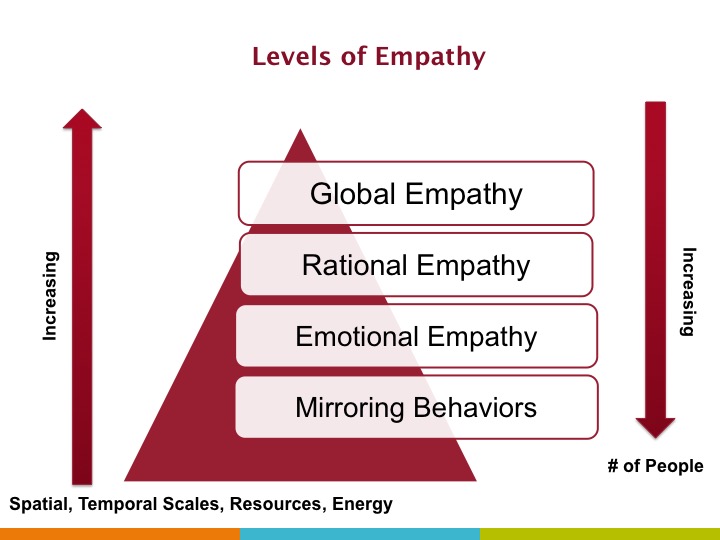
So how does one go about developing more empathetic team members?  The beauty of understanding the empathy pyramid, combined with using the societal/leadership authority present in the Principle of Reinforcement, tell us what is more likely to stick earlier on in the process.

Not surprisingly, enlightened master Mahatma Gandhi said ‘be the change you want to see in the world.’  Directly addressed by mirroring behavior, this statement addresses the first tier of any empathetic transition of an organization.  Leaders have to demonstrate the behavior, and this is a well-known principle of management.

The other levels offer more guidance on behaviors.  Emotional empathy, where leaders honestly feel other people’s successes and pain, can establish the leader as a compassionate individual.  Compassionate leaders are typically held in high regard — which at some level is a status-based response, and is a primary incentive in authoritarian/legalistic organizations.

Rational empathy, best exhibited by place-taking, is where things start to get tricky.  Real rational empathy is challenging for most people.  Fundamental egocentricity has to be overcome — remember when I talked about giving my students a customer as a way of combating this tendency.

But there are other ways.  Great spiritual teachers, divine or not, depending on your belief system, have invented what I call ’empathetic ladders’ –development tools for creation of complex empathetic response in individuals who are not particularly highly evolved.

One of my favorites is Jesus Christ’s  The Golden Rule — “Do unto others as you would have done unto yourself.”  How did this come about?

I can imagine Jesus sitting around one day, pondering his ostensible flock.  “Father, what can I do with these people?  They’re mostly pretty egocentric, thinking only of themselves.  I really would like them to understand their fellow man and woman, and comprehend the individual journey each of us are on in this world.  I’d like them not just to develop rational empathy, but global empathy as well, and realize that we are all connected in our existence.  I’d like them to think not just about what the people individually ask for, but what they honestly need by considering their past, as well as their future.”

And then he said “Nah — they’re never gonna get that.  Do unto others…”

What’s fascinating about the Golden Rule is that it is what I call an empathetic, or Spiral Ladder.  At first blush, everyone will respond to the Golden Rule, especially if one considers the more drastic potential alternatives.  I don’t want to die, so I won’t kill someone.  I don’t want to have my stuff stolen, so I won’t steal someone else’s stuff.

But once you get past the Ten Commandments, things start getting a bit more tricky.  I like chocolate ice cream.  Does that mean I should go out and distribute chocolate ice cream to the lactose-intolerant?  And so on.

Yet if we practice the Golden Rule, it evolves rational empathy.  The first time you bring someone chocolate ice cream to someone who doesn’t like it, you’re cued to pay attention to what that person’s preferences are.  If you can’t provide that preference, then you show a little compassion.  I am never able to bring home for my Taiwanese wife red bean ice cream, so I have to demonstrate sympathy for her deprivation.  She remarked on a picture of a child eating a roasted Japanese yam.  So the next time I was in the Asian grocery store, I made sure to pick one up.

And of course the evolution continues.  So many of our favorite treats are from childhood.  You might like oatmeal cookies because your mom made them.  But what were the childhood treats in Taiwan?  What was childhood like at all?  Was there a whole lot of joy besides studying for tests?  (Hint — not that much!)

Most business development/success books focus on the transition between Authoritarian/Legalistic title-based leadership and Performance-based Communitarianism in evolving corporations because in American business culture, that’s where a lot of the work that needs to be done is.  There is no better example of this than Steven Covey’s Seven Habits of Highly Effective People.

But that landscape is changing.  Now, good leaders work to identify the level of empathetic development of each of their employees, and then construct ladders to help them evolve.  As our workforces gentrify, people in their 50s are looking for different structures of meaning than people in their 20s.  And that’s going to demand a different toolkit of both understanding and pathways.

Takeaways:  Using the Principle of Reinforcement, smart leaders seek to evolve their employees, both by working with them directly and creating environments where ways of being drive empathetic growth. Since all employees are different people, each of them will need something different to help them on their own pathway toward higher meaning.  Empathetic ladders, such as the Golden Rule, offer a way to accelerate development by combining v-Memes where people are in a way that reinforces where the leader would like them to be.

Further reading:  Zen Flesh, Zen Bones, by Paul Reps, is a great collection of accessible stories containing age-old empathetic ladders.

Understanding the Emanuel African Methodist Episcopal Church Shootings — Empathy Disorders and the Effects of Societal Racism (Part II)

rangerpeak

Ranger Peak, crest of the Bitterroot Mountains, Idaho, from the Beaver Creek fire lookout

If we can’t control individually the empathy-disordered in society, what can we do?  All civilizations have battled with this problem for thousands of years.  Dependent on the level of societal evolution, different cultural solutions have evolved that manage these people.  I remember (wish I could find the reference!) a conversation with an anthropologist about 15 years ago on Hutterite community size in Montana.  One of the primary drivers behind keeping bruderhöfe or colonies at around a 120 member size was that this was the size where one could keep track of potential child molesters.  More members than that, things would fall through the cracks.  I’m sure that no Hutterite explicitly leads with that information for community size inside the faith.  Such knowledge is encoded, along with a substantial list of behaviors and Bible study, to manage their 12-17% of high conflict personalities.

In short, we are not the first community of humans to deal with this problem.

So what societal change should be considered in the case of the EAME shootings? For those interested in activist social change, the real question that should be debated is ‘what are the system boundaries, and what are the timescales for enacting real change on this issue?’  This debate, held in an open, heterogeneous society, is going to be noisy.  If you ask most evangelical Christians, they will tell you that no prayer in schools is the root of the problem.  Psychology Today ran an article blaming it on anti-intellectualism.  There are a thousand different ways of looking at the elephant.

But the problem with most of these ways is that the majority offer no realistic way to change the elephant.  Without some change in the bedrock culture, based on the social physics of the systems, nothing will change.

How do we speed up change?  Societies themselves have emergent dynamics.  We are not the same society we were 200 years ago, when African-Americans were slaves.  We are not even the same society in 1963, when the 16th Street Baptist Church bombing in Birmingham, Alabama, undertaken by four Ku Klux Klan white, male members, killed four African American girls aged 11 to 14.  Viewing the preceding link indicates a long history of this type of activity.  This society, with its different level of empathetic connection, is in the process of creating different emergent behaviors — systemic change that occurs because of the force of history and these events.  In 1963, similar events caused the South to double down on segregation and, for example MORE symbols of hate.

But things are not the same today.  There are different sets of emergent dynamics in our society that will create changes of behavior in those societies through actions of individuals.  The Principle of Reinforcement says that societies affect the people in them, and the people in them affect societies.  But what should individuals do?

Creation of successful change requires defining the problem by considering what the system boundaries are that change can be effected in.  Psychology Today, in discussing anti-intellectualism in American culture, says we should draw boundaries around the whole society.  Maybe, but fundamentally impossible in the short term.  The evangelicals want to get everyone into church.  Once again, maybe — but likely out of their locus of control.

Gun control is another solution that might have prevented the massacre.  Dylann Roof would not have been able to kill the 9 without easy accessibility to firearms.  That might prevent the means of such individuals such as Roof from acquiring firearms.  But the current climate in the country and the power of the NRA makes such change extremely unlikely in the short term.  Plus, it would not eliminate the types of psychosocial forces that have contributed to similar, tragic events such as the Oklahoma City bombing — a crime that was pulled off with bags of fertilizer and a Ryder Truck.

One of the campaigns that emerged out of the tragedy was a united effort to remove the Confederate flag from its pole over the Confederate soldiers’ memorial in front of the South Carolina statehouse.  The call to remove the flag, first by a large cross-spectrum of center and left concerns, was joined, after reconsideration of toxic comments after the tragedy, by Nikki Haley, governor of South Carolina, and the two Senators, Lindsay Graham and Tim Scott.  The flag removal will be scheduled for a vote in the state legislature.  As I mentioned in Part I, Jon Stewart of The Daily Show questioned the toxic bullying and racist reinforcement by the plethora of monuments to the Confederacy across the South, including naming highways after Confederate generals.

Social physics and a deeper understanding of the queuing behavior of psychopaths suggest that this might be a powerful tool for stopping people like Dylann Roof.  Various pathologies in the empathy-disordered community respond powerfully to authority — remember that psychopathy itself is a collapsed Authoritarian v-Meme response to existence.  When the governor and two senators come out and start calling for de-sanctioning government use of racist symbols like the Confederate flag, that matters.

And it’s an action that will require an about-face from leadership across the South.  The Confederate flag is either displayed or it’s not.  There’s not a middle position on it.

As this entry is being written, we are seeing more and more calls from the business community to take down the Confederate flag and remove it from prominently displayed public spaces.  Of note, the current CEO of NASCAR, Brian France, grandson of Bill France, a prominent George Wallace supporter, banned the Stars and Bars from its races on June 27, 2015. Walmart, Sears, amazon.com and eBay all banned flag sales on June 24 — just three days earlier.   Business concerns are typically more empathetically connected to customers than bureaucracies or institutions, as what their customers think directly affects their bottom line.

A concerted movement to remove governmentally endorsed racist symbols of slavery is a good step toward resolving systemic racism in our country.  The Confederate flag is not a symbol of lost nobility.  And the propagation of these symbols through government means conveys a legitimacy these symbols do not deserve.  It also serves as a bullying tool for empathy-disordered leaders in power — not just as a ‘dog whistle’ for the systemically powerless like Roof.  In the past, various white leaders have denied the obvious meaning of the flag.  But African-Americans know — which actually makes it the perfect tool for bullying.  When your target knows they’re under your thumb, while everyone else thinks the bully’s a great guy — hey, what’s not to like?

And if other countries can teach us anything, let’s just put it this way — there’s a reason the Germans banned the swastika after WWII.

At the same time, I think it’s very important to allow individuals to choose what symbols they want to use.  Banning the display of the Confederate flag by individuals, as opposed to governments, is a whole ‘nother ball of wax.  And gets back to individual suppression of speech from an entirely different direction.

Takeaways:  Societies must always struggle against the empathy-disordered, both the powerless and the powerful.  De-endorsing powerful, divisive symbols is one meaningful way of doing this.  At the same time, societies should be aware that institutional speech and individual speech are fundamentally different in intent and amplification.

Further Reading:  If you’re having a hard time believing that more memorials to the Confederacy are being built, read this.  Mind-boggling.

The Emanuel African Methodist Episcopalian Tragedy — the Short Version

monkeyflower1

I’m posting my op-ed from the Moscow-Pullman Daily News today as the short version of a longer analysis I’ll write later. Takeaway:  Reinforcing social paradigms from authorities (as predicted by the Principle of Reinforcement) define what the empathy-disordered in a society will think, since they lack core integrity.  Symbols — especially endorsed symbols — matter.

Joy Cometh in the Morning Chuck Pezeshki, Reality-Based Lefty June 26, 2015

It was with tremendous surprise that I greeted the news that South Carolina Governor Nikki Haley, Senators Lindsey Graham and Tim Scott announced support for lowering the Confederate Flag in front of the South Carolina State Capitol building Wednesday morning. Some people have criticized the potential meaninglessness of the gesture in removing the flag in the wake of the horrific Emanuel African Methodist Episcopal Church shooting, that took nine lives a week ago Wednesday.

But it’s not just symbolic. It’s a huge step toward correcting a psychopathic bullying culture that has institutionalized racism across our country. Some might question the above statement. Here’s how it works. Displaying the Confederate Flag underwent a resurgence of popularity in the early ‘60s in the South, in direct opposition to the Civil Rights movement and desegregation. And while it’s questionable whether every white guy on the street knows exactly what the Stars and Bars stands for – there’s a great book by Tony Hurwitz called “A Confederate in the Attic” that proves that – there’s no question that the Southern Racist Intelligentsia know exactly what it stands for. And while I haven’t done a survey, I’m willing to bet that the vast majority of African-Americans knows what it stands for as well.

The long-standing position of the Southern Racist Intelligentsia is to psychopathically deny the intent and value of the flag. They say it stands as a testament to a lost, yet noble cause. They point to some bizarre construction of a noble heritage. You can almost hear the music from the movie, “Gone With the Wind” in the background. It’s all a nonsense myth, of course. But it’s devious, constant abuse. As Jon Stewart from The Daily Show noted after the killing, black people have to see the flag, and drive on highways named for Confederate Generals all the time.

It’s the best kind of abuse; the kind where the target knows exactly who wants to get them, while all the other folks (mostly white folks) get to go on about their business and ignore the crime in front of them. It would be one thing if those were the only people in the mix – the Southern Racist Intelligentsia and the African-Americans.   Over time, the African-American community would rise above, and the abuse wouldn’t affect them.

But enter Stage Left – the low level, empathy-disordered who actually believe this stuff. They’re poorly integrally defined, which means they’re empty on the inside, except for a profound sense of victimhood and blaming. And they absorb all the constant positive reinforcement for hating African-Americans from the bombardment of the messages from the Southern Racist Intelligentsia. They’re mentally ill, all right. But it’s more useful to think about them as being the mash in a whiskey still, fermenting their hate. And as they boil away, exacerbated by hate radio, secret clubs that give them distorted meaning, and the chronic grinding of poverty that we’ve grown to accept in America, one drop comes out the top.

And that one drop of poison is Dylann Roof. That’s how you get a shooting of an 87 year old grandmother reading Bible verses, along with eight others, in an historic church. It’s a system effect.

There are other big picture issues to consider, such as gun control, or how we perceive and develop our society. Psychology Today even had an article saying that the shootings were the result of anti-intellectualism in our society. All this may be true. But an enormous first step is the calling for removal of the directly racist symbols of the Confederacy. It’s time to realize that the Myth of the South was just that. We need to dismantle the psychopathic bullying infrastructure, whose construction continues today. And maybe we can take one step forward toward dismantling racist attitudes across our country. As Psalm 30:5 so eloquently said: weeping may come at night. But joy cometh in the morning.

Understanding the Emanuel African Methodist Episcopal Church Shootings — Empathy Disorders and the Effects of Societal Racism (Part I)

parking garage

Montreal Parking Garage, Braden Pezeshki photo

“Our lives begin to end the day we become silent about things that matter.”  Martin Luther King

To be honest, I had a hard time writing this post.  There is so much swirling around on the Internet about what must be done, and who, or what, is at fault, that writing anything seems like appropriation of a tragedy.  But at the same time, there is also such a lack of systemic and systematic understanding of this event, and the potential for this moment of sacrifice to be lost, that I felt compelled to write.

On June 18, at the EAME Church in Charleston, SC, a young white man shot and killed nine members of the congregation during a Bible study session.  The suspect, Dylann Roof, allegedly entered the church at the start of the session, and participated in the scheduled study for nearly an hour before pulling out a .45 caliber handgun and methodically shooting the nine of the twelve participants.  He allegedly reloaded five times in the context of the event.  His first victim was 26-year-old Tywanza Sanders, nephew of 87-year-old Susie Jackson, whom Roof had pointed his gun at first.  Tywanza had dove in front of Susie to protect her from being shot.  While shouting racial epithets, he proceeded to shoot at close range the rest of the churchgoers, leaving Tywanza Sanders’ mother, Felicia Sanders, intentionally alive, so he said, to spread the word of what happened there.

The basic facts and victim profiles can be found here.  Roof apparently had done research on the symbolic significance of the EAME Church, and was a member of multiple racist hate groups.  A picture of  Roof taken earlier shows him wearing a jacket with symbols from South African and Rhodesian apartheid promotion organizations.

It is difficult to wrap one’s head around the event itself, and imagining the wild terror and horror that occurred is traumatic.  The victims were not simple, one-dimensional individuals.  They were complex, deeply empathetically developed people.  The leader of the church, Pastor Clementa T. Pinckney, was also a state senator.  Other individuals shot were part of the larger heterogeneous community of the Church, ranging in age from 26-87 and served in a variety of service roles in the Charleston area.  It is important to understand this as part of their own empathetic development, and why they would welcome what obviously appeared on the surface as an Out-group individual into their Bible study group in the first place.  Obviously governed by high moral principles, they maintained their openness until Roof shot them.

Responses from political officials after the tragedy were at best obtuse, and at worst, appalling.  South Carolina Governor Nikki Haley said “While we do not yet know all of the details, we do know that we’ll never understand what motivates anyone to enter one of our places of worship and take the life of another,” she said.

Senator Tim Scott, who last year became the first African American elected to the U.S. Senate from the south since Reconstruction, said in a statement  “My heart is breaking for Charleston and South Carolina tonight. This senseless tragedy at a place of worship — where we come together to laugh, love and rejoice in God’s name — is absolutely despicable and can never be understood.”  If anything, Senator Scott’s response shows that racial paradigms of potential understanding — that because someone is also African-American, they have an immediately attuned sensitivity to such events — are deeply flawed.  It is the empathetic development of any given person that must be considered, as well as the reinforcing social system.  As Larry Wilmore of The Nightly Show said, “Black don’t distract.”

How to understand what happened that day in the EAME Church?  The debate that followed was mind-bending.  Conservatives on FOX News speculated that Roof, a declared white supremacist, had based his attack on religious grounds, appropriating the event for their ongoing theme of a War against Christians.  Political leaders in South Carolina, as shown above, declared the attacks a mystery.  Psychologists called the attack an outgrowth of anti-intellectualism in the U.S.  Both comics from the Comedy Central Network, Jon Stewart and Larry Wilmore, came in with by far the most sensible answers — trans-societal, inherent racism.  Jon Stewart, besides noting the Confederate Flag flying over the Confederate Memorial adjacent to the State Capitol Building, also drew attention to the numerous highways in South Carolina named after Confederate generals.

There were also numerous attributions of intent to the usual individual causes — mental illness, and lack of consistent open carry of firearms.  But understanding the interplay of both individual intent and larger societal forces was notably absent.  How does a 21-year-old man get to the point of being able to deliberately plan and execute a crime of such hate?

Societal Racism, Empathy Disorders,  and the Principle of Reinforcement

One of the things that has been sorely lacking from the discussion of this event has been a systemic understanding of how the influence of larger societal influences create the state of mind that would compel an individual such as Dylann Roof to, in a very cold-blooded fashion, pull out a gun and shoot nine innocent people who had only welcomed him into their circle an hour earlier.  Roof himself, when confessing to the police, had commented on how nice they were, and how that had almost dissuaded him from committing his murderous act.  Yet in the end, he had done it.  His stated goal of starting a race war was probably apt, and also lends insight into why he followed through.

But in order to have a more concrete understanding of how and why Roof, the individual, did what he did, we have to understand, to some extent, what was going on in his brain.  He made the decision to pull the trigger.  He was not in some wild, psychotic rage when he did it — though I’m willing to bet he experienced a distorted flood of positive reinforcement of his actions when he was killing all of them.  He did it because the society that he operated in reinforced the internal  justification for his behavior that he had created — the Principle of Reinforcement.  Everything that he did was constructed as part of his own pathology that resulted in a disordered empathetic connection with others.

Empathy disorders from a systemic and systematic perspective

That’s easy to say — but how did it actually work?  Let’s start with Roof and how his mind was likely working at the time of the attack.  At some level, we have to have a model of mental illness that describes how Roof thought when he made the series of decisions that he made both before, and during that fateful event.  The short version is this:  he has an empathy disorder, and by killing all those people, he got his rocks off.  He’s a vampire.

The understanding of mental illness in general in Western society has largely been focused on the individual, with treatment being considered primarily in the context of an individual modality.  The short version of this is that someone’s brain is sick, and you give them a pill and hope they get better, or you send them to talk it out with a psychotherapist.  There is more complex thinking out there, but it is rare.  If you have depression, schizophrenia, or bipolar disorder, there are pharmaceutical regimens one is supposed to be on to prevent aberrant behavior.  As long as you don’t ‘go off your meds’, you’re going to be ‘normal’.  Underlying this worldview is the Western belief that if you’re unhappy, it’s your problem.  How many times when you’re having a bad day, you’ve heard someone tell you ‘well, you realize you’re in charge of your own happiness?’

Even of the surface, this view of day-to-day existence is fallacious.  The reason you’re unhappy, of course, might have to do with your own egocentric frustrations (think Authoritarian v-Meme).  But often, it’s because someone else is doing something to you that’s making you miserable.  They’re part of a system that you also belong to, with the variable levels of empathetic connection that are embodied in all the blog posts I’ve already discussed.

Of course, sometimes we do things to others that make others upset.  If we’re at fault, if we’re more evolved empathetically, we then do things to make others in our social system feel more normative.  We apologize;  we send flowers;  we buy someone a beer.  These types of behaviors depend on either societal convention, or some integral definition of self — in a very basic sense, we get to the point of apology because we have an independently generated, data-driven, trust-based relationship with ourselves.  The latter is important, because it gives us the ability to reflect on our own actions, and make amends.  And making amends is what makes the social system able to keep chugging along.

If we don’t have that level of empathetic development — really at least a beginning of rational empathy — then society steps in for us.  All the external definition stuff that rests in the lower v-Memes is there.  Someone is there to tell us not to do something bad (Authoritarian).  There are rules, or laws we’re not supposed to break (Legalistic/Absolutistic).  There are taboos (Tribal/Magical) we’re not supposed to break, or rituals we should follow when we do.  And finally, we could even get down to Survival level thinking — if we do something wrong ourselves, we could die.

Almost every human being is a mix of both relational v-Memes — externally defined, and independently generated.  The Principle of Reinforcement will dictate largely which ones society tries to cultivate in you.  Not everyone in an advanced society (like socialist Denmark) has evolved to the level of Communitarian/Global Systemic.  But the cultural sidebars make everyone who hasn’t gotten there think, to some degree, in that fashion.  For example, no one argues about health care for everyone on the street in Copenhagen.  It just is.

But back to mental illness.  There are the kinds that are contained in the individual — and the psychologist’s treatment prescription book, called the DSM (Diagnostic and Statistical Manual of Mental Disorders) is encyclopedic in these types of things.

There is a section in the DSM, however, that focuses not on just the obvious malfunctioning of our neural circuits.   This section deals with what are called personality, or empathy disorders.  These disorders are poorly understood, and these are not so easily treatable — if they are treatable at all.  There are varying modalities — folks often have heard of Borderline Personality Disorder — but the landscape is more complex that just that.  Psychopaths, narcissists, histrionics and sociopaths also fall into this category.  My favorite writer on the more practical side of all of this is Bill Eddy, who coined the term High Conflict Individual, to describe how these people function.  They are victims, and blamers, and Bill does a great job of describing how one might deal with them one-on-one in a work environment, or a courtroom.

But all these insights are typically not systemic.  And the effect of the empathy-disordered on social systems is profound.  According to the NIH, some 14-17% of the population has some version of an empathy disorder.  That’s a lot of people.

My perspective is that if there is a definition of a healthy mind, it involves being empathetically connected to others, in relationships, defined externally or independently, in a way that either promotes stability of the social context, or evolution of the society, as well as some level of personal happiness.

The empathy disordered do not do that.  Instead of being relational constructors, they are relational disruptors.  Instead of damping out disagreements, according to that combination of external and independent relational formations that healthy people have, they inflame them.

Engineers will recognize this as a classic stability argument, dependent on the eigenvalues of the system.  The short version is that negative eigenvalues give convergent behavior;  positive eigenvalues give divergent behavior.  For systems with positive eigenvalues, all it takes is a little nudge to blow everything up.  You can’t look at the system for some huge force that makes it self-destruct.  That capacity is internal, and inherent.

From a v-Meme perspective, the empathy disordered occupy what I call ‘Authoritarian – collapsed egocentric’ mode.  There’s only one person whom the profoundly disordered recognizes as in existence — and that is the self.  It is a state beyond selfishness, though selfishness is part of the spectrum of emotions and behaviors available.  Like a black hole, the worst of the empathy disordered are collapsed in on themselves under their own personal gravity.

What that means, when rationally spooled out, is fascinating.  It means that the empathy disordered person probably has no subconscious boundaries that are important for establishing differentiation between themselves and other people.  It means that self-definition is solely dependent on external stimulus — there are no insides, and as such, the empathy disordered person is likely acutely aware of feelings of others around them — in fact, they have kind of a super-radar to figure out what one’s surroundings are, and how to adapt to them.  Detecting other’s empathetic signals is important, and the empathy disordered person often has no problem with that.

But because the processor inside someone who is empathy disordered is broken, how that person will react to a particular outside input is dependent solely on the pathology of that individual.  And since they are ‘collapsed egocentric’, they are likely to act in a way that is self-stimulating for their own pleasure.  They get off on others’ suffering.

Consider, for example, a child molester.  Most normal people do not need laws to prevent them from molesting children.  For myself, and most of us, such an act is reprehensible.  It’s gross and sickening.  Why would anyone want to traumatize a child for temporary pleasure?

But for the empathy disordered,  it is a different scenario.  Without boundaries, one cannot recognize the identity, let alone agency of the child.  The child is an object that exists solely for the stimulus of the disordered.  If the child screams or objects, this only feeds more emotion into the situation.  With no internal feedback damping, the empathy disordered individual only becomes more aroused, until neurological limits come into play.

Societies have evolved myths about such individuals — the iconography of the vampire is a great example.  Vampires see nothing when they look in the mirror (no independent definition.)  They externally are well-dressed.  They live only at night (lack of awareness of their condition from other people.)  They perish in sunlight (when people finally figure them out, they are ostracized, imprisoned, etc.) They drink others’ blood.

There is much more to write about the empathy-disordered, and how they make up the Dark Side of our empathetic evolution.  But some takeaway points would be as follows:

  • Collapsed egocentricity — only their feelings matter.
  • Lack of diversity of v-Memes — as Authoritarians, they decide on reality.
  • No integral definition — the only relationships that exist are ones that are defined externally.
  • Able to exquisitely sense their surroundings and blend in — they can often be very charismatic, often borrowing behaviors from higher v-Memes for their own purpose of desiring control.
  • Small disturbances can lead to explosive behavior.
  • Poor or non-existent boundaries — unable to see that other people are individuals.  No respect for different agency.
  • Relational disruptors.  Instead of being interested in relational evolution of their communities, they are interested in relational disruption –especially for their own neural stimulus.

And there is certainly a distribution of level of empathy disorders, besides the various types.  But when you’re dealing with 14-17% of the population, you have to realize that there are going to be extreme cases out on the tails of the distribution.  Here’s the main takeaway — there is largely, on an individual basis, NOTHING you can do about them until they commit an act that lands them into the legal system.  And even then, their skilled pattern of deception will aid them in escaping what society might call justice.

Understanding empathy disorders and how they operate lay open the lack of awareness regarding the mental illness side of the argument for stopping such heinous crimes.  You can spend all the money you want on treating the empathy disordered (they’re not likely to think they have a problem, BTW!,) and while you might intercept some individuals, lots are going to get through — the most deceptive and powerful.  And the thing that is easily forgotten — an empathy-disordered person is likely to obey all the rules, because they are focused so strongly on societal cues.  Until they decide they want the juice.

In summation, you cannot focus on fixing the sole individual in stopping events like the EAME shootings.  And while it is true that as a society, we need better mental health care, you can spend all the money you want, and you won’t even find, let alone fix these people.

We Interrupt our Regularly Scheduled Programming to talk about Diversity and Empathy

Transcultural Panda

Guangxi Province, China, Ancient Han Village outside Yangshuo

Yesterday, I attended a panel presentation in downtown Seattle, hosted by Northeastern University’s satellite campus (yes, that’s right folks — the folks from Boston) regarding diversity, and how to increase it, in the workplace.  The first part of the panel held few surprises — lots of the usual stuff about leaders having to step forward and make diversity important (think ‘bottom of the empathy pyramid/mirroring behavior’) — and not a whole lot of pronounced thought about empathetic connection as a way of holding diverse constituencies in place once one went through the trouble of hiring them.  Other than it wasn’t easy, because the Pacific Northwest/Seattle isn’t a particularly diverse place, and when people didn’t feel comfortable (or really connected) they would move back to family and places where they did.

Slide1

The Emergent Empathy Pyramid — Don’t go thinking it’s Sympathy!

All the panelists said the usual stuff about diverse workforces being more creative, and that new products and systems needed the input from lots of folks in order to create breakthrough products.  Readers of this blog will likely guess that I agree with this viewpoint — and I do.  But I’m not sure that I agree with it for the more surface- level viewpoints that others have advanced with the diversity argument.  I actually think that this part of the argument is pretty weak.  To my mind, the ‘consumer preferences’ part of the argument typically advanced by the diversity promotion crowd holds maybe a little water — but not much.

Why? Start-ups make lots of different products, and most of the engineering that occurs on them has very little to do with life experiences that individuals have where can actually give that kind of meaningful input.  If someone’s making an esophageal probe, well — all people have an esophagus, and the fact that my past involved chasing cows around the barn really doesn’t help me add much to the physics of what goes on inside someone’s esophagus during surgery.

Additionally, all around the world, there is an increasing positive homogenization of human experience — nothing shows this better than Hans Rosling’s videos on global health.  Even in my own experience, only 23 years ago, when you traveled to the Developing World, it was imperative to be careful about everything you ate, and most of what you drank, or you’d get sick in short order.  Now, making the mistake of washing your toothbrush with tap water is no critical error, save in only the most desperate economies.  Tragedy — the real teacher of surface level experience, and the thing that really separates discriminated against populations from dominant in-groups, while not eliminated, exists in lesser forms, especially as a function of percentage of population.

Why do we hang on to this belief regarding the value of diversity, when there are likely much more profound benefits to diversity than we currently realize?  Understanding this worldview once again gets back to the social/relational structure of researchers, who in their own fragmented worldview, look at the individual being the creator, or even the creator of a sub-system for a larger system, instead of a part of a true integrated team and all that is entailed in that statement.  Plus, the story of the diverse team pulling from childhood stories is a powerful meme in itself.  Many people would find that far more compelling than the more complex interpretations offered by this blog.

A much more profound reason for diverse teams rests in understanding our own transition from lower-level emotional empathy to communities based on rational empathy.  The research has pretty clearly shown that humans do not feel the pain, nor have our pain modulated as automatically by members of racial/gender-based out-groups as it is by members of our in-groups.  In other words, it’s a lot easier to impulsively hate on people outside your own ethnic/racial/gender subgroup than folks who look just like you.

What that means, however, is that what diversity also does is drive more development of rational empathy in work environments.  It makes us work our brains harder, because we have to engage in more place-taking than if everyone looks like us.  That encourages us to be more data-driven thinkers, and pay more attention to assuring coherence in stories and concepts.  And that extra empathetic development in team formation fundamentally drives more synthesis, creativity, and synergy, because it forces more independent relational generation.  More data driven, more trust-based.  It forces us to surface our deeper emotional empathetic biases and makes us more self-aware.

In short, it makes us better people.  Who would have thought?  🙂

Talking about self-awareness and self-differentiation are on the topic list for future blog posts.  And I think that the standard diversity theorists would agree with one thing in particular that this perspective triggers.  Diverse work groups force us to evolve.

Takeaways:  Diversity doesn’t only benefit creative teams through different experiences.  The rational empathy that diverse relationships require drive deeper data-driven thought and trust.  And that can separate us from our biases and get us all just a little closer to the truth.

Shout out to Dean Garfield, whose interaction at the event forced me to think through all this more thoroughly!

Using the Principle of Reinforcement for Evolving Empathetic Teams (I)

All for One

Cold water, North Fork of the Clearwater River, Idaho

Let’s get this straight — you can’t just tell people to be evolved.  “Go out and be an enlightened being!” said no master, ever.  If you’re the authority in the management space, you have to construct boundaries and protocols that enable people to, over time, evolve an enhanced sense of emotional and rational empathy.

But let’s back up a little.  In order to develop protocols for the different v-Meme levels to grow empathy, it’s helpful to understand where each v-Meme stands with regards to empathetic evolution.

Here’s the short list — there are higher v-Memes above Communitarian, but let’s just stick with these six for now.

Survival — Mirroring behavior, maybe a little emotional empathy.

Tribal — Mirroring behavior, highly developed emotional empathy for In-group members, some emotional empathy for identified behaviors in Out-group members.  The first is baseline neuronal.  The second means you can love your homeboys and homegirls.  It also means you recognize potential positive or negative behaviors in people in your Out-group — the ‘noble warrior’ archetype.

Authoritarian — Mirroring behavior, highly developed emotional empathy for your In-group, authority-sanctioned emotional empathy for other Out-group members. Source of many a myth of the warrior who recognizes nobility on the battle, and emotionally connects with someone not sanctioned by the authority, often with tragic results.

Legalistic/Absolutistic — All of the above, plus rules for applying an emotional empathetic standard that are agreed upon across the culture, society, or organization.  The beginnings of some rational empathetic behavior, as there is a data stream that serves as input for any rule-following process.

Performance/Goal-based — All of the above, but now much more developed rational empathy, based on evaluating whether an individual is part of reaching a shared goal.

Communitarian — All of the above, plus a rational empathy directed toward understanding and differentiating oneself from those around one.

With regards to the students, I know that they’re pretty much Authoritarian/Legalistic.  And with them, especially, I’m attempting to generate that rational empathetic transition.  That means I want them to connect, in a data-driven way with two very important parties.

The first probably won’t surprise you.  I give them a technically savvy customer.  Remember, that these kids are engineering students, still status oriented, and so the idea of working for an engineer in an active company holds out some serious good vibrations.  Virtually all of my students, by that point in their academic career, are convinced that I am stupid — even the ones that haven’t had me for any classes yet.  So I give them a person whose opinion has to matter to them.

And then I tell that person — the industrial mentor — that they can’t mentor.  They have to act like a customer.  Customers are interesting things in empathy development — especially in engineering.  First off, the customer typically wants a product that requires technical sophistication, and that drives all sorts of pre-frontal cortex activity in the students.  But even more important, when the experience is complete and the students deliver their product, the customer must also be happy.  No more meaningless academic reports that no one really reads.

What this does, from a neuroscientific perspective, is it triggers combined limbic and rational center processing, along, of course, with the usual basal ganglia stuff that we have to have to continue to breathe.  A customer makes the students work their whole brain.  They have to meet that customer, talk to her, and really read their face. That’s the beginning.

But the second party that they have to develop an independently generated, trust-based, data-driven relationship with (boy, that’s a mouthful!) is themselves.  They have to start assessing their own abilities against a real target, because the project is what I call an authentic experience.  It’s not the same as school work, where they rest comfortably, weighing their report and making sure it’s long enough.  They have to plumb their own soul, backstopped by the laws of physics.  Because whatever they make has to work.  And they’ll know it themselves.

Great masters of all stripes have all sorts of techniques that lead to similar results. Meditation and mindfulness training are all part of historic techniques toward developing independent relationships with oneself.  Debate is another way.  I’ll write more about this in the next post.  But the first step in developing empathetic, high-performance teams is developing empathetic, high-performance team members.  And setting the stage is important.

Takeaways:  Empathetic evolution depends on having a rational audience, with a reasonable ability for emotional response.    Combine that with a task that demands self-assessment, and you’re on your way.