What are the Implications of Bad Scaffolding? China and the Last 100 years.

Daluandme

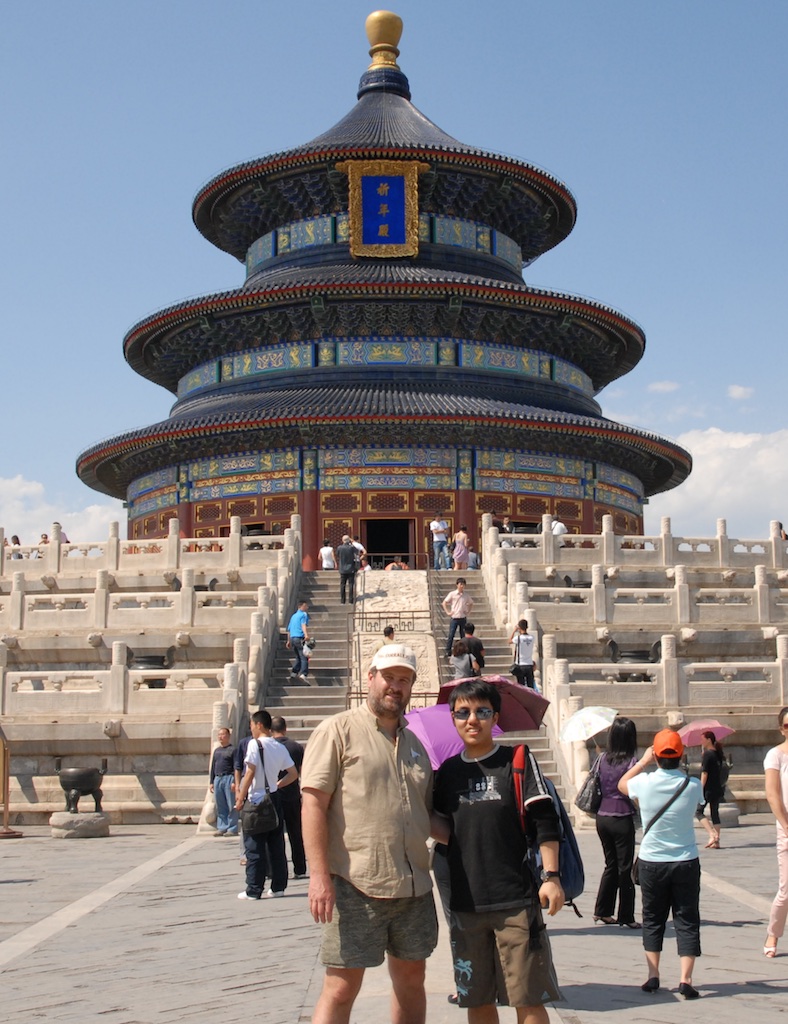
Runlu Li — my Godnephew and me in front of Sky Temple, Beijing

One of the biggest problems, when talking about evolving societies, is the natural critical expectation of an evolved society to get everything right.  Just like there are no perfect people, there are no perfect societies.  We all have our weak points.

Here, Spiral Dynamics can do an excellent job of giving guidelines on how to find the holes, or at a minimum, where to start looking.  A great example might be China in the 20th and 21st Century.

China at the beginning of the 20th Century was a mess.  Its government was really not a government, and regional warlords ran most of the show.  China had never really emerged from its dominant governmental form of narcissistic authoritarianism that made up the majority of its vast history.  The result of 2000+ years of relatively constant v-Meme assertion, however, was one of the most sophisticated forms of arguably empathetic authoritarianism in history.  Chinese culture was, and still is, even post-Cultural Revolution, extraordinarily complex, and I’ve talked about how things like chengyu buffered the population from the excesses of the Emperor, as well as the modifications offered up through Confucianism and Legalism.

WWII led to further fragmentation, rule by the Japanese in the north, and eventually, the collapse of the Kuomintang government, which then led to one of the most destructive and austere forms of authoritarianism on the planet — rule by Mao Zedong, and the reduction of Chinese society into two classes — party members and non-party members.  What is interesting about all this is that it is very difficult to second-guess history.  Would modern China have been possible without the narcissistic psychopathic excesses of Mao?  Without the Great Leap Forward, or the Cultural Revolution?  With China’s chronic problems with overpopulation, there are huge questions in how one gets to a society where individuals might be valued, when there is such an excess number of them.  This is NOT intended as an apologia for a cruel and vicious regime.  But the agricultural reforms implemented by Mao also broke the back of the regressive authoritarianism present from the various warlord periods.  As wild as it may seem, Mao was a strange agent of societal evolution for China.  He established an unstructured sense of a Legalistic v-Meme ‘We Mode’ that elevated the peasant class, while killing a lot of the landed gentry — somewhere between 1-2 million landlords were executed.  This came with enormous informational cost — no question.  But it also dismantled a social structure that had been in stasis for thousands of years.

After Mao’s death, Deng Xiaoping implemented many of the economic reforms (Performance-based v-Meme) that led to China’s current prosperity.  The numbers of Chinese peasants lifted into the middle class in the last twenty years is staggering — it is estimated that the Chinese middle class now composes approximately 68% of the population.

Yet China as a whole still has a relatively undeveloped legal system.  Most of the population do not believe in the courts. IP theft is commonplace (and well-publicized) and the lack of ability (that comes out of a poorly developed Legalistic v-Meme) to develop uniform codes and standards dramatically affected the ability of China to even have a civil airspace.  You can’t have commercial aviation in an Authoritarian v-Meme setting.  What happens when the boss is asleep?  Who gets to land first?

Relationships in China are still primarily externally defined.  I’ve mentioned earlier in this blog that if you see two people fall in love in a Chinese movie, you can be sure that this will result in their death at some later point.  But the effects of increased peer-to-peer communication are changing China.  There is a growing environmental movement.  Some of it is local and independently emergent.  But what is fascinating is that the Chinese government realizes that there is no way to avoid the development of SOME kind of environmental movement, as Chinese pollution problems are so bad.  Keeping with the v-Meme of external relational development, the Chinese government has set up GONGOs — Government Organized Non-Governmental Organizations — whose purpose is to be concerned with various environmental issues that the government may be slightly on the other side.  By setting these up, the government intends to control their activities.

But the reality is you can run, but you can’t hide from the fundamental empathetic physics present in sentient development.  Membership in the GONGOs is self-selected.  Which means like-minded people are going to meet, and start the data-driven evolution out of their former belief systems.  They, by virtue of being involved with each other in that independent, self-selected fashion, will start demanding real laws, and real data-driven solutions.  My bet is that between the One-Child policy, which is going to force an entire generation out to make friends, and the environmental movement in China, we will finally see the backfilling in of the Legalistic v-Meme that was skipped by Deng, and an increased developed empathy across the country — perhaps even to some level of communitarianism.  Sure, it will take 20-30 years.  But it’s on its way.

Further reading:  McKinsey reports are a great research resource for a broad range of issues.  This one is on China’s emergent middle class. And this one is on the Chinese consumer of 2020.  The reports focus mostly on aspirational capitalism and ignore the other trends that accompany an increase in purchase of status-based goods — namely diversity of goods, and the increase in empathetic identification that becomes important as consumer goods become increasingly fractionated — as well as the demand for design thinking (and the creative networks) to make those goods with a Chinese cultural flavor.  But that’s a topic for another blog post.  

Star Trek — Good Scaffolding, Bad Scaffolding, and Knowing it When You See It.

Seceshriver (1)

Secesh River, Secesh Roadless Area, Payette National Forest, Idaho

As I discussed in the previous post, v-Meme Scaffolding is important — without it, we open our organizations and our messages to corruption — some of it virtual, some of it quite real.

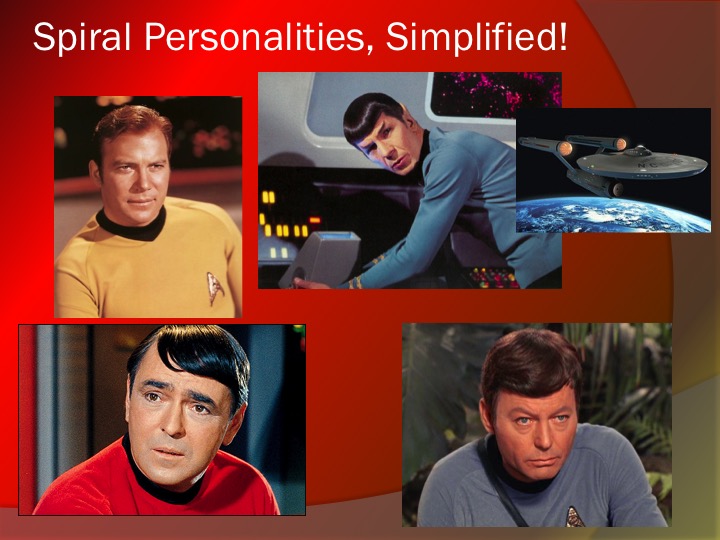
It might be helpful to understand an example that, over time, have been highly resonant  of both well-scaffolded messages, as well as organizations.  One of my favorites is the original series of Star Trek.  Almost everyone can recognize the four characters below:

Slide03Bridge Crew of the Starship Enterprise, from the Star Trek, the Original Series

For those that forget, we’ve got Captain Kirk, Mr. Spock, Dr. McCoy, and Commander Scott.  No question that these four are a high performance, if not just a little sexist team.  Lieutenant Uhura at least made it on the bridge — a major first — but she was sentenced to answer the phone.

Still the personalities, and their different levels of empathetic interaction, are highly instructive on how they were effective.  Consider the basic plot of the show — the Enterprise is thrust into a situation where there are major metacognitive unknowns — whether it was an unknown alien civilization, or trouble with Tribbles.  There were always Survival-level stakes — the Enterprise was in constant jeopardy of being destroyed.  Yet time and again, this integrative v-Meme team would think their way through the situations, and largely remain friends.

How did that work?  First off, we have Lieutenant Commander Montgomery Scott, head of engineering.  Even though he had an informal nickname — ‘Scotty’ — he was pure Authoritarian.  The Captain was the captain — I have yet to find a single instance where Scotty calls Kirk ‘Jim’.  He’s two v-Memes removed from Captain Kirk, and when the Captain tells Scotty to turn the Warp Drive past maximum, Scotty might say “I don’t know how much longer she can take it, Cap’n!” — but he turns up the dial anyway.  He follows orders.

Next up the v-Meme ladder is Mr. Spock.  A Vulcan, and the chief science officer, he is the master of logical, algorithmic thinking.  He is famous, of course, for mastering his emotions, and viewing this as a pathway to superior status.  Yet time and again, algorithmic thinking, while leading to reliable results, fails the validity test.  The one answer he comes up with might be part of the solution — but not all of it.

For that, we need the more complex, empathetic profile of Captain James T. Kirk.  Ever the integrative, multiple-solution, performance-based thinker, he’s not afraid to assert his authority in times of crisis.  But he also demonstrates a broad range of both emotional empathy, as well as rational empathy.  His ability to trade places with the alien mind enables him to very accurately guess what his adversaries are going to do — and saves the Enterprise from getting blown up on numerous occasions.

Finally there is Dr. McCoy, the deeply empathetic communitarian.  McCoy often speaks as the voice and liaison of those lower in the service hierarchy than any of the bridge officers, and is prone to using a combination of humor and grumpiness — emotional affect — to convey his points.  As a doctor, he processes data for diagnoses of difficult problems.  But he also takes his role in promoting psychological well-being very seriously — and demonstrates a deep sense of emotional empathy.

One of the easiest ways I’ve noticed to diagnose the v-Memes operative in any work environment is how people use titles, as well as the degree of dependence.  Star Trek is no exception.  Scotty NEVER calls Captain Kirk by his first name — typical of a true authoritarian.  Spock mixes it up — calling him Jim in more relaxed situations, as well as Captain when the phasers are firing.  McCoy is famous for almost always calling Captain Kirk by his first name.  Note that this would be extremely consistent with their representative v-Memes.

Additionally, v-Meme conflicts are also well-represented with the characters.  McCoy and Spock are often in conflict — rules vs. exceptions for individuals.  McCoy basically never talks to Scotty — the 3 v-Meme gap would mean they would have a hard time understanding each other anyway.  Captain Kirk sits in the middle of all of them.  Yet even the two level v-Meme difference between Kirk and Scotty pops up every now and again.  In the famous episode ‘The Trouble with Tribbles’ — Scotty and the engineering crew end up getting into a bar fight with some Klingons on a space station.  When interrogated about the brawl, Kirk asks what happened to get things started.  Scotty then goes on to explain that the Klingons had called Kirk many names — but Scotty told the Captain he had specific orders to not get into a fight from him.  So he let it pass.  It was only when the Klingons started insulting the U.S.S. Enterprise — the core sense of Scotty’s identity — that the fists flew.

The original Star Trek premise also promised its viewers a much more egalitarian, evolved, self-aware world — truly embodying the Global Holistic v-Meme.  What is interesting is that after the series ended, a fan community sprouted up, complete with costumes, and Trekkie conventions.  William Shatner even made a movie about it — called Get A Life!  What’s fascinating is that Shatner starts out being very cynical about all the folks participating — but is won over when he recognizes and realizes the higher ideals that this group of geeks are attempting to embody.

I doubt Shatner or the most of the Trekkies have ever thought much about empathetic development.  But it is fascinating that when people come together, under a set of higher guiding principles that everyone has to follow in order to be part of a larger group, that beautiful things can happen.  Even if they involve adults playing dress-up.

Takeaway:  Balanced Teams have balanced v-Memes — and real leaders use this stuff to understand both strengths and weaknesses of how individuals in their organizations work — and process knowledge.  The Original Series Star Trek is a great example that’s easily recognizable of v-Memes on display — and who you want to do what.

Knowledge Structures and Scaffolding — How to Fill in the Stretch Marks as you Evolve

Loonlake

Braden at Loon Lake, outside of McCall, ID

One of the big problems when reading posts like the previous, about empathetic ladders and knowledge structures, is it looks like it just might exist to make fun of your authoritarian friends.  That’s not the intent, because really successful messaging, or social/relational structures, have a diversity of both v-Memes and ways that knowledge is represented that reinforce each other.  It’s nice to come up with a magic ‘super bullet’ that creates all the meaning anyone could want.  But it’s not often easy.

Now what does THAT paragraph actually mean?  What it means is that if you’re working at a Communitarian level, and you’re not wallowing around recognizing everyone as an individual all the time, you’ve also leavened in some Performance-based, Goal-oriented thinking.  And you probably have a good Legalistic rule set that governs your operation, as well as appropriate Authority, and some Tribal knowledge.  And there’s also likely a bathroom on every floor of your workplace — because to Survive, we all have to go sometime.

I call this v-Meme Scaffolding, and without it, evolutionary philosophies often run astray.  Let’s talk about how this works on a practical level.

In the Industrial Design Clinic (IDC), the program I run for students, the main thing I’m trying to do is evolve them socially so they can be solid, goal-based thinkers.  Since the students work on mechanical design projects, we follow a very standard Design Process.  It’s actually a heuristic — a rule of thumb path that most of the students follow in order to complete their projects.  And it goes like this:

1.  Scoping (myself and the company).

2. Specification writing, including development of a House of Quality/QFD.

3. Preliminary Design Development, and Review.

4.  Final Concept Selection and Development.

5.  Manufacturing/Benchmarking/Testing.

6.  Customer Delivery and Celebration.

A graphic of this process is below:

Slide1

At some level, this looks like an algorithm (Legalistic/Absolutistic v-Meme), but it’s really a Performance-based heuristic — students roughly follow this trajectory through completing a project.  At the same time, they have to select, mix and match various algorithmic ways of knowing (calculating entropy, or enthalpy, etc.) as well as develop independent relationships with people both inside and outside the university who can actually help them — like our staff machinist, or a technical sales person who might sell a particular kind of specialty adhesive.  Trust me when I tell you the students don’t like getting on the phone — but they have to practice that relationship development, or they won’t get the project done.

So under this heuristic are those algorithms.  As well as lots of engineering specifics (Authoritarian v-Meme) — we can’t reinvent the strength of steel every time we need to do a calculation.  And then there are the important parts of Tribal knowledge — students are, for example, expected to understand the Guest-Host relationship concept (read about xenia here — the ancient Greeks live in my class as well!)  so that everyone has an enjoyable lunch.  Sponsors and students both need to have fun, as well as not commit unforgivable sins.  Finally, students need to know how to deal with the university motor pool if there’s a car accident.  That’s part of their fundamental university Survival knowledge.

At the same time we’re making sure to fill in the scaffolding with all the appropriate levels, I also make clear to the students that all of it is subject to update — that’s the beauty of getting up to the heuristic level.  Procedures and algorithms may change.  Specific knowledge of what hotel to stay in when visiting a particular client also may vary.  Knowledge isn’t always in flux — but sometimes it is.  We keep track of this on a class Wiki, so the students always know how to fill out the relevant university travel forms.  We do work in a bureaucracy.

Scaffolding inventories are great things to do to improve messages or organizations.  For example, with organizations, one could start with understanding what are your rules that govern various functions in your organization.  Do your rules follow accepted ethical standards?  Are there ways to change the rules?  Does it devolve to one person’s singular authority to change them, and is that appropriate?  Could someone with performance or community considerations tell their supervisor and have them listen?  What are the actual channels for empathetic communication in your organization?  Is all communication meaningful, or is it simply pro forma because HR is worried about getting sued?

And on and on.  No matter where you start, however — your organization can evolve.  Scaffolding inventories help make sure that as you evolve, you fill in the stretch marks.

Shorty Post — Where is All This Heading? Plugging Someone Else’s Work

fieldofflowers

Indian Paint Brush, Clearwater Country, Idaho

Just got done reading this.  This guy totally gets it, and this entire piece in the Guardian is worth reading.  What this blog is, in part, about, is explaining from First Principles how the planet is growing a nervous system — which is directly connected to the level of empathetic connection we establish with each other.

But more practical readers may appreciate that he talks in real terms, as opposed to more theoretical models.  Click here for Paul Mason’s The End of Capitalism has Begun.  If you’re a capitalist, and want to keep making money, you need to read this.  And if you think it’s some Marxist screed, you’re dead wrong.  And haven’t been doing your homework.  😉

Empathetic Ladders and What People Can Understand — Matching Knowledge Structures for Messaging (Part III)

Braden Montreal

Lovely French food at L’Express in Montreal, Canada,  with Braden

Unless you’ve been thinking about this stuff forever, you might be at the point with this blog where you’re Pee Wee Herman in “Pee Wee’s Big Adventure” — where he’s busy explaining to everyone all the evidence around his bike getting stolen.  Pee Wee has a captive audience of all of his friends, and after going through some 240 different exhibits (where everyone is fast asleep) he stands up and says — “What does this all mean?  I DON’T KNOW!”

But it does mean something.  What I laid out in the previous post is how you have to explain things to people who inhabit given social/relational structures.  If you’re talking in a Survival situation, the answers better be immediately relevant, and only pertain to matters at hand.  If you’re in a burning building, you’re probably not interested in the potential hazards you might be experiencing because of building codes written 20 years ago.  You just want to get out!

Since most business environments fall along the Spiral from Authoritarian to Communitarian (sorry, but there are precious few self-aware business environments out there — I’m hoping you’re reading this so you can create these!), it helps to understand and master the language for the four dominant v-Memes.

Now here’s the kicker — you have to remember that when you address an audience, even if you want to change them, you have to address them where they’re at.  If you have some idea that you’re going to persuade them with a knowledge structure other than the one they own, well, good luck.

If you’re talking to a bunch of Authoritarians, then it helps to be an Authority yourself, and speak mostly in terms of knowledge fragments.  Authoritarians tend to have a terribly developed temporal sense, to the point of a total lack of consequentiality in their thinking.  Why should they think about any future other than their own?  They’re in charge!

How do knowledge fragments represent themselves at that level?  One of the great examples to consider is how different people might recommend dealing with the homeless problem in the U.S.  An Authoritarian would be receptive to hearing “Just buy them a bus ticket to the next town!”  It’s short, sweet, and completely devoid of temporal context.  The Authoritarian assumes, or rather, believes that no change is possible inside the power structure.  And homeless people, being on the bottom, will always be on the bottom.

Once we have this understanding of solution (out of sight, out of mind!) then we can see that there’s little empathetic progress to be made on the issue in a vacuum.    You’re going to hear lots of stuff like ‘they should pull themselves up by their bootstraps!’  It sounds like something they need to do, but who even knows what bootstraps are nowadays?

Legalistic/Absolutistic v-Memes will need to be communicated to with algorithms and processes that historically have generated higher status individuals.  “Education is the answer” might appeal to the standard legalist, along with some version of absolutistic nostrum.  “How can they make progress if they don’t have their G.E.D.?”  We see the emergence of certification of process that starts dominating thinking.

As a professor, of course, I value education, and view it as necessary scaffolding for lots of different types of situations.  But it’s not always the answer.  The hopeful part of the legalistic v-Meme is that in algorithms, we now start to see a developed sense of consequence.  If we dump people into a given algorithm, when they pop out the other side, they will be changed.  The Hands of Time at least have started to move.

At the same time, however, most legalistic/absolutistic v-Meme members are not going to recognize individuals as individuals.  There can be, in evolved legalistic thinking, different sub-classes of populations  (‘rural poor whites have different problems than urban poor blacks’).  And that should be expected — remember that legalistic v-Memes would be dominated still by externally defined relationships.  No one yet gets to achieve individual status, so we’re not yet interested in any person on a case-by-case basis.

Moving up the Spiral to Performance/Goal-based v-Memes, different thinking starts to emerge.  Remember, this is where we start to see heuristic thinking emerge.  How might that look for our example?  “Well, Homeless Bill here used to be a plumber.  Then he took to drink, and fell off the wagon.  We think that the first thing he needs to do is join AA, and get him in a recovery program where he can remember how to braze a pipe joint.  Then he could apprentice with the local union and get a job.”  The steps along the way might follow a general path (another simpler way of saying heuristic!)  of personal health, professional re-training, and financial stability.  But the exact prescription would depend on the individual.

Finally, a quick look at the combined heuristics of a Communitarian v-Meme would add recruitment of larger partners into Homeless Bill’s problem.  “It takes a village to get a homeless person off the street,” some might say.  And then we see the emergence of public-private partnerships, each with a slightly different approach, adaptable to individuals, for solving both the individual and group problem of homelessness.  One can also see the development of a much more complex web of relationships between actors in the solution of the problem.  Government is going to play a role, as well as potential landlords, job training, churches to take away the demon rum, food stamp providers, and a host of other angles.

Different approaches will likely take different amounts of time, and that requires a much greater developed temporal sense than the Authoritarian’s solution of frog-marching any homeless person to the bus station and buying them a ticket to leave town.

One can now see how empathetic development is co-evolutionary with both diverse and complex solutions.  Authoritarians are going to have one quick solution (the bus ride).  Legalists are going to set up a single government program in charge of the homeless.  Performance/Goal-based thinkers are going to support links in a chain.  And Communitarians will start weaving the local web.

That means that you, as a leader and communicator, have to figure out who’s who in the Spiral world.  Because it makes no sense to talk about local webs of relationships to the Authoritarian to deal with the homeless.  The next thing you know, you’ll have a bus ticket out of town in your hand.

Takeaways:  Knowledge structures tell us how we must structure messages to convince audiences.  It’s not enough to be on topic, or on message.  That message has to match the modes of thinking of the people we’re trying to reach — or else it’s just gibberish to the people listening to you.  Not very empathetic.

Future reading/watching:  There’s no better example of wildly funny egocentric projection that Jerzy Kosinski’s novel/movie Being There.  The movie, starring Peter Sellers, is a classic.

Empathetic Ladders and What People Can Understand — Matching Knowledge Structures for Messaging (Part II)

oldmanriver

The Intermediate Corollary is a powerful construct — in the pathway of Social Structure -> Knowledge Structure -> Design Structure, it implies that certain social systems will create knowledge in particular ways, depending on the level of empathetic development.

Why does this matter?  We’re used to thinking of knowledge, for the most part, as a 2-dimensional construct, based on a plane of ‘objective’ knowledge vs. ‘subjective’ knowledge.  Scientists claim the high ground through objectivity.  Religion claims the high ground through channeling the Word of God.

This view of knowledge is a mental model, and not surprisingly, lacks a fair amount of detail or nuance.  Tearing it apart on either side is not particularly productive, either — especially in a blog post.  Every competent scientist knows that objective data is always constrained by the context of the experiment that generated it — the researcher decides what factors to vary, which ones to study and so forth.  Religious experts argue from historic texts and long tradition.  While we’ve grown to accept the debate, when you back up from it, it really is a mess.

There is a better way in understanding knowledge that’s produced.  It’s by understanding Conway’s Law, and the Intermediate Corollary, and then linking this through the emergent social structures given by Spiral Dynamics.  By understanding how people trade information (that is able to be validated or not) we can start creating more of a multi-dimensional knowledge landscape that gives a better perspective on how people structure knowledge neurally — inside their own head.

Understanding that humans operate with three primary variables that govern their social evolution is the basis.  Humans have a temporal (time-based) calibration (this has been discussed before with regards to empathy) , a set of spatial scales (3-D, x, y, z) and some level of energetics — the ability to get from one place to another, in a certain amount of time.

So what’s a summary of these knowledge structures look like, starting from the bottom of the Spiral?  When reading these, it’s important to remember that v-Memes higher up the Spiral include new modes of thinking, as well as all the ones beneath them — like Russian nested (matryoshka) dolls.

Survival v-Meme — knowledge is temporally short-term, spatially small (where do I find food/water), and exists in fragments.

Tribal v-Meme — knowledge is shared inside the tribal band, either temporally long-term (creation myths, coded survival information) or short-term, in stories that reference long-term memory.

Authoritarian v-Meme — knowledge exists primarily in fragments, where the truth/veracity of the given fragment is decided by the authority/boss.  If you are below someone in the power structure, it is expected that you will accept your authority’s definition of reality and truth, unless some cultural sidebar of appeal is offered.

Legalistic v-Meme — knowledge exists in rule sets that apply across a group of people.  Knowledge can be fed into these rule sets and transformed into other information (if THIS is true, then when a given rule is applied, THAT is true.)  Note that this kind of knowledge representation implies a high level of determinism and no tolerance for ambiguity.  There are no multiple solutions possible, nor implicit recognition of unknown factors.

Performance/Goal-based v-Meme — knowledge exists in heuristics (rules of thumb) that allow the individual to pick and choose various pieces of knowledge and rule sets to reach a conclusion.  Goal-based knowledge is the first that recognizes metacognition — knowing that there are unknowns that you can’t predict nor understand in any given decision-making process.  Most contemporary design processes fit inside this v-Meme — a given set of specifications can yield multiple designs, all more or less optimal dependent on a given interpretation of the customer.

Communitarian v-Meme — knowledge exists in combined heuristics of individuals in the community, that may be more or less valid dependent on the aggregate opinion of the community.  In an initial land use determination, where there is no code or body of law to apply, a community may get together and jointly share opinions, based on a variety of arguments, on how a piece of land might be used.  Later on, after a series of decisions are made, these may then be codified in a more legalistic v-Meme set that removes larger ambiguity.

Global Systemic v-Meme — the first of the Tier II v-Memes, there is an explicit self-awareness of the picking and choosing of knowledge structures from the lower Tier I v-Memes.  The primary differentiator in this knowledge structure is an awareness of the individual of personal bias — “I’m trying to reach this goal because of my own past experience, thought process, and feelings regarding this issue.”

Global Holistic v-Meme — fundamental guiding principles.  Guiding principles are very different from simple rule sets in that when applying them, they can generate complex structures of knowledge themselves.  When combined, they can produce a potentially large, or infinite and complex set of behaviors and knowledge, with complex interactions and synergies.  Temporal scales are long (we can understand how the universe started) and prediction can be large (we can guess how planets around other stars revolve) with some accuracy.

A simple example of a guiding principle might be the Law of Gravity.  We don’t have to go run an experiment across town to convince ourselves that if we jump off a building across town, we’ll end up on the pavement.  True guiding principles are hard to come by.

Takeaways:  Knowledge, synergies, spatial and temporal scales increase as we move up the Spiral.  The more empathy in the system, the more complex the synergies available, and the greater number of time and spatial scales.  At the top of our current understanding are Guiding Principles, that are capable of spinning out complex patterns and multiple solutions.

Further reading:  Fractals, a class of geometry present in nature, are a great example of how a given rule, with some simple input, can generate extremely complex behavior.  The Mandelbrot set is a great example, and you can vary simple pictures of your own by going to this NOVA website.

For those that want more, you can start here and keep exploring.

Empathetic Ladders and What People Can Understand — Matching Knowledge Structures for Messaging (Part I)

rainierrapids

Rainier Rapids, Main Salmon River, Idaho

Empathetic ladders are fun to find — enlightened leadership has been using them since the beginning of time.  I’m sure, if we could find some sequence of caveman paintings on the wall in some cave somewhere and looked with that in mind, we could find an empathetic ladder with lots of wooly mammoths and dudes with spears running around, painted by the local mensch attempting to get his or her tribe to up their game.

At the same time, any person who’s trying to grow has been stuck in a meeting with a leader who insists that everyone has a chance for ‘input’, while doing a seemingly endless round-robin around the room, with the same people saying nothing, and the same people doing some weird humble-brag about their area of interest.  Communitarian on the surface, but eh — not so much.  Really just the same authoritarian assertion of status.

And after a while, you might find yourself, with certain empathetic ladders, picking them apart.  What do they really mean, after all?  Your own level of sophistication will start to pick apart these kinds of things.  And I think there’s few people that really like those pithy sayings on the bottom of motivational posters.  In fact, I’m sure most of you have seen these anti-motivational posters, with the same beautiful picture, but tagged with an ironic punchline, like this one:

gettowork-topdemotivators

Since I’m writing this blog with the intent of turning it into a book, there’s also a natural tendency to want to list quick ‘how-tos’ Internet-able memes.  These would inevitably be used to torture workers in as-yet inconceivable ways by the percentage of psychopaths who buy business books.

At the same time, there ought to be a way to discern between sound-bites of pithy wisdom, and things that can revolutionize cultures and societies.  That’s where understanding what knowledge structures are used by the evolving v-Memes come into play.  One of the next big concepts in this blog is the idea that social structures create design structures — Conway’s Law.  And the breakthrough concept that comes out of that is that in between social structure and design structure is knowledge structure.  I have named this principle The Intermediate Corollary. And it starts the process of unlocking the idea that social/relational structure, all dependent on empathetic level, creates different ways of thinking for people in those social  structures.  

Slide2

I’ve found that this concept is very difficult for people to grasp.  There’s a part of our fundamental humanity that wants to believe that even though there may be different cultures, or surface level structures, that all humans process information the same — same organic matter in between the ears, after all.

But that’s a pretty hardware-oriented view of the brain.  Every day, we are reminded that we don’t all think the same.  This worldview discounts the role of software in the brain — that programming the brain is not just assembling surface level knowledge.  As we move through life, our brains actually function differently.  And the strand that runs through all of that is empathetic development, and the social structures we operate in.

Takeaways:  Conway’s Law says that social structure produces design structure.  In order to produce a design, though, we first have to produce the knowledge.  That concept — The Intermediate Corollary — directly implies that different social structures will produce different knowledge structures — and that means that different people in different social structures will fundamentally think differently.

All this links back to empathetic ladders.  The next thing I’ll discuss is how we can identify the knowledge structure of our empathetic ladders, so we can get down to real ‘guiding principle’ evolution, instead of just one more annoying motivational poster.

Elephants, Rhinos, UAVs and Interdisciplinary Teams — Does Any of this Empathy Stuff Really Matter?

Liverpool (1)

Liverpool, England, in front of the Hard Days Night Hotel.  Not surprisingly, Liverpool has a thing for the Beatles!

If you’ve been following this blog for a while, I know by looking at my statistics,  that you likely have not read all the posts.  After all, I am aware that while a lot of my readers are fond of me — I was the professor that helped get them ready for the work world, or a business associate with my Industrial Design Clinic, and we enjoyed educating students together — I also know that I am not an internationally recognized expert on organizational development, or empathy, or philosophy.  I haven’t cut it yet in the status-based lower v-Memes.  I’m not bothered by this —  those that know me personally know that I’m not much of an Authoritarian or Legalist.

But you’re probably thinking — “well, Chuck, that’s nice.  But why should I really care?  And how does this really matter?”

Here’s some insight.

Last week, I was in Liverpool, England, at Liverpool John Moores University (LJMU) at a conference for UAVs (Unmanned Aerial Vehicles — think quadcopter or fixed-wing drones) applied to environmental science and problems.  The breadth of application of UAVs to problems in the environmental arena was immense.  The keynote speaker, Tom Snitch, talked about his program, which involves using relatively low-cost drones to monitor elephant and rhino poaching in Africa   Others talked primarily about the use of LiDAR mounted on a UAV, which is basically using light like radar waves to map vegetation and landscape features.  Others used UAV-mounted regular cameras to create high-resolution photo mosaics of landscapes that are much more high resolution than available from satellite images.  And so on.

But in such a potentially synergistic, systemic world, those connections were few and far between.  The key element in all this was the structure of the combined UAV – sensor system.  In a room full of passionate, sophisticated people, the basic structure of a UAV system was ‘take a store-bought UAV and mount a camera on it.  Figure out how to trigger it and capture the location of the image and bring that back to the ground for post-processing.’  The design structure of any system that does that — regardless of the complexity of the design of either the UAV, or the measuring instrument (like the LiDAR unit) — is three fragmented, non-synergetic blocks in a row.  Learn how to fly the UAV, bring back the pictures, make your map.

It’s pretty obvious that this maps to the non-empathetic structure of researchers in the academy.  Three blocks put together, basically in what we call open loop feedback (read ‘no feedback at all’) .

What is interesting as well is to see how this social/relational structure will attempt to solve their problem.  How will they evolve?  In a fragmented social structure, the first (and likely subsequent) iterations will likely involve more pictures (read more fragmentation) and more detail.  More computer processing, with more sophisticated on-the-ground mapping algorithms for more complex assemblages of images.  Greater accuracy in the GPS units used.  Paying more money for UAVs with greater flight stability.  And so on.

Notice how NONE of these things engage in any meaningful feedback between the elements.  How could they?  How could the people engaged in the task develop any synergies at all, given the social structure of the typical academic enterprise?  Synergies with this given social structure are likely to come (not surprisingly) when the resolution of pictures taken on the ground get down to pebble size.  Fancier cameras.  More stable UAVs.

And that’s exactly what is happening.

What would be required for synergies?  The short answer is a different social/relational structure.  We might start with the old ‘multidisciplinary teams’ axiom.  Perhaps if we added someone who was an expert in flight control and dynamics, they could stabilize the UAV better.  Someone in cameras could invent a camera with greater resolution.  And so on.

What’s the takeaway? If we pursue a similar, fragmented non-empathetic structure, we can see that multidisciplinary teams approach doesn’t really add much to the synergies of the device.  At first blush, the different component providers don’t need to do much understanding of each other — knowledge can be passed in fragments, like ‘well we’d like finer resolution.’  And things would march down exactly the same path.  Perhaps a little faster, but likely much more expensive.  More people on the project definitely means more dollars.  Higher resolution equipment is going to climb up that marginal cost/performance curve that every product possesses.

What happens, however, if we pursue a different structure — where we now have a multidisciplinary team, with pairing between different components of the entire UAV system?  The mapper says to her partner, the camera designer ‘I want finer resolution.’  In an empathetic exchange, the camera designer would hopefully ask ‘why?’  The mapper would then explain that things aren’t going so well on the boundaries of images, and she figured that finer resolution was the answer.  The camera designer then might say ‘well, you can get finer resolution, but if you still can’t improve the auto-stabilization and orientation of the UAV, any more pixels are just going to get lost in the noise.’  So after understanding the problem with perhaps a little math, they make a decision to engage the flight control person.

The flight control person goes through an empathetic exchange with both the mapper and the camera person.  It turns out that the real problem with getting the pictures to overlap is that the UAV turns a little in the wind, and that makes the photos not line up on a nice, even grid.  So the real answer is to put two GPS units on the UAV, separated by a meaningful distance, so that the UAV can be flown with both a static coordinate, as well as an angular direction orientation.  Then mapping can commence so that you don’t have blurred pixels on the boundary, and so on.  The social structure, as well as the degree of empathetic connection, all has to change.  And in the world of empathetic connection, there’s going to have to be a whole lot more of it.

Or if nothing else, it gets discovered that we can’t yet orient the UAV at a given angle.  So we don’t waste money on more and more expensive cameras, or mapping software — because we really can’t do better than the fragmented system.  Either way, the performance of the system goes up.  Money is saved from not pursuing something not feasible (or too expensive), or mapping accuracy is improved.

And we can also see how trust is brought into the picture.  If one component expert doesn’t know the other component expert, how does one know whether they can believe them?  Only through an evolved working relationship can the mapper be sure if the flight control UAV expert is telling the truth — whether it be that you can orient a UAV, or you can’t.  Empathetic connection is the primary tool for assessing someone else’s metacognition — if they know what they know, as well as what they don’t know.

The non-empathetic, multidisciplinary effort yields results similar to the fragmented academic social structure.  Just as Conway would have predicted.  And the understanding of the level of empathetic connection leads the project manager on the same path as has been discussed in this blog.   😉

Takeaways:  Sophistication of individual knowledge doesn’t do you that much good if you can’t work at the boundaries (or even in the guts of these systems) with other experts to optimize and synergize shared results.  And empathetic connection between teammates is the pathway toward getting a better shared result, without having to go outside and pay a ton of money for experts who may or may not know what they’re talking about.  A little bit of empathetic relational development goes a long way.  Change the social structure if you want to change the performance.

Further reading: This piece on Tom Snitch’s work in South Africa regarding using drones for prevention of poaching elephants and rhinos shows, better than anything, that it is often social factors and trust that limit all our efforts.  It is indeed all about empathy.

Using the Principle of Reinforcement for Evolving Empathetic Teams (II)

sforkconfluence1

So how does one go about developing more empathetic team members?  The beauty of understanding the empathy pyramid, combined with using the societal/leadership authority present in the Principle of Reinforcement, tell us what is more likely to stick earlier on in the process.

Not surprisingly, enlightened master Mahatma Gandhi said ‘be the change you want to see in the world.’  Directly addressed by mirroring behavior, this statement addresses the first tier of any empathetic transition of an organization.  Leaders have to demonstrate the behavior, and this is a well-known principle of management.

The other levels offer more guidance on behaviors.  Emotional empathy, where leaders honestly feel other people’s successes and pain, can establish the leader as a compassionate individual.  Compassionate leaders are typically held in high regard — which at some level is a status-based response, and is a primary incentive in authoritarian/legalistic organizations.

Rational empathy, best exhibited by place-taking, is where things start to get tricky.  Real rational empathy is challenging for most people.  Fundamental egocentricity has to be overcome — remember when I talked about giving my students a customer as a way of combating this tendency.

But there are other ways.  Great spiritual teachers, divine or not, depending on your belief system, have invented what I call ’empathetic ladders’ –development tools for creation of complex empathetic response in individuals who are not particularly highly evolved.

One of my favorites is Jesus Christ’s  The Golden Rule — “Do unto others as you would have done unto yourself.”  How did this come about?

I can imagine Jesus sitting around one day, pondering his ostensible flock.  “Father, what can I do with these people?  They’re mostly pretty egocentric, thinking only of themselves.  I really would like them to understand their fellow man and woman, and comprehend the individual journey each of us are on in this world.  I’d like them not just to develop rational empathy, but global empathy as well, and realize that we are all connected in our existence.  I’d like them to think not just about what the people individually ask for, but what they honestly need by considering their past, as well as their future.”

And then he said “Nah — they’re never gonna get that.  Do unto others…”

What’s fascinating about the Golden Rule is that it is what I call an empathetic, or Spiral Ladder.  At first blush, everyone will respond to the Golden Rule, especially if one considers the more drastic potential alternatives.  I don’t want to die, so I won’t kill someone.  I don’t want to have my stuff stolen, so I won’t steal someone else’s stuff.

But once you get past the Ten Commandments, things start getting a bit more tricky.  I like chocolate ice cream.  Does that mean I should go out and distribute chocolate ice cream to the lactose-intolerant?  And so on.

Yet if we practice the Golden Rule, it evolves rational empathy.  The first time you bring someone chocolate ice cream to someone who doesn’t like it, you’re cued to pay attention to what that person’s preferences are.  If you can’t provide that preference, then you show a little compassion.  I am never able to bring home for my Taiwanese wife red bean ice cream, so I have to demonstrate sympathy for her deprivation.  She remarked on a picture of a child eating a roasted Japanese yam.  So the next time I was in the Asian grocery store, I made sure to pick one up.

And of course the evolution continues.  So many of our favorite treats are from childhood.  You might like oatmeal cookies because your mom made them.  But what were the childhood treats in Taiwan?  What was childhood like at all?  Was there a whole lot of joy besides studying for tests?  (Hint — not that much!)

Most business development/success books focus on the transition between Authoritarian/Legalistic title-based leadership and Performance-based Communitarianism in evolving corporations because in American business culture, that’s where a lot of the work that needs to be done is.  There is no better example of this than Steven Covey’s Seven Habits of Highly Effective People.

But that landscape is changing.  Now, good leaders work to identify the level of empathetic development of each of their employees, and then construct ladders to help them evolve.  As our workforces gentrify, people in their 50s are looking for different structures of meaning than people in their 20s.  And that’s going to demand a different toolkit of both understanding and pathways.

Takeaways:  Using the Principle of Reinforcement, smart leaders seek to evolve their employees, both by working with them directly and creating environments where ways of being drive empathetic growth. Since all employees are different people, each of them will need something different to help them on their own pathway toward higher meaning.  Empathetic ladders, such as the Golden Rule, offer a way to accelerate development by combining v-Memes where people are in a way that reinforces where the leader would like them to be.

Further reading:  Zen Flesh, Zen Bones, by Paul Reps, is a great collection of accessible stories containing age-old empathetic ladders.