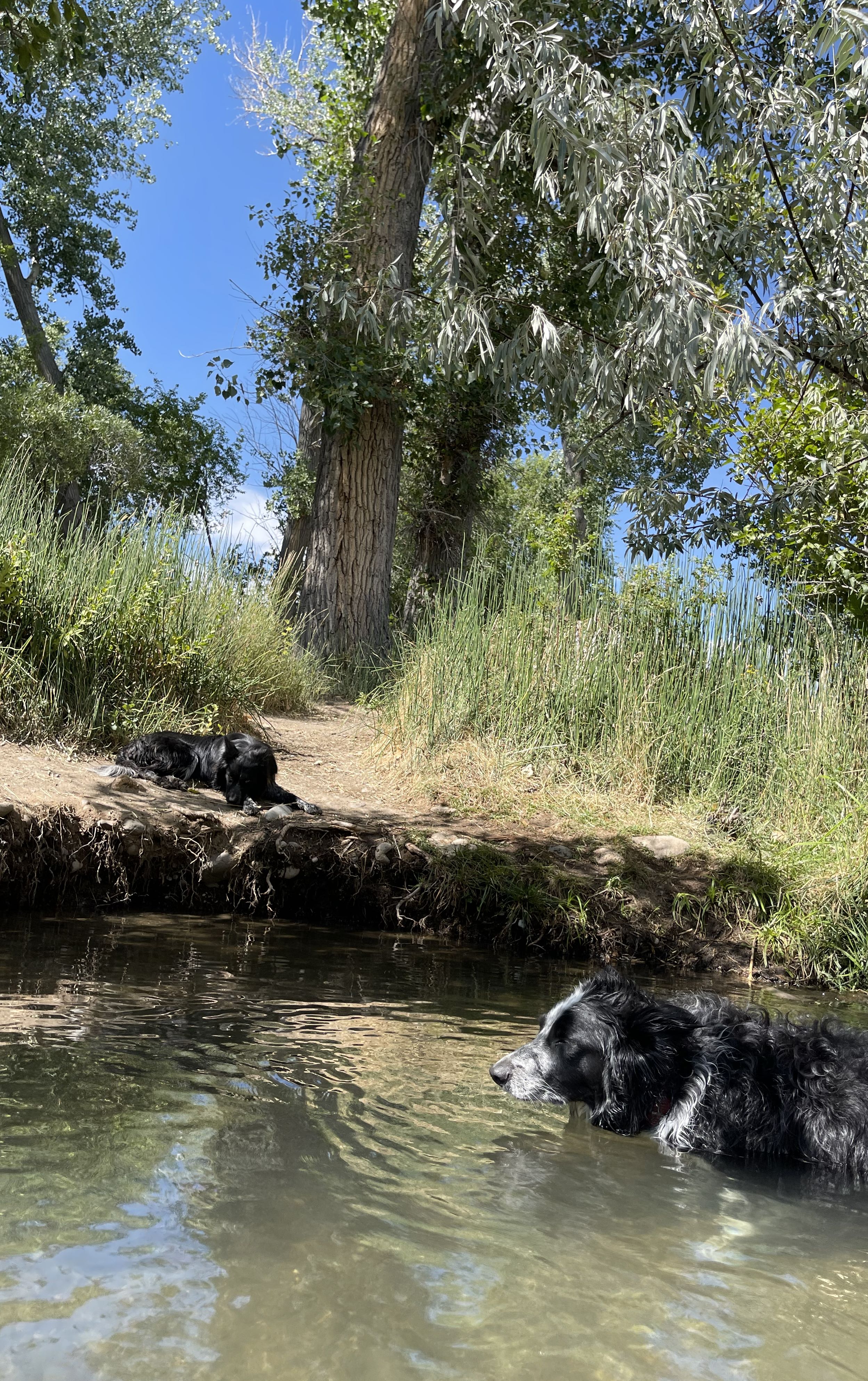
Ceci and Ghillie (aka Squeaky and Squonky) by my favorite cottonwood tree
The latest scandal still ongoing now involves the Cambridge professorship that blew up of Jason Arday, a black Brit, who only yesterday killed himself after being revealed as a serial plagiarist and generalized record manufacturer. Arday had been given a position as a Distinguished Professor at Cambridge in their functional equivalent of race and gender studies in their department of Sociology of Education, in Cambridge’s Faculty of Education. It’s very difficult for people outside of the Sausage Factory to understand how little credible work is actually done in Colleges of Education. They are, along with the various diversity departments, the burning dumpster fires of the academy.
They used to be responsible for training teachers, but as time rolled on, and pressure from higher administration grew, branched out into research and general grandstanding. Needless to say, I don’t know a one that didn’t jump onto the DEI-crashing aircraft. And I tried to work with those people in the context of my own career. Two fun facts for those that don’t know who I am — I ran, before I retired, the largest active/problem-based learning engineering clinic in my university system, and raised a ton of money as well. At the same time, I was never contacted to give a seminar nor advise on any education issue outside of my role as the President (or whatever the title was) of the President’s Teaching Academy — a position I held for three years.
And while I maintained some affinity for precious few individuals inside that organ, it was very difficult to hold one’s nose while reviewing the various proposals for internal funding. And lest ye think this was somehow constrained inside my home university, I attended enough engineering education conferences to realize that this rot was across the entire academy. I remember one particular university seminar with a denizen from ANOTHER university (I’m sure they paid her money) where she was expositing on how if students didn’t want to stand up and give presentations in class, professors should respect their wishes and not force them. She then went on to say that SHE was one of those people who had problems presented. She was waxing stupidly on how she was in a poetry class, and loved having poetry read to her, but found the situation where the professor had demanded that all class members also had to, before the end of the semester, stand up and recite a memorized poem to the class as well, as cruel and unusual.
Because I am particularly thick headed (I definitely had late-stage academic burnout by this point) I stood up and asked her, since she was giving a public lecture (and getting a big, fat check for it) how she was able to give a public speech now. She launched into a stream of invective about me being a white male (this was a convenient go-to) and how I could not be cured of my thick-headedness. This seemed perfectly reasonable to the other 100 or so people in the auditorium at the time. No one spoke in my defense.
Never underestimate the lack of courage of people in the academy. Craven doesn’t even begin to describe it – especially in the current milieu of the darker arts of sociology, education and psychology.
Arday was a character, who claimed multiple superhuman feats on his path to both his professorship at Cambridge, as well as his inevitable suicide. He ran some 600 miles in six days, on a broken bone. He was autistic, and didn’t speak until he was 18 or something. The lies go on and on, of course. It’s not that hard to Google them all up. And he also was black. I suspect he was also carrying on with some of the search team that selected him. Such a figure would be intoxicating to them, and a similar set of circumstances also surrounded the last notorious black fabulist, Ian Roberts, the former superintendent of the Des Moines, Iowa, school district. Apparently, he was having an affair with Nicole Price, who happened to be married at the time and basically served as a consultant to the school district that got him the job. No one ever wants to bring up the actual fuckery that often accompanies this type of scandal. But where there’s smoke, there’s fire. It will be interesting to see what Cambridge’s internal investigation turns up. Polymarket may disagree, but I’m betting on the sex.
Why, though? While it’s fun to trot out all the old tropes with this kind of a story — and believe me, the tropes keep coming and coming — they are a total distraction for the deep flaws in the actors, as well as the flaws in the system that keep these types of things roiling around. Arday’s trope, of course, was race, and somehow people must hate him and wish for his downfall because he was a black dude. Of course, that might have some merit.
But most of it has shown up after the fact. Academia is a closed society, folks. It’s why so many have gotten away with so much for so long. And academia also has memetic problems. The way status and clout are metered out in the academy is with low empathy externally defined relationships. I can’t tell you how many times I’ve rolled my eyes being told that “Provost Blah” or “Vice President Bleh” want to talk to me by their satraps and minions. Meaningless titles matter in the academy, because they’re not meaningless inside the Sausage Factory. What that means is that the academy does not function on reason. It functions on belief. You believe what someone says because they have a fancy title. Not because they actually know something, that makes sense, and you can observe for yourself.
In my case, I was certainly around long enough for those same idiots to know exactly who I was. I remember at one of this nonsensical talks going to fetch a cup of coffee at the seminar coffee bar. Because of my own position, as some kind of lethal faculty weapon, I usually got called in by top leadership — the various Presidents and Provosts — to talk about systemic problems early — a truly ersatz Diogenes.
I remember one particular Provost that was different. She did NOT call me in. She was a classic midwit, and her role at the time was to demonstrate exactly the max you could expect to make if you got an anthropology Ph.D. Which was, as a provost, quite a lot. So she happened to be at the coffee bar at the same time. I stuck my hand out, and probably called her by her first name, “XXX, I don’t think we’ve officially met. I’m Chuck Pezeshki down in MME.” She gave me a look that could freeze ice. “I know exactly who YOU are” she retorted. And then she spun on her feet and walked away.
If you’re familiar with the concept of collegiality — which is kind of a coded geniality all academics are supposed to practice with each other, but has really fallen out of favor in the last ten or so years — you would have seen why we need it. FYI — she is now a President, and has to be making somewhere north of $600K.
But back to Arday. It’s very hard for folks to really understand how someone like Arday ended up in the position he managed to secure, if you’re outside the academy. But it’s really not very hard to understand from the inside. He was in a BS department, in a BS college, that was completely ungrounded, that believes nonsense and has an interest in guarding that nonsense — i.e. making it reliable. Universities love to sell to the public that their mission is discovery of new knowledge. But that has really only been a side hustle in the last 50 years, save for a rare handful of institutional examples. Putting aside all the negative similes my brain could spin forever, what they really do is provide RELIABILITY of knowledge. Universities were/are supposed to take stuff that circulating in the noosphere, and get at to the stuff that is reliable AND reproducible.
So for disciplines that have the Real World at your door, what that means is you set up experiments, grounded in reality, that allow you to test if a given proclamation can hold weight. You then discover results, vet them, and put them through the publishing meat grinder.
But that’s for REAL stuff. Not the Sociology/Anthropology/Psychology fraud factory. Especially in the last 20 years, they’ve been specialized in doctrine. Which is just made-up bullshit. And lacking any real, in your face evidence that things like racism are ACTUALLY happening, or at best, a receding signal, it’s the equivalent of grounding a system to itself. The reliability then turns into who can reliably produce self-reinforcing bullshit. Because that self-reinforcing bullshit is the way you get to the top.
Most of the time. The other way is to produce outlandish, unverifiable claims that catch attention, sound great, that they rely on your “trust me, I lived it” nonsense argument. And who better to produce that than someone like Jason Arday? Who didn’t speak until 18? And was the first black “blah blah blah” who ran 600 miles in six days, and raised a bazillion dollars for charity? It was whopper after whopper. Plagiarism was really just a small part of it – a number inflater. I can’t really think of plagiarism in Arday’s case as actually amplifying the TRUTH of anything. Rather, because of his discipline, he was just imitating someone else’s codpiece. And no, I’m not going to go read all his papers. You go waste your own time.
In systems talk, that kind of effort results in an entire system with positive eigenvalues. What does that mean? It means that the system itself feeds back into itself, creating greater and greater lies. Until the whole thing explodes. Which, of course it did.
But now the issue becomes “who could be so ungrounded? Who could do something like that?” And the answer for that, dear reader, is a special kind of personality-disordered person called a narcissistic fabulist. Here’s the ChatGPT definition:
A narcissistic fabulist is a person who repeatedly invents, embellishes, or substantially distorts stories about themselves in order to construct and maintain an inflated, admirable, exceptional, or victimized identity.
The term combines two concepts:
- Fabulism — persistent fabrication or embellishment, often involving elaborate autobiographical stories. In its extreme form it overlaps with pseudologia fantastica (“pathological lying”). The stories may contain kernels of truth woven together with invention.
- Narcissism — a pattern characterized by an exaggerated sense of importance or uniqueness, strong concern with status and recognition, entitlement, and a need to protect one’s self-image. This is broader than the clinical diagnosis narcissistic personality disorder (NPD).
What makes someone a narcissistic fabulist, rather than simply a habitual liar, is the function of the fabrication. The stories characteristically support the person’s preferred identity: I am unusually accomplished; I overcame extraordinary adversity; important people recognize my brilliance; institutions have sought me out; my failures resulted from persecution rather than my own shortcomings.
A useful compact definition would be:
Narcissistic fabulist: A person who habitually fabricates or embellishes autobiographical claims in service of an idealized self-image, particularly claims concerning achievement, status, adversity, relationships, or personal importance.
Sound familiar?
_________________________
Now we start running into rough sailing, cognitively. None of this has anything to do with the old tropes. In fact, everything the fabulist produces, content wise, cloaks reality.
And this is where ordinary people start getting into trouble. Unless you are a true Zen master, you’re in the business, when you communicate with other people, of attempting to form shared coherence with what they’re saying and doing. Understanding is the simple word we use to describe this. But it’s really about coherence of information. That means identifying things you DON’T agree with as well, which is why there’s so much discussion on social media about finding ways to disagree and not disrupt relationships (doesn’t work very well.) Why? Because humans are really not just individuals — we are, as my Metamodern friends might say, dividuals. Both socially connected, and independent in our own right. How exactly we form these aggregate selves is the entire subject of this blog. (You know you can use Google on this thing, right?)
But narcissistic fabulists, and their brains, DON’T work on those principles. You, dear reader, are stuck with your humanity and how you understand what being a human is. And you project that out on the people you deal with. The whole Golden Rule is built around it. But narcissistic fabulists are really outside of that paradigm. They are fine, and feel no shame with telling lies and embellished stories (which, you CANNOT know) to you. They may be highly evolved, and doing it on purpose. But maybe not. It could be that their behavior is completely emergent.
And here’s the rub. You CAN’T know. The only thing you know is that this type of person is DOING something to bring more power, control, or resources to them. Or they’re literally just fucking with you. Or trying to boink the members of the search committee. Assuming that they ever, for a red second, feel any guilt or remorse is really not in your favor.
Academia attracts them as well. The sales pitch I used to use to raise money for my engineering clinic involved explains the fundamental narcissistic mechanism used in any classroom.
- You teach them some material (any more with a Powerpoint slide.)
- You send them away to study.
- You call them back in and ask what they think of your ideas.
- The students reply “you’re a genius!”
- You give them a test to make sure they understand exactly WHY you’re a genius.
- You then report back to various people with titles you’re attempting to impress that you’re teaching Critical Thinking.
This is called narcissistic supply. I stopped doing this about seven years into my career. I noticed that while I loved it, and the students loved it, no one was really learning much of anything.
But for a narcissist, the administration gives you an award and tell you that you’re great! And so, at some level, a sizable minority of individuals who have some version of a narcissistic disorder flock to a career doing it like a fly to honey. The physical sciences (engineering being one) have built in feedback mechanisms to kick your ass and keep you humble — or at a minimum, really force you to confront your lies, even if you do it.
But made-up BS like what Arday and others pull off don’t have that. They’re making shit up all the time. As an example, you can ALWAYS find students that will learn if you stand on your head and juggle balloons, and set up some bogus experiment to show that pedagogically this is an improvement. But that really doesn’t mean you’re an effective teacher. (Do note — students love this shit. Trust me — I’ve done my share.)
The problem with a university of like Cambridge is they long ago got high on their own supply. And the more you do this, the more you turn into a Vampire Colony — a group of self-reinforcing narcissists whose primary claim to fame is inventing more and elaborate bullshit. One of the latest trends in academia is making sure all disabled people can access our web pages. What that means is that if you’re blind, you have to be able to see visual web content. At some level, this is a worthy goal — I really don’t want to shut down all research into ways to help disabled folks, and I have done quite a bit of research in that space with various actors whom I consider dear friends.
But there are diminishing returns. Blindness IS a sadness. And sadness is also part of the human condition. But if your administration demands that you produce visual material that blind people can see, you’re going to run into a psychopathic double bind sooner or later.
Back to Arday. Arday had been doing this promiscuous lying his entire career. And the intensity of HOW he did it indicates to me that he was the original model. What THAT means is you CANNOT understand the whole reason he did what he did. And if you decide to waste time on that, well, that’s your business. But there are vanishingly few people with a severe condition like his that haven’t gone on to make LOTS of other people’s lives a living hell. Don’t cry for him, Argentina. Maybe his other sins will come out. But I’ll bet most will not. At the same time, you don’t get to be a narcissistic fabulist and a full professor at Princeton without bullying a lot of people. To show you how difficult all this is, is to process the standard riposte “I don’t feel sorry for him. But I do feel sorry for his kids.” Really. Do you really think someone like this was a good dad? The fact is WE DON’T KNOW. Just remember — Darth Vader was a father as well. NOT a great dad.
The right-wing hordes are indeed swarming over the Arday case as well. But before you decide to throw in with them, regardless of Arday’s misdeeds, it’s important to remember that a good hunk of your allies will also be anti-hierarchicalists. They want to break down the university because, at some level, we’re staring down the barrel of some serious reform. But they also want to derail the primary reason for the university — which HAS NOT CHANGED. And that is to create reliable knowledge for society to use, as well as train people for future employment.
There needs to be a longer piece written on solutions, and I’ll probably write one soon. But lots of these problems are baked in. When it comes to plagiarism, for example (one of the least of the academy’s sins, FWIW) we have amazing tools like iThenticate that scan and find it. These things have been around for at least 20 years. But be forewarned — rigorous plagiarism enforcement will eliminate most foreign scholars speaking a language different than English relatively quickly. And for reasons you wouldn’t want. I’m not going to go into this here now.
The bigger sins in the academy come from its fundamental rigid hierarchical structure. And while a good dose of antiseptic might help clean out some of the chancres, the larger benefit will come from opening up the academy to reality. Which means wholesale elimination of the proliferation of DEI as a driver. Most forces in the academy are hoping that Trump is just an anomaly, and they’re holding out for two more years, hoping (and lying to themselves) that things will just get back to business.
My guess is that we can’t afford our fabulists any more. They’re expensive actors to have.
But we’ll find out. Vampires and their colonies have been in the historical literature forever. We want it to be a bug. But it’s likely a feature.


