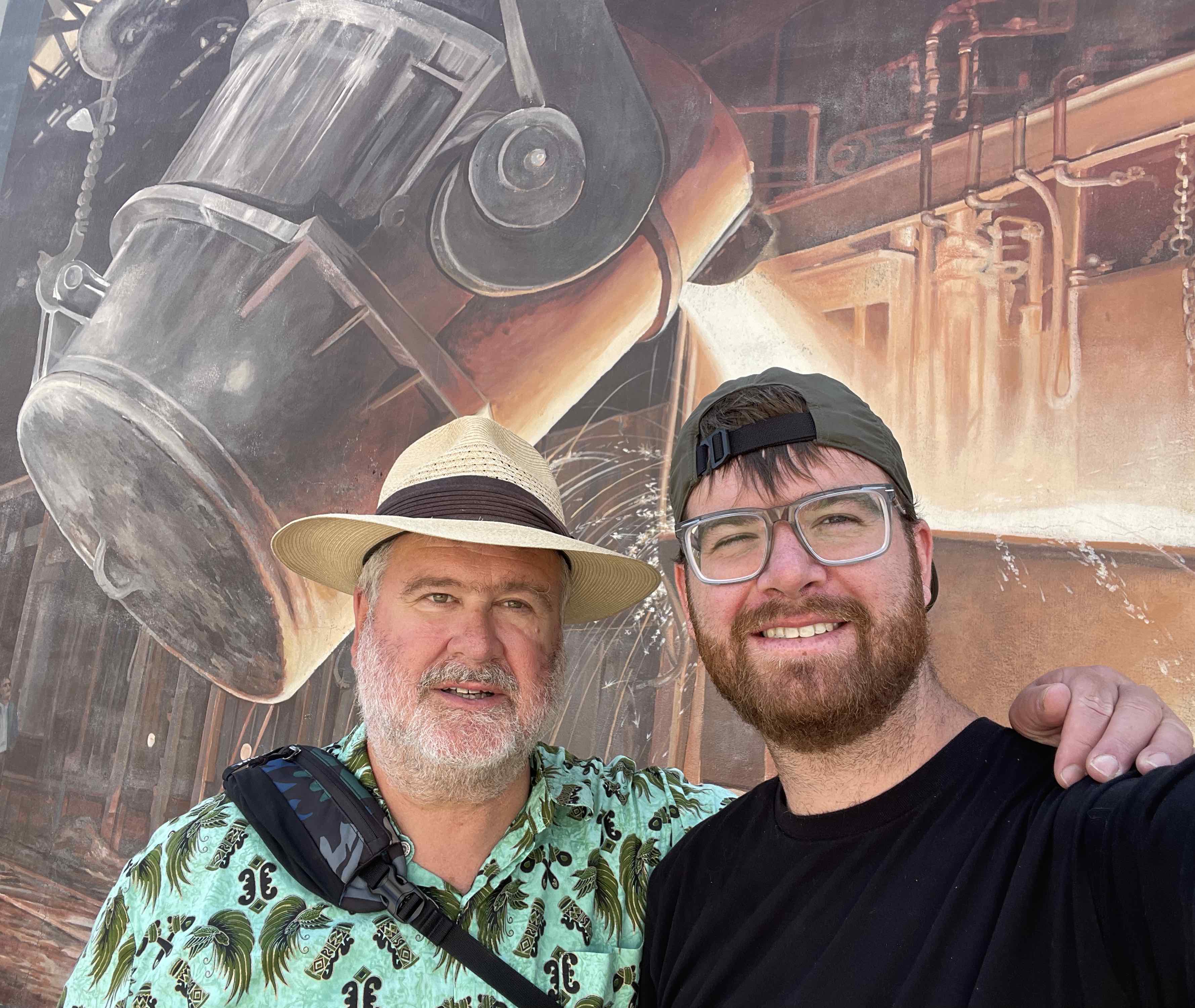
Trip back to the homeland – Portsmouth, OH — in front of the mural wall. Steel mill art in the back
One of the most important elements to understand regarding my work, as well as the confusion extant in most debates in modern society, is the concept of grounding validity. Grounding validity (the noun) or validity grounding (the process) is exactly what the words say — it’s grounding what you observe/believe in your thoughts with what is happening with the outside world.
A simple example — you’re looking at a stovetop. You THINK the stovetop is hot. You touch the stovetop and you burn your fingers. The mental model that stovetops are hot has been validated by your touching it. You are now GROUNDED in the notion that stovetops often can be hot.
Nature/Darwinian evolution has given us a complement of senses with which to establish grounding validity with all sorts of things. We have eyes for visible light, ears that can detect vibrations from 20Hz-20Khz, and other scaled phenomena like sense of smell. On and on. These integrate in the brain to help us make sense of our world. You may LOOK at something that looks like Grandma’s apple pie. But you’ll know it is if you taste or smell it.
Different senses feed different memories into our brains with different levels of persistence. You may witness a complex pattern in a second, but will likely not remember that pattern enough to reproduce it in even 15 minutes. Likewise, apparently, smells are amazingly persistent, and smelling something years later will still stimulate recall of the scene where the smell took place!
Grounding validity can be more complex than just our five senses integrated into an experience, though understanding this opens the door to appreciating why experiences are so important as part of knowledge persistence. Experiences traverse the entire knowledge structure stack, and our brains have evolved to store those in ways we really do NOT understand. As such, when someone tries to tell you a particular theory they have, it’s perfectly VALID to respond “well, not in my experience.” One of the great examples of this that has come out involves “gender affirming care”, which usually involves some version of chemical sterilization or castration, or actual physical mutilation, sold as a cure for adolescent depression. It is, once again, perfectly valid, and grounding to say “well, if someone cut off my testicles, I don’t think that would cure my depression.” The fact that we have to do extensive research and measurements on such a thing is great proof that many in the medical profession have little grounding validity in their practice.
Theories are an important part of how human thought moves forward. But they are only important in the long run if they can be grounded with measurement or experiment. A great example is Hawking’s work on black holes. Stephen Hawking, using mathematics, proposed that black holes could exist. But the evidence that grounded this took another 27 years of radio telescope measurements.
In this piece, I discuss grounding validity in the context of McDonalds, the restaurant chain. Much work has been done by that corporation to statistically improve the uniformity of the hamburgers they produce. Every hamburger you eat from McDonalds will taste like that hamburger in any of their restaurants — or the hamburger you ate ten years ago. That implies that their process is RELIABLE. But their PRODUCT is only valid if people will buy it. And the process of validity grounding matters if you chart their revenue earnings. Currently McDonalds profits are in decline, not because of the reliability of their product. It is because their UNGROUNDED corporate office decided to remove McDonalds’ PlayPlaces — slides and such that kids would play on — because they were germy and had potential injury liability. But McDonalds’ hamburgers were only valid (they’re mediocre hamburgers at best) because of the entire ecosystem of a given restaurant. When they removed the PlayPlaces, they cut a huge part of their market of parents with young children. Apparently, McDonalds, REGROUNDED THROUGH THEIR BALANCE SHEET, are spending some $8.5B in a modernization initiative to create a valid business proposition once again.
What is interesting about the McDonalds’ experience is that while the corporate boardroom was likely regrounded THROUGH their balance sheet, they could have just interviewed customers all along the way and NOT removed the PlayPlaces in the first place. It was deletion of their empathetic system that got them into trouble in the first place. The knowledge structure way to understand this is they created a closed information system which excluded their customers, and they paid the price because they didn’t want to believe that their hamburgers were garbage. As such, they deleted their real asset — the PlayPlace experience — that actually was the reason people came to McDonalds in the first place. It was only when their boardroom realized, by losing money, or as we would say on this blog, got driven down to the Survival v-Meme, that they fundamentally needed to reground their understanding of their business model.
Actually applying some process of grounding validity adds complexity to the knowledge you might base a product development decision on. As I said earlier, actual experience teaches you stuff you might not learn any other way. Take one of my affectations/hobbies — whitewater kayaking.

You can create a kayak in your boat shop, based on whatever theories of fluid mechanics that you may have mastered. But whitewater is a complicated and complex environment. Grounding validity happens when you paddle off the edge of a hard rapid. That environment has tons of coded information that makes it what it is — it grounds your intuition. And if your kayak responds the way you think it should, then that is the experience of validity grounding. And if it doesn’t? Old Daddy River pulls your pants down around your ankles gives you a spanking.
Being aware of a lack of validity grounding, and then using manipulation to change a debate or political view is a prime tool of psychopaths. I’ve written here how psychopaths use food scarcity as a way of convincing you to give money every time you go to the grocery store. In the US, you can walk into ANY grocery store, or down any street, no matter how poor, and see obese people stumbling around. It IS a national crisis. And by doing so, you are participating in your own experience of grounding validity. Availability of food is NOT a problem.
Yet you’ll be told, over and over, what a heartless and cruel administration we currently have (not that it doesn’t have problems, mind you) because the current HHS Secretary Robert F. Kennedy has banned purchase of sugary beverages with food assistance money. Whenever I feel poorly motivated to exercise, a trip to Walmart fires up my urge to get on the bike. It is a validity grounding exercise to see the collapse in our nation’s health by looking at the representative population sample of a Walmart on a Wednesday afternoon.
Another one, far less easily grounded, was the march through my engineering clinic of water purification projects for Third World countries. This one is more complicated, involving drilling wells, and various water filtration schemes. It has many redeeming features as an exercise. But grounding validity for all of them hit me square in the eyeballs when I visited remote villages in West Papua, Indonesia. No matter how many wells you might drill, the reality is that everyone drinks bottled water. No one counts on water coming out of the ground as being safe — no matter how many times you might educate for it. So — it might be a great school project. But it is academic.
I recently wrote about Mayor Zohran Mamdani’s grocery store proposal for NYC. He was going to start a city-run, discounted grocery store in each of the five boroughs. We can assess the validity of his efforts by drawing from a locus of information on how many grocery stores already exist in the five boroughs. Depending on which AI is doing the counting, we’re into the thousands. So if we look at validity grounding for even the concept of opening city-run grocery stores, instead of them existing as a manipulative tool, we can quickly see that the whole grocery store deal is a psychopathic stunt, distorting people’s worldview to deliver political blame because of the impacts of inflation.
To sum — validity grounding is taking a given piece of information, and then finding something physical that ties that piece of information to reality. And THAT is what creates COMMON SENSE.
I leave you with this famous scene — with multiple instances of grounding validity. From ‘O Brother Where Art Thou’.
Never be afraid to say “that don’t make NO sense!”
P.S. — this is a great piece about one of the empathy pioneers — Franz de Waal and his famous monkey experiments. Greater validity and opportunities for grounding is determined by expanding the system-in-question’s boundaries. It’s really funny — and exhibits how you can twist the truth by cleverly moving those system boundaries around. One last point — what you exclude in your argument often matters more than what you include.

