Information Dynamics and Memetics in Laggard Organizations

Son Conor wrapping up his first ultra-marathon — the 50 mile Bryce Canyon Ultra.

One of the more pathologically interesting facets of institutional evolution is how institutions who are behind, stay behind. Business analysts toss around the word ‘culture’ constantly. But what is Laggard culture? And how, if we inherit such an institution, do we do a meaningful turn-around?

In order to understand where to start, you have to understand what are the primary characteristics of a Laggard organization. A Laggard organization is one that consistently falls behind its peers, and seemingly is inured to meaningful change that would alter its status-based relationships with its peers. What this means that, especially in its upper-level administrative ranks, decisions are only made after other, more intellectually progressive orgs. have moved on from past historical patterns that may have provided success. It’s only when those other leaders have established a pattern of accomplishment that laggard organizations will then move in behind the leaders and adopt the ostensibly new successful patterns of operation.

There is no better place to observe this pattern of behavior than in academic institutions in the new milieu established by Donald Trump. With a series of Executive Orders, the Trump administration established, under no uncertain terms that the vast Diversity, Equity and Inclusion apparatuses built up to enshrine Woke Doctrine across all aspects of university life was to be dismantled, or lose all federal funding. This was actually affirmed, pre-Trump 2, by the Supreme Court in 2023, with the case Students for Fair Admissions vs. Harvard.

But the universities “fought back” — some kind of idiot euphemism that they weren’t going to dismantle their various DEI kingdoms, and “somehow” the public was going to rise up to defend the various machinations the universities had developed in the name of the various terms over the years. Academics screamed “academic freedom!” as well. But academic freedom, for the unwashed, means the ability to pursue intellectual paths inside the university, as long as it was a.) scholarly, and b.) somewhat defensible as far as being related to one’s focus of the home department, or related to a collaborative effort across the university, in pursuit of knowledge. Being one of the few that has actually exercised academic freedom (this blog is just the latest instantiation) I can tell you that most academics never come up against any boundaries where one would need to play that card.

At any rate, many of the leading universities soon settled with the feds (Columbia, Brown, Cornell, Virginia) seeing the handwriting on the wall really NOT that early, but enough to be in front of a pack of very slow donkeys. Many of the others reacted almost immediately with shock — basically changing title names to conform with federal grant applications. But they mostly regrouped, except now those same bureaucracies were doing even less than they were doing before the EOs. If you do some comparison of before/after org charts in most universities, you’ll see all the usual suspects.

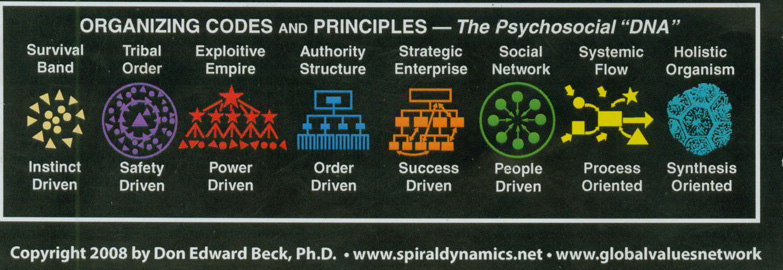
This is actually a key identifying element of Laggard institutions — the obvious inability to change in the face of larger societal forces, while turning the entire apparatus of sophistication present in the organization into justifying the status quo. Inevitably, it’s wrapped in some kind of Communitarian v-Meme banner (“we CARE about our people.”). But the reality is it is a deeply tribal response that more maps to the Tribal/Authoritarian v-Meme structures most universities operate under.

What does this mean in terms of information flow and memetics? Laggard institutions exist, with both their members and their chieftains, in a closed information ecosystem. The minute that an institution enters that state, it becomes very difficult to even get leadership to develop larger-scale consequential thinking. Prior change, often due to arbitrary whims of fashion, could easily be managed as long as that information did not provide disruption for the dominant org. chart. And once some paradigmatic comet outside streaked across the sky, while it may have startled at least some of the denizens, everyone immediately put their heads back down and started chomping away. Dinosaurs have to eat.

The other problem with closed information structures, especially when manifested at the Tribal/Authoritarian v-Meme level, is that there is little information exchanged in terms of rational argument, or predictive models. Information discussed is primarily represented as long time myths. And those long-time myths are very prone to institutional parthenogenesis — the analogous process to where bacteria, unable to find other bacteria with which to conjugate, start self-replicating off their original pattern. This would be fine if the old Second Law of Thermodynamics — the tendency of entropy to create increased disorder — wasn’t in play. But trust me — there’s no better place to witness this than in anyone’s faculty meeting. Inevitably, the same memetic restructuring will be brought up again to be debated — again. And instead of new data (or any data) adding to most of the decision making, there will be some tweaking of dominant myths, which further reinforces the notion that fundamental change is not necessary.

If one considers the various developmental stages of universities, much as one might human societies, it’s easy to see that while ALL universities are slow donkeys, at least some have ingratiated outreach and faculty borrowing and lending to modestly prevent the natural tendencies of the social structures they all functionally operate under. For example, MIT doesn’t feel constrained to always follow the pack, and while they are still in thrall to many of the vicissitudes of the entire academic structure, if they want to try something different, there’s no one in the wings saying “well, XXX university hasn’t done that yet.” As part of their fundamental ethos, they’re SUPPOSED to try new things.

That’s not true for any laggard institution. In these, the dominant information transfer always has to be mirroring of whom the institution perceives is in front of it. And while the superficial take is indeed problematic, what’s even worse is that decay in consequential thinking that also happens in the context of the thinking of their leadership. In the case of universities, any change often takes something like 3-4 years to be implemented. Once even a relevant curriculum change might be proposed inside a department, the timescales mean that it won’t end up as a permanent change, an incorporation into the official university catalog for at least two years. Extremely problematic in a world where the major news cycle churns weekly.

All laggard institutions, and universities, with no exception, were hit memetically very hard during COVID. If one believes the memetic principles laid out in this blog, aggregate collective intelligence is very dependent not just on social structure of a given institution, but the frequency and velocity of relational transactions between agents in that system. And there’s no question — high trust societies and businesses maintain their ability to have high information coherence through face-to-face interactions. By sending everyone home to “work from home”, especially with laggard institutions, a new, low baseline of performance was established. Most people simply do not possess the discipline to “work from home.” They require both the encouragement as well as the policing that comes from co-location with other humans. Being who I am and having the ability to talk across Pacific Northwest industry with my former students, my guess is that north of 60-70% of people really are incapable of the self-motivation necessary to do so.

The problem was exacerbated in Laggard institutions because there was a memetic sorting mechanism that also occurred. Those who were actually able to maintain a reasonable work output during the isolation proved that their job talents were NOT tied to geography. And progressive institutions further up on the developmental scale could then scoop up these performers and add them to their staff. They didn’t have to move, and they would get paid more money.

That further separated workforces in Laggard institutions to people who were now testing the bottom of the work output pile. People actively were finding out how little they had to do to keep their job. And with the inherent social fragmentation imposed when entire institutions went home, there were no lateral feedbacks in the social structure. There was no one beating the drum on the slave ship, and worse — you were locked into the oars with no one. Many just quit rowing. Or rather, rediscovered gardening – and I’m not talking figuratively.

And to add even more difficulty to the problem, laggard institutions tend to index their performance relative to “close” peers. The dominant myth assumes stasis of position. And if you’re second rate, that’s where you’re going to stay. And then that turns into a major status myth that impedes any improvement in performance. “Well, we’re just not that good” turns into a self-fulfilling prophecy.

Not surprisingly, especially when there are umbrella excuses like COVID lockdowns, any break from low performance, and return to a high performance mindset, is not greeted well by the broader members of the parthenogenic community. Now moral rackets come into play (“she has Long COVID, and you’re making her look bad!”) as well as negative targeting of higher performance individuals. There’s a natural regression downward in all institutions, from Performance-based Communities, back down into complicated Tribalism. High performing institutions, not surprisingly, attempt to have some mechanisms for rewarding innovation. Moderately performing institutions end up having praise mechanisms for the hierarchy itself, which inevitably involves praise for the non-involved. You can’t disrupt the narcissistic supply a normal hierarchy typically has for ranked actors.

But Laggard institutions are the worst of all, in that any activity outside the memetic box the institution has drawn for a given department becomes a threat to the institution itself. This is enshrined in the famous, but apocryphal “Five Monkeys and a banana” story, where a reward (a banana) is hung on a string below a ladder, and one of the monkeys attempts to get the banana, while the others are sprayed with ice cold water by the supervising researcher. Needless to say, it doesn’t take too many rounds of the experiment for all the monkeys to either a.) figure out such behavior is going to result in punishment, or b.) they better do whatever the other monkeys are doing or they’re gonna get the living daylights beat out of them as well.

The key takeaway is that once a given performance level is lowered and found permissible, and is coupled with absence from larger social forcing (as in work-from-home situations) one sinks into a very deep well that is difficult to recover. Even a visionary leader is going to have a difficult time fixing such an organization, primarily because the circumstances that caused them to assume a visionary perspective in the first place probably didn’t involve layoffs or lots of coercive Survival v-Meme thinking. The integration of an entirely different v-Meme set (“we take care of our people, no matter what!”) based along Tribal values makes it almost impossible. The moral racket turns into the Perfect Racket.

But the problem with being a Laggard organization is that you’re still the last zebra in the herd. And while herds offer substantial protection, when the going gets tough and the lion finally shows up, he’s not going to pick off the one in the front.

I shouldn’t have to state this, but Laggard institutions thrive on “work from home” or “remote work.” End it.

What can be done?

The key to fixing Laggard organizations is to realize where they are in the information space. Typically, they are grounded only weakly to organizations around them, and often not grounded to any reality at all. While all organizations operate in some public context, that does not mean that the appropriate signals actively being generated trigger any behavior modification — especially if people at the top of the organization don’t see anything like reduction in pay, or a lack of raises. One of the classic lines in Laggard organizations in decline is “we’re just not getting our message out,” or “they simply don’t understand our situation.” This is classic low empathy drumbeating — focus on one’s own victimhood, instead of doing any kind of real reflection on how the circumstances causing pain arose in the first place. And forget that connection and processing the views of the larger community. Those Deplorables have no right to judge us. They are deplorable, after all.

There are a couple of primary strategies, though, that can be executed. First and foremost is to make hard targets matter. If someone says they are going to increase enrollment by 50%, then NOT hitting enrollment should result in some physical penalty that is not just passed down the authority structure chain, but hits at the top level. Gaslighting is heavily rewarded in Laggard institutions, and rarely felt by those at the top. Readjustment strategies for targets can rapidly eliminate inflated estimates, without catastrophic measures like “if you don’t hit your target, you’re fired.” Cross-institutional transparency helps as well. Make it clear that failures will be publicized.

One of the most effective strategies for leadership for moving Laggard institutions off the dime once they’ve been told they have to move is to force yet another numbers-oriented version of “what are the deliberate, measurable steps you intend to take in order to do that?” The goal is to ground every piece of the process in reality, so that people cannot wiggle off the hook.

Since Laggard institutions work primarily on mirroring as a learning tool, setting up opportunities to visit known institutional leaders can also help. When someone is also actually doing something difficult, the excuses can vanish. Leadership has to also prepare for the inevitable “we could never do that here!” line of reasoning. Demanding some numerical number of changes after an aggregate set of visits would be a way to ground that process.

Finally, leaders in Laggard institutions must realize that they must lead from the front, with example. This is not easy in a large organization — but can be very meaningful. Volunteering budget reallocations and some number of experiments at the top sends a loud message to the rank and file that there will be no business as usual around here. Remember that mirroring matters. You are not going to evolve people to be data-driven, consequence estimators overnight.

And never forget it is authentic relationships that drive internal growth. When people are connected to other people in real ways, larger loci of responsibilities follow. The number of solutions to be generated for any problem will always be related to the interconnectedness of the social topology of your organization. That one is just the law — because it’s in the memetics.

Sedition

The Parthenon — One of the interesting things about it is how small it is — Athens, Greece

On a personal note, it’s super-depressing to be writing about the events of the past week on the day before Thanksgiving. Hoping these simply pass means that when you unearth this post a couple of years from now, you won’t know what I’m talking about.

Last week, six Democratic senators decided to make a large-scale announcement on X, telling the troops of the US Military that they didn’t have to obey “illegal” orders. They didn’t give any examples of illegal orders, doing nothing but admonishing the rank-and-file with the implication that Trump has in the past given them illegal orders, and that at a minimum, they need to be insubordinate to these. As I said, there are no examples — just a broad brush telling them of the oath to the Constitution. The Constitution itself is notoriously sparse when it comes to telling the military exactly how to run itself, other than members of the Army and Navy (that’s all there was at the time) should obey the orders of the Commander in Chief, and the Commander in Chief was the President of the United States. I don’t think our Founding Fathers quite anticipated the psychopathic information wars (they were not totally naive to the ways of manipulation, but still) we are encountering today. I kinda think they wouldn’t have imagined senators and congress-critters as using gross stupidity as a defense, or the notion that language should be parsed without any implication.

But here we are — where we’ve had the Democratic Party shrieking that the current President is a fascist (once again, total Humpty Dumpty with this word.). For those that need a Humpty Dumpty refresher, showing psychopathic manipulation was alive and well even during Lewis Carroll’s day, here’s the famous quote from Through the Looking Glass

“When I use a word,’ Humpty Dumpty said in rather a scornful tone, ‘it means just what I choose it to mean — neither more nor less.’

’The question is,’ said Alice, ‘whether you can make words mean so many different things.’

’The question is,’ said Humpty Dumpty, ‘which is to be master — that’s all.”

What is fascinating, if you follow this blog, is the memetic tricks being played by the various actors — in particular Mark Kelly, D-AZ. While he admonishes the military rank-and-file (he is a decorated veteran and Space Shuttle pilot) in a tone that implies they’re being given illegal orders, he beats feet away from this position in subsequent interviews. He poses his comments as some kind of avuncular reminder to the troops as a post-statement interpretation. It’s totally whack, of course. But decide for yourself. (Youtube has problems embedding in WordPress pages, but the link should work.)

Arguing against the original posting by the Six is a fools errand, and I won’t do it here. But what is fascinating is the Six surf the wave of memetic understanding, arguing that what is obviously a context-laden message, full of insinuation, should be taken literally and completely fragmented, and out of context. The perpetrators use memetic simplicity, along with a follow-on message of assertion of the First Amendment as their escape hatch. They have the right to say anything they want, of course, and they get to pull the Humpty Dumpty.

When Trump responded on X and Truth Social by angrily reminding them that basically what they have done could be considered an act of sedition, punishable by hanging, there’s a cascade of angry pearl-clutching in unison across the entire Left. What’s wild is that they all ran Trump’s statement of fact into “Trump wants to hang all of us.” Well, he might, but Trump didn’t say that at all. They are counting on psychopathic manipulation — clever deletion of a few words, while counting on the Neo-tribal politics I discuss in this piece to hold sway. The Left has spent the last nine or so years demonizing Trump — certainly the public must realize he is an illegitimate President, disposable by violence.

What is wild is that the Left continues to lay ground for what is known as a Color Revolution. And what is a Color Revolution? From ChatGPT –

Large-scale public demonstrations calling for political reform or resignation of leaders.

Unified branding (e.g., a color, flower, or simple symbol on clothing, banners, etc.).

Civil resistance tactics such as marches, strikes, and occupation of public spaces.

Rapid mobilization often sparked by disputed elections, corruption, or economic crises.

Focus on nonviolent action, although violence may occur around the edges.

This Color Revolution is focused on Trump, obviously, in attempts to brand him as a fascist and some kind of ersatz King. Even considering the argument a year into Trump’s Presidency is exhausting. The force of the current Color Revolution derives from endless haranguing using generic terms that the general public really can’t define. If Trump was a real fascist, the various operatives on the Left would at a minimum be in jail, and likely have already been executed. But the drumbeat of social media repetition goes on. The immiseration process never stops.

And the people doing this are pros. One of the Seditious Six, Senator Elissa Slotkin (D-MI) is a former CIA officer. Her bio is incomplete, but it doesn’t take much reading in between the lines that she helped subvert active organizations for a living. The others are trading on their service records in a “how could I possibly want to subvert the government” sleight of hand.

As of tonight, November 26, there have two National Guard members critically injured by an illegal immigrant from Afghanistan. There’s no question that the constant direct emboldening by specific members of the Seditious Six contributed to the atmosphere allowing these killings. Slotkin herself was warning that National Guard members were likely to start shooting US citizens in the various cities that they’ve been deployed to only last week, which translates to legitimacy of various aggrieved parties taking shots of their own. It’s going to be a wild week seeing how this latest development gets spun.

Stay tuned.

Identifying Collapse Narrative Purveyors

I don’t know how I get anything done around here.

If there’s one particularly execrable, gaslighting icon in our journalistic night, it would have to be The Atlantic. Owned basically by Laurene Powell Jobs, Steve Jobs’ widow, it is a textbook piece of narcissistic fabulism — a complex brew of half truths, polemics, and status elevators set in front of a background of a lack of reporting on a variety of issues. It is an amazing example of the manipulation of what I call the “dark matter” of the information space. The Atlantic counts on you NOT being exposed to the other side of the story.

And when this dynamic is combined with structurally sound writing by top professionals — truth be damned — the structural coherence of the prose is very compelling for making and changing narratives inside the brains of the readership. It’s a magazine of perfect, pathological brainworms for the predisposed readership on the Left. Look at the success of write Ed Yong, who ended up winning a Pulitzer Prize for his largely incorrect take on COVID, that contributed to the panic of millions, and destruction of trillions of dollars in economic value.

The latest thing to fly across The Atlantic’s radar is the recent Department of War attacks on Tren de Aragua, the Venezuelan narco-cartel, who are busy importing all the necessary ingredients for fentanyl production into the Unite States. Primarily a problem within the last ten years, fentanyl abuse hits people that no one really cares about in society. As such, the need to take care of their problems are largely sublimated, and then occasionally used as a psychopathic moral racket by the Left. Legal NGO industries around homeless people, who are often fentanyl addicts, have sprung up around supplying needles, homes, substitutes and conditions, all funded through a variety of local and state governments. Why would the Left want to solve the fentanyl crisis? They’re making bank.

In the background of all these efforts has been the cultural drumbeat that source interdiction doesn’t work. That drugs, even if they’re not legal, should be almost legal. And swimming upstream against this notion will get you banned inside an increasingly exclusionary Left.

So in walks Trump, determined to end the potential national gaslighting on this issue. Trump orders his Secretary of War to start sinking the boats bringing the requisite chemicals, or the product itself, into the US. Governments like the Venezuelan government are marginally legal in and of themselves, and the globe is a big place. The idea that, considering the enormous amount of money in the drug trade, there are not going to be quasi-illegal narco states is ridiculous.

So Trump sends the Navy and the US Coast Guard out to just sink the boats – a classic Gordian knot perspective. It’s not very hard to identify them — satellite telemetry show boats filled with barrels, stacked in an orderly fashion, right before their sinking. Some of the boats are really submersibles — they ride just under the surface of the ocean. No one is fishing off these boats.

Venezuelan drug-running submersible, sunk by the USN

Here’s where things get interesting. The problem of fentanyl interdiction has been intractable. At the same time, the US has been fighting a quasi-narco state that has been busy shipping its military-aged men here. The Venezuelan government, through corruption and mismanagement, has created such an internal crisis that its entire professional class has run out of its own country to roughly adjacent states in Central America. The government continues to fund itself, at least in part, with money from cartels. It has continued as well to threaten its more peaceful neighbors like Guyana. Short version — the bad guy chits keep piling up.

But what side does one of the primary writers for The Atlantic line up on? Persistence of current paths of action are a Collapse Narrative. What we’re doing now is definitely not stopping the running of fentanyl and supplies into the US. At the same time, the rule of law to prevent the trafficking has obviously broken down, and brandishing it as a weapon against US military action only serves to further weaken the USA.

And there’s little concern for that consequentiality exhibited by Friedersdorf – just an assertion of a moral racket. The lives of the drug runners are paramount, and the people suffering in the US are incidental. One of the first things that popped into my head is that when Trump sank a couple of these obvious drug runners, the word would spread that this is really a great way, if you’re a local, to be guaranteed to get killed. The gloves are off — Trump is going to defend an appropriate locus of his constituency, and this is a profound sea change in the messaging being spread internationally. In a memetic sense, Trump is forcing the Venezuelan and Colombian drug lords, and especially their minions, down into a Survival v-Meme crisis. But such actions are intolerable to Friedersdorf. Collapse and anarchy is the game, and forcing drug interdiction agents to jump through hoops is the path forward.

It is fair to ask — Does Trump’s strategy work? Look at the ‘intractable’ border crisis. Since Trump was elected, illegal immigration into the US has also collapsed. The dominant Collapse Narrative, that illegal immigration was fundamentally unstoppable, has been proven to be a sham.

I’ve written about how this works from an empathy perspective in this piece on Moral Heat Maps. The reality is, at this point in time, that at least in the Trump administration, the actors are far more grounded and pragmatic in how they get results that the current Lefties, which remain committed to the collapse of the US.

Whether Trump’s strategies will actually work or not remains to be seen. But the way the elites veritably seethe when they declare his philosophies “populist” gives me some hope. And if you want to hedge on all this, buy Yamaha stock. That seems to be the brand for most of the outboards used on the drug boats, now on their way to Davy Jones’ locker.

How Psychopaths Weaponize Free Speech

Cascade Mountains, WA — Winter is Coming

One of the craziest things that’s happened in the last six or so years is the blatant injection of speech control by the Left in all aspects of what I’ve called Collapse Narratives. What is a Collapse Narrative? It is the story and framing of a “moral racket” to bully others into silence, and that if you follow the narrative thread, your society will collapse. “If you say that, not only are you evil, but we will ostracize you from society AND kill the baby panda. And it will be ALL YOUR OWN FAULT.”

The technique works best when utilizing sexual taboos, which the psychopaths are allowed to discuss in celebration. But if you protest, you are (pick one or all) a bigot, a racist, and so on. And you better shut up.

No better example could be found than when Sam Brinton, former undersecretary in the Department of Energy, in charge of nuclear waste disposal went on various tours promoting his kink, which I can’t quite characterize. It involves being surrounded by other men dressed up in leather dog costumes, complete with butt plug tails inserted into their poopers.

Brinton was later dismissed for a particularly pernicious habit he had of stealing other people’s luggage off airport baggage carousels, then going home and wearing the dresses in public.

But while Brinton was in play, we, the public, were subjected to what I’d call “Walsh’s Progression” (credit to Matt Walsh at the Daily Wire) regarding all this psychopathic nonsense. We were supposed to Tolerate this reprehensible behavior, followed by Accept this as normative, then forced to Celebrate this as somehow adding to the modern cultural zeitgeist, leading to Normalization, and ending, of course, in Coercion and Punishment if you can’t follow the script.

All these types of manipulations depend on the psychopathic entity violating taboos and norms in society, followed by a pronouncement that only they are allowed to discuss this. The only allowable response across society is sycophancy. What they are promoting is usually, by their standards, some ostensibly necessary sexual deviancy. Why does it have to center around that deviancy, in the larger psychosocial picture? Because it mainstreams a channel for sexual abuse, mostly directed at children, who once traumatized, will then increase the odds of them developing a personality disorder and joining the ranks. It’s a combo psychosocial control/memetic reproductive act.

And that’s why it’s necessary to be done in public, especially publics containing children. It simply doesn’t work behind closed doors.

To repeat — psychopaths take taboo subjects, self-identify, demand acceptance and then use these to shut down broader debate. And because these subjects are ALREADY taboo in the larger cultural zeitgeist (call it polite society), it’s not that hard a task.

Let’s take another example — illegal immigration. While LEGAL immigration policy is a debatable good, illegal immigration is truly a consolidated blight on society. They are not the same. Illegal immigration often involves human trafficking. And human trafficking is inordinately profitable, both for the Mexican cartels that pipeline people into the US, as well as the various entities in the US exploiting the labor.

How does this work? Let’s say you are a contractor bidding a federal contract. You must bid this contract at prevailing wage rates, or it will be rejected. But if you fill your workforce with illegal aliens, you can likely pay these people half or less that same wage rate, resulting in a windfall for you. This becomes money that both you and the cartels can pump into the political machine to “look the other way” in whatever regional market you occupy.

Now pour on the psychopathic messaging. “These are hardworking families (growing dope in Ventura County.) “If you don’t support them, you’re a racist!” and so on. One pours on the messaging because there is an extensive web of government support services that are also profiting off the existence of these people, with housing, food and medical assistance, all part of the associated moral racket. “They are only looking for a better life, you monster!” And unless you’re made of sterner stuff (like me) you’re going to wilt.

Folks on the other side can’t even open their mouths regarding the very immediate impact to their own circumstance — especially in adjacent, poor communities. In the Scandinavian countries, rapes increased some 50% from baseline with the importation of migrants from Africa. And heaven forbid if you actually discuss the demographics of the illegal migrants — mostly young men in their 20s and 30s, and the inevitable characteristics of letting in an uneducated army into your country, while housing and feeding them. It’s all booby-trapped with psychopathic taboos designed to make you keep your mouth shut.

It’s even difficult for me, writing in the abstract, to imagine using the very real argument that my friends’ daughters will increase the chance of them being raped by allowing this illegal wave in.

That’s the power of psychopathic taboos.

One can also see the extreme reaction from the Left on this issue against Donald Trump. Tom Homan, Trump’s deportation czar, attacks the psychopaths head on. Instead of deferring to their manipulation of taboos, he confronts them with stories of direct experience. But because the majority of our mainstream media has abandoned their own ethics, or are willingly supporting the psychopaths, there is no amplification.

And, as with all things psychopathic, in the v-Meme space, the psychopaths take any dissent, as well as detail, and shove it down into the macerator of reality. The only “appropriate” response is conformity. And that requires relational disruption and loss of agency — THE key psychopathic identifiers — for all adjacent actors. And so the folks responding to the use of these psychopathic taboos march down into Tribal v-Meme knowledge structures of myths about past immigration. Nuance or reasonable policy is not acceptable.

Do the psychopaths know they’re doing this? I think the ones at the top do. But much of this turns into an emergent cascade — once the masters at the top, interested in some strange brew of anarchy, chaos and low level control, set the tune, the local dynamics of relationships comes into play. Understanding the complex web of both illegal actors, and legal institutions in perpetuation of all this strains the brains of all but a few of us.

Diabolical.

What’s the remedy? The modest thing is resist the psychopath’s efforts to rename pathological behaviors into more palatable forms. Don’t use the language of the psychopath. Call illegal immigration “illegal immigration” — not undocumented workers. Do not use the phrase “children’s gender affirming care.” Call it child castration. You’ll see an immediate revulsion for describing these various things as they are. But if we cannot reclaim the language, we will see the psychopaths carry the day on the field.

Let’s get going.

Why Can’t the Dems Quit the Trans Movement?

Sometimes, you need the safety of a pack

One of the most insane parts of the last six or so years has been the rise of the trans movement — to the point where it’s moved off the pages of various freak show publications, to a place of prominence where, at least if you live in anything resembling a college town, you’re confronted with it with some degree of regularity. Whether it’s lining up your pronouns in your e-mail address, or making sure you tell some ugly, middle-aged individual they are something they’re not, you’d better be on point in the gaslighting game of the decade.

And it’s highly relationally disruptive and devolutionary. Instead of YOU (yourself) assessing the most basic aspect of a person’s make-up — their gender — you’re supposed to believe whatever they say that comes out of their mouth. You’re supposed to suspend belief. And until Donald Trump came along, you could be fired, persecuted, or potentially slapped with penalties for not indulging someone’s often auto-erotic fantasy.

I really think that most people knew all this would end, sometime. But note to my community. It hasn’t, and it’s not going to end anytime soon. The respective cat is out of the bag.

The research on what’s actually happening with trans people’s brains is somewhere between mediocre to awful. Others have covered that, and I wrote a piece on trans demographics here. There are some key things to note. Not all trans people are afflicted in the same way. It is a mental illness, and these things reside on a multi-axis range of factors. But a significant percentage of them have what are called Axis II/Cluster B personality disorders.

Axis II/Cluster B disorders are major dynamic change units in societies, and have been, literally since the beginning of time. These are things like psychopathy, narcissistic personality disorder, borderline personality disorder, histrionic personality disorder, and some version of schizoid and paranoid personality disorders. Out of the center around Axis II/Cluster B are the lesser known ones that often create massive damage. My own mother had a Cluster C Avoidant personality disorder, and the chaos that this created in both my younger life, as well as my maternal search image in how I’ve dealt with women has created all sorts of forks in the road. But it’s also given me insight, unobtainable by any other means.

And what is the main insight? A key, neglected aspect of personality disorders is that they all fall under the umbrella of relational disruption. There are laundry lists of symptoms/characteristics, generated by various psychological researchers over the years. But I’ve found most of the lists inconclusive (there are obviously better/worse ones) likely dependent on whether the researchers themselves had a personality disorder, and were attempting either to discover truth, or hide their tracks. But you, as an individual, know when you’re dealing with one. It’s very similar to a piece of dark matter passing through your orbit. You can’t see it. But you feel the tug. And that’s EXACTLY why there’s so much pressure from the trans community to take away your agency. It’s not just the make-up they’re trying to hide. It’s the chronic relational disruption.

But back on target. The purpose of this piece is not to dig independently into individual personality disorders. Rather, it’s to understand how they act in the context of human social networks and systems.

A couple of years ago, I put some serious time into thinking about how system boundaries in human systems affect how we perceive cause-and-effect of various actions, and lessons from human activities. I centered this around the famous monkey grape/cucumber experiment run by Frans de Waal. In the experiment, there were two side-by-side monkeys, and a researcher would alternately (dependent on the monkey) give a grape reward for retrieving a rock, or a cucumber reward. The key was the two monkeys were able to see each other. And because of that, it didn’t take long for the monkey only getting a cucumber for a rock to get pissed when he saw the other monkey getting a grape for the same action. Everyone laughs at the video, posted below. But it’s actually much darker than that.

The natural tendency of the human brain is to draw a system boundary around the two cages, and leave it at that. But I started realizing this led to a very defective conclusion. What happened if you drew the system boundary around the researcher as well? Or included the cages or open space the monkeys would be returned to in the back? Would the monkey that got shorted beat the hell out of the other monkey? You can read this here to construct your own thoughts. Short version — lots of stuff we do to animals in labs is positively psychopathic.

A couple of years later (that piece was written in 2016) I turned my thoughts to the larger question — what happens when you have psychopaths in systems of HUMANS? This is a harder question, because now one must ask very carefully what the effects are going to be, and whether to consider both temporal and spatial effects. Further, it’s easy to decide that psychopaths (I’m going to use this as my generic term for Axis II/Cluster B/C individuals) are some defect in brain function — poor attachment, brain injury, sexual abuse, cultural environment, etc. All of which may be true. And maybe, in an organ as complex as the human brain, some error rate is inevitable. But that still does not explain their evolutionary persistence. Psychopaths are characters in literature down through the ages. If they really were a deep liability, or rather, a bug, as opposed to a feature, then societies without them would always prevail. And the ones that had any would collapse.

But that’s not the story of human history. I had to face up to the very hard, and disturbing fact that psychopathy is likely a feature of large-scale human systems. Not a bug.

I am a fan of Spiral Dynamics, Clare Grave’s masterwork, and am no believer in cultural relativism. I think the current post-modern anti-colonial rhetoric is actually gaslighting of entire disciplines — sociology, anthropology, as well as psychology. To gainsay the evidence of more or less successful societies is to deny the evidence in front of us. Short version — some people live in upwardly developing prosperity, while others live in squalor and violence. But figuring out exactly why is difficult.

But then I realized. It IS actually possible to draw a system boundary around Tribal societies relatively easily. Once you get above this, it gets more and more complicated. So I looked into Tribal societies.

There is some research on that is good, or at least a little rational. There is also a lot that is total garbage, full of romanticism and nonsense, generated by people who would never last a week in a real one. Some of the backlash is due to guilt over, across the world, our functional genocide of most tribal societies. That is a fact. But in the process of what the civilized world did to these people, we also lost our way in understanding the core of how many of these function. One of the many books I’ve read on how tribal societies function is Guns, Germs and Steel,by Jared Diamond. Diamond has the personality (and probably the research staff) to write long books. Trust me — you have to be neurodivergent to punch out a 1000 page tome. Why that is true will have to wait for another time.

The one thing that Diamond did document, however, is how intrinsically violent tribal life was, and is. People at the tribal stage of development kill each other ALL THE TIME. Murder rates run at 10x-100x of civilized societies. From ChatGPT – but this matches what I remember well.

___________________________________________________-

“In The World Until Yesterday (2012), Jared Diamond draws on anthropological field data—especially studies by Lawrence Keeley, Napoleon Chagnon, and others—to estimate that traditional tribal societies experienced homicide rates far higher than those of modern state societies.

He summarizes the comparison roughly as follows:

  • Tribal / traditional societies: on the order of 500–1,000 homicides per million people per year.
    • This comes from archaeological and ethnographic data for small-scale societies such as New Guinea highlanders, Amazonian Yanomamö, and various pre-state groups.
    • It equates to about 0.05–0.1% of the population killed each year, or over a lifetime the chance of dying by homicide can reach 10–30% in some groups.
  • Modern state societies: typically around 1–10 homicides per million per year in peaceful contemporary nations (roughly 0.001% per year).

Diamond uses these figures to argue that, per capita, the murder rate in many tribal societies is roughly 10 to 100 times higher than in modern nation-states.

These numbers are not meant as a precise single statistic—Diamond stresses that rates vary widely between tribes and through time—but his central estimate is that the risk of violent death in pre-state tribal societies was about an order of magnitude (or more) greater than in modern societies.”

______________________________________________________

More reading led to another interesting insight. Lots of tribal “coming of age” rituals involved sexual abuse. It’s pretty well established that child abuse is a problem across Native reservations, even in the US. But what was more interesting (pathologically) was this was once again, not a bug, but a feature of the vast majority of tribal societies. And it obviously happened to girls as well as boys. After some ritual deflowering, there was almost always what I would call a “re-integration” ceremony, where the particular gender would be declared a man, or woman in the tribe. I can’t bring myself to read such publications as Margaret Mead, but there’s lots of stuff in her research romanticizing this.

The other thread I managed to weave into this line of psychosocial development is this: “what happens to individuals who are sexually abused, especially en masse?” The only person I found who had done research on this was Simon Baron-Cohen, Director of the Autism Research Centre at Cambridge, England. His work showed a probabilistic spread — most kids rebounded. But some did not, and went on to display deeper pathologies.

But getting back to system boundaries. What happens when we draw that system boundary in both time and space? What is the long continuum over the years in human society that we see, at least at the Tribal v-Meme level? Institutionalized sexual abuse creates key actors in those same societies, that go on to assume roles that, like it or not, are part of that tribe’s persistence. Their warrior societies are stacked with crazy-ass psychopaths. The ones that most of the time, sit in the warrior lodge — because the rest of the tribe knows they are some crazy-ass MFs. But at the right time, when the tribe is threatened by another tribe over the hill, or mountain, the warrior lodge doors get opened, and they pour out. If there are not enough of them, then the tribe CEASES TO EXIST.

What role do women serve in tribal societies? Sadly, by our civilizational standards, women, from a genetic perspective, exist to have an affiliation to being traded to other tribes, during some period of potlatch or some occasion. This is just historical record, folks. And what women would have the affiliation to get down to business with whomever they met? Once again, relationally disruptive women. You can look up your own stories about the libertine nature of various tribal ceremonies. But once again — it’s not a bug. It’s a feature. Without a particular level of genetic mixing, tribes would falter and CEASE TO EXIST.

Don’t shoot me. I’m only the piano player.

So what happens when you’re dealing with a large cadre of people in the middle of a memetic collapse, as the Democrats most clearly are? You end up with what I call the Great Simplification. There aren’t any new ideas to grab onto. So you hang onto your past winners. The problem, though, is this shifts your organization or group back into the Tribal v-Meme space. Anyone that thinks that tribes have more developed information spaces than modern societies, I can’t help you. And that means you’re also looking at downstream seizing of historical mental models (this is a great piece — short version, takes a complex society to create a nuclear bomb, but only a terrorist with a piece of wire to use it.)

But the models you pick will be the ones that your Neo-Tribe has an affinity for. And those affinities, like it or not, arise from The Matrix.

There’s a top-level thought going around right now in the form of emancipation population theory. What’s happened is that in our society, we’ve basically liberated everyone, and now the only ones left are the criminally insane (DeCarlos Brown murdering Iryna Zarutska on a train in Charlotte, NC) or the larger trans movement, which is now starting to produce a statistically significant number of assassins (Tyler Robinson killing Charlie Kirk) all hopped up on hormones and fantasies of self-castration. On the surface, it’s compelling. But both these potential groups hold extreme damage to the public reputation of the Democrats.

And in the age of social media, we get to watch, within the span of six weeks, two actual snuff films. Over and over. You cannot deny either the murder of Iryna nor Charlie Kirk being shot in the throat. For any human without isolating levels of Tribal v-Meme affiliation, simply put — that dog won’t hunt. You would not want to affiliate yourself with a group that advocated for crazy people slitting throats in public, or defend a textbook assassination. No contemporary organization could hold up under those circumstances.

Yet endless pronouncements by a variety of celebrities and D politicians do just that. So something else is going on in the deep subconscious of the Democratic party.

And that thing is a complicated stack. But in the current moment, the question that Ds ask me is this: “Why can’t you drop the trans thing? There just aren’t that many of them.” To which I reply “Why can’t YOU drop the trans thing?”

And the neo-Tribal answer is “we will never betray our psychopathic warrior caste. We’re gonna need them to kill people, whether we’re publicly endorsing this or not. Or we’re going to cease to exist.” Now tag on some modified form that allows for the DeCarlos Browns of the world, whose own MOTHER was pleading for help in dealing with her schizoid/psychopathic son. But the systems set up, profoundly Democratic in essence, refused. Especially in a time of perceived threat, they need those people.

Obviously USAID (which various D actors/operatives have consistently defended) has known about the importance of maintaining a cohort of psychopathic warriors for a while. They’ve funded them in Bangladesh, and Sri Lanka. And a bunch of other unstable countries. All masked, of course, as health-related. But when you look at the history of revolution and warfare in these places, you really have to be fooling yourself to see this as benevolent.


From ChatGPT

Here’s the updated master list of documented trans-rights/LGBTQI+ groups or initiatives supported by USAID, now including Bangladesh and Sri Lanka.
(It highlights direct grantees or well-documented local partners; many broader USAID health projects also sub-grant to numerous smaller community-based organizations.)

Group / Initiative (lead org)CountryWhat USAID funded / supported
Blue Diamond Society (BDS)NepalPartnered with USAID on inclusive disaster-risk and health programs; also received HIV‐program support under PEPFAR and was affected by the 2025 funding freeze.
Parichaya SamajNepalCommunity center providing HIV prevention and counselling; supported by USAID-backed HIV programs until the 2025 pause.
LINKAGES (FHI 360) – MSM & transgender community partnersNepalUSAID/PEPFAR project providing HIV services and community-led monitoring through local trans/ MSM CBOs in 19 districts.
LINKAGES (FHI 360) – trans partnersKenyaUSAID/PEPFAR project supporting trans-competent services and advocacy recommendations for Kenya’s national AIDS strategy.
ACCELERATE / “Mitr Clinics” (Johns Hopkins Univ. & Fenway Institute)IndiaUSAID-funded network of transgender health clinics (Hyderabad, Kalyan, Pune) providing gender-affirming care, mental-health and HIV/STI services.
Humsafar Trust (collaborations)IndiaLong-running partner on HIV services for MSM and transgender communities; noted as affected by the 2025 funding pause.
Africa Queer NetworkUgandaKampala-based NGO that reported receiving a USAID stop-work order during the 2025 pause; previously funded for HIV programs serving LGBTQ—including trans people.
SUSTAIN program (with local partners)UgandaUSAID-funded “Strengthening Uganda’s Systems for Treating AIDS Nationally,” which highlighted key populations including transgender people in HIV treatment and testing.
LGBT Global Development Partnership (via Astraea, Victory Institute, etc.)Guatemala, Honduras, Ecuador, ColombiaUSAID partnership that provided small grants and capacity-building to local LGBT groups—including trans-led CBOs—through Astraea’s grant network.
Bandhu Social Welfare Society (Bandhu)BangladeshImplementer of USAID’s SHOMOTA (Equality) Activity (2022–2027) to advance rights and services for gender-diverse people.
Sompriti SamajBangladeshCo-partner with Bandhu in the SHOMOTA project supporting gender-diverse communities.
Transgender Network Sri Lanka (TNSL)Sri LankaNational trans-rights NGO receiving USAID support, including through the LINKAGES HIV program (2017–2019) for trans-inclusive services.

Overall pattern:
USAID’s support for trans rights has typically flowed through health-focused programs (PEPFAR, HIV prevention/treatment) and the LGBT Global Development Partnership, which channel funds to local trans-led or trans-serving community-based organizations across Asia, Africa, and Latin America.


You might think this is a play from a new playbook. But it’s not. I remember reading about the late ’90s civil war in Sierra Leone. The rebels set up a variety of checkpoints throughout the country. And who staffed them? 16-year-old boys, with AK-47s, dressed in negligees. Called Kamajors, they believed the dresses gave them spiritual protection. What IS interesting, as I investigated this (I remember the pictures from the Granta book I had) is that ChatGPT was very intent on painting the Kamajors as some kind of noble warrior cult defending innocents, than the berserker cult they were actually. Though, TBF, ChatGPT admitted these people did commit war crimes.

So here we are — stuck with a former major party, in the process of social devolution, captured by its own sexually abused and abusive psychopathic members, with no ideas on how to make a better world. And desperately reaching for its own warrior caste that used to be discreetly backed by the US government itself.

They just can’t quit them. And we as a nation better wake up to the deep roots of this. I live deeply entrenched in a community with a lot of their supporters. They are also old, and I suspect dementia, or some low level Alzheimer’s disease is also a problem. But I’ll tell you — they have absolutely no problem serving up fresh hell on the opposition. Or attacking me. And it is true that where I live is a microcosm. But microcosms are useful for understanding larger dynamics.

Civil societies are great things. They preserve far more human life than tribal societies, and provide lifestyles and benefits unimaginable even 100 years ago. But they are inherently fragile as well. And the path back down to the level where circumstance naturally puts the psychopaths back in the warrior hut is gruesome. I wrote this because I finally decided it mattered enough to get this model out there. The challenge is to get enough people to realize that a lot of what is going on with these people is not conscious — but it is actionable. Centering a societally devolutionary group’s (The Democratic Party) psychopathic warrior caste as those creating the diktats of the future is only going to result in societal chaos and destruction. Don’t fool yourself.

There’s still time.

But not as much as we’d like.

P.S. I wrote this two weeks ago. It explains how the Ds turned tribal.

Fearless

The Squad

I’ve been thinking quite a bit about Charlie Kirk lately, and his assassination. It’s no surprise that as the holes get filled in, there is more and more sexual perversion coming to light — Tyler Robinson, his assassin, had a male lover, embroiled in some version of the hopped up hormonal soup the medical establishment has decided is A-OK as far as a legitimate treatment for obvious mental illness. This is an unfolding story, with the latest chapter being his lover displaying about the level of loyalty you’d expect for someone who wants to engage in self-mutilation of his genitalia. Crazy doesn’t do any of this justice.

What is more interesting to me is Charlie, and his career going around to various campuses, and in a very relaxed way, dealing with all sorts of comers in discussion and debate. The videos I’ve seen indicate that Charlie was very good at defusing tension to an acceptable level in stressful situations, and moving through the crowd and their issues. This is not easy — Charlie was an obvious master, and there are really no words to describe his loss. I pulled apart the memetics in this piece — Charlie was someone who believed if you sat down with someone and established your own, independent relationship, you might change their mind. I call this empathetic brain-borrowing. There’s no way that any of Charlie’s opposition stood a realistic chance of doing anything other than drawing a stalemate with him. Charlie had mastered the venue.

Few people have actually had the exact experience Charlie lived. But I actually have. As an environmental activist, I, on more than one occasion, found myself facing a large, hostile crowd who wanted to do damage to my person, that I had to talk my way out of. Sometimes that crowd was large — I remember well, testifying at a 500 person hearing in Orofino, on the roadless initiative back in the 2000 timeframe. That resulted in some chanting to off me, so I left quickly. Outside, the same people who were wishing my demise had their children, who seemed to be trying to grab me, but in reality, were attempting to shake my hand. “You’re telling our parents things we can’t,” they said. And while it was moving, I still got the hell out of there.

There were other episodes in all of that, giving speeches and such. It was a rush. And I think it might be easy to ascribe to Charlie that for him, it was a rush as well. He was bold, and obviously far more famous than I ever was. But I’d caution anyone about jumping to conclusions on any narcissistic reasoning that he was doing it just for himself. I think, as a fundamentalist Christian, he believed in his mission, just as I believed in mine. But his never stopped, whereas mine did. And what happens that I can attest to is that each time you’d end up in one of those conflict-laden situations, it dulls you. Or rather, you become dismissive. You’re going to end up on the other side, very likely having dinner with people who you like, and the debates, especially with college kids, are not going to vary that much.

What likely happened with Charlie was he got into a routine where he may not consciously, but certainly unconsciously, viewed himself as invincible. There was enough security, enough handlers, to dull down the prospect of a true low probability event. And it seemed that he didn’t really mix things up as far as his routine. Somene wanting to kill him could — and did. He was predictable. And he was known by the masses. Almost no one in the timber industry, save actually for the top level, ever knew who I was. I would have been far more likely to die through an actual assassination, and I just wasn’t that important even to do that. You’d have had to read my book, and follow far more closely actual actions.

What happened to Charlie seems to me to follow a movie that I’ve found very relevant to my own experience. Called Fearless, starring Jeff Bridges, Isabella Rossellini and Rosie Perez, it involves a plane crash survivor who becomes convinced he is basically immortal. He doesn’t have to worry about getting killed. It’s just not in the cards. The movie catches well the mental gloss that settles in after wave after wave of severe trauma. And you better believe Charlie had trauma.

But he learned to deal with it, powering through repeated attacks on his person, all the while being reinforced in his belief system by some of the most powerful people in the world. What’s the mental effect of having the President of the US tell you you’re doing important work? It’s not going to make you back off — especially at 31.

I like to think that my own experiences, which while not being at the same level as Charlie’s, and were far from trivial, helped me to evolve the perspective of an enlightened master. But sometimes, I think I engaged in that dismissive mindset myself. I’ve been attacked since the pandemic started four, and really five times. Each time, I seem to wave off the attack, instead of processing through potential increased risk. Some of us turn into psychopathic targets — we’re just too interesting to leave alone — and I’ve spent a lot of time thinking about how to decrease my own modest profile.

But there’s something about deeply believing in something that brings out the psychopaths. They came for Charlie. We’ll have to see how this story really unfolds. But the bottom line is there is always a true price for being a hero.

I also look at my sons, who have no grand expectations of political action. They’re reasonably earnest and resolute young men. Noble, in fact. But they have no interest in the crowds. Still, when shit hits the fan, they don’t think twice. They run towards the trouble. It simply doesn’t occur to them to be afraid. Having kids almost Charlie’s age makes me ponder the level of integrity you want to raise your kids at. It’s a foregone conclusion with my own. But the answers aren’t as obvious as you might think.

Requiem for Charlie Kirk — A Victim of Memetic War

Charlie Kirk at WSU, April 2025 — picture from the Moscow-Pullman Daily News

Charlie Kirk, Turning Point USA ED and conservative influencer, was assassinated yesterday, September 10, in Orem, Utah, while doing an event at Utah Valley University. There are lots better sources of Charlie’s life trajectory than this blog, and I’m not going to repeat all the various details of his activism, his life, nor his demise.

What was interesting about Charlie was that his events consisted of direct engagement with students. Opinions will differ on his intellectual veracity, or his demagoguery. I’m not really interested in that, either, because so much of one’s take on Charlie’s opinion directly depends on your own position in the v-Meme stack. But you cannot argue — there is simply too much evidence — of his relational style. He would get out there, meet people, and talk to them. It didn’t matter in the least what your title was, or what your take on an issue was either. He would debate you, bringing his perspective and facts, against your facts and arguments. Some might say it was his schtick — and maybe it was. But it was straightforward. It was how he built relationships.

If one were categorizing Charlie with my work, it would fall into someone passionately committed to independently generated, data-driven, trust-based relationships. He would look people in the eye, and construct his argument based on what you said. It is the way that empathetic relationships start, even if these conversations were only 5 minutes long. For those that need a translation, here’s the short version. He was interested in authentic friendships.

People are asking today “why Charlie?” I would argue that his relational construction mode made him a primary target in The Matrix. Whether you loved or hated his opinions, he was firmly on the side of rational, data-driven relationships. Yes, he did have status — he knew Presidents and such. But that was not the card he played. He leant heavily into his argument.

And that made him a key target in the Memetic War we find ourselves in. The vast majority of the population do not understand this, nor acknowledge it. The media prefers old labels — Left/Right, liberal/conservative. On and on. But that is really not what is going on. What is going on is a memetic conflict — two different primary pathways people’s brains work — belief vs. reason. And that is not so easily remediated. It is deeply structural, buried in our subconscious, both locally and across the Matrix. I discuss its downstream outcomes in this piece. It’s one of my best.

Rest in peace, Charlie. I appreciated what you were attempting to do. Let’s hope more folks wake up and realize that it’s not just the top level that matters. Independently generated, trust-based relationships built the world we enjoy today. You were a champion of this. The old externally defined, status-based relationships simply cannot maintain it. And we are, as a society, under massive attack from psychopaths and elites attempting to herd us back down that devolutionary trail. I weep for your children, who will never know you and your genius. And I am sorry you are gone.

Moral Heat Maps and Relational Dynamics

Blue Canyon, Salmon River, Idaho

One of the most difficult concepts for people to internalize that I write about is the notion of Independently Generated, Data-Driven relationships vs. Externally Defined, Belief-based relationships. These two archetypes form the core of all human relational systems and social structures, and if you believe me, are the things that create the baseline of our cognitive neural systems. The first is based on agency-driven, data-based empathy (think in terms of simplification as reading the complex mix of verbal and non-verbal communication for building gradated trust.) The second is belief-based, and created outside the individual by the larger social structure in play. These require no agency — the fact that I’m a professor, for example, is defined by my university. Whether you think I’m a nice guy or not, however, is dependent on your own judgment.

The short version is that these belief-based relationships map to the same part of the brain as limbic/emotional states. As such, they’re coupled to very short timescales, as well as immediate reactivity to information. Very different than an independently generated relationship, that depends on interaction, autobiographical narratives, and far more complex and complicated processing in the pre-frontal cortex. Your conscious mind is a powerful thing. But it takes more time and energy.

I’ve often been asked if there’s any set of experiments I could do to validate my various theories, other than trust in my skills of observation. I always laugh, and say “well, if you gave me $10M I could.” I’d have to hire real people in psychometrics, and sort through all of it.

But then this meme started making the rounds of the Internet. And maybe, just maybe, it might not be so impossible. I’m talking about the figure below.

Paper in Nature Communications, Waytz, Iyer, Young and Haidt (Sept. 2019)

My primary critique with Haidt’s work is that he basically just makes up categories with no physical basis, that sound good, and this is no different. But he also is great at intuitive guesses, so at the same time, I do recommend reading him.

What this graph shows is the differentiation between how conservatives and liberals view moral obligation. Conservatives, on average, start closer to home, with more weight placed on people that they know, and then with concern dying out as distance in time and space increases. Liberals are the exact opposite. People adjacent to them accrue no credit for distance minimized, with concerns being projected on people further away, or even things that are often deeply unknowable.

What these folks don’t posit (mostly because they’re academics, and are invested in a low empathy environment, which then conditions their own bias) is that this also clearly demonstrates the potential morality that springs from a combination of independent, empathetic connection, as well as validity grounding — the ability to believe something because you witness it with your own senses. These two things are necessarily confounded (the experiment wasn’t set up to separate them) but you can still see how this plays out.

Short version — some majority of conservatives value a personally collected stream of information more than they do other sources, or experts and their stories. With the exact opposite being true for liberals/progressives. And this creates a profound neural gap between how the two will sort into social structures. Because of this relational divide, conservatives are far more likely to be communitarians than liberals. And liberals are far more likely to sort into elite-governed hierarchies, and be status conscious. You show your level of cool to your liberal pals by being concerned about the politics in West Papua, which you can never really hope to affect. And you can also appreciate how missionaries tend to be conservative. You want people to be saved? You travel and tell them about Jesus.

One can also see how this develops low- and high-responsibility mindsets. You can care about the entire world, but the reality is there’s not much effect you can have on the entire planet. But you can impress others with your virtue, which will then elevate your status in your social hierarchy. Contrast to the conservative viewpoint — you can affect your local environment, let’s say by planting a tree in your downtown, and while the global effect of that action is also unknowable, you can be responsible, and hold yourself accountable for that particular action. You can check on how the tree grows — an exercise in validity grounding –– and then, importantly change your behavior to improve the tree’s thriving. And all the time, you’re really cultivating how your brain processes information.

Since the election of Donald Trump, I’ve had to deal with a spate of attacks and abandonment from many of my liberal friends. This is not pleasant — even for me. Any straying from more and more extreme party orthodoxy means condemnation and alienation. I have picked up some more conservative friends along the way, and honestly enjoyed the development of some very honest and refreshing relationships, often hooked to the social media app X/Twitter. For me at least, these are data-driven — I ‘tweet’ and then people follow me for my ideas. I’m fully aware there is group aggregation in all of this. But as an original content creator, it’s been very refreshing.

The downstream cascade of the isolation the liberal community is actually promulgating is not going to be pretty – for them. Based on purity tests and adherence to orthodoxy, it is inherently relationally disruptive, and as such, prone to being kidnapped by psychopaths, who are far better liars than most of my friends trapped in progressive claques. Because it’s tied to our limbic centers, more people are likely to make snap decisions about which friends to keep or reject. I’ve certainly seen this on Facebook. And worse — if you’re prone to splitting, it ain’t gonna get better.

It’s also disorienting for those same progressives. As more fantastic crimes get dreamt up, the more the liberal mind loses its grip on a more adjacent reality, and the more we see projection of this mindset on conservatives. And that adjacent reality is the thing that creates the world we navigate.

As I’ve noted before, psychopaths always make a big splash up front. But over time, the system manages to find a way to isolate its relational vampires.

Or the whole system collapses. Stay tuned.

On Immigration

Yosemite North Country, headwaters of the Tuolumne River

Immigration has turned into one of the most controversial issues of our day. Why? Because we are in the days of what I would call the Great Validity Grounding — where our elites have carried population manipulation through propaganda to such a level, there is no way we can swallow the various fictions and not get hit over the head by reality.

And immigration is far from the only issue. We are told that boys are girls, and there is no harm in pumping teenagers full of cross-sex hormones. We are told that our very agencies responsible for subversive activity around the world are only the positive narcissistic storefronts for saving lives around the globe. That Americans really aren’t owed any reasonable egalitarian trade policies. That we should be involved in endless, historic wars around the world. The list goes on and on.

Most Americans want to retreat from all this — and have. Being hyper-informed (I am the worst when it comes to digesting the constant stream of news out of the Internet and social media) AND being a teacher who actually engages my students — I sit with them and nonjudgmentally ask them what they know — it is stunning how little most of them are aware of what is going on, nor how they are being manipulated 24/7. But the crunch is coming for the population, and certainly no one has championed the re-grounding effort in common-sense reality than Donald Trump. I’ve been very critical of Trump in the past. But as I wrote in a recent piece, maybe we needed an inveterate narcissist to play-act the role of national father to shake us out of our shared cognitive delusion.

When it comes to immigration, I am profoundly against illegal immigration of any sort. What happened during the Biden administration was an appalling betrayal of the national interest. And the accounting of the damage is yet to be reckoned with. And assembling coherent narratives of that damage is nearly impossible – because by and large, the elites in our society have benefited. And our press will simply not report in any coherent manner on the actual effects of the past 20M (or more) illegal immigrants coming into our country in the past four years.

But such a tidal wave of humanity had to have mechanisms that supported it. That led to growth of large-scale Non-Governmental Organizations (NGOs) and the gaslighting machinations to hide from and defraud the American people, who paid for all of it. But there is more — if you need more proof of the size of the effort, go to Youtube and search for “migrants – Darien Gap”. You’ll see the encampments set up in Colombia — often nation- or language-specific that shepherded the mass of humanity (mostly 20-30 something males) up through some of the most remote jungle on the planet, and onto buses and trains into the United States. Bret Weinstein on Tucker Carlson gives insights on the darker part of all this — Chinese migration into the US.

The other dark side of all this is that Sinaloan gangs from Mexico form a huge part of the infrastructure for getting illegal migrants from around the globe into the U.S. There are no clear numbers on the money involved with the cartels, but it is clear that it ranges in the tens of billions, to potentially hundreds of billions of dollars. The idea that peasants or lower caste individuals from African countries could figure out how to get to Ecuador or Colombia and then traverse the Darien Gap, purely on their own gumption, is laughably ridiculous. The cartels get the cash, and then provide the services. And any deficits are made up in the sex slave trade.

Further, the travesty of the border then fuels huge monetary reserves for those same cartels to buy politicians on the border, as well as along the route. If you expect these same cartels, with their violent economic morality to suddenly acquiesce to the federal government shutting down a primary revenue stream, you are deluded.

But that is not the main point of this piece. My experience is primarily with the connected consequences of our legal immigration policy — which involves the evolution and development of our technical workforce. That is something we must address as well, because how we approach this already has, and will continue to dictate our own economic composition of our own country.

To start, I think it’s important to remember that there are phases behind any social policy. While social policy is always going to be heavily biased towards elite interests (Peter Turchin in his book, End Times, notes that there’s basically no period in a society’s life where this ISN’T true) that doesn’t mean that every policy propagated will necessarily damage those not high-status. Policies, however, run their course, and inevitably, as they get hacked and manipulated by sophisticated individuals, who have some psychopathic members as part of their cohort, must be revisited before the disparate impact becomes so damaging they threaten the fabric of that same society.

Let’s get to the basics. Folks have been gaslit for so long on this issue they deny basic realities.

1. Increased competition drives down wages at the bottom of the wage scale.

2. Same makes housing more unaffordable for poor folks.

3. Labor surpluses leave little incentive for politicians to fix deficits in training and education for people on the lower part of the wage scale.

4. H1B visas gut the demand drivers for improving technical education for high school and undergraduate students.

5. Lack of a society that generates good jobs mean more “culture of poverty” problems for society, as poverty and single-parent homelessness drive crime rates and violence.

What one realizes is that these policies directly fuel the Wealth Pump — the social mechanisms that Turchin describes that moves money from the lower classes into the upper classes. This then exacerbates the income gap problem the country has been experiencing since the early ’70s. Which then drives an empathy gap, as the country moves away from egalitarian, high social contact lifestyles that might lead to emergent levels of compassion, as well as compensatory policies that actually make sense.

But what is NOT discussed is that immigration also serves as a metacognitive drag. I’m an engineering professor, and one of the drumbeats in the background of my entire career has been the need to educate more engineers. Or recruit them. Or whatever.

But around 1996, I noticed a new phenomenon. Engineering students, who a priori had typically received two offers at graduation, suddenly only were receiving one. And salaries had also gotten stuck. Neither of these phenomena indicate a starving job market. In fact, the opposite. And this has not changed. In fact, what HAS happened is there have been an increase required in experience for someone to get a job as an engineer. 30 years ago, maybe 50% of all students had an internship, which then did facilitate them getting a job. Now, my guess is that 90% of students have internships. And jobs are not really available for students who have below a 3.0/4.0 GPA. We in the university have compensated for these pressures as far as facilitating some of these requirements. But the pressure on the universities themselves to improve their own curricula has been non-existent. Instead, universities, contaminated by status-seeking behaviors, have doubled down on “research productivity.” Most research produced by universities is garbage — but then again, most new thought is garbage. You’d never know from watching how universities sell themselves, though. And it’s also true you have to have some area of inquiry for faculty to pursue — especially in rapidly changing fields like engineering. Without it, it is far too easy for faculty to stagnate. But, as with all things, there are limits. And universities, with their meta-linear metrics, fuel nonsensical creep of numbers rather than looking at actual advancement.

Like it or not, one starts to realize the key lever to forcing this society to fix its problems is to radically cut back on the number of H1-B visas currently issued. Then elites will have to start applying pressure to political systems to fix the educational system. Yes — there will be some pressure to offshore some of the work. But that is not without its costs. And I’d argue it would be far easier to just to fix our own educational systems.

And, as Americans, we would all be better off.

The Iran Bombing and the Detox from National Gaslighting

Reproduction of a Side Table designed by Tage Frid – Walnut

It’s been over a week since the B-2 strike force, armed with GBU-57 “bunker buster” bombs, took off from Whiteman AFB, flying some crazy mileage to and from sites in Iran (Fordow, Natanz and Isfahan) and dropping some specified load literally down the ventilation shafts of the Fordow site, to devastate the caverns where Iran had set up their centrifuge cascades. Uranium starts out as a gas, and then is spun in these centrifuges, each stage concentrating a little more, until sufficiently dense fissile material is collected.

From a memetic perspective, building any nuclear weapon requires a society of sufficient complexity, so that the parts of each step along the way can be coordinated and formed into a bomb. As I’ve said earlier, everyone pretty much KNOWS how to do it. But it’s kind of like watching a high diver pulling off two flips off the high board. You KNOW how to do it. But actually doing it ain’t so simple.

Less than 24 hours after the strike, a Defense Intelligence Agency report, ostensibly of “low confidence” was leaked to the likes of CNN and MSNBC, saying the strikes had not been successful, and that Iran’s nuclear program had only been set back “a couple of weeks” or some such icks. I thought that was patently ridiculous — I’ve worked as a military-adjacent rocket scientist my entire career, as well as supervising numerous projects in the nuclear nonproliferation space. The Air Force had dedicated a single individual to deeply understanding and planning this raid for FIFTEEN years, according to JCS Chair, General Dan Caine, when then led to the development of the GBU-57. That’s some crazy information sophistication right there.

But at the time of the raid, the point was straightforward — at that time, there was no way anyone could believe that any human could even know what happened to Fordow. At least any normal human. Fordow was a site buried under 300′ of mountain. Yet journalists like Jake Tapper jumped on the narrative that the strikes had failed. When, after some time had passed, it was obvious that there was a.) no way Iran was restarting its nuclear program any time soon, and b.) the strikes had been a devastating success, clowns like Tapper decried attacks on their reputation, as well as their obvious compromise of the intelligence apparatus of the country that hosts them.

Tapper had, however, played his important role in The Matrix — as one of the key gaslighters in the media apparatus. He had cast some doubt (however short-lived) on Trump’s declaration of victory, accompanied of course by the usual Trump bloviating. Trump is far from perfect, and boy he do go on. Those of us that have watched the gaslighting trajectory of what Mike Benz calls “The Blob” weren’t surprised by any of it. But there, for a brief time, the MSM had managed to spin up, along with the Blob-Congressional-Industrial Complex, the idea that the US Air Force, as hegemonic a force as has EVER existed on the planet, could once again not get anything done.

I’ve confessed in the past that I’m a Tolkien fan. And if there’s two quotes that roll through my brain on a regular basis, both are from the Lord of the Rings – notably, The Two Towers. The first is by Eomer, Lord of the Mark – “Those who do not lie are not easily deceived,” and the second by the traitor to Theoden, the King of Rohan, Grima Wormtongue, upon being daylighted on his deception, uses rules of engagement to avoid a dark fate “You have no right to assail me. I have not drawn sword nor threatened you.” Classic manipulation of civilization to protect obvious treachery. Those Eomer-devotees were not fooled, even if we didn’t know the answer.

What Tapper and others were doing were feeding into the chronic gaslighting narrative that the American public has largely been fed since the mid-90s. It is relatively nonpartisan (think Clinton’s impeachment trial as a start) as well as Bush’s Iraq War (GWOT) as well as Obama’s continued prosecution of it through Libya, as well as Afghanistan. It’s moved to high dudgeon with the Democrats, and the insidious development of the NGO-Industrial Complex, that’s formed so many channels for money to flow out of the Treasury, to all sorts of congress-lizards’ pet causes and spouses. Most of it has been squandered in the name of whatever cause-du-jour sounds the most virtuous for elites. But the reality is that the money hits hard in the travel budgets of the well-connected, as well as the academic institutions that prop up the philosophical component of the current elites, that is so important in forming rationalizations that confuse.

Which is the point. The definition of gaslighting, a term popularized from the movie ‘Gaslight’ with the immortal Ingrid Bergman, is a chronic and repetitive manipulation of information that the target experiences, with the intent of making them doubt all their own senses. Which then, deprives the victim of actually figuring out what the truth is on their own. It’s intended as a spatial/temporal agency destroyer, and boy howdy — it can work.

Gaslighting expands in the space of a society being overwhelmed by increasing complexity. People go looking for easier, simpler explanations of phenomena, often with high-level emotional resonance, which makes the various stories easier to remember. Psychopaths figure this out, and are more than happy to create these stories, almost always designed to strike fear in the target audience, with the intent of immobilization of the populace. You get to the point where you have no real idea what’s going on. So when something happens that you should know something about, you give up early. This drives relational disruption as well as the bonding that can happen over actual truth, between disparates parts of the population. The truth might be out there, folks might be able to agree on what that is, and form synergistic perspectives from different sides of the political spectrum. But we just can’t. We’re already been taught some version of learned helplessness.

And what THAT does is drive some form of decentralization, or its darker form, disintegration of societies. Things that OUGHT to be knowable suddenly are not. And then the folks making bank exactly from that confusion rush in to vacuum up the money feeds from the downed carcass. If a pack of hyenas comes to mind around a hapless giraffe, you’re not far off.

And so it is with Trump’s bombing of the Iran nuclear sites. One of the persistent myths in the US is that our armed forces are somehow incompetent, and cannot do their job. The reality is so strikingly different from this. In all cases, all branches of the military are wildly effective at blowing stuff up, everyone else literally runs for cover when they hear we’re going to show up. We consistently wiped the map of any of our enemies in ANY of our past conflicts. Even in ostensible debacles, like the Blackhawk Down incident in Mogadishu (I had a friend at that shit show) where 15 Army Rangers got killed, we killed over 1500 Somalis. And that was in the presence of Somali children running supplies for the warlords.

But tagged to that obvious first-wave success has also been myths — and they ARE myths — about our ostensible obligations in enforcing the American Empire. Colin Powell, former Secretary of State, as an inveterate liar as ever disgraced the State Department, said “you break it, you own it.” Of course, this is not true — we might have bogged down in Afghanistan and Iraq because of that philosophy, but we sure as hell didn’t care about Libya when we whacked Qaddafi. Libya now sits, a profound wreck of a society, with open air slave markets. The real point of the gaslighting was to prime the pump for both military contractors and NGOs to make a shit-ton of money. So we had to manufacture gaslighting myths to explain our presence in those countries, so that our winners, consisting mostly of elite East Coast families, could continue to make bank from the public trough.

When you assign someone to a 15 year tenure to blow up one place on the map, you’re doubling down on sophistication to fix your foreign policy problems. And in the case of Iran, Trump, wielding his own sword to cut the Gordian Knot of gaslighting around the use of military power, did that. I have no doubt, just looking at the subsidence patterns around Fordow, that the ceiling literally came crashing down. And Trump did NOT pay attention to the Collapse Mavens, like CBS’ Margaret Brennan, whom Secretary of State Marco Rubio demolished in an interview last week. It’s profound de-gaslighting when someone like Rubio basically said “these people have been obviously making a bomb, and we didn’t listen to all you idiots that attempted some re-interpretation of the fact that they had built this huge underground facility to make a bomb.” If Brennan’s side of the argument can’t be perceived as a Collapse Narrative, well you, dear reader, are not going to have your mind changed by a piece on a relatively obscure blog.

And, especially with regards to military power, we’ve ALWAYS totally dominated, for lots of reasons that I’m not going to go in here. Our military is powerfully sophisticated — to the point where the Collapse Champions have gone after it to make it less so. Obvious things, like “trans women in the military” or even deployment of women to forward zones (the pregnancy rate goes through the roof when it looks like real conflict is brewing, regardless of the actual valor of some women (some of whom have been my students) ) are attempted by the gaslighters to be turned into conflict-laden narratives, intended to divide.

I’ve mentioned Anand Gopal’s fantastic book before, No Good Men Among the Living, about our war with the Taliban. Militarily, we established country-wide superiority in almost no time at all, spunky mujahedin myths be damned. But we couldn’t hold it, because the gaslighting contingent, interested in turning our foreign wars into a money printing machine, didn’t define a military goal and then get out. When the Taliban was first subjected to F-18 strikes from carriers, it blew their mind — a literal alien force showed up and annihilated any resistance.

But where the lack of clear goals came in was in our lack of understanding of societal psycho-social development. Afghanistan could only be moved so far — especially in any kind of meaningful progression. And democracy was not going to be the end state. What that meant was that we would need to decide if we could do what the psychosocial DNA of that society, with its enslavement and chronic rape of women, men and animals, could be reformed. That would require a level of murder and assassination we are simply incapable of providing from our advanced civilization. And putting military and CIA operatives in place was not going to change that. It was the toxic sludge produced in the minds of our history and sociology profs that condemned us as much as the desire for money laundering from DynCorp and Halliburton, as well as the insane USAID network and plans to help Afghans increase the opium trade in the name of rural development. Gopal’s book details how the tribal leaders, realizing our own military leaders, with THEIR own limited psychosocial development, could be manipulated in taking out each others’ enemies using our military, which they had accurately assessed as being so overwhelming superior to their own. Societal evolution was not required.

And similarly in Iraq. While the various factotums were running around championing turning Iraq, a nation held together for reasons by Saddam Hussein’s barbaric form of Tikriti justice, the fact that Iraq as well was no monolithic mass of body politic (similar to what the gaslighters are projecting now on Iran, though Iran’s is a few evolutionary clicks ahead of Iraq) also escaped our analysts’ projections. Military strikes are one thing — and relatively sterile. But War itself (with a big W) always entails the same things, and Americans historically don’t have the stomach for it. War involves killing all the men, and raping all the women. It’s the way the game is played, deep in the Tribal/Authoritarian v-Memes. And if you can’t play that game, you better not show up with your various virtues. And the real reason your ostensibly virtuous NGO is there is to rip off the pig.

The real effect of Trump in the mind of the American people is he is ripping off the mask of the psychopathic gaslighters, that have sold us a myth of civilization in places that aren’t capable of sustaining a lot of it. Men can be women? Trump rips off the mask. Boys wearing lipstick and pretending to be girls aren’t destabilizing the level playing field of high school sports? That scab is coming off. USAID is really about curing AIDS around the world? That one’s gonna hurt.

And even further into our institutions. My pal, Jay Bhattacharya, at NIH, is also doing yeoman’s work in the de-gaslighting of the American populace. AIDS vaccine research that’s going on for 40 years, with no meaningful advance — that one’s gonna go. As well as a host of other emotional triggers that the old gaslighting elites have been using to great effect, to keep the money flowing into their various institutions. Look at the gaslighting virtue argument used FOR Gain-of-Function viral research. Mind-boggling that there’s even a discussion.

But don’t count on the old gaslighters to go without a fight. The recent donnybrook over illegal immigration is a great example of how the elites making the bank have their own Praetorian Guard of True Believers, holding forth on everything from “dads who are human traffickers are dads first” to “who will scrub my toilet at a rate under minimum wage?” The current 14th Amendment Birthright Citizenship kerfuffle is an amazing example of this. The 14th Amendment was passed to insure justice and citizenship for slaves at the end of the Civil War. Using it to argue for anchor babies, as well as birth tourism from China, in order to make sure their one precious baby can get into the UC System requires a different level of gaslighting. Yet, in this moment of time, it’s the Ds screaming about the unconstitutionality of Trump’s EO on this issue. And like all good gaslighters, they’re doing it with a straight face. With tears. Never underestimate the power of women crying. It’s an old trick.

Of course, America will remain confused for a while. Any detox process takes time. And the gaslighters, while fading, aren’t gonna stop any time soon. We didn’t get into this rut overnight, and we’re not going to climb out overnight. The irony that it took Trump, a pathological narcissist, to start the unraveling of the Great Gaslit Empire (backed with data from Elon) isn’t lost on me. But when your civilization is on the brink, your heroes you get are the ones you get.

And as for Fordow — that place went boom. Boy howdy.

P.S. A piece for another time — but how many of our institutions can we hope to save, considering how deeply they’re invested in gaslighting? Dunno. Some have completely turned into what I call Vampire Colonies. Where the psychopaths have functionally taken over. Not much hope for them.