Information Dynamics and Memetics in Laggard Organizations

Son Conor wrapping up his first ultra-marathon — the 50 mile Bryce Canyon Ultra.

One of the more pathologically interesting facets of institutional evolution is how institutions who are behind, stay behind. Business analysts toss around the word ‘culture’ constantly. But what is Laggard culture? And how, if we inherit such an institution, do we do a meaningful turn-around?

In order to understand where to start, you have to understand what are the primary characteristics of a Laggard organization. A Laggard organization is one that consistently falls behind its peers, and seemingly is inured to meaningful change that would alter its status-based relationships with its peers. What this means that, especially in its upper-level administrative ranks, decisions are only made after other, more intellectually progressive orgs. have moved on from past historical patterns that may have provided success. It’s only when those other leaders have established a pattern of accomplishment that laggard organizations will then move in behind the leaders and adopt the ostensibly new successful patterns of operation.

There is no better place to observe this pattern of behavior than in academic institutions in the new milieu established by Donald Trump. With a series of Executive Orders, the Trump administration established, under no uncertain terms that the vast Diversity, Equity and Inclusion apparatuses built up to enshrine Woke Doctrine across all aspects of university life was to be dismantled, or lose all federal funding. This was actually affirmed, pre-Trump 2, by the Supreme Court in 2023, with the case Students for Fair Admissions vs. Harvard.

But the universities “fought back” — some kind of idiot euphemism that they weren’t going to dismantle their various DEI kingdoms, and “somehow” the public was going to rise up to defend the various machinations the universities had developed in the name of the various terms over the years. Academics screamed “academic freedom!” as well. But academic freedom, for the unwashed, means the ability to pursue intellectual paths inside the university, as long as it was a.) scholarly, and b.) somewhat defensible as far as being related to one’s focus of the home department, or related to a collaborative effort across the university, in pursuit of knowledge. Being one of the few that has actually exercised academic freedom (this blog is just the latest instantiation) I can tell you that most academics never come up against any boundaries where one would need to play that card.

At any rate, many of the leading universities soon settled with the feds (Columbia, Brown, Cornell, Virginia) seeing the handwriting on the wall really NOT that early, but enough to be in front of a pack of very slow donkeys. Many of the others reacted almost immediately with shock — basically changing title names to conform with federal grant applications. But they mostly regrouped, except now those same bureaucracies were doing even less than they were doing before the EOs. If you do some comparison of before/after org charts in most universities, you’ll see all the usual suspects.

This is actually a key identifying element of Laggard institutions — the obvious inability to change in the face of larger societal forces, while turning the entire apparatus of sophistication present in the organization into justifying the status quo. Inevitably, it’s wrapped in some kind of Communitarian v-Meme banner (“we CARE about our people.”). But the reality is it is a deeply tribal response that more maps to the Tribal/Authoritarian v-Meme structures most universities operate under.

What does this mean in terms of information flow and memetics? Laggard institutions exist, with both their members and their chieftains, in a closed information ecosystem. The minute that an institution enters that state, it becomes very difficult to even get leadership to develop larger-scale consequential thinking. Prior change, often due to arbitrary whims of fashion, could easily be managed as long as that information did not provide disruption for the dominant org. chart. And once some paradigmatic comet outside streaked across the sky, while it may have startled at least some of the denizens, everyone immediately put their heads back down and started chomping away. Dinosaurs have to eat.

The other problem with closed information structures, especially when manifested at the Tribal/Authoritarian v-Meme level, is that there is little information exchanged in terms of rational argument, or predictive models. Information discussed is primarily represented as long time myths. And those long-time myths are very prone to institutional parthenogenesis — the analogous process to where bacteria, unable to find other bacteria with which to conjugate, start self-replicating off their original pattern. This would be fine if the old Second Law of Thermodynamics — the tendency of entropy to create increased disorder — wasn’t in play. But trust me — there’s no better place to witness this than in anyone’s faculty meeting. Inevitably, the same memetic restructuring will be brought up again to be debated — again. And instead of new data (or any data) adding to most of the decision making, there will be some tweaking of dominant myths, which further reinforces the notion that fundamental change is not necessary.

If one considers the various developmental stages of universities, much as one might human societies, it’s easy to see that while ALL universities are slow donkeys, at least some have ingratiated outreach and faculty borrowing and lending to modestly prevent the natural tendencies of the social structures they all functionally operate under. For example, MIT doesn’t feel constrained to always follow the pack, and while they are still in thrall to many of the vicissitudes of the entire academic structure, if they want to try something different, there’s no one in the wings saying “well, XXX university hasn’t done that yet.” As part of their fundamental ethos, they’re SUPPOSED to try new things.

That’s not true for any laggard institution. In these, the dominant information transfer always has to be mirroring of whom the institution perceives is in front of it. And while the superficial take is indeed problematic, what’s even worse is that decay in consequential thinking that also happens in the context of the thinking of their leadership. In the case of universities, any change often takes something like 3-4 years to be implemented. Once even a relevant curriculum change might be proposed inside a department, the timescales mean that it won’t end up as a permanent change, an incorporation into the official university catalog for at least two years. Extremely problematic in a world where the major news cycle churns weekly.

All laggard institutions, and universities, with no exception, were hit memetically very hard during COVID. If one believes the memetic principles laid out in this blog, aggregate collective intelligence is very dependent not just on social structure of a given institution, but the frequency and velocity of relational transactions between agents in that system. And there’s no question — high trust societies and businesses maintain their ability to have high information coherence through face-to-face interactions. By sending everyone home to “work from home”, especially with laggard institutions, a new, low baseline of performance was established. Most people simply do not possess the discipline to “work from home.” They require both the encouragement as well as the policing that comes from co-location with other humans. Being who I am and having the ability to talk across Pacific Northwest industry with my former students, my guess is that north of 60-70% of people really are incapable of the self-motivation necessary to do so.

The problem was exacerbated in Laggard institutions because there was a memetic sorting mechanism that also occurred. Those who were actually able to maintain a reasonable work output during the isolation proved that their job talents were NOT tied to geography. And progressive institutions further up on the developmental scale could then scoop up these performers and add them to their staff. They didn’t have to move, and they would get paid more money.

That further separated workforces in Laggard institutions to people who were now testing the bottom of the work output pile. People actively were finding out how little they had to do to keep their job. And with the inherent social fragmentation imposed when entire institutions went home, there were no lateral feedbacks in the social structure. There was no one beating the drum on the slave ship, and worse — you were locked into the oars with no one. Many just quit rowing. Or rather, rediscovered gardening – and I’m not talking figuratively.

And to add even more difficulty to the problem, laggard institutions tend to index their performance relative to “close” peers. The dominant myth assumes stasis of position. And if you’re second rate, that’s where you’re going to stay. And then that turns into a major status myth that impedes any improvement in performance. “Well, we’re just not that good” turns into a self-fulfilling prophecy.

Not surprisingly, especially when there are umbrella excuses like COVID lockdowns, any break from low performance, and return to a high performance mindset, is not greeted well by the broader members of the parthenogenic community. Now moral rackets come into play (“she has Long COVID, and you’re making her look bad!”) as well as negative targeting of higher performance individuals. There’s a natural regression downward in all institutions, from Performance-based Communities, back down into complicated Tribalism. High performing institutions, not surprisingly, attempt to have some mechanisms for rewarding innovation. Moderately performing institutions end up having praise mechanisms for the hierarchy itself, which inevitably involves praise for the non-involved. You can’t disrupt the narcissistic supply a normal hierarchy typically has for ranked actors.

But Laggard institutions are the worst of all, in that any activity outside the memetic box the institution has drawn for a given department becomes a threat to the institution itself. This is enshrined in the famous, but apocryphal “Five Monkeys and a banana” story, where a reward (a banana) is hung on a string below a ladder, and one of the monkeys attempts to get the banana, while the others are sprayed with ice cold water by the supervising researcher. Needless to say, it doesn’t take too many rounds of the experiment for all the monkeys to either a.) figure out such behavior is going to result in punishment, or b.) they better do whatever the other monkeys are doing or they’re gonna get the living daylights beat out of them as well.

The key takeaway is that once a given performance level is lowered and found permissible, and is coupled with absence from larger social forcing (as in work-from-home situations) one sinks into a very deep well that is difficult to recover. Even a visionary leader is going to have a difficult time fixing such an organization, primarily because the circumstances that caused them to assume a visionary perspective in the first place probably didn’t involve layoffs or lots of coercive Survival v-Meme thinking. The integration of an entirely different v-Meme set (“we take care of our people, no matter what!”) based along Tribal values makes it almost impossible. The moral racket turns into the Perfect Racket.

But the problem with being a Laggard organization is that you’re still the last zebra in the herd. And while herds offer substantial protection, when the going gets tough and the lion finally shows up, he’s not going to pick off the one in the front.

I shouldn’t have to state this, but Laggard institutions thrive on “work from home” or “remote work.” End it.

What can be done?

The key to fixing Laggard organizations is to realize where they are in the information space. Typically, they are grounded only weakly to organizations around them, and often not grounded to any reality at all. While all organizations operate in some public context, that does not mean that the appropriate signals actively being generated trigger any behavior modification — especially if people at the top of the organization don’t see anything like reduction in pay, or a lack of raises. One of the classic lines in Laggard organizations in decline is “we’re just not getting our message out,” or “they simply don’t understand our situation.” This is classic low empathy drumbeating — focus on one’s own victimhood, instead of doing any kind of real reflection on how the circumstances causing pain arose in the first place. And forget that connection and processing the views of the larger community. Those Deplorables have no right to judge us. They are deplorable, after all.

There are a couple of primary strategies, though, that can be executed. First and foremost is to make hard targets matter. If someone says they are going to increase enrollment by 50%, then NOT hitting enrollment should result in some physical penalty that is not just passed down the authority structure chain, but hits at the top level. Gaslighting is heavily rewarded in Laggard institutions, and rarely felt by those at the top. Readjustment strategies for targets can rapidly eliminate inflated estimates, without catastrophic measures like “if you don’t hit your target, you’re fired.” Cross-institutional transparency helps as well. Make it clear that failures will be publicized.

One of the most effective strategies for leadership for moving Laggard institutions off the dime once they’ve been told they have to move is to force yet another numbers-oriented version of “what are the deliberate, measurable steps you intend to take in order to do that?” The goal is to ground every piece of the process in reality, so that people cannot wiggle off the hook.

Since Laggard institutions work primarily on mirroring as a learning tool, setting up opportunities to visit known institutional leaders can also help. When someone is also actually doing something difficult, the excuses can vanish. Leadership has to also prepare for the inevitable “we could never do that here!” line of reasoning. Demanding some numerical number of changes after an aggregate set of visits would be a way to ground that process.

Finally, leaders in Laggard institutions must realize that they must lead from the front, with example. This is not easy in a large organization — but can be very meaningful. Volunteering budget reallocations and some number of experiments at the top sends a loud message to the rank and file that there will be no business as usual around here. Remember that mirroring matters. You are not going to evolve people to be data-driven, consequence estimators overnight.

And never forget it is authentic relationships that drive internal growth. When people are connected to other people in real ways, larger loci of responsibilities follow. The number of solutions to be generated for any problem will always be related to the interconnectedness of the social topology of your organization. That one is just the law — because it’s in the memetics.

Gaslighting and Psychopaths – Back to Basics

Cute Little Thing — but NOT a Gaslighter

One of the words that has surged in popularity in the last four years is the word “gaslighting”. I think the reason for this is that since the pandemic, the popularity of the technique among politicians has also surged. I can remember working on timber issues back in the mid ’90s, when there was a shift in messaging by the US Forest Service from admitting there were lots of problems with various destructive timber sales, to wholesale denial and lying about the conditions on the ground, were a bellwether. Yet lying — even pathological lying — is not necessarily gaslighting.

The origin of the term comes from the eponymous play, and subsequent remake of a British movie of the same name. In the American version of the movie, Ingrid Bergman is a woman, married to a man, played by Charles Boyer, who, through manipulation of lights in the house (the gas lights) is convinced that she is going insane and cannot trust her own judgment. He does this with the intent of having an affair with the couple’s promiscuous maid. There are plot twists and turns, and if you’re interested, you can go watch the movie.

What is more salient is the concept of the psychopath twisting the information stream, directed at a particular target person, to remove their natural sense of grounding validity– the ability that a person has to assess their temporal and spatial surroundings, and establish their own reference frame. The end game of the psychopath is to make the person subject to the gaslighting to psychopathic control by the abuser. The reality the abuse victim experiences is reconstructed through the mental ground wire of the abuser. This is an important angle of gaslighting — by controlling the functional ground of the person who is the target of the manipulation, they also control their perceptions of their situation.

Gaslighting is often present in chronic battering love relationships, and can be executed by both women and men. In a battering situation, the gaslighter does not construct a negative image of that part of the relational dyad. Rather, the gaslighter manages to, through a combination of isolation and manipulation, a POSITIVE image of themselves, through some combination of dissolution of ego boundaries, and arbitrary rewards (often sexual) in their target’s mind. Most people external to such situations often wonder how someone in a chronic battering relationship can stay. But that’s not the correct view. The real conundrum occurs in how the mental models inside the target’s psyche are constructed by the controlling party. It becomes how can they leave? These memories can linger long after the gaslit party is removed from the abuser. They are deeply limbic, and as such are not easily removed.

Much has been written about cult behavior, and how gaslighting is a primary tool of programming (and subsequent deprogramming) from cults. My experience is that one doesn’t need to go all the way into a cult in order to see various psychopaths executing disorienting strategies toward potential victims. Gaslighting can, and does, happen all around us — especially when the larger cultural zeitgeist promotes it. The recent COVID pandemic, had the public been led by anything other than a group of crazy psychopaths, would have ended in April of 2020. Instead, the psychopaths in charge (various members of the CDC, NIAID and the heads of the federal government) seized upon the chaos to dismantle the public’s ability to ground itself.

One of the best scare tactics used was the promise that hospital availability in general, and Intensive Care Unit rooms in particular, were always in short supply. Yet there was an application developed by MIT where one could look up ICU or regular hospital availability, using crowdsourced data, that showed there was no availability crisis. The mainstream media played a dominant role in this warping of reality, enlisting late night talk show hosts like Jimmy Kimmel, who served as a moral arbiter of the nationwide vaccine campaign, going so far as to say policy development should exclude the unvaccinated from receiving health care.

All of this gaslighting fell under the umbrella of what I called Elite Risk Minimization — a governing philosophy manipulated by elites whereby others outside of elite communities should be deprived of various agency-based health care decisions, if the end result was greater health protections for elites. Elite Risk Minimization is alone not evidence of gaslighting. But when facts and circumstances are directly manipulated in order to place a burden on others outside the elite group, it most certainly is. The worst of the COVID gaslighting was directed at children, with false prophylaxis of forcing young children to wear masks, attend school remotely, and suffer extreme isolation.

The worst of these excesses have not even come to light. Because of complexity issues, especially when dealing with the larger public, there’s a tendency to focus on the top-level intervention — e.g. the actual wearing of masks interfering with children’s speech development. While this was bad enough, what is always ignored is the punitive disciplinary regime necessary to get kids (especially young ones under the age of 10) to even wear masks. This allowed psychopathic teachers, crippled by their own OCD fears, to lash out at children who simply couldn’t comply because of their own neurodivergent problems. And the continuing lack of addressing these issues is psychopathic gaslighting at its finest. Professional societies, like the American Academy of Pediatrics, still refuse to acknowledge pandemic abuses. And what that does is elevate those inside their organization who are more than happy to play yet another gaslighting charade against their membership. Hateful, abusive relational modes start piling up, and move entire professional organizations away from working to regain the public trust, and shifting back into data-driven trust-based relationships.

Instead, they rely on psychopathic assertion of authority. And the end result of that? As I’ve commented elsewhere on this blog, when psychopaths initially show up on the scene, there is a hue and cry for the contamination of the information channel. But over time, societies and social networks shift towards exclusion of these organizations. No one may speak against their ostensible authority. But no one pays attention to their recommendations either. COVID booster shots now run about 10% for kids under 12. Once the ground wire is seized away from psychopathic organizations, it is almost impossible for them to control the debate again.

One of the main things to be aware as a cautionary tale regarding gaslighting is one’s own belief in the potentially conscious or deliberate nature of psychopathic messaging designed to seize control of the victim’s ground wire. If you watch the various psychological thrillers involving individuals gaslighting others for various goals, you might believe that most gaslighting is conscious. But psychopaths often do not operate with conscious strategies — it is very difficult, if not impossible, to predict accurately the outcomes of the psychopathic mind. In a person with fractured, or hopelessly destroyed ego boundaries, strategies are often ad hoc and enacted to stimulate cortisol or other hormonal rewards buried in the limbic system. And psychopaths are different than normal people in that they have extremely poor habituation responses. What that means is just like the hamster hitting the cocaine water repeatedly in the lab experiment, psychopaths can continue to go back to the well over and over. And whether that is a conscious strategy or not is open to fair debate.

One of the key elements of understanding gaslighting strategies is to also understand psychopathic projection. Projection is the phenomenon whereby the psychopath projects onto its victim its own predilections. It appears to be a process of self-justification — “I’m not the only person that wants this bad thing to happen, so I’m going to guess that this other person is thinking this.” Gaslighting supplements this as a strategy, because once the control victim is established, if the psychopath can get the target to also do something bad, what happens next is a self-justification loop built around the victim’s response. Here’s a lighthearted display (I need this about this time writing about gaslighting) of projection and deflection at work, with one of my cinematographic heroes, Pee Wee Herman. “I know you are, but what am I?” indeed.

https://www.youtube.com/watch?v=xfeLsPRl3so

Finally, one thing the master gaslighter takes advantage of is information complexity. In large-scale, conscious manipulation strategies, the psychopath-in-charge may indeed realize that the issue they’re using to manipulate public opinion has multiple levels of complexity — from the day-to-day effect of the issue, to long-term outcomes that may not be desirable at all to the target. Yet the psychopath basically chops out the nuance of the issue, with the goal that the target has no real way of knowing the detail, and the psychopath can fill that in, in a way beneficial to the psychopath’s control, at a later date. As I write this, the Democrats are attempting to use a canned set of talking points (obviously manufactured from a central source) to disavow the fact that the current government shutdown is a result of their filibuster of the Republican’s offered Continuing Resolution to fund the government at Biden-levels of dollars until a compromise is reached. It’s certainly not like Republicans, placed in disadvantageous positions, haven’t tried similar strategies. But this one will certainly come back with loss of support for Democrats in the long run, mostly in the context of people, once again, moving away from relational disruption in order to get on with their lives.

To sum up — gaslighting is a hallmark of psychopathic actors. It is a control strategy whereby the perpetrator attempts to grab the ground wire, in order to change the perception of the victim and leave them open for abuse. It also is fundamentally relationally disruptive, involving isolating the target from other grounding inputs, such as other people. It also often involves triangulation of external sources into making the isolated victim fill with doubt. We are seeing, for example, a proliferation of Münchausen Syndrome by Proxy cases related to mothers in the trans issue, declaring their 3 year old toddler gender-diverse or other such nonsense, gaslighting the infant through dressing them up in gender-inappropriate clothing, and then leaning heavily in the public sphere on maternal authority to continue to perpetrate the abuse.

Oh boy. Now I’m exhausted.

Moral Heat Maps and Relational Dynamics

Blue Canyon, Salmon River, Idaho

One of the most difficult concepts for people to internalize that I write about is the notion of Independently Generated, Data-Driven relationships vs. Externally Defined, Belief-based relationships. These two archetypes form the core of all human relational systems and social structures, and if you believe me, are the things that create the baseline of our cognitive neural systems. The first is based on agency-driven, data-based empathy (think in terms of simplification as reading the complex mix of verbal and non-verbal communication for building gradated trust.) The second is belief-based, and created outside the individual by the larger social structure in play. These require no agency — the fact that I’m a professor, for example, is defined by my university. Whether you think I’m a nice guy or not, however, is dependent on your own judgment.

The short version is that these belief-based relationships map to the same part of the brain as limbic/emotional states. As such, they’re coupled to very short timescales, as well as immediate reactivity to information. Very different than an independently generated relationship, that depends on interaction, autobiographical narratives, and far more complex and complicated processing in the pre-frontal cortex. Your conscious mind is a powerful thing. But it takes more time and energy.

I’ve often been asked if there’s any set of experiments I could do to validate my various theories, other than trust in my skills of observation. I always laugh, and say “well, if you gave me $10M I could.” I’d have to hire real people in psychometrics, and sort through all of it.

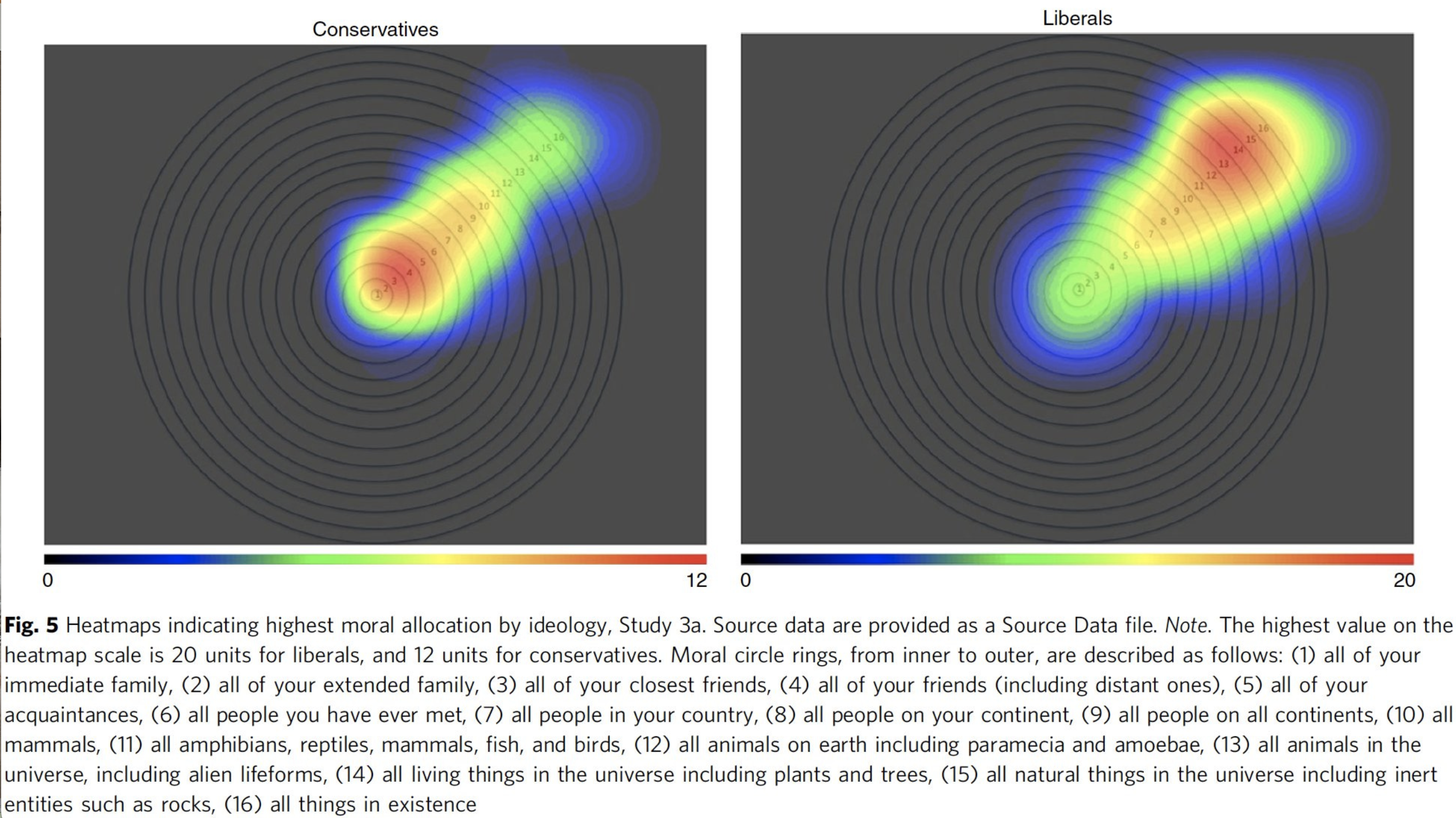
But then this meme started making the rounds of the Internet. And maybe, just maybe, it might not be so impossible. I’m talking about the figure below.

Paper in Nature Communications, Waytz, Iyer, Young and Haidt (Sept. 2019)

My primary critique with Haidt’s work is that he basically just makes up categories with no physical basis, that sound good, and this is no different. But he also is great at intuitive guesses, so at the same time, I do recommend reading him.

What this graph shows is the differentiation between how conservatives and liberals view moral obligation. Conservatives, on average, start closer to home, with more weight placed on people that they know, and then with concern dying out as distance in time and space increases. Liberals are the exact opposite. People adjacent to them accrue no credit for distance minimized, with concerns being projected on people further away, or even things that are often deeply unknowable.

What these folks don’t posit (mostly because they’re academics, and are invested in a low empathy environment, which then conditions their own bias) is that this also clearly demonstrates the potential morality that springs from a combination of independent, empathetic connection, as well as validity grounding — the ability to believe something because you witness it with your own senses. These two things are necessarily confounded (the experiment wasn’t set up to separate them) but you can still see how this plays out.

Short version — some majority of conservatives value a personally collected stream of information more than they do other sources, or experts and their stories. With the exact opposite being true for liberals/progressives. And this creates a profound neural gap between how the two will sort into social structures. Because of this relational divide, conservatives are far more likely to be communitarians than liberals. And liberals are far more likely to sort into elite-governed hierarchies, and be status conscious. You show your level of cool to your liberal pals by being concerned about the politics in West Papua, which you can never really hope to affect. And you can also appreciate how missionaries tend to be conservative. You want people to be saved? You travel and tell them about Jesus.

One can also see how this develops low- and high-responsibility mindsets. You can care about the entire world, but the reality is there’s not much effect you can have on the entire planet. But you can impress others with your virtue, which will then elevate your status in your social hierarchy. Contrast to the conservative viewpoint — you can affect your local environment, let’s say by planting a tree in your downtown, and while the global effect of that action is also unknowable, you can be responsible, and hold yourself accountable for that particular action. You can check on how the tree grows — an exercise in validity grounding –– and then, importantly change your behavior to improve the tree’s thriving. And all the time, you’re really cultivating how your brain processes information.

Since the election of Donald Trump, I’ve had to deal with a spate of attacks and abandonment from many of my liberal friends. This is not pleasant — even for me. Any straying from more and more extreme party orthodoxy means condemnation and alienation. I have picked up some more conservative friends along the way, and honestly enjoyed the development of some very honest and refreshing relationships, often hooked to the social media app X/Twitter. For me at least, these are data-driven — I ‘tweet’ and then people follow me for my ideas. I’m fully aware there is group aggregation in all of this. But as an original content creator, it’s been very refreshing.

The downstream cascade of the isolation the liberal community is actually promulgating is not going to be pretty – for them. Based on purity tests and adherence to orthodoxy, it is inherently relationally disruptive, and as such, prone to being kidnapped by psychopaths, who are far better liars than most of my friends trapped in progressive claques. Because it’s tied to our limbic centers, more people are likely to make snap decisions about which friends to keep or reject. I’ve certainly seen this on Facebook. And worse — if you’re prone to splitting, it ain’t gonna get better.

It’s also disorienting for those same progressives. As more fantastic crimes get dreamt up, the more the liberal mind loses its grip on a more adjacent reality, and the more we see projection of this mindset on conservatives. And that adjacent reality is the thing that creates the world we navigate.

As I’ve noted before, psychopaths always make a big splash up front. But over time, the system manages to find a way to isolate its relational vampires.

Or the whole system collapses. Stay tuned.

The Iran Bombing and the Detox from National Gaslighting

Reproduction of a Side Table designed by Tage Frid – Walnut

It’s been over a week since the B-2 strike force, armed with GBU-57 “bunker buster” bombs, took off from Whiteman AFB, flying some crazy mileage to and from sites in Iran (Fordow, Natanz and Isfahan) and dropping some specified load literally down the ventilation shafts of the Fordow site, to devastate the caverns where Iran had set up their centrifuge cascades. Uranium starts out as a gas, and then is spun in these centrifuges, each stage concentrating a little more, until sufficiently dense fissile material is collected.

From a memetic perspective, building any nuclear weapon requires a society of sufficient complexity, so that the parts of each step along the way can be coordinated and formed into a bomb. As I’ve said earlier, everyone pretty much KNOWS how to do it. But it’s kind of like watching a high diver pulling off two flips off the high board. You KNOW how to do it. But actually doing it ain’t so simple.

Less than 24 hours after the strike, a Defense Intelligence Agency report, ostensibly of “low confidence” was leaked to the likes of CNN and MSNBC, saying the strikes had not been successful, and that Iran’s nuclear program had only been set back “a couple of weeks” or some such icks. I thought that was patently ridiculous — I’ve worked as a military-adjacent rocket scientist my entire career, as well as supervising numerous projects in the nuclear nonproliferation space. The Air Force had dedicated a single individual to deeply understanding and planning this raid for FIFTEEN years, according to JCS Chair, General Dan Caine, when then led to the development of the GBU-57. That’s some crazy information sophistication right there.

But at the time of the raid, the point was straightforward — at that time, there was no way anyone could believe that any human could even know what happened to Fordow. At least any normal human. Fordow was a site buried under 300′ of mountain. Yet journalists like Jake Tapper jumped on the narrative that the strikes had failed. When, after some time had passed, it was obvious that there was a.) no way Iran was restarting its nuclear program any time soon, and b.) the strikes had been a devastating success, clowns like Tapper decried attacks on their reputation, as well as their obvious compromise of the intelligence apparatus of the country that hosts them.

Tapper had, however, played his important role in The Matrix — as one of the key gaslighters in the media apparatus. He had cast some doubt (however short-lived) on Trump’s declaration of victory, accompanied of course by the usual Trump bloviating. Trump is far from perfect, and boy he do go on. Those of us that have watched the gaslighting trajectory of what Mike Benz calls “The Blob” weren’t surprised by any of it. But there, for a brief time, the MSM had managed to spin up, along with the Blob-Congressional-Industrial Complex, the idea that the US Air Force, as hegemonic a force as has EVER existed on the planet, could once again not get anything done.

I’ve confessed in the past that I’m a Tolkien fan. And if there’s two quotes that roll through my brain on a regular basis, both are from the Lord of the Rings – notably, The Two Towers. The first is by Eomer, Lord of the Mark – “Those who do not lie are not easily deceived,” and the second by the traitor to Theoden, the King of Rohan, Grima Wormtongue, upon being daylighted on his deception, uses rules of engagement to avoid a dark fate “You have no right to assail me. I have not drawn sword nor threatened you.” Classic manipulation of civilization to protect obvious treachery. Those Eomer-devotees were not fooled, even if we didn’t know the answer.

What Tapper and others were doing were feeding into the chronic gaslighting narrative that the American public has largely been fed since the mid-90s. It is relatively nonpartisan (think Clinton’s impeachment trial as a start) as well as Bush’s Iraq War (GWOT) as well as Obama’s continued prosecution of it through Libya, as well as Afghanistan. It’s moved to high dudgeon with the Democrats, and the insidious development of the NGO-Industrial Complex, that’s formed so many channels for money to flow out of the Treasury, to all sorts of congress-lizards’ pet causes and spouses. Most of it has been squandered in the name of whatever cause-du-jour sounds the most virtuous for elites. But the reality is that the money hits hard in the travel budgets of the well-connected, as well as the academic institutions that prop up the philosophical component of the current elites, that is so important in forming rationalizations that confuse.

Which is the point. The definition of gaslighting, a term popularized from the movie ‘Gaslight’ with the immortal Ingrid Bergman, is a chronic and repetitive manipulation of information that the target experiences, with the intent of making them doubt all their own senses. Which then, deprives the victim of actually figuring out what the truth is on their own. It’s intended as a spatial/temporal agency destroyer, and boy howdy — it can work.

Gaslighting expands in the space of a society being overwhelmed by increasing complexity. People go looking for easier, simpler explanations of phenomena, often with high-level emotional resonance, which makes the various stories easier to remember. Psychopaths figure this out, and are more than happy to create these stories, almost always designed to strike fear in the target audience, with the intent of immobilization of the populace. You get to the point where you have no real idea what’s going on. So when something happens that you should know something about, you give up early. This drives relational disruption as well as the bonding that can happen over actual truth, between disparates parts of the population. The truth might be out there, folks might be able to agree on what that is, and form synergistic perspectives from different sides of the political spectrum. But we just can’t. We’re already been taught some version of learned helplessness.

And what THAT does is drive some form of decentralization, or its darker form, disintegration of societies. Things that OUGHT to be knowable suddenly are not. And then the folks making bank exactly from that confusion rush in to vacuum up the money feeds from the downed carcass. If a pack of hyenas comes to mind around a hapless giraffe, you’re not far off.

And so it is with Trump’s bombing of the Iran nuclear sites. One of the persistent myths in the US is that our armed forces are somehow incompetent, and cannot do their job. The reality is so strikingly different from this. In all cases, all branches of the military are wildly effective at blowing stuff up, everyone else literally runs for cover when they hear we’re going to show up. We consistently wiped the map of any of our enemies in ANY of our past conflicts. Even in ostensible debacles, like the Blackhawk Down incident in Mogadishu (I had a friend at that shit show) where 15 Army Rangers got killed, we killed over 1500 Somalis. And that was in the presence of Somali children running supplies for the warlords.

But tagged to that obvious first-wave success has also been myths — and they ARE myths — about our ostensible obligations in enforcing the American Empire. Colin Powell, former Secretary of State, as an inveterate liar as ever disgraced the State Department, said “you break it, you own it.” Of course, this is not true — we might have bogged down in Afghanistan and Iraq because of that philosophy, but we sure as hell didn’t care about Libya when we whacked Qaddafi. Libya now sits, a profound wreck of a society, with open air slave markets. The real point of the gaslighting was to prime the pump for both military contractors and NGOs to make a shit-ton of money. So we had to manufacture gaslighting myths to explain our presence in those countries, so that our winners, consisting mostly of elite East Coast families, could continue to make bank from the public trough.

When you assign someone to a 15 year tenure to blow up one place on the map, you’re doubling down on sophistication to fix your foreign policy problems. And in the case of Iran, Trump, wielding his own sword to cut the Gordian Knot of gaslighting around the use of military power, did that. I have no doubt, just looking at the subsidence patterns around Fordow, that the ceiling literally came crashing down. And Trump did NOT pay attention to the Collapse Mavens, like CBS’ Margaret Brennan, whom Secretary of State Marco Rubio demolished in an interview last week. It’s profound de-gaslighting when someone like Rubio basically said “these people have been obviously making a bomb, and we didn’t listen to all you idiots that attempted some re-interpretation of the fact that they had built this huge underground facility to make a bomb.” If Brennan’s side of the argument can’t be perceived as a Collapse Narrative, well you, dear reader, are not going to have your mind changed by a piece on a relatively obscure blog.

And, especially with regards to military power, we’ve ALWAYS totally dominated, for lots of reasons that I’m not going to go in here. Our military is powerfully sophisticated — to the point where the Collapse Champions have gone after it to make it less so. Obvious things, like “trans women in the military” or even deployment of women to forward zones (the pregnancy rate goes through the roof when it looks like real conflict is brewing, regardless of the actual valor of some women (some of whom have been my students) ) are attempted by the gaslighters to be turned into conflict-laden narratives, intended to divide.

I’ve mentioned Anand Gopal’s fantastic book before, No Good Men Among the Living, about our war with the Taliban. Militarily, we established country-wide superiority in almost no time at all, spunky mujahedin myths be damned. But we couldn’t hold it, because the gaslighting contingent, interested in turning our foreign wars into a money printing machine, didn’t define a military goal and then get out. When the Taliban was first subjected to F-18 strikes from carriers, it blew their mind — a literal alien force showed up and annihilated any resistance.

But where the lack of clear goals came in was in our lack of understanding of societal psycho-social development. Afghanistan could only be moved so far — especially in any kind of meaningful progression. And democracy was not going to be the end state. What that meant was that we would need to decide if we could do what the psychosocial DNA of that society, with its enslavement and chronic rape of women, men and animals, could be reformed. That would require a level of murder and assassination we are simply incapable of providing from our advanced civilization. And putting military and CIA operatives in place was not going to change that. It was the toxic sludge produced in the minds of our history and sociology profs that condemned us as much as the desire for money laundering from DynCorp and Halliburton, as well as the insane USAID network and plans to help Afghans increase the opium trade in the name of rural development. Gopal’s book details how the tribal leaders, realizing our own military leaders, with THEIR own limited psychosocial development, could be manipulated in taking out each others’ enemies using our military, which they had accurately assessed as being so overwhelming superior to their own. Societal evolution was not required.

And similarly in Iraq. While the various factotums were running around championing turning Iraq, a nation held together for reasons by Saddam Hussein’s barbaric form of Tikriti justice, the fact that Iraq as well was no monolithic mass of body politic (similar to what the gaslighters are projecting now on Iran, though Iran’s is a few evolutionary clicks ahead of Iraq) also escaped our analysts’ projections. Military strikes are one thing — and relatively sterile. But War itself (with a big W) always entails the same things, and Americans historically don’t have the stomach for it. War involves killing all the men, and raping all the women. It’s the way the game is played, deep in the Tribal/Authoritarian v-Memes. And if you can’t play that game, you better not show up with your various virtues. And the real reason your ostensibly virtuous NGO is there is to rip off the pig.

The real effect of Trump in the mind of the American people is he is ripping off the mask of the psychopathic gaslighters, that have sold us a myth of civilization in places that aren’t capable of sustaining a lot of it. Men can be women? Trump rips off the mask. Boys wearing lipstick and pretending to be girls aren’t destabilizing the level playing field of high school sports? That scab is coming off. USAID is really about curing AIDS around the world? That one’s gonna hurt.

And even further into our institutions. My pal, Jay Bhattacharya, at NIH, is also doing yeoman’s work in the de-gaslighting of the American populace. AIDS vaccine research that’s going on for 40 years, with no meaningful advance — that one’s gonna go. As well as a host of other emotional triggers that the old gaslighting elites have been using to great effect, to keep the money flowing into their various institutions. Look at the gaslighting virtue argument used FOR Gain-of-Function viral research. Mind-boggling that there’s even a discussion.

But don’t count on the old gaslighters to go without a fight. The recent donnybrook over illegal immigration is a great example of how the elites making the bank have their own Praetorian Guard of True Believers, holding forth on everything from “dads who are human traffickers are dads first” to “who will scrub my toilet at a rate under minimum wage?” The current 14th Amendment Birthright Citizenship kerfuffle is an amazing example of this. The 14th Amendment was passed to insure justice and citizenship for slaves at the end of the Civil War. Using it to argue for anchor babies, as well as birth tourism from China, in order to make sure their one precious baby can get into the UC System requires a different level of gaslighting. Yet, in this moment of time, it’s the Ds screaming about the unconstitutionality of Trump’s EO on this issue. And like all good gaslighters, they’re doing it with a straight face. With tears. Never underestimate the power of women crying. It’s an old trick.

Of course, America will remain confused for a while. Any detox process takes time. And the gaslighters, while fading, aren’t gonna stop any time soon. We didn’t get into this rut overnight, and we’re not going to climb out overnight. The irony that it took Trump, a pathological narcissist, to start the unraveling of the Great Gaslit Empire (backed with data from Elon) isn’t lost on me. But when your civilization is on the brink, your heroes you get are the ones you get.

And as for Fordow — that place went boom. Boy howdy.

P.S. A piece for another time — but how many of our institutions can we hope to save, considering how deeply they’re invested in gaslighting? Dunno. Some have completely turned into what I call Vampire Colonies. Where the psychopaths have functionally taken over. Not much hope for them.

Survivor, Psychopathic Fishbowls and Late Stage Feminism

My funny dinosaur Valentines having a morning laugh

Dunno about you, but friends send me videos, intending me to watch them. There’s only so much time in the day to peruse such content, but I’ll tell you — you send me a video of cute dogs, or some Florida hillbilly catching Burmese pythons, I’m all over it. Especially if it’s under two minutes.

One of my former, original students (from 1989 or so!), though, sent me the video below — it’s over 17 minutes! I initially wasn’t going to watch it — but now it gets my “MUST WATCH” recommendation, if you want to have any hope of understanding the chaos some of us are attempting to contain. Orion Taraban is the owner of the channel, and he gets it about 80% right, with only the sins of omission to really characterize. In my Global Holistic world, that’s really good.

Here’s the video.

In this video, he talks about a series of the TV show, ‘Survivor’ — this coming from Australia. I really don’t enjoy the show — the premise (which most people miss) is of relational disruption and psychopathy. It’s what I call a Psychopathic Fishbowl, where we sit on the outside and watch the psychopaths manipulate and trick each other while munching on a bag of Doritos. As such, it just gives me PTSD. But the fact is also that the show runs some showcase of the various Stanford Prison Experiment, or the Milgram Experiment, over and over while tweaking the boundary conditions. For those that like to watch some modestly friendly (frenemy) competition, and see some hot chicks bounce their boobs, it’s not bad. If you can stand it.

Here’s the key thing — the intrinsic dynamic in the show is psychopathic. Various people, playing a selection of Game Theory paradigms, attempt to end up at the end of the show as the Last Person Standing, and collect a million dollar (or whatever) prize. There are two tribes, these two tribes start off competing, before eliminating enough that it becomes some singular competition.

This particular series, though, intrinsically had a more profound premise. The tribes were separated by sex. There was a male tribe, and a female tribe. Originally, the men organized their societies, with some loose hierarchy. There were Alpha men, and there were Beta men. And as described, they all got along. I’ve seen this in my own kayaking groups from younger days. You might be a better, or worse paddler than your buddies. But there was some skill-based (and judgment-based) ranking, and we all drank beer at the takeout and made fun of each other.

In the show, the males, through coordinated action, quickly mastered their material circumstance. They were living comfortably. The women, however, were failing miserably. They were cold, wet and hungry. They simply couldn’t get their act together enough to provide for basic needs.

The short version of the video is this. The women were drawn into interaction with the male tribe. They quickly learned that they could not beat the Alpha men. But they aligned themselves with the Betas, creating relational disruption between the Betas and the Alphas. Once they had the Alphas eliminated, they set about eliminating the Betas. In the end, the women won. I’m not going to watch the show, for reasons stated above. But I am also sure, as I talked about in this piece on men and women, the women targeted the Beta men due to their susceptibility to social control, and maybe a little nurture, and got rid of those pesky Alphas, which of course were the ones who created the society in the first place with their strong Protect and Provide instincts. I’m sure the women did it with toxic emotional empathy, as well as appropriate shaming. And the psychopathic women assuredly looked at the strongest and most virtuous men for early elimination. In the long game, once the Alphas had been eliminated, the Betas might have had more access to females to spread their own genes – or believed they had. And the females likely tortured the Betas once they had control of them — established Elites ALWAYS have cohorts of Immiserators.

In such a psychopathic game, one ends up with a debased, low resource, poorly functioning society. But the women are running the show. Which was the whole point. “An evil man (or woman) will burn his own nation to the ground to rule over the ashes.” -Sun Tzu

There are now some more unsavory aspects of such a society that might be meta-stable, but is also weakened. Inside the parthenogenic system, the women now run whatever version of sociobiology you fancy. Older women are absolutely obsessed with control over younger women’s uteruses, and who gets to choose who produces the next generation. How this works is complicated, and spans across the lower v-Memes. If you need a primer on what gets older women off, read pulp romance novels. And if you need evidence of the first statement about controlling younger women’s uteruses, tune into the abortion debate, or any May/December (or even September) relationships. Yes, I could write about this, but I understand psychopathic women as well, and don’t want my own writing weaponized against me. (Note — not all women are psychopathic! – it’s a sub-category.) In fact, in any female community, there is powerful striving between the virtuous members and the psychopaths.

But the end result is still the end result. Societies that focus on ungrounded emotional amplification end up being controlled by women, and produce even weaker men. Anyone doubting this can see the crisis in our university systems. And then, once that system boundary defining that society is compromised by an external, invading tribe, the whole thing unravels. What you get is collapse. And societal collapse is monotonously the same. The men are killed, and the women are raped and enslaved. Society then devolves back to a Tribal/Authoritarian state. The psychopathic women don’t care about this — their time horizon is notoriously small. And in some weird “selfish gene” way, the genes don’t care. If they’re in a weakened fitness environment, and violence is the way they upgrade from far away, well that’s just the way the cookie bounces. A version of this is EXACTLY what’s going on with the Grooming Gangs in England currently. When you see 13 year olds offered up for the sexual needs of truly an invading nation, scroll your evolutionary calendar back.

What IS interesting is that there are ways out of this catastrophe that we seem to be heading for. Psychopathy is the real problem, and psychopaths suck in a high trust, high agency world. Making our systems more Performance/Goal based, where actual merit does the sorting, makes them far more robust than our BS DEI frameworks, which, being identity/assumed status/phenotype driven, are set up for manipulation. Independently generated, rational relationships will always carry scaffolding from the lower v-Memes. But when people engage their brains, I’m convinced that almost anything is possible.

You can now see how this ties in with importation of tribal elements from across the world, in the former administration’s immigration policy Trump (an obvious Alpha) is desperately trying to undo. And how, crazily, emergent drivers are present in the males (and families) that are coming from around the world — notably polygamy, societally sanctioned or not. But there’s a different long game when we have a collapse of both physical and psycho-social fitness in a society that can make such a game have more broad appeal outside the psychopathic cohort serving as collapse’s Praetorian Guard. Anyone that believes Haitians or Somalis are offering a leg up on the evolutionary Psycho-Social Ladder need to have their heads examined. Or go visit Port-au-Prince. Hence, it’s necessary to gaslight the public on the virtue of these folks, because the truth is so painfully obvious.

We’re used to the old Burke-ian saw “All it takes for evil to triumph is for good men to do nothing.” But I’ve become convinced that men simply can’t, in aggregate, figure out this game. And while I’ll stand up and use my perspective to point out the finer features of all this, at least until this election, men are no longer running the show. This one’s on the girls. I’ve met few guys that get that something is going on in this larger testosterone/estrogen conflict. But women figure this shit out almost instantly.

And here’s the thing — you virtuous strong women whom I admire and am friends with. We’re lost without you. Time to saddle up and come to the rescue. We’re in a tight spot!

Quickie Post — Weaponized Empathy

Sharing a lovely bottle of Sancerre with my 14 year old son at L’Express, in Montreal

One of the terms that gets batted around quite a bit lately is the phrase ‘weaponized empathy’. I’ve been talking about ‘empathy as a weapon‘ for a while, but I think it was my Twitter/X pal, Theo Jordan (@Theo_TJ_Jordan) who certainly rearranged the word order.

What does ‘weaponized empathy’ really mean, though? Most people misunderstand the basic core — empathy — as wanting to give someone a hug, or rather, your predilection to give someone a hug, if you’re slightly more evolved. This is not what it means at all.

I created a modified version of Frans de Waal’s empathy pyramid that folded in my understanding as far as what happens when you put all the researched areas of connection together. These are represented in my own Empathy Pyramid. Short version of a long story (like the rest of this blog!) the stuff at the bottom is fired by the base of our autonomic nervous system, and it goes up from there in complexity, and utilizing the later evolved parts of the brain. The realization of the blocks on the side were one of those “angels singing” moments when my brain makes up for torturing me the other 98% of the time.

What empathy REALLY is is some version of coherence matching of brain states. I’ve written a TON about this already. If you see someone yawn, you yawn. If you see someone crying, you feel sad. If you’re more evolved, you read other people’s faces and body language and attempt to predict what has upset them. This is really NOT novel. Honest researchers have been studying this since forever (everyone knows, for example, that a big hunk of communication is nonverbal, amirite?) 

But the problem is that empathy research ALSO attracts more than its share of psychopaths. They’re looking to make things more confusing, because they’re anti-empathetic. And like it or not, academia houses a lot of these people. For reasons, mostly emergent. Meaning that “it’s the way we do things around here in our rigid, pathological, title-driven hierarchy.” How the hell do you think we can spend so much time grading young people if we weren’t against empathy? We’d understand too much about our young people’s predicaments. 

But back to weaponized empathy. Weaponized empathy is when you have an actual empathetic sense, but instead of really connecting and feeling someone else’s pain, or predicting how someone else might be thinking in a given space, you sneak in, and you use that knowledge to twist the knife. And the knife is best twisted at the bottom of the empathy pyramid, deep in the brain’s core survival and emotional functions.

How does that work? The more sophisticated are familiar with the range of mental models of their targets, and then manipulate them directly with their virtues, hopes and dreams. It’s like the trolley problem, where you set people up to pull the switch to murder the grandma of your choice, instead of theirs. Or you get them convinced to tie everyone up, and reverse the trolley so it goes over both tracks.

The relationally disruptive in the world — the Axis II/Cluster Bs and Cs of the world — are the best at this. They do it because it provides clarity for them to manipulate situations as THEY see fit. Take the current sadness of the October 7 Hamas attack against Israel, originating from the Gaza Strip. All of it is a wildly sad and crazy situation, because there is a larger history of Authoritarian v-Meme provocations on both sides that have degenerated this entire coupled social system (Israel and the Gaza Strip) into a pre-medieval developmental state, where raping women and killing children is just part of the deal.

But the weaponized empathy part is taking how you feel about something as raw as Palestinian children being killed in bombing attacks, and then distorting the reality that what is going on is a genocide. Look folks — it’s appalling. It’s terrible. But killing even 20K folks, in a nation of 2 million, isn’t genocide. That’s weaponized empathy at work.

Weaponized empathy lays a black-and-white, splitting pallor on complex issues, in an attempt by the manipulator to take their side. They connect with you, and understand your own personal biases, then use those biases against you to flip your brain. And they can do that with material that is factually true, factually false, or somewhere in between. It affects your core because the smart wielders of weaponized empathy know that they’ve got to get down to YOUR base level — the deeper in the brain the connection, the better. 

I just wrote a (for me) somewhat simpler piece on the complex issue of transgenderism, which lays out the case that some transgender folks have honest problems, while others manifest either Borderline Personality Disorder or Anti-social Personality Disorder. You can read it and decide if it’s fair-minded or not. But someone interested in using weaponized empathy will distort this current societal travail and tell you things like this is the same as the Civil Rights movement, or more recently, LGB rights. It is preposterous. Jim Crow in the past was NOT the same as transhumanism today.

But if you believe that it is, it’s because a psychopath has weaponized your own empathy, your own ability to connect with others, whether emotionally or predictively, against you. And if reading this makes you irrational toward my argument, then you’ve been brain-wormed.

And that’s the power of weaponized empathy. Especially in a space where we are really fighting memetic wars.