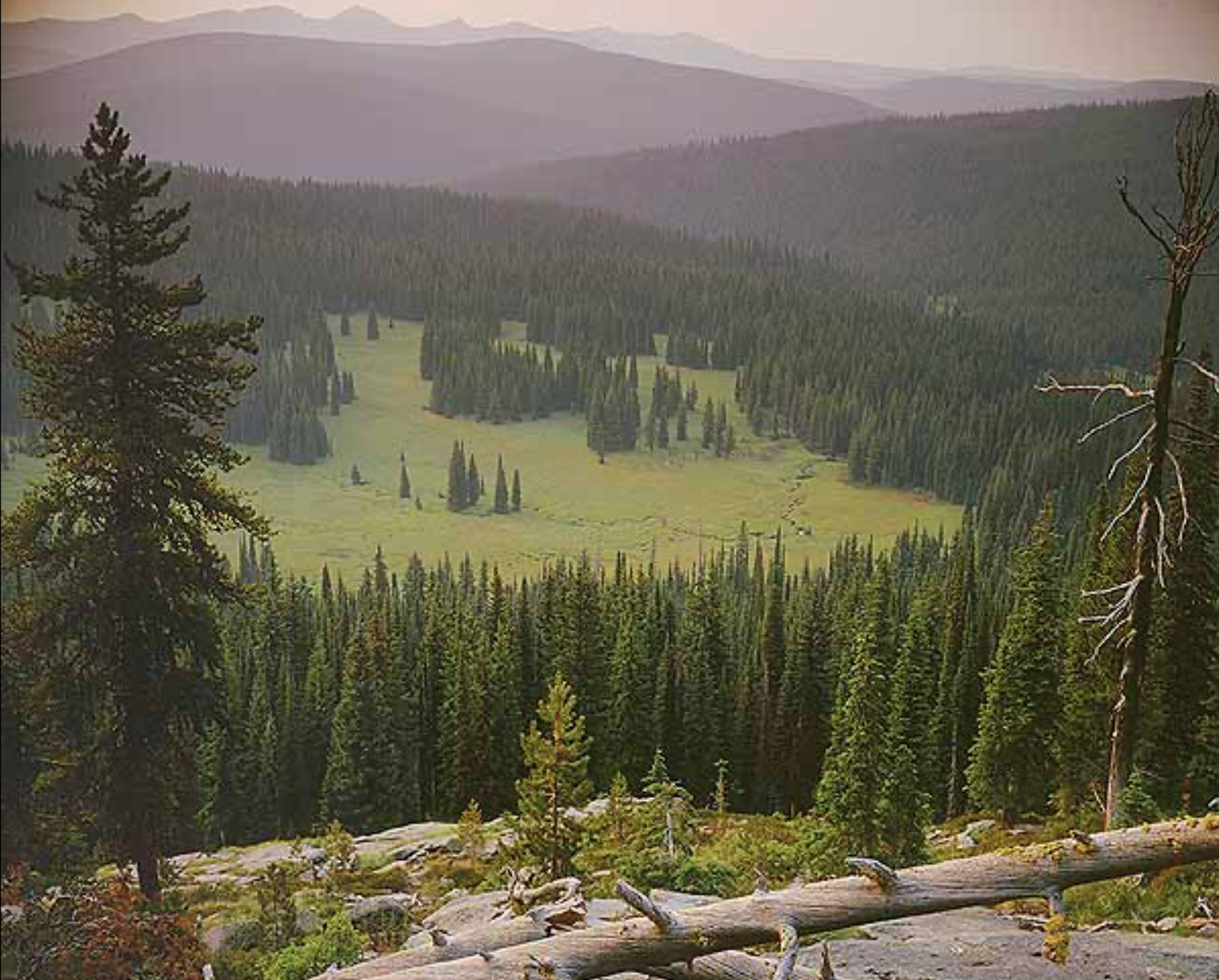
Grave Peak, Selway-Bitterroot Wilderness, North Idaho
One of the most amazing books-on-tape I listened to recently is Denis Johnson’s Train Dreams. Following the story of a life of a literal nobody — this was Johnson’s forte — Robert Grainier, a day laborer in the American West, he writes in unsparing style about Grainier’s life from his perspective. The events that happened, both good and bad, are raw, and unscripted. The basic plot — an orphaned man living in the Inland Northwest, outside of Bonner’s Ferry Idaho — is never broken by much comfort, at least for very long. Living here myself, and sitting here watching the December rain fall outside, it was an act of constant endurance, without a pile jacket or Gore-Tex raincoat in sight. Johnson, besides being an elegiac writer, also embodies Robert Heinlein’s concept of a fair witness. – an unsparing, but non-critical analyst of a situation.
The book reading is stunning, and if you have time, I highly recommend you listen to it. It is disorienting in a strange, immersive way, and showcases Johnson as one of the premier writers of the last 50 years, at least. Johnson doesn’t attempt any intentional emotional manipulation of the reader. Instead, there is just the narrator telling his ghost story from his point of view. The story centers around losing his wife and child in a fire, and I won’t say more than that.
At the same time I had the book recommended to me by an X pal (Amanda Fortini, also a writer, and wife of yet another X pal, Walter Kirn) a movie made from the plot of the book was also released. While the movie is not terrible — the cinematography is evocative, and if you’re familiar with the landscape, as I am (I live adjacent) they do a fine job of capturing what it means to be set in the wild landscapes of the Inland Northwest — an area crossing over from eastern Washington to Northern Idaho.
But instead of scrupulously adhering to Johnson’s book, the movie struck me as a psy-op designed to manipulate the viewer on the issues of our day – not the issues of the 1920s. In the book, for example, a Chinaman caught stealing from the company store is attempted to be executed by a mob, but manages to escape. In the movie, he commits no crime (of course) but is summarily executed, and becomes a ghost that haunts Robert. And Grainier, after the fire, instead of being befriended by a drunk Indian with a bad habit of laying on railroad tracks, as happened in the books, is instead lifted up by a prosperous local native merchant. Magic realism is one thing. But this is so preposterous as to defy belief, especially when one considers the dominant time period being set in the early 1920s. Finally, Grainier isn’t even allowed the elevation of his enlightenment through meditation. Instead, he is lifted up by a woman. White men really cannot save themselves.
I actually enjoyed the movie as much as I’ve enjoyed any movie made in the last five years. And I find myself pondering whether I’m hallucinating these things. But that’s the thing about a good psy-op, especially one aimed at sophisticated audiences. When they had a black vigilante kill a white preacher in the movie, an absolute plot insertion with no match in the book, I was pretty sure I was being had. But the scenery was nice — I love my backyard, having dedicated an enormous amount of my life to saving it from destruction, and the movie turned into at least a watchable movie.
Maybe that has to pass for “good enough” in a time period with a collapsing film industry. But it’s still a shame. Ordinary people — even drunk Indians — can walk through life with a certain dignity that does not ascribe to Hollywood’s current morality plays. And people deserve to understand exactly how difficult life was for all the actors on the last frontier of the lower 48 states.
Where’s a cinematic fair witness when you need one?
One of the radical changes in the structure of our society in the USA is the dramatic shift in how generalized populations are supposed to not only address mental illness, through care modalities, but how mental illness is supposed to be mainstreamed into the various operations of our corporations and institutions. No longer is mental illness a condition to be treated and overcome. Rather, now, it must be accommodated in your normative social environment. And if you, as an individual cannot accommodate a given neurodivergent condition, then you face punishment or loss of employment.
Worse, if you are trapped with a severely mentally ill person in your immediate family, the “mainstreaming rehabilitation” mindset is so powerful that if you are dealing with a violent version from a protected class who ALSO has a mental illness, the current systems and institutions supposedly set up to protect society as well as family units collapse. YOU are the bad person for refusing to accept aberrant behavior, and not go along with disordered social service agencies who offer little, if any help.
There can be no more terrible example that the recent arbitrary murder of Iryna Zarutska by DeCarlos Brown on the commuter train in Charlotte, NC. Brown had been convicted and released 14 times for violent crimes, including armed robbery, and his own mother had attempted to have him involuntarily committed. But despite violent schizophrenic outbreaks, this failed, even in light of his extensive criminal history. My suspicion is that had Brown not been African-American, he would have been committed. But our social institutions are so contaminated with the notion that racism must be the root of all evil, even Brown’s own mother’s concerns — she had taken him to a homeless shelter because she could not control his behavior — landed on a tin ear in the justice system. She didn’t persist — and Iryna Zarutzka, a person honestly seeking refuge in this country paid with a violent death, and her life.
When such a crazy, violent event happens, one needs to reflect on what principles are our society structured around. It’s easy to go through some litany of the usual list of the various v-Memes, laying out safety and security at the bottom, moving up to rules to regulate such areas as commerce, or even traffic, and then ending up in the space of opportunity to create new economies, or protect the environment. The list would certainly go on.
But if we were to look at things from a more generalized relational substrate, we might come up with profoundly different answers. From a guiding principles perspective, a society is supposed to lay the groundwork for fundamental coherence of action among its residents. Dependent on the overall psychosocial development of its members, societies should create structured environments that allow members to participate, within reason, in an environment that allows enough predictability for people to join some group action, and have some set of expectations about what the outcomes will be.
The short version is coherence, within the context of development and values of a given society, must be the desired end state. It is one of the hallmarks of Collapse Narratives that they promote other, decidedly more disordered, egocentric outcomes.
When people read that word “coherence” it is very easy, without an understanding of v-Memes, which code how people change and grow over a lifetime, to assume that somehow it means that everyone should be a goose-stepping minion. This is ridiculous. A simple example is in order. In contemporary society, the guiding principle of coherence implies that you ought to be able to get in your car, drive to the local supermarket, and provided you have cash or credit cards in your wallet, buy yourself a six-pack of beer. All those activities rely on a much larger stable system to instantiate this simple action.
And psychopaths know this. So if they want to relationally disrupt the coherence of the system, they have several pathways available to them. One is the obvious, conscious mode of throwing a brick through the grocery store’s window. While that is dramatic, it’s also highly unlikely that brick throwing is going to be mainstreamed as a stated societal value any time soon.
Better to co-opt mental models of virtue that a society might hold dear, that inherently are unstable, and arm different cohorts of society, with these as attack modes to the foundations of a society — which inherently includes coherence — and get people inside the system, functioning on different temporal and spatial scales — to fight. Then the psychopath gets to sit back and quite literally watch the world burn.
Much of this has manifested in the last 30 years. My own mother had a relatively profound personality disorder — she was likely Avoidant/Borderline. She was an absolute fire starter when it came to manipulating people into a constellation where people believed they were justified in starting a fight, especially as she aged. But her demeanor, projected as someone who was introverted, gained her allies across the community, especially in the face of my father’s alcoholism, which was also real. It took me to about 48 years of age to realize that at least part of the reason my father drank was because he was married to my mom.
Yet at the same time, my mother functioned relatively well in society. It was because society had imposed constraints on her behavior. As a doctor’s wife (my father was an obstetrician in good standing in the community) she had a role to play, and she knew it. We were Catholic, and she befriended the local sisterhood, who played no small part in our social lives. They also had problems, but once again, they were constrained by social expectations. There were particular situations where it became obvious my mother had problems. But here’s the key — for the most part, because her role was scripted, and she did have a couple of bright kids, she had little latitude for finding or displaying any deep, disordered feelings.
The key element in her progression through life in the ’60s and ’70s was that she was supposed to be an upstanding citizen, PTA leader, and mother. Any activities straying out of that would have been considered aberrant and anti-social. Her focus of her identity, which was madly scrambled inside her own head, was EXTERNAL to her true self. It is also true she had a brutal childhood, full of poverty and uncertainty, and my own grandmother had multiple husbands that she had. to navigate. But her path was set. And that was a GOOD thing.
Contrast this to any young woman emerging into modern society. As part of the bedrock belief structure of any version of late stage feminism, you get to be, ostensibly, whatever you want. But that means very little if you have a combination of disorders, as well as a lack of family structure. Young men, even though they are an aggrieved and attacked group in modern society, have far more. Bedrock ‘Protect and Provide’, though diluted, still exists. Focusing on the egocentric needs of some women does benefit some — I have some outstanding female colleagues that I wouldn’t trade for anything. But most people have little integral sense of self until they are north of 26. Couple this with the very natural drive to have children, which is then wildly confounded by extant societal messaging, and it’s no wonder we’re in some version of societal crisis. Short version — like every society, we have some percentage of crazy people. We then strip away boundaries for normative behavior, and then additionally arm young women in particular with powerful legal tools to lash out, and we end up with a lethal stew for relational disruption.
The people that suffer most from this are, not surprisingly, healthy young women, who then inherit a hostile relational environment that they are poorly equipped to navigate.
And while there is more to say here from a gendered perspective, the real point is that the de-centering from some version of societal conformity as an expectation for young people, to a re-centering on the poorly developed needs of the self is a recipe for societal chaos. And chaos goes directly against the need inside a society for coherence. The society simply cannot function effectively at the complexity level that it may have evolved to. And so it begins to decline.
Psychopaths love this circumstance of combining what has been called a “moral racket”, combined with my term, “narcissistic shielding.” The more out of it a given person with alternately neurodivergent issues that might have been more manageable in a more constrained environment, or someone who actually suffers from mental illness, the more they show up on the psychopath’s radar as someone who can be co-opted and manipulated against the relational hierarchy in a social setting. In my clinic program, which is somewhat unique in that I send students out into the real world, I noticed a pattern where a more well-formed psychopath would adopt a functional “child” — and then wait for affront from me. It was relatively unconscious, though the impetus for “splitting” by the personality-disordered ‘parent’ was usually a bad grade for work.
Then the bias towards centering the social situation around the person with mental illness or neurodivergence would come into play. It’s well known, for example, that people on the autism spectrum are often literalists, and have a very difficult time with irony or sarcasm. So the student would misunderstand something I said (I use a lot of humor in the classroom, akin to a football coach goading players to higher performance) and then the psychopath would raise the interests of her narcissistic shield in order to gain power and control.
This has happened on systemic levels across society. Academia is well-known to include more than its fair share of mentally ill people (who could study a particularly obscure, minute area for their entire career without the advantage of OCD?) and it’s not surprising, with its development of complex micro-aggressions, often developed by its own psychology and sociology faculty, that there is a rapid relational collapse into externally defined, low empathy, relational modes. The problem with this is that our brains will only do what they practice, and when you end up with entire modern systems that enshrine siloed thinking, exacerbated by a heavily siloed social system, there is a profound decay in the ability to synergize larger solutions that society needs.
As the society plunges ever deeper into the meaning crisis, it exposes even more avenues for psychopaths to use the narcissistic shields of the mentally impaired to focus on ostensibly empathetic solutions for problems — “let’s focus on making people who are severely disordered feel comfortable everywhere.” This creates a wild level of cognitive burden on the rest of society. If a 50 year old man with lipstick wants in your high school daughter’s locker room, she must be accommodated. If the homeless person refuses being housed, and prefers to sleep in the open-air drug market they’ve established at the local park, they must be accommodated! This re-centering causes everyone else to retreat from public spaces, which causes further social degradation, as well as establishing hyper vigilance as the norm for public interaction. Everyone you meet doesn’t mean you well — because they probably don’t. During the recent Palisades Fire in Los Angeles, I brought up on social media the likelihood that homeless people had helped spread the fires. My ultra-virtuous liberal friends immediately went on the attack. How dare I impugn such an obvious source (homeless people in LA often live at the mouths of canyons, and have burn barrels they gather around)!
And it hardly helps the mentally ill, either. I had a memorable adventure once chasing a bipolar schizophrenic through the streets of Vancouver, BC. I don’t know if that sounds like fun — but it wasn’t. He had actually escaped from an institution, but real mental illness is no joke. Mentally ill people need help because they are not normal. And they are often very low functioning. A lack of understanding that differential actually worsens the societal consequences for them. It does not help to pretend.
But for psychopaths, it’s any manipulative virtue/narcissistic shield in a storm. And when your goal is relational chaos, there are multiple paths to get there. Facilitating the crazy is just another tool in the toolbox.
If you think it’s almost designed to make you crazy, or at a minimum, retreat from society, you’d be correct. That’s the key game in the psychopath’s playbook — relational disruption, or make you nuts. And what could be more delicious than using the helpless against society?
One final note — I was in Vietnam looking for venues for international projects, when I happened to encounter a British psychiatrist. We hit it off famously, and ended up having drinks at the Hotel Metropole with another Vietnamese mental health care provider. He had been working in Laos, and I asked him what they did in the villages there. “They build a set of pole cages outside the villages, and when they have someone go on a manic episode, they lock them in the cage.” He went on to tell me that there were only eight psychiatrists in all of Laos, a country of approximately 7.7 million people.
One of the most insane parts of the last six or so years has been the rise of the trans movement — to the point where it’s moved off the pages of various freak show publications, to a place of prominence where, at least if you live in anything resembling a college town, you’re confronted with it with some degree of regularity. Whether it’s lining up your pronouns in your e-mail address, or making sure you tell some ugly, middle-aged individual they are something they’re not, you’d better be on point in the gaslighting game of the decade.
And it’s highly relationally disruptive and devolutionary. Instead of YOU (yourself) assessing the most basic aspect of a person’s make-up — their gender — you’re supposed to believe whatever they say that comes out of their mouth. You’re supposed to suspend belief. And until Donald Trump came along, you could be fired, persecuted, or potentially slapped with penalties for not indulging someone’s often auto-erotic fantasy.
I really think that most people knew all this would end, sometime. But note to my community. It hasn’t, and it’s not going to end anytime soon. The respective cat is out of the bag.
The research on what’s actually happening with trans people’s brains is somewhere between mediocre to awful. Others have covered that, and I wrote a piece on trans demographics here. There are some key things to note. Not all trans people are afflicted in the same way. It is a mental illness, and these things reside on a multi-axis range of factors. But a significant percentage of them have what are called Axis II/Cluster B personality disorders.
Axis II/Cluster B disorders are major dynamic change units in societies, and have been, literally since the beginning of time. These are things like psychopathy, narcissistic personality disorder, borderline personality disorder, histrionic personality disorder, and some version of schizoid and paranoid personality disorders. Out of the center around Axis II/Cluster B are the lesser known ones that often create massive damage. My own mother had a Cluster C Avoidant personality disorder, and the chaos that this created in both my younger life, as well as my maternal search image in how I’ve dealt with women has created all sorts of forks in the road. But it’s also given me insight, unobtainable by any other means.
And what is the main insight? A key, neglected aspect of personality disorders is that they all fall under the umbrella of relational disruption. There are laundry lists of symptoms/characteristics, generated by various psychological researchers over the years. But I’ve found most of the lists inconclusive (there are obviously better/worse ones) likely dependent on whether the researchers themselves had a personality disorder, and were attempting either to discover truth, or hide their tracks. But you, as an individual, know when you’re dealing with one. It’s very similar to a piece of dark matter passing through your orbit. You can’t see it. But you feel the tug. And that’s EXACTLY why there’s so much pressure from the trans community to take away your agency. It’s not just the make-up they’re trying to hide. It’s the chronic relational disruption.
But back on target. The purpose of this piece is not to dig independently into individual personality disorders. Rather, it’s to understand how they act in the context of human social networks and systems.
A couple of years ago, I put some serious time into thinking about how system boundaries in human systems affect how we perceive cause-and-effect of various actions, and lessons from human activities. I centered this around the famous monkey grape/cucumber experiment run by Frans de Waal. In the experiment, there were two side-by-side monkeys, and a researcher would alternately (dependent on the monkey) give a grape reward for retrieving a rock, or a cucumber reward. The key was the two monkeys were able to see each other. And because of that, it didn’t take long for the monkey only getting a cucumber for a rock to get pissed when he saw the other monkey getting a grape for the same action. Everyone laughs at the video, posted below. But it’s actually much darker than that.
The natural tendency of the human brain is to draw a system boundary around the two cages, and leave it at that. But I started realizing this led to a very defective conclusion. What happened if you drew the system boundary around the researcher as well? Or included the cages or open space the monkeys would be returned to in the back? Would the monkey that got shorted beat the hell out of the other monkey? You can read this here to construct your own thoughts. Short version — lots of stuff we do to animals in labs is positively psychopathic.
A couple of years later (that piece was written in 2016) I turned my thoughts to the larger question — what happens when you have psychopaths in systems of HUMANS? This is a harder question, because now one must ask very carefully what the effects are going to be, and whether to consider both temporal and spatial effects. Further, it’s easy to decide that psychopaths (I’m going to use this as my generic term for Axis II/Cluster B/C individuals) are some defect in brain function — poor attachment, brain injury, sexual abuse, cultural environment, etc. All of which may be true. And maybe, in an organ as complex as the human brain, some error rate is inevitable. But that still does not explain their evolutionary persistence. Psychopaths are characters in literature down through the ages. If they really were a deep liability, or rather, a bug, as opposed to a feature, then societies without them would always prevail. And the ones that had any would collapse.
But that’s not the story of human history. I had to face up to the very hard, and disturbing fact that psychopathy is likely a feature of large-scale human systems. Not a bug.
I am a fan of Spiral Dynamics, Clare Grave’s masterwork, and am no believer in cultural relativism. I think the current post-modern anti-colonial rhetoric is actually gaslighting of entire disciplines — sociology, anthropology, as well as psychology. To gainsay the evidence of more or less successful societies is to deny the evidence in front of us. Short version — some people live in upwardly developing prosperity, while others live in squalor and violence. But figuring out exactly why is difficult.
But then I realized. It IS actually possible to draw a system boundary around Tribal societies relatively easily. Once you get above this, it gets more and more complicated. So I looked into Tribal societies.
There is some research on that is good, or at least a little rational. There is also a lot that is total garbage, full of romanticism and nonsense, generated by people who would never last a week in a real one. Some of the backlash is due to guilt over, across the world, our functional genocide of most tribal societies. That is a fact. But in the process of what the civilized world did to these people, we also lost our way in understanding the core of how many of these function. One of the many books I’ve read on how tribal societies function is Guns, Germs and Steel,by Jared Diamond. Diamond has the personality (and probably the research staff) to write long books. Trust me — you have to be neurodivergent to punch out a 1000 page tome. Why that is true will have to wait for another time.
The one thing that Diamond did document, however, is how intrinsically violent tribal life was, and is. People at the tribal stage of development kill each other ALL THE TIME. Murder rates run at 10x-100x of civilized societies. From ChatGPT – but this matches what I remember well.
“In The World Until Yesterday (2012), Jared Diamond draws on anthropological field data—especially studies by Lawrence Keeley, Napoleon Chagnon, and others—to estimate that traditional tribal societies experienced homicide rates far higher than those of modern state societies.
He summarizes the comparison roughly as follows:
Tribal / traditional societies: on the order of 500–1,000 homicides per million people per year.
This comes from archaeological and ethnographic data for small-scale societies such as New Guinea highlanders, Amazonian Yanomamö, and various pre-state groups.
It equates to about 0.05–0.1% of the population killed each year, or over a lifetime the chance of dying by homicide can reach 10–30% in some groups.
Modern state societies: typically around 1–10 homicides per million per year in peaceful contemporary nations (roughly 0.001% per year).
Diamond uses these figures to argue that, per capita, the murder rate in many tribal societies is roughly 10 to 100 times higher than in modern nation-states.
These numbers are not meant as a precise single statistic—Diamond stresses that rates vary widely between tribes and through time—but his central estimate is that the risk of violent death in pre-state tribal societies was about an order of magnitude (or more) greater than in modern societies.”
More reading led to another interesting insight. Lots of tribal “coming of age” rituals involved sexual abuse. It’s pretty well established that child abuse is a problem across Native reservations, even in the US. But what was more interesting (pathologically) was this was once again, not a bug, but a feature of the vast majority of tribal societies. And it obviously happened to girls as well as boys. After some ritual deflowering, there was almost always what I would call a “re-integration” ceremony, where the particular gender would be declared a man, or woman in the tribe. I can’t bring myself to read such publications as Margaret Mead, but there’s lots of stuff in her research romanticizing this.
The other thread I managed to weave into this line of psychosocial development is this: “what happens to individuals who are sexually abused, especially en masse?” The only person I found who had done research on this was Simon Baron-Cohen, Director of the Autism Research Centre at Cambridge, England. His work showed a probabilistic spread — most kids rebounded. But some did not, and went on to display deeper pathologies.
But getting back to system boundaries. What happens when we draw that system boundary in both time and space? What is the long continuum over the years in human society that we see, at least at the Tribal v-Meme level? Institutionalized sexual abuse creates key actors in those same societies, that go on to assume roles that, like it or not, are part of that tribe’s persistence. Their warrior societies are stacked with crazy-ass psychopaths. The ones that most of the time, sit in the warrior lodge — because the rest of the tribe knows they are some crazy-ass MFs. But at the right time, when the tribe is threatened by another tribe over the hill, or mountain, the warrior lodge doors get opened, and they pour out. If there are not enough of them, then the tribe CEASES TO EXIST.
What role do women serve in tribal societies? Sadly, by our civilizational standards, women, from a genetic perspective, exist to have an affiliation to being traded to other tribes, during some period of potlatch or some occasion. This is just historical record, folks. And what women would have the affiliation to get down to business with whomever they met? Once again, relationally disruptive women. You can look up your own stories about the libertine nature of various tribal ceremonies. But once again — it’s not a bug. It’s a feature. Without a particular level of genetic mixing, tribes would falter and CEASE TO EXIST.
Don’t shoot me. I’m only the piano player.
So what happens when you’re dealing with a large cadre of people in the middle of a memetic collapse, as the Democrats most clearly are? You end up with what I call the Great Simplification. There aren’t any new ideas to grab onto. So you hang onto your past winners. The problem, though, is this shifts your organization or group back into the Tribal v-Meme space. Anyone that thinks that tribes have more developed information spaces than modern societies, I can’t help you. And that means you’re also looking at downstream seizing of historical mental models (this is a great piece — short version, takes a complex society to create a nuclear bomb, but only a terrorist with a piece of wire to use it.)
But the models you pick will be the ones that your Neo-Tribe has an affinity for. And those affinities, like it or not, arise from The Matrix.
There’s a top-level thought going around right now in the form of emancipation population theory. What’s happened is that in our society, we’ve basically liberated everyone, and now the only ones left are the criminally insane (DeCarlos Brown murdering Iryna Zarutska on a train in Charlotte, NC) or the larger trans movement, which is now starting to produce a statistically significant number of assassins (Tyler Robinson killing Charlie Kirk) all hopped up on hormones and fantasies of self-castration. On the surface, it’s compelling. But both these potential groups hold extreme damage to the public reputation of the Democrats.
And in the age of social media, we get to watch, within the span of six weeks, two actual snuff films. Over and over. You cannot deny either the murder of Iryna nor Charlie Kirk being shot in the throat. For any human without isolating levels of Tribal v-Meme affiliation, simply put — that dog won’t hunt. You would not want to affiliate yourself with a group that advocated for crazy people slitting throats in public, or defend a textbook assassination. No contemporary organization could hold up under those circumstances.
Yet endless pronouncements by a variety of celebrities and D politicians do just that. So something else is going on in the deep subconscious of the Democratic party.
And that thing is a complicated stack. But in the current moment, the question that Ds ask me is this: “Why can’t you drop the trans thing? There just aren’t that many of them.” To which I reply “Why can’t YOU drop the trans thing?”
And the neo-Tribal answer is “we will never betray our psychopathic warrior caste. We’re gonna need them to kill people, whether we’re publicly endorsing this or not. Or we’re going to cease to exist.” Now tag on some modified form that allows for the DeCarlos Browns of the world, whose own MOTHER was pleading for help in dealing with her schizoid/psychopathic son. But the systems set up, profoundly Democratic in essence, refused. Especially in a time of perceived threat, they need those people.
Obviously USAID (which various D actors/operatives have consistently defended) has known about the importance of maintaining a cohort of psychopathic warriors for a while. They’ve funded them in Bangladesh, and Sri Lanka. And a bunch of other unstable countries. All masked, of course, as health-related. But when you look at the history of revolution and warfare in these places, you really have to be fooling yourself to see this as benevolent.
From ChatGPT
Here’s the updated master list of documented trans-rights/LGBTQI+ groups or initiatives supported by USAID, now including Bangladesh and Sri Lanka. (It highlights direct grantees or well-documented local partners; many broader USAID health projects also sub-grant to numerous smaller community-based organizations.)
Group / Initiative (lead org)
Country
What USAID funded / supported
Blue Diamond Society (BDS)
Nepal
Partnered with USAID on inclusive disaster-risk and health programs; also received HIV‐program support under PEPFAR and was affected by the 2025 funding freeze.
Parichaya Samaj
Nepal
Community center providing HIV prevention and counselling; supported by USAID-backed HIV programs until the 2025 pause.
LINKAGES (FHI 360) – MSM & transgender community partners
Nepal
USAID/PEPFAR project providing HIV services and community-led monitoring through local trans/ MSM CBOs in 19 districts.
LINKAGES (FHI 360) – trans partners
Kenya
USAID/PEPFAR project supporting trans-competent services and advocacy recommendations for Kenya’s national AIDS strategy.
USAID-funded network of transgender health clinics (Hyderabad, Kalyan, Pune) providing gender-affirming care, mental-health and HIV/STI services.
Humsafar Trust (collaborations)
India
Long-running partner on HIV services for MSM and transgender communities; noted as affected by the 2025 funding pause.
Africa Queer Network
Uganda
Kampala-based NGO that reported receiving a USAID stop-work order during the 2025 pause; previously funded for HIV programs serving LGBTQ—including trans people.
SUSTAIN program (with local partners)
Uganda
USAID-funded “Strengthening Uganda’s Systems for Treating AIDS Nationally,” which highlighted key populations including transgender people in HIV treatment and testing.
LGBT Global Development Partnership (via Astraea, Victory Institute, etc.)
Guatemala, Honduras, Ecuador, Colombia
USAID partnership that provided small grants and capacity-building to local LGBT groups—including trans-led CBOs—through Astraea’s grant network.
Bandhu Social Welfare Society (Bandhu)
Bangladesh
Implementer of USAID’s SHOMOTA (Equality) Activity (2022–2027) to advance rights and services for gender-diverse people.
Sompriti Samaj
Bangladesh
Co-partner with Bandhu in the SHOMOTA project supporting gender-diverse communities.
Transgender Network Sri Lanka (TNSL)
Sri Lanka
National trans-rights NGO receiving USAID support, including through the LINKAGES HIV program (2017–2019) for trans-inclusive services.
Overall pattern: USAID’s support for trans rights has typically flowed through health-focused programs (PEPFAR, HIV prevention/treatment) and the LGBT Global Development Partnership, which channel funds to local trans-led or trans-serving community-based organizations across Asia, Africa, and Latin America.
You might think this is a play from a new playbook. But it’s not. I remember reading about the late ’90s civil war in Sierra Leone. The rebels set up a variety of checkpoints throughout the country. And who staffed them? 16-year-old boys, with AK-47s, dressed in negligees. Called Kamajors, they believed the dresses gave them spiritual protection. What IS interesting, as I investigated this (I remember the pictures from the Granta book I had) is that ChatGPT was very intent on painting the Kamajors as some kind of noble warrior cult defending innocents, than the berserker cult they were actually. Though, TBF, ChatGPT admitted these people did commit war crimes.
So here we are — stuck with a former major party, in the process of social devolution, captured by its own sexually abused and abusive psychopathic members, with no ideas on how to make a better world. And desperately reaching for its own warrior caste that used to be discreetly backed by the US government itself.
They just can’t quit them. And we as a nation better wake up to the deep roots of this. I live deeply entrenched in a community with a lot of their supporters. They are also old, and I suspect dementia, or some low level Alzheimer’s disease is also a problem. But I’ll tell you — they have absolutely no problem serving up fresh hell on the opposition. Or attacking me. And it is true that where I live is a microcosm. But microcosms are useful for understanding larger dynamics.
Civil societies are great things. They preserve far more human life than tribal societies, and provide lifestyles and benefits unimaginable even 100 years ago. But they are inherently fragile as well. And the path back down to the level where circumstance naturally puts the psychopaths back in the warrior hut is gruesome. I wrote this because I finally decided it mattered enough to get this model out there. The challenge is to get enough people to realize that a lot of what is going on with these people is not conscious — but it is actionable. Centering a societally devolutionary group’s (The Democratic Party) psychopathic warrior caste as those creating the diktats of the future is only going to result in societal chaos and destruction. Don’t fool yourself.
It’s not exactly a secret that I’ve been a social activist, almost completely unpaid, my entire life. It started back in 1989, after I moved out to Pullman and became involved with the environmental movement. I fell under the tutelage of Leroy Lee, a Native American wannabe as close to being a Nez Perce Indian as one could be. Leroy was no Pretendian — but he was as ingratiated with both the Coeur D’alene and Nez Perce tribes. And he decided I was smart, which has always been a curse, and enlisted me in helping him with what turned into the Phantom Forest scandal. Leroy was a timber stand examiner, and worked in the woods measuring exactly how much actual timber was present on both private and mostly National Forest land. So he drug me along as he compiled damning evidence on the US Forest Service, showing that they had kept two sets of books regarding sustainability of that resource — one inflated, to justify increased cutting. And one actual — because in the end, the USFS had to sell that timber. I was a protege — not an architect. But I learned a lot from Leroy, who had intuited that I would go on to continue his work.
Leroy died young — 18 years ago, but I still remember him fondly.
And that launched my own benighted career — defending beautiful places that no one knew, and no one really cared about. Most people, when it comes to saving forests, sort the world into what they can see from the highway. And if there’s a “beauty strip” — a row of trees that blocks the view of clearcuts from the road, most will never question any of it. Even in this latest round of dealing with Donald Trump and ostensibly renewed calls for more logging on National Forests (most people don’t even understand that National Forests are NOT National Parks — they can and are logged) I’ve found that most people, even while professing care about ecological integrity, haven’t the foggiest what that means. Even professional environmental activists have fallen into line defending agencies I literally spent decades fighting.
But that’s the memetics for you. We’re in the middle of a war, as I’ve written here, between elites and counter-elites, and the elites long ago managed to figure out, regardless of whatever the noble cause was, to hack the institutional income stream from whatever the charitable, front-and-center projection du jour. I’m a huge fan of Mike Benz and Jennica Pounds, a woman that goes by DataRepublican on X. They have deconstructed the NGO-Industrial complex better than anyone. And along with the Department of Governmental Efficiency (DOGE) have been responsible for bringing the pain to the deep, ingrained corruption on the Left. None of this doesn’t mean that a mirroring corruption wasn’t already present on the Right. But I was one of the people that at least thought that, by being a Lefty, I was on the right side of these large issues.
Along the way, I started writing for the local newspaper, the Moscow-Pullman Daily News — a bi-weekly op-ed column under the tagline ‘Reality-Based Lefty’. I have, and still do believe that local news reporting is essential in smaller communities. I’ve seen various studies that show local newspapers profoundly damp down the corruption in governance . So as much as I believe anything coming out of the academy nowadays, I, once again, thought I was working on the right side.
I had written at least 23 years of columns until I quit in 2023. The column made me recognizable, and notable in the communities of Moscow and Pullman. My administrators at the university notably also hated the fact that I was writing, and found various and sundry ways to persecute me (bogus ethics violations, etc.) for writing it. Academic administrations are about power and control — and that matters in small, university communities. And though I’ve always been excellent in my job (raising money, publishing, blah, blah, blah) as university governance has declined, my ability to speak has also gone down. I’ve enjoyed some reprieves dependent on the university president, and WSU has had some good ones. But my colleagues and lower level factotums memetically have had an impossible time believing that a professor could or should speak with an independent voice.
As far as external audiences, I’ve had to deal with more than my fair share of potential directed violence. During the Cove-Mallard campaign, my phone was very likely tapped by the FBI. At various public hearings, I had other forces of the timber industry threaten me. And I went toe-to-toe with millworkers and loggers as well. I’ve written about some of this in my book, Wild to the Last: Environmental Conflict in the Clearwater, which was published in 1998 by WSU Press. At least at the time, I couldn’t have been so far out of the blessings of the university hierarchy.
What I found with folks that worked in the woods was that, while they had problems, and would threaten me, if I also matched their approach, and talked to them, they would back down and we would talk. There’s a certain pattern to the dance when someone threatens to kick your ass — they step forward, and yell. And you better step forward, chest-to-chest as well. Fear doesn’t wear well. But then they would inevitably step back, and you would talk. Mill owners and timber magnates were worse. But the industry just wasn’t, and isn’t about killing people for their political views. That’s not true for all natural resource industries — I’ve always told people I’d never mess with Basque sheep farmers (those guys are nuts). They’d kill you at the drop of a hat. Maybe it’s just the fact they’re the only humans alive still pretty much descended from Cro-Magnons. But while there was indeed tons of political skulduggery in the timber/USFS game, murder is just not in the cards. Or I’d be dead.
I took a hiatus after Clinton’s Roadless Initiative got passed. We had managed to move off the table most of the remaining public wild country on National Forest ground (no roads) off the table. I had kids to raise, and I wanted to make change in the university landscape. So I became the Chair of the Faculty Senate — kind of like the elected president of the faculty — and went to work on the issues of the day, which mostly revolved around DEI. This led to me participating in hiring Elson Floyd, a black man, who turned out to be a narcissistic psychopath. He spent WSU into penury, and we’re still struggling financially from this. He also made sure to wreck my career in administration as well. He simply couldn’t tolerate having another powerful person in his orbit. That’s a longer story in itself that will have to wait until retirement. I also got divorced, and ended up in a protracted struggle with the mother of my two sons, who was aided and abetted by a school system, which calling it corrupt would be mild. It was painful as hell, but it did yield profound insights into how our country has gotten the problems that it has. Short version — we didn’t get here overnight, and we’re not gonna get out of here overnight either.
And then came COVID. I was involved in the ramp-up to the lockdowns and masking, and I’ve written extensively about all of it, as well as my eventual discovery that it was all a farce — a diabolical one that still goes on today.
And along the way I wrote my column in the local newspaper. I was, at the first, earnestly attempting to communicate with the public about civic issues while hewing to the mainline science. This, though, went sideways during COVID, when it became obvious that the powers-that-be were deliberately lying for lots of reasons — the largest being what I named Elite Risk Minimization. Elite Risk Minimization is the psychopathic manipulation of public interventions, using the force of government, to minimize any perceived risk elites have to their well-being. It is absolutely anti-empathetic, and it utilizes other ensconced elites (like professors at universities) to propagate bullshit beliefs. The guiding principle became “if it saves one life” — as long as that life belongs to an elite. If you’re poor, your life can be wrecked — and many were. It’s a well-worn story how elites sat at home and had food delivered to them, while ostensibly the poors wandered about waiting on them, dropping food in bags outside their doors while ostensibly subjecting themselves to clouds of the virus. Fortunately for the poors, the lethality of COVID turned out not to be true — though it is still BELIEVED to be true. Especially in small university communities like Moscow, ID.
And around the world, folks found out that all that science, and all that elite opinion, had largely been arbitrary, or manufactured by the folks paying the bill. Which, more often than not, turned out to be the taxpayer.
So I wrote about this. Initially, I wrote about the need to follow government mandates. But then the data came in, and I made some influential friends (hi, Jay, if you’re reading this!) and the whole fraud got grounded. So, I started out, initially kindly, and then more forcefully, telling elites in the two university towns that the rational case behind their affectations and hero worship of criminals like Tony Fauci was a crock of rotten fish.
And they responded. Boy, did they ever. I received all sorts of emails about “staying in my lane” and how I was killing people with my op-eds. I was screamed at in public, and ostracized. What was also unusual was that other citizen columnists for the paper, instead of covering their own viewpoints on issues, started writing libelous columns about me. The ethics of the op-ed game are pretty simple. You write your opinion, and then the public gets their shot. What was wild about all this was that it wasn’t just letter writers. It was other op-ed columnists. After three years of all of that, I decided it wasn’t worth the $25/column I was receiving. I figured the persistence of hate against me wasn’t worth it.
The residue from my column still haunts me. The latest incident happened just four days ago. A retired lab manager from a biology department at WSU, that I used to work on Democratic politics, while at the dog park where I run my border collies, picked up dog feces in a bag, came stomping and screaming at me about how irresponsible I was as a dog owner, and threw the feces at me. He then attempted to steal my dog. There were plenty of witnesses — I hang out with a bunch of, well, elderly ladies at the dog park, who are on my team. The perp didn’t leave until I called 911.
But even as he left, as I was running the calculation in my head on who exactly he was, he walked away with a smug grin. His point to be made, in a veritable community of elderly immiserators, was that there would never be a price I could pay to not be tormented by these people in public. Am I 100% sure it wasn’t just about the fact that my dog took a poop? Of course not. But if there’s been any theme in my life over the last four years, is that once you are declared an outcast in a Lefty community, you are fair game for whatever happens to you. And if that thing is evisceration, you may have a Greek chorus weeping for you on the sidelines. But no one will do a thing. You deserved it.
There’s a pattern here that’s worth noting, that I’ve seen over and over since Trump got elected — but was really in play during COVID as well. It plays into the whole Elite Overproduction thing I write about. If you piss off a logger in a logging community, they may threaten to kick your ass. But it’s a direct threat. You square off, size each other up, and then take your chances. The logger (or miner) isn’t counting on some institution to manipulate to change the circumstances. They know that they’re likely breaking the law to kick your ass, and they’ll end up having to explain this to the judge. But they’re functioning inside some rational understanding of an ordered society.
That is no longer true on the Left. When I’ve been assaulted — and it’s happened three times, full-on — the expectation of the person screaming at me/spitting on me/hurling a bag of dog shit at me is that, in their minds, they have functionally been deputized by society to punish me, and any institutional authority summoned would back them up. Ostracism is guaranteed. And because Trump is evil/a rapist/a criminal, they have decided that the rules of a civilized society no longer apply. At least to them — but in the case that I act (in all three cases of assault and battery, I had to passively absorb the abuse) I will be the one that the cops haul away.
This thought is not with rational merit. One of the problems with being a large, muscular human (I’m a big guy, though at 62, not as strong as I used to be) is that they also assume bias in the police, and after I literally break them, I will be the one to pay. Even if it’s obviously self-defense. When the person that was attempting to steal my dog was trying to clip a leash on her collar, I was very careful to not touch him, all the while yelling at him to stop. Witnesses, as I said, and another gentleman were on my side. But so certain he was of his righteousness — it was me, a local societal pariah — it never occurred to him that he would ever suffer any consequences. It’s fundamentally a pattern of psychopathic inversion — claiming self-victimhood as the tool to justify whatever cruelty they decide to mete out. Remember that the next time one of these psychopaths start talking about “the cruelty being the point” when talking about Donald Trump. They’re self-identifying and projecting one of the key behaviors they’re familiar with. And they get to be the judge.
This phenomenon is not just limited to me. There have been numerous other situations where various lefties acted out to disrupt events with no expectation of consequences. In March, a Republican Central Committee meeting in Coeur D’Alene, Idaho, was disrupted by Teresa Borrenpohl, an official at North Idaho College and a Democratic candidate who was forcibly removed from the meeting by private security after disrupting the meeting. She claimed ‘free speech’, though she did not follow the rules of the hearing. While I can understand her actions, at some level, the bottom line once she was thrown out of the meeting was to demand reparations for not being allowed to continue to disrupt the meeting. She was the authority, and she would not tolerate the fact that a group of people might object to her declaring her authority illegitimate. Further, she made it abundantly clear that this was not an act of civil disobedience, where an entity breaks the law, fully expecting to face consequences. There would be no consequences – at least not for her, she informed the press, other than the Kootenai County Republicans paying her tribute. She controlled the morality of the event.
I was heavily attacked as well on Facebook after the event by many people by bringing up similar points. Many of the people on the FB thread know me personally and deeply. It was clear — any questioning of her moral authority would result in permanent ostracism. Some of the people on that thread were individuals who had also participated, or supported our own Civil Disobedience efforts. Clearly, at least in their minds, the rules have changed. As Lefties, they now embody the law, the judge, and the jury. As well as the executioner.
It is worth pausing for a minute and considering what is happening in communities, or rather tribes on the Left. And here’s the thing — Trump Derangement Syndrome is just a symptom. There has been an overall psychosocial v-Meme devolution on the Left. There is still some hanging onto higher-level narratives from Legalistic and Authoritarian v-Memes. But overall, the corpus has adopted a psychopathic perspective based on the psychological condition known as ‘splitting’ — where there’s a descent into black-and-white thinking, where only the current observer, as long as that observer is correctly tribally aligned, gets to decide on the veracity of any given situation. Tribal Taboos have been established (e.g. there will be no firing of any black official, regardless of their self-evident level of corruption) and they will not be broken. And if they are broken, it’s like an entire unraveling of worldview that takes place, instead of any attempt to relate a change of condition with society, or any functional integration of their worldview with what’s actually happening in current affairs. They are literally operating in a fantasy world of their own creation.
But it is reinforced through large-scale LARPing as social-justice warriors, or some other icks. No grounding necessary. The problem is that scales of their fantasies keep growing. As well as the concomitant gaslighting of the general public.
Core characteristics of much of this involve what I call ‘narcissistic shielding’ — where an ostensibly innocent, group-declared victim is moved into a position between the out-group and the psychopathic champion of the in-group. “Don’t approach, or I’ll be forced to shoot the baby panda!” to paraphrase Elon Musk. Agency goes to zero with the Lefties. But the result of that is that it’s all the suspect outsider’s fault. All my attackers were their own narcissistic shields — champions of virtue. And while they threatened physical violence to me, had I responded, they were absolutely sure that the institutions would have been on their side. One of the screamers in my three incidents was a women in a motorized wheelchair who took it on herself to accost me for saying wearing masks were B.S. She accused me of wanting to kill her family.
All the confused outsider sees is the results of psychopathic projection from the Lefty insider. And this projection is both constant, and relentless. Consider the current Russiagate situation. Trump was pathologized, largely by a cabal under ex-President Obama and Hillary Clinton, to be a Russian asset, controlled by Putin. This is now being revealed as a combination plot that refuses to die. But the Left still persists in projecting this ostensible lack of agency on Donald Trump, due to their judgment of (of course) his lack of moral character, as well as mental incontinence, through sophisticated advocates like Heather Cox Richardson, even while there is nary a peep about the fact that Democrats were propping up mental invalid Joe Biden for basically his entire term.
Some of this stems from mental deterioration from the aging of the Left’s core group, which seems to mostly consist of AWFULs (Affluent White Female Urban Liberals) and men and women over the age of 65. I suspect some of this has to do with degenerate cognitive decline — as people age, unless they really work at it, they march back the cognitive development v-Meme ladder, becoming more and more tribal and authority-driven. Much of this seems also like schismogenesis — the creation of a self-image through negative reverse polarization. They must be the opposite of everything they hate about Trump, or else their own, fragile ego boundaries, decaying in the face of their own death, are shattered. It’s a reverse role of the stereotype of Uncle Bob showing up as the arch-conservative at Thanksgiving dinner. But it’s still emblematically characterized with a focus on Trump himself. The various policies, that are simply disastrous for society (like open borders, or masking small children) are conveniently shunted to the side. As they decay, they lose more and more sense for precise time, which then helps them construct Collapse Narratives, based around dubious moral principles, as well as policies only rejecting what is occurring, as opposed to creating alternate solutions that would even have measurable outcomes. The only thing uniting their worldviews is the desire for collapse.
From a neurogenic relational perspective, the Lefties are also moving back down the relational/agency development scale. If you’re not an Externally Defined expert/Tribal Elder, you can’t be listened to at all. And if you go against the drumbeat of dread, then you’re immediately scapegoated. Contrast that to my confrontations with the loggers. It started out Externally Defined (I was an environmentalist, they were timber workers) but over the course of our relationship, their view of me evolved. I became a person — with an independently generated relationship that was fundamentally data-driven. We had talked, and exchanged perspectives, which were likely never completely resolved. But I was still, at the end, a human. Contrast with the current crop on the Left. I know at the end of any conversation with a Lefty True-Believer I’m merely to be added to the list of people to be, at best, re-educated. Or put up against the wall. I gotta get my mind right.
An incredible example of this popped up in my FB feed. I encourage you to read the piece for yourself. A relatively famous Native American writer is condemning her fellow writers for not coming to her Struggle Session workshop, and directly faults one of the people that did come for leaving early. She freely admits that the framework was a Struggle Session. But simply cannot acknowledge that maybe the reason for why the various feminist authors did not show up was that they were just human. And busy. Her response is emblematic of collapsed egocentricism — which is itself a prime symptom of Axis II/Cluster B personality disorders.
And here’s the thing, folks. She did this publicly, in a regional magazine, to people who are her ALLIES. If these people ever manage to gain power again, you can imagine what they’ll do to apostates like me. We continually believe we cannot have a Chinese Cultural Revolution here. But I’m here to tell you that we can. These people are laying the groundwork for it. There are steps — devolution of relational development, followed by rigid appropriation of various orthodoxies, mixed in with no absolution possible.
I’ve had in-laws like this — and they were psychopaths. They are hiding behind the screen of a culture that has, what we believe, an intrinsic, if not invisible thesis of forgiveness. It is a core Christian philosophy. But what I’ve learned in my own life is that there are various rituals for you to confess your sins. However, at the end, you are not granted absolution for your ways, nor elevated for your transcendence. You have merely acceded to a guilty judgment against you. And now you must be punished. Preferably by execution. I’ve got stories.
Civilizationally, we’re in a tight spot. It is true that a lot of these people are literally aging out of the population. But they are exceptionally weak-minded. It’s also true that Lefties are also not reproducing at the rate that conservatives are, which, for all the problems the conservative movement has, it is fundamentally a Christian movement, which does have paths for redemption. Time will tell. But it is also time to start punishing with the judicial system those that break the law. They are not breaking the law with the expectation of societal elevation, as in the past with large civil disobedience campaigns. They are breaking laws expecting that their moral hegemony will dominate.
If you aren’t afraid, you aren’t paying attention. The clip below can happen here.
Two therapy dogs, Ghillie and Cecilia, getting ready for a child client
One of the most frustrating parts of what I write about is getting people to realize that they don’t know stuff, and the real solution when you don’t know stuff — at least to start — is to realize you don’t know stuff. You can’t effectively harness new modes of understanding until you get to the point where you realize that all the old answers you used to think might explain stuff just aren’t going to cut the mustard. Too many contradictions, and such, means you have to accept your ignorance and move on. It is only then that enlightenment can occur.
This is hardly a new idea, and the Zen masters — my favorite go-tos — were big on this. One of my favorite stories from Paul Reps’ collection, Zen Flesh, Zen Bones, is below, and deals directly with my line of employment.
Once, a university professor went to visit a well-respected Zen Master to learn about Zen. The Master first invited him to sit for a cup of tea. The professor sat down and started talking about Zen. The Master quietly prepared and poured the tea. When the tea was filled to the cup’s brim, he kept pouring. The professor watched the overflowing cup until he could no longer restrain himself. “It’s full! No more will go in!” blurted the professor. “The same with your mind. How can I teach you Zen unless you first empty your cup?”
But changing adapted mental models is hard. Why, for example, would you bother to learn what I talk about on this blog? You really have to be tortured by your own confusion to sit down and spend the time to instantiate all this stuff. And you’re likely not going to get much community support dwelling on what some rando on the Internet says might change your life. (That Rando would be me, of course.)
In short, you have to possess the developed ability of metacognition — knowing what you don’t know, and having a sense that there is stuff out there that you’re not even aware of.
Why is this so challenging? As I said in this piece, once you open your mind to the notion that maybe the truth is really shared information that different, active sentient agents use for inter-agent coordination (read the piece for details — it’s a little complicated) you realize that if you adopt a different mental model than your friends, you risk alienation and loneliness from your cohort group. And humans no likey that kind of thing, at all. Being alone means that tigers are gonna eat ya. And if you think you’re going to retreat from some likely 10M years of evolution just to figure out how to help pilot our society out of its current mess, I’ve got news for you.
Metacognition — or admitting that you don’t know — in a group is going to have also other active agents rush in to fill you up with their views, which probably aren’t any better, and likely worse than your own. It’s how we get those mass psychoses we’ve got going. And the more externally defined/emotionally available you are to what others think, it’s going to get ugly fast. Corrections in this kind of peer pressure are long-term. People just don’t want to hear your bullshit confusion.
Some things we don’t know are also profoundly comforting in not knowing, especially if you already have a narrative figured out that makes sense with the surrounding sensory inputs in your environment. I used to be a big Anthropogenic Global Warming (AGW) advocate. But as time went by, and, well, the seas didn’t swallow New York City, I became more and more of a skeptic. And then when people in the IPCC threatened something I happen to love very much — in this case, vast swaths of native forest, which at least some of them wanted to cut down to make the planet more shiny (that’s the albedo thing) I woke up. There are more things in heaven and Earth than my philosophy can know, Horatio.
And then I continued my journey with meeting people like Judy Curry, the former chair of atmospheric sciences at Georgia Tech, and someone that had made the jump herself a couple of decades ago. Judy’s book, Climate Uncertainty and Risk, is dense — but a classic. Only someone like Judy could go through the probabilistic analyses of what actually is going to happen in the climate space, as a risk management and probability expert. It was one piece in the puzzle that convinced me we actually have a memetic problem with climate science — not so much a scientific one. Status elevation in the field was (and still is) tied to how catastrophic the narrative one creates, instead of anything resembling a grounded reality. Those louder voices have seized the megaphone, and they’re screaming. And if you don’t fall in line, it’s only tigers for you.
And what do those loud voices do? That’s where my expertise kicks in. Some very famous loud voices in the climate science community are also connected in a very closed-loop feedback modality to the insurance industry. If they’re all saying we’re gonna wash away in the next big storm, someone has to sell us insurance so we can rebuild back in the same place. That’s what insurance is all about. And that means they have to raise their rates, because business is business, don’tchaknow? Or the government has to cover the house. Or something. Short answer — the real problem is brain worms in the scientific climate community.
So to understand all of how this might be connected, you gotta start admitting you don’t know stuff, and looking for other signals that people are lying to you. The biggest would be insurance company profits. Which is downright metacognitive-y. Because now people are paying increased premiums for things that didn’t happen. And our news media stream is not about reporting things that didn’t happen. You didn’t read a piece recently “China didn’t invade Mongolia this week,” because that wouldn’t have much signal value. Or emotional value either.
But just because I wasn’t aware of insurance profits, didn’t mean that the signal wasn’t there. That’s the whole Dark Matter part of metacognition. Dark Matter is the stuff in the universe that doesn’t reflect light, but it’s still there tugging on all sorts of other stuff through gravity. Considering that it makes up 85% of the matter in the universe, though, you can’t just ignore it. And that’s what is happening in the memetic-sphere with our thoughts. Metacognition is accepting that it really does exist, and then starting the process of adjusting our worldview to understand it.
My friend, and atmospheric scientist at UC-Davis Joe Biello sent me this picture. Once you understand where that Dark Matter is, it’s not surprising that the picture it gives of what’s going on starts becoming more coherent, or in the colloquial, making more sense. Here’s insurance industry profits.
I used to use the signal that the insurance industry was raising their rates as proof that AGW was real. But it turns out not so much. It turns out the same people spreading the AGW hysteria are also looped into the money-making machine. And it’s not that some level of GW is happening (and some is caused by humans) it’s that the hysteria signal prevents more reasoned debates from occurring on what actual solutions might be. Or on what scale we should respond. I’m extremely pro-environment (spent my entire life working on various issues) and totally believe humans can fuck up stuff locally, as well as regionally. Big time. Anyone can see a clearcut. Or an urban heat island. But actually grounding yourself to changes in the global system needs lots more research.
Which we should be doing. But when the hysteria meter is off the charts, instead of understanding how our natural systems, which are obviously complex, modulate the climate, through vegetation, circulation and growth (see my buddies Anastassia’s and Andrei’s work on the biotic pump) we end up with people demanding we turn Siberia into a parking lot. We still don’t know exactly how all this works. But we won’t even study it if all the money is diverted into computer time and large models. It’s like sticking our fingers in our ears and saying “Nyah nyah nyah!” Not very metacognitive-y. Nor wise.
It’s no surprise that human brains work like this. Yeah, I like my work on knowledge complexity. But you’ll also find me recognizing Michael L. Commons’ work on hierarchical complexity as well. Not quite as system-y as mine is but spot on as far as understanding what humans are capable of knowing. And here’s the key. One of the hardest things for humans to process is cross-paradigmatic complexity. In our example case here, the cross-paradigmatic complexity is how AGW research feeds into insurance industry profits. There are at least three jumps across physical to social systems that reveal the relative truth of a lot of this stuff. Most human brains no likey. And even if your brain DOES like it, you’re likely to be missing something. I know I certainly was. The easiest immediate proof that storm intensity and frequency are NOT increasing is found in insurance industry profits. Because if it actually was, you better believe the insurance industry would be howling more than they already are. And there’s also ancillary cause-and-effect (like building more cheap houses in places like Florida) that are also potentially causal in insurance industry profits going down, if there actually were a hurricane. It’s all part of the metacognitive puzzle — not just looking at the connections, but also looking at how, and which are the connections that matter.
This kind of analysis (or really, meta-analysis) can leap all over the map. I’ve been going back-and-forth on the risks of AI tech, for example. And one ALWAYS ends up with the “correlation is not causation” tropes, like increasing ice cream prices are tied to tiger predation, or some such icks. You can look those up yourself.
If there is any answer to all this, it is awareness and your agency. So walk around and think about stuff you really don’t know much about. And then investigate. The worst thing that can happen is you become a more interesting cocktail party guest. Even if no one wants to invite you.
P.S. Judy’s latest contribution to the DOE’s climate report is here. They did a great job in pulling apart a very confounded body of work that is mostly nonsensical. You’ll hear the usual hue and cry about the oil industry blah blah blah, but I really encourage you to read it. It’s good mental exercise.
Back when I was a bona-fide environmental activist — a phase/career that lasted close to 14 years (if I had to be honest counting) I wrote a book, called Wild to the Last: Environmental Conflict in the Clearwater Country (WSU Press, 1998). In it, I documented a series of stories through my various adventures in the social and political landscape, which turned out to be far more interesting than the physical landscape I had spent so much time defending.
Why? The trees were beautiful — the wild rivers clean, and it’s hard to explain the deep awe I had, and still maintain for these wild places. But there was simply no cognitive dissonance in the fact that these places, functionally remnants of a bygone era, should be saved. All the truly economically conflicted places had, at least in the Clearwater Country in Idaho, had been logged. The timber industry was literally running on fumes. And the end was near, at least in that era, of large-scale resource extraction. What WAS left was gorgeous, striking and more than a little anachronistic. But the remaining stands of old-growth might build a couple thousand or so houses, or actually cedar shakes for roofs of houses. Or vineyard bracing. Saving this last, best place was simply a no-brainer.
But the forces persisted. There was no aesthetic swaying, no changing of minds. It was obvious to me that the timber industry was going to keep going until its own, bitter end.
It was then that I turned my attention away from just looking at trees, and working to understand the convergence of forces that allowed the destruction of rare, simplistic beauty. And in the process, often done meditating (or doing whatever it was that I did huffing through the mountains) I came up with the notion of The Perfect Racket.
What is a Perfect Racket? It is when you create a psycho-socio-economic machine that manages to cut across class lines, to achieve an end in spite of overwhelming demographic and other boundary conditions. And what had been set up in the heart of the Clearwater Valley in Idaho was exactly that.
What did that look like? There was a mill in Kooskia specializing in cedar. The mill owner was quite rich, and had sons who had left the area. The profits from the mill funded his sons’ passion — high end NASCAR racing, and there were articles about their success in the local paper. Further down, the blue collar people who worked in the mill were receiving their cut, as well as the ones that sawed down the trees, and drove the logging trucks. The bottom of the socioeconomic ladder was dominated by locals as brush monkeys — people who assisted with the various high-line logging jobs and would pile the logging slash for burning at the end of the season.
And the middle class? It was there as well — the US Forest Service. And then the surrounding small communities had some version of medical clinics, or small hospitals, which then were also fed by traffic by local farmers. Government spending in these communities was enormous. Logging and milling often only made up 5-10% of the workforce, as mills had been increasingly more automated even while I was fighting my own personal jihad. But I also noticed that lots of driveways had a Caterpillar D-8 parked there. Turns out a D-8 is about the right size for punching in roads into the backcountry, and the US Forest Service heavily subsidized road construction with both dollars per mile, as well as the timber cleared from the P-line, the route through the forest, where the road was supposed to be built.
Everyone was cut in. It was The Perfect Racket.
Buttressing the Perfect Racket were also myths, and lots of them. The hardworking logger. Trees as a renewable resource. Thriving local communities. On and on. The problem with living in any remote community, though, was that the culture varied in levels of violence pretty dramatically. Some were reasonable. Others were not. All had elevated levels of child abuse and poverty, because that’s what happens when you build a town in the middle of what we, in the PNW, call BFE (Butt-Fuck Egypt.) Don’t ask me the etymology. I don’t know.
When the trees had mostly been felled, and enviros like myself appeared to be winning the battle to protect these last wild places, the stories kept propagating. Loggers could “sustainably” log and build furniture. Or mobile homes. Or program computers (literally). Whatever. It was all insane, and it was all a myth. The real structure of the economy had been built on enormous government subsidy, and once the metrics involved with that were altered (miles of road into wild places being key) there was no simple replacement. Normal people cannot conceive of the scale of the Clearwater anyway. It’s huge by contemporary standards for Lower 48 wild places. So inevitably, people create smaller abstractions that they can place inside their Overton Window. To say we, the environmental activists, were cast as bad guys, well, yes. But most enviros never got out to the woods either. I was the freak, hiking, paddling and driving all over the vast landscape, and all hidden by those damn trees I was attempting to save.
It’s June 11 today, and it’s been a crazy six months of Trump’s presidency. Donald Trump came in with a mission, and a new cast of characters. Having gotten his ass handed to him during his first Presidency, he brought the appropriate guns to a gun fight – an entirely different set of Cabinet members and advisors, some of whom are true rebels. Donald Trump is far more of a cipher than people give him credit for. For his supporters, he’s MAGA. For his detractors, he’s Trump Derangement Syndrome (TDS) and the Anti-Christ. What he is doing, however, is intruding across the board on an ensemble of Perfect Rackets. Or rather — the money to fund them.
I happen to think that the Perfect Rackets we’re seeing are more corrupt and convoluted than the ones I fought. They’re staffed with people from Non-Governmental Organizations (NGOs) from the prior administration, all holding up some version of what I’ve named a Narcissistic Shield — some innocent thing hostage, with the threat that if the money goes away, the bunny rabbit gets it. Most of the appropriated money for these NGOs goes into the hands of an increasingly incompetent administrative caste, that’s woven together with corporate interests, in ways that are wildly indeterminate on who’s getting what. The amount of money flowing into these organizations from sources like USAID, to fix things like clean energy appliances, or homelessness, is staggering. But there’s some visual evidence that the money is flowing — namely in communities around Washington, D.C. Or even my hometown of Pullman. Look at the 4000 sq.ft. McMansions. That money came from somewhere.
Most of these people employed in their current niche as bureaucratic activists are just as unemployable in the private sector as the loggers were in writing code. When they lose their sinecure, it’s not obvious what any of them will do. So they’re willing to fight for whatever their piece of the racket is with savage lies, attacking the morality of anyone that says society might be better off without them. And as their numbers of followers and children have grown, it also creates incentives for them to spool up the various rate functions in their problems. No one working on homelessness actually wants to SOLVE it. What the hell would they do? There’s a lot of money in NOT solving homelessness.
In LA, especially when these systems come into contact with divergent interests, like the Mexican drug cartels, more and more convoluted connections are formed. Then, the primary vector of spread becomes actually social intelligence. The cartels master bringing in illegal immigrants from East Africa, or India. But that’s not the end of it. Do you know how to set up a transnational human cargo smuggling operation through Ecuador? I don’t. Yet these people meet aligned interests in L.A., funded by the state government, like CHIRLA. Bureaucratic and economic alignment ensues. And those people need a place to stay — bring in the real estate managers. Once coupled with D.C. politicians, Mike Benz calls this “The Blob”. The more money brought in, the higher up in the system this goes. Elections must be paid for, or bought off. Key pieces, like the Citizens United Supreme Court decision, saying corporate money spent is equivalent to speech. All of the sudden, we are bombarded with nitwits who never wrote an op-ed, nor had a political opinion of any nuance, screaming about “free speech” and “constitutional” rights.
It’s the Perfect Racket. And take it from someone who’s spent a lifetime fighting them, they don’t just go down because you expose them.
For the last couple of days, riots have been building across the poorer parts of Los Angeles — supposed protests of ICE actions to deport illegal aliens. The riots had been escalating, to the point where Trump called out the National Guard, going against the will of both Karen Bass, the mayor of LA, and Gavin Newsom, the governor of California. It’s hard to know exactly what is going on in LA right now. I have solid friends on the ground, who don’t live in the various neighborhoods (majority Hispanic and poor) where these types of actions would take place, and they say “nothing is happening.”
But something is happening (they also confirm that) and it’s important enough to consider the dynamics. We know enough to know that Karen Bass, the mayor in most need of replacement in all of our urban centers, was a former organizer for a variety of groups tied to actors like USAID, and most importantly the National Endowment for Democracy, a CIA-cutout organization famous for organizing overthrow of legitimate governments around the world. We also know that while Bass has a history of sucking up to governments like Fidel Castro’s in Cuba, (all this could be construed as some kind of bizarre LARP if it weren’t so) she’s obviously woefully incompetent as any kind of manager. We know she hasn’t learned much in her 40+ years of political activism by watching her appalling performance during the recent Palisades fire in LA. Sometimes having no coherent political philosophy other than proto-socialism will gain you a sinecure in one of our corrupt, government-funded NGOs. But you still don’t know what to do when excrement hits the respective ventilator.
But there are other actors afoot in this. It’s easy to focus on Bass and Newsom, who only yesterday evening backed off from their encouraging the public to confront ICE in the streets. Yes indeed — that is bad enough. But there are other coherences and convergences that are interesting. In the spirit of “follow the money,” who stands most to lose if ICE eliminates the potential for importation of large numbers of illegal aliens into the U.S.? The various Mexican gangs (they are numerous) who are making bank literally rounding up people, mostly young males, from around the world to transport to the US. I’ve read articles before the current crisis that this business of human transport was equivalent to the drug trade in terms of raw dollars. Think they might have opinions? Especially if the mayor and the governor were throwing down on the side of the rioters?
And speaking of those gangs, one thing they know how to do is buy politicians and run a shadow government behind the scenes in Mexico. We chronically ignore the social sophistication required to pull off the fact that Mexico is essentially run by gangs, because our news media feeds us polemics about how that would work. The portrait is that if an area is run by gangs, there are constant public executions and whatnot.
But the reality is that the gangs, like any organized force, can only deal with so much chaos in any given time. Chaos doesn’t lend itself to some level of organized economic activity. And people can be poor, and if the weather is good (as it so often is in Mexico) they can get by. But any population is only nine meals away from anarchy, as Alfred Henry Lewis once said. Make no mistake — they are still violent. But psychosocial evolutionary lines must be drawn. Or there is mass death. It’s the reason folks can still fly into Cancun and have a pleasant vacation. Life must go on.
Here’s the point. Those gangs have learned how to buy politicians, and to a limited extent, manage the civil society that matters to them. They bump up against this in LA, where there are poorly organized, but at least legitimate political organizations at work. So they seek out the various tribally aligned politicians, and court the psychopaths running the American side of the show under a variety of guises. The point is that there may be disagreements. But not by much. Both the gangs, and the current political caste in LA have an interest in continued dilution of the voter pool. Especially as the established minority population (in this case Latino) becomes more and more disillusioned with the decline of their communities. The Democrats in LA may be blinded by race, and unconstrained in screaming at Trump and the Republicans, but the people actually adjacent to the violence of this recent unprecedented wave of illegal immigration are not.
And this is what I call Memetic coherence. When memetic coherence exists, it’s not important for everyone to be a conscious actor. They can help. But the broad interests in how society is structured is really not in play. That dramatically eliminates conflict, at least in the short run. It can be a powerful thing, rapidly evolving societies up or down. The Civil Rights Movement of the 1960s is a great example of disparate forces coming together to eliminate Jim Crow and create an integrated society. But it can also happen when devolutionary forces band together to provide cover and distract from the real psychosocial mechanisms at hand. The elite psychopaths like Bass, as well as other white folks (this is NOT race-delimited) are going to work to drive society back to that tribal level where their behavior is not anomalous. And they’re not going to have a hard time forming alliances with complicated organizations like the Sinaloan gangs, or Latin Kings. Those people mastered that playbook in Mexico. They bring logistical game to the table. No learning curve required.
And LA politicians who are simply avaricious are available for sale.
What none of these people are counting on is that these types of Tribal/Authoritarian societies are poorly organized. And up against any group with real military training, they’ll run away. Which is exactly what is happening this morning as I write this. It’s historic. Very few tribal societies can stand strong against an actual, organized government — Cortes’ 500, with a little help from friendly neighbors, dropped the 1M member Aztec empire. It wasn’t just guns, germs and steel. All those Brave Warriors on the ostensible Left, riding motorcycles and waving Mexican flags, have vamoosed.
One thing that people also don’t realize, when leadership is psychopathic, is while there are certain things psychopaths do well, they are also chronically dissociated. That inability to focus in on real events is super-important. Organization beats chaos almost every time. But they are still going to cast their spells of illusion broadly. And the MSM is going to be there to help and amplify — they crave collapse so badly, mostly because it’s exciting. But also even today in L.A., they’re up on the 405, with their fellow white elites, and don’t have to experience anything other than the game they hear over their mass media channel of choice. Just as long as they don’t take the wrong exit.
Stay tuned. This was written the morning of June 8, 2025. It’s going to be an interesting day.
P.S. One fair question might be “why aren’t these Tribal/Authoritarians fighting with each other?” The answer is “no real overlapping economic interests.” Gangs fight over turf. In this case, Bass, Antifa, and the other DSA partisans have no physical things they’ll be denied by aligning with the Mexican gangs. Groups may have conflicts due to ideology. But when your ideology is chaos, and no one is stealing your very real cheese, it’s just getting as many idiot actors out into the street as possible.
And that’s what we’re seeing. Bass and Newsom only started backing off when the feds started doubling down on removing more of California’s sovereignty. Cuz that’s where the real money is.
PPS — just to reiterate — there is no conflict in the two camps regarding their Deep feeder streams of money. Bass and the CA gov’t gets money from the feds, which is now being threatened to be cut off. Activists get money from the feds due to NGO cut-outs (CIA/USAID/State). The Sinaloan gangs get money directly from the immigrants they’re smuggling. SoCal politicians get money from the cartels, and from the NGOs, but the actions are coherent, so everyone is happy.
It’s the Perfect Racket. Everyone gets cut in. And the only victims are legal immigrant communities, as well as the rule of law.
Birds Eye View — being on an abandoned tropical island
One of the questions I ponder quite a bit is this: “What, exactly, is AI good for?” I’ve written quite a bit about how it works (e.g. this post and others) and how AI could be very good for things that are already known. But as I’ve said in the past, AI is NOT good for things that are not known. It doesn’t do anything other than low level knowledge synthesis.
What that means in the information/memetic space is that if anyone expects AI to figure out novel strategies or new designs, you’re going to be waiting for a long time. Most breakthrough innovations come from new combos of dissimilar information from different fields, or completely new, and unpredictable discoveries. This is embodied in the concept of knowledge structure evolution. An AI, locked in the meme space inside a computer, cannot really comprehend anything new — yet.
But what AI can do is decomplexify, or rather reconstitute information that’s coded for sophistication.
AI is perfect for reading large documents and pulling out the relevant knowledge fragments. That’s pattern matching. And AI can do this in spades. Two of my students just constructed an agent that will take a complicated piece of academic work, and create summaries and how-to lists of the important information. This is a breakthrough in and of itself in the academic space. Literally no one reads tedious academic work — it’s one of the reasons I started this blog. I was explaining this exactly to an outside consultant who has turned into an asset by helping my design program. “Darin — when I say that if we write this paper, ten people will read it, I am not using the number ‘ten’ metaphorically. I mean only ten people will read it.” If you want to actually disseminate an idea, you have to use a different format. This blog is closing in on 400K hits from around the world, and I consider this blog esoteric. Had I spent that time writing papers, maybe 60 people would have read my ideas.
While AI still sucks at more complex analogies, though, it is great at following homogeneous bread crumbs. Pointers in information that point to other, connected information is exactly what it does best. This is exactly what DOGE, Elon Musk’s brainchild is doing when it parses large budgets. It can hunt through 5000 page budget documents with ease. So you literally can deconstruct the old saw “we’ll know what’s in it when we pass it.”
But even better, inside networks of information that is largely homogeneous, it is really good at following the money. The Democrats and Republicans have been, for the last 15 years (or more) been constructing flows of money out of the federal government, which has at least some rules about how that money might be spent, to a variety of Non-Governmental Organizations (NGOs) that are far less constrained. Humans have historically (formerly journalists) been the ones to do this work. But it’s extremely tedious, and the biggest problems humans have is to know where to look once they actually find the pointer. This almost inevitably involves information requests, and while the information may be hiding in plain sight, the investigators can’t know this. So they end up relying on hostile information stewards at the organizations they’re investigating — even if the information is a public record.
Two individuals who have cracked this code are Mike Benz (@mikebenzcyber) and @DataRepublican ‘s work on what Mike calls The Blob. Here’s a linkage piece if you want to follow the Byzantine bread crumbs on how USAID was diverting large sums of money into Congress-Critter’s spouses’ pockets, through sinecures. I’ve been fortunate enough to talk to Mike on his frequent X Spaces, but haven’t connected with @DataRepublican yet.
I haven’t asked Mike yet how much exactly is his savvy vs. the AI usage, but I guarantee that figuring out these pathways would be almost impossible without AI.
The key to understanding this concept is understanding on the top level data homogeneity. That’s something people can grab onto. But how do we win if data is functionally the same, but in different formats? Or in different databases? This level of differentiation makes the task of following the breadcrumbs almost impossible for humans in a timely fashion. But it ‘s something an AI will make short work on. If you want to ask an AI how a penguin might be like a submarine, or what to do to make the penguin swim faster, well, good luck. If a human hasn’t answered that question somewhere on the web, you’ll likely get back garbage.
But monetary flows? That’s a different story. And that is exactly what is happening now. Which is why the institutional class is in stitches over DOGE and Trump.
Stay tuned. Elon said this a while ago — the distorted media landscape we’ve inherited is not only what is explicitly printed. It’s what has been left out. And that’s more than you can imagine. But AI can find it.
One of the most vexatious arguments, to me at least, is this whole idea that “smart people should run the world.” As a certified Smart Person, I can tell you that the last thing you want is for smart people to COMPLETELY run the world. I do think smart people come in handy — we can do particular things very well, and some things that no one else can do that’s not a smart person. But having not just fallen off the turnip truck yesterday, I’ve known plenty of people that wouldn’t score so highly on something like an IQ test that have saved my bacon.
What’s worse, from an epistemological perspective, we have a very poor idea of what “smart” even means. Smart can often mean self-delusional, and that kind of BS leads to all sorts of sadness and death. I really do like this video by Gurwinder (the full credits are on the Youtube clip.) Gurwinder’s a pretty smart guy himself, and on the way to becoming wise.
The short version is that smart, or rather High IQ people can be very good at self-delusion, in that their brains can create false, self-justifying scenarios that they themselves can believe. And then because they often have more intellectual/memetic tools at their disposal, they can be very good at amplifying these beliefs. In status-driven hierarchies, they can rise to the top.
But then, if you actually study some of the concepts on this blog, you see how this can become very self-limiting. Why? That old concept of Grounding Validity. It’s not enough to have things that are complicated and sophisticated. Sooner or later, you’ve gotta ground your ideas (or at least try) in some kind of reality. Touch grass, as it were. Or else you’ll envision planets like Dune, and have spaceflight-sending psychopaths. Which is fine for entertainment. But hardly any way to build a rocket company. My favorite example of this kind of nonsense is Black Panther’s Wakanda. Here we have an advanced, technological society that’s basically hidden, that settles leadership through hand-to-hand combat. Give me a break. Conway’s Law just says “no”.
Back to IQ. My mother, socially dysfunctional as she was, drug me down to some testing center when I was 15, and put me through the various tests. My IQ came back — 164. She was already at her personal limits attempting to figure out how to deal with her home situation, and she had no real idea what to do with me. I obviously wasn’t autistic (though I have been called meta-autistic — one of my favorite compliments!) and had already passed through the typical calculus gauntlet at 13. So the following year, they packed me off to Case Western Reserve to engineering school. There were other bona-fide, award-winning mathematical geniuses at the school, but they were actually autistic, and I didn’t fall in with them. Instead, I practiced drinking a lot of beer quickly (I was a perennial beer chug contender) and worked on getting out of school, which I was going to have to compensate my parents for, as quickly as possible.
There’s a whole lot of academic “blah blah”, as well as a stint in the steel mill, in between there and here. Recently, I re-tested my IQ with one of those informal tests. It made my head hurt, but did remind me what goes on in an IQ test. My retested IQ at 60? About 115. Certainly, my friends and acquaintances will support the notion I’ve gotten much stupider. But maybe not that much.
What IQ DOES test is some version of pattern-matching ability. It is intrinsically algorithmic, which means that kids raised up in a stricter legalistic environment are far more likely to get a higher score than kids raised more loosey-goosy. People in the Survival v-Meme don’t stand a chance, and kids raised in neo-Tribal societies are gonna struggle as well. It’s no surprise that Asian-American kids do the best, at least to me. White kids come in second, on average, though if you understand that demographics are some form of Gaussian-distributed, once people are in a stable version of modern society, there’s going to be convergence. I don’t even want to get close to the question of “IQ as a genetic inheritance,” other than to say that if you’ve got smart parents, you’re gonna get a leg up on whatever processor architecture compared to the rest of the population. Both my own sons are wicked smart, though I say with no humility that at least some of this comes from their mother. And yes — they had some IQ advantage coming genetically from us. But a lot of their smarts come from them be raised in environments where grounded problem-solving was the norm. See below for that environment. Needless to say, you gotta think for yourself when you’re in a tight spot.
Conor at 12, dropping in.He wanted it — bad.
What IQ means cannot be decontextualized outside canonical knowledge structures. And young people’s affinity for future learning also cannot be separated from the dominant culture they come from, as well the developmental stage most young people are in at any given time. IQ testing comes along right when kids, in advanced, legalistic cultures, are passing through the gate of evolved algorithmic thinking. And so it’s no surprise that kids that likely have genetic affinity, along with reinforcing culture, and developmental tracking are going to do better on IQ and other tests, like the SAT. Of course.
And if there’s any understanding of how that plays out, it’s that the kids, relative to others in their age cohort, are going to be more SOPHISTICATED thinkers than others in their cohort. But now societal trade-offs come into play. You’re also going to be pre-biasing the educational system, especially for professions that have complicated hierarchical social structures, like medicine, or even programming, for kids that at this point in time are optimal. Certain types of neurodivergent kids are going to win this competition every time.
But down the road, they may NOT be the kinds of people who you really want that have the ability to cross-fertilize with others. Who are more evolved and empathetic thinkers. Who may indeed be the kinds of people who can integrate disruptive paradigms into innovative strategies that move society forward. Let’s review quickly Evolution vs. Sophistication with this graphic:
What this means is that you are selecting young people for tracking into institutions (like universities) where the be-all and end-all actually IS status. And you’re not leaving the door open for those that might be superior not so much in ANALYSIS – but actual SYNTHESIS. Because successful designers require agency, and the ability to make choices, which inherently is a very different set of neurogenic pathways. And THOSE people have to be able to listen to others, and synthesize their viewpoints into a larger, aggregate understanding. There are decisions being made when one solely considers IQ that inherently can close off those future paths to career success.
Long-term, from a societal perspective, this ain’t so hot. Without some understanding of how disruptive innovation works, which often involves folks taking a Hail Mary moonshot, in a different field, you’re only going to end up with incremental innovation inside a particular type of legalistic/algorithmic knowledge structure. That is, of course, what is happening inside academia. I got tenure with (I think) ten papers. Now, all our young faculty better have about 20, or they don’t stand a chance. So the system is, from an incremental Darwinian perspective, selecting for rule-following neurodivergence and IQ. But this will not produce the people who will necessarily invent more profound ways of teaching the current crop of young people, which is going to require more understanding of others, in a different cultural milieu, and a different set of tools that they may have facility with, that the teachers do not (e.g. ‘digital natives’.) Which is especially problematic in engineering, with the huge turnover in relevant knowledge happening constantly.
Further, the people you want inventing ways of measuring these higher cognitive skills — academics! — also end up being v-Meme limited in how they even assess heuristic decision making ability, because these abilities are poorly evolved in their own context! One ends up with obvious complexity ceilings among the teachers. And that is problematic.
How? Over the years, we’ve had various “critical thinking” projects at my university. These are well-meaning. But it doesn’t take long (usually after the pioneers of said programs have moved away) to only reward and call things “critical thinking” that agree with the professors’ viewpoints. In the Woke World of the modern academy, this has been disastrous in stifling debate, as well as producing ideologues. And because the subject matter is often about societal interpretation, it attracts more than its fair share of psychopaths, interested in only power and control.
The path to answers I’ve followed, at least from an engineering perspective, is to open my classroom up. Lots of contact with the outside world of engineers, which means LOTS of validity grounding, for both the students AND myself. I’ve been very successful with this — there ARE answers.
But this does not get at the heart of people wanting testing protocols for K-12. And therein lies the rub. And because education is, inherently, at the lower levels, a status-sorting game, the interest in actually creating more enlightened young people is just oh so boring. I’m not the first to say that the system is functioning exactly as it’s been created to function.
The problem is that the asteroid of complexity in many fields, as well as how to run a multi-ethnic society, is approaching. We’ve done a pretty shitty job of creating a society where people can find meaning, as well as developing pathways for others to find it, as well as make sure the trains run on time and the grocery stores are full of food. The problem with NOT doing this is that you end up lots of elites working to find ways to tear it down, because that’s in their non-self-aware elitist interests during periods of Elite Overproduction.
Educators might consider what might happen to our shared future when it finally hits.
Summary
There’s a lot in this post. Summarizing:
We test for legalistic/algorithmic abilities and sort kids based on these at THE critical juncture in their lives — at 18 — with things like IQ tests and SAT tests.
Some cultures have a profound leg up because their kids are raised in orderly societies.
We don’t test at all for agency and empathy, nor do we particularly focus on raising young people to be independent. Yet these two things are critical for evolving our society as life conditions change.
Academia has little to no interest in persistently systemically confronting this failure.
We have no accepted epistemology for even looking at this problem in knowledge and decision making ability.
Without some enlightened sense of awareness, we’ll eventually converge on societal stasis and promotion of neurodivergence, which will not play out well in the long run.
One of the terms I bat around occasionally is the concept of ‘memetic war’. But what, exactly, is a memetic war? It’s a great buzzword, for sure. But it’s actually a complicated idea.
A memetic war is a war that occurs in an information space, between information generated by different v-Memes, or meta-value systems that then in turn generate real life social structures — and conflict. Memetic wars can turn into actual wars, when the information generated in the meme-space boils over and grounds itself in reality. The reverse is also true. Real wars can give rise to memetic wars, that then feed back in consequences on the real world battlefield. Information, and its virality can influence who provides real-world materiel and support for the folks actually shooting each other in the trenches.
The memetic war, whose boundaries exist only in the noosphere/information sphere, functions on very different statistical principles and speeds than the real world, because spatial separation is NOT the primary decelerator in it. In fact, the ability of like-minded/like-valued others to find each other in the information sphere allows allies who may have absolutely NO physical connection or grounding (or even specific knowledge!) to join in a conflict. I would remark that the modern age is NOT the first to generate societies that have participated in memetic war. I’d guess that the Crusades might have been the first, with the Children’s Crusade being the best example. But the comment on spatial deceleration still stands.
The first time I used the term was to describe what my now-pals, Jay Bhattacharya and the other Great Barrington Declaration authors were facing from all sides when they proposed focused protection as a strategy to minimize the damage from COVID. I remarked back then (it was October 2020) that they were very likely unprepared for the fall-out, being high-status, extremely intelligent professors from famous universities, used to the power of persuasive argument built on reason. That turned out to be true, but all of them also were quick studies, and are still leading the charge on the information war front for public health to this day.
Since memetic wars run on information, the structure of that information, and the social structure that generates that information, matters greatly. A memetic war based on complex informational structures will have a hard time propagating its ideas. That’s bad news for reason- and evidentiary arguments. They require both the ideas, and the people that transmit them, to be highly developed and robust, as well as operating in their conscious minds. No bueno!
Contrast that to dichotomous emotional appeals. In a world full of strife, these easily map across the minds of people/agents with access to the same communication network. Exactly for this reason, the PRC’s CCP has the Great Firewall across their Internet, and stringent constraints on internal chat systems like WeChat. The leaders of the CCP might have eugenicist tendencies, but they are acutely and intuitively aware of the stage of development of their population, and what an angry mob of Chinese nationals can do. As well as how the Internet can spread this
We are witnessing both a real war, and a memetic war in both Ukraine AND Gaza right now. In the case of Gaza, Hamas regulars staged a real attack, reflecting the pre-medieval value system/v-Memes of fundamentalist Muslims, involving rape, kidnapping and hostage-taking, even going so far as to circulate video of the atrocities. This ran directly counter to more Western v-Meme states, but also due to some belief of decorum as well as obscenity and violence standards, and the video logs of their actions did not virally propagate in any convincing fashion. There’s a crazy-ass lesson there, if you think about it.
Instead, disillusioned Leftist youth, hearing only the top level of the conflict (sans details, folks) and traumatized by their own prophets of apocalyptic despair, turned into the willing memetic receptacles of some belief and longing for a concept of a utopian independent life. Armed with simplistic messages of “From the river to the sea, Palestine must be free!” these memes rapidly propagated across the information space, and turned into real protests, shutting down traffic and airports across the world.
The actual memetic generation functions of the conflict are still intact. Fundamentalist Jewish factions are in part to blame for actions in the real space — I can remember Jewish colonists building kibbutzim INSIDE Gaza, and Benjamin Netanyahu talks about the destruction of his Arab opponents constantly. That meme-plex complements and empowers the high-conflict meme-plex on the Arab side of the aisle. Money matters to reality — both sides have billionaires with essentially medieval v-Meme sets that are more than happy to fund the ideas that have led to the current precipice. And when you add on the almost certain embezzlement of international aid funds into the Hamas treasury from weaponized empathetic fundraising campaigns for refugees, well, you get what we’ve got in that part of the world. It’s just a field day for the psychopathic jet-setting caste. They can eat their caviar, and participate in the craziest LARP they could imagine. All in the name of Allah. Or something.