Quickie Post — Say Hello to Conway’s Law and Your Micro-Biome

Birthdaypresent

Braden’s first self-caught salmon, Chinook, WA, 2015, with a little help from Les Okonek

One of the most interesting examples of how social/relational structure is empathetic (or non-empathetic) destiny is the Linnaean taxonomy, which rates and ranks biological organisms in a hierarchy, starting at the phylum level and ends up down at the individual species.  Linnaean taxonomy was invented by Carl Linnaeus, a Swedish botanist, physician and zoologist.  If there ever was a relevant example of Conway’s Law in action.  A legalistic classification mapping to a legalistic social structure.  Who woulda thunk?

Linnaeus preceded Darwin temporally by about 100 years.  Linnaeus was mostly active mid 18th century, publishing the Philosophia Botanica in 1751, that significantly raised the bar for taxonomy of species.  He followed that in 1753 with the Species Plantarum, that attempted to name every plant known at the time.  The hierarchical system established with it is still in place.

Darwin, with the idea of temporal descendants, was to come 100 years later.  Coming out of a similar social structure, one can see a natural evolution in thought occurring with the introduction of his theory of natural selection.  Natural selection says the primary genetic transfer mechanism is through inheritance, with modifications in the genome coming through small mutations, selected out by the environment, over time.  If you look at either Linnaean taxonomy, or Darwin’s heritability, not surprisingly, you see trees — fractalized trees, with behaviors replicating up and down different time scales, mapping to changing spatial scales on the animals itself.  As scientific hierarchies grew, so did their observations, going smaller and smaller in differentiation.

If you need a social explanation, that’s why we needed another 140 or so years to get to something far closer to the truth — that arranging taxa and evolution in terms of trees is a mirroring of our scientific organizational social structures.  It’s definitely not the truth, or even close to the end game.  In this piece from the New York Times,written by Michael Pollan, titled Some of My Best Friends are Germswe get at an image of ourselves that is much closer to the truth.  We’re a micro-biome — bags of bacteria, and what we are human-wise is around 10% of the total, at least gene-wise.

I’m not smart enough to do this, but it would be great if a complexity theorist type decided to look at redundancy and error-coding in the genetic code.  My guess is that incorporating bacteria into our very existence is likely a chemical hack that lets us have far more information encoded in genes that we could if it were all up to our own mitochondria.  Our own system complexity was pushing our own error correcting modes.  The way our bodies found around the complexity limits was to generate chemical empathy with a host of other organisms.  We’d trust them enough to swap a little DNA now and then, but mostly we let them do their thing.

There’s a couple of takeaways from all of this.  One is that once you’re locked into a given knowledge structure system or coding algorithm, you’re going to run into information complexity and error rate limits.  Diversity is going to help with this, if robustness is a goal.  Much less easy to corrupt a weakly coupled system of symbiotic anythings.

The second is that the next time you go to the museum, it’s OK to look at all those tree-like knowledge structures just a little askance.  They came out of the way scientists organized their social communities, which were just a scaled up version of the way scientists organize their brains, for the most part.  It’s not that those knowledge structures can’t be illuminating, or shed insight.  They most certainly can.  But they skip over the synergies and potentials for interaction, because, well, the scientists also do that kind of relational skipping themselves. They have to be almost rubbing shoulders, or bacteria, before the fact that everything is connected hits them between the eyes.


Mapping Rogers’ Theory of Diffusion of Innovations to Empathetic Development

pantanal giant otter

An Ariranha, a giant river otter, Pantanal, Brazil, 2006

One of my favorite social theories is Everett Rogers’ Theory of Diffusion of Innovations.  Splitting up categories of innovation adopters along a Gaussian curve, it breaks out individuals into five categories — Innovators/Pioneers, Early Adopters, Early Majority, Late Majority, and Laggards.  Wikipedia’s post on the theory is a great place to start, for those unfamiliar.  Most of the information discussed below comes from that page.  Rogers wrote his book on the theory and was published in 1962.  The theory itself is extremely innovative, integrating 508 studies from areas as diverse as anthropology, rural sociology, education and medical sociology.  And it has been used across multiple disciplines as well, including organizational studies and complexity management.

Screen Shot 2016-06-17 at 11.08.34 AM

Rogers Everett – Based on Rogers, E. (1962) Diffusion of innovations. Free Press, London, NY, USA.

Rogers’ posited a five step process for adoption of an innovation.  Once again, direct from the Wikipedia post, these are:

  1. Knowledge — The individual is first exposed to an innovation, but lacks information about the innovation. During this stage the individual has not yet been inspired to find out more information about the innovation.
  2. Persuasion — The individual is interested in the innovation and actively seeks related information/details.
  3. Decision — The individual takes the concept of the change and weighs the advantages/disadvantages of using the innovation and decides whether to adopt or reject the innovation. Due to the individualistic nature of this stage, Rogers notes that it is the most difficult stage on which to acquire empirical evidence.
  4. Implementation — The individual employs the innovation to a varying degree depending on the situation. During this stage the individual also determines the usefulness of the innovation and may search for further information about it.
  5. Confirmation — The individual finalizes his/her decision to continue using the innovation. This stage is both intrapersonal (may cause cognitive dissonance) and interpersonal, confirmation the group has made the right decision.

Rogers’ work is seminal, and has stood the test of time.  Originally published in 1962, it has been re-published and updated as recently as 2003, and is still in heavy use today.  However, it is not without its Legalistic/Absolutistic problems.  Some of it, such as the concept of individual choice in adoption, has been looked at empirically, with little agreement.  Individuals choose to adopt for a variety of reasons, none consistent on the topical level.  Those followers of this blog should not be surprised.  The surface level lens almost always fails in broad studies, because many people may state the same reason for a given tech. adoption, but may be motivated for underlying causes that are not captured in a surface level analysis.

So you know what that means — let’s apply our Theory of Empathetic Evolution to the various actors in Rogers Theory and see if that helps!  What comes out is a portrait of social organizations and their dynamics for innovation.  Quelle surprise!

Pioneers/Innovators

Pioneers in any technology have to have, at some level, a core level of egocentricism in order to buck the tide.  Personal fascination, status-seeking and such are all part of someone’s v-Meme make-up when they buy the first electric car on the block, or whatever electronic gadget is newly extant.  There often isn’t any real data on a given product, though there is hype that can be generated in pioneering communities.

What does that mean from a perspective of empathetic evolution?  There’s gotta be some limbic/impulsive core to the Pioneer.  But interestingly enough, there’s likely a fair amount of diverse empathetic development.  Pioneering communities increasingly spring up on the web, where gender and ethnic/racial profiles don’t matter.  It’s fragmented information that’s feeding the beast.  Plus, what’s really interesting is that metacognition and experimentation have to be core values.  People in pioneering communities have to be comfortable with knowing what they don’t know, as well as being aware there are going to be unknown unknowns out there.  Pioneers also, by definition, are not going to be playing Follow the Leader.  So that also gives credence to the notion of some extended empathetic development.  Relationships have to be based on cross-connection around a product or goal.  I’m going to guess that there’s some pretty strong Authoritarian/Performance-based coupling going on. Not much Legalism, though — a Pioneer is likely to be a rule-breaker.

Early Adopters

Early adopters are people with developed metacognitive abilities — knowing what they don’t know — and are likely more data driven than the Pioneers.  They’re the ones scanning the various trade publications and magazines like Wired, looking for what’s new and what the beta is.  I’m going to guess that this involves a lot more data-driven thinking, and places Early Adopters in the Performance-based Communitarian v-Memes.  Empathetic development also means sharing across networks, and duplex information exchange, as choices are likely being made between performance profiles.  There’s also likely to be some mirroring behavior, and I’ll bet that Early Adopters, while being opinion leaders themselves as Rogers noted, are also heavily influenced by more specialized thought leaders.  That means seeking out more data-driven relationships and respect, once again, as often the Pioneers/Innovators are not going to necessarily be famous.

Early Majority

All the things about Early Adopters, but likely with a more Communitarian v-Meme bent.  Early Majority thinkers are less likely to be as comfortable with metacognitive guessing, and while being aware of their position and the need for change, are less likely to take risks.  I’m guessing that Early Majority are likely a little less data-driven (though that plays an important role) and a little more hierarchical in their thinking.  When someone important who’s a thought leader stands up and says it’s time to change, they jump.

Late Majority

Late Majority participants are definitely less comfortable with metacognitive stretch. They’re the ones likely to dismiss any change as a fad.  By the time the Late Majority gets involved, data has now started getting aggregated into belief.  The information on change is everywhere, and likely requires little empathetic exchange to come to a decision.  As such, Late Majority organizations are likely responding to Legalistic/Absolutistic change (such as new regulations), consist of hierarchies and power structures, and are sliding down the empathetic scale.

Laggards

Laggards are everything the Late Majority is, but in spades — belief-based thinkers, who are surprised by performance demands and changes in the regulatory environment.  Change happens to them — it is not something they welcome.  New regulatory environments are something they fight — not look as a method for driving product change and performance.  The millennial change fight over Combined Average Fuel Economy standards are a great example. How did that, in the end, help the U.S. auto industry?

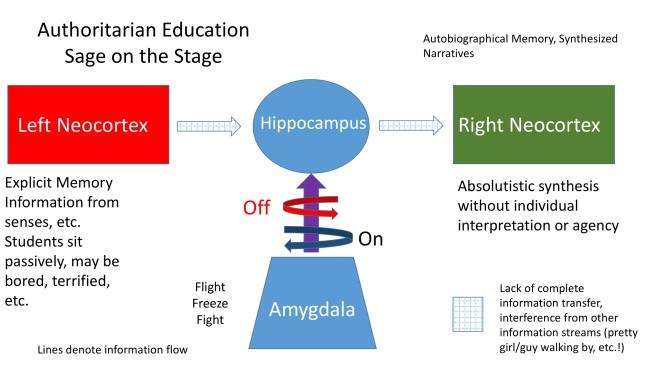
As stated in the Wikipedia article, Laggards also have an aversion to change agents — something that really smacks of Authoritarian thinking, and the metacognitive shrink wrapping that happens in these types of organizations.  Not knowing is a downer to personal status, and that means two things:  a collapse of knowledge to organizational borders, as well as a connected collapse in awareness.  If you need an example of this, one need look no further than the contemporary university.  When one considers the fact that the dominant social structure in universities today is rampant authoritarianism, with a collapse in shared governance, it’s no wonder universities fall further and further behind the needs of contemporary society.  A triple whammy of a non-empathetic social structure, coupled with a lack of more profound societal grounding (aka the Ivory Tower effect) and declining budgets (decreased energetics) does not bode well.

It’s worth the time to read through the Wikipedia/Rogers definitions written below and see how they support the v-Meme analysis above.

  1. Innovators – Innovators are willing to take risks, have the highest social status, have financial liquidity, are social and have closest contact to scientific sources and interaction with other innovators. Their risk tolerance allows them to adopt technologies that may ultimately fail. Financial resources help absorb these failures.
  2. Early Adopters – These individuals have the highest degree of opinion leadership among the adopter categories. Early adopters have a higher social status, financial liquidity, advanced education and are more socially forward than late adopters. They are more discreet in adoption choices than innovators. They use judicious choice of adoption to help them maintain a central communication position.
  3. Early Majority – They adopt an innovation after a varying degree of time that is significantly longer than the innovators and early adopters. Early Majority have above average social status, contact with early adopters and seldom hold positions of opinion leadership in a system (Rogers 1962, p. 283)
  4. Late Majority – They adopt an innovation after the average participant. These individuals approach an innovation with a high degree of skepticism and after the majority of society has adopted the innovation. Late Majority are typically skeptical about an innovation, have below average social status, little financial liquidity, in contact with others in late majority and early majority and little opinion leadership.
  5. Laggards – They are the last to adopt an innovation. Unlike some of the previous categories, individuals in this category show little to no opinion leadership. These individuals typically have an aversion to change-agents. Laggards typically tend to be focused on “traditions”, lowest social status, lowest financial liquidity, oldest among adopters, and in contact with only family and close friends.

What’s the takeaway from all this?  The first is that if you want an environment for innovation, you have to have an environment where Innovators and Early Adopters are comfortable and feel safe.  That means fewer titles, less status-based thinking, and an empathetic corporate/institutional culture. Books like more traditional texts like Arthur’s The Nature of Technology — What It Is and How It Evolves support this same premise at a more superficial level as well, with theories that new tech primarily comes out of combinations of old tech.  If that’s true, then the more diverse ideas one has on the table, the more potential combinations.  And then popping down to the deeper level of the Theory of Empathetic Connection, how people connect and what their social structure is Innovation Diffusion destiny.  The more populated your social structure is with Pioneers and Early Adopters, the more likely they can connect and create the innovations your institution needs to survive.

There’s one more thought to ponder in all of this — what kinds of communities do empathy really matter in?  Rogers’ Theory gives insights as well to the formation of titles and belief-based structures.  If things aren’t changing, we can add more and more verbiage to people’s salutations.  It’s a marker of where a company banks its innovation profile when they have a Director of XXX Innovation — and not a good one.

Takeaway:  Rogers’ Theory of Diffusion of Innovation dovetails perfectly with what we’ve been writing about on this blog as far as creating innovation environments.  The addition from our Theory of Empathetic Evolution is the need to emphasize empathy and duplex communications if you want to stay on the Early Adopter part of the curve.  The other big takeaway is to not attack your change agents.  They’re the ones scouting what’s coming next.  And in a world where ‘Next’ is always coming, you need them if you don’t want to end up in the Survival v-Meme.


Transgenerational Empathy –Adding Time, as Well as Space to the Empathy Equation

Taiwanese GrandmaMy 阿嫲阿公 (Grandmother-in-law), Taipei, Taiwan, 2011

There’s a tremendous video ad that is a must-watch for all designers and ponderers of empathy — a commercial for SoftBank, a Japanese telecommunications giant, about linking technologies for transgenerational communication between a family (with grandkids) in Osaka, and their parents in Tarama, a remote island in the Pacific in Okinawa prefecture.  The video is in Japanese, and apparently the technology shown in the video is not available commercially.  But it’s well worth the pondering for any designer about the temporal dimensions of our rapidly accelerating technological society, as well as our more traditional concepts of spatial/national separation defining what we call culture.  I’d even go so far to say that it’s a must watch.

The storyline of the video is the separation that the family feels is initially framed as spatial — Tarama is a long way, and multiple flights, from Osaka. But it also clearly paints the picture of technological/temporal separation of generations of a family. The youngers are obviously ingratiated in the modern age.  But the grandparents live in the world of legacy technology — they have a black, dial phone (picture below for those that don’t know what that means!)blackrotarygif2

from BoldOldPhones.com

as well as legacy technology, including a VHS tape player for their TV.

The company pitches solutions not yet commercially available across this transgenerational culture divide.  These include things like a Facebook post aggregator, that prints out for the grandparents an actual newspaper of all the posts; an automatic linear traverse height measurement pole with a CNC stylus to engrave the heights of the grandkids; and a QR code reader that is installed in their VHS Videocassette Recorder that immediately accesses the Cloud for the latest videos of the grandparents when they insert the cassette in the machine; and the rotary phone that when dialed, opens up a video conference on the old folks’ TV with the pertinent party.  It’s pure genius.

Of course, assistive technology for old folks has been around forever — and things like stair lifts, or smart homes, are continuing to ingratiate themselves in our daily lives.  But what’s awesome about this video is that it directly confronts the empathy/connection gap between old and young in our rapidly accelerating technological cultures.

We are used to framing cultures in terms of national identities and spatial separations.  But the reality of the globalized world is that these mental models are themselves becoming outdated.  My son is an anime’/manga buff.  Young people everywhere love Hello Kitty.  The Peanuts’ Snoopy is well-known in Taiwan, even though many have never watched A Charlie Brown Christmas One of the very real empathetic separations is temporal separation, and the idea of a modified culture under constant change is now profoundly generational.  Whereas it used to take hundreds of years for cultures to change and evolve, our new tech can create cultural gaps overnight.  Anyone remember Myspace?

For the entrepreneur, such tech opens up new market possibilities by expanding our potential markets to temporal culture separations. And for the educator interested in developing empathy across cultures, instead of flying people across the world to increase empathetic range, there are opportunities here for rational place-taking in our backyard. The obvious side-benefit of developed emotional empathy and deeper compassion are out there as well, waiting for us to act.  I also have to admit curiosity that there may be bio-social aspects of loss of ability to read faces across the different ages.  This may be a larger empathetic issue than we realize.

What has to change for this vision shift to occur is to remove the stigma from those that are, by virtue of age, falling behind the wavefront of tech. evolution.  I’m proposing a hackathon series that confronts this issue.  Any takers?


Maxwell’s Demons, The Pirate Pugg, and the True Nature of the Internet

Elephant drinking from pool

Scene at the Pool, in the Greater Kruger, 2008

One of the more interesting constructs in thermodynamics, and by extension, how we create information and meaning, which this blog is dedicated to,  is the concept of Maxwell’s Demon of the First Kind.  Maxwell’s Demon was a hypothetical construct, proposed by the famous mathematician and scientist James Clerk Maxwell, on how the Second Law of thermodynamics could be violated.  The Second Law is famous because it says “you can’t break even” when it comes to energetics.  If you do something, there’s going to be waste energy, and so you can’t get to some higher state of order without putting in some energy.

Temperature in a given substance, like air, is characterized by the oscillation of molecules inside some given space.  Maxwell proposed that if we had a closed container with two chambers, we could invent a Demon — some little dude, sitting on top of the box.  The Demon controls a door between the two.  When he sees a rapidly moving molecule, he shunts that toward the right chamber. For the ones that are moving slowly, he keeps them  on the left side of the chamber, and only opens the door if he thinks the cold ones on the right can move to the left.  Over time, the right side gets hot, and the left side becomes cold.

Maxwells Demon CroppedCourtesy Wikimedia Commons author この利用者は日本語母語話者です。

Maxwell proposed this as some kind of perpetual motion machine, and there are lots of debates you read about this thought experiment.  The simple argument against this being a perpetual motion machine is that the little green dude needs energy to operate the door, and as such, that energy has to come from somewhere.  So the Second Law of Thermodynamics — you can’t break even — is preserved.

This concept was picked up and used in one of my favorite books — The Cyberiad, by Stanislaw Lem.  It’s a part of the sophisticated canon of science fiction for geeks, and one of the most deeply insightful, as far as trends and meta-trends, of all the early science fiction books ever written.  It’s full of word play so math geeks can feel good about themselves as well (we need that now and again!)– though the book, written as kind of its own divine comedy, is much more profound upon multiple readings.

The plot of the book revolves around two meta-robots, called constructors, Klapaucius and Trurl, and their various adventures across the galaxy.  The general plot thesis is that Klapaucius and Trurl end up in a pickle, and then build some kind of infernal device or robot to get themselves out of it.  Lem explores different scenarios in AI, logic, and interestingly enough, societal development, with humor and insight, through these short stories.  My favorite out of all of these is “The Sixth Sally, or how Klapaucius and Trurl create a Demon of the Second Kind to Defeat the Pirate Pugg.”  On one of their trans-galactic adventures, our heroes meet the Pirate Pugg — a very different kind of pirate.  He is a pirate with a Ph.D., and instead of wanting jewels or gold, he desires only to steal information.  He captures the two, and holds them for ransom.  Klapaucius and Trurl even offer him a magical machine to create gold out of constituent atoms, but the Pirate Pugg is too smart.  He realizes that once he can create gold consistently out of anything, it will be worthless.

But information?  That’s a different story.  So the robot constructors, in order to free themselves, strike a deal with Pugg.  They set out to create Maxwell’s Demon of the Second Kind.  Different than our more simplistic Demon of the First Kind that only sorted hot and cold, this Demon was designed by our heroes to look into a box of foul air in an old barrel, and out of the infinite number of coalescing and diffusing patterns, pull out only the ones with meaning.  Our Demon of the Second Kind is also equipped with a pen nib, and a roll of semi-infinite paper.  Upon discerning the pattern, the Demon writes furiously (lots and lots of disconnected facts are scrolling by!) and buries the Pirate Pugg in paper.  Pugg has a thousand eyes, and as he is furiously reading all the little snippets of information, tangled in paper, our heroes make their getaway.

Lem_Doodle_4

from http://english.lem.pl/arround-lem/doodle, by Daniel Mroz (I think!)


What interests us today — to give you a glimpse where this is going with regards to Pugg, the Internet, and, believe it or not, empathy — is the idea of a Demon.  In particular, how would we characterize one?  Our First Demon sits up there, eating snacks, essentially coding out a binary sequence of hot and cold on top of his box.  That’s the lowest, and only level of information the Demon can parse out of this scenario, only controlling one box.  The time scales are short — the Demon has to be pretty fast to guess whether the molecule needs to go left or right.  And the spatial scales are down on the molecular level.

How about the energetics?  Well, those have to be pretty low, too, or we’re gonna have some problems with another famous law of physics — Heisenberg’s Uncertainty Principle.  That says when you try to measure something (like the temperature of a given molecule) you’re going to distort the measurement in direct relation to how much energy and time you put into measuring that quantity. I don’t want to get bogged down in the essential physics here, but the short version of our powered, snack-eating Demon is this:  he’s got to be quick, he’s got to be focused, and he can’t spend much energy on each individual molecule, or it will mess everything up.

Now we move up to our Cyberiad heroes, Klapaucius and Trurl.  They are desperately trying to deal with the Pirate Pugg, a most pernicious Pirate with a Ph.D.  He wants facts, and the primary thing about those facts is that he wants them to be true.  Similar to Maxwell’s Demon of the First Kind, which measures atomic oscillations and therefore temperature, Maxwell’s Demon of the Second Kind is grounded deep in reality. But Pugg, with his thousand eyes, wants lots of facts.  He’s not going to be happy with just the temperature equivalent of binary 1s and 0s.  Each of those eyes is self-pivoting, hungry for information, with the mental model of how we traditionally think of information — disconnected fragments.  How does that work?

Pugg Daniel Mroz

The Pirate Pugg, by Daniel Mroz for the original Lem text

“and little by little his hundred eyes began to swim and it dawned on him that all this information, entirely true and meaningful in very particular, was absolutely useless, producing such an ungodly confusion that his head ached terribly and his legs trembled.  But the Demon of the Second Kind continued to operate at a speed of three hundred million facts per second, and mile after mile of tape coiled out and gradually buried the Ph.D. irate beneath its windings, wrapping him, as it were, in a paper web, while the tiny diamond-tipped pen shivered and twitched like one insane, and it seemed to Pugg that any minute now he would learn the most fabulous, unheard-of things, things that would open up to him the Ultimate Mystery of Being, so he greedily read everything that flew out from under the diamond nib, the drinking songs of the Quaidacabondish and the sizes of bedroom slippers available on the continent of Cob, with pompons and without, and the number of hairs growing on each brass knuckle of the skew-beezered flummox…

And on, and on.  You get the idea.  Pugg, our Ph.D. pirate says he craves truth.  But what he really wants is data, with an emphasis on maximizing reliability.  Pugg, imbued from saw nose to tail with the Authoritarian v-Meme, is wildly, deliriously ecstatic with the efforts of his Maxwell’s Demon of the Second Kind.  He doesn’t care if there is no shared meaning– he’s an Authoritarian, and he gets to decide, in his own egocentric way, if the facts matter.  And there’s no one in that part of space besides himself anyway.

Because the Maxwell’s Demon of the Second kind is devoted to parsing true knowledge (or what we might call simplistically known knowledge) out of dirty air in a barrel, it is giving him this in the form of knowledge fragments.  These fragments map back to the social/relational empathetic structure (or lack of an evolved one!) with all its silos and lack of synergy extant in the modern academy, in Pugg’s brain.  Or in the case of Pugg, the post-modern academy, Pugg himself having been invented far in the future after all the humans are extinct.  That’s the thing about Authority-based relational structures — they aren’t designed to change.  Meet the new boss, same as the old boss.

Like Maxwell’s Original Demon, Lem’s Demon of the Second Kind has inherent temporal, spatial and energetic scales coded into its existence.  Time is short — the Demon has to be able to decipher a true fact in a micro-second, before the pattern dissolves.  Spatial scales are small.  The Demon looks in a barrel of dirty air.  That’s pretty constrained.  And finally, energetically, the Demon has some ability to judge the various strings of molecules.  But most of the energy is spent running the paper tape writer, which very quickly engulfs our Pirate with a Ph.D.

I had originally read The Cyberiad as a graduate student, upon recommendation of my office mate — Wayne Miller, now a Deputy Director of High Performance Computing at Lawrence Livermore National Lab, in California. I had put it aside in my mind until about 20 years ago, a period when I was doing environmental activism.  A friend gave me another book,  The Last Extinctiona collection of essays on biodiversity loss.  In the final essay by  David Ehrenfeld, one of the founders of the field of conservation biology, he compares the Internet to the Pirate Pugg’s Maxwell’s Demon of the Second Kind, saying if we think we’re going to find the answers on, or because of the Internet, we’re not.  We can get inundated with facts and information from all over the world, and it won’t make any difference.  It was — and is — a compelling argument to many, including myself at the time.  Like Pugg, in our modern age, we are buried in the paper tape coming from our Demon of the Second Kind.  We cannot extricate ourselves.

But it is a view that is deeply flawed.  We may still be screwed, extinction-wise.  With increasing population, biodiversity loss, and global warming, there are plenty of days where I’ve got that bad feeling.  But that’s not the Internet’s fault.

A better question to ask is why Ehrenfeld’s view of the Internet is what it is — and why that mental model of the Internet is still so popular.  Why does he think the way he does?  Ehrenfeld was writing this back in 1985, when the Internet was still in its infancy.  Almost no one had any inkling that the Internet would be what it is today.  Yet the notion of the Internet as facts, disconnected, and unable to provide meaning, flows naturally from the Authoritarian/Legalistic v-Meme set that Ehrenfeld occupies.  It’s what the v-Memes in his head say he HAS to say.  And the other idea — that those flows of information are what will provide answers because individuals with egalitarian access to those perceived knowledge fragments may act on them doesn’t even occur to him. From the viewpoint of those imbued with status from knowing ‘known knowns’ — where Ehrenfeld and most scientists occupy — individuals don’t have agency to make change.  It doesn’t even occur to him that there might be the possibility that other people, being informed might make a difference, or that even the low-level data itself would make a difference to endangered species.

As far as the collective mind of the Internet, which plays out in literally billions of ways on a daily basis, from a molecular physics discussion board, to Yelp, to real-time tracking of sea turtles, there is no conception. Ehrenfeld, himself a professor with a Ph.D., and compellingly, being a founder of conservation biology — a field wholly devoted to connections in nature — identifies himself as the anti-Pugg. Yet to him, there are no Demons that can be invented greater than a Demon of the Second Kind.

But Spiral evolution, mapped with Conway’s Law and the Intermediate Corollary, tells us that this not true.  We can’t know what we don’t know, and we’re limited in understanding what knowledge structures we ourselves can process by the complexity of the social structures, coupled with empathetic development, that we can comprehend.  In fact, we can be part of something bigger than ourselves and still not be aware of what the larger consequence is for aggregate intelligence.  That’s a function of our own empathy.  To use an aviation example, no one person can, any more, know every subsystem in a commercial aircraft.  But a large group of them, structured appropriately, can make one of the most complex systems available to mankind.

So — trust me.  There are higher level Demons.

What would a Demon of the Third Kind look like?  Our theory of Empathetic Development and Spiral Dynamics point the way. That Demon would collect data from off the internet, and process this data with a set of defined algorithms, generating useful meaning or validity. In fact, this happens in many forms today. In Alex Pentland’s book, Social Physics — how Social Networks Can Make Us Smarter he details the next transition in the v-Meme set of the cutting-edge scientist’s mind.  Pentland, himself a professor at MIT, discusses algorithms and applications that sample data (some of it real-time) and construct adaptive models for  sensing cities, how people pick restaurants, and how to predict stock market behavior. Pentland is busy creating Maxwell’s Demons of the Third Kind, differentiated from Klapaucius’ and Trurl’s creation, by watching the atomized molecules of humanity, running about their daily lives, and processing them through a combination of both algorithms and scaffolded heuristics, to give conclusions that are reliable (they can be repeated) and valid (the results actually mean something in the Real World.)  In the case of disasters, such systems could re-route individuals away from areas in crisis, as well as tell you which parts of a given city are going to be too crowded to get a table at your favorite type of restaurant.

We can go back to the scaling properties discussed earlier with these types of systems to understand how these Demons of the Third Kind have to work.  Most of the applications discussed in Pentland’s book, as far as being reactive, are temporal short-scale, and variable spatial scale.  Information can be collected from all over the country, but it’s typically knowledge fragments from a specific category that are collected.  Energetically, that’s pretty small.  And there are few connections, or modes of being, that are being processed.  It wouldn’t surprise us, once we understand evolution of sentience, for that to be the case.  Taking knowledge fragments and actually extracting meaning from them is a big step up from Pugg and his Demonic pet, whose only raison d’être was to bury the Pirate in paper.

But it’s still not very connected, or empathetic.  Connections in Pentland’s models are explicit, and only imposed by the rule set coming from him and his crew of experts.  And while he pokes and prods at the borders of empathetic understanding, there’s not a single time in the book he even mentions the word.  Not surprising, considering its relative lack of importance in his own social organizations, as well as the fact that he’s collecting points of data off of mobile phones.  Not much opportunity to judge the individual coherence of independent interactions.  He bases many of his beginning arguments on Kahneman’s ‘fast and slow’ non-empathetic thinking, regarding giving people agency.  Guess what — they don’t have much.  Pentland comes down on the side of impulsive ‘fast’ for most thought processes. But because of the fundamental fuzziness and uncertainty in the analysis, he can’t shake any way of classifying humans as connected networks other than lumping them into finer and finer demographic groups.

What that means is that there is plenty of headroom for the invention of a Maxwell’s Demon of the Fourth Kind. What would that look like? A Demon of the Fourth Kind might proceed with a base set of heuristics and look to larger behavioral trends to create deeper understanding of decision-making processes.  Such a Meta-Demon would have to be receptive to identifying emergent strategies — not just data trends — and show connections across social/relational classes.  One might step up from meaningful data aggregation with some kind of functional aggregation, looking at how networks react, and charting information flow.  It’s something to think about.

And if there’s a Demon of the Fourth Kind, it means that there’s a Demon of the Fifth Kind — the Internet itself. In the Internet, all sorts of people, information, groups, heuristics, and algorithms are integrated — from our Pirates Pugg to Daoist masters.  It functions at multiple levels, creating coherences and meaning that are at some level easily identifiable, like the best pizza joint in town, to the principle that school girls, no matter if they live in Nigeria or the United States, should not be raped and captured.  It embodies the empathy of the actors, because that empathy is intrinsic in the social networks that create at least part of it.  In the last week, it was the Internet that exposed beatings of partygoers in Iran, as part of another Islamic crackdown.  It also helped create Donald Trump as we know him.  Not surprisingly, for this particular Demon, empathetic and evolved in ways we can’t understand, timescales are long, and spatial scales extend out to near-Earth orbit, with tiny windows on the galaxy from the Spitzer Space Telescope.  Energetics are summed on a global scale.

I think it’s easy for people to comprehend the fact that the Internet stretches across the Earth.  But when it comes to seeking higher truth — that nested expression of validity, infused with reliability — we have to understand that time scales also are long.  We have a lack of self reflection toward our own personal evolution if we expect larger truths to pop up overnight, like whether or not Donald Trump should be president.  But that’s not the way that our Demon of the Fifth Kind can operate, and obey the fundamental laws of Thermodynamics.  It takes time for larger coherence to emerge out of chaos.

As far as whether our Maxwell’s Demon of the Fifth Kind will save the planet, I’ve got no definite answers.  If I did, it would demonstrate my own lack of metacognition!  And one must remember that Maxwell’s Demons — all of them — only create a given level of scaffolded truth that has to inform our actions.  Yet I’m pretty sure that it’s safe to say we can’t save the planet without it.

What’s Maxwell’s Demon of the Sixth Kind?  Now we start reaching into James Lovelock’s Gaia hypothesis.  The interested reader can pursue the Wikipedia article.  But I’ll stop here!  I’m just not enlightened enough to suggest anything past that!

Takeaway:  We are, of course, all Maxwell’s Demons.  Think about that for a while!  Bring snacks!


More Boeing Blues — or What’s the Long Game of Moving the Bosses Away from the People

lion sleeping

Sleeping Lion, Manyeleti Game Reserve, Greater Kruger Park, South Africa, 2008

I was over for an after-action review at Boeing two weeks ago, for a shared project with my students called the Boeing AerosPACE program, where virtual teams of students follow a gated design process to produce a small UAV as part of their final, capstone class requirement.  The review was fine — it’s always great to participate in a project with other, talented educators.  But the real news that was confirmed by my Boeing partners was that Boeing is going through another major cutback — somewhere between 4,000 and 8,000 management and engineering employees will be laid off, mostly in Washington State, ostensibly because of fierce price competition from Airbus. Reading through the various pieces in the Seattle Times like this one indicate that the folks at the top of Boeing in Chicago don’t seem to have any problems with South Carolina, and no jobs are planned to be cut there.  It’s only in the Puget Sound and the recently relocated folks from the Puget Sound, to Long Beach, CA, that have worries.

It all sounds so familiar.  According to Boeing leadership, Airbus (an international competitor) is kicking Boeing’s butt in getting new orders, and Airbus’ planes are good enough now that there’s no edge for monopolistic competition.  Earnings per share, as well as market share, are going to go down unless Boeing ‘does something’, which always means hacking away at their knowledge and relational infrastructure of high-priced employees in Seattle.  Commercial aircraft are supposedly a low-margin business, and as such, will be subject to the same forces as Tinker Toys and consumer electronics — doomed to move to places where labor is cheap (like South Carolina or China).  These are jobs that would be lost anyway, and if the people in Seattle have any expectation of a higher quality of living through knowledge and practice, well, they better wake up and smell the global competitive coffee. It’s all the neoliberal mental model we’ve been programmed to believe over the years, so we just accept it at face value.

And who can pull apart all the dire financial predictions, anyway?  Not the person on the street — or even empathy-wonky-junkie me.  You just gotta believe.

Fortunately, I have an e-mail pen pal inside the financial analysis community — Richard Aboulafia, vice-president and analyst with the Teal Group, whose paying job is to pull apart these arguments put forward by the aerospace corporate group, and figure out if they’re telling the truth.  In this piece in Forbes, he argues that they’re not.  And there are plenty of knowledge structure signs that they’re either unaware, or fibbing.  BCA CEO Conner is making his persuasive argument for job cutbacks not on data — but anecdotes — which is a typical belief-based mode.  He pitches hard the story from EVA Airlines, the national Taiwanese airline prone to Hello Kitty paint jobs and pillows (I know about all of this because of my Taiwanese wife, who is a loyal customer), who were ready to bail from Boeing to Airbus, and tells the public in this article by Dominic Gates in the Seattle Times. “That’s our reality” says Conner.  The question is more simple than that — is Conner’s reality actually reality?

Hello Kitty Airlines

Hello Kitty Boeing 777-300ER, providing service between Taipei and Paris, credit EVA Airlines website.  Most of the Hello Kitty flights are between Taipei and Asian capitals.

Aboulafia lays out the data succinctly. From his piece,

The problem is that the plural of ‘anecdote’ is not ‘data.’ Conner’s notion of lost market share is simply not supported by reality.  Last year Boeing delivered 762 jets worth over $60 billion, while Airbus delivered just 635 jets worth $43 billion.  In terms of market share by value, that was BCA’s best performance since 2002.

Orders have been strong too, with 868 received last year. While Airbus scored 1,139, a higher percentage of Boeing’s orders are for more expensive twin aisle jets, meaning a much closer ratio. Also, so far this year Boeing has brought in 107 orders, while Airbus’s net total is just 11. While BCA’s profitability declined last year to a 7.8% operating margin from 10.7% in 2014, much of this was due to an $885 million pre-tax charge on the troubled 747-8 program.  And of course these margins are considerably higher than Airbus’s.

Best of all, as Muilenburg noted, the company’s backlog is extremely robust – 5,758 jetliners. This, too, undercuts Conner’s notion of price pressure as a chronic problem. 

Aboulafia goes on to destroy BCA’s Conner’s argument about aircraft orders, noting that the company has a backlog of orders out at least 7.5 years, at today’s pricing.  And what does that mean?  Last year, Boeing Commercial had the best year it’s had since 2002 as far as making money.  Why would Boeing want to spook investors with talk of a price war, when there really isn’t one?  There’s normal competition, and BCA will need to innovate.  But what about the long-term damage to the organization, from deleting managerial staff, needed to help transition product lines?  Why is Conner doing this, cherry-picking facts to support what could be a layoff of 10% of company staff in the Seattle area?

And what about the long-term damage to Boeing’s reputation in Washington State, that has consistently ponied up tax cut after tax cut just to keep these jobs?  How do you get to be Dennis Muilenburg, the current Boeing CEO of such a large part of our global economy and have that failure of vision?  You can track his career here.  One might point to signs that someone like Muilenburg might be untethered from the civil aviation sector. His career path went up through the defense ranks. But there’s lots of global developmental overlap with coordination with Boeing global services and such that Muilenburg oversaw. If anything, this shows that relying on understanding the mind of one individual in such a large organization — even if that person is the CEO — is a flawed path toward predicting what the person would do.  When Muilenburg replaced Jim McNerney, whose past career path had led up not through making planes, but making Sticky Notes at 3M, many people I knew breathed a sigh of relief.  Finally — a CEO that knew how to build planes.

Yet the path that Harry Stonecipher, former McDonnell Douglas CEO started, and followers like McNerney kept the company on still continues.  And to understand that, one must look for different understandings.  We’ve been raised here in the U.S. that the leader and the money are everything — that Conner, McNerney, and Muilenburg all must be doing whatever it is that they’re doing to maximize the bottom line.  But what does it mean if they’re not, on any time scale?  Boeing is simply too large for anyone to consider as an acquisition target, so the notion of gutting 8000 jobs to make the company more desirable to sell doesn’t make sense.  And no one’s talking about breaking up the megalith and selling off parts, a la Carl Icahn. Even if it were possible, Boeing itself demonstrated, with the 787 program, what happens when you de-verticalize your production chain.  You end up with disaster after disaster that pushed the 787 launch back by 3 years.

The only way you can understand what’s going on is through looking at the underlying social structure of the transition Boeing underwent when Boeing and McDonnell Douglas, merged with a stock swap in 1997. Up to that point in time, Boeing had mostly made airliners, and McDonnell Douglas had made fighter aircraft — two very different kinds of aircraft.  As we’ve discussed before on this blog, commercial aircraft have to maximize validity of multiple modes (design through construction through operation) of the company in order to perform. It’s a complex systems coordination problem — getting a couple of million parts to fly through the air over Greenland, land in Amsterdam, take on a tank of Jet-A kerosene, and turn around and do it over again.  No commercial aircraft makes money on the ground, and everything throughout the life cycle of the plane is designed to keep that $200M investment in the air.  Something gravity is not fond of.

In order to pull that off, Boeing (or at least the commercial division) had to evolve socially. Though Boeing Commercial is largely a Legalistic/Performance-based hierarchy, intertwined as it is with the FAA, its people are connected and interact with people all over the world.  There’s hardly a country on the planet with a national airline that doesn’t have a couple of Boeing airplanes.  I have former students who work in aircraft delivery, and that involves ingratiating yourself in whatever culture so that when you get in the plane and drop it off in Dubai, you do the right thing.  It’s a big deal. Boeing has multiple unions — even ones for engineers — that empathetically scaffold that global outlook (in a union, the folks on the floor have no problem talking up, as well as sideways, because of job protections,) and it’s no surprise that such a social/relational structure, and level of empathetic development, would create a very different problem-solving mindset than a defense company.

How would an aerospace company primarily dedicated to defense function?  Military aircraft are fundamentally different in scope than commercial aircraft.  Instead of validity across a broad system of concerns, military aircraft have really only one — the ability to not get shot down while executing whatever their respective  mission is. Not surprisingly, military aircraft adopt new technology far earlier than commercial aircraft (check out this Nazi flying wing if you don’t believe that) and are often poorly scaffolded when it comes to things like maintainability and such.  Getting 1% greater performance often relies on relatively rigid design hierarchies with algorithmic design processes.  And while there are examples of independently generated relational dynamics in military aircraft (I write about the SR-71 Blackbird here), this is usually the exception, not the rule.  It’s Authoritarian power structures all the way.

What happens when  Global Communitarians (the old Boeing Company) and old-school Authoritarians (McDonnell Douglas) combine?  We’re all engineers that love planes, right?  Though I’d argue that it’s not always the way the cookie crumbles, it IS the way the cookie crumbled this time.  The Power and Control group got the upper hand.  McDonnell Douglas was the Alien inside the host, with its corporate culture seizing control of the Boeing Company.  With an Authoritarian v-Meme sub-culture at the top, and a healthy demand for aircraft in the global market, there’s not much the communitarians COULD do — even if cooperating and collaborating would make more money for Boeing.  Because it’s not about the money.  It’s about power and control.  The  Authoritarians would honestly feel is likely be embarrassed if they were wrong and Boeing made more money by being kinder to its workforce.  That would be a major v-Meme violation.

The reality is that Boeing Commercial Aircraft (BCA) only has one real competitor for the near future — Airbus — though other companies like Bombardier and Embraer are attempting to nip at their heels. That’s a low competition market.  And as long as BCA can do better than Airbus in the short term, that’s good enough. Boeing also has enough higher-order social structures, like its unions, laid in so that its planes are unlikely to start falling out of the sky any time soon, which would also drive change from external societal pressures.

And the other problem is that BCA’s culture is emergent — it wasn’t designed with forethought to keep planes in the air at all times. It evolved.  That means that without major reflective exercise, there’s an ability to have consistent failure of understanding in leadership about what makes Boeing work — and that’s this complex, emergent social structure.  It’s not even a thought that is out there very often. Though I’d be happy to be proven wrong, no one writes about the larger collective intelligence/social dynamics in aircraft manufacture except me.

What was the critical stroke in the entire equation that really sent the Boeing Company down its path to current misery, besides its merger with McDonnell Douglas?  I’d argue it was the decision to relocate corporate headquarters to Chicago in 2001. Relational distancing was even stated by then-CEO as the reason!  Before 2001, there was the deeply grounding effect of having the corporate offices across from Boeing Field, and the overlap should not be underestimated.  Executives simply couldn’t cloister themselves from the reality of aircraft design, production and delivery.  You would run into the whole mix of people who built those planes, and the complexity would ground the executive corps on a daily basis.  They would have to be exposed to what made the company work, whether they liked it or not.  No Synergistic Stooge Effect — or at least one dramatically attenuated.

And when you put Authoritarians in charge of a Global Communitarian company, essentially people with fragmented, status-based thinking style in charge of a bunch of interconnected folks making highly sophisticated systems, relational destruction AND depletion of social capital has to happen.  First was the decision made in 787 construction to globally outsource important core components, like the main fuselage to Alenia, that resulted in the various rivet and rivet hole fiascos.  Relocation of facilities to South Carolina, all in the name of making more money followed, of course — that’s the mental model that sells in the U.S. Following that was the long attack on the various unions with pension replacement and such — shortening the empathetic timeline of what used to be a big vision company.  Deletion and cannibalization of research efforts have followed — McNerney, when CEO, even proudly trumpeted this.  And the latest attack on managers, largely the cohort who possess the social capital to facilitate the large-scale transitions that will be needed as Boeing phases in new product lines, like the 737-Max, or the 777-X, are exemplars of the Authoritarian overmind working to assure its v-Memes spread throughout the operation.  Even if it’s not the way you develop or build complex, integrated systems that can’t fail.  Those managers are a threat to the Authoritarian mind — even if the Authoritarians are unaware of it.  They feel it in their bones — or in their impulsive limbic systems.

It’s also no surprise that this comes on the heels of sending Boeing Services south to Long Beach.  I’ve worked with the people in that organization, and if there were ever a bunch of data-driven global thinkers, it rested there.  They’re the folks in charge of making sure any plane stuck on the ground, no matter where, is back in the air as quickly as possible.  On my tour of the command facility, filled with news streams from global news organizations filled multiple screens overhead.  It turns out the folks in Seattle were more likely to learn of an emergent problem by watching CNN than waiting for a phone call.  How’s that for pragmatic, data-driven decision making?

But the v-Memes said they had to go.  And so they went.

The problem with all of this relational disruption, which should deeply concern our national government, as well as investors, is they can’t keep this up and expect to make money, or innovative aircraft, over the long haul.

But that’s really a minor problem compared to the Big Enchilada.  The commercial aerospace industry has to innovate, or they’re going to destroy the planet. The number of passengers will double, according to the FAA, and that additional CO2 load has to be managed.  That will not happen without breakthrough innovation social organizations.  And the creativity to drive that innovation is going to depend more than ever on empathetic development.  I’ve had conversations with industry leaders, and they’ll all tell you they’re deeply worried.  Because that complex relational development/higher responsibility/empathetic connection thing really is true.

There are no easy answers here.  Boeing and Airbus are both large, transnational corporations — one through emergent dynamics, and the other through contracted agreement and design. As a transnational actor, Boeing has demonstrated over and over an impunity toward acting in good faith toward anyone at the state government level or below.  And even the federal government hasn’t done such a great job — the pervasive corrupting, influence of corporate money in politics in general, and defense contracts in particular, keeps getting demonstrated time and again.

But even though answers aren’t easy, they’re something that have to be sought, especially in the light of understanding how manufacturing, hooked with production, creates the larger empathetic mind.  Offshoring manufacturing, as we are realizing a bit too late in the U.S., besides creating economic dislocation, also disrupts the larger social/relational structures that manufacturing creates.  In any manufacturing operation, independent egalitarian relationships have to thrive, if only because of the Deming revolution that inverted the hierarchy of production and gave the individual on the shop floor the ability to stop the line when production went bad. That creates an information sharing culture that fuels empathy.  And those effects are felt far away from the source.  Donald Trump, anyone?  If there’s any solution for Boeing, though highly unlikely, it involves moving corporate back out of the boardroom and to proximity with manufacturing.  Marveling over the complexity of building commercial aircraft, as well as talking to the lunch bucket crowd, is good for the executive soul.  And we’ve got to hope it also rewires their brains.

Further reading:  One of my favorite Howard Kunstler books is ‘Home from Nowhere’, where he discusses the effects of built architecture on community development.  He makes a persuasive case that our current restrictive zoning, that disallows adjacency between the lower and upper classes, is a huge part of our collective empathy deficit in the U.S.

Others in the aircraft/airline industry also have concerns and recommend customer focus and empathy.  Read here for another two analysts’ perspective.


The Theory of Everything and Multi-Scale Analysis

Cap'n Bob

Cap’n Bob and Yours Truly, in the Whitsunday Islands.  Cap’n Bob gave me the immortal advice, when I was up in the rigging about 30′ off the deck.  “Ya won’t fall off if ya don’t let go!”

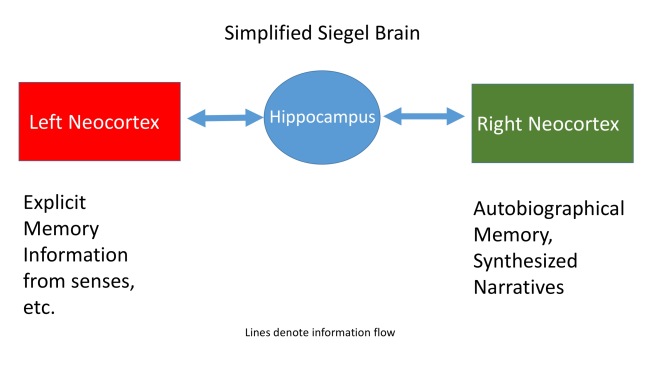
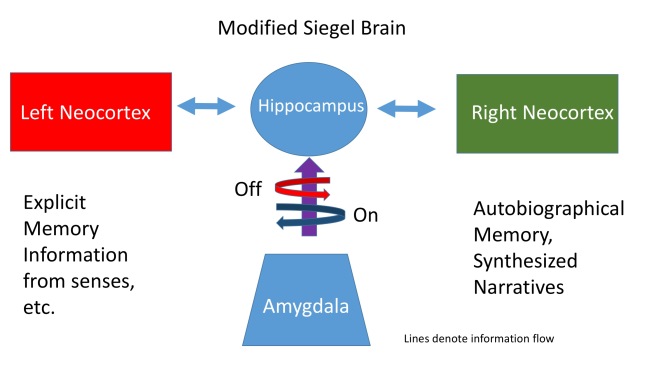
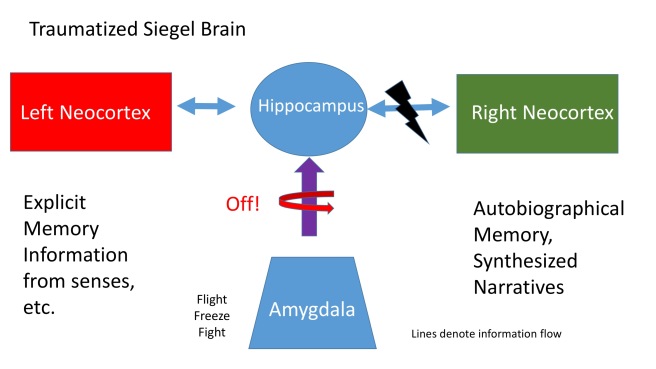
I’ve been listening to (and have almost finished) Daniel Siegel’s audio discourse, The Neurobiology of We.  For those folks that seriously read this blog (Sela Hocker– this is a shout-out to you!) it’s worth the eight hours of talk time to hear what Dr. Siegel has to say.  He’s a super-famous psychiatrist, a holistic thinker, and a key person in the evolution in the field of interpersonal psychology.  Like me, he’s attempting to link a series of insights together on how the holistic mind works.  And also like me, he likes the ‘blind men and the elephant’ analogy.  If we have a difference, it’s that Siegel, who interestingly enough goes by “Dr. Dan” — very similar to my “Dr. Chuck” — focuses more on the smaller, more individualistic and neurological scales of the Theory of Everything.  As a psychiatrist, he wants to treat people and help them get over their trauma.  So for him, he’s recognized that there’s an elephant, and then crawled up the elephant’s nose and spends a ton of time poking around the elephant’s brain figuring out how the elephant connects to other elephants on an independent elephant level.  That’s a lot of elephants!

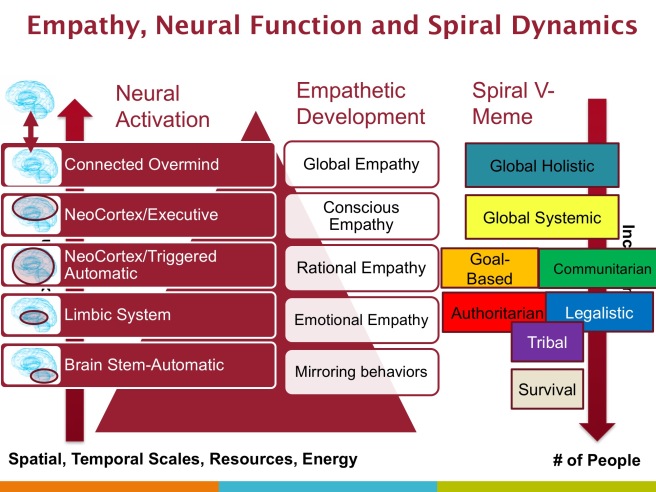
I’m one hour away from finishing the entire eight hours, and he’s deep into individual processing and the role of emotion in integrating experiences.  His goal is pretty obvious — it’s focused on understanding how to help people heal and be happy.  Which is great.  And he distills that down to his concept of ‘Mindsight’ — which is in reality, just an integrated version of my Empathy Pyramid.  I’ll write more on that in another post.

Dr. Dan’s analysis of brain science is excellent, and if you’re into that kind of thing, you’ll love his explanations.  They’re a great curation of the neuropsychology research.  Dr. Dan makes sure he weeds out the stuff by holding up the research work to structural and functional bars — he makes decisions about what to believe with a validity- based lens. Does it work, and actually describe the various observables?  It’s refreshing, and different than just trusting the data.  And while he does talk a bit about complex systems theory (he’s not an expert in this by his own admission) and gets a little sideways with some of the paradigms, he should be forgiven.  As someone playing in the neuroscience field, I’m also grateful when those specific practitioners grant me some deference in my unintended abuse, or more generally omission of certain concepts.

Where does my work fit in with Dr. Dan’s stuff?  Remember– he’s figured out there’s an elephant, and he’s spending a lot of time with his flashlight inside that elephant’s brain.  I’m the guy that realizes that there’s an elephant, and I’ve got a casual understanding of the brain inside the elephant’s head — as well as basic map of the three parts of that brain. I do realize that all the parts of the elephant’s brain are hooked in some form or another to all the other parts, because I bring in an evolutionary perspective.  Things had to evolve, and that means that they have to be hooked together.   We didn’t just get a huge neocortex overnight.

(That’s a huge advantage, because a lot of contemporary neuroscience is dedicated to the proposition that each little part of the brain is segmented off, with limited communication ability, from every other part of the brain.  That’s a direct reflection of the Authoritarian/Legalistic social structures that form the scientific community.  In order to be noticed, everyone’s got to claim their own little piece of turf.  No holism is allowed!)

And then, I hop on my flying saucer and take off.  And look down at a herd of elephants — not just one.  And that this herd of elephants is structured differently than other herds — all herds are not created equal, nor do they act equally.  And because of that, the dynamics created by that social structure create different brain wiring inside different members of that herd.  Which then affect how their offspring’s brains are wired, through things like epigenetic phenomena, that can fundamentally affect the individual elephant’s genes.  And then I bring in the concept of self-similarity — propagation of patterns up and down the various scales (the elephant’s genes, neural wiring, personal affect with other elephants, social structure, elephant culture, and finally interaction with the elephant ecosystem) are going to be resonant.

Enough about elephants.  Though I DO like elephants!  Here are a pair that I met about 8 years ago!

Elephant nursing

Mother and child, Manyaleti Game Reserve, Greater Kruger National Park, 2008

So that leads us to a better, modified version of the Theory of Everything.  If we want to understand how an individual thinks — not just an organization, or what they will do, then we’ve got to move past my first version:

Culture + Social Structure/Empathetic Development = Behavior

And we need to add a couple more things into the mix:

Culture + Social Structure/Externally Promoted Empathetic Development + Individual Experience (Trauma Included) + Independently Generated Empathetic Development (level of mindfulness) + Epigenetic Influences + Genetic Disposition = Individual Behavior

We’ve covered each of these subjects individually.  Now we have a complete multi-scale roadmap of the information space that all sentient beings (not just humans!) operate under.  This roadmap starts at the chemical and cell level (epigenetics and genetic material, which then manifests as neurophysical structure), moves up to the individual structure level and experience (individual experience and independent empathetic development), then on up to the organizations one participates in (social/relational structure) and the larger culture an individual operates in.  Of course, these things are all bound together — remember the ‘elephant wrapped in spaghetti’ when we were talking about addiction?  ALL of these parts of the various elephants have connections and influences up and down the scales.  Hardware, firmware, software — there are lots of metaphors that we can use to understand this.

As we’ve discussed before, genetics can and does limit expression and speed of development.  But the path of sentience, and emergent organization guides all.  Even if, as the larger collective intelligence, racing down that evolutionary path, can only see past the end of our noses.

Further watching:  Besides listening to The Neurobiology of We, for those who are still skeptical and insist that this stuff  (like social structure and its effects) only applies to humans, I’d encourage you to watch the National Geographic special on stress.  The interesting part for me was the baboon before-and-after an epidemic.  A priori, a group of baboons were run in an authoritarian fashion by a bunch of bully baboons.  All the baboons suffered. Then a plague killed off the leadership, and a more tribal/ potentially communitarian structure popped up.  Overall health rose.


Quickie Post — Donald Trump, Narcissistic Authoritarianism, and Knowledge Fragments

iPhone Jesus

In front of the main cathedral on Plaza de Bolivar, Bogota, Colombia, 2014

I really don’t want to get bogged down with politics on this blog too much.  But every now and again, a piece comes rolling along that’s so close to the heart of the material of this blog, I can’t pass it up.

So it was with this piece by Neal Gabler, titled Why Donald Trump can lie and no one seems to care.  Gabler attributes much of Trump’s appeal to what we’ve discussed as confirmation bias in the electorate — Trump lies and changes his story about many things many times. By doing so, he finds something that plugs into everyone’s story that lets them identify with what he has to say.  We naturally skim over most of what he says, living as we do most of the time in our own distracted, impulsive minds.  When he says something that sticks, it reinforces our already extant mental models of the situation.  By broadly traversing the knowledge space, Trump uses his “sea change antennae” to score more wins than the other, more rigid and consistent Republican candidates.  And by doing so, he gains allies.

Which is, of course, what narcissists do.  I really recommend checking out my previous post on this here, and the effect of hyper vigilance and that super radar.  This lets individuals with these disorders quickly pick up on what people think they need to hear, and use that lowest level of empathy — mirroring behavior — and send it right back to them.  I wouldn’t be the first to call Trump a dyed-in-the-wool narcissist. But that’s not what’s so interesting about Trump’s rise in the polls.

What’s more interesting is what Gabler calls “The Winchell Effect”.  From the post above, here is a great quote that describes it:

“Walter Winchell, about whom I wrote a 1994 biography, was a hugely popular New York-based gossip columnist for the Hearst newspaper chain and an equally popular radio personality, although saying that is a little like saying that Michael Jordan was a basketball player. Winchell was thegossip columnist, with an estimated daily audience of 50 million. He practically invented the form, and the form was a long chain of snippets — rumor, prediction, innuendo — racing down the page, separated by ellipses.

Some of these snippets were scarcely more than a noun, a verb and an object: Mr. So-and-so is “that way” about Miss So-and-so. Does her husband know? In this way, Winchell became not only the minimalist master of gossip but also, quite possibly, the first tweeter – before Twitter.”

The Donald is definitely a modestly Performance-based Authoritarian.  And he’s mastered a similar speaking style.  No long-winded diatribes — only short knowledge fragments, straight out of an Authoritarian Conway’s Law mapping — that alludes to a better, higher v-Meme Performance-based view of the world.  To steal from Nike, Trump repeats over and over again “we’ll just do it.” And for a nation with increasing fragmented social spaces, and increasing Authoritarian methodologies on both the Left and the Right,  that narcissism thing, combined with knowledge fragments with memetic-viral potential, lets him hit the mark.

I wouldn’t want to deny Trump his own agency, that at some level, he is responsible for his actions.  But it would be great if we would own up to a greater understanding that Trump is also an emergent phenomenon of our own social structure.  And upon realizing that, love ourselves enough to get busy with the hard work of repairing our own grounded social/relational empathetic networks that more accurately enable us to seek the truth.

Takeaway:  Narcissists can hack elections in representative democracies using their super-sensitive antennae to pick up on memes that are resonant in their constituencies they are courting.  Agile narcissists — ones with no problems lying, able to speak to different constituencies in an electorate, and skilled in using knowledge fragments/sound bites — can use confirmation bias in receptive audiences to secure disparate constituencies.  When the majority of politicians are operating under old systems of beliefs that are in conflict with some level of data-driven thinking in the constituencies they are attempting to secure votes from, the narcissist has a huge advantage. Old-time reliable messages are no longer valid, and the narcissist can exploit this to his/her advantage.  

Narcissists can lie any way that is persuasive.  But the electorate is left, unfortunately, only with the truth they experience.

Back to Basics — Empathy, Metacognition, and Managing Uncertainty

Guangzhou Jade Market

Guangzhou’s Jade Market, 2010, Guangzhou, China

Every now and then, I have an ‘Ah Hah!’ moment that makes me realize that while things may seem entirely consistent to me (or those damn squirrels in my head!) they may not seem so obvious to my readership.  There’s a famous (likely apocryphal) story about a mathematics professor teaching a graduate class.  He’s scribbling like mad on the board, and then turns to his class between steps of a proof.  He says “it’s obvious that XXX follows”, then turns and looks at the two steps.  He then exits the room, returning 20 minutes later, and says, “Yes, it’s obvious,” and then continues writing.  Another famous cartoon by Sidney Harris captures this as well:

miracle

Such was the moment I had earlier today. I was forwarded this opinion piece on the importance of art and poetry in managing uncertainty, written by Tod Marshall, the most recently named Poet Laureate of the State of Washington.  It’s really highly recommended, as it gets at the core of much of what I explain in a more systematic fashion, and that is the role of modern society in fragmenting us, as well as the importance of art in unifying our vision, increasing empathy and connection.  While I’ve emphatically maintained that education in literature and the arts alone is not enough to create empathetic individuals (years of observing sociopathy across the various disciplines at the university has convinced me of this, as well as the fact that there is no substitute for empathetic connection and its practice) there’s also no question that art and literature can expand us empathetically, once that groundwork is laid.  Or in the practice of learning together, we can be profoundly transformed in our ability to connect.

How does that work?  Lower level empathetic relational structures — those that exist mostly in the world of titles and beliefs — have a natural tendency to exclude asking questions about what else is out there.  Authoritarian structures are very bad in particular, as whenever one gets up and admits a lack of knowledge, that person suffers a loss of status.  Over time, such structures see metacognitive shrink wrapping — an inability to know what you don’t know, as well as cultivate an awareness of what is unknown out there — those ‘known unknowns’, as well as the ‘unknown unknowns’.  That loss of appropriate mystery is anathema to empathy for those different than you, and inevitably gives you angry, judgmental gods.  Before you know it, you’re sacrificing 40,000 people a year on an altar just to make sure the sun comes up every day, or burning witches at the stake.  Not very empathetic.

Higher, more developed empathetic relational structures encourage metacognition. You don’t know, but since you want to get to a goal, you can work to find out (Performance/Goal-based Thinking).  You’re going to work with a diverse group because you’re all going in the same direction.  Or you don’t know that stranger, but you can read them and figure out whether they’re friend or foe by analyzing their face, or their body language, because we’re all humans after all (Communitarian Thinking).  As you develop, you become more comfortable with the idea of knowing that you don’t know stuff, and that means you also become more comfortable with uncertainty.  The two are intrinsically paired together.

There’s deeper scaffolding involved than just that one connection.  The more empathetic you are, the broader network of people you’re able to assemble in your life.  That means you’re also able to deal with greater contingencies, because you have access to a broader knowledge base.  Uncertainty doesn’t bother as much, because you know someone who probably knows.  Your car won’t start?  You have a friend that knows what to do.  That’s gotta help your fundamental Survival and Safety needs.

You’re also able to understand the different social structures and the behaviors they generate.  That’s gotta help with overall predictability when you see behavior that is unfamiliar to you.  If something unusual pops up, you can relate it to something you’ve seen before.  That brings us back to art and literature — by placing different situations with different people in context, we can amass a greater body of shared experience than one person can in one life.

And that empathetic development also leads to a fundamental element of human development — the ability to trust others.  And not only that — you can also trust yourself.  You can only get that through development of personal agency, which then also involves the higher, more empathetic social structures that enable this kind of development.  Which then circles back around to the more- or less- empathetic.

But if you’re locked down in a fundamental incuriosity of one In-Group, you’re going to suffer.  Things unfamiliar are going to be scary.  Things uncertain are going to be threatening.  People with different, more difficult-to-read faces are going to be suspicious.

And now, hopefully, we can see that this ties back to a lack of larger empathy.  When you can’t connect, you’re gonna be alone, and your genes are going to tell you a lion is going to eat you.

So… it’s obvious.  🙂


Proving the Value of Diversity — “The Difference”

Downtown Guangzhou

Guangzhou, 2010, before a large sporting event I can’t remember!

Scott Page is a professor at the University of Michigan, Ann Arbor, and author of The Difference: How the Power of Diversity Creates Better Groups, Firms, Schools, and Societies.  Page is a researcher, like me, in collective intelligence, and a skilled statistician and mathematician.  In The Difference, he set out on a truly massive task — how does one prove mathematically that diversity makes a difference?  We’ll discuss his argument in this post, and then also note that Page is also extremely self-reflective.  He spends the last third of his book, dedicating it to getting a handle on how much really can be known and proven with this question.  It’s a great book, and for a book with pretty formal mathematical proofs, it’s actually pretty readable.  I’ll summarize the main arguments, which highlight both the strength of the argument, as well as how any absolutistic argument is not just limited by the decision space you exist in, but also limited in evolutionary direction.

Why do we need to prove diversity works in the first place?  On a broad scale,it would seem that the benefits of diversity are obvious.  Having excluded out-groups in any society can cause chaos.  Integrated wholes and shared common purpose are good for nations, not just companies.  And even with the unsupported (and wrong) belief that companies that pursue diversity strategies are ‘taking one for the greater good’, one could still argue for societal benefits.  I made the argument here that team diversity actually makes us more creative and rational on a deeply neurogenic level, so I’ve staked out my position on this issue.  What we’re going to explore in this post is how Scott’s work on diversity meshes with mine — and how in these larger questions we attempt to balance reliability of knowledge with validity, and evolutionary path.

The way Page goes about proving diversity (roughly) is this.  Every person on a team brings some unique talents to the table.  These talents can be summarized as a point, or more appropriately, a bounded knowledge fragment, in the knowledge space of heuristics.  I gave a more formal (and nuanced) definition of what a heuristic is a couple of posts back. In Page’s argument, this is boiled down to a solution and a direction on the larger map of what mathematicians and engineers call an optimization problem.

What’s an optimization problem?  Let’s say you’re out hunting in hills and valleys on a landscape.  You know that if you get to the top of a hill, you’ll be able to see further.  You continue to search around your piece of ground until you find the top of a hill.

But what if you were on a diverse team, with different perspectives?  They might have a different piece of real estate, or a different method of getting to the top.  If the two parties got together and compared their solutions, the odds that they’re going to get to a higher piece of real estate is going to go up.  Getting people who have exactly the same perspective won’t do much for finding new things, or improving an old solution.  But with diverse perspectives, you’re much more likely to get to the highest hill in the neighborhood consistently.

Page goes on to rigorously prove some very interesting results:

  1.  In a group, aggregate diversity trumps individual ability, provided the problem is difficult ( no one person knows all the answers).
  2. Having individuals learn diverse perspectives themselves helps overall in understanding how to solve problems.
  3. Individuals may make bad choices, but overall, crowds are wise.  That’s why someone always guesses the number of gum balls in huge jar at the fair — or why it’s almost impossible to consistently beat the stock index when picking stocks.

There’s more in there, along with some great reflection on the limits of diversity.  If you have no expertise, but lots of diversity, you’re still going to have a bad solution that comes out of your process.  Yet while it’s important that someone like Page steps forward to come up with a rigorous proof of some of these concepts, lots of stuff that happens in real life gets left out.

So what insights can we get from our Theory of Empathetic Connection, and how does it inform expansion of Page’s work?  The first part we have to start with is the very basics — where does Page’s work sit on the v-Meme scale?  And how does that influence expansion, reliability, and validity?

To start, any rigorous proof is going to sit squarely in the middle of the Legalistic/Absolutistic v-Meme set.  You’re showing something, with a set of carefully prescribed conditions to be true or false.  That’s not a shades-of-gray kind of deal.  What that means is that reliability is a given — you prove it once, you can prove it again.  That’s a standard for publishable work, and a core element of what the academy is supposed to be known for.

But it also imposes v-Meme restrictions, not obvious on the surface.  To start, it means that the heuristics referenced must either be represented as a self-contained knowledge fragment, or an enclosed algorithm.  What does that mean?  The heuristics brought to the table need to objects to be moved around as part of the argument.  If we are trying to find an answer, either Party A has the path, or Party B has the path.  When they get together in a diverse environment, at any given time, one or the other has the answer.  One or the other has an answer that is more optimal — or MORE RIGHT.  By combining their efforts, they’re more likely to be a success.  But there’s never any knowledge synergy in the context of how they go about seeking jointly the answer.  There’s no empathy in the process of solution, and that has major effects on understanding the validity of the result.

How do humans in diverse groups (or any group) actually work together? Usually there’s a larger meta-heuristic (like a design process — the NASA/Ulrich and Eppinger one, or OpenIDEO) that guides larger actions by the group.  Inside that (let’s say everyone’s working in the preliminary design phase), group members may meet for lunch, and discuss what they need to do next.  One person — Bob, has an idea about how to proceed.  He enters into a more involved conversation with another person in the group — Lisa.  Lisa has some thoughts/heuristics of her own.  They start discussing between the two — let’s say they’ve built up a trust-based relationship, and while having similar competencies, don’t share exactly the same background.  They synthesize a shared heuristic that may include elements from both individuals’ backgrounds, and decide how to share information.

Now the shared heuristic doesn’t look at all like an either/or situation.  It may settle mostly around Bob’s ideas, or mostly around Lisa’s.  And maybe the way that it settled was Bob wasn’t feeling great, or had a softball game he wanted to go to.  Maybe Lisa felt sorry for him, and decided to share the larger burden of work.  There are an almost infinite number of possibilities that could exist to create that new, shared heuristic.

But there was likely one moment — and this is not trivial — where, in the discussion, either Bob or Lisa switched, and changed their mind about either part, or all of the developed plan of action.  That impulsive, unpredictable part is key.  Because it is in that unpredictable moment that whatever the process for combining plans, or in our parlance, developing a shared heuristic, our system of meta-linear aggregation of information — picking either Bob’s heuristic, or Lisa’s heuristic — transformed into a meta-nonlinear problem.  And by transforming into that meta-nonlinear process, any hope of rigorously proving anything just went out the window.  Proving something for nonlinear systems is infinitely more difficult than for linear systems.

Yet the validity of how I described the actual process went way up.  Anyone participating in a design team knows that tasks get parceled up, and depending on the difficulty of the unknowns, or more formally, the metacognitive space — both the known unknowns, as well as the unknown unknowns — the schedule of the activities, or really, the schedule of the executable heuristics, will vary.  Development activities that have lots of stuff to be discovered are going to have schedules that look very different from designing a building according to code.

Page’s insights with the simplified system still hold water, and can inform our understanding.  Parties coming together are going to do better with some overlap in understanding of each other’s disciplines.  They’re going to be able to share information and come up with synthesized heuristics if they’re close enough in understanding.  Diversity in thought is going to likely get to a better answer.

And Page’s insight that not knowing anything but being diverse won’t get you very far is also still applicable.  But it’s more valid if we take it in the empathetic sense.  Everyone knows something – Will Rogers said “Everyone is ignorant, just on different subjects.” But if parties involved are separated by large in-group/out-group dynamics, it can be much harder to bridge the gap.

Let’s look at the case of the Boeing 787 battery fire problems.  Marketing may have come up with the idea that the plane needed to lose four tons in order to be salable.  But it’s highly likely that they didn’t sit down with the battery group, nor the subsequent vendors, and sort through the scenario of risk associated with attempting to apply a new technology at such a scale in a commercial aircraft.

How can we take these insights from Page’s work and expand them using our Theory of Empathetic Connection in understanding not just when diversity works, but when it doesn’t work, and how to predict a team’s performance, as well as develop individual team members to realize the benefits of diversity?

Page’s first point — that diversity gives better solutions, provided the problem is difficult (no one person holds all the answer) also keys in well to understanding algorithmic vs. heuristic design.  In cases of design requiring specialized knowledge and incremental refinement, diversity isn’t likely to help you very much.  The solution space exists primarily in low-empathy, Legalistic v-Meme processes. Specific expertise, well-developed, is called for.  But in the case where creativity (and empathy) matters, you’re taking a performance hit.  You just can’t live without it.

And still there are times when diversity doesn’t work — consider the potential for v-Meme conflict inside a diverse team.   One of the things I’ve noticed with helping under-represented groups at the university level is that they often do not have the social/relational constructs that the majority has.  These vary from group to group, and as you can imagine, create a hot-button issue when discussing them.  Very often, Chinese graduate students from Authoritarian v-Meme backgrounds have to be inculcated with the need to follow academic standards against plagiarism and augmented ‘borrowing’ — a Legalistic v-Meme concept that rests very lightly in mainland China.  Workshops help.  With students from disadvantaged backgrounds in the U.S., I’ve worked with our Team Mentoring Program at WSU in having peer guides for new students from locations like the Yakima Valley, a primarily Hispanic and disadvantaged area where students are often first-generation college attendees.  For them, scraping along in Tribal/Authoritarian v-Meme societies of trabajadores migrantes, what is important is to trigger Mirroring behavior through guidance by a peer mentor that looks like them superficially, but has experience in navigating the labyrinthine bureaucracy that is the contemporary university.

It doesn’t take long for them to figure out by watching their mentor — this is not a summary judgment on mental capacity.  They’re plenty smart.  But a deeper understanding of the social structure and empathetic expectations of their environment improves their ability to master more complex heuristics.  And then a synthesis of different lower v-Meme scaffolding, along with the ability to talk at the same structural level, create a path for real benefits of diversity.

Should we hold out before implementation for higher level proofs of the benefits of diversity, using more complex models of shared heuristics?  Something tells me that an individual using that argument has other issues.  Any modeling along that line will necessarily involve systems of nonlinear equations, as opposed to Page’s relatively simple models.  In order to have equations that can capture that impulsive moment, they have to have the capacity to have bifurcation behavior — in particular, a Hopf bifurcation.  How you’d tune such a system is beyond me.

How I create greater reliability in my understanding of diversity is something that I’m working on in my head.  That alone is challenging — getting enough data, from enough folks, working on the same problem, and then doing a meaningful comparison looks to be super-challenging, if not impossible.  Until we get to the point where we can do brain scans of people as they process the faces of people from different racial and ethnic backgrounds — people that don’t look like us, basically — while they do design tasks, this is also going to be elusive.  But the validity is there.  And it creates pathways that Page’s reliability work directly augments.

If there’s a real takeaway in all of this, it is also that developing people socially and empathetically is not an either/or proposition.  Diverse or not, one maximizes validity in a group, regardless of the nature of the design space, through sharing of information.  People don’t exist as a single data point in time.  And even in the most algorithmic of situations, there’s still no excuse for feeding the larger pipeline with a non-diverse group of individuals.  Because while we may not be able to prove everything algorithmically, as Page has done, we have to recognize our own metacognitive limitations.  Besides the provable ones regarding creativity, there are benefits to diversity still out there, waiting to be discovered.


Quickie Post — Dolphins, Problem-solving and Empathy


DCIM100GOPRO

Trying to get close — off the Kona Coast, Braden and Alicia, 2014, Kealakekua State Park, Hawaii

Check out this link from the New Scientist.  It discusses dolphin team problem-solving, in the context of removing a lid from a food container. My initial thesis has been the driver of higher intelligence and empathetic development on the planet Earth was the need for mes0- (middle) scale predators to coordinate both prey attack, and predator defense.  Early mirroring behavior dates back to the Silurian, with schools of bony fishes.  And there are lots of examples of empathy and intelligence development stagnation among animals, both reptilian/saurischian (dinosaurs) and mammalian.

But when you put the need to both avoid getting eaten, and, well, eating other things, you’re on your way out of the Survival v-Meme.  You’re not guaranteed to make it, as this piece on near-extinction shows.  There’s a fine line of ecological sustainability, while being lucky enough for only modest climate catastrophe.

For those that need a longer treatise on trans-species empathy, you can read this post that I’ve written here.