The Answer to Life, the Universe and Everything

spiraldynamics

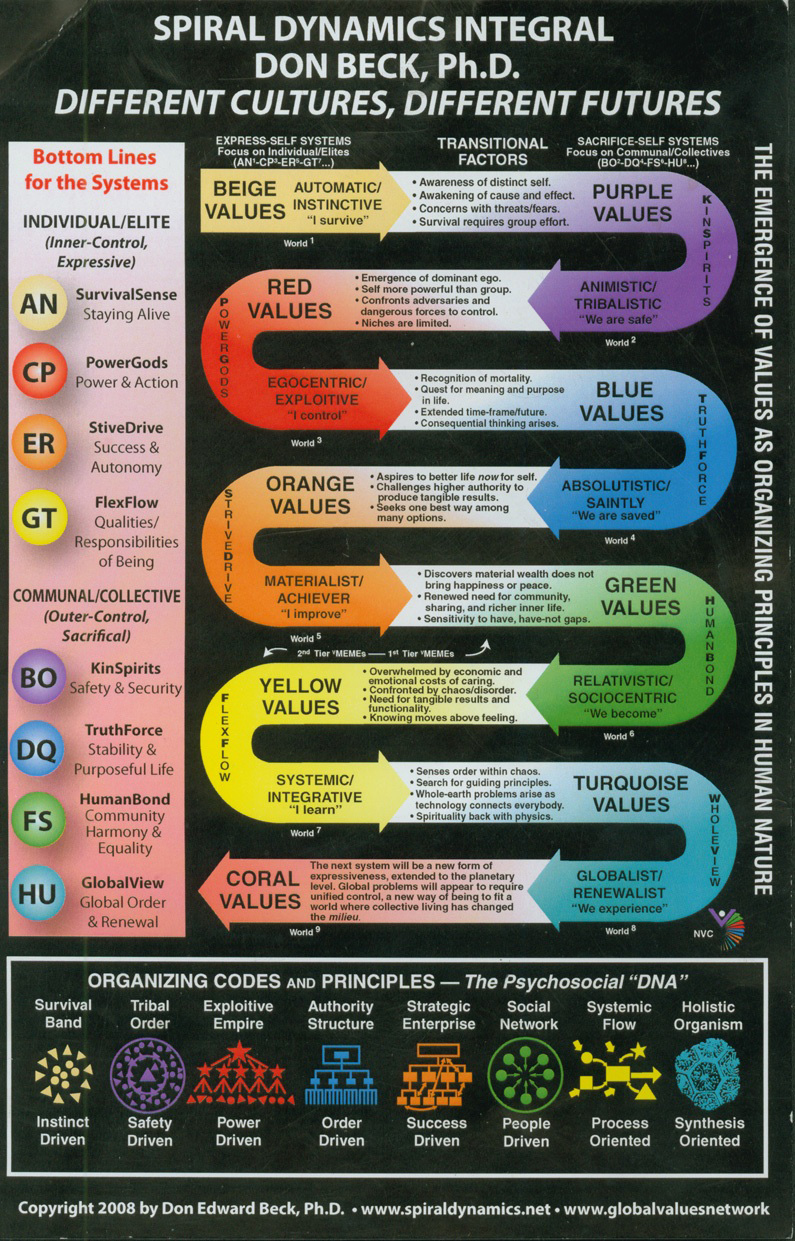
About 60 years ago, one of the great thinkers of the last century, Clare W. Graves, a psychologist at Union College, developed a theory of adult human development that he called “The Emergent Cyclical Levels of Existence Theory” (ECLET).  This theory, which states that humans, and societies made up of these individuals, pass through a self-similar transformation on the way up, in an open-ended format. The chart above shows eight levels, but Graves wanted it to be open-ended because he believed that there was no ‘uber human’ that could be perfectly realized.  Don Beck, who was Grave’s lifelong student, further advanced the theory, and named it Spiral Dynamics (SD).  His chart is above, and if I could pick one thing to put on a plate very similar to the one on the Voyager spacecraft, it would be Beck’s chart.  Don Beck worked with Chris Cowan to further develop the theory, and was followed by one of the great philosophers of our time, Ken Wilber, and his own variant of the theory, Spiral Dynamics Integral, and Integral Theory in general.

One of the big ideas that Graves had was that human beings, and the societies they inhabited, would traverse the different levels as the needs of the people and the culture demanded.  There was to be no static assessment — just a fluid interpretation moving up and down.  The way I like to understand this is that Graves, while talking about human values, wanted that conversation to be mostly perceptual — free of moral judgment.  That’s the spirit that I follow when I use his theory.  And a simple example might be in order.

Let’s say you’re this incredibly evolved person, from top to bottom. One of the key elements in SD is that once you evolve to, or past a certain level, you have not just the mode you have evolved to. You also have access to the lower levels, or ‘Value Memes’ (v-Memes for short) of the other levels.  In a simple example, you might be invited to a sharing dinner for a retirement of a dear colleague.  There might be several independent relationships (or friends!) that matter to you at the dinner, and you also might have brought something special as a gift for the person or the group.  All very communitarian.

But if the building caught on fire, and you didn’t know the exit, you’d be pretty happy to hear some authoritarian yell ‘Get out over there!’

I’ve spent the better part of the last six years thinking about Integral Theory and Spiral Dynamics.  There are some elegant thoughts in the chart above, and they’ve really helped guide my own thinking.  But I’m not prone to much mysticism.  Mysticism generally exists to explain big stuff that we can’t wrap our minds around in cause-and-effect.

Much is made in the SD literature (as much as there is out there) regarding the Tier 1 – Tier 2 transition.  The idea is that upon gaining self-awareness, there is much that can be gained as far as insight goes.  I pretty much agree with that.

But my contributions to SD mostly focus around understanding how the Spiral got put together in the first place.  What drives the thread that moves societies and people along up the Spiral?  How do we create the conditions so that people will naturally become more balanced, data-driven thinkers, while reflecting on past lessons?  What ties it all together?  That’s where empathy comes in.  When you add that key ingredient of understanding, then things start falling out and getting simpler.

If you want to follow along, it really helps to memorize the titles of the v-Memes, as well as the dominant social structures at the bottom of the chart.  I’ll go through a v-Meme description of my own devising for the various modes as well.

But the real secret is you have to read, and think about this stuff.  Empathy is about connections, and if there is a key to understanding, certainly some of the most important connections are the ones in your head.  They’re your own gift to yourself.

Takeaways:  Spiral Dynamics is cool.  It explains both the development of human communities, as well as the development of human beings themselves, back and forth in a never-ending climb.  Well, for some of us.  The other big thing is you have to think about it.  SD is a true meta-structure for sentience, and tied together by empathetic development.  That’s the real story of this blog.

Further Reading:  I kinda seized up thinking about this, because the reality is that the reading out there on SD is mostly not-so-hot.  But then I remembered one of my favorite books from my young adulthood — The Foundation Trilogy — that profiles the fall and rise of the Galactic Empire.  If you want to be Hari Seldon, you gotta start with Spiral Dynamics.

Culture and Empathy — Sidebars, or Why the Two Lovers in a Chinese Movie have to Die

Wedding picture 2

Wedding day, Alicia, me, Conor and Braden

It’s not easy to pigeonhole culture. But we can start with the British Dictionary’s definition: “the total of the inherited ideas, beliefs, values and knowledge that constitute the shared bases of social action.” Cultures  dictate aggregate societal views of relationships, as well as various mores, and as such are inextricably wound up with the levels of empathy in a society.  More tribal or authoritarian cultures are less empathetic, and more belief-based.  More evolved cultures tend to be more empathetic, and have more space for reason.

As such, cultures state what relationships are externally defined, as well as what space exists for independently generated relationships.  My preferred concept for this is that cultures provide the sidebars for the fundamental organizational principles in a given society, and as such, can bring reinforcement for certain types of lower-empathetic behavior, as well as provide ladders for higher-level modes of empathy that may not be widespread in a given society.  Cultures can bring out the best or worst in us.

One of my favorite ways of figuring out how empathy works in a given society is to look at their literature, or even more fun, their movies, and see how people interact.  Or rather, how they’re allowed to interact.  Great works of literature, of course, are signs of the times.  Reading Homer’s Odyssey lets you know that life in Chthonic transition Greece was not very empathetic, and certainly no picnic.  When Odysseus returns home, his son Telemachus hangs the various servant girls in the suitors’ court.  Can you imagine how the press would cover a mass hanging of women today?

Current cultures in transition also show empathy levels in love stories.  In the U.S., for example, it’s not enough to have formal roles for the various family members.  In the movie Meet the Fockers, everyone in two families — one very traditional authoritarian, and one more of the peace-and-love hippie variety — have to form independently generated, trust-based relationships.  Of course, this is very difficult, if not impossible, for reasons that we will cover (if you want to hold on to a term, the problem is what I call v-Meme mismatch) and some version of uncomfortable hilarity ensues.  Well, sort of.

Movies out of China are particularly fascinating.  In Crouching Tiger, Hidden Dragonyou know that the main character, Li Mu Bai, is gonna die when he falls in love with the daughter of the governor, and that there’s going to be even more carnage when the other beautiful woman in the film, Shu Lien, falls in love with Li Mu Bai.  The plot is complicated, but the bottom line is that even 15 years ago, Chinese society didn’t allow people to fall in love and get married.  In fact, for that transgression of independent relational generation, pretty much everyone gets killed, and no one gets laid.  Things are changing — but the fact that the movie is an icon in China tells you something.

One can also see devolution of cultures as well.  For those film buffs, contrast the typical current puff fare of ‘girl meets boy’ with the usual ‘they have a crisis’ and then ‘they get married and live happily every after.’  In relational terms, that would be usually some impulsive, magical connection, followed by independent relational generation, and finishing up with external relational definition and approval by society (husband and wife).  Everyone has to get a title to be bona-fide.  Contrast that to almost 50 years ago, and the movie The Graduate.  Dustin Hoffman sleeps with his potential mother-in-law, and gets the girl.  How about that?

Takeaways:  Culture is core to how empathy both manifests, and evolves in societies.  Watching movies and monitoring relational health, as well as physical health of the characters, is a great way to see how much latitude folks get in picking who they hang out with, as well as how things are changing over time in that culture.

Fun to watch:  Cinema Paradiso — what does this tell you about conflicting empathetic levels in post WWII Italian society?  (and hey — it’s a fun, great movie!)

So How Does Empathy Synchronize Time?

Jumeirah Station

Jumeirah station, Dubai, UAE

One of the more interesting thoughts that I’ve had about empathy is how it has to work to both generate and synchronize time scales in the brain.  Why?  Or rather how does that work?

If one understands that empathetic connection, at whatever level of the pyramid we’re at, is the bedrock of how the communication channel between two people (or more) works, then one starts realizing that the context of the relationship must also provide cues on how time is processed.  It is, in many ways, similar to how two computers have to be synchronized in order to talk to each other on the Internet.  There are protocols that must be followed — from external (like a meeting time) to independent sources (watching someone’s face in a round of poker.)

Except it is learned from the outside — different social structures and cultures have different senses of time.  And if you’re put inside one, you either have to adapt or be ignored.

Consider a tribal social structure.  Anyone who’s worked in these situations know the meaning of ‘Indian time.’  It can be used in a derogatory fashion.  But it is also insightful, and for someone that has worked in parallel with tribal cultures, a useful construct.

The short version is that there are two time scales in tribal societies — a long time ago, and somewhat in the present.  One can add perhaps a nature-based, animistic trigger to some of this (the Lakota had a ‘Moon of Popping Trees’ for the middle of the winter, when things were so cold the trees would literally freeze.)  A friend of mine doing work in Mongolia told me of a story once where she was told to meet someone ‘tomorrow’ — but tomorrow turned out to be a week later.  In Barry Lopez’s classic book, Arctic Dreams, he talks about walking with Inuit hunters and have them calibrate time in terms of distance, blurring the two variables.  Looking across the horizon, they would pronounce the distance in terms of some time in the future.

Other social orders have other time scales.  Survival-based social structures only have the now.  Authoritarian structures have the Now where the boss is.  Before the railroads, the clock in a town was set by high noon in the town square.  After the railroads, which required a legal hierarchy in order not just to make sure the trains ran on time, but also that they didn’t wreck into each other, the government gave us time scales.  Time is self-reinforcing along many self-similar orders.  It’s no surprise that the British Empire established Greenwich Mean Time as the time where the day starts.  That’s the advantage of having a map of your holdings that stretches around the world.

Since relationships are where we practice the vast majority of our information processing, it should come as no surprise that the various social orders affect the way we view time — or if we view time (or consequentiality) at all.  And that such repetition should beat down in our fundamental neural circuits?  Why do you think we use expressions like ‘we just didn’t click’?

Takeaways:  Empathy and social connection directly create and calibrate our brain’s notion of time, as well as our ability to think consequentially.  Reflecting on our own temporal scale will tell us how much are able to care about both the small stuff (our next dental appointment) and the big stuff (like global warming)  which will all be tied back to how we construct relationships.  Which is all about empathy.

Further reading:  neuroscience plods along, failing to account for our connectivity — but this fine scale stuff is still interesting. 

Independently Generated Relationships — What does Having Friends Really Mean?

Chucklochsa

Chuck on a high-water Lochsa River, Idaho, Spring 2011  (Allison Thomas photo)

For those that like to guess, you might think that writing down a complicated line like ‘Independently Generated Relationships’ is a complicated, professor-ese way of saying that you’ve got some mates.  And at some level, this is true.  But it also reflects on the neural process that one goes to pick those friends.  Do you pick friends based on position or status?  Or do you pick friends because they’re nice to you, or you find them funny?  One is belief-based, status-oriented thinking.   The second is extremely data-driven.

Likely, you might have met someone with whom you share a label with.  For me, in my youth, that would have been associated with the term ‘kayaker’.  I was a passionate whitewater buff from about 17 to 46.  I was fascinated with wild country, and those that also loved wild places.  But in the end, because of the inherent danger of the sport, for the most part, I ended up paddling with people I trusted and knew.  When your life is on the line running Class V, you need people that you know what they’ll do in a given situation.  And the only way you can build that is with strong, rational empathy.  You have to assess the information stream coming from that individual.  Labels don’t work.  It’s the type of  relationship that maximize validity — you’ve shared an experience with someone.  You know they can do it because you — no one else — watched them do it before.  It’s in your own brain.

Very often, independently generated relationships are performance-based.  If you’re crunching on a big project, and you need a critical part machined, if you’re an engineer, it doesn’t help to take a hierarchical position with your machinist — that somehow, they’re a lesser person than you.  If you’ve developed a strong trust relationship with that person, it’s very likely that you’ve seen their work.  You know their sense of timescale.  Likely that you’ve also treated them in an egalitarian fashion.  And if you’ve done the empathetic relational work, it’s also almost certain that the person, if they spot an error you’ve made, will communicate back to you what that error is.  One of the key signs of relationships that maximize validity is duplex communication and confirmation.  Both parties know the relationship is data-driven, and actively provide data in both directions.

That’s the thing about independently generated relationships — because of their duplex nature, they are fundamentally error-correcting.  You can’t make significant, complex technology without them.  If you’re building something like a commercial airplane, with a minimum of 300,000 parts, there is an inherent error rate that exists in its assembly.  And without a constant stream of feedback on what goes together and what doesn’t, you simply can’t get the bugs out.  The rareness of existence of that rational empathetic culture globally is one of the main reasons that commercial jets are built in only a handful of locations in the world.

And here’s the other thing.  In order to have a team of individuals design a plane, on a very basic level, they must also be rational.  At some level, every plane is different.  You need the lower levels of scaffolding: expert knowledge of materials and components; advanced algorithms for stress analysis and propulsion;  codes and inspections by the FAA.  All matter.  But without duplex information flow, it’s all for naught.  Too many exceptions.  Too many heuristics.

As one relates, so they think.  If you want rational people, they have to have rational relationships.  That describes a situation where some level of agency is required in order to develop the people to fulfill tasks requiring complex thinking.

Takeaways:  Independent relationships are built on data exchange, which leads to trust, differentiation (I’m good/not good at something someone else is good/not good at,) and agency — someone’s fundamental responsibility to themselves, that gives them the ability to act independently.  Friendships are a key type of independently generated relationship — but they’re not the only one.

Independently Generated vs. Externally Defined — Trust vs. Loyalty

Huangshan stairs

Endless stairs, Anhui Province/Huangshan, Anhui Province, China

One of the things that starts happening once you set up the relational dichotomy of independently generated, trust-based, data-driven relationships vs. externally defined relationships is that certain behaviors, thoughts and actions also clearly start falling in the various bins associated with these two fundamental empathetic/relational types.

One of the biggest is the difference between trust and loyalty.  Trust is inherently associated with something inside yourself, and ties itself back to data you’ve collected on the other person.  One can march down through the various idioms — trust is earned; trust is fragile; trust, once broken, is hard to regain.

Loyalty, though, is completely different.  No surprise that members of the military or government take loyalty oaths.  They are asked for explicit declarations of faith in institutions, or the people who are placed in authority by those institutions.  There’s many an infantryman who might have felt loyalty to their country, but did not trust their commanding officer.

It’s also interesting how it’s quite easy to pull up temporally dependent definitions of trust — as trust is fundamentally based on a data collection exercise.  It’s what we in the sciences call a time series — a fluctuating variable charted out over time.  Contrast that to loyalty — it’s what scientists and mathematicians call a binary scalar value.  Either you’re loyal to your country or not.  A loyal friend or not.  Loyal fan or not.  You can’t be sorta loyal, just like you can’t be sorta pregnant.

Words like this give insight and clues into how the brain processes different empathetic modes, and how different relational types either develop, or don’t develop timescales in the brain.  In the land of externally defined relationships, time seems not to have as much meaning to the individual.  Relationships, defined by the outside, elude control of a person.  Friendships, though, depend on time — calibrated by that time series of data known as trust.  And that creates interesting synchronization potentials in the brains of people that engage in that kind of relational development, that don’t exist at all in individuals immersed in organizations immersed in external definition.

One of my old girlfriends was Chinese.  She had lived an amazing, but tumultuous life, passing through the Great Leap Forward, the Cultural Revolution, and the Tian’namen Square Incident (she was there) before emigrating to the United States.  “I am a very loyal woman,” she would tell me.  But I never felt she trusted me at all!

Takeaways:  There are many traits that naturally fall out under the Independent/External relationship dichotomy.  Trust and loyalty are just an example.  Trust depends on data and some rational process, loyalty depends on belief and emotion.  All corollaries can tell us important things about how the brain processes time — and that has enormous consequences for how we synchronize actions with others.

Further Reading:  Nothing better than the life of Musashi — a samurai turned Zen monk, who swings back and forth between both relational types.

What Do We Do in Absence of Specific Data?

1.0.2
1.0.2

Powell Plateau, Utah, Escalante/Grand Staircase

In the last blog post, we talked about externally defined relationships, and how, because of their belief-based empathetic characteristics, they shape the belief-based mind.  But how does it work, anyway?  Why do we have beliefs?  At some level, beliefs protect us and serve in many ways.  And the other fact is that they don’t burn up nearly as much valuable brain time or brain energy in their processing.

Let’s say you’re in a situation in a crowd, where someone has just had a heart attack.  He’s lying on the ground, and you’re trying to remember how to do CPR.  What’s the first thing you’re likely to do?  Get out an interview sheet, with 100 questions about individual backgrounds and experiences?  Gonna create that independently generated, data-driven, trust-based relationship?  By that time, the poor dude with the heart attack would likely be expired.

Or are you going to yell ‘Is there a Doctor in the house?’   In the words of Daniel Kahneman, author of Thinking Fast and Slow — a Nobel Prizewinner in Economics — this would be considered fast thinking.  Not much data processing — just a survival level call for help, for an authority that would hopefully know what they’re doing.  And it’s coming out of the limbic system.  You might look at the person stepping forward quickly and evaluate, especially if the potential patient is your friend.  Do they appear competent?  What’s their affect?  Are they lying to gain attention?  But beyond that, you’re probably pretty happy (think limbic system/ emotional empathy) and relieved (think emotional empathy again!) that someone stepped forward.

Do you have a thing for brunettes?  Love at first sight?  Another emotional empathetic, belief-based relationship, if not completely externally defined.  Or maybe it is?  Mom a brunette?  And hey, you know those engineers — always thinking this way or that.  Sometimes, we call these things stereotypes, if they’re negative.  Yet the vast majority of us use these constantly in navigating our society.  We don’t have time to do otherwise.

With many externally defined relationships, we cede authority or status based on institutions — and those institutions are either authority-based, or legally grounded.  More group, process-based decision-making.  Police have specific authority, granted by law, to detain you if they think a crime has been committed.  Physicians are granted a license to practice based on receiving a degree from a university, serving a residency, and taking a test.  All these mechanisms, once again, serve to maximize the reliability of your instant assessment — your belief — that this person knows what they’re talking about.

People with such titles also are often bound by executing certain algorithmic processes — step by step, agreed modes of doing things that have received scrutiny from experts/authorities.  Such institutions and processes are a necessary part of the scaffolding of modern society.  One of the more interesting examples of authorities generating an algorithm occurred at an oil refinery I was associated with.  A committee of engineers from across the industry had developed a code for welding on a pipe for gasoline while the pipe was still flowing gas.  Well-defined certification and algorithmic thinking allows a total stranger to cut open your chest if you have a heart attack and save your life.

At the same time that these institutions maximize reliability, we also find that they can be notoriously hard to change their ways when what they do doesn’t work any more.  And changing culture?  Not so simple.  Why that is so will be explored in the future — and believe it or not, it has to do with a fundamental hypothesis of this author on how empathetic development shapes the brain.

Takeaways:  Our lives are filled with relationship labels, based on beliefs, that function with a low level, or non-existent level of empathy.  These relationships are scaffolded by institutions, cultural perceptions, and faith in them rests primarily in the limbic part of the brain.  They utilize fast thinking, and enable us to navigate complex, modern society.  Their dominant social order is either an authoritarian power structure or a legalistic hierarchy, and they are heavily status-based.

External Relationships — WHAT we are

Picture Spot at Huangshan

Formal picture spot, under the Welcoming Pine — Yellow Mountain (Huangshan), Anhui Province, China

塞翁失马,焉知非福。(sàiwēngshīmǎ, yānzhīfēifú.)

Above, in Chinese characters, is a classic chengyu — a short, Chinese idiomatic expression telling a story.  This is the one about the old man who lost a horse.  The village people came up to him.   “What bad news, Wong!”  He replied, “Good news, bad news, who knows?”  The next day, his horse came back, with another horse.  The townspeople once again returned — “Good news, bad news, who knows?” he said.  And so the story goes on.

So it is when we talk about empathy and relationships.  When you arrange empathetic levels in a pyramid, inevitably someone will want to claim a higher status because of an ostensibly more evolved viewpoint.

But empathetic levels simply are.  And it may be true that as one evolves, one’s capacity for understanding (as we will see) can expand, there’s no guarantee. Relationships happen in the context of other relationships.  Good news, bad news — who knows?

And that the context that one must understand externally defined relationships.  Externally defined relationships, by the inherent virtue of being defined by others, are not as dependent on empathy, and so are typically characterized by the lower empathetic modes.  A policeman, father, mother.  All of these have defined roles in society.  Most externally defined relationships apply to an individual in the singular, and gain context only in the framework of a power structure or a hierarchy.  Armies and Navies are famous for their hierarchies, of course, but universities are not far behind.  Someone with a title speaks with authority invested in them by their status in society.

Culture, which simply defined, is a set of shared beliefs that have evolved inside a community of individuals, be that a region, state, or nation, often defines these external relationships.  Asian culture, for example, is replete with codes for managing the parent-child relationship, to the point where there are volumes of books on filial piety and its effects on society.  Position and authority are both regulated and protected, though, by external codes — some very complex — that modulate privilege.

But when you boil it down, they rest on belief.  You believe that a police officer is enforcing the law because that is their external definition in society.  You believe a mother provides care to her children because she is a mother.  You believe that when a father punishes or rewards his child, he is doing the right thing — because he is the father.  You believe the physicist knows what she is talking about because she is the authority on the subject area.

What becomes obvious is that all these definitions are based on often complex mental models of how people see the world, which is directly related to information exchange in society.  And these mental models are designed by society to rest heavily in your limbic system.  If a cop says ‘Put your hands up!’  you feel a knot in your stomach and you obey.  If your mother says ‘I love you!’ you feel a warm wash of reassuring emotion.  You’re not supposed to process so much.  You just do.

Takeaways:  External defined relationships, though they may be associated with actions that an individual has taken (like earning a degree), are assigned outside the individual.  A judge says that you are husband and wife.  A university says you are a graduate.  They are accompanied by shared mental models on what these relationships mean — and as such, are fundamentally belief-based constructs.

Two Types of Relationships

uncle al

Uncle Al, Braden and Conor

It follows directly that empathy, of whatever developed variety, is the foundation of all relationships — because relationships, by definition, involve the communication and inter-relational coordination of two people.

It them makes sense to explore how different levels of empathy play in the relational dynamic, and how they then construct the social/relational structures of broader communities.  At some level, there is an inherent premise in all this — that relationships between individuals have larger structural effects as social structures are created.  In the fractal/chaos theory world that I used to play in over thirty years ago, this principle is called self-similarity.  Social structures on a large scale are self-similar to those constructed at the small scale.

There would be a whole lot of unpacking to do if I intended to resolve every potential contradiction here (for those that are immediately interested, look up multi-fractals) but the short version is that things might be different in a branch office than the way things work at corporate headquarters.  So bear with me.

A useful dichotomy, relationship-wise, is what I call externally-defined relationships vs. independently generated, trust-based, data-driven relationships.

The first — externally defined relationships — are defined outside the individual.  Whether you think I’m brilliant or a kook, the reality is that, barring unforeseen professional catastrophe, I’ll wake up and still be a professor tomorrow.  And if you’re a project manager, art director, or chief cook and bottle washer, tomorrow you’ll wake up and that’s WHAT you’ll be.  You could also be a father, a mother, or any of a variety of labels.  Like Grandma always said — you can pick your nose, but you can’t pick your relatives.

Independently generated, trust-based, data-driven relationships are different.  At some level, you get to choose these.  One of the simplest is in front of you right now.  You read my blog, you decide if it makes sense, maybe you leave a comment.  I respond back — perhaps you didn’t quite understand something I was talking about.  Or I got something wrong.  I fix it.  Back and forth.  Over time, we develop trust based on the experience.  It’s a data-driven exercise

The first kind of relationship — I’m a professor, you’re a project manager — is belief-driven.  As a professor, you believe what I say because of my title.  Or not.  I’m a mechanical engineering professor, and as such, you might think I have no business discussing social psychology.  So you don’t read the argument.

The second kind of relationship — Chuck (that’s me) and whatever your name is — is data driven.  You’re making a series of decisions on whether you believe what I say, or find value in it, based on the argument itself.  Does it jibe with your experience?  Am I just flat-out wrong?

Whichever it is (and there’s no question that these two types overlap — my students, for example, call me Dr. Chuck) will dictate how your mind works around me, and in the context of the relationship.  How we relate is how we think.

Takeaways:  Two kinds of relationships — externally defined, and independently generated.  The first is belief-based, the second data-driven.  How we relate is how we think.

Global Empathy (Part I)

wallowasfrom the top of Aneroid Peak, looking toward Pete’s Peak, Wallowa Mountains, Oregon

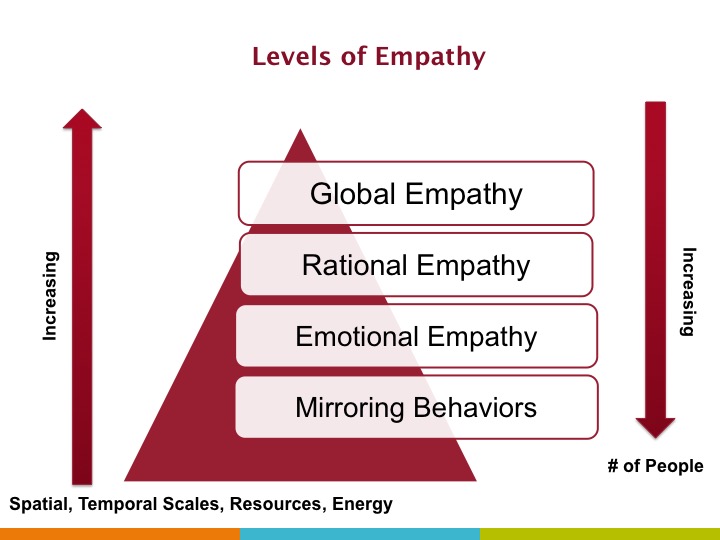
Global empathy ain’t easy.  One thing that I haven’t told you is that one of the ways the Empathy Pyramid works is that you yourself have to have some level of integral generation of self in order to move on up, if you consider populations of humans in anything resembling a statistical fashion.  What that means is that it’s hard to be rationally empathetic (or rather, display cognitive empathy) without development of the lower levels (emotional or affective empathy.)

And what that leads to is a ceiling in my own ability to theorize — because I’m not there yet when it comes to global enlightenment.  I’m sure that there are some folks out there (I think the Dalai Lama comes to mind, or Desmond Tutu) that are, but it’s not me.  Most days, I feel like I’m just another blind dude with the elephant.

And global empathy is also likely (I’m guessing here) a field effect.  It’s more likely in possession of groups of connected individuals, as opposed to one person.  There’s an interesting phenomenon called the Overview Effect that has  been reported by former astronauts and cosmonauts.  The basic idea is that seeing the Earth from a distant perspective profoundly changes your sense of connection.  And I have theories that I will expound on why this is true — bottom line is empathetic development is a function of temporal and spatial scales in the brain, facilitated by your base energetics (gotta pay attention to the laws of thermodynamics) and there’s nothing that grows your spatial scales like being in space.  But you don’t have to fly in a spaceship to connect to feelings en masse.

Because these kinds of experiences affect all of us, even if in a lesser fashion.  I found out not too long ago that before the space program, all representations of the Earth — pictures of the globe — never had clouds.  Now, since that famous picture of Earthrise, it’s hard to think of the Earth without an atmosphere.

But there are likely other examples of global empathy that might be deconstructed.  Because when one’s brain is limited in developing an a priori model, perhaps the best method for understanding the phenomenon is to back it out of larger examples.  Like the foreboding a country might share before a war.  Or the exuberance of winning the World Cup.  How does that work?

We might look at the Internet itself — our only true global technology — for insights.

But one thing I’m not interested in doing in this blog is attributing global empathy to some extra-dimensional spiritual dimension.  There’s plenty to unpack here with regards to the phenomenon in the four dimensions available to us (don’t forget time!)  Sometimes it’s OK to say ‘well, I just don’t know.’  And leave people to the interpretations that work for them.

Takeaways:  Global empathy is real, and if we work on it, can explain things like national mood, as well as things like the Overview Effect.  We can see its effects, even if we can’t understand the mechanisms.  And with regards to mechanisms, let’s keep it real, even if it has to be phenomenological.  No extra dimensions need to apply.  We can be comfortable without answers.

Rational Empathy (Part II) — Or Nothing Says ‘I Love You’ Like a Dark Shadow on your Door

pyreneesmtns

Mt. Sauvegarde, in the Spanish Pyrenees

One of the most interesting parts of my life has been watching how my students in the capstone class I teach complete project after project.  Allow me to explain.

About 21 years ago, I jumped up on a table like a good Viking and said “my students need industrial experience!”  I was in charge of teaching essentially the exit class for the mechanical engineering undergraduate curriculum, called ‘capstone design’ in education-ese.  Students had been doing a variety of activities beforehand for their supposed ‘masterwork’ — like helping other professors design a piece of lab equipment, or working on one of the many projects associated with student club activities, like a Baja car, or one of the American Society of Mechanical Engineering’s (ASME) challenge.  The only real requirements were a.) the students were supposed to work in groups, and b.)  the project had to have something to do with mechanical engineering.

Professors complained — students are worthless, they can’t get anything done.  Students complained — professors are worthless, no one does anything, this is jumping through hoops.  (That last expression is a favorite.)

So I swore an oath — only ‘real’ projects.  Projects from industry.  I went out and solicited those real projects from past grads whom I kept in touch with.  They sent descriptions, I said ‘thank you’.  The students attempted to do the projects.  Basically, all of them failed.

At the time, it didn’t matter.  Students were screwing up projects inside the university.  Why should it be any different?  It was still something good for the resume’.

I had a good friend, an ex-student who had gone to work for the ARCO refinery in Bellingham, WA refinery.  He had told his engineering supervisor about what I was trying to do.  That engineering supervisor wanted to talk to me.  I called him up.  His name was Les Okonek.

“I want you to visit the refinery.  I have a project for you.”  The project involved a junket — a trip to Bellingham.  What’s not to like?

I met Les, and we put on the Nomex safety jumpsuits that are de rigeur in an oil refinery, and took the tour.  We returned to his office.  “I’ve got a project for you,” he said.  “Yes,” I replied.  “Sounds great!”

He then said “Oh no — I’m going to pay you for it.”  I gulped.  Students — undergraduate students — were going to do something for money?  Those same failures that were tubing projects on a regular basis?  “The kids have to come to the refinery,” Les said.  “And I’m going to expect you to get it done.”

Basically no one gets anything done in academia.  That’s not what it’s about.

But the students did.

I wish I could tell you I had a flash of brilliance at that moment on why the students got that first project done.  And with consecutive industrial projects, why — when I charged money — all the others got done.  But here’s the short version.

I had a customer.  And I did not want to let that customer down.  I call it the ‘Catholic Guilt’ effect.  But it was more than that.  I wanted to develop my program.  I had a person willing to take a risk with me — he trusted me.  I wanted to show him that his trust was not misplaced.  If he felt bad, I was going to feel bad — that’s empathetic connection.

And that kind of situation exercises the whole brain.  Not only did that customer need a product that was technically viable (think pre-frontal cortex,) I had to worry about whether that customer was happy (think limbic system.)  The students were the ones front and center, in that they had to go to the refinery and also develop a rational empathetic relationship with Les.  Les did more than one thing right, but the big thing he did was at some level, he refused to directly mentor them.  He was the customer — the students had to do the thinking — and empathizing.  And in the end, the solution the students generated had to be coherent with what Les also thought the solution should be — or he wouldn’t be happy.  They had to achieve a goal, and they had to develop shared coherence with Les on the fact that the achievement was significant.  And everyone had to be happy.

The customer/service provider is one of the most powerful relationships we have in contemporary society.  Many folks outside the business sector simply cannot understand why corporations have such powerful influence.  The usual accusations are that it’s all about greed, or money or evil.

But it’s more complicated than that.  Rational empathy — the bedrock of the customer/provider relationship — is a major creator of the rational mind.  It exercises all parts of the brain.  Note that I did not say, necessarily, that it is the creator of our moral mind or sense.  It is not.  But truly rational people become multi-solution thinkers, and form far different social/relational structures than people who are not.  And because they are usually much more performance/goal oriented than many other social structures, they often get to the point of running the show.

There is a lot more in empathetic development to be explained regarding this development.  Stay tuned.

(a quick tip of the hat for the title to another business friend — Phil Ohl, of Kurion)

Takeaways:  Rational empathy is, in contemporary society, a chief constructor of the rational mind.  And in contemporary society, it is the customer/provider relationship that is its key developer.  There is no better way to develop that relationship than going to visit, as there is basically no substitute for the experience of meeting someone face-to-face when it comes to developing an independent relationship.