Back to Basics — Algorithms and Heuristics

Sydney Harbor

Sydney Harbour Bridge, Sydney, Australia

A couple of terms I toss around with a fair amount of frequency are ‘algorithms’ and ‘heuristics’. Though I think I’ve discussed algorithms and heuristics before, a deeper understanding of both based on empathetic development is in order — especially as we pursue deeper understanding of their effects in our minds, and how our social/relational structures generate knowledge with them.

To start, both are process-based knowledge.  When we decide to use either, we know that we are going to step along some path, and transform some set of input conditions to a final condition. That means both require some sense of temporal scaling in our heads — from start to finish, time will pass in their execution.  That matters, because as we’ve discussed earlier, how we conduct our social business directly affects how time scales in our heads, and whether we follow a ticking clock, the passage of the seasons, or a pre-arranged agreement based on events that might or might not occur.  That’s going to  affect process execution and sense of consequentiality.

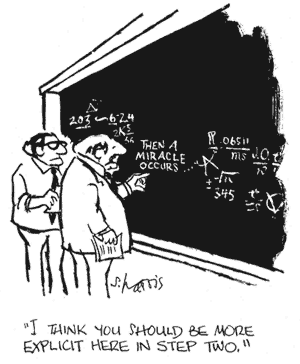
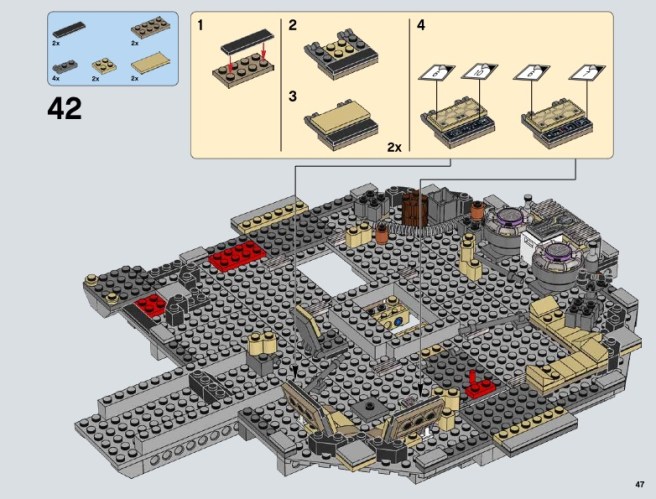
But algorithms and heuristics are fundamentally different.  The generation of perfect algorithms lies primarily in the Legalistic v-Meme.  We have a process, we have some inputs, we tick through the steps, and we get a result.  No agency required — and likely some other person, community or society has figured it out before.  Of course, there are tons of algorithms in fields ranging from accounting to engineering to medicine, but perhaps the best example of algorithmic thinking can be found with Lego directions.  Totally visual, they click the viewer along through thousands of pieces, in sequence.  You start with a bunch of little plastic blocks, and four hours later, you’ve got a reasonable facsimile of the Millennium Falcon sitting in front of you.

Millennium Falcon Directions

Instructions, Lego Millennium Falcon — follow the arrows!

Algorithms can be written down with language, math symbols or pictures.  The key ingredient is during execution, there is no (or extremely limited) agency required.  Just follow the steps.

Not so for heuristics.  The formal definition of the noun heuristic, from Dictionary.com,  is:

  1. (mathsciencephilosophyusing or obtained by exploration of possibilities rather than by following set rules.
  2. (computingdenoting a rule of thumb for solving a problem without the exhaustive application of an algorithm: a heuristic solution.

Let’s unpack this.  To start, heuristics exist up and down the Spiral.  Down at the Survival v-Meme level, if you want to start a fire to cook up a lizard you just caught, you get out your piece of flint and steel to make a spark.  The process/algorithm for making that spark may be an algorithm, but you’ll practice some heuristic in collecting the tinder to catch the spark, the kindling that burn afterwards, and the wood that you’ll use for you campfire.

Moving up the Spiral, Tribal societies may have rituals that are pretty algorithmic, but there’s lots of heuristics in the set-up. Up through Authoritarian and Legalistic, the heuristics may still be pretty constrained, but even in the military, you get to choose whether you put on your right boot or your left boot first — at least once you’re out of boot camp!

Heuristics, with their temporal and spatial dimensions, give a great insight into agency and empathy in the lower v-Memes.  If someone’s struggling under a load that they’ve just been ordered to carry, do you get to help them or not?  How much choice do you have? Such simple questions tell us tons about the development of emotional empathy, as well as the prevalent cultural sidebars.  If the boss comes after you with a whip for helping your buddy when he stumbles, that’s a pretty strong message about the strength of the authoritarianism on the job site, as well as the appreciation for heuristic thinking.  Talk about keeping spatial scales confined to about one foot around you.  Not a lot of agency there.

What that tells us is at the core of any heuristic is the level of agency you have in selecting the steps you take.  Since this blog is nominally about design, all design process must constrain the process within some sidebars for some level of predictability and report-out to management.  There’s nothing wrong with a design process that goes

Specification=> Preliminary Design => Final Design => Manufacture => Test => Improve.

For a design to be successful, though, it must be a Scaffolded Heuristic.  For any heuristic at the Performance/Goal-Based level to work — or increase the validity of the solutions it generates, it has to have lower v-Meme information and processes folded in.  Let’s say we want to build a water tank for the roof of a house.  We can talk to all sorts of different customers about the most appealing shape, the color, ability to be easily cleaned, and so on, and have these factors guide our design (pretty Communitarian!)  But if we’re not scaffolded with the basic physics (down there in the Legalistic/Algorithmic v-Meme level!) and don’t design the tank to withstand the hydrostatic pressure of the water, the tank will be a failure.  Literally.  It will spring a leak, and then the validity of the solution will be zero.  We still get to choose the steps for our design heuristic– maybe we talk to the customers first.  But sooner or later, we have to figure out how to make it strong enough to hold the water.

It’s the combination of agency and good scaffolding are far more likely to improve the outcomes.  And as we’ve discussed before, appropriate agency that comes from Independent Relational Development and rational empathy are going to empower the individual, or working group, toward searching the solution space thoroughly.  Self knowledge is going to work well in supporting scaffolding — either you recognize that you know how to solve that algorithmic statics problem or not.  It all starts intertwining.

The challenge for the business manager comes in with which heuristic do you pick, as now heuristics are guiding level processes.  I’ve covered Heuristic Design and OpenIDEO in the previous posts.  These integrate features from both the Performance/Goal-Based v-Memes and the Communitarian v-Memes.  Expanding that heuristic space further in design, and putting in the Global Systemic/Self-Awareness v-Memes, we just keep going.  Onward and upward.

And solid heuristic thinking is not just constrained to engineering.  Academics in the Liberal Arts call this stuff ‘critical thinking’.  Here’s a great summary I yanked off the web.  In the second section, the summary’s authors Michael Scriven and Richard Paul say:

“Critical thinking is self-guided, self-disciplined thinking which attempts to reason at the highest level of quality in a fair-minded way.    People who think critically consistently attempt to live rationally, reasonably, empathically.    They are keenly aware of the inherently flawed nature of human thinking when left unchecked.    They strive to diminish the power of their egocentric and sociocentric tendencies.    They use the intellectual tools that critical thinking offers – concepts and principles that enable them to analyze, assess, and improve thinking.

What they require, though, in order to function correctly, is an increased sense of agency and empathy. ”

Same stuff.  The two authors above scaffold the generalized heuristic of critical thinking with some great stuff.  “They are keenly aware of the inherently flawed nature of human thinking if left unchecked.” Sounds like a strong demand for cross-check and empathetic grounding, recognizing the need for connection with others in order to increase the validity of the result.  Awesome.

What’s the takeaway?

Algorithms are step-by-step procedures requiring little or no agency for execution.  Little or no agency means very low-level empathetic development, and social structures based on external definition (certifications, titles, degrees, etc.)  

Heuristics are processes involving solving problems where, dependent on the complexity of the problem to be solved, require choices to be made along the path toward solution completion.  The v-Meme level a community operates in will tell much about the scales of awareness, empathetic development, and larger validity of solutions the community comes up with.  More highly evolved heuristics will be scaffolded with knowledge and processes from the lower v-Memes.  There’s nothing wrong with having a set of algorithms that an individual or group chooses from in order to solve a larger problem through a heuristic method.

Finally, if you want people to be good critical thinkers, or users of scaffolded heuristics for larger, more complex problems, they have to have developed agency AND empathy.  Otherwise, they will not possess the independence of thought to evaluate data critically and make valid choices toward valid solutions.  As we relate, so we think.

Further reading:  We’re warming up to an important post on an important book — Scott Page’s book on diversity’s mathematical roots — called “The Difference — How the Power of Diversity Creates Better Groups, Firms, Schools, and Societies.”  In order to fully understand this, though, we have to understand what a heuristic is.  So if you’re excited about understanding Page’s work, re-read the stuff about heuristics again.  We’re going to build on this important work.


The Wise Organization — What is it?

Aborigine Performer

Downtown Sydney, Australia, on the Quay, with the local didgeridoo player

I’ve been reading and listening a little bit on the Internet about the issue of wisdom — what people perceive it to be and such, and thinking about how to map this to our business organizations.  As I’ve said before, I’m a big fan of Ken Wilber, and have spent some time with Ken’s dialogues with another great thinker on wisdom, Roger Walsh.  Ken and Roger both are obviously enlightened, Second Tier thinkers, but the lower v-Meme that consistently comes out is pretty legalistic.  There’s a lot of classification of different heuristics in their models for wisdom, which are are somewhat useful, but still lack a guiding principle ethos.  I think that one can discuss wisdom from a topical level — for example, few would question “be kind to others” is a sign of wisdom.  But after that, one can get bogged down in the details pretty quickly, as with all surface-level analyses.  Someone who is wicked might quickly interpret a statement like “be kind to others” as a pathway to “so you can exploit them later.”

Is there a way, then, to understand wisdom in the context of the work we’ve done on empathetic connection?  I’d argue ‘yes’. It would be as an evolutionary process — and that implies the processes we create with an eye to wisdom would also create wise behavior that would hopefully be naturally emergent.  We’d also want to use a metacognitive lens.  How do we handle and process what we don’t know? If we create wisdom-generating processes in our meta-world, wise solutions will appear in our constructed reality, without having to be imposed from one viewpoint.

The other guiding principle must be that wisdom is fundamentally tied in with validity.  It should increase the validity of solutions or products that an organization creates, as well as its ways of being. Validity also helps up and down the v-Meme value chain.  Products that are valid will solve customers’ problems, as well as not kill the people who make them, as a small example.  The problems with microwave popcorn come to mind.  While a person may enjoy sticking in a bag into a microwave and two minutes later pull out a hot, tasty snack, it’s not going to be held up as an exemplary, wise product if the workers are sick from the oils in the factory with Popcorn Lung, or the waste is one more thing added unnecessarily to a landfill.

So here are the two guiding principles, somewhat tied together of course, that we can use, to evaluate our social/relational structures and our tools and cultures for our organization.

1. Wisdom is a direct outcome of how well we – ourselves, and our organizations – develop and use our metacognition — knowing what we know, awareness of what we don’t know, and a deeper awareness of knowing that there are unknowns out there we can’t know until we encounter them.

2. The amount of wisdom inside an organization will express itself in the validity of the solutions it provides, which emergently includes the health and well-being of the sentient actors inside it,  its ever-increasing temporal and spatial scales of consequences associated with its actions, AND its self-awareness of potential consequences outside it.

These two principles tell us some very important things about how we can discriminate wisdom in the various v-Meme levels.  Chief among these is that wisdom is going to be dependent on the knowledge structure spawned.  That doesn’t mean that lower v-Meme levels can’t have wisdom — far from it.  But the limitations of the knowledge structures (and the social structures that created them) are going to constrain tools and processes that can be used by contemporary business for planning product development strategies.

Let’s walk through a couple of examples in order to understand how this might work.  Few would question the Native American wisdom about the need to take care of the Earth.  It is fundamental on such a basic level — without water to drink or air to breathe (Survival v-Meme) we will all die.  The concept is deeply valid, and indisputable.  At the same time, it does not inform specifically on the first principle in a way that helps us plan our action.  So while it must be part of our bedrock scaffolding — organizations that destroy the place they live are fundamentally unwise (anyone questioning that can look at the picture below of a mountaintop removal site in West Virginia) it doesn’t help much with structuring processes on smaller scales, where trade-offs will inevitably be made.

Mountaintop Removal Site.jpg

Mountaintop Removal Coal Mining in West Virginia — Geologic Time Devastation (2009)

Once again, I do want to repeat — we ignore deep Survival/Tribal v-Meme wisdom at our existential peril.  At the same time, it was the inability of development of the first principle that led to the overwhelming of the Tribal/Authoritarian societies back during the Columbian Exchange.

Next up on the social/relational evolutionary scale is our Authoritarian/Legalistic v-Meme pair.  These, too, offer insights on how to develop wisdom inside our organizations.  Authoritarian systems process systems in knowledge fragments for the most parts, and I’ve already discussed chengyu in past posts as effective ways of coding validity.  This type of wisdom, that captures guiding principles in a short story, is another example of triggering larger understanding, metacognition and validity.  My favorite is 塞翁失馬 — the story of Sai Wang, who lost a horse.  The villagers came to him, consoling him for his bad luck.  He said ‘Good news, bad news, who knows?’  The next day, the horse returned, with another horse.  Hit repeat on the villagers’ script, except this time as good news.  Sai Wang replied again in the same way.  A good explanation of the story is here.

As a piece of wisdom, Sai Wang’s story holds up to the two principles.  Sai Wang encourages the villagers to think regarding longer consequences of events (though not actions)  reminding us that there are things that we just don’t know, and events in the future that we can’t know.  But, as with all fragments, it can’t satisfy the second statement, on what to do next.  Even the best Authoritarian perspectives are frozen for that moment of impulsive time.  For that, other insights are needed.

Other examples of wisdom can flow out of Authoritarian cultures.  Confucius was famous for giving advice to rulers on how to be good authorities, all with the notion of developing that leadership with empathetic ladders.  One of the main directions of Confucius’ wisdom was that leaders should be virtuous — embodying the positive side of a people’s culture.  Very wise indeed, in that modeling triggers mirroring behavior across an organization, and as such, makes more people inside the company act in a virtuous manner — even in the short term.

Yet people acting virtuous is alone not enough to guarantee wise, or humane actions.  Many cultures have constrained their virtue to their in-group, and that lack of larger empathy has been documented in the genocides of other out-groups down through the ages.  I am sure the returning Crusaders enlisted by Pope Innocent III in his genocidal campaign in 1209 against the Cathars, made famous by the pronouncement of the abbot, Arnaud Amalric, quoting “Caedite eos. Novit enim Dominus qui sunt eius  (kill them all — God will know his own) felt virtuous.

Bumping up to the Legalistic v-Meme,  wisdom becomes embodied in process.  Our Constitution is a great example of long-time wisdom embodied in both specific rules and guiding principles.  It contains the beginnings of starting the exploration of the unknown, and development of metacognition.  By establishing bodies of individuals, such as the three branches of government, the Constitution essentially established a data-collecting sensor network and larger collective intelligence exercise that could evolve as American society changed.  There’s also no question that there is long-time wisdom embodied in our penal code, dating back to the Code of Hammurabi and the Ten Commandments — ‘thou shalt not kill.’  Yet with a fully developed legalism, laws, processes and rules can also metacognitively develop.  Circumstances, lost in long-time integration, on whether someone should be punished for killing someone (self defense being, for example, an exception) start to emerge out of the collective.

Understanding things from this viewpoint can also show the profound lack of wisdom in bodies like the Supreme Court upholding the Citizens United case about corporate money in politics.  By hijacking the collective through repetition of belief-based messaging favorable to a corrupt business class, validity of solutions applicable to a larger population takes a dive.  Not very wise indeed, and a major source of information constriction that may well bring down our society in the U.S.

If we had to finger the main problem with developing  a more comprehensive wisdom in the lower v-Meme structures, it goes back to metacognition — knowing what we don’t know.  As was discussed here, Authoritarian structures just don’t do ‘not knowing’ very well — it directly goes against the concept of authority, as well as the power and control dynamic.  Admitting that you don’t know is a pathway to down migration in the power structure.  And over time, you end up with an organization that has metacognitive shrink wrapping — the only knowledge possessed in the organization is what is already contained inside.  There is scarce interest in finding out what you don’t know.  That’s not the route toward supporting the expansion of wisdom, which necessarily has to be associated with an open-mindedness toward changing circumstances and addressing validity.  Understanding this is also an insight into how collapse is fundamentally incorporated into any Authoritarian societal trajectory.  The lack of wisdom, or ability to acquire it, is built into the v-Meme NA.

Legalistic thinking does better than Authoritarianism, by giving the potential to create governing bodies with processes that can tackle those unknowns and turn them into knowns.  That gives Legalistic systems built-in metacognitive processes.  The problem with these systems is that in order to establish their authorities, they’re not so hot on imagining circumstances where Legalistic approaches can’t work.  Their metacognitive deficit is understanding that you can’t create processes to cover everything, and there is a constant tension between passing another law to achieve a potentially more pure result.  Any Legalistic system fundamentally has to have rules that constrain itself — the Constitution, for example, reserves certain powers to individuals in the Bill of Rights, or it will end up constraining personal agency out of the system.  And any system that, to paraphrase Clint Eastwood, can’t know its limitations, or makes it so difficult to change itself, is going to hit wisdom ceilings.

A great example of this might be the Deepwater Horizon crisis involving the blown oil well in the Gulf of Mexico.  There’s no question that BP and Transocean are deeply legally culpable in the largest oil spill in history, and should be held accountable for their crimes.  Rules were broken, and 11 people were killed.  But more rules that don’t include formulation with participation by the culprits are likely not the answer toward preventing the same crisis again.  In the world of deep water drilling, it’s simply impossible for the regulators alone to have the technical knowledge to create a legal framework that could work.  That knowledge rests only in part with the people doing the drilling.  And barring a higher expression of wisdom — banning deep water drilling altogether and redoubling our efforts toward renewables — there is going to have to be a participatory process that includes understanding the existence of unknowns, which, precisely because they are unknowns, can’t be preemptively regulated.

For businesses moving past the Legalistic v-Meme, crossing the Trust Boundary, and into the Performance v-Meme, some recognized metacognitive processes start popping up.  Everyone in business school learns about SWOT — Strengths, Weaknesses, Opportunities and Threats.  Strengths and Weaknesses can be tied directly to self-knowledge, and as such can serve as a source of wisdom.  Opportunity is directly tied to a limited validity — can we make money on this? And Threats, while at some level tying back down to Survival, also force an organization to look outward toward things they don’t know about.  How’s that for metacognitive development, and potentially an increase in wisdom?

If we stay at the Performance v-Meme level, we can dramatically increase the sophistication of our metacognitive reach, and through that become aware of larger issues involving our business.  Couple that now with a desire for product validity, and it’s inescapable that we have to fold customers into the mix.  Relating to those customers drives our own empathetic development, and the coupled rise in both knowledge and awareness, if we’ve scaffolded that with some long-time stories (don’t destroy the planet!), some basic virtuous authority, and a moral code, can lead to a wise organization.  And we can keep growing and evolving this by using such tools as Lean Startup, nicely summarized and developed by Techstars Managing Director Zach Nies.  There’s too much to talk about, but for those looking for a great introduction to Agile thinking, the webpage lays out tools that now promote a process for developing both metacognition and validity.

On his Impact and Uncertainty page, Zach walks an organization through a process that identifies four paths for taking action:  Obvious, Complicated, Complex and Chaotic.  It’s not surprising that these four bins map to four different v-Memes.

  1.  Obvious — Authoritarian.  Obvious things to do are the result of compacted limbic knowledge inside an organization, and while they may involve complexity, solutions (though potentially laborious) are down on the automatic level.
  2. Complicated — Authoritarian/Legalistic — involve going outside for experts, who in the technical world are likely complex rule followers and algorithmic thinkers with very specific, already discovered knowledge.
  3. Complex — Now we’re up in the Performance/Communitarian space, where multiple solutions, heuristics and such are going to drive more complex empathetic interactions and trade-offs.  In the process, it is inevitable that specific unknowns will be discovered, as well as undiscovered countries of knowledge.
  4. Chaotic — what’s awesome about this category is it is the beginning of an expression that there may be a higher awareness that an organization doesn’t possess.  It’s not directly stated, but the path forward Zach recommends is a good one — plan exploratory actions (great for increasing metacognition, validity, and potentially wisdom) and execute them.

What’s above this in our Spiral/Empathetic Development world?  The self-aware company builds into it a knowledge of its own bias that comes from its past through a deep understanding of how it got to be the way it is.  Boeing is a great example of an uneven application of this awareness in its leadership team.  It’s hard to imagine Boeing NOT making a passenger hauling solution that isn’t a tube with a couple of wings hooked on the outside.  Former CEO Jim McNerney, a card-carrying relational disruptor if there ever was one, announced publicly in 2014 that deeper, more fundamental research was not in Boeing’s cards, and that the company would focus on reaping the harvest of work with the advances in composites from the 787 and applying them to the 777x.

At the same time, external pressures forced deeper soul searching inside Boeing regarding its competitive position with Airbus.  Boeing’s planes had a prestige and performance edge, but that edge wasn’t enough to always guarantee a sale.  Airbus has had a manufacturing cost advantage, and now Boeing is attempting to overtake Airbus in this arena with construction of a new facility in Everett.  I don’t have that many friends with news from the top to understand completely the decision making process, but change is afoot.

What could be the next level of evolutionary tools?  There’s much to write on that, but here’s a preview — truly understanding information flows inside a company, and the level of empathy/information coherence in networks inside an organization.  Every organization has a formal org chart. But I’ve yet to see one that documents social capital, and how that plays out in an organization (probably because that would be perceived as an explicit threat to the titles on the org chart!)  Such a deeper understanding would help maximize validity of product to the customers and stakeholders, by showing exactly who understands and empathizes with the customer, and how information is aggregated into the product.  In the process of doing that across an organization, one sees what one really knows, and what one really doesn’t — more benefits for metacognition.

Other factors will certainly come into play. That understanding can’t be complete without a deep history of understanding trauma inside an organization.  Trauma also will shape our approach toward unknowns, and through that, receptivity to metacognition.  Large failures may prevent explorations of avenues for advancement that may not have been possible 30 years ago, but with fundamental technological change, should be explored now.

There’s no question that the process will also drive development of the people inside the organization, making them more empathetic, and hopefully data driven in their actions.  While larger organizational meditations have to have some limits in scope, a modest amount of soul searching can uncover root causes that stifle innovation, as well as unearth ways that products created, and processes needed affect others on the outside.  A great example would be the hunt for replacement substances for coltan inside cell phones.  Awareness of terrible death and conflict inside the Democratic Republic of Congo, the primary source for Coltan — truly WWIII for Africa, with over 6 million dead — spurs on research efforts, sustainable sourcing, and regulations so our cell phones don’t have to be coated in blood.

Metacognition and validity — and an appropriate focus on both — will drive wisdom.  The only thing holding us back is our understanding of ourselves, and the willingness to take that collective leap.

Further Reading:  I’d be totally remiss if I didn’t mention the B-Corps movement, which attempts to externally guide companies to larger levels of empathetic development, validity and wisdom.  Much to unpack — but the link is a start.

Here’s also another link on how philosophers view wisdom.  It’s fascinating that the models presented do not directly address not knowing, and as such are Legalistic v-Meme limited, as would be expected from the majority social structure philosophers sit in.  But they are making progress.  This link also is great scaffolding on attempting to make some advancement on the subject of wisdom.

One more thing — it’s going to be a future piece — but the Wise Organization is much more robust in the face of a Black Swan event.  Because there is an awareness that events out there can be unpredictable and not knowable by an organization’s experts, there is a capacity to a.) build in robustness, and b.) adapt more rapidly than an unwise organization.


Quickie Post — True Transdisciplinary Thinking — Thermodynamics and Empathy

Marble Canyon 2

Marble Canyon, Grand Canyon, Arizona, March, 2009

My debating/collaborating/empathizing partner, Jake Leachman, is really knocking one out of the park today, so I thought I’d point folks toward his stuff.  It’s NOT trivial, and it sure helps if you have a physics/thermodynamics background.  But it’s a great first step toward stepping along a mathematically grounded, guiding principles path toward understanding human evolution.

Here’s the link.

What’s the backstory here to all this stuff?  Here’s the short version.  If you accept that this post is true — that at some level, the Master Equation of Culture + Structure = Behavior creates what one sees in the world today, then one of the big questions that comes up is “well, what makes structure and how does THAT work?”  My materials science colleagues work on this all the time for everything from steel to ceramics.  They make plots called phase diagrams that look like this.Brosen_ironcarbon.svg

Iron-carbon phase diagram, courtesy of Sebastian Brosen

What this particular plot tells you is what happens (behavior) to iron (structure) when you heat it and add some carbon (culture).  Dependent on the various conditions, the metal changes phase and becomes the stuff we use for all sorts of things, including low-carbon steel, cast iron, and such.

What about human societies?  We have some characterization of the different phases of humanity — that starting point is Spiral Dynamics.  Empathy characterizes the bond strength/information transfer and coherence between individual actors in a society.  So what happens when you cook a bunch of people with different cultural influences?  How do we reach those breakpoints where we move up the Spiral and evolve?  Can we make a phase diagram for humanity?  The diagram above is only two dimensions (carbon % and temperature.)  How many dimensions would you need to capture the actual behavior of a human community?

Asking these questions is important, as Jake points out.  Currently, psychological research has a repeatability in their various experiments of about 50%.  Understanding human behavior solely from the Legalistic v-Meme isn’t taking us where we need to go.  When I look at the engineering education research, I also find it discouraging.  No big questions get asked — and the small questions aren’t really worth answering.  Clearly we need a paradigm shift in how we approach understanding ourselves.

What does The Matrix really look like?  Jake takes a great first shot at laying down the thermodynamics of human change.


Quickie Post — A Look inside Amish Culture

Neuseidlersee Sunflowers

Field of Sunflowers, in the Burgenland, Austria

The link below is a stunning modestly long post regarding conversion to the Amish faith/way of life that is perhaps the best piece of evidence I’ve read about how Authoritarian Legalism limits empathetic connection.  The Amish, or Plain Folk, live in a highly prescriptive world that denounces modernity, to different levels.  The current perception in the modern zeitgeist is that group cultures must, by definition, be more empathetic.  This extremely accurate piece shows the real trade-offs that happen with low-empathetic group dynamics. Not surprisingly, some of it is not very pretty.

Can an Outsider Ever Truly Become Amish?

I do realize that this is a long read (it’s even listed as such!) but worth it for those attempting to understand how temporal, spatial and energetic scales are truly calibrated by levels of empathy and social structure.  The bottom line in this piece?  Don’t go to church, or break an edict — even those with lifelong attachments get thrown out of the church.  When structures limit empathetic development, the in-group/out-group dynamics are tremendous.

Further Watching:  The movie ‘Witness’ with Harrison Ford and Kelly McGillis, about investigating a murder in Amish Country captures some of the conflicts and beauties in an extremely entertaining and watchable movie.  The movie won Academy Awards for Original Screenplay and Film Editing.  Highly entertaining, and believable.

Against Empathy — Really?

pantanal wasps

Paper wasps — the Pantanal, Mato Grosso do Sul, Brazil, 2006

Every now and again, folks send me stuff about empathy.  Such was the case with this piece below, a short animation published on the Atlantic ‘s website, and titled Against Empathy.  The video is put together by the animator, with content and narration by Yale psychology professor Paul Bloom.  It’s pretty short (less than 3 min.) and in it, Bloom equates empathy to selfish moralizing. In the course of the video, he knocks charitable giving, saying that empathy leads to people giving small amounts of money to lots of charity, which causes the various charities to lose money, instead of the ostensibly dispassionate, non-empathetic giver who is a more effective altruist.  Bloom goes on to say that charities don’t know what they’re doing in the context of fundraising (he knows, but not them) and that empathy is fundamentally impulsive and destroys consequential behavior.

There’s more — he also points to leaders psychopathically using empathy against us, and then says that having empathy starts wars, which end up in lots of people dying.  If we go to war against ISIS, he argues, it will be because of empathy and wanting to help the people in Syria.  But there will be many more victims than people save, and we essentially won’t care.

Oh boy.

I could spend a whole lot of time refuting point by point what Bloom says — but what’s more interesting is to dig beneath the surface and attempt to understand why he’s saying what he’s saying.  And that context is far more interesting than writing a long soliloquy on nuance in the context of Bloom’s argument.  At the same time, it’s important to spend just a little time with his various points so you don’t think I’m dodging the argument.  Here goes!

  1.  Bloom defines empathy as the rush you get from instantaneously connecting on an issue or thing that prompts impulsive behavior on your part.  There is no duplex information flow in Bloom’s definition — it’s just one way, and it’s all about you.
  2. Bloom is pretty clearly anti-agency for anyone but himself — at least in the context of his argument.  If you’re giving $5 to the Heifer Project, it’s not about helping the Heifer Project.  You’re an impulsive slave to instantaneous emotion (simplex again) and need to be told by your more rational betters how to give money.
  3. Not even charitable organizations know what the right thing to do — they are running fundraising strategies that must lose them money.  A more logical authority needs to tell them how to really help their cause.  There’s only one reason for doing what they’re doing when soliciting small donations — that is increasing the size of their bankroll — and they’re doing it wrong.
  4. Empathy causes war because it creates an in-group with people across the world who we ignorantly decide to save, and then we kill them through our good intentions.
  5. Therefore, empathy is bad, and you need to disconnect from people around the world if you really want to be a moral person.

What do I have to say on the topical information above?

  1.  Empathy is far more complex than a rush one gets in isolation.  It is all about connection, and doesn’t exist without another actor in the equation.  That’s not just my opinion — it’s all the other empathy researchers out there.  It is true that my empathy pyramid is my own representation of evolutionary empathy.  But it’s all based on stacking and arranging the research of others for a systemic and systematic perspective.  Bloom is being manipulative and conflating empathy with sympathy, and a defective, egocentric, potentially narcissistic sympathy at that.
  2. Even in low level v-Meme systems, empathy is a function of personal agency.  Higher forms of empathy require more agency, which means more filtering/resistance/data processing when an Expert from the Outside tells you what to do.  We’ll get around to talking about why Bloom might be doing what he’s doing below.  He is the Expert from the Outside — a professor at one of the most prestigious universities in the world. If you’re status-based, why should you believe me over him?  Or believe anyone besides him?
  3. There are many reasons that charities solicit small donations — chief among them for receiving large matching grants from foundations wanting those charities to expand their outreach and grow their donor pool. Some of it involves direct outreach and growing their member base that read their magazines and literature, which may come in handy in lobbying state governments in all their myriad forms.  There are literally thousands of reasons for NGOs to take loss leadership on one type of fundraising in exchange for social capital in another.  And Bloom brings no data showing that even his main point is even valid.  Even on the surface, his main point doesn’t hold up.  Organizations that lose money over time go out of business.  But he’s big on using his authority once again to get you to believe him, and deprive the NGOs of agency.  Time to remember W. Edwards Deming’s favorite statement — “In God we trust.  All others must bring data.”
  4. Vanishingly few wars are started by enlarging in-group dynamics to include the people we are attacking.  Nation-states start wars because their leadership have effectively created the target nation as an out-group that deserves whatever it gets.  We attacked Iraq because our government declared that Saddam Hussein had Weapons of Mass Destruction.  Millions of people in the U.S. took to the streets to keep the Iraqi people inside the In-group, and NOT make war.  In the current situation with ISIS, attacks by Western powers are triggered by terrorist attacks, which create profound in-group/out-group dynamics that enable leaders to launch counter-attacks.  It is true that pleas for sympathy (not empathy) come from leaders of belligerents, but they are almost always ancillary to the real motive — a lack of empathetic connection to the population we are attacking.
  5. A perversion of the Legalistic/Absolutistic v-Meme is the moralism that says empathy is bad.  At some level, Bloom constructs his argument around the idea that empathy is as he has defined it — an impulsive, egocentric squirt of go juice in the limbic system — instead of the broader accepted definition of empathy, with mirroring behavior, affective and cognitive empathy that is used in the psychological community, or my evolutionary model that links all these things together.  Yet he is still using this to say that ‘this is connection’ . And by arguing against it, he causes a person who may want to do the right thing to mistrust their feelings and perceptions.  What that causes is, of course, a loss of agency, and a willingness to accept both the opinion of an authority, and the control that comes along with that.  Don’t trust your own mind.  Let your betters do the thinking for you.  Like him.

What is more interesting about this piece is not that argumentation and refutation.  What is far more interesting (at least to me!) is how he would construct the argument, and why he would say it.  That, of course, has to come out of his own brain wiring and the social/relational structure he resides in.  Once we understand that, we can understand him — and why he would make the argument is he is making.  And then you can decide whether you want to believe him or not.

To start, it’s pretty clear that Bloom is speaking with the voice of the Authoritarian v-Meme.  He’s the psychology professor at Yale, he went to school at MIT, he’s written a bunch of books, and as such, he gets to create definitions out of thin air.  He’s ensconced deeply inside an Authority-based system — not just any system, but one recognizable around the world.  That creates powerful effects from the Principle of Reinforcement, regardless of the self-referential peril in all of it.

As far as creating coherence with his larger community of psychological professionals, that’s not his job.  At Yale, he’s supposed to be a thought leader. He’s deeply concerned about people connecting, because when people connect, that has the potential to diminish his authority.  As an Authoritarian, he’s not likely aware of this — it’s just what they do — but it comes out of deep automatic programming in his own brain.

And standing up and saying something like Empathy is Bad, and the Root of Our Problems in the world — well, that will get attention.  Getting attention will increase his status, and that will make him even more of an expert. It’s hard to believe that he hasn’t read any of the empathy literature — there’s a lot of it, and that likely makes his position deliberate.  But there’s no hay to be made by standing up and saying ‘Empathy is Good’ because, in general, this society, at this point in time, wouldn’t remark upon that as a unique opinion. That’s not going to get you on any talk show, or sell many books.

And while it’s true Bloom is taking advantage of the general public’s lack of specific knowledge about empathy, and using his authority to assert a different definition and follow on with ostensibly immoral acts, it doesn’t mean that the public’s beliefs are wrong.  What I’ve found giving talks to different audiences is that people’s understandings regarding empathy are incomplete.  When I organize my stuff and present it to them, it makes sense.  At some level it matches their experience — after all, it’s not their job to stare at a wall and think about this stuff, going over and over it to make sure the categorization is consistent.  That’s what I do.

What’s always fascinating, though, about an Authoritarian projection of any concept is what it tells you about a.) how that person views other people, and b.) the extent of their own limited subset of behaviors that they project on others in conveying an understanding of a social phenomenon.  This is where Bloom gets pretty scary.  The only reason Bloom can see for charitable giving is narcissism and self-pleasuring.  Altruistic behavior can only exist in the context of a lack of emotion and connection.  Forget real attachment — that doesn’t exist in the rabble.  That soldier that threw himself on the grenade didn’t do it because he loved his buddies and was profoundly empathetically connected to them through a series of traumatic experiences.  He did it because he thought it would feel good.

And one of the likely reasons that Bloom is advancing the thesis that connection is bad?  It makes people feel bad.  And when people feel bad, they become passive.  And passive people are far more easy to control.  That allows more of that Authoritarian v-Meme to dominate, regardless of the fact that Bloom himself won’t necessarily be the benefactor of that control.  That’s the thing about v-Memes — they want to propagate, and they have lots of agents out there doing the propagation.

One can also see how Bloom’s argument maximizes reliability — which is a key element of Authoritarianism in general.  If someone does something good, it’s because they got an instantaneous buzz off of it.  No need to get to know someone more deeply, or understand the longer history behind their thought process.  The passage of time doesn’t exist in Bloom’s projection of his world onto yours — so as the Authority, it doesn’t exist in yours either.  You have no agency, and therefore, no consequence.  It’s simplistic, right/wrong thinking — empathy decreases morality.  Being connected makes you more immoral in your actions.  And why?  Because he said so.

But it fails the basics of validity — is something an obvious, demonstrable outcome of whatever theory one has.  Authoritarians like Bloom almost always have no problem with this, as they believe they control the truth inside their own head.  But the reality of empathy, which this entire blog is devoted to, is far more complex.  Going full Zen dualism on you, empathy, as the primary factor in information coherence, can lead to good or bad consequences.  And those are dependent on observed time and spatial scales, which, as has been discussed, empathy manifests developmentally.  Getting to the objective truth of any action, as philosopher Ken Wilber has discussed, is profoundly difficult.  It’s not just categorizing a feel-good moment.  But that level of complexity, with its mix of independent agency and external forcing, is apparently outside Bloom’s ability for comprehension, at least with regards to empathy.

One of my favorite stories for illustrating exactly the larger dynamic of why empathy is threatening to Authorities is the story of Boko Haram’s kidnapping of the 276 schoolgirls in Nigeria.  I’ve discussed this earlier here, but it’s illustrative, and worth a re-tell.  Most people are familiar with the story, but the short version is this:  Boko Haram, a radical, tribal Islamic militant organization operating in northern Nigeria, kidnapped 276 schoolgirls with the intent of distributing them to their fighters as wives.  The world found out about it, and it dominated the news cycle for months.  The girls were never released, but the event spurred international engagement in resolving Nigeria’s situation that continues to this day.

How does empathetic development matter in the case of Boko Haram?  100 years ago, a group like theirs might kidnap girls and no one anywhere in the world would know.  Fast forward fifty years, and now a cultural anthropologist — an authority — might be on hand to tell us that such kidnappings were routine, though this one might be anomalous in its size.  Such an expert would also likely tell us that this was a manifestation of the culture in the area, and we would be engaging in cultural imperialism if we became outraged.  In today’s world, though, with the Internet and mass connection, a large and varied data stream is being sent into every household regarding the incident — from Facebook and Twitter to the more traditional news organizations.  Even Michelle Obama posted a photo and hashtag #bringbackourgirls on her Twitter account.  No longer would the academic authority’s sole opinion hold up — that somehow this was acceptable as a cultural/externally defined manifestation of behavior.  The global public had decided it was wrong.

That doesn’t mean the collective intelligence is always long-term moral, and certainly there is room for discussion.  But one thing that is abundantly clear — collective intelligence, empathetically connected, is a profound threat to the Authoritarian v-Meme.  So should it be any surprise that one of the last bastions of perceived international Authority — the faculty at one of the most prestigious institutions in the world — might send forth an emissary to wound the empathetic development beast that they perceive is threatening their existence?

If anything, Bloom’s thesis and lack of integrative ability should be one more wake-up call to the academy.  Regardless if Bloom publishes his book or not, the emergent trends are all on the side of more empathetic connection.  And understanding this, in my opinion, with its shades of gray, would be a much better use of a developed mind.


The Difference between Male and Female Brains

Australia Blue Gum Forest

Katoomba Overlook, Blue Mountains, Australia

Slate, an online magazine with some modest video features, ran this piece today, on the difference between male and female brains.

http://www.slate.com/articles/video/video/2016/03/the_difference_between_male_and_female_brains_video.html

Readers of this blog will likely not be surprised to hear the punchline of the video — the most recent research on brains indicate that there are no significant, documentable differences between male and female brains.  The video is still worth a watch (it’s short) because, if anything, in the 3 odd minutes it lays out the evolution of the social structures that generated the knowledge that originally told us the opposite — that there were categorical differences between male and female processors.  Hierarchies of experts set up to study the issue (like university faculties) originally pronounced huge differences.  But as finer and finer granulation happened — queer, gay, trans, etc., couple with trauma, experience and so forth — we ended up, not surprisingly, one step away from the Communitarian v-Meme.  Interestingly enough, it’s all there in that video.  They actually talk about those things.

What does that mean?  What I’ve already said.  That we are a sum of a spectrum of biology, and a spectrum of experiences.  Legalistic v-Meme categorizers are gonna still categorize — people in these types of social structures are going to come up with increasingly sophisticated categorization schemes.  But what does it mean when your categories are down to everyone as their own little snowflake?

There’s a purpose in all this study — and it’s the scaffolding principles we’ve talked about.  If you’ve ever wondered what was the point of the academic focus on such areas as Queer Studies, here it is.  That fine-scaling is actually an important part of the trajectory of how time-dependent collective intelligence, organized into legalistic hierarchies, comes to the point of definitively concluding that there are no differences.  Synergistic, guiding-principle thinking can, and does emerge, once the granulation gets to the level that the researchers decide that they can reliably say there are no differences.  That’s the point of this.

Starting from the other end of the empathetic evolutionary scale — positing guiding principles through reason and philosophy, as we do on this blog — is inherently more perilous in the arena of public opinion.  I’ve said it before on this blog — the brain, like the hand, is an evolutionary adaptation of the circumstances of the prehistoric ur-human, up to when we moved out of the Survival v-Meme.  Then it became, in connected aggregate, a very different kind of node in a network.  And though we’re stuck with the hardware, we continue to evolve the connected empathetic software, which is far more complex than most people are willing to give credit to.  Just like the Panda’s Thumb, which evolved so that the panda could eat bamboo.  But once the panda got the thumb, it’s highly likely that they figured out other things to do with it.  It’s no different with brains.  Once we got past the day-to-day survival aspects, we had to find something else to do.  And evolving as mesoscale predators, down there in the Survival v-Meme, we already had it in the cards to collaborate.

I know that some people reading this are still going to cling to the ‘Men are from Mars, Women are from Venus’ stereotypes.  But personally, I’m hopeful.  Recognizing core neural capacity of all sentient beings is going to give our entire civilization greater metacognitive stretch.  More diversity means more solutions, in a bigger solution space, available for the big problems.  Now more than ever that’s critical. Dismantling gender stereotypes doesn’t give us fewer bins — it actually gives us more.  You are unique because you actually are unique.  That’s pretty cool.

On a lighter note –if  there’s a real aspirational hero in the mix, it’s gotta be Aquaman, who used to be able to telepathically communicate with all sea creatures.  Yeah, he was a white dude with some serious white privilege, being a descendant of a former queen of Atlantis.  But if we could decide that there really was only sentience and connection, we’d quickly move past the stage of accepting that members of our own species were equals.  And then we finally might make some progress in talking to dolphins — and hammerhead sharks!

Further Reading — bizarrely, this article in the Guardian makes exactly the point I just referenced regarding the value of things like Queer Theory and how reliability (which some might feel is beating a dead horse) actually matters in the arc of society.  I just got this after finishing editing the above post!  


Quickie Funny Post for the Day — Five Minute Psychotherapy

mexico city zocalo clown

Dancing with a Clown, on the Zocalo, Mexico City

One of the challenging and frustrating things is life is when you have a friend who can’t figure out how to fix their life all the while they’re participating in self-destructive behaviors that keep them there.  I know that I’ve frustrated my own friends in this fashion — so I hope this gives them a chuckle as well.  Bottom line?  Establish an appropriate level of emotional empathy.  Then play the Authoritarian v-Meme card.  If that doesn’t work, go Full Survival Mode!  Bob Newhart at his best…


Takeaway Worth Contemplating — Why does this skit work?  Brilliant acting, as well as resonant temporal and spatial representation of the various v-Memes.  Best portrayal of an shortened Authoritarian time scale that you’re likely to get.  🙂

Brain Candy Master Class — Why Leia didn’t Hug Chewy in The Force Awakens

REY-LEIA-HUG

Pulled off the Interwebs — Rey and Leia’s hug at the end of The Force Awakens

OK — let’s have a little fun in attempting to use v-Meme theory to analyze a mini-tempest-in-a-teapot regarding J.J. Abrams reflective knowledge-of-self in plot decisions in The Force Awakens.  Regular readers of this blog might remember this post where we discuss the relative low level of empathetic evolution in the whole Star Wars series (especially this episode) and how that low level might make the whole series fun to watch, but not particularly transformative.  And unfortunately telling about the state of our own society today.

But back to our Master Class.  At the end of the latest movie, when Chewbacca and Rey were stepping off the Millennium Falcon, Leia, instead of hugging her old friend and fellow warrior Chewbacca, gives Rey a hug first.  Here’s a link that discusses this.

In this interview, J.J. Abrams, the film’s director claims the following:

“That was probably one of the mistakes I made in that. My thinking at the time was that Chewbacca, despite the pain he was feeling, was focused on trying to save Finn and getting him taken care of. So I tried to have Chewbacca go off with him. And [meanwhile to] focus on Rey, and then have Rey find Leia and Leia find Rey. The idea being that both of them being strong with the Force and never having met, would know about each other — that Leia would have been told about her beyond what we saw onscreen and Rey of course would have learned about Leia. And that reunion would be a meeting and a reunion all in one, and a sort of commiseration of their mutual loss.”

OK, folks — I’m calling v-Meme Bullpuckey.  What we’re really seeing is a continuation of the low level v-Memes that haunt the entire flick (and the Star Wars saga in general) and was absolutely consistent with the general theme.  George Lucas declared back in Episode 1 that all this stuff was biologically inherited (though potentially trans-species) and set up all sorts of genetic destiny in the series.  The whole lot is predicated around the Magical Authoritarianism of the Force, with some nod to Authoritarian Legalism with the whole Jedi schtick.  It’s not a meritocracy — it’s a biological caste system, that attempts to be trans-species through the Good Old Midichlorian Club.  And that joins people far more in the movies than the power of Independently Generated Trust-Based Relationships and larger, more evolved empathy.

So it’s no surprise to all of us empathetic evolutionary warriors that Abrams would have Leia hug Rey — biological connection uber alles, be that White Woman <-> White Woman or Midichlorian Level (Abrams declares the latter.) We already know that Chewy, super-cool Sasquatch that he is, is not one of the Biologically Chosen — no matter how many medals he has for Galactic Heroism.  In-group/Out-group dynamics much?  How could it be different?  There’s also likely some lacking of trans-species empathy as well — no speculative higher Galactic Holistic resonances.  They can’t even exist in the writers’ minds.  But we don’t have to go down that classification road.  Abrams’ own words supports my first hypothesis.

chewbacca-han-solo-e1436634523782

Now here’s an independently generated, trust-based, data-driven relationship I can get get behind… Disney press photo

Of course, some might disagree.  But the striking thing is how our minds (in this case, Abrams’ mind) generate consistent v-Meme interpretation.  Especially when we’re not aware of it.

Just a quick note — Abrams, in his comments, does reveal that he’s thought a lot about this — and at age 49, he’s right on time in our society/culture with budding, larger self-awareness.  Another small testament to the power of evolutionary empathy and all our ability to grow.  That means the next movie might actually be profound.  We’ll see.  The baggage of the series is pretty heavy down in the lower v-Memes.  But one can hope.  And since we’re already committed to Magical Thinking, maybe if we all cross our fingers!  😉

Retaining Millennials — Lessons from Georgia Tech’s Invention Studio

Craig Forest GaTechStudent/Prototyping Instructor (PI) and Craig Forest, Associate Professor, School of ME, Georgia Tech, Atlanta, GA, in the woodshop 

One of the questions that’s been getting batted around a lot is ‘how do we recruit technical Millennials, and once they’re recruited, how do we keep them?’  The Millennial Generation is generally assumed to have been born between the late ’80s and the early ’00s.  Readers of this blog will hopefully not be surprised to hear me be a bit skeptical toward the idea of a Millennial Generation.  They are sentient, evolutionary actors like all other humans in history, and subject to the same dynamics as all others.  And, of course, that would be true.

At the same time, the world of culture and externalities does produce different v-Meme spectra as we evolve as societies.  It may not be particularly useful to say things like ‘Millennials are just selfish’ — that’s branding a particular characteristic that more than likely reflects the writer’s own self-projection.  And the studies were likely done when the Millennials were mostly teenagers.  What teenagers aren’t self-centered?  Some of the conclusions are more in line with where people are age-wise developmentally than any deep insight.

But it is useful to consider how societies evolve empathetically in aggregate.  We don’t have the same v-Meme set as Genghis Khan’s armies, and we can’t go back without serious psychopathic devolution.  Subject of a future post — similar to expert knowledge, societies as a whole down convert more complex empathetic behavior into the culture and expected automatic/limbic thought processes.  And then there’s the whole issue of epigenetic transfer as well — which has ‘hot button issue’ written all over it.  But I digress.

The point of all of this is that Millennials can indeed be a valid label, if one considers it from a v-Meme spectra perspective.  What that means is that the level of activation of the six basic v-Memes — from Survival to Communitarian — can vary from past generations (Boomers, Generation X, and such.)  Older keepers of the keys for organizations-in-place can start the process of adapting work processes and environments to accommodate the different evolved empathetic mindsets of those that follow.

Don’t think that this means throwing out all past organizational knowledge.  In the case of large Legalistic/Performance v-Meme organizations like Boeing, there will always be a need for Reliability in design, and the appropriate scaffolding that will enable this.  The need for extensive certification processes, as well as back-and-forth between design engineers, manufacturing engineers and the FAA isn’t going to go away if we don’t want airliners to fall out of the sky. But the expansion of communication, sharing of information, and speed-up of the innovation cycle has the potential for much more revolutionary approaches to flight.

Ploughing throw all the Millennial research, for me, is pretty dull.  First off, it’s all over the map.  Millennials are alternately more selfish and narcissistic, or more community-oriented and social-change conscious.  It depends on who you ask.

It’s time for a different hypothesis — one v-Meme-centered.  Let’s assume that Millennials are part of a pattern of social/relational empathetic evolution, as all stable generations before them have been.  We can determine how this might be the case by looking at the balance of their externally defined relationships that matter, as compared to their independently generated relationships. Here, the data is easy to find and plentiful.  Add in their communication patterns — duplex vs. simplex — and we can hypothesize how their brains might actually work.  Millennials are most likely to talk to their parents via cell phone at least 1.5 times/day.  They own computers and all different types of tech.  They text message constantly.  They get their empathetic needs met differently, with less actual presence and more telepresence, like social media/Instagram/Facebook.  The whole of their communication space is duplex, with very little one-way transmission.  I see this in my own teenagers.  Mark Prensky coined the term digital native to describe them.  They are also more open to change than previous generations — not surprising, since many of their conceptualizations are data-driven.  And money matters less.

What that means, not surprisingly, is that they are less status-conscious.  With the ability to reach out to others in diverse communities of interest, there aren’t any single icons of status, because that depends on your own personal preference.  Not surprisingly, with diffuse networks, driven by specific interests, Authoritarian and Legalistic v-Memes are in decline, while Performance/Goal-Oriented v-Memes and Communitarian data processing are ascendant. Millennials are more connected informationally with each other, making them better at rational empathy, even if, with less face-to-face contact, their emotional empathetic skills are less developed.  The question that drops out of this for employers is how to make the Real World at least as interesting topically, and more enriching emotionally as their own, created virtual one.

One answer to this question can be found in a creation of my good friend, Professor Craig Forest at Georgia Tech.  Called the Invention Studio, it is a leader in the Makerspace movement, which in the academy is an attempt to shift students to more studio-based learning.  Located organizationally under the George Woodruff School of Mechanical Engineering — one of the largest mechanical engineering departments in the world numerically — the Invention Studio was founded in 2009.  “I gave the key to the first and only room to 10 students who had volunteered because they already knew how to use the machine shop, and their volunteering guaranteed further access for their senior design process.  But what happened instead was they began to care about it as their own and recruited new users.  They began to hang out there on the couches and it became a place they called home.”

Here’s a video about the Invention Studio that’s worth the two minutes to orient yourself.

Not surprisingly, the video is focused on the capabilities and projects emerging from the Invention Studio — a direct manifestation of the Performance/Goal-Oriented v-Meme the students are growing into, out of the Legalistic Authoritarianism of university culture, which is just as strong at Georgia Tech as it is in any other institution — albeit an extremely well-funded one.  Social/relational structure is still, at some level, destiny.  The Invention Studio fills in what’s missing in the social environment, creating a testbed for evolving students’ empathetic development.

I met Craig at the 2014 Capstone Design Conference when he approached me after a workshop I was giving on managing relational dynamics.  We struck up a friendship that day.  As a result, I had the pleasure of visiting Craig’s rapidly expanding and vibrant operation just last week.  It is an energetic, friendly and positive environment, and a true empathetic growth accelerator for all the students.  Craig implicitly started it with the principles of Servant Leadership 2.0 in mind, with that small group of students.  In our conversations, he pointed out another student leader, Chris Quintero, who embodied the same Servant Leadership 2.0 skills.  “Chris could communicate the values of the new club and their mission and also get down to the details realizing the need for, and then going out and finding and buying t-shirts, power tools or pizza – whatever was needed.  He provided a single contact for me – he requested the first Makerbot.  So all I had to do was make it rain.”

From a physical infrastructure viewpoint, the Invention Studio is well-equipped.  For 3-D printing alone (only one part of a series of dedicated rooms) there are 30 consumer-grade printers, and 10 professional printers that run an average of 20 hrs./day.  Heavy use dictates that they are constantly being rebuilt by student volunteers.  The Studio itself is run by approximately 80 Prototyping Instructors (PIs), servicing about 1000-2000 students/month with woodworking, 3D printing, metalworking, electrical circuit construction and other modes.  Students work and participate in the Invention Studio for free.  Rapid prototyping is free.  Materials are paid for by a tech fee and revenues from Capstone Design.  But students don’t mindlessly exploit the resources, nor waste.  Their system is self-monitoring and self-regulating, through the efforts of the PIs.  There’s all the details here if you need them.  But those are surface-level.

Craig Forest GaTech 3D Printers

Monitoring the bank of 3D printers

What’s more fascinating in the context of this blog is to observe the social evolution of the space.  Started by a Servant Leader 2.0 (Craig) and fractalized down to the student level (Chris), the origination culture of the space was established high up on the Spiral, with strong Guiding Principles with Bodhisattva leanings.  Both individuals were in it to serve and learn.  Craig made the comment that the most important part of the Invention Studio is the couches, which are really out in an alcove attached to the main hall, where students talk, eat, and sleep.  Openness is written into the v-MemeNA.  If the PIs see someone shrinking back, looking confused, they make it a point to help that person.  And though original recruitment of PIs was founded on potentially selfish interest — access to the tools was primary — the community rapidly evolved around shared interest and competent.  A fantastic example of an empathetic ladder.

One of the more fascinating aspects from my observation was the extremely high levels of social skills among the students I talked to.  Ranging from full-on Geek to more average expectations, the communication style of all the young people was direct, empathetic and friendly.  For a profession known for having more than its fair share of folks on the Asperger’s Scale, the Invention Studio is a fantastic accelerator and integrator for young people that normally would have a tough time connecting in the more rigid, status-conscious world of fraternities and sororities.

As the Invention Studio has grown, the need for structured leadership has also grown.  This has been requested by the students — a profound sign of emergence.  At what I have found to be natural breakpoints — approximately 80 PIs — the PIs themselves self-organized to elect a servant leader president.  One of the topics Craig and I discussed was the need to make explicit the Guiding Principles that are woven through the fabric of the organization, to better insure that the service principles are not lost to necessary algorithmic rule scaffolding.  Maintaining an environment based on larger shared heuristics can be challenging, because there will be some best practices that are discovered, and those will create natural social pressures for more algorithmic thinking. I’m confident that Craig and his students will navigate these waters successfully.  We discussed making formal and informal relationship maps, posting these on the walls so students could become explicitly aware of both the declared structure of the organization, as well as acceptable information pathways that have already been created by students.  I have confidence that these too, will become naturally emergent as needs arise.

What’s can we learn from the Invention Studio as far as keeping Millennials engaged and involved?  A big part of it is filling in the need for Millennials to grow in emotional empathy while being engaged with some level of autonomy with others.  Meeting the Vice-President of Operations who just flew in from the coast isn’t going to provide much motivation to them.  Title-based leadership without competency just isn’t going to work with the majority.  One of the key takeaways is how Craig uses his Millennials to manage and suggest new tech, while operating underneath a broader social umbrella.  This is a technique I use as well in the Industrial Design Clinic.  Students are much more likely to be tuned into new technology, so when they suggest stuff, if we can afford it, we buy it.  That way, individuals can feel directly valued for their unique skills, while working in an evolved social environment that inherently builds social competencies they may not have been exposed to.

Part of it also means management has to change.  Receptivity to new ways of working that are familiar to Millennials, but not so much to older employees, such as more complex on-line environments, is going to be important.  In the Invention Studio, students can queue 3-D printing jobs from across the university.  There’s no requirement to show up and drop the cards in the card reader.  And social spaces need to be friendly and accessible.  Our organizations have to continue to evolve — because through that process of v-Meme downconversion, it’s just expected that we’re going to start at a higher level.

It’s really not that hard.  And as I continue exploring this space, I’ll post.


Design Process Evolution — The Roadmap

Coral Trekker Rigging

Up on the mainsail yard, almost out to the yardarm.  Cap’n Bob’s immortal words yelled at this moment — ‘ya won’t fall off if ya don’t let go…’  in the Whitsunday Islands, Australia, on the Coral Trekker.

On this blog, we’ve looked at the evolution of design thinking — from Authoritarian v-Meme (I’m the brilliant genius and folks should do what I say!) to Communitarian v-Meme design.  We’ve examined Algorithmic Design, and moved through to Heuristic Design, or the standard gated design process most practitioners are familiar with. All map to the various v-Meme levels in Spiral Dynamics, and different stages of empathetic development.  So what’s the master pattern here?  Since all designs must originate from the knowledge of the designers, there is an implicit mapping back to the thought processes characterizing each of the Spiral levels, in the I- and We v-Meme pattern — as well as the social/relational structures of the organizations that we function within.

But before we dive headlong into another open-ended Theory of Everything for Design, let’s go one step further and unpack a paradigm developed by Daniel Kahneman, of Thinking Fast and Slow fame, and winner of the Nobel Prize in Economics. Kahneman called impulsive, fast thinking ‘System 1’ thinking, and logical, slow thinking by the individual as ‘System 2’ thinking.  These thinking modes are constrained to the individual — and it’s not surprising that Kahneman would stick down at that level.  While his book is fascinating and a major contribution, it’s also pretty clear that the demands of academia are centered around reliability.  And he’s an academic, in a fragmented social structure centered around the individual.  The number of experiments proving the same concept, and centered on individuals in the book is a powerful reflection of the Legalistic/Absolutistic thinking required by the current university system.  You walk away absolutely thinking he’s right — which is the point!  Here’s a nice graphic illustrating System 1 thinking.

System 1 Thought

When you cross the street, you look both ways.  Even if it’s a One-Way Street.

How about System 2?  What could be better than allusion to Mr. Spock:

System 2 Thought

There are always those logical procedures that undergird the process of the logical mind.

And it’s a great start.  So, if there’s System 1 thinking, and System 2 thinking, there has to be System 3 thinking.  Right?  Let’s define System 3 thinking as the first collective thinking mode, requiring the combined processing that empathy fundamentally demands, between Designer/s and Customers.

System 3 Thought

Successful System 3 communication will embody the initial rational place-taking between the responsible designer and his/her customers.  Performance-based thinking, built with customer input is the minimum required for a successful design.

What about System 4 thinking?  I like to conceive of System 4 thinking along the lines of a high-performance team, with coordinated practices, plays and strategies that also embody the nested nature of all our previous work — System 4 will also include Systems 1, 2 and 3 scaffolding. And that principle will hold as we move on up.

System 4 Thought

Egalitarian, rational, data-driven exchange, coupled with respectful lessons from everyone’s past experience will characterize System 4.

System 5 thinking is the first of the Spiral self-aware Tier 2 modes.  Now, there is a requirement for the designer to be self-aware of their biases, and reflective on how their strengths, weaknesses and past experiences play into the role of design.  Here’s a graphic that shows this concept:

System 5 Thought

Up from System 5, now my own enlightenment and insight becomes less clear. System 6 thinking may take many different modes.  An example might be a globally networked teams headed by a self-aware designer, or more likely, a group of designers.  Remember back to the posts on Servant Leadership 2.0?  Now the need becomes apparent.

But on a local level, I like the metaphor of a very tight group of designers as musicians, riffing off each other’s immediate and long-term patterns.  Jazz band might be a good term.  Or we could use the Beatles as a metaphor for a group growing, changing, and collaborating in many different modes over time.

System 6 Thought

(For those interested in reading about the empathetic dynamics of the Beatles, I highly recommend the recent book by Josh Schenk, called  Powers of Two, also about innovation and creativity!)

Above System 6?  Enlightenment-wise, I’m fading fast.  If it follows the pattern of Spiral Dynamics, System 7 needs to be an I-mode.  Ken Wilber has explored the idea of what it means in the modern age to be a Bodhisattva, the Mahayana Buddhist term for an enlightened being that has stayed behind from entering Nirvana to help others do so.  This corresponds to the Coral I-mode v-Meme in SD –a designer that has sublimated their desires and needs to understanding completely  both the short-term and long-term needs of his/her customer and helping them along their path.

Guangzhou Hall of Buddhas

Hualin Temple, built to commemorate Bodhidharma, the founder of Zen Buddhism, in Guangzhou, China

Once we get up in these rarified spaces, I’m gasping for my own air of insight.  But the pattern is clear.  We can think about continual empathetic evolution.  But as with all paths to larger awareness and enlightenment, we have to do the work.  And just because I’m only able to get to System 7 doesn’t mean that there’s not more on top.  The process will always be open-ended.

Further Reading:  I wrote a paper on this concept, called “Understanding Engineering Relational and Knowledge Structures for Facilitation of Collaboration and Global Development,” for the American Society of Mechanical Engineering’s 2014 Annual Meeting, called IMECE.  It’s a nice compact explanation, with empathetic evolution and SD thrown in.