Shorty Post — The Value of an Individual in a True Communitarian Setting — Rising Tide Carwash and ASD employees

Just a quick post — not everyone’s story has a happy ending, but there’s no question that with data-driven, adaptive thinking that shows up at the higher v-Memes, there are simply more of these possible.

Rising Tide Carwash was started by a father of a child on the autism spectrum, in part to give his 24 year old son a life outside of a room in the house.  There is a lot more that goes into making a successful business than just a feel-good perspective, and I personally shy away from any idea of a quick fix.  But the fact that SOME young people are out of their rooms that have autism is good enough for an announcement on my blog.  See:

http://www.huffingtonpost.com/nationswell/meet-the-gutsy-dad-that-s_b_7903320.html

The data-driven mind, well-scaffolded, has access to many solutions.  Let’s all keep evolving!

Shorty Post — Pet Peeves and v-Meme Markers — We’ve Got ‘Em

Vienna Christmas Market

Christmas Market, Vienna, Austria

One of the interesting things I’ve watched in American society is the devolution of many traditional forms of communication with increased formalism.  At the same time that the world (really through the Internet) is driving increased connection, I see increasing, bizarre formalism in basic communication.

One of the ways that this manifests itself is in greetings/salutations and closings in e-mail.  When I was in high school, we were all taught how to write a letter.  Inevitably, it started with

Dear So-and-So,

And dependent on whether the relationship was formal or informal, So-and-So was either Mr. Jones, or Ms. Bates, or some such.  Punctuation was, for all intents and purposes, with a comma, a brief pause before the letter stated intent.

At the end of any given letter, to whomever, formal or informal, one wrote

Sincerely,

These things were so standard, they were included in the dictionary.

Now I get all sorts of various salutations, often with no title, and almost always with a colon.

Mr. Pezeshki:

or

Chuck:

So brusque!  So Authoritarian v-Meme!  No hope of friendship or independent connection there!  This person means business!  Or some assertion of status!

Closing statements now are often along the line of

Respectfully,

or

Very respectfully

or the very annoying

Kind regards,

Huh?  You mean when you asked whether a textbook was required for class, you were afraid of being disrespectful?  Are you looking down on your keyboard with winsome emotion as you sign off?  If I only give you regards, are they simply not kind enough?  What if I say Best? (my standard)  I always thought Cheers was OK — my British friends all say this as they are getting off the telephone.  I once had a woman tell me See you later, skater! that has now been enshrined in my best friend folklore.  Huh?

Standard protocols in societies free up more bandwidth for real relationships.  I understand the idea of expression of individuality, but the reality is that more idiosyncratic protocols just increase isolation.

Sincerely,

Chuck

Shorty Post — Article in NY Times by Nicholas Christakis

whitesandlakepan

Fog on White Sand Lake, high in the Bitterroot Mountains, Clearwater NF, ID

An interesting article on freshman social networks by Yale researcher, physician and Silliman House director, Nicholas Christakis.

He makes the observation

“In fact, studies that my colleagues and I have conducted of face-to-face social networks of college students and of the Hadza hunter-gatherers of Tanzania reveal that, in fundamental ways, they are not very different.”

For readers of this blog, this is, of course, not surprising.  Both Tanzanian hunters and freshman college students are likely to be centered square in the Tribal/Authoritarian v-Meme, and so process relationships and interests in much the same way.

In the piece, he doesn’t mention empathy, but I wrote him a note — I’m hoping he will write back.  As I mentioned before, empathy level dictates information coherence levels in transfers between actors (a phenomenon he alludes to in the piece), with higher forms of empathy possessing more nonlinear aspects of behavior.

Another interesting point of the article is that he notes that when young people are plopped together initially, there is an explosion of friendships (independently generated, trust-based, data-driven relationships!)  But after about three weeks, the effect starts to die down, and then settle back to the externally defined groupings that people in that cohort’s brains are comfortable with.  The takeaway?  Epiphanies without follow-up don’t last.

Evolving your People and Reducing Conflict — the Lessons of Groundhog Day (Part II)

Slide02

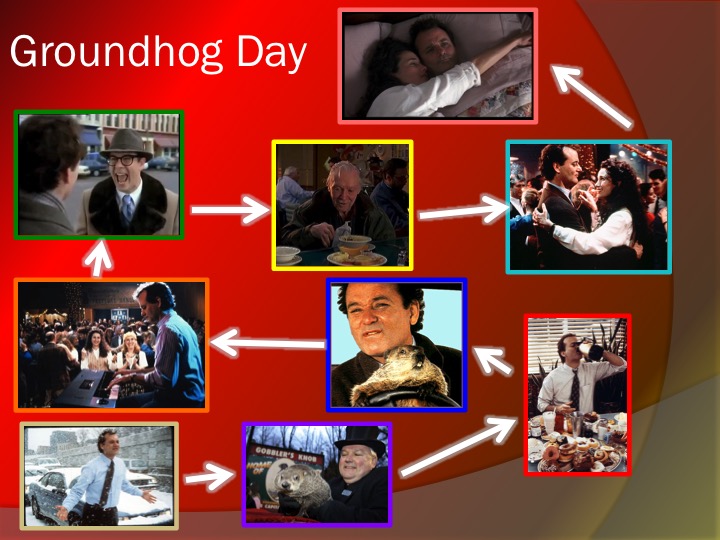
Groundhog Day, with Bill Murray, Spiral v- Meme Evolution

In the last post, we talked about one of the benefits of more highly evolved employees — a more profound, variable sense of time scales.  And then talked about the movie Groundhog Day, a classic as far as evolutionary enlightenment.  We ended with the question — how do you get individuals to evolve from externally defined, belief-based relationships to independently generated, data-driven, trust-based relationships?  How do we start the process of development of rational, and even global empathy?

If you want people to have independently generated, trust-based, data driven relationships with others, the first person they must have them with is themselves.  And in Groundhog Day, this is accurately portrayed.  The first thing Bill Murray’s character, Phil Conners, does to break the destructive rut he is in with his Legalism is learn to play the piano.  He goes on to learn French, ice carve, and a host of other things, for those that remember the movie.  But the first big step is at the keyboard.

What does this mean? Performance, mastery and appropriate calibration/grounding are the key things that develop one’s relationship with oneself.  When you make a mistake at the keyboard, the piano lets you know.  Either it sounds right, or not.  One can listen to recordings and determine if the piece is being played correctly — it makes sense to benchmark against other standards.  But the ivories don’t lie.

Not surprisingly, this same evolutionary principle is in play with my students in the Industrial Design Clinic.  By giving them a real customer, that wants a real product, it radically rearranges the circuits in their head.  No longer can they make up reports that they intrinsically know teachers will never read.  No longer can they make up reports that are automatically 20 pages long to get an ‘A’.  The purpose-driven life starts with an authentic experience.

It is always an amazement to my students that their customers read their reports.  Instead of the usual glossing over that professors (or TAs) give the stack of reports, my customers give detailed feedback.  They complain if reports are TOO LONG.  It’s a shock to the system.  And it starts the process.

Back to Groundhog Day.  Phil Conners continues up the evolutionary ladder.  The next step is Communitarianism, and represented by his development of relationship between himself and the insurance salesman, his old high school comrade, Ned Ryerson.  At some level, that might be predictable.

But the next transition — to the Global Systemic/Second Tier Self Awareness is one of the most interesting in the movie.  As Phil becomes more empathetically connected with everyone in Punxatawny, he encounters an old, homeless man.  He  does the best he can to save him, over and over.  Yet the old man always dies.

What is being communicated here is the developmental stage of self separation and differentiation necessary for self awareness.  In order to become truly self aware, one must realize that one simply cannot project one’s persona onto someone else.  The movie does this with a stark contrast — Phil Conners lives on, and the old homeless man dies.  Yet at the same time, Phil learns the larger value of a complete, rational compassion.  He can only help the old man in his transition — and it is enough.

After this, the movie trips on up the next two levels — Phil is involved in a fractal temporal and spatial fashion with everyone in Punxsatawny (he always has to be in the same place, at the same time every day to catch the kid falling out of the tree.)   And at the final ball, with the potential, chronically unrequited love interest, his weather producer, Rita, played by Andie MacDowell, not only is he empathetically connected with everyone in Punxsatawny, he is also helping them.  This is a v-Meme that doesn’t show up on the prior Spiral chart —  known as Coral/Bodhisattva. In Mahayana Buddhism, a Bodhisattva is essentially someone who has stayed behind from ascending to Nirvana to help all sentient beings on their path.  It is only after getting to this point that Phil wakes up in bed, next to Rita, unconsummated, of course, with the clothes he is wearing from the night before.  The time cycle has been broken.  He is enlightened.

Since it is an American movie, of course, the lovely Rita wants to get married to Phil, and naturally he agrees.  When she asks him where he would like to live, he says “why not right here in Punxsatawny?”  If you’re enlightened, it doesn’t matter where you’re living.  But then after that, he says “but we’ll rent.”  He still has a capacity for self-discrimination.

The movie has many lessons for employee evolution, and is especially helpful for finding paths for meaning in work for all ages.  Though not everyone is at all the same, my observations of my students confirm the Performance/Goal-Based v-Meme development that happens between the ages of 19-26.  After that, I have found a steady cycle of clients looking for that Communitarian v-Meme transition around the age of 35.  What is interesting is that they often approach the university through athletics.  Football is, unsurprisingly, popular as a Communitarian gateway.  Everyone wants to be a member of the ‘Cougar Nation’ (our mascot is the Cougar.)  When the fascination with football wears a little thin, mechanical engineers often find me and the IDC as a way to contribute.

The next transition happens around the age of 52, often in the wake of a personal, mid-life crisis.  Facing one’s own death, regardless of prior v-Meme evolution, often causes personal epiphanies.  People in this age group are concerned about larger and longer legacies, and interestingly enough, are not as concerned with student projects and bottom lines.  I work with them to form meaningful relationships and structures, not just for completing projects, but also providing career and life advice.  In recent years, the IDC is also involved with several non-profit projects, and I have successfully utilized one colleague/friend to develop low-cost prosthetics as well as UAV systems for conservation.

Nothing is written, empathetic-development-wise, however.  People often get stuck.  Not everyone will become an enlightened master or employee.  But by increasing one’s own awareness as a leader, one can help both the individual and the company you work for along the way.

Evolving your People and Reducing Conflict — the Lessons of Groundhog Day (Part I)

Pantanal Bird

Weaverbird, Pantanal, Brazil

A long, long time ago, in a post far, far away :-), I explained the basics of  Spiral Dynamics v-Meme evolution.  Naturally, throughout this blog, this is also coupled with all the others — societal, and empathetic evolution.  But to get out of the spaghetti trap that inevitably comes up when talking about all of this (there are days I like to say “Hey, I know what the whole elephant looks like, and I’m all tangled up with him in a big ball of spaghetti!”) let’s just set those causal connections aside — go ‘Open Loop,’ as it were. How do we understand that personal evolution that we need to promote to reduce conflict?  And why should we care if our employees are enlightened?  Shouldn’t they just listen, and do their job?  Can’t have people meditating on the job, after all!

But really — why do you want enlightened employees?  What principles can we borrow from empathetic evolution to help us understand how higher levels of empathy can assist in the workplace?

To start, evolved minds will have a variety of temporal scales programmed into their neurons that they can operate under.  An enlightened person can more effectively sort the priorities of quarterly reports, yearly summaries, and whose turn it is to clean the coffee pots.  An example is in order — where you can see the consequences when folks DON’T have this.

In my Industrial Design Clinic (IDC), I have somewhere between 60-80 students a semester, all working on their final project for graduation.  There are some 10-15 projects/semester, all with a deliverable.  My age cohort is, not surprisingly, very uniform — most around 21-24, looking to graduate.  As I’ve said earlier, they’re transitioning out of complete externally defined relationships, into the land of independently generated relationships and their first real brush with high-stakes rational empathy.  They have a customer — usually, their very first in their profession!

That means that most of them are very egocentric.  There are only a couple of recognized time scales in their head — their own Survival v-Meme time scale (I wanna drink a beer tonight!), my imposed Authoritarian time scale (canonical design process) and of course, graduation.  My authority is in profound eclipse by this time.  In the back of their heads, they know that whatever they do, they’re likely to graduate.  It’s up to me and my system to stimulate higher-evolutionary behavior in order for them to complete their task.

So what do I have them do?  I have them draw up a schedule for work, multiple times during the semester.  Not surprisingly, the first couple rounds of the schedule are utter B.S.  They have been taught in other classes about Gantt charts and the like — and their charts are typically very linear (as one would expect from their empathetic development and relational sophistication) with broad, generic topics like ‘Research/Development/Design’.  Underneath task assignments are the personnel listing.  Mostly, these are ‘All’.

Which, as anyone who’s worked knows, means ‘None’.  Everyone’s responsible, and no one’s responsible.  All mid-term deliverables are vague, so nothing can get done.  Being a young Authoritarian means having poor executive function — someone else is supposed to tell you what to do.  They’ve had 16 years of education beating THAT lesson in their head.  Do what your betters tell you.

I go at the kids, full-tilt, of course.  The schedule must have multiple paths.  It must have measurable deliverables.  Pairing, as I’ve mentioned before, is big.  Multiple people must be assigned and justify their behavior across the group.

What happens, with poor temporal evolution?  In scheduling, there is a method called Critical Path Analysis, or Critical Path Method (CPM)  In this method, the schedule is laid out as a branching tree, re-converging at the end of the process when the deliverable is shipped.  One route through the network of tasks is the ‘Critical Path’ — the longest time through.  All the other paths have what is called ‘Slack’ — extra days/weeks that exist because those tasks are not on the Critical Path.

Inevitably, the majority of the student groups let all tasks not on the Critical Path slip until, instead of having one Critical Path, you have Critical Paths along ALL the project branches.  Now, if anything comes ups, the project is screwed on the delivery date.  The students do this because they have poor metacognitive awareness and an un-evolved sense of time.  Low responsibility, present because of low empathy, means that nothing will happen until the Survival v-Meme kicks in.  There’s a lot more to unpack here.

It’s in your business’ interest to have employees with a highly evolved sense of time.  It allows appropriate job scheduling and discrimination, for one.  The above is just one example.  You can’t get everyone to be a Zen master, but the more people you can push up the chain, likely, you’re better off.  There are others, of course — but this is a big one.

So how do you do it?  The best example I’ve come up with in explaining the various v-Meme transitions is the movie Groundhog Day, with Bill Murray. Groundhog Day, besides being entertaining, is a very interesting movie.  It’s been translated into (at my last check) over 35 languages.  It’s on a number of ‘best movies of all time’ lists, and I’ve found that I can travel far back into rural China and almost always, find someone who’s seen it.  This is pretty amazing for a movie that is ostensibly about a colloquial American holiday, and not a very famous one at that. But what the movie is about, of course, is the search for human enlightenment.  And that is a transcultural, universal theme.

The movie starts out with Bill Murray, as Phil Conners, a weatherman, stuck in a snowstorm in Punxsatawny, PA, the Groundhog Capital of the world, for the annual Groundhog Day celebration.  It’s all too low-level for Phil, and after he films his clip, he tries to get out of town.  Survival v-Meme all the way – he gets turned back in the snowstorm, as the freeway is closed.

Then the major plot device of the movie kicks in.  Stuck in a magical loop (Tribal/Magical v-Meme), with a totem animal — the groundhog — Phil is forced to repeat that same day over and over again.

The first part of the movie displays Phil in all his Authoritarian/Egocentric glory.  He stuffs his face with donuts.  Impervious to consequentiality, he steals single pieces of information from women to use to get them into bed the following day.  He indulges himself.  And none of it makes him happy.

Phil then moves into the Legalistic v-Meme part of the movie.  He attempts to break the rules of the system, mostly through trying to kill himself.  He tries to kill the groundhog.  Nothing works.

In the first half of the movie, what is interesting is that Phil has almost completely, an externally defined or exploitative relationship not just with others, but himself. He’s going to be the next NYC weatherman, and so on.  And then comes the admission — “I’m not really sure I even like myself.”

But how does Phil start the path toward independent relational generation?  Pause before reading the next paragraph and think.

Most people I’ve talked to will immediately say ‘he gets involved with the community,’ or something similar.  This is actually not true.  We often view community interaction as a way for evolutionary growth, and there’s nothing wrong with that.  But in order for Phil to first have an independent relationship with others, there’s an important person he has to have one with first.  Himself.

And how he does this is the key toward evolving your cohort in the 21-35 year old age group.  The answer awaits in the next blog post!

Conflict — Understanding, Avoiding and Healing it — Inter- v-Meme Conflict (Part III)

steamboatbend

Steamboat Bend, Yampa River, Utah in Dinosaur National Monument

——————————————————————–

“If you want epiphanies, you have to put them in the schedule.”  Phil Brick, Politics Professor, Whitman College, on his Semester in the West program

I’ve been short on solutions in the last three posts — namely, because there honestly aren’t any simple ones.  When you have two people in conflict, and the way they structure knowledge is fundamentally different, meta-structures are not easily reconciled — let alone fundamental beliefs and precepts.  Those that argue folks just need to sit down and talk it out?  Well, it’s not that it never works.  But often it’s not just a failure to communicate.  It’s a failure to truly connect.

One of the things that I have seen work in resolving conflict is the creation of opportunity by leadership for shared epiphanies between warring parties.  Note that this will NOT work with relational disruptors.  But for those involved in Healthy Evolutionary Conflict, the elevation in empathetic connection that can occur with shared experience should not be underestimated.

In my youth, I used to be a hard-core whitewater kayaker.  I originally moved out to the West because of my obsession with the sport.  Running hard whitewater was still in its infancy when I started (1979), and basically, you had to paddle with whoever was available who could paddle at that level.

When I moved to Pullman, WA, in 1988, I also became intensively involved with the environmental/old-growth protection movement.  I went on to write a book on the larger issues involving my home watershed — the Clearwater River in North-Central Idaho, called Wild to the Last:  Environmental Conflict in the Clearwater (WSU Press, 1998).

While working on the book, I had more than one logger who was my kayaking buddy.  I am still friends with these people now.  I am convinced that what bound us together was shared experience.  Loggers like being in the woods;  I like being in the woods.  Additionally, we would have to share a Survival v-Meme level interdependence.  If someone went for a swim in some of the rivers we paddled, without a strong cohort to rescue them, that person could drown.  Additionally, there were lots of opportunities to develop shared heuristics — sometimes we’d run particular rapids;  other times we’d have to find ways to carry around them.  The harder rivers were always team efforts.  A particular empathetic ladder practiced by one of my friends was the instilled practice of fetching each other a beer.  If someone asked you to get up and get them a cold one, you did.

At the same time, we were relentless in our taunting of each other if you went for a swim, and failed to roll your boat.  I asked one of the guys one time why we were so hard on each other — his response was simple.  “Dude — keeps you safe.”  You don’t want to be the butt of the next joke.   So you make your roll.

For bridging large gaps, there is nothing like shared, stressful experiences that bring out deep core values in all people.  One finds almost no healthy person on this planet that doesn’t understand the guest/host relationship, or the fact that most people care deeply for at least a few people.  But bringing out these connections requires making time for them.  If you have nothing in your organization except endless work and meetings, you shouldn’t expect anyone to care about anyone else.  Almost every workplace has formal relations and titles.  But independent relationships take time to develop.  And without these, there will be little trust or shared responsibility in an organization — especially when times get tough.

The starting quote at the top of this post was told to me by a friend and another professor, Phil Brick, who teaches at Whitman College.  Whitman is a small, elite school, filled with some of the smartest and self-aware kids I’ve ever gotten to teach.  Phil had launched a pioneering active learning program at Whitman, called Semester in the West, where students would travel around in a van to various sites of environmental conflict all the way from Washington to Arizona and New Mexico.  He had tagged me for explaining forest politics to his kids, on the ground in the Clearwater National Forest.

As a fellow professor and environmental activist, I asked him that evening to show me his schedule for the semester.  It was fall, and I was scheduled early on, and was curious what they would do as the light failed.  Battery-operated LED headlamps had recently come into vogue, so that was one question that was answered.  About 11 or so weeks into it, he had a week in Nevada labeled ‘Epiphany Week’.  I asked him about that.  “How can you expect students to have time to have any realizations if you don’t schedule them in?”

At that point, I had an epiphany.

The best solution for resolving conflict is avoiding it in the first place.  Some conflict is inevitable, but if you have chronic conflict in your organization, it means that leadership has set up a non-viable structure for getting the job done.  As the Star Trek blog post shows, you can have different v-Meme actors in any organization and have them form a functional, high-performance team if their roles are appropriate.  But organizations that do not put some priority on individual growth of their workforce are asking for trouble.  Because people will grow and evolve, regardless.

Since this blog is going to get turned into a book, there’s a little voice in the back of my head that says ‘Create things that are Internet listicles!’  But a better thing to tell you, the reader, is this:  what is the structure of the organization that is causing the conflict?  Have you looked at your scaffolding, and appropriately balanced authority, rules, and the ability to change rules?  Do you provide opportunities for data-driven relationships, or are you obsessed with titles?  If you create irrational environments, you should expect irrational people.  And irrational people get into fights.  If you need a bottom line motivation, fights cost money.  But hopefully, by this point in this whole blog, you should be motivated by more than that.  If you’re not, you’re likely not really needing higher synergies to get the job done.  Though I’d argue that even a lawn service company will benefit from structuring environments and roles to avoid conflict.  Happy employees figure out better ways to make happier customers.  One of the things I also do with my students is have them work through what is commonly known as the Five Whys, or some form of root cause analysis.  Having two warring parties write these kinds of things down separately, and then have them be empathetically reconciled, where both sides have to engage in a more rational empathy, can be useful.  If you practice knowledge structure identification yourself, you can also bring both parties along by serving as a bridge for larger consequentiality of action — the things that people often find are missing.

But there is no substitute for shared experience in empathy construction.  As well as epiphanies.  Make time for them — and the reflective time that is also required.

Conflict — Understanding, Avoiding and Healing it — Inter- v-Meme Conflict (Part II)

Hobo Old-Growth

Hobo Cedar Grove, outside Clarkia, Idaho

————————————————————————-

“Thunderdome’s simple. Get to the weapons, use them any way you can. I know you won’t break the rules, because there aren’t any.”  

“All our lives hang by a thread. Now we got a man waiting for sentence. But ain’t it the truth: you take your chances with the law, justice is only a roll of the dice. A flip of the coin. A turn… of the Wheel.”

Dr. Dealgood, in Mad Max Beyond Thunderdome

In the last post, I talked about what happens when one has 2 levels of v-Meme mismatch — the Incomprehension Gap.  Larger problems start occurring when instead of just 2 levels, one has 3.  I call this gap the Insanity/Barbarism gap, and it occurs up and down the Spiral.

Examples illustrate this better, but I’d argue we have an intuitive sense when this is the case.  The first two quotes, from the movie Mad Max Beyond Thunderdomeis a classic v-Meme scramble that might be found in a collapsed, post-apocalyptic society.  The main premise is the scenario of recovering civilization after a nuclear war, where Max, a former police officer and chief protagonist, has a variety of adventures as we wanders somewhat aimlessly through the post-nuclear landscape.  He ends up in Bartertownafter his camel-drawn wagon is stolen, and ends up in trouble.

Thunderdome, the primary site and source of justice in the town, is where any two conflict-oriented protagonists are sent when there is a problem, to battle it out to the death with a variety of weapons strapped to the walls of the dome-shaped cage.  In a Survival v-Meme environment, the idea of any higher justice is simply insane.  It goes without saying that anyone at a higher level of legalistic nuance would find Thunderdome barbaric.  But at a Survival v-Meme level, Thunderdome makes sense.  Conflicts are terminated quickly, and entertainment is provided for the locals.  What’s not to like?

The Insanity/Barbarism conflict is easily applicable up the Spiral, at any levels most of us are likely to evolve to.  An example of the conflict might be seen between a Tribal society with strong taboos, and a Performance/Goal-Based culture or organization.  Locally, for example, the Nez Perce Indians have a strong taboo against the presence of an owl in any venue.  True Nez Perce are supposed to just go home and take the day off if one is seen in a tree.  Imagine how a conflict might play out on a job site for a time-critical project.

The figure below shows some of these examples:

Slide07

Another great example goes back to the conflict between Communitarians and Authoritarians, and what to do with homeless people.  An Authoritarian wants to put them on a bus to the next town.  The Communitarian wants to help them, clothe them, house them and educate them.  To the Authoritarian, the Communitarian is obviously a kook.  What are they doing attempting to help someone at the bottom of the social ladder?  To the Communitarian, the Authoritarian is a barbarian.  Why can’t they think of anyone but themselves?

Conflict here encompasses multiple knowledge process systems.  Authoritarians, by virtue of their externally defined relationships and low empathy, are belief-driven.  Time scales are also externally defined, and there is no master scale for recovering a homeless person’s life.  Spatial scales are also small — the homeless person, if they weren’t camped out in the Authoritarian’s town, would be someone else’s problem.  Out of sight, out of mind.  We’re all familiar with the intensity of local rivalries as well.  Who cares if those people in the next town over are unhappy?  Back in Southern Ohio, where I grew up in an economically depressed region along the Ohio River, we relentlessly made fun of Kentuckians and how stupid we thought they were.  Reality doesn’t matter — there was little separating the social evolutionary level of either community along the river.

Contrast that to the data-driven Communitarian.  When everyone is different, the implication is that everyone then possesses their own story, their own sentience, and their own humanity.  Each case may fit under larger, generic classification (mental illness, substance abuse, past history of child abuse) but a rational empathetic sense necessary for an evolved Communitarian v-Meme is also going to identify individual characteristics that create an independent personhood.  Additionally, a more developed sense of responsibility (why would we just send our problem to another community?) and a larger sense of consequence (what would I say to a member of that other community if we just shipped them our problem?) are also going to dominate the Communitarian’s action.

Regardless, the Authoritarian perceives the Communitarian as a kook, and the Communitarian perceives the Authoritarian as a barbarian and an agent of chaos.

Many current political debates occupy this particular v-Meme gap.  Social welfare issues, property rights — anything involving a fundamental, egocentric belief vs. a more complex, data-driven landscape ( can we talk about national health care now?) makes this a very difficult chasm to span.  And the problem, which will be covered in future blog posts, is the belief-based manipulation by Psychopathic Devolutionary Conflict instigators that even prevents lower v-Meme evolved individuals from recognizing self-interest.  This gap, and its manipulation through a variety of interests, is the key element preventing evolutionary progress in the American political system today.

Conflict — Understanding, Avoiding and Healing it — Inter- v-Meme Conflict (Part I)

Hallstadt

Hallstatt, Upper Austria, on the Hallstatter See

In my previous post, I talked about what I called Intra v-Meme Conflict.  I didn’t go on much about solutions, because there is an enormous body of accessible literature on conflict resolution, and so many of these people have done much deeper thinking on this than I have.  One of my conversation partners, Tom Tripp, a professor at Washington State University – Vancouver, for example, has written an excellent, encyclopedic book on workplace revenge.  It’s a great book that covers dealing with Authoritarian/Legalistic v-Meme conflict.

What is more interesting to me is how mismatch in temporal and spatial scales that creates information structures inside people’s brains causes larger conflicts.  Egocentric conflict, though widespread, is easily understood.  I want something, you want the same thing, and I’m willing to hit you over the head to get it.  But what happens with major modes of misunderstanding?  Why can’t folks understand global warming, for example?  And why do we have such virulent conflict in our political spaces today?

In this blog post, I am going to cover what I call Healthy Evolutionary Conflict (HEC).  This is opposed to Psychopathic Devolutionary Conflict (PDC) — a different animal altogether.  The difference is simple.  HEC implies an honesty of evolution, where someone possessing the mental models they have come by them through a conflation of formal learning and personal experience.  For example, it is not realistic to statistically expect someone raised in a Full-Bible church their whole life to stand up and support the idea that the a man named Noah never existed, and the world was not, at one time in the past 6000 years, covered with water.

This is VERY different from PDC, where someone with a disordered empathetic sense, borrows from others’ mental models, based on some intuitive reading of THEIR beliefs, in order to manipulate, fool, and control another individual.  The best portrayal of this type of character in recent cinematic history is the Joker, in the movie The Dark Knight — a must-watch for people wanting to understand relational disruption by an individual.  The Joker is worthy of a multiplicity of posts regarding empathy himself, and how anti-empathetic characters cause relational disruption at a variety of v-Meme levels.

Inter v-Meme conflicts arise because of the naturally generated consequences between how different societies and individuals generate worldviews based on their social and knowledge structures.  For example, someone with a performance-based v-Meme likely holds that the most important thing is achievement of a given goal. How much that individual does this in an ethical fashion, with respect to authority, and such is dependent on their lower v-Meme level scaffolding.  As discussed earlier, someone without much Legalistic programming in their background may indeed be Performance-based — but they are likely also corrupt.

When you put a person with a dominant Performance/Goal-Based v-Meme together with someone who is predominantly an Authoritarian, what arises is what I call the Incomprehension Gap.  An Authoritarian might be able partially to understand why a Performance-based person wants to achieve a given goal — status, or money, for example.  But if achieving that goal means surrendering some level of control in order to achieve it — “to hit our targets this quarter, you’re going to have to let Bill take charge of this key project” — they’re not going to understand.

Likewise, the Performance-based v-Meme actor is going to be confused by the behavior of the Authoritarian.  Don’t they realize that their behavior jeopardizes the larger success of the company?  What about the amount of stock dividend?  What about having to answer to shareholders at the annual meeting?

The reality is that this kind of thinking requires a level of consequential awareness that the Authoritarian does not possess.  This is a very difficult concept for most people to grasp — that social/relational order actually creates the timescales inside people’s heads.  At the same time, it’s not difficult to generate 100 situations that we all have dealt with in our work worlds where this kind of behavior is exhibited.

I call this the Incomprehension Gap, and it is characterized across the v-Memes by a 2 v-Meme gap.  See the figure below.

Slide06

The picture above refers to Incomprehension among all “I” v-Memes in the Spiral. But there are also Incomprehension gaps inside the “We” v-Memes.  Compare the understanding that might exist between someone in an evolved Legalistic v-Meme, vs. a Communitarian.  The Legalistic v-Meme person will be prone to classification, because things are ‘fair’.  The Communitarian, believing that everyone should be treated as an individual, might attempt to explain extenuating circumstances for not including that person in a particular classification scheme.

An example might be this:  in my career as a professor, I’ve worked extensively with the Hispanic population.  Washington State has a large Hispanic underclass, mostly originating in the Yakima Valley (Trabajadores Migrantes — migrant workers) and my primary reason for offering my services was really class-based social justice.  When asked by Legalists why I didn’t do more to recruit middle class Hispanic students to the various labeled social organizations, I told them I didn’t think it was necessary.  Hispanic kids from Seattle, for the most part, were indistinguishable from any other middle-class kids from Seattle.  Often the only way you could tell them apart from the other middle-class kids was because of their surname.  This was met with some consternation.  “They’re Hispanics!” the Legalists would cry.  Never mind that the students themselves didn’t want to participate.

My personal experience with people working across the Incomprehension Gap is that conflict can occur, but mostly results in mystification of both parties.  Their understanding of the other seems so close — yet especially when spanning the gap between Externally Defined relationships and Independently Generated relationships, the distance is still large.  People in the former categories are belief-based thinkers, and messages to them are going to have to be translated into their belief systems.  Independently Generated relational people are going to be data-driven, and more contemporaneous and situational in their thinking.

As might be expected, it is up to the more evolved thinker in the conflict to develop the knowledge structure that the other can understand.  And at the same time, these types of conflicts show why it is so important to continue evolutionary development of everyone in an organization.  People will always settle on a particular v-Meme modus operandi — for example, I almost always settle back to a default Performance/Goal-Based v-Meme.  “Let’s get the job done!” I’ll say.  That sounds good — but in a Power Structure/Hierarchy, jumping levels to upper level decision makers above your main boss can hurt your career.  ‘Nuff said!

But self-awareness on both parties can make all the difference — and lead to negotiated solutions.  More on this later.

Conflict — Understanding, Avoiding and Healing it — Intra- v-Meme Conflict

hmeadows

Hanson Meadows, Kelly Creek Roadless Area, Clearwater National Forest, ID

“What we’ve got here is a failure to communicate.”  The Captain in the movie Cool Hand Luke

One of the interesting things revealed by understanding people and the social structure they inhabit, in terms of the knowledge structures their brains are wired to accept, is when one can expect conflict.  Conflict always boils down to two types — Intra v-Meme conflict (conflict between people or organizations with the same v-Meme sets,) and Inter v-Meme conflict (conflict between different people or organizations with differential v-Meme sets).

Intra – v-Meme conflict is the base lens that most people view conflict through.  Two people, roughly evolved to the same level, can’t agree on surface-level facts or situation.  This expresses itself as a disagreement, and will have to be resolved through whatever the dynamics and tools that are available to the individual or organization inside that v-Meme.  The classic conflict we’re all familiar with is Authority vs. Authority — two authoritarians, each with a different view of the world that they control, that can’t agree.   As history has shown repeatedly, these types of conflict have to end with exhaustion of both sides (essentially a v-Meme devolution to a Survival v-Meme,) or destruction of the other party.

It’s not hard to generate examples from the other v-Memes, as long as the dominant v-Memes are dominated by externally defined relationships, and emotional empathy.  Many have said the main reason Native Americans lost in their struggle against white imperialism was because of fratricidal relationships between the tribes.  Crow Indians hated the Sioux, for example.  The Iroquois Confederacy (more accurately described as a Legalistic Authoritarian system than a Tribal alliance) sided with the British against their ancient enemies, the Hurons, who allied with the French. One might not be so surprised by the chronic rioting after football/soccer games if one considers the tribal/magical allegiances that shape powerful, low empathy in-group/out-group dynamics.  And Survival v-Meme conflicts are also easily understood — if it’s your survival band that needs the watering hole, and without it, you’ll die, one can see how more evolved behavior goes by the wayside.

The costs of intra- v-Meme conflict are interesting generators of higher-level empathetic cultural modifiers themselves.  The tradition of Potlatch among Northwest Native American tribes was a period when classic Authoritarian v-Meme violence between the highly evolved salmon tribes of the coast was set aside for gift-giving between aristocrats in the tribes, that obviously developed relationships that held off chronic inter-tribal war.

Needless to say, a great deal of human history is filled with intra v-Meme conflict — as well as many organizational conflicts inside modern corporations and organizations.  I was previously the Chair of the Faculty Senate at my home university, Washington State University, a large land-grant institution stuck in the middle of the wheat fields of Eastern Washington.  Anyone who wonders whether education structurally changes behavior in social systems — eh, not so much.  One of my favorite quotes was “if you wonder why faculty fight like the gangs in South Central L.A., it’s because they have the same social structure.”  How true that is.

And these types of v-Memes, while ancient, are still prevalent in the minds of leadership.  When asked why he invaded Iraq, aside from all the hoopla over non-existent weapons of mass destruction, George W. Bush said succinctly about Saddam Hussein — “He tried to kill my daddy.”

Takeaways:  Intra v-Meme conflict is something that we are all familiar with, and is almost always confined to the lower v-Memes.  Egocentric projection dominates — who cares about the fate of whoever is in the out-group anyway? — and consequential behavior is minimized.  Lack of multi-solution thinking forces these conflicts in organizations back a devolutionary chain.

What are the Implications of Bad Scaffolding? China and the Last 100 years.

Daluandme

Runlu Li — my Godnephew and me in front of Sky Temple, Beijing

One of the biggest problems, when talking about evolving societies, is the natural critical expectation of an evolved society to get everything right.  Just like there are no perfect people, there are no perfect societies.  We all have our weak points.

Here, Spiral Dynamics can do an excellent job of giving guidelines on how to find the holes, or at a minimum, where to start looking.  A great example might be China in the 20th and 21st Century.

China at the beginning of the 20th Century was a mess.  Its government was really not a government, and regional warlords ran most of the show.  China had never really emerged from its dominant governmental form of narcissistic authoritarianism that made up the majority of its vast history.  The result of 2000+ years of relatively constant v-Meme assertion, however, was one of the most sophisticated forms of arguably empathetic authoritarianism in history.  Chinese culture was, and still is, even post-Cultural Revolution, extraordinarily complex, and I’ve talked about how things like chengyu buffered the population from the excesses of the Emperor, as well as the modifications offered up through Confucianism and Legalism.

WWII led to further fragmentation, rule by the Japanese in the north, and eventually, the collapse of the Kuomintang government, which then led to one of the most destructive and austere forms of authoritarianism on the planet — rule by Mao Zedong, and the reduction of Chinese society into two classes — party members and non-party members.  What is interesting about all this is that it is very difficult to second-guess history.  Would modern China have been possible without the narcissistic psychopathic excesses of Mao?  Without the Great Leap Forward, or the Cultural Revolution?  With China’s chronic problems with overpopulation, there are huge questions in how one gets to a society where individuals might be valued, when there is such an excess number of them.  This is NOT intended as an apologia for a cruel and vicious regime.  But the agricultural reforms implemented by Mao also broke the back of the regressive authoritarianism present from the various warlord periods.  As wild as it may seem, Mao was a strange agent of societal evolution for China.  He established an unstructured sense of a Legalistic v-Meme ‘We Mode’ that elevated the peasant class, while killing a lot of the landed gentry — somewhere between 1-2 million landlords were executed.  This came with enormous informational cost — no question.  But it also dismantled a social structure that had been in stasis for thousands of years.

After Mao’s death, Deng Xiaoping implemented many of the economic reforms (Performance-based v-Meme) that led to China’s current prosperity.  The numbers of Chinese peasants lifted into the middle class in the last twenty years is staggering — it is estimated that the Chinese middle class now composes approximately 68% of the population.

Yet China as a whole still has a relatively undeveloped legal system.  Most of the population do not believe in the courts. IP theft is commonplace (and well-publicized) and the lack of ability (that comes out of a poorly developed Legalistic v-Meme) to develop uniform codes and standards dramatically affected the ability of China to even have a civil airspace.  You can’t have commercial aviation in an Authoritarian v-Meme setting.  What happens when the boss is asleep?  Who gets to land first?

Relationships in China are still primarily externally defined.  I’ve mentioned earlier in this blog that if you see two people fall in love in a Chinese movie, you can be sure that this will result in their death at some later point.  But the effects of increased peer-to-peer communication are changing China.  There is a growing environmental movement.  Some of it is local and independently emergent.  But what is fascinating is that the Chinese government realizes that there is no way to avoid the development of SOME kind of environmental movement, as Chinese pollution problems are so bad.  Keeping with the v-Meme of external relational development, the Chinese government has set up GONGOs — Government Organized Non-Governmental Organizations — whose purpose is to be concerned with various environmental issues that the government may be slightly on the other side.  By setting these up, the government intends to control their activities.

But the reality is you can run, but you can’t hide from the fundamental empathetic physics present in sentient development.  Membership in the GONGOs is self-selected.  Which means like-minded people are going to meet, and start the data-driven evolution out of their former belief systems.  They, by virtue of being involved with each other in that independent, self-selected fashion, will start demanding real laws, and real data-driven solutions.  My bet is that between the One-Child policy, which is going to force an entire generation out to make friends, and the environmental movement in China, we will finally see the backfilling in of the Legalistic v-Meme that was skipped by Deng, and an increased developed empathy across the country — perhaps even to some level of communitarianism.  Sure, it will take 20-30 years.  But it’s on its way.

Further reading:  McKinsey reports are a great research resource for a broad range of issues.  This one is on China’s emergent middle class. And this one is on the Chinese consumer of 2020.  The reports focus mostly on aspirational capitalism and ignore the other trends that accompany an increase in purchase of status-based goods — namely diversity of goods, and the increase in empathetic identification that becomes important as consumer goods become increasingly fractionated — as well as the demand for design thinking (and the creative networks) to make those goods with a Chinese cultural flavor.  But that’s a topic for another blog post.