Father and Son, in front of the perfect human form, Galleria dell’Accademia, Florence, Italy – pre- weight loss, 2015. Note that Michelangelo’s David does not have metabolic syndrome!
One of the largest cognitive challenges I’ve found in understanding and disseminating my work is that we are not accustomed, at all, in thinking of populations as having Gestalt thought processes outside what various social mores dictate. We are very comfortable in saying, for example, that Japanese people are very polite, or that the French like to argue. And we are also accustomed to saying pro-social things like ‘academics are liberal’ or ‘universities are full of smart people.’ Equally so, we are also comfortable with negative stereotypes of populations that are culturally contained. As someone from the foothills of the Appalachians, I am very familiar with the American cultural notion of “the stupid hillbilly.”
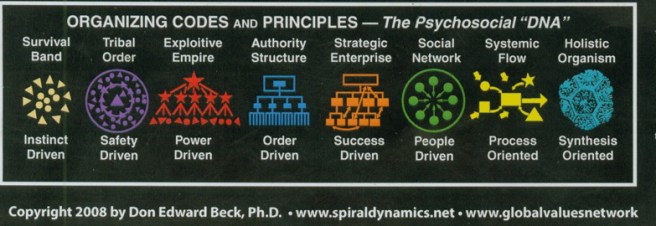
The problem with all this is the initial interpretation, especially if the stereotype is negative, is that we’d like to then state something like “hillbillies are smart” to escape a negative labeling of our own perceptions and tendencies to stereotype — because most people, if asked if stereotyping is bad, will say “of course.” Stereotypes of stereotypes come out of the lower status-based v-Memes. And before you know it, things get very meta. It’s turtles all the way down.
But when you step outside of accepted social demarcations, discussing how people think is fraught with peril. I’ve found that most people view it as a boundary violation (“how dare you tell me how I process information in my brain!” ) and usually leads to being shut out of their larger consciousness — especially if they haven’t developed any deeper reflective process on their own. And on a larger, societal scale, what this prevents is more thoughtful analysis of how our culture changes over time, and what are the origination v-Memes that will generate the future cultural sidebars that may be more long-lasting.
We’re prevented from understanding ourselves in aggregate as we evolve over time — which means hindsight is the only politically palatable and available means for modification of our own perception. And that doesn’t really help with the here-and-now. If one examines our current political milieu, for example, will a stereotype emerge that Americans are, for example, very conflict-prone? Are they victims of a unique bi-polar disorder when it comes to politics? Or has this really been a long time coming?
With this piece, I’m going to discuss how excess sugar consumption might be affecting our fundamental v-Meme tendencies, and convert us from a more egalitarian, communitarian society, to one where Authoritarianism is the dominant v-Meme. But I also hope to show how one might move people beyond the current dichotomous world — and to help understand the real implications of our Theory of Everything applied to multiple factors that shape our current consciousness. I’ll discuss how the Principle of Reinforcement, and the self-similarity it advocates for– the idea that what we see in the society at large is reflected in the individuals, and those individuals then have their aggregate probabilistic v-Memes reflected upward — are in play, and always have been. The implication is that how our brains function, even on the smallest neural scales, on an individual basis, will inevitably express itself in the larger society.
The other thing that seems impossibly difficult to accept (in part because it requires faith in the powers of reason, no matter where they may lead) is that societies manifest their v-Memes across the entire spectrum of potential causes-and-effects in the larger system. Lately, for those that follow this blog, I’ve been writing about diet. And as crazy as this may see at the beginning of this — my sons warned me that writing about this, to the casual observer, as being ‘Tinfoil AF’ — as I said at the beginning, I’m going to make the case that sugar and its consumption/over-consumption in Western diets is one of the major drivers of our current neurogenic, physical, as well as political ills.
The minute that someone says something like this is that most people will expect a conspiratorial argument, along the lines of “the Sugar Industry is behind the scenes, pulling the levers politically, and they are making a ton of money off of making us sick.” The way society in general views large problems is often from the perspective of a cabal of Illuminati, working diligently to advance their financial cause, and screw anyone, or anything that gets in the way. Very Authoritarian/Legalistic “known knowns, unknown knowns” kind of stuff, direct from our Reptilian Overlords, whose real interests are fattening us up for the slaughter.
And certainly, there are cases where conspiratorial dynamics truly ARE the case (or rather, a major part of the case.) Take the domination of the oil industry over our society for the past 120 or so years. Anyone wanting a global perspective on the use of oil can read Daniel Yergin’s amazing book, The Prize, for a compelling look on how money, power, and resource networks form, thrive, and actively manipulate politics.
Yet at the same time, even though there are clear names of dynastic families and companies to put on the conspiracies present in that book, it’s also important to realize that the behavior of this network was also emergent out of the v-Memes of the time. Winston Churchill, the primary driver as the First Lord of the Admiralty for Great Britain of converting the British Navy from coal to oil, had no choice but to pursue oil as the dominant energy source for its navy, for Great Britain to emerge as the dominant empire of the 19th and 20th century. The speed gained in her warships, and the transportability and availability of fuel was vital to projecting Great Britain’s Legalistic Authoritarian v-Meme set across the globe.
There is no question that conspiracies were at work, both known and unrecognized. But there were also emergent factors, such as the fundamental laws of naval physics, that drove adoption. One can never separate oneself from the desire of information and its replication, be that encapsulated in understanding as genes, culture, or memes, or what have you, to spread and persist.
The other interesting artifact about oil as a substance, though, is that it gives perspective that large systems can be influenced through leverage points, regardless of the obvious complex system of feedback loops involved. Cut off oil, or raise the price, and all of the sudden, societies will indeed race for renewables, for example. All sorts of pronounced exigencies of the need for oil, if it is taken away, will become meaningless. People, or rather the information structured and embodied in people and their social networks, will find a way. I’ve found that it makes people uncomfortable to think of themselves in this fashion. But that’s the way the v-Memes roll.
And this is true, unless something on the inside of the social network attacks the way the information contained in the people, is fundamentally disrupted. Even though I’m not going argue against the power of propaganda, this is hard to do on a superficial level. If you, for example, hate Donald Trump, and there’s a positive piece on him on the front page of your favorite website, it’s unlikely that your mind is going to be changed. But what if you understood your love or hate for Donald Trump as some part of the larger social dynamic that you were part of? How might that modify your perspective?
And even deeper, what if there was something in the larger psycho-social-environmental ecosystem that predisposed you and your thoughts, subconsciously, or even unconsciously, to an increased Authoritarianism? Though I’d argue we were well on this path as a country before 9/11/2001, there’s also no question that when Osama Bin Laden’s Al Qaeda operatives flew the three planes into the Twin Towers and the Pentagon, the world became far more predisposed to Authoritarianism in the Free World. We’re still emptying obvious bottles of water in the name of flight safety at TSA checkpoints in airports. At the time, there was no way to express an alternate opinion on the wisdom of invading first Afghanistan, or even Iraq. And now we are left with the larger consequences of those impulsively driven actions, even today. Hindsight may be 20/20, as it’s said. But the fact that we still cannot extract ourselves from either Iraq, or Afghanistan, indicates the persistence of the mental models, and their underlying v-Memes, as anything extant in the world today.
Below, I’m going to make the argument that our consumption of sugar is one of the most powerful emergent drivers of Authoritarianism in our society today. I want to start by giving credit where credit is due. I’ve been listening to a handful of books that I’ll list below that are the source material for the individual, independent background necessary to synthesize the material I’ve thought about. Any independent credit belongs to these authors. The psycho-social dynamics, though, are all mine. The books are:
Because I’m an academic, and it’s part of our code of ethics, I want to start, before I launch into the larger argument, where I got the background information for the various ideas, from each source. There’s likely MORE stuff that’s jumbled up in my head that comes from these books — but hey, this is a blog post. Not an academic paper.
From Taubes’ book, I learned about the history of sugar, as well as the etiology of sugar as a source of Western medical maladies, and the interrelationship of sugar industry sponsorship and the campaign against dietary fat — especially saturated fat.
From Teicholz’s book, I learned about the history of the whole Dietary Fat -Heart Hypothesis, as well as how cholesterol rose front and center in our belief that saturated fat causes heart disease. This book also profiles the birth of the notion of (and deceptions regarding) the Mediterranean diet, and other current diets, as well as the genesis and extreme potential problems with vegetable oils. It also fleshed out the continued bias in the research community of even challenging the notion that saturated fat was bad, and in reality, was probably good for your overall health.
From Fat Chance, by Dr. Lustig, I learned about the basics of sugar metabolism, and the separation between sugar from fruit, as opposed to refined sugar. I also learned about childhood metabolic issues, as well as the increase in sugar consumption.
From The Hacking of the American Mind, by Dr. Lustig, I learned about the twin reward systems of serotonin and dopamine in a more concise way, as well as dynamics in the food industry and how this shapes their perspective on change.
All four books I processed over many long bike and car rides. All four I listened to as Audible audiobooks first. For any missed ideas and citations, I’m more than happy to cede credit to the four authors above.
What is happening to health in the United States, and increasingly, in the rest of the world is stunning. In spite of remarkable leaps and bounds of understanding human biology and metabolism, the entire world is getting fatter and more unhealthy. Though treatment modalities and success/cure rates are improving, cancer rates are on the rise. The same for depression, especially among the young. If you track childhood depression next to obesity, we see that both track each other over a ten year period, with obesity rising approximately 2% over the period 2005-2015, and depression rising 4%.
If you click through on the cancer link, you’ll see a study for the U.K., with the rationale that ‘people are living longer,’ and the caveat that about 50% of the population will contract cancer at least once in their life. It sounds so reassuring — we’re getting cancer because we’re better off, health-wise, over a longer period of time, and something has to get us.
But if you look at the long historical record, even though cancer has always been part of human existence, the reality is in aboriginal societies, there was essentially no cancer. Taubes does an extensive review of the British literature, which had access to reportage from the far-flung reaches of the British empire. Cancer simply didn’t exist until Western diets showed up. And one of the inevitabilities of our showing up was the introduction of refined sugar and flour.
Sugar, which is what I will refer to from here forward for the term ‘refined sugar’, is a very interesting substance. Everyone from either basic health, or chemistry class, will have learned about the Krebs cycle, or how the body uses glucose to fuel all of our actions (which is what we are taught, but turns out not to be true, either.) Yet, at the same time, sugar is almost non-existent as a pure substance in nature. Sure, there’s honey, and sugar cane, as well as agave plants. But sugar itself is only identifiable to humans as a sweet taste in fruit, which is a sugar heavily buffered by lots of fiber, that has lots of other consequences in our guts. The short version is that the fiber slows sugar uptake, as well as limiting the amount we can eat. Read Fat Chance for more details.
I’ve done a lot of thinking on why the body would focus on using sugar, and its partner in energetics, to drive metabolism, when it is such limited availability in the outside world. Our bodies are great at taking things like starches, or even protein, and turning it into sugar. And in fact, that’s the key insight. Evolving the ability to use a high-energy fuel source inside our systems, made from a variety of feedstocks that are available external to the system, is a fascinating evolutionary adaptation for a complex creature. It allows us to traverse many diverse environments, where foods may come in a variety of macronutrient forms (carbohydrates, fats, and proteins) while converting any and all of them into energy.
At the same time, because our primary energy driver ISN’T typically available in the external environment, it has allowed us to develop an exquisitely tuned biological system that maintains its own homeostasis regardless of the environment it’s placed in. It goes beyond being a warm-blooded animal. Our entire system has evolved to have an extremely limited reactivity to the outside environment. No wonder we can live in the Tropics, as well as the Arctic.
This is a modestly difficult concept to understand. So here’s an analogous example. Perhaps you, or someone you know, has hay fever. Every year, when the grass pollinates, or if you take a walk through golden fields that may appear beautiful to others, your eyes start watering. Your nose starts running. You get a headache. What’s really happening is that your body is losing its ability to self-regulate the actions of your mucus membranes. As a result, you’re covered in snot, have to take an antihistamine and go to bed. That’s the result of losing homeostasis because of stimulus from the outside environment. The same effect happens if you’re allergic to cats. Cute kitty slithers up next to your legs in a friend’s apartment, and you start to do a dance.
Needless to say, an organism wouldn’t be particularly evolutionarily successful if its primary motive force was subject to the same type of environmentally caused dysregulation. If our environments had deep-historically been flooded with available sugar, then we would have evolved in some form or another to buffer this outside influence. 1+ million years of shared humanity will do that.
But the sugar glut is really recent — only the last 400 or so years. The problem is now our environments are flooded with ingested refined sugar, and the idea that just because sugar is available inside our muscles, or in our bloodstream, does not negate the potential for loss of homeostasis. And indeed, over time, that’s what happens. Why? Because of a phenomenon called insulin resistance. Insulin is the primary hormone, excreted by the pancreas, that is used in the energetic transfer of sugar that moves our bodies, and fires our brains. Insulin resistance is when the cells lose their ability to regulate glucose levels in the muscle, resulting in higher and higher levels of blood glucose.
But it’s worse. Insulin is a double-stack substance. It is also a key signal in the control system that governs our metabolic homeostasis. When you dump sugar into the system, over a period of years, the body also loses its ability to control blood sugar, or restore homeostasis. The key result of this collapse of function is the body then starts taking the glucose and packing it on as fat. This leaves a person exhausted without knowing why, other than they either ate sugar or some form of a refined carbohydrate, like white flour- a usual suspect. The short version is that insulin is part of the metabolic process. But it is also the trigger that things are about to happen.
What this means is that over time, ingestion of sugar not only destroys the homeostasis of your energy balance. It also destroys one level up — your ability to control that homeostasis. If you’ve ever messed around with car engines, it would be akin to spraying carburetor fluid in the engine. If you did this, any mechanic will tell you that the engine will rev. But that’s the only thing you’re doing. You’re spraying carburetor fluid, which is highly volatile, all over the electronics that control how your engine revs. This double whammy feedback loop is now having amazing, terrible, and unforeseen consequences.
Part of the problem in creating a deeper understanding of all this comes directly from the people studying these effects — especially in the medical community. Physicians are arranged in modified legalistic/authoritarian hierarchies, which immediately dictate the level of metacognition and knowledge structures that they have access to in explaining things. For those unfamiliar with the work in this blog, reading Taubes’ book will give a good description of these problems. But once you unpack the knowledge structures that these individuals work with, you can see the deeper problems. Authoritarians in general gravitate to dichotomous thinking, and one-on-one mappings. If sugar is used by the body, then it must not be a poison when eaten externally. Your muscles use sugar, after all. Sugar is obviously either ‘good’ or ‘bad’ — and since the body uses it, it must be ‘good’. Or so the collective thinking goes.
Low empathy social structures are also terrible in understanding long-term anything. Authoritarian social structures work on transferred authority, where questioning is really not allowed or desired. This belief-based thinking sits, as has also been explained in this blog, primarily in the limbic centers. Long-term developed timescales are not its strong suit. That’s why doctors are so prone to prescribing a pill for any given condition – a point solution for a systemic problem. It’s the way their brains are wired, and it takes the exceptional physician to see beyond that tendency. And therein lies the rub. The obesity crisis has been generated over decades, or really the last four centuries. It is not amenable to Authority-based understanding or superficial mappings.
And it gets worse. Sugar itself is an addictive substance. Yes, we have nice terms for it, like having a ‘sweet tooth’. But fundamentally, the desire to eat sugar is rooted deep in one of our primary reward centers — the dopamine pathway — where we get our own little secret rush out of drinking a Pepsi, or chewing on a candy. It does not affect our primary empathy and attachment reward system, which is dominated by the hormone serotonin. As Dr. Lustig describes it, it’s the difference on an individual basis between pleasure, which is all about you, and eudaemonia, which is the sophisticated word for long-term happiness and contentedness, which usually revolves around connection with others or self. Sugar does not promote empathy. This is easy enough to observe on Halloween, as kids argue over buckets full of candy. And since it is an addictive substance, sugar is its own hack into our neurobiology, which means bringing it up as a cause of major societal dysfunction is likely to meet with serious resistance. Sugar as a substance has its own memetic protective mechanisms.
This is in spite of the fact that we are now surrounded by seas of metabolically destabilized individuals, which may very well include you as a reader of this blog. The odds of spreading enlightenment are not in our favor.
For those wanting to bounce back to Spiral Dynamics, and its oscillation between ‘I’ and ‘We’ v-Memes, the psycho-social implications of sugar also start opening up. Sugar is not a substance that is prone to influencing a person’s desire to meditate. It sits firmly down in the lower ‘I’ v-Memes. It’s mostly Egocentric/Authoritarian v-Meme – pleasure mode, with maybe an occasional reach up to improving performance (hence the Performance/Goal-Based v-Meme) at best. And if you were really hungry, of course, you’d eat it to survive – though almost nothing else living on the planet shares our affectation, which is why it can be used as a preservative, and is.
You don’t have to be a budding psychonaut and Spiral Dynamics junkie to see how any reference to removing sugar from one’s diet is socially destabilizing. Sugar is a primary reward that parents use for their children. We marvel at our children’s incipient excitement at a frosted birthday cake. And my Facebook feed is filled with parents feeding their infants their first taste of ice cream. If sugar really is poison (and an addictive poison at that) what does that say about that moment of reflection regarding what we’ve done with our own kids? And too often, it’s far easier to just kill the messenger (decide, for example, that I’m Tinfoil AF, as my boys said.) Telling someone what and how they should reward their kids with is about as family boundary-violating as it gets. Don’t bring it up at Christmas dessert, or a birthday party, for chrissakes!
And then, the Authoritarian v-Meme, with its superficial mappings, just keeps on talking. Focusing on the obesity symptom of the real problem, called metabolic syndrome, which is the result of our sugar addiction, and the precursor to Type II diabetes, is the easy, limbic, superficial thing to do. And that leads to a whole Authoritarian v-Meme cascade. Once we move away from our systemic understanding that metabolic syndrome provides — that obesity is merely one symptom of larger metabolic function, the whole systems-thinking thing gets thrown out the window. Once we huck that important link, we end up with the thinking that people are obese because they are lazy, and they don’t move around. They’re fat because they have perverse appetites (that’s a real technical term!) and they can’t control their eating. Which implies they need someone to do that — like some Authority. And the person who’s obese won’t be too happy when that happens. And that is built, of course, on the sound science that a calorie in is the same as a calorie out (another one-one superficial mapping, that remains a dominant view in society today.)
There’s a whole anti-empathetic case to be made as well about the origins of sugar in our society. Sugar was a primary driver for the slave trade, which originally exported slaves from West Africa to the Caribbean and Brazil. Slave ships had some 400-850 people crowded in their holds, on their way to being beaten to do a task that only slaves could be compelled to do — cultivate sugar.
The problem with reinforcing such perceptions regarding sugar is much larger than just repeating outdated models regarding the cause of obesity, because it directly affects our mental function. Sugar hacks our brains. Studies have shown clearly that sugar causes brain inflammation. Here’s a piece on what happens to rats when they get too much sugar. Rats fed sugar became passive, and refused to swim when placed in water. Additionally, they became far impulsive and scattered in their behaviors. From the article:
“A typical experiment goes like this: rats are deprived of food for 12 hours each day, then given 12 hours of access to a sugary solution and regular chow. After a month of following this daily pattern, rats display behaviours similar to those on drugs of abuse. They’ll binge on the sugar solution in a short period of time, much more than their regular food. They also show signs of anxiety and depression during the food deprivation period. Many sugar-treated rats who are later exposed to drugs, such as cocaine and opiates, demonstrate dependent behaviours towards the drugs compared to rats who did not consume sugar beforehand.”
After reading this, you may become worried about the effect of sugar on you, and perhaps your loved ones. The larger problem in a society that consumes somewhere close to 1/4 – 1/2 lb. of sugar every day (this turns out to be a hard number to pin down exactly)– and since this is statistically distributed, some people eat far more than that — then becomes that the psychosocial dynamics of an entire population are affected.
What does that mean? We have a population that is seeing epidemic levels of depression, and with that, the incumbent passivity that depression creates. That we can know. Add to that the bias toward impulsive thinking, and increasing dopamine habituation and self-gratification behavior that comes from animal research, and clear biological reactivity mechanisms. The cluster of these effects are clearly reflected, and reinforced in the Authoritarian v-Meme. As we’ve witnessed this past year, we have a national government where the rule of law is flouted on a daily basis, led by a knowledge-fragment Twitter-tweeting narcissistic psychopath.
And lest the Left gets too heady on its fundamental self-righteousness, it too has fallen to a different wave of Authoritarianism — counting on individual authorities, like Special Prosecutor Robert Mueller, to take out Trump. Vast marches and social action have faded away, once again characterizing the larger social Gestalt. A hero — or really, someone else that we don’t know, is going to save us. Talk about passive, faith-based thinking.
Unfortunately, it gets worse. The ideas in the paragraph above are easy to take as a snapshot of things that WOULD be different had the elections not turned out the way that they did. But that is not the case. One of the biggest problems with the sugar epidemic is the dramatic rise of metabolic syndrome. Metabolic syndrome doesn’t strike young people, for the most part. In my own personal experience, it started slowing me down around the age of 43. Though childhood obesity statistics, and presence of childhood metabolic syndrome are growing, it’s still a disease of middle age and onward. Taubes and Lustig both write about the current problems with childhood obesity because of increased insulin resistance showing up in the womb, with earlier and earlier onset of problems. But children aren’t responsible for larger political decisions — that’s for adults.
And when you start statistically reducing your middle-age population’s knowledge structures to knowledge fragments, the process is started regarding diminution of the neural value of extensive temporally continuous experience bases. Now that’s a mouthful! What it really means is that it’s life experience that more than anything that gives us windows into “shades of gray” and modulated, multiple solution thinking, as well as the empathy that creates this type of thought. It’s THE primary bridge toward a broader appreciation of individual circumstance, as well as deeper and more profound consequential thinking. Sugar will statistically affect that — and its extreme form, even create Alzheimer’s Syndrome, which is now becoming known as Type 3 diabetes.
And while you can argue that only a certain percentage of the population possesses this kind of developmental empathy, there’s a profound shrinking of the pool of available intelligences and consciences. I’ve been involved in political work across multiple scales (local, regional, national) for a number of years, and can speak on authority that you’ll find evolved people (as well as the non-evolved!) working at all levels, on all sorts of problems. One can see a self-similar degradation of collective intelligence in solving all sorts of societal maladies. The smartest and best are not always at the top. So it’s not just that this epidemic affects national governance.
What this means is that if we can’t fix this problem of sugar consumption, that is affecting the core of our psycho-social cognition — the base evolution of our collective consciousness — it will be extremely difficult to recover our brains enough to evolve the empathy we’ll need to fix our problems in that more complex world. Devolutionary Authoritarians are not going to be the folks that find a better way out of power and control, and into connected synergies and kindness.
Lest all of us fall into the rut of thinking sugar is the only thing that needs to be fixed in order to have society start fixing itself, I want to warn against that kind of single-solution thinking as well. The lowering of empathy in broader society is multi-factorial. No question that the broadening income gap, and stagnating or declining salaries at the lower end, self-arrests many well-known empathetic development ladders, like increased time for independent social contact, or travel. And fundamental insecurity and safety of home drive trauma, another huge potential impediment to empathetic development. Trauma and income deflation are both huge causes of our problems, which sugar feeds into as a dopamine-infused balm. The challenge, though, comes in developing a shared leverage point between the classes. The rich in aggregate haven’t shown the will to go along with income redistribution. And while trauma as well is something the powerful in society share as a problem, they don’t particularly want to discuss it as a shared problem. I can’t recommend Bessel Van der Kolk’s book, The Body Keeps the Score, highly enough, especially for its discussion on how Sigmund Freud’s various dream theories arose as an explanation for upper-crust Vienna’s need to hide the prevalence of incest.
Sugar may be that leverage point. It affects everyone. Both rich and poor alike could have healthy diets. And while the potential collapse of our health care system might affect the poor first, it will hit home with the rest of larger society. We need more clear-headed poor people, and a kinder and more empathetic rich class.
——————————
Why should you believe the argument and statement of the problem above? Why should you start by working to cut sugar out of yours, and your connected others’ diets? Understanding the argument means backing up our intellectual process and asking what knowledge structures we, as humans (and social communities) have that can understand such a large, interconnected problem.
To start, as Taubes clearly states in his book, there is no way to run a traditional scientific hypothesis-testing experiment on the effects of sugar on human metabolism. We can’t take a group of people, split them into two groups — the experiment, and the control, and over a 20-year period feed one sugar and one not. The best we can do is run these kinds of experiments on animal proxies, like rats, and we’ve done that. There’s lots of research on rats that show how sugar messes them up. I’ve linked to some above.
The ‘Why’ or ‘How’ of sugar is also elusive for people. Taubes talks about how certain researchers have maintained a program around the ‘anything sweet’ hypothesis, which would then put sugar an artificial sweeteners in the same harmful category as sugar. Where this hypothesis falls apart is in understanding the pure energetics of sugar in the body. Metabolic pathway research can, and has, shown how sugar works in the body. Saccharin and other artificial sweeteners can’t compete.
Classic epidemiological research, performed by the nutritional community, has been until recently, a total disaster. One of the real fathers of our dietary science woes, Ancel Keys, the psychopathic nutrition professor behind the Diet-Heart hypothesis, was funded by the sugar industry, and rammed the notion that dietary fat was behind all our metabolic disease woes. He actively persecuted scientists who refused to assume his dietary fat hypothesis, and actively worked to discredit individuals like John Yudkin, founder of the nutrition department at Queen Elizabeth College in London, and author of Pure, White and Deadly, which was one of the original expose’s on the perils of sugar.
Looking at long-time history is useful, and Taubes does this in his book. Additionally, he profiles a couple of aboriginal societies, and the emergence of the host of Western diseases as those social groups were exposed to sugar, albeit in an uncontrolled (from a scientific perspective) fashion.
What this means is that there is a v-Meme knowledge structure stack that creates a very convincing case for sugar as a major dietary vector of metabolic syndrome and Western disease. To recount, with the v-Memes next to the evidence:
- Guiding Principle thinking — a deep understanding of maintenance of bodily homeostasis (Global Systemic)
- Classic laboratory studies on lab animals (Legalistic)
- Metabolic mechanism studies (Legalistic/Performance-Based)
- Epidemiological Studies on transplanted aboriginal populations (Authoritarian/Legalistic)
- Long-term history of sugar (Tribal/Mythic)
The list could go on. But it’s the consistent v-Meme stack that shows how we might navigate complex decision making with some level of confidence. All these levels reinforce each other as far as the veracity of the conclusion that sugar is the culprit in our dietary woes — and a potential leverage point for larger societal system dynamics.
—————-
I’m not going to comment on low empathy solutions to this problem. They won’t work, and they just give the psychopaths justification for wild behavior. The answers that come out of Performance and Communitarian v-Memes rely on individual experimentation, and social support. Both are powerful forces, and evolve a shared understanding on what is possible. It’s not that solutions like laws restricting sugar wouldn’t help some, or having various Authorities speak against sugar consumption — they would. But we’re not going to ban the white stuff, and even if we did, as with all addictive substances, people would find a way. Prohibitions never work.
But social networks CAN be part of the solution. During my weight loss period, I started my journey by deciding to make it public on Facebook. My Facebook ‘friends’ are a relatively diverse lot, from arch-conservatives to arch-liberals, and are people who I’ve met as I’ve traveled through life. A big hunk of them are my high school friends, as well as students that I’ve taught. I’m not easy to embarrass, so I posted photos of my big belly for everyone to see as I ran the experiment on myself. In hindsight, the result wasn’t surprising. People on my list who were middle-aged started tracking what I was doing, and encouraging me to keep posting. They also started carbohydrate reduction and sugar elimination themselves. Many started messaging me with questions, and most lost significant amounts of weight (+15 lbs. or more) with a couple losing 50-60 lbs. Alone, we are subject to the vagaries of our own dopamine habituation and sugar addiction. But together, we formed a reasonably powerful collective intelligence regarding the issue. With my high school friends, I have a reputation as a “brain/geek” so it was easy to accept my authority with the science.
But understanding the science turned out only to be a small part of how to implement weight loss in my own minimally-sized population. Most people don’t work on science (my friends are no different,) and few have the education that can teach them how to critique whether a particular study is scientifically valid or not. I’ve read a significant hunk of the historical research, and it’s definitely been a pretty unproductive use of my time. It’s absolutely unrealistic to expect that those non-scientifically trained will have any response other than their eyes glassing over.
What did my social network actually need? People need coping techniques for the various feelings experienced during sugar withdrawal, and a transition to a more healthy intermittent ketosis state. I found others had experienced the same lack of empathy, and consequently, analysis of hunger feelings that I had with the medical community. People are quick to run back to “genetic variations” or “need more exercise” when weight loss slows or stops, because that’s what they hear from authorities most often. Both promote powerlessness. You can’t do anything about your genes, and many people are so overwhelmed by their lives, and also have dramatically reduced levels of energy because of their own manifestation of metabolic syndrome, that this is reason to give up.
And simple things like how to modify eating habits eluded many of my friends. I posted quite a bit of information on what I would do while traveling, when you can’t control your food environment as well as being surrounded by sugary foods and refined carbs that make up the food-scape we have to pass through. People have traditionally associated dieting so heavily with starvation, instead of metabolic modification, it’s challenging to convince people to start any behavior mods that will lead to encouraging, tangible results early on.
Not surprisingly, changing people’s behavior also required modifications and justifications up and down the v-Meme stack. The fundamental guiding principle — carbohydrate reduction/elimination — may have governed the advice I gave. But folks also listened to me because of my authority as a man of knowledge inside my community. And equally important was encouragement directed toward individuals to develop their own heuristics. Certain individuals in my social network had problems with the concept of my authority, but nonetheless would, over time, adapt a more experimental approach toward diet because I would establish the example, and then broadcast encouragement to them. Most 12 Step programs for kicking addiction emphasize messaging about being powerless over the addictive substance. I view this as counterproductive. Sugar is an addictive substance in the classical sense. But instead, I insisted on more agency building and adaptive heuristic reasoning. You CAN use acquired knowledge to adopt new habits and modes of eating that will be satisfying and improve your life. I also helped people reason through other fads they might be exposed to, and understand them from a shared basis of metabolic fact. Not discounting approaches that others have, while sometimes challenging (the walking barefoot as galvanic grounding as a solution to weight loss regime did get to me a little) paid off with keeping information flowing in the social network.
There’s a lot in the piece above to chew on (so to speak!) And at some 6300 words already, I’m going to cut this off. But the short version is, when it comes to refined carbohydrates, and sugar, we’re going to have to go all Authoritarian v-Meme on you and just say this: cut that shit out. Because at first, it messes with our heads. And over long-time, it’s really going to kill us, and our children, each generation more quickly than the last.