For New Years — Identifying and Utilizing the Legalistic v-Meme — Good Scaffolding

UAV and Ryan.jpg

Ryan Woods and our African Painted Dog-Chasing UAV, Summer 2015

One of the big challenges that confront managers attempting to transform their organizations to more synergistic, creative enterprises is understanding the role of rules.  How do you manage some modest level of hierarchy in a more empathetic, free-thinking organization?  It’s not easy.  And as friend Jake Leachman pointed out, it’s important to differentiate rules from values (regardless how much some folks will scream.)  Values are more fuzzy, definitionally, where as rules — well, they’re the rules.

I’ll tell you from personal experience, though — you need rules.  Rules serve as constraints from total creativity, and while that might sound restrictive, it will actually encourage creativity and synergy if done right.

Let’s consider how that works, from a historical perspective.  Back when I was in college (dinosaurs were still ambling the streets, and leopard skin tunics were the hot number) friends of mine were working on developing some of the first consumer/commercial Ethernet products.  There were a plethora of algorithms for networking — I can remember, as a young boy, dreaming of Apollo token ring workstations strung together in a row — but what it really meant was that nothing could work together unless it was built under the same roof.

Along came the Open Systems Interconnection (OSI) movement, started in 1977, where the International Organization for Standardization laid out a general plan for various network layers, drafted by Hubert Zimmerman.  Though the TCP/IP Internet protocol ended up being the one primarily implemented for construction, the OSI turned into more of a semantic model that still guides networking today.  It pointed the creativity of an entire cutting-edge community toward developing the Internet we have today.  Appropriate standardization — one of the key aspects of the Legalistic v-Meme — is one of the primary drivers in creating a nervous system for our planet.

How do we decide what to standardize and what not to standardize?  Certainly there is some level of application dependence on the answer.  Framing the question appropriately is, however, important.  One of the ways I like to approach the problem is by considering a language analogy, originally introduced to my thinking through the Computer Graphics text by Foley and Van Dam.  The authors split up processing for computer graphics along a four part hierarchy:

  1.  Lexical — fundamental elements used to build phrases (words, phonemes, letters, etc.)
  2. Syntactic — rules used to string lexical elements together, but not responsible for larger meaning.
  3. Semantic — Rules for constructing paragraphs out of sentences, learned methods of expressing thoughts, etc.
  4. Conceptual — High level heuristics that deliver large, sweeping points that characterize a general argument.

Product variability, as well as reliability is going to dictate how many rules you’re going to have in how many places.  Naturally, more rules means more constrained designs.  If you want breakthrough thinking, you’re obviously not going to constrain concepts, or larger paradigms.  Think electricity — hydropower, natural gas combustion turbines, wind, solar, batteries and fuel cells are all valid conceptual level approaches.  But if you need a certain compactness, or a particular energy density, or you need to build on technology already generated by your experts, then some rules are going to be in order.

How can we perceive rules, and have a meaningful discussion about their place, and generation?  Here are some thoughts that require a little 2nd Tier reflection:

  1.  Consider rules from the v-Memes above and below.  What’s the percentage of effect of a rule on improving performance (the v-Meme above) vs. the % of effect on increasing/decreasing control?  Have the discussion in a grounded group.
  2. What’s the process for creation or changing of rules?  Rules only enfranchise your employees if there are meaningful ways to change them if they no longer apply.
  3. Recognize that rules are, fundamentally, belief structures.  They are the result of data and circumstances integrated over a number of instances.  Historical records of why rules came into being can be very helpful in managing, expanding, or deleting them.
  4. Avoid making rules for the first exception in behavior that comes along.  The rule is likely to be a weak rule, and have unintended consequences.
  5. Once you get a certain body of rules, practice timely deletion.  Don’t just leave archaic rules on the books.  Historical reflection helps here.
  6. Rules cost money.  Cost/benefit analyses of rules is always a good idea.  This concept goes along well with #4.
  7. Remember that rules have their fundamental limitation –Godel’s Incompleteness Theorem.  The short version of understanding this famous proof is that there will always be spaces outside of rules, no matter how hard you try.

Finally, remember that rules, for good or bad, decrease agency and responsibility.  That’s what rules do!  Consider the impact on the creative direction of your workforce.  And remember — psychopaths, often the people for whom rules are intended to control, are the best ones in using rules to game the system.  There’s no substitute for real guiding principles in any operation.

Takeaway:  Just like the Performance v-Meme post, I’ve created a slide with tons o’ behavior to help you identify your own (and others) legalistic predilections.  Enjoy!

Legalistic

Embracing your Inner Performance v-Meme for New Years

Steak Florentine Mercato

On to becoming Steak Florentine, the Mercato, Firenze, Italy

I don’t much like to write solely about personal empathetic development.  The reason is simple — I’m a systems guy, and writing about how one person can move up the Spiral seems to be counterproductive.  There are lots of self-help books out there.  On top of that, I also personally feel that one of the largest problems with SD is that it easily lends itself as a tool for hierarchicalization — my v-Meme’s better than your v-Meme — with higher being necessarily ‘better.’  You go to work on yourself, you evolve, maybe — but the larger structure just doesn’t change.

That said, we NEED more evolved people.  And yes — it’s been a universal problem forever.  Various cultures and religions have been working on this for thousands of years, using different aspects of empathy.  My favorite example has to be Tibetan Buddhism, which places all its money on an enlightened, Global Holistic v-Meme leader (the Dalai Lama), magical thinking, and mirroring behavior.  Realizing that there’s no way the resources exist to pop everyone out of the magical v-Meme, where so many poor Asians reside, they formed a system where everyone looks up (and copies) the head honcho, whom a select elite makes sure grows up to be one of the coolest dudes on the planet.  Add to that a pipeline through which many young men and women pass through (many young people become monks for a couple of years, then go back to more normal lives) that teach meditation and self-reflection — pretty unbelievable.

In that spirit, there’s nothing wrong with a little thinking, especially with the approaching New Year, on how the various v-Memes actually work, knowledge-structure-wise.  Most of us would like to improve our Performance-based behavior.  Performance-based behavior is the first v-Meme where real New School Design Thinking becomes emergent.  So it’s worth a little time pondering over the holidays.

Let’s start with a little deconstruction from our basic empathetic social/relational structure background, and see if we can’t reason through this together.

Here are some principles that govern all of the v-Memes:

  1.  As we evolve, our temporal, spatial and energetic scales necessarily increase.
  2. We increase our agency (capacity for independent action) and responsibility toward ourselves and others.
  3. As we increase our agency, we increase our awareness of timescales, and our ability to affect them.
  4. We transition more and more toward data-driven thinking.
  5. As our empathy increases, we also increase our receptivity toward grounding our thoughts in larger and larger circles.

The transition from Legalistic/Absolutistic thinking to Performance-Based thinking is one of the most important of the transitions. When we make the transition, we are now opening ourselves up to independently generated, trust-based relationships — meaning that we will evaluate/perceive people not just on WHAT they are, but WHO they are.

The line that divides this portion of the Spiral is what I call the Trust Boundary, and starts a very important transition from primarily belief-based thinking to rational, data-driven analysis.  At this point, it’s important to remember the nested, emergent nature of the Spiral — we don’t just throw away all our lower modes of thinking — beliefs still matter — but we incorporate them into new modes.

For Performance-based v-Meme development, here are some good vectors.

  1.  Develop authentic mastery of a given area.  Authentic mastery develops the empathetic relationship to self — if you want to have  independent, data-driven relationships with other folks, you first have to have one with yourself.  Yvon Chouinard, the founder of Patagonia, insists in his book that he never felt comfortable hiring someone who couldn’t do real work with their hands — an implicit endorsement of this authenticity principle.
  2. Reflect on your level of mastery and expertise — use data and examples to accurately assess where you are on your journey toward expertise.  Looking at what others have done gives you metacognition — making you aware of what you don’t know, and how much further the journey will take you.  For example, I am a woodworker, and participate in Internet groups that have lots of other work displayed.  This lets me see how far I’ve come, as well as how far I have to go — and also gives me people whom I can ask for advice and consent while seeing the real results they’ve produced.
  3. Be aware of your own impulsive thought — slow down your timescales and pause before making decisions.  One of the books I’ve discussed, Thinking Fast and Slow, by Daniel Kahneman, exhaustively catalogs the benefits of slow thinking.
  4. Practice engaging in multi-solution thinking, preferably with a partner that you respect and trust.  Brainstorm multiple solutions to a given problem, and then list the reasons why or why not you think the solutions might be good (or not so good) ideas.  A fun book that shows this (especially if you like the Beatles) is Powers of Two by Joshua Schenk.  He details the paired interactions of some of the most creative people in the world.
  5. If you’re given a problem, assemble multiple paths that could be followed to arrive at a solution.  Write down what you’re trying to optimize, and then judge those paths based on your criteria.  Think of this as being similar to finding your way across town during heavy construction.  There are many roads that you can travel — but which one you’re interested in is the one that suits your temperament.
  6. Iterate, iterate, iterate!  — This word was a gift from a new friend, and is the key toward becoming a Performance-based thinker.  Iterating naturally puts different timescales in your process, and starts you on the path of decoupling your emotions from your process, and focusing on getting results.  Modify the path, and perhaps, modify the goal as new data becomes available.  Make fewer parts of your final state set in stone, and adopt a fluidity of mindset.
  7. Ask someone (or work with someone) outside your normal group cohort for their opinion, and then actively work on incorporating that person’s ideas into a synthesis of your work and their ideas.  Nothing beats a diverse workforce, or a strong customer ethic, for growing this part of your brain and empathetic profile.
  8. Understand your own path as a heuristic — a series of assembled steps that you control, that have inherent potential for good outcomes as well as bad.  Estimate the risk in each step, and in your overall path.
  9. Understand that there will always be factors you can’t control — the other side of metacognition — while at the same time, work towards defining these and exploring them so they become more and more concrete.

That’s a start.  And maybe one more.  Practice saying ‘I don’t know’ if you really don’t know.  Change this from “I don’t know, and so therefore I must be stupid” to “I don’t know, and now that I know I don’t know, I’m going to find out!”  It’s the sign of real expertise.

Takeaways:  Here’s a Powerpoint Slide I use to describe Performance-based thinking and data structures.  Worth a read!

Performance.jpg


What does Star Wars – The Force Awakens Tell us about Ourselves?

Star Wars: The Force AwakensPh: Film Frame

©Lucasfilm 2015
Star Wars: The Force Awakens Ph: Film Frame ©Lucasfilm 2015

NOTE:  I Tried Hard Not to do it, but Potential Meta-Spoilers Contained Within!!

As I start writing this, I want to tell readers of this blog that I grew up on Star Wars.  It seems hard to believe, but for a boy in the ’60s and ’70s, even watching Star Wars‘ sci-fi predecessor, Star Trek, we were blown away by the clumsy-in-retrospect special effects, leading us to dream about life aboard a starship.  2001 — A Space Odyssey, with its peaceful depictions of deep space travel, was out in 1968, but out of reach to a six-year-old boy with modestly conservative, alienated parents.  And VHS technology hadn’t come along yet, so there was no way to play back most movies once they had left the big screen.

We had the space program — astronauts were headed to the moon! — but nothing could compare when the original Star Wars visuals were released in 1977.  It’s my personal belief that nothing hurt NASA more than Star Wars.  It took astronauts crammed in a small capsule three days just to reach the moon.  But the characters in Star Wars could explore exotic planets, taking off and landing, in the span of two hours of movie time.  In no time, the national imagination changed.  Give us Single Stage To Orbit or bust.  And damn the technological hurdles.

The original Star Wars trilogy fit neatly into a 14-17 year old’s mind.  I had an extremely difficult childhood, and the whole idea of the original six movies was really a father saved by his children — a theme that was profoundly resonant to a young man with an alcoholic father.

Now, as my own view has grown, though, the movies amuse not-so-much.  You’d think a guy into the power of empathy would be enthralled by The Force.  Yet, for the most part, the Global Holistic (or beyond!) v-Meme aspects, aside from a couple of scenes with Yoda, are profoundly neglected.  The Force is mostly used for choking people, magic green fire, or throwing things around, with a couple of nods to manipulation of the weak-minded.  Not surprisingly, it’s almost always for the ‘good’ — as believed by the egocentric perspective of whatever character happens to be doing the choking.

Why?  Because Star Wars is firmly mired in the Magical-Authoritarian v-Meme pair, with a variety of genetically pre-ordained Space Wizards using their considerable talents mostly for reasons of power and control.  We get a little Legalistic/Absolutistic v-Meme behavior from the Jedi in the Jedi Temple.  But there’s really not much development.  The only standard rule seems to be “don’t go over to the Dark Side.”  And the direction given for NOT going over to the Dark Side is to listen to your betters, even if it goes against your own judgment.  You don’t gain agency in the Jedi Order — remember that these are the Good Guys — until you’re at the top of their particular Authoritarian v-Meme heap.  Young Obi-Wan didn’t want to train young Anakin in the ways of the Force, but did so because Qui-Gon Jinn, his master, said he had no choice.  It was Jedi filial piety that got the whole series rolling.

From a relational perspective, Star Wars is internally consistent.  As good Authoritarians, they’re primarily concerned about blood relations, and there’s a particular gene pool that egocentrically thinks the galaxy belongs to them.  And the way you get to be a Space Wizard is through good breeding as well.  Those midi-chlorians in high concentration are a genetic anomaly.  So it’s no surprise that we end up with kings, queens, princesses and empires, regardless of species.  No real Performance-based v-Memes and personal development show up.  It’s all pre-ordained, as well as the various responsibilities one might have in the universe.

The Principle of Reinforcement, the idea that societies values and the individuals form a self-reinforcing cycle, runs deep in the Star Wars universe as well.  The battles are classically Manichaen — good vs. evil, with (not surprisingly) the good guys wearing white, and the bad guys all in black.  No surprises here.  What’s fascinating, though, is how higher v-Meme multi-solution design thinkers and negotiators, like Han Solo, are portrayed.  They’re slimy, until off-screen coupling initiates them into the space wizard blood clan.

Not surprisingly, this lack of independently generated relationships in anyone’s upbringing produces messed-up kids, that end up in various stages of rebellion.  Childhood trauma (various orphaning, slavery and such icks — bad things happen to Chosen People/Space Lizards too!) produces kids with a tendency toward empathy disorders.  Not good when you control things like planet-destroying machines.  What’s killing a couple billion people when you’ve got daddy (or mommy) issues?

For those readers of this blog, naturally, the technology defies belief.  Huge, integrated structures, like the Death Star, or in the The Force Awakens, the Death Planet (or whatever its called) are designed by Authoritarian societies — not the highly-connected Global Systemic societies that would actually be required, a la Conway’s Law, to build them.  Can you imagine the wiring errors in that thing?  At least the one thing that the v-Memes did get right is that the Empire, or in the case of The Force Awakens, The First Order (the new bad guys), does tend to concentrate power in a few large artifacts.  No different than today’s nuclear power stations or weapons. And even though this strategy has been shown to not work so well in two prior movies.  When one learns about the existence of such a tool, there’s a certain thrilling fatalism that has to appear in the audience.  We know what’s going to happen to THAT.

I don’t know if it’s particularly disappointing .  The Star Wars universe was never very open-ended, v-Meme wise.  And The Force Awakens uses all the same tools in the toolbox to construct its fable.  Or rather, a more accurate descriptor would be that The Force Awakens uses its particular set of Lego pieces to make its story.  It’s true that the Baddies are bigger, and badder, and the tech is even more powerful — no question that we’ve got Kardashev Type III leanings!  It’s like J.J. Abrams went to McDonalds, crammed everything into the back kitchen, and super-sized it all.

But in the same way that Legos are limited — fragmented blocks with limited attachment points — so goes this story.  There are only a certain set of pieces that can be used, and J.J. Abrams and the writers got to choose whether they were positioned up or down.  Like the binary, self-centered mind the Authoritarian v-Meme generates, the plot places characters constantly in conflict, where it’s always the case that the conflict is resolved through destroying the other party, getting destroyed, or running away.  Just like my empathy theory predicts.

Even the young Stormtrooper convert, Finn, isn’t given a complexity break.  We do get a My Lai massacre to start the ball rolling.  But Finn’s no battle-rattled vet.  In his very first battle, he doesn’t want to kill people. No blood on his hands — because if there were, he couldn’t follow the arc of the story laid out that the good guys are fundamentally always good, and the bad guys — well you know, they may get a chance at a deathbed epiphany.

There may be some feminists who might find succor in The Force Awakens .  The female character, Rey, is portrayed as a rugged individual, extremely tech. savvy, and relatively fearless.  Much is made out of her refusal to take Finn’s hand in one scene — multiple times.  Methinks they protest too much. And Princess Leia gets a prominent new role. But Leia’s role really isn’t that much different from the last one where she was calling the shots.  As a princess, she’s always been high up on the social order, and the fact that she’s a general should surprise no one.  There are even women commanders in The First Order’s Star Destroyers.

But I’ll bet the more evolved feminists have to be rolling their eyes.  Women are running the show, and they’re still doing this stupid ‘planet-blowing-up’ shit?  Doesn’t anyone ever want to talk anything out?  Can’t we step outside, loosen up a little, and have a cigarette?  Though there’s a couple of nods to various character’s cultural femininity, Death Star Christmas cookies are nowhere to be seen.  And there are no signs of day care on a Star Destroyer.  This is the best a hyper-advanced civilization can do? Someone needs to send Snoke, the new Super-Bad-Guy a little primer on Attachment Theorist John Bowlby.

As I mentioned above, the whole Force concept — so amenable to higher empathetic development, as well as plot development — really takes a v-Meme beating.  If there’s any proof to my various theories on how empathy deficits in Magical/Authoritarian social structures work, it’s got to be in The Force Awakens.  The embodiment of global empathy, the Force gets used on a variety of characters, by a variety of characters, to choke people, and manipulate others. As the plot evolves, it becomes a sign of spiritual development in the various characters’ abilities to prevent themselves from being choked.  Or maybe pick something up.  Never do we proceed to rational place-taking or a point of understanding.  Does that sound like your boss’s interpretation of empathy?  Run fast.

And the movie scaffolds along this line to make reconciliation on a large scale impossible.  The First Order folks pull pages from the Nazis and the Nuremberg rallies, even though they’re from a long time ago and a galaxy far, far away.  It’s a oddly fawning authoritarianism, too.  The First Order is extremely well-organized and efficient, with everyone neatly arranged in rows.  No classic signs of the real, historically documented Authoritarian v-Meme –cronyism, corruption and concubines — here.  Just ruthless efficiency and a fascination with very large, concentrated weaponry — deep re-creations of nuclear weapons and the Maginot Line.  Even the name — The First Order — has mathematical linkages to the meta-linear nature inherent in the v-Meme.  How weird is that?

Critics have raved about the various plot twists in the new film.  But I’ll warn you.  There really aren’t any.  There are binary moments in all the various scenes that come out of the limited Lego pieces in the canon.  In any given scene, you get to guess if the plot is going to go right or left.  From a metacognitive standpoint, (knowing what you don’t know) I couldn’t find a more profound reinforcement that Authoritarian social structures destroy metacognitive development.  There are simply no real unknowns.  You know, in every scene where there’s a bifurcation point, which way things could go.  A selected subset of outcomes are pre-ordained.  Certainly one or the other will make you feel something different.  But there’s basically no point of ambiguity that makes you think.

As a result, the film feels trivial.  You’re not going to walk away from this one the least bit changed.  It’s not a whole lot more sophisticated than the Teletubbies.  The Teletubbies were designed for the 3 year old mind — when Tinky Winky pops up behind the flower with his handbag, the infantile mind waits until Tinky Winky does it again.  That’s what gives it satisfaction.  It’s really about the same for The Force Awakens.

And judging from the reviews, most viewers will find comfort in that.  They didn’t go into the movie looking for an epiphany.  So they don’t have to worry that they might get one.

But at some level, I find the whole spectacle extremely worrisome.  If we have any moment of national unity, in our national conflict-driven dichotomous dialectic, infused with both Ferguson and Donald Trump, it’s around the release of this film. It forces our imagination along the line that our biggest problems are some kind of structured, lawful evil a la terrorists are organized by masterminds of the Caliphate, or something.

Yet our real problems are rooted deeply in the chaos, and inherent unpredictability from responding to world events with such dichotomous, black-and-white thinking.  Our problems in the Middle East come directly from decisions based on destroying controlling authority, under the aegis and reasoning of wiping out their Death Star Equivalent — their nuclear weapons capability.  It’s no coincidence that the two countries we’ve most recently destroyed the leadership in — Iraq and Libya — were potentially seeking nuclear weapons.  And that the third country we’re seeking regime change in — Syria — has its leader, Bashir Assad, accused of using chemical weapons of mass destruction.  The chaos that’s being generated is creating its own darker form of resistance in ISIS.

The Force Awakens, like all Star Wars movies, has no refugees from wars.  Planets simply get blown up.  There’s never any show of long-term suffering.  And though the crashed Star Destroyers on the surface of Jakku allude to conflict long ago, every fight in the current moment leads to short term oblivion in the Star Wars universe.  Wars there map to wars here in our national perception — clean, instantaneous things.  There are no X-Wing fighter pilots that need extensive rehab, or treatment for PTSD.  In space, you get to hear them scream once.  And then, well, their parts are scattered across deep space — or inside a burnt-out Star Destroyer.

In writing this, I don’t want to be non-sympathetic, or non-empathetic, to the national mood.  But the Principle of Reinforcement holds for us, too.  And we could use a little more humility, messiness, and metacognition in our national parables — especially if we really want the Force to be with us.

Further thinking:  I don’t want to get into this in this piece, but that J.J. Abrams — he’s kinda wrecked Star Trek in the same way.  We might have been headed that way anyway — but at least Star Trek was calling to those higher metacognitive values — going where no one has gone before and all that.  Real higher-level empathetic development.  Now, even the bridge crew yells at each other.  Sheesh.


Quickie Post — How we Train Medical Interns, or Why Information Coherence and Empathy are Literally Life-or-Death Issues

little girl botero

Mirroring behavior — Botero Museum, Bogota, Colombia

A post in Slate caught my eye today, about the care delivered by residents and interns in hospitals.  Basically, the piece was documenting reforms made on medical intern work hours, which had been diminished from single shifts running 36 hours, to 24 hours with some mandated breaks.  From the article, “The Accreditation Council for Graduate Medical Education, the nonprofit that oversees residency programs, followed New York’s lead and barred residents from working more than 80 hours a week or spending more than 24 straight hours on duty caring for patients.”

When the results of this action were studied, though, the effect on patient morbidity was unchanged.  In fact, the situation may have gotten worse.  Why?  The obvious reason is that individual interns that stay constantly by the patient’s side are more likely to have up-to-date and continual information on the patient they’re monitoring, and as such, symptoms that may have large consequences don’t fall through the cracks.  When interns are forced to transfer information as part of continual patient care, the system breaks down.  By the time anyone has been up for 36 hours, their cognitive impairment is such that they’re equivalent to being drunk.  So what this is saying is that you’re better being looked after by a chronic alcoholic than two tired people forced to bridge a shift in patient care.

What it really exposes, however, is the deeply authoritarian and hierarchical nature of Western medicine, and the non-empathetic social structures that govern its delivery.  Everyone, in modern medicine, is viewed as a fragmented piece of the puzzle.  There’s some nod to the fact that interns may be connected to their patients (hence the benefits of constant monitoring) — but there’s little concern about the actual cognitive processing (or well-being) of the individual interns.  Add to that the fact that the non-empathetic social structure applies to what would be considered abuse in other professions (and is grossly illegal in many — such as airline pilots, etc.) because doctors are high-status in our society.  They OUGHT to know better.  But of course, we can only know, especially experientially, what our empathetic development allows us to know.  My dad was a doctor, and there’s a ton of mythical reasoning in the profession (this is the way we’ve always done it!)

What needs to happen is that interns need to be considered people — and have a regimen that boots them out of the Survival v-Meme, so they can focus on others.  Add to that a serious inventory of how information is actually transferred in hospitals, and we’re on to something.  Focus on information coherence and patient representation, as well as consider transients in care — as when supervising doctors come on to a shift, and when they leave.  Ideas wouldn’t be that hard to generate (what about shift overlap, for example?)  Then we would see care improve.

Takeaway:  Information transfer between people is critical for success for continuous running operations.  Lots of solutions appear when we realize that what we have to do is manage for information flow continuity, as opposed to ‘one person, one shift.’  The medical community has one thing right — nothing can replace experience.  But without considering a broadened systemic perspective, we can’t create the integrative environment that patient care actually needs.

Happy Thanksgiving — U of Missouri Op-Ed

Florence Dome

Inside the Duomo, Florence/Firenze, Italy

It’s Thanksgiving Day in America, and I’ll keep it short, while posting a more pedestrian op-ed on the crisis over both racism and control at the University of Missouri.  These events unspooled over the last few weeks, only to be eclipsed by the mass murder in Paris by ISIS.  The fact that both thrive on tragedy should be a wake-up call to all sentient actors.  Is this how we want to run our civilization?  Can we move to that higher plane of understanding that it’s not just individuals, but systems that produce certain outcomes?

I’m happy this Thanksgiving, as I usually am on a daily basis, for my loved ones and myself being able to get up and breathe.  That’s how simple I am.  But if I had a wish, it would be this:  that everyone in the world spent a little more time stretching their timeline, and spatial scale of consequence, and think just a little longer about how our actions affect other living things and the planet.  Everything we do is a ripple, and reaches out and interacts with all other things around it.  And we, in turn, are reached by others’ ripples.  And though we all must surrender, in some fashion, to the larger currents moving our time, we all have some level of choice where we seek to send out our energy.  Like moving our hands in the water, while standing in a cool lake on a summer day, we have some agency to send our ripples where we want.  I’m hoping in the coming months, we’ll all think about that just a little more profoundly, and think about where, and how far, our waves will carry. Because like it or not, connection is real.  And our ability to understand is all about empathy.

Happy Thanksgiving — here’s the op-ed.  This first ran in the Moscow-Pullman Daily News Nov. 14, 2015.

Time for Systemic Change at Missou

For those of us with a fascination for land-grant institution governance, this week’s events at the University of Missouri – Columbia are proving to be a fascinating spectacle for what happens to both upper administrations and student bodies when incidents provoke a breaking point response. Here’s the short version.

The University of Missouri has had problems with racial incidents for a long time. I dug through past press, and while the press is focusing on a couple of key provocative incidents, including a feces-smeared swastika in a bathroom, and cotton balls scattered in front of the Black Culture Center, there are more disturbing things. For example, one African-American faculty member reported being called the N-word to her face by other faculty – and without the fanfare of someone distorting events to get attention.

One African-American student went on a hunger strike, and demanded the resignation of Mizzou President Tim Wolfe for inattention to racial climate issues on campus. This was followed by the threat of a boycott by African-American athletes on the Mizzou football team. The same day after Wolfe’s resignation, nine deans of a variety of Mizzou colleges demanded the resignation of the system Chancellor, R. Bowen Loftin. Chancellors are one step down from presidents, and in charge of the Columbia campus. The deans stated that Loftin was responsible for a “toxic environment through threat, fear and intimidation.”

As I write this, the Mizzou campus has not quite returned to normal. Protests continue, and now Mizzou must come to terms with finding a new set of leaders to fix this mess.

But this mess will not be so easy to fix. The Board of Curators, those responsible for the system, similar to WSU’s Board of Regents, conceded to a number of demands for diversity training for administration, faculty and staff, a doubling in the number of African-American faculty, and increased support for mental health facilities on campus. I’m sure the Curators had no problem with the first and third, but increased diversity faculty is something that many administrators promise, but none can really deliver – because they’re constrained by employment law. Part of it depends on convincing more African-American faculty to live in Columbia. And after all this, as well as Ferguson, why would a talented person want to move there? Having been involved in similar searches myself in our own rural campus, these things are just tough. It’s nuts to think that smart diversity faculty don’t have other options.

What is as telling is what the Curators didn’t accept. They didn’t agree with fixing the broken health care insurance system for graduate students, or real concerns about grad students working at the university living in poverty. Interestingly enough, they also refused to cede a larger role to the diversity community in the next search for Wolfe’s and Bowin’s replacements.

What to make of this? Fundamentally, Mizzou is going to remain a system with a very authoritarian social structure. And the only way such social structures handle large-scale change is with some level of violence and chaos. Forget the various actors, as well as the endless academic fascination, on both sides of the political spectrum, with finding ubermenschen to run these increasingly complex systems. Not enough information can flow in this multiple stacked hierarchical systems.

And the powerless are going to remain functionally powerless. When the institutions’ governing board fails on act on employees’ fundamental right to eat and be healthy, nothing good is coming downstream. Though it may be a modestly popular current view that penury is permissible in the cause of one’s education, leadership shouldn’t expect to sleep well at night as long as this is the case.

Social justice needs to consist not just of non-discriminatory environments. It has to consist of modified governance structures, and baseline support for living. Otherwise, we shouldn’t be surprised when the mob comes once more with pitchforks.


The Passion of Nicholas Christakis

Uffizi

From the Uffizi museum, Firenze, Italy — one of the fascinating aspects of many of the religious paintings involving Jesus was seen in the backdrops– all scenes from Italy, not the Holy Land

For those that have been paying attention to the higher education landscape lately, there has been a fair amount of upheaval around the issue of race — namely the lack of progress on a variety of diversity issues.  These complaints are broad-based, and often touched off by an incident, which may or may not be small.  There are typically also other concerns mixed in with the crisis, often involving social justice, like poverty or insurance issues for academia’s permanent underclass– temporary faculty and grad students.

Two separate situations made it to the top of the fold.  The first, a racially instigated crisis at the University of Missouri, led to the resignations of Chancellor R. Bowen Lofting, the nominal head of the Missouri-Columbia campus, and the President of the entire system, Tim Wolfe.  The second, involved, curiously enough, Yale University, and an individual whose work on social networks I had blogged about earlier — Nicholas Christakis, a professor, and his wife and fellow professor, Erika, about an e-mail concerning Halloween costumes, cultural and racial appropriation, and students’ ability to choose what they wear for holiday parties.

The University of Missouri’s situation is large and complex.  I’ve written an op-ed about it for the local paper, and I’ll post it after this post.  It is a cautionary tale about how Authoritarian v-Meme systems change, which means they fight until they collapse.

It’s more interesting to look at the situation at Yale, which blew up because of a seemingly innocuous issue — students’ ability to choose what they wear at Halloween.

Here’s the backstory:  in the run-up to Halloween, members of the Yale Intercultural Affairs Committee sent this e-mail to all members of the Yale community regarding dress for the holiday.  For those that don’t bother to click through, it pretty much says dressing like any other culture than your own (whatever that means in this polyglot world!) is off-limits.  It’s reinforced by a Pinterest board that’s even more prescriptive — no Steve Jobs costumes, or Amy Winehouse for that matter.  The tone of the e-mail isn’t bad, but there’s not much left over, costume-wise, if you carefully parse the contents.

Some students apparently complained about the first e-mail to the Christakises, who are live-in ‘masters’ of a residential community at Yale, known as Silliman House.  Such living groups are common at residential campuses like Yale, and the various titles, like ‘master’, are historic.  If you want to get upset by this kind of thing, well, that’s another post!  I’m sentencing you to read the rest of my blog!

In response, Erika Christakis, who is a child development specialist and professor herself, wrote this e-mail, basically arguing that the Halloween costume e-mail sent by the Yale Intercultural Affairs Committee, though typical — lots of universities send out these kinds of things — was overstepping sensible bounds of restriction on student choice.  The level of control being implied, that students wouldn’t be able to figure things out Halloween-costume-wise, was inappropriate, she maintained. Experimentation and exploration was supposed to be part of the college experience, and as long as things didn’t get too far out of hand, then it was just fine.  She explicitly stated that she didn’t want to tell anyone how to act. So it was not a case of an authority attempting to impose her will or taste on others.  Quite the opposite.  She was making a case for independent agency — the ability for students to choose their costumes on their own.

This e-mail led to a crisis among the students, with demands by a group called Next Yale for the Christakises to be booted out of their role as house parents.  The culmination of public exposure for this incident were the following three videos, which shows students in Silliman House demanding apologies from Nick for his wife’s e-mail (talk about reinforcing traditional patriarchal gender roles!) and culminating with one student having a mental screaming breakdown.  See the following three videos for a complete review of the incident.

This incident is a classic example of how a High Conflict Personality (HCP) (in this case, there is more than one!) using well-traversed mental models (in this case, the relatively rigid perspective on diversity on today’s university campuses) to demand obedience from an authority figure that they may, or may not like.  The worst offender was student Jerelyn Luther, who is the one in the final video apparently melting down in a preconscious rage, while earlier in the second video, mugging for the camera.

The Halloween costume issue itself lends itself well to v-Meme unpacking, mostly along the lines of how different social structures have different levels of In-group/Out-group sensitivities dependent on empathetic development and cultural/religious sidebars.  Once one moves out of the grossly inappropriate racist parodies (such as blackface), Native Americans are well-known for resenting costume appropriations by Out-group members — especially those that use religious symbols as part of costume play.

Yet generalizing this exclusion to all folks — saying you must stay in your ethnically or racially designated In-group to play dress-up — starts running into larger problems with reality.  People protesting someone wearing Chinese garb, such as a Qipao, or one of the myriad head adornments, have obviously never visited mainland China. There, it is popular for any tourist, or person out for a Sunday afternoon in the park, with a few extra dollars, and hours, to dress up as a Qing-dynasty emperor and have their picture taken.  Such photo studios exist at many of the major tourist attractions, and are rooted in a deeper history going back to a desire for play with limited resources during the Maoist era.

But that’s not what’s really interesting to me.  What the HCPs in this video are doing is, on the surface, objectionable, and likely to trigger readers of this blog.  The screaming, dismissal of Dr. Christakis’ argument, and what many would call a lack of respect for him is all interesting enough.

What’s more curious is the demand from the younger generation for less agency — not more.  And the sidebars in the press around how they treat the students is equally fascinating.  The Christakises, in every news release, are named, and their relationship to both Yale and each other is well-publicized.  Yet the students attacking Nicholas Christakis in the video, though over 18, are almost never named.  Students in a public space are as accountable as anyone in a public space.  Yet the press itself does not recognize newsmakers if they are undeclared and under the age of 30.

What we see here is classic evolutionary/devolutionary v-Meme conflict, being manipulated by HCPs, for the end of power and control.  Students are demanding an apology from a husband, Nicholas Christakis, for his wife’s behavior.  The students doing the screaming are pure, collapsed Authoritarians, borrowing from higher Communitarian, as well as bottom-level Survival/Safety themes, to demand a homogenized environment that they get to control. Because the e-mail that Erika Christakis wrote was so innocuous — all it argued for was to trust students a little — that makes it an even more powerful tool, if they win.  Every appointed figure will have to walk on eggshells around the student groups, lest they be called out.  That’s a pretty rough situation to place someone in if they expect to finish the job of raising the young adults in the video.  I’ve been working with this age cohort my entire career.  And while none of my students would ever accuse me of being an Authoritarian, sometimes you need to have the last word.

Nicholas Christakis does a pretty good job of evolutionarily holding his ground with the various questioners/attackers — talking about personal agency, choice, freedom of speech, and some reserved personal boundaries on whether to apologize or not.  Though his voice raises a couple of times, he gets points from this author for not being the Batman. Both he and his wife are obviously very Communitarian v-Meme, with a fair amount of self-awareness, and that’s to be commended. Yet the fundamental elements of a three v-Meme separation, the Insanity/Barbarism Conflict, is clearly evident.  In the second video, to the students surrounding Dr. Christakis, they think he’s nuts for not giving in and apologizing to his primary accuser, who is busy demanding an exaggerated emotional empathetic response.  She declares herself ostensibly in pain (though there are no facial cues that she actually is) and is demanding reparations for her perceived hurt.  And while Dr. Christakis’ thoughts are reserved to himself, my own empathetic sense is that he’s wondering if these kids can be saved from their darker impulses.

At the same time, you can see how the students surrounding him are, whether HCPs or not, mired in external definition.  Some clap as the student leaders attempt to score Survival v-Meme points, as well as demonstrating what Foucault talked about with power not always being vested in a title.  But even the ones that aren’t clapping aren’t stepping up to actually argue the points Dr. Christakis is making.  Not a single young person will go against the Groupthink.  It’s all about power and control.

Current trends in the university aren’t helping them realize that they need to have responsibility and rational empathy toward others.  In the videos, Dr. Christakis urges them in that direction.  But the Principle of Reinforcement in this case, of the v-Memes of Authoritarianism and Legalism, too common on university campuses,  being applied, is pulling down the empathetic ladder he’s attempting to give them.  Anything declared racist by someone of that race must be, de-facto racist.  No one outside the In-group has any ability to speak or argue, rationality be damned. Rightness is determined by grossest measure possible — phenotype.

In other videos, and other pieces of news on this case, it’s pretty apparent that the social structure extant on university campuses is not dealing with change well at all.  In the piece tagged above, the Dean, instead of processing the students through their concerns — some legitimate, some not — spends time kowtowing to them.  I’m sure that Yale is not the perfectly evolved, racially diverse environment — and things need to continue to evolve. At the same time, such dichotomous thinking does not promote the kind of multiple solution thinking the future needs so badly.  The Ivy League is where, for meritocratic reasons or not, future leaders are expected to emerge.  And diversity, as I’ve argued, is absolutely fundamental in that.   Yet at the same time, giving in to the moment of the mob is also not a very evolutionary path.

How to understand what Yale can do?  Yale’s social structure is virtually identical to every other university in the US, which means not much real or declared authority or responsibility for diversity, or anything else, is in the hands of the students.  It’s a legalistic authoritarian environment.  And there is the expectation that change, order and security is supposed to rest in the hands of the administration.  By the fundamental definition of the social structure of the campus, the students are placed in a role of low responsibility.  And unfortunately, they are responding by arbitrarily lowering the bar.

Yet that very fact makes the whole system unstable, and prone to manipulation.  And the externally defined, title-based thinking is absolutely ubiquitous in how people are perceived.  Jonathan Holloway, noted in the article above, is described first not by his name, but by the fact that he is the first black Dean.  He’s not a person first — he’s a category.  And he knows full well that his continuation in that authority rests not on him speaking truth to the real power in the room — in this case, the HCPs — but instead on mollifying them about concerns that are truly trivial.  Most of the students at Yale ARE well-off.  Inside the Silliman House sit two magnificent Steinway pianos.  And the ones that are not well-off have won the equivalent of Willy Wonka’s Golden Ticket, with heavily subsidized tuition, or likely a free ride.  The student most noted for screaming (though there are others) was Jerelyn Luther, whose mother, at least we know, owns an ad agency.  It is unlikely she has known much deprivation or discrimination, especially due to her racial profile.

What’s happening here many would like to blame on spoiling, or infantilizing youth.  Some might say narcissism is the problem — and it may well be the problem for the disruptors.  But the bigger problem is that young people in this society are being raised in more fragmented, control-based social systems, with less and less agency — less ability to make choices, enjoy freedoms of association, and face scaled consequences — than the generation I was raised in. My own sons, ages of 17 and 15, spend far less time in any independent social milieu with other age groups than I did.  No one hangs out or cruises.  They have far more homework, and even in school, there is not even the sociableness of gym class.  Lunch is short, and breaks between classes are only 5 minutes. Even the homogeneous age mixing necessary for teenage development is truncated.

This lack of social and empathetic diversification is having, and will continue to have profound effects.  Students are taught to be passive in the face of authority — and they are.  But what happens, when authority fails to deliver on some of the promises, the HCPs, sensing an ‘in’ to get the party started, uses marginal complaints to provoke an episode of group Borderline Personality Disorder.  The student mentioned above, was on the committee that picked the Drs. Christakis as masters.  Now she wants him to quit.  Splitting much?  And an unspoken truth that could come back to haunt all of us in the future?  Students broken into an authoritarian system are very likely to be comfortable with a future, larger authoritarian leader.  How does democracy play into that set of biases?

At last report, it looked like the Christakises were being taken down off the cross before death by Yale President Peter Salovey and Yale College Dean Jonathan Holloway.  They will remain as masters of Silliman House, and lead an effort to ‘move forward’ their respective constituencies — whatever that means.  What it needs to mean is more empathetic development and exercises in connection for all the students, especially with real Out-Groups.  I honestly recommend some time spent in Papua New Guinea, or maybe next door, in the slums of New Haven.  Combine that with situations with real accountability, and responsibility — if things don’t get done, then other people get mad at them — and these young people might begin the transformation into real Independent Relational Generation.

But it’s not going to be easy. Real change is going to involve doing things differently, and organizing differently.  The HCPs have persistent mental models on their side, and aren’t likely to respond well to demands that they actually step up and do something, other than terrorize and manipulate. They’re not afraid to use crisis for their own needs for excitement, power and control. But change has to start somewhere.  Like it or not, at least some of these students will end up in the next leadership cohort of governance or corporations.  It would be far better to start them on a path toward data-driven, critical thinking now.  And the best way to do that is with empathetic development.


Shorty Post –Nothing New Under the Sun — the OSS Simple Sabotage Field Manual

copenhagen ice rink

Ice skating, Copenhagen — January, 2008

We’re going to get back on track with some design thinking analysis of modes, and off the disruptive organization track.  But this article shows that various operators have been aware of exactly how one disrupts social organizations for a long time.  Pulling a couple of quotes, from the CIA’s predecessor in WW2, the Office of Strategic Services'(OSS) Simple Sabotage Handbook.  These are under ‘General Interference with Organizations and Production’:

“Insist on doing everything through ‘channels’.  Never permit short-cuts to be taken in order to expedite decisions.”

“When possible, refer all matters to committees, for ‘further study and consideration.’  Attempt to make the committees as large as possible — never less than five.”

“Bring up irrelevant issues as frequently as possible.”

“Advocate ‘caution.’  Be ‘reasonable’ and urge your fellow-conferees to be ‘reasonable’ and avoid haste which might result in embarrassments or difficulties later on.”

“Hold conferences when there is more critical work to be done.”

It makes me groan to read through this.  Ugghhhh…

Further Reading:  You can find the original here.  Don’t blame me for triggering your PTSD!

ISIS, the Paris Attacks, the Structure of Religion, and Psychopathic Devolution

Chuck Camel

The only camel I ever liked, Arabian Desert, 2011, UAE

Just so you know, I don’t like writing about religion.  The short version of why I don’t like writing about religion is that it makes people really angry — more angry than usual.  But in the wake of the attacks on Paris that killed 150+ people, and Beirut only a few days earlier that killed 40-some, I thought it might be a useful meditation to understand how these things come into existence from the collective mind.  The dominant narratives are simply not working, and it would behoove all of us to pause before the brink — regardless of what those next steps became.

For most people, their choice of religion is inscribed in their deep limbic circuits — virtually every religion has an entry ceremony for youth at the earliest possible age (think baptism, circumcision, etc.) and even people who have continued to a point of rational evolution don’t like their beliefs picked apart.  For those that come into a new religion later in life — it’s likely a profound epiphany, (like being Born Again) which has some element of trauma involved.  And that hits a reset button in the limbic system as well.

On top of that, people a whole lot more thoughtful and smarter than I have picked religion apart pretty thoroughly on an individual basis.  Here’s a great piece by the Integral Philosopher Ken Wilber, that splits things up in a dichotomy I’d never have thought of, myself being far more of a collective thinker.

But when it comes to the components of religion, those are like any other knowledge structure — largely arrived at by collective agency among a group of people.  And the same principles of knowledge formation and mapping of social structure, as well as importantly, the fundamentals of metacognition — knowing what we don’t know — come into play.  Those in belief-based social structures are likely to have angry Gods and short timescales.  Those with more rational associations are likely to be a little more accepting of the unknown, as well as embracing metacognition and agency of the Believers in deciding what they want to believe.

Religion, as a knowledge structure, evolves over time.  No better illustration of this can be found than one of my favorite versions of the Bible — The Brick Bible — where all the stories are re-enacted with Lego characters.  If you read through this version (and yes — I have studied the ‘Real Bible’ as well) you can track the the v-Meme evolution of the Jews, and Christianity through the stories.  I was raised a Catholic, so I’m pretty familiar with all the various parts.  The Brick Bible does a great job of showing how we started out in the Survival v-Meme (Adam and Eve,) progressed through the Tribal/Magical (the story of Lot and his daughters is really about the need for an evolving Legalistic v-Meme) and through to Jesus’ Communitarianism and beyond.

All religions were (and are) artifacts of their time. If you believe in Islam now, you may want to believe in the magical stuff, like Muhammed springing to Heaven on a Winged Steed.  But regardless of the level of the Touch of God, all the various prophets were v-Meme limited, just like all of us now.  Muhammed inhabited a world devastated by two empires — the Byzantine and Sassanian (Persian) — and came into a world of loose tribal confederations in a hostile land with few resources. (Sound familiar?)  His construction of the Qu’ran was designed around consolidating those warring tribes into an Authoritarian v-Meme empire, where future rulers would be constrained by some level of Legalism as well as some element of meritocracy.  Station at birth was important, but you also had to know something.  Considering the world that Muhammed was born into, these were radical, progressive social innovations.

The Qu’ran is also prescriptive, as most religious texts as this were earlier.  The Sharia, Islamic Law derived from both the Qu’ran and the Hadith, as well as a deliberative process from various Imams, mullahs, and scholars, was designed for governance.

This is very different from the Christian Bible — especially the New Testament, where Jesus only staked his claim in prophecy and guiding principles.  Muhammad was a military leader and someone who tried to keep some very fractious desert tribes from killing each other.  As a consummate Authoritarian, however enlightened he may have been, it is not surprising that he would use some elements of societal terror to keep everyone in line.  Add to that the fundamental fatalism embedded in Islam — every action is concluded with Insha’Allah — doesn’t, for those with short time scales, imply much independent agency.  In conservative Islam, the governing authority is fully invested with the power to tell you how to behave and think.

The problems with these belief systems is that humanity and sentience moves on.  As an aggregate, we are simply not the same people, with the same levels of empathetic evolution, as we were 1400 some odd years ago.  For better or for worse, we have evolved radically different social structures than what dominated the ancient world, that have allowed more complex knowledge structures.  These have led to a different built architecture, and machines, that the world had never seen, or barely conceived of.

So, are those with more modern v-Meme sets, superior to those in the past?  The tendency when looking around is to then take the pattern of the Spiral, and the Intermediate Corollary, and pronounce modern humanity as smarter.  That’s a dangerous leap to take.  That implies that lower v-Meme systems cannot embody more complex and nuanced knowledge structures, and we must necessarily, always be ‘smarter’ than tribal people.

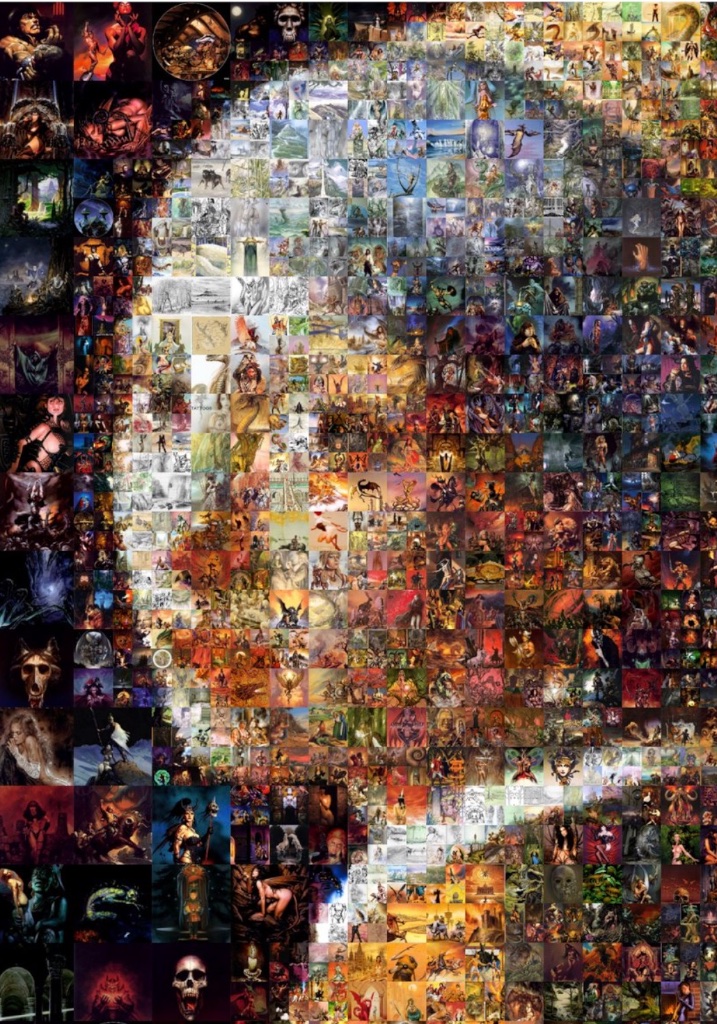
The best way to explain that this is not necessarily the case is metaphorical.  See the picture below:

pearl earring

Girl with the Pearl Earring (Enrique Cornejo-Sanchez by way of Vermeer)

Above is a mosaic by Enrique Cornejo-Sanchez of a well-known Western painting — Girl with a Pearl Earring, by the Dutch Master Johannes Vermeer.  Upon closer inspection, the painting is composed of a series of fantasy art ’tiles’ from the ’70s and ’80s (think Frank Frazetta!) assembled by Cornejo-Sanchez.  When viewed from a distance, the picture looks like the famous painting.  Viewed close-up, though, one can see that it is constructed from a multitude of stories.  Cornejo-Sanchez is very talented — check out his other art!  In a similar fashion, Tribal/Magical v-Meme stories can be used to construct extremely complex knowledge structures, that can mimic the disruptive jumps in knowledge that are much more naturally emergent and inherent in more complex, synergistic social structures.

But two things are also obvious, and inherent in the faux-Vermeer: the primary image is much more vulnerable to corruption of knowledge and intent than the knowledge produced through higher v-Memes;  and the facsimile took much longer to construct than if someone had used a paintbrush.  In a nutshell, this is why higher v-Meme social structures have such tremendous advantage over lower v-Meme social structures.  They can assemble data and get at a predictive truth much faster than the lower v-Memes, making them much more adaptive to change.

In this manner, we can also understand the challenges faced by various faiths in adapting to more modern, empathetically connected times.  Ancient shamanism can come up with great truths — but when the oil company is knocking on the forest’s door, it is communitarian organizing and suing them in the Hague that matters.

The easiest to adapt — the Taoists and Buddhists, who at their most developed, demand an individual agency and metacognitive reflection, excluding some of their magical rituals, transfer to the post-modern age with little cognitive dissonance and relative ease.  Faiths like Islam, that in their real form are prescriptive governance arising from the 7th Century, are going to have a harder time.  Evangelical Christians who are Full Bible adherents are going to have similar difficulties.

Further, faiths with tremendous In-group/Out-group differences are not going to deal well with a transcultural, or probably better said, a transcategorizational/individuational (gender, race, class, etc.) world.  Islam is one of the last, great bastions of ingrained In-group/Out-group differences.  If you’re a Christian living under Sharia law, or a woman, your world is fundamentally decreed by the divine to be less valued.  That obstructs the kind of rational empathetic development and information exchange advanced societies need to function — and if your viewpoint is also extreme or fundamentalist, the modern world holds even further challenges.

One of the biggest that is almost never discussed is the ability of the modern state to enforce laws in a much more rigorous and vigorous way than was possible in the past.  Take, for example, speed limits.  Back in the ’50s, if you were going to get busted for speeding, it took two cops with a radio and a timing device to nail you.  Then came radar guns, then laser guns, and now in many countries, automatic cameras that automatically maintain speed on roadways.  And any record you now get is known nationally, or even internationally.  Police forces in Western nations increasingly have no discretion on whether to enforce the law.  In the United States, there’s even an increasing dispensation with courts and the idea of ‘innocent until proven guilty’.  Prosecutorial justice takes the evidence, however generated, and used to force the accused to plea bargain.  Something like 95% of all crimes in the U.S. are adjudicated in this fashion.  Add to that the fact that in the U.S., your picture is taken some 200 times/day.  There is no private space any more, physically, as well as informationally.  We are all subject to instantaneous background checks.

Now put yourself in the position of a modern Islamic State.  Before, where ambiguity for the prescribed harsh punishments of Sharia Law, such as amputation, crucifixion and beheading were subject to the vagaries of a background tribal culture, leeway could be offered to various communities for the different violations.  Now, a dichotomous archaic/ modern state like ISIS has made possible an atmosphere of terror that even the most devout can hardly comprehend.  Sharia law is absolutistic in nature.  What that means is that if the authorities know, then they must act, or face divine retribution.

No one of less stature than Osama bin Laden recognized this.  In his management and direction of Al Qaeda, before his death, he and his cohort were in constant conflict with ISIS over enforcement of hudud (fixed punishments in Islamic Scripture).  Osama, believe it or not, said ‘go easy on the tribes’, and focus on development of what might look like a modern welfare state.  The ISIS leadership would have none of this, and have shown an increasing penchant for the most  drastic of punishments.  ISIS leans heavily on the whole concept of terror as decreed in the Qu’ran as being more merciful than not, because it brings communities into line quicker, thus saving more souls (though liberating more in the process!)  And they have the tools of the modern informational state with which to apply Allah’s Will.

If we were back in the 7th Century, all of this would likely have been viewed as evolutionary.  Instead of treating all women as chattel, women who were kidnapped during raids now had an opportunity for some type of citizenship after being forcibly raped.  That doesn’t sound like much of an improvement — but you have to not think with modern sensibilities.  The rape was inevitable.  Some kind of security for children who were products of that rape were not.  As such, though please note!! at a very low level, such standards and rules were relationally progressive.

But in today’s times, they are quite obviously not.  Humanity as a whole has advanced, and now such behavior is considered wildly regressive and relationally disruptive.  The tragedy of the Yazidi people, running up the mountainside to escape from ISIS troops, who have received religious blessing to rape and enslave them, is viewed by modern society to be monstrous — because, of course, it is.  Believe it or not, that is only a higher truth from an evolutionary empathetic perspective.

What this means that Muhammed, when he founded Islam, may have been an enlightened being.  His trajectory for him and his subjects was upward, and aimed toward righting many of the wrongs that he saw in the world.  Because Islam was fundamentally an instrument of governance as he developed it, it was necessarily v-Meme limited to a Legalistic Authoritarianism, which was a progressive concept at the time in human history.

But the world has moved on from Legalistic Authoritarianism being the most enlightened state a human on this Earth can expect.  Buddhism grew in prominence.  Zen Buddhism happened. The Protestant Reformation happened.  The Western Enlightenment happened.  And ISIS is headed in exactly the opposite direction.  By contemporary standards, ISIS is tremendously regressive, even by others in the Islamist movement — Osama bin Laden and his lieutenant, Ayman Zawahiri, included!  That implies it is also anti-empathetic and devolutionary, which means that it must be run, in this place and time in humanity’s evolution, by psychopaths.  There is no rationale in this current media-saturated world for accepting slavery and mass murder.  The fact that ISIS is cleverly using ur-v-Memes out of the Qu’ran for manipulation is yet another piece of evidence for empathy-disordered behavior.  Such calls out of the distant past as routes for stability in a war-torn, devastated part of the world may have short-term value.  But long-term, ISIS cannot expand outside a certain geographic area of ignorance.  The v-Memes of the rest of the world are against them.

Additionally, when an organization like ISIS becomes known for ruling with dominant 7th Century behaviors and v-Memes, it is necessarily forced, by its absolutistic position, to swallowing the whole enchilada.  This, from a knowledge structure and coherence position, is absolutely devastating.  7th Century Arabia was filled with lots of magical thinking, and arbitrary beliefs.  In fact, Muhammad himself struggled against the various tribes in Mecca, who were polytheistic, in attempting to incorporate them into his monotheistic system.  Along the way, he had to invent his own set of magical stories — winged steeds included — in order to establish the hegemony of an empire that he would rule.  This is not the way toward modern battle planning.

Nothing could be more demonstrative of this kind of nonsense than ISIS’ obsession with a small agrarian village called Dabiq.  Dabiq, in Syria, is the place where the decisive battle will be fought with the Christian Crusaders and mark the end of the world.  Dabiq WAS the site of a major battle fought in 1516 between the Mamluks and the Ottoman Empire, so it may have some strategic significance.  But it is hard to believe that modern Western war planners are going to be constrained in any campaign to roll battle tanks up to Dabiq, stop, and wait for ISIS to show up.  Such swallowing of magical thinking creates unreality in any larger war strategy that ISIS may have.

And magical, apocalyptic thinking creates other cognitive dissonances.  In his book, The ISIS Apocalypse (where I’ve gotten most of my understanding of the recent ISIS timeline) William McCants discusses ISIS’ misfires in planning events around the return of the Mahdi — the Islamic savior who comes back at the End Times, along with Jesus, and leads the Righteous to victory.  Needless to say, the Mahdi hasn’t shown up.  And this incessant debate confuses and obstructs any real advances for ISIS on the contemporary battlefield.  The moral to the story is that ISIS is headed for collapse.  It is only a matter of time.  Tribal/Authoritarian v-Memes, with some Legal scaffolding, just can’t cut it in a global society.

But that doesn’t mean that there isn’t some inherent stability in the system.  Reports from a variety of sectors indicate that ISIS has at least part of its leadership from the old Baathist Iraqis, and it’s been said multiple times that the worst thing we did when we conquered Iraq was disband the Iraqi Army.  Terror is an effective weapon, and no one’s going to gainsay that Saddam’s old buddies didn’t know how to terrorize a local population — in fact, many of the tribes that are incorporated into ISIS caliphate are ones formerly terrorized by Saddam.  Meet the new boss — same as the old boss.

The region also has historic precedent for this kind of behavior.  The 11th Century Nizari Ismailis, otherwise known as the Assassins, or Hashashin, led by Hassan-I-Sabbah, practiced a devoted, limited fanaticism that sprung from mountain fortresses across much of the same geographic area as ISIS.  Spanning the landscape from Northern Syria to their key fortress at Alamut in Iran, the Order of the Assassins, with the same type of fatalistic fervor as seen by today’s suicide bombers, kept Saladin, his successors, and the Ottoman Empire at bay for over 200 years.  It is instructive as to how they were defeated.  Only through utter devastation by the invading Mongol armies of Genghis Khan were they wiped off the map.

Fast-forward to the present.  Though I have been reading and studying ISIS for the last three months, events in Paris, and Beirut show a new internationalist bent to the terror.  Similar to the Assassins, ISIS is projecting its activities outward.  There are several possible reasons for this.  All spring from the strategies documented in the last couple of blog posts on the workings of the psychopathic mind.

First is that ISIS is projecting power and strength by attacking targets away from the Caliphate — the Islamic State declared by ISIS, whose only legitimate ruler is blessed by Allah, and wields the authority of Sharia.  Public attacks have the potential to draw recruits to the homeland to fight in the ongoing wars against Bashir Al-Assad, the current dictator running Syria, as well as the Kurds and Iraqis in Erbil and Baghdad respectively.  But this is, in my opinion, likely not the real reason.  There are likely more psychopathic plans behind the current efforts.

Another effect of the attacks, especially in the West, is to create a powerfully constrained and tenuous environment for the Syrian refugee community.  Over 9 million Syrians have fled their homes, and are residing outside the country, or in other displaced locations inside contemporary Syria.  Regimes that practice radical control inevitably cause people in their countries to stop reproducing, as well as leave, and ISIS is no different.   By triangulation of the Western powers against escape routes into other countries, ISIS in effect ‘backs up’ the escape route pipeline.  Further, those refugees who now are backed up in home territories, if they are apostate, can now be enslaved.

Thirdly, the attacks are part and parcel of the core of the delusional apocalyptic fight that ISIS believes is in their favor.  The current morass of confusion that exists with the U.S., Russia, Turkey and the Kurds all fighting either an air war, or land conflicts, is not enough to bring on the End Times.  For that, there has to be a Roman (read Western) invasion ending up on the plains outside of Dabiq.  Forget that prophecy couldn’t predict the existence of fuel-air explosives or A-10 Warthogs.  It’s not a party if you don’t send out invitations, and if no one RSVPs.  And nothing gets the TV/Internet pundits going like assassinations of civilians.

I am not trivializing the deaths of the hundreds that have died in Paris or Beirut.  But the histrionic nature of the coverage is fascinating.  The constant drumbeat of the coverage is that “ISIS must be all-powerful” because a handful of people pulled off a handful of attacks at the same time using relatively available weaponry.  How many AK-47s are there in the world now, anyway?  More than anything, these stories are created to fuel our own Authoritarian/Survival v-Meme narrative.  If anyone can hurt us, they must be at least as powerful as we are — instead of viewing things through a more Performance-based v-Meme lens.  I’ve always thought that the number of people that pulled off the 9/11 hijackings was far closer to 20 than the 100s, or even 1000s, the media alluded to — namely because it would be much harder to keep a lid on the whole plot with hundreds involved.  Performance-based productivity, unfortunately, also applies to goal-driven suicidal hijackers.  It would behoove the West to be mindful of this kind of talk, especially if we intend to subscribe to former Secretary of State Colin Powell’s Pottery Barn principle of failed states — you break it, you own it.  We have done a miserable job with Iraq in that regard.

What to do about ISIS?  I’ve laid down the case that ISIS will expire.  The quicker we cut off their energetics, which is, in the modern world, directly related to money, the quicker that will be.  There’s no question that ISIS receives broad financial support from similar issue-oriented (those that hate Bashir Assad) and v-Meme backers, like Saudi Arabia, Kuwait and Qatar.  But the problem with so much of what goes on in the Arab world is that the legitimate regimes are corrupt — either Authoritarian v-Meme, or mixed Tribal/Authoritarians, like Saudi Arabia — using Sharia when convenient to keep the population in check with beheadings at Chop-Chop Square, while at the same time, gambling and living the high life in Monaco.  Cutting off the money is an absolute requirement.

Another invasion may well be in the cards.  France is very unlikely to let the current incident go without something greater than aerial bombing.  The destruction of a Russian jetliner over the Sinai brings another potential set of ground troops into play.  And Obama has already committed Special Forces in very limited numbers for reinforcing the Kurds.  All these players, provided that they coordinate actions together, may result in a larger global strategy that may combine efforts in a way that will actually help in rebuilding the Middle East.

But we also have to understand that the current U.S. position of hitting the reset button when we are unhappy with a regime that doesn’t exactly represent our interests has to go.  Empathetic evolution is a long game to play.  And it’s much better to start from Authoritarian, as opposed to Survival v-Meme, if you want to get to some state of Performance-based Legalism.  No passing through the magical stage we’re seeing right here with the End-of-the-World types. Because, in the end, empathetic evolution is the only game in town.  And Social Physics are, like it or not, the Law.

Further Reading:  I’m not as confident as some that there won’t need to be military action to take out ISIS.  But I like this piece a lot — it gets at a big hunk of the problem with sophisticated, diversionary politics in the Gulf States.

Rat Park — Implications for High-Productivity Environments — Part II

Loreto and Kayak Cat

Mellow sea kayaking — outside Loreto, BCS, Mexico

One of the interesting things about Rat Park is the fact that doesn’t seem to be recognized explicitly is that the rats were in a plywood box in Dr. Alexander’s office.  They were happy rats, for lots of reasons — adequate food, fun places to play, and places to raise lots of little rat-babies.  All looked after from a benevolent rat-God, staring down from above.  Who would do cocaine in a circumstance like that?

Yet one of the key benefits of Rat Park, that had to contribute to domestic Rat Bliss was the fact that they didn’t have to worry about being eaten.  I’m not so much on the animals-are-super-intelligent-all-the-time spectrum that I would assume that rats have loads of consequentiality in their thinking.  But I do believe that rats are empathetic, connected creatures, sharing information in ways we probably don’t completely understand yet.  And one of the things that has to contribute to rat stress is the overhanging worry of a larger animal eating them.

Why does this matter?  Because rats are aware that they CAN get eaten.  I’ve never raised them, but I have raised chickens, and chickens are keenly aware after only one incident if you’re the axe-murderer.  The word is out in chicken-land when you come around.  I happen to believe that rats don’t have long-term memory, precisely because, as a food species, lots of rats and their brethren and sisters DO get eaten.  And it’s likely that their mourning period is extremely short — the colony reorganizes around the remaining rats, and gets on with business.  I read somewhere that you’re never more than 90 feet away from a rat at any given time.  So the strategy must be successful.

Yet rats are empathetic.  They likely have very well-developed mirroring behaviors, and they, as mammals, have some level of emotional empathy.  They have some plug in their brain where they need to be connected.  And when they’re not, they drink cocaine-laced water until they die.  If they didn’t have that, they’d likely get eaten, because, well, rats get eaten.  Yet evolution has geared them so that the rats that hang together and connect are the ones that survive.

What does this have to do with high-performance work environments?  If you want to have healthy, creative people, thinking about connecting with others, you have to boot everyone out of the Survival v-Meme.  Things like accessible day care, steady, calibrated salaries, good health care, and a meaningful, non-threatening performance review system that finds weaknesses in employees with the intent to improve that characteristic are overall likely to be more effective than ones that seek to find weakness to aid in a campaign of dismissal.

To the evolutionary manager, this all seems to be pro-forma.  Yet company after company has implemented Jack Welch-like strategies, where after every performance review, some bottom 10% of the employment cohort is whacked.  The hawk is constantly circling overhead, and the rats run for cover.  You might end up with a couple of wickedly fast rats with these kinds of strategies.  But no one’s going to talk to anyone else.  For those that want a detailed exposition on this, Vanity Fair’s expose’ on Steve Ballmer’s stack ranking system is stunning.  Highly recommended on how to kill creativity.  And just a little anecdote — before Jack Welch and his ‘whack the bottom’ every year strategy, I was of the engineering cohort (Class of ’82)  that wanted to work for GE.  It is absolutely not aspirational for the kids I teach now.

Daniel Pink makes this point very eloquently on a slightly higher v-Meme basis with the following video — well worth the watch.  Spoiler Alert — Daniel is very much a Communitarian, and so the punchline at the end isn’t very surprising — don’t do the carrot and stick thing with people, like you would with a donkey.  What he doesn’t quite understand is that with any empathetic connection — and you can have those with donkeys, too — don’t do the carrot and stick thing.  Unless they’re a teenager wanting a car.  THEN do the carrot-and-stick thing!

One thing I would say before moving on is that there are always people that you can’t reach, that are going to have to be fired.  Very Authoritarian v-Meme.  That’s life.  But you simply can’t manage your entire workforce like that.  Unless you want the rats to run for cover every time you walk in the door.

Takeaways:  Examine what you’re doing to your workforce, and if there’s anything that involves making people constantly fear for their survival, cut that shit out!  Possess enough of your own personal agency and responsibility to whack the bad actors.  Remember that an evolved manager has all the lower v-Memes to work with — but if you want creativity and innovation, you’ve got to cover your bases at the bottom as a matter of course.

Further reading:  The Wall Street Journal article I linked to above is a great one for understanding why we have far too many psychopaths — with the incumbent fallout– in the executive suite nowadays.  Here’s another one — ‘the near-perfect CEO’.  To be fair, Jack also preaches some enlightened stuff as far as employee development.  And if you look at GE’s primary businesses, they were hierarchies where refinement was more important than innovation.  So some of it makes sense.  But as the power business rolls over to more distributed modes, dark clouds are on the horizon — and GE could be dramatically reduced, just like other hierarchical powerhouses of the past, like IBM.  Live by (and optimize the performance of) the power structure, die by the power structure.  Because, well, you’re still a power structure.

Interlude — Addiction as an Elephant Wrapped in Spaghetti, and Dopamine Transfer Explained by a Dummy

Lower Salmon Toad BeachAnother version of Rat Park — Toad Beach on the Lower Salmon, Gary MacFarlane, Photo (with my camera!)

After reading the last post, you’re likely wondering what intellectual rabbit I’m planning on pulling out of my hat to explain how Rat Park informs us of how we should structure work environments for optimal productivity and creativity.  Here’s the simple version, for those that are waiting with bated breath.  Keep everyone safe, well-fed and happy, and in plain view, and you really cut down on the opportunity for relational disruptors to terrorize people.  Optimize connection, as well as appropriate alone time, and let the experiment run.  For more than that, you’ll have to wait until the next post.

One of the things I’ve mentioned before about v-Meme analysis is that while Spiral Dynamics as a whole can give us an overview of how we perceive our larger problems, it does not mean that individual v-Meme levels can’t inform critical understandings of essential parts.  Everyone — literally everyone, even your gaslighting psychopaths — possess an element of the truth.  The challenge of the manager is in the integration of both data and patterns, while being aware of their own perspective.  Rat Park may indeed give us a larger, say 10,000′ view of how addiction functions. At the same time, once we understand the system boundaries of the lower-level v-Memes, we can figure out the truth that those researchers that may even be anti-Rat Park are telling us, and strategize across the different temporal and spatial scales.

At the same time you’re appreciating your more detail-minded friends, you have to guess a functional, system-level description of how things actually work.  And here’s the rub — that guess may be all that we start with, or live with for a while.  Because setting up a fine-scale experiment to determine absolute truth may be impossible.

When researching the Rat Park phenomenon, one of the things I found on Wikipedia was the general agreement that the mesolimbic pathway is the nerve pathway primarily affected by opiate addiction.  (In case you wonder what intrigues me on a Sunday afternoon… 🙂  What the heck is the mesolimbic pathway anyway?  It’s one of the dopaminergic pathways in the brain, that move dopamine around in the system — the stuff that regulates our mood and modulates our reward behavior and emotional response to others.  In other words, a key element of empathy.  The mesolimbic pathway is also, interestingly, very short.  It starts out touching the spinal cord, cuts across the limbic center, and then branches out in the very bottom of the prefrontal cortex.  See the figure from Wikipedia if you’re curious.  I can’t figure out how to insert it in the blog!

Here’s the key thing.  It’s short.  It goes from the top of the Spinal cord, across a little real estate in the limbic system, and then touching the prefrontal cortex — the shortest way to connect all three systems of the triune brain.  Evolutionarily, it’s a core function, and likely one of the first to evolve.  Now if it just connected to the vagus nerve — that empathy backbone connecting the lower body systems up to the face muscles.  And, not surprisingly, it very well may.  This is recent research by a team in Poland.

So one of the things we know functionally is that heroin and its cohort are drugs that head straight for the empathy circuit.  Or humans take heroin BECAUSE that circuit isn’t working right, or isn’t getting what it needs.  The neuroscientific, small scale analysis tells us that heroin addiction is actually something that occurs because of a lack of connection!

Now, why that lack of connection is happening is not so simple.  Perhaps, there’s a genetic abnormality that prevents connection.  Perhaps trauma has so flooded those neural circuits with cortisol, the hormone released during stress and trauma, that the circuit is busted.  Perhaps the individual is isolated for reasons beyond their control, by either a larger societal mechanism –they’re in jail, or at war, or something.  Or perhaps this person is being abused and isolated by an HCP/empathy-disordered individual.

As we start peeling off the layer, it’s actually the core insight by the Authoritarian Legalists that gives us the starting point for exploring the effect of higher-level v-Memes.  The main thing that shows the Authoritarians’ bias, though, because of their perspective generated by their social structure, is the idea that the majority of people are self-pleasuring.  It is far more likely that they are taking opiates because they are in pain.

I’ve used the metaphor of understanding sentient evolution by borrowing from the old story of the five old blind men and the elephant.  The reality is that once you get far enough away from the elephant, you will likely recognize that you’re looking at an elephant — if you’re not blind.  What does Spiral Dynamics also tell you?  You also then realize that the elephant is wrapped in spaghetti.  Everything is connected to everything else.

A multi-scale analysis of addiction leads to similar problems of causation.  Dopaminergic pathways are disrupted in addicts.  They may have gotten there through a defect of moral character.  But they likely had a genetic predisposition for addiction, and couldn’t quickly recover.  They may have been cut off from their community for their behavior, but certainly possible, some traumatic experience happened that started the downward cycle of isolation, and severely short-circuited their chances for personal evolution out of the crisis.

How to understand what to do next?  We can go back to the Principle of Reinforcement, that says there is a self-similar loop of causation — a coupled system — between individual and social structure.  If someone is addicted, we can both help the individual’s biology (maybe with methadone or buproprione) and at the same time create supportive community that allows the addict to process their past trauma, and restore an empathetic ability to reconnect with others.

But if you really want to fix your larger addiction problem from a population perspective, the whole society’s going to have to be on board.  Addicts make up a percentage of a given population, and that population functions in the way that it does because of the whole elephant.  In U.S. society, we’ve accepted social dislocation, stress, and economic wealth redistribution toward the top.  Though my personal opinion is that this is an absolutely crazy way to run a larger society, the society makes the consensus, with all the various dynamics and factors that come into play.  That means we also have to accept that there is going to be a transient population moving in and out of addictive behaviors as their circumstances change in the stressful world we live in. We can, and should do better.

But until we figure out our larger evolutionary goals, the last thing society as a whole should do is wage war on the more helpless victims involved with the system.  The trauma and isolation from those actions aren’t going to get us anywhere — except in the creation of more patients.

Takeaways:  If we want to stop individual phenomena like addiction, it would behoove us to consider the social aspects of how individual biological phenomena manifest.  

Further reading:  Forget the New York Times crossword puzzle!  Read the Wikipedia article on dopamine!  So much cross-functional and synthetic thinking possible!  The secrets to why nicotine is so bad, and heroin not-so-much from an individual perspective are buried within.  Plus a ton of other stuff.