How What You Think About God Can Tell You Who You’re Picking as Your Business Advisor

Arm Around Minnie

Cute Chinese Chicks in front of the Olympic Stadium, Beijing.  Minnie’s a Dude, in case you were curious… now think about how you can tell just from the photo!

My son, last night, brought home an assignment from his high school literature class, basically asking him to explore the ontological intimations of a given viewpoint on the infinite.  The short version of the prior word salad is this:  what do we think God is, and how can we understand that?

Fair enough.  Because I am, well, who I am – or maybe a function of how weird I am, I took this and applied this to understanding our empathetic development, and social/relational structure.  It would stand to reason that the various v-Memes would want a God that lined up with the way that they think.  No surprise there.  But what’s also fascinating is more how it lines up with our comfort with the unknown.  The short version of this is that our own metacognition tells us buckets about how comfortable or uncomfortable we are with giving God definition — or limits.

Naturally, Tribal Gods are going to be present, and likely unpredictable.  Authoritarian Gods are likely to be angry (just like your boss!), and Legalistic Gods are going to have lots of rules.  Better not break ’em!  They might feel sorry for you, but they’re still sending you to Hell.  No echoes of place-taking, rational empathy down here!

Moving up into Performance level v-Memes, we’re going to have affiliated, helpful Gods, whom you get to have your own, personal relationship with.  It’s no surprise that the Protestant Reformation was so big on coming up with a canonical set of rules of reform of things like indulgences (they didn’t call it the Reformation for nothing!) but also removed authorities between the individual and God.  Funny how that happened all around the time of the Enlightenment and such.  Can we say ‘Independent Relational Formation’, anyone?  And I’m sure from my own Catholic upbringing that Communitarian God plays the guitar.  Because the Good Sisters who taught me were a little lacking in musical ability.  No surprise that as our empathy increases, God becomes more understanding, and less likely to send us all to Hell.  One in the Spirit, One in the Lord and all that!  He’d have to go there too.

Talking about religion makes people a little squirmy, regardless who does it.  And since I’ve decided that a lot of my stuff already makes people feel like bugs are crawling around on their brain, I think we should segue into business gurus instead.

How can we tell what v-Meme a given business advice book tops out on?  Look for where they start talking about magic.  Peter Senge, in The Fifth Discipline, gets to spirituality pretty quickly, though I’d argue we’ve got to cut him a little Second Tier, self-awareness slack.  For the most part, systems thinking is short for legalistic algorithms with an eye toward performance.  Roger Martin puts ‘mystery’ right on top of heuristics, with some Second Tier systemic perspective thrown in as well.  And so it should be no surprise that Design Thinking for Business stops at the Performance v-Meme for the hard-and-fast.  I’m sure there are some other books out there on social capital that map into the Communitarian v-Meme.  But they all cap out sooner or later.  I’m sure there are other writers than the core Wilber/Beck/Cowan group out there in the higher business v-Meme landscape (Eckhart Tolle? Frederic Laloux?) and there obviously have been other, super-evolved business leaders — for real inspiration, read about J. Irwin Miller, one of the architects of Cummins Diesel.

We’re not going to cap out in this blog.  Instead, I’m just going to double down on that metacognition card and admit I don’t know.  And then have the rest of you fill in the blanks.  The reason?  One of my budding theories is that while we may not be able to evolve all of us to a Global Holistic state, if we connect enough of us together, we can, in aggregate, function at those higher levels.  Onward!

Takeaways:  When people start talking about God, or whose business books they like to read, one of the big things they’re telling you is their metacognition and how they process what they don’t know.  A good idea to pay attention!

Reliability, Validity, and Metacognition — Why Young People Don’t Know what Kodachrome Is

wildernessfire

Wild land fire, Selway-Bitterroot Wilderness, Clearwater NF, Idaho

Sometimes, when I read my own prose, I find myself victim to the same Dunning-Kruger effects I discuss.  Seems like I did this in the last post, so let me expand.

One of the interesting concepts that come out of Roger Martin’s book, The Design of Businesswhere he presents the system model for business evolution going from mystery -> heuristic -> algorithm.  In this previous post, I document how this also relates to a regression in social/relational structure, and in a related fashion, empathetic development.  Martin does a good job of contrasting this to what he calls the reliability/validity trade-off.  As a company ages, if it is not careful, it will follow a decay path where Legalistic/Algorithmic v-Meme hierarchies will slowly subsume the organization, and creativity will die.  The only person who gets to be creative is the person with Creative in their title.

This should not come as a surprise to readers of this blog.  If one understands rational empathy, and the creative energy it releases through unpredictable, nonlinear interactions between independent actors as a primary driver, then when you give everyone a job with a title, and tell them with whom they get to talk to, it’s  no surprise that you get in to a ‘New Idea Rut’.  Everyone’s saying the same old, same old, to the same old.  Barring a personal crisis in someone’s life, there’s just nothing new under the sun.

But hierarchies (and to some extent, power structures) are good at some level of incremental, algorithmic improvement.  If we’re trying to grow our company with ‘solid growth’ — 4%/year — it might be prudent to just keep on with incremental product improvements.  But as anyone with a high school math background might remember, even 4% a year turns into exponential growth — something we count on for compound interest, our kids’ college savings account, and our retirement.  And companies, sooner or later, will reach size thresholds, or business/innovation events will happen that will demand restructuring and re-thinking.

So why do people cling to past ways, especially in Authoritarian/Legalistic v-Meme environments? This gets back to the core principles that we’ve discussed regarding Reliability and Validity, and the way we form relationships.  It’s a good guess that if we want an authority on engineering, we’d go talk to a Licensed Professional Engineer, or an engineering professor.  But if we wanted someone to tell us how to hang-glide — a profoundly aerodynamic venture, but something a little more off the beaten path– we’re as likely to have a Valid discussion with an amateur hobbyist as an engineering prof in my department whose specialty is micro-fluidics.

Going back to the business world — an Authoritarian company is likely to seek the usual outlets for product refinement, which might seem like it makes sense.  But over time, their metacognitive reach is going to naturally shrink and shrink.  The knowledge that they may have  becomes more reliable, in that it is tried-and-true.  But as circumstances change, that lack of metacognition prevents proactive solutions.  The product or the game can only change after a failure.  There’s no better example than Kodak’s demise.  The largest film photo company in the world utterly failed to understand the power of the digital revolution.  And now they’re pretty much gone.

What’s so interesting about this insight is now we can understand the roots of how someone thinks when they say things like ‘you learn more from your failures than your successes.’  If there ever was an Authoritarian v-Meme statement, it’s that one.  Because of the lack of metacognitive sweep — actively confronting unknowns without fear — there’s just no learning.  Except when things fall apart.  And then it’s a surprise.

Contrast that to a Performance v-Meme.  If we want to improve, we design Process for Practice, and adapt strategy to find out what we don’t know, before it fails.  When confronted with the question, “do you learn more from your successes than failures?” folks might say that they learned more from failure, but that’s just the lower v-Memes talking.  In the class I teach, the Industrial Design Clinic, I teach successful practice, with an emphasis on Design Thinking and an exploration of multiple options.  Because there is no engineering company in this world that will accept a graduate who constantly, chronically fails after shipping product.  Even if they’re learning.

Takeaways:  Understanding how demands from the different v-Memes reinforce Reliability and Validity is key in not falling into the trap of only incremental product performance.  I’m sure the folks at Kodak thought film was going to last forever.

Further reading:  Complacency, Reliability?  Poe-tay-toe, Poe-tah-to.  Read here for a quickie piece on Kodak’s downfall.  Published in Forbes, no less.

How We Know what We Don’t Know — Relating Empathetic Evolution with Metacognition

bigsandlakepan

Big Sand Lake,Selway-Bitterroot Wilderness, Clearwater National Forest, Idaho

Why are Authoritarians so sure of themselves, while the self-aware are constantly questioning their very existence?  And how do these very large questions fit into the larger schema of social/relational structure?

One of the things that I work with students on is development of metacognition, which is the technical term for “knowing/being aware of what you don’t know.”  At its root, metacognition involves an individual self-assessing knowledge that they have, being aware of knowledge that they do not have, and in its largest form, being aware of the fact that there may be more subjects/areas that they haven’t encountered yet.  In a certain sense, this is a meta-awareness.  Though I was never a big fan of Donald Rumsfeld, one of the most profound things he ever said was his famous ‘known unknowns’ and ‘unknown unknowns’ comments.  The quote is reproduced below:

There are known knowns. These are things we know that we know. There are known unknowns. That is to say, there are things that we know we don’t know. But there are also unknown unknowns. There are things we don’t know we don’t know.

Donald Rumsfeld

Rumsfeld didn’t invent the idea of metacognition — that probably goes back to the great Buddhist and Hindu philosophers.  But by packaging it in contemporary lingo, and then being subject to the scorn of the press corps, speaks loudly about the level of media discourse today.  And not in the press corps’ favor.  In an evolved society, knowing what you don’t know is a key toward curing your ignorance — not an insult toward your status.

How can we understand metacognition in terms of empathetic development?  Profound metacognition requires that we have a data-driven, inner dialogue with ourselves — assessing what we know relative to the data available — and at some level, still valuing ourselves at the end of the process — in short, we have to develop empathy for ourselves.

If, after such an assessment, we feel worthless because there is so much we don’t know, that is extremely telling about the social/relational structure we exist in, and how it influences our thoughts.  Accurate assessment of metacognition involves us having a developed, independently generated relationship with ourselves, and at some level, also involves our developed ability to trust our own judgment.  That implies that we have some sense of our own agency (we get to evaluate whether we should trust our judgment, instead of having someone on the outside tell us whether we should trust it or not) and in a healthy, developed form, is a behavior only manifested at v-Meme levels (Performance and above) where independent relational behavior comes into play.

With this definition, we can then see that the Principle of Reinforcement will play heavily into whether we have metacognition or not.  Different social structures will dictate to their constituencies incentives (or disincentives) for metacognitive development and belonging, which then makes it interlocked with empathetic development — our primary practice tool for our own neurological processing.  We have to know that we don’t know how someone else feels in order to make the decision to collect the data to assess their emotional and cognitive state.

This is a complex thought.  But one can really see how this works when examining the different motivators relative to the different v-Memes.  Authoritarians, when confronted with their ignorance, are going to be insulted.  Their status will be diminished — hence the desire for metacognitive development is relatively low.  Those in the Legalistic v-Meme will still be tentative in their recognition of things they don’t know.  They will want the assurance of new, transformative algorithms to take them from their current, known state to newer, unknown information.

It is when we move past the primarily Belief-based social organization structures that we start to see metacognitive development accelerate.  Performance-based organizations, when confronted with unknowns that impede progress toward the goal, will recognize them, and construct mechanisms to solve those unknowns.  Communitarians will recognize unknowns as part of the hidden mystery of every individual in the community, and part of the process of increasing individuation in their community member assessment.

Higher v-Memes than these ratchet up the state, in that they force the observer to confront their position of observation.  Self-aware Global Systemic will start the cycle of asking what one’s self-interest is in knowing/not knowing.  Global Holistic will start the process of understanding the larger connection of not-knowing to potential impacts, short and long.  And just saying — I haven’t gotten this all figured out.

Nothing demonstrates this better than watching an academic audience interact with a speaker.  And I’m not talking students — I’m talking professors.  A speaker can throw out softball question after softball question in order to get the audience to participate.  But professors, by and large, unless they are a recognized authoritywill largely, passively sit and not answer.  They intrinsically know that their status is directly related to always pronouncing the right answer.  Why take a chance, when there may be a trick involved?

There’s a flip side to understanding metacognition.  Aggressive lack of metacognition manifests itself both at the levels of profound sophistication and expertise, as well as in the world of profound ignorance.  The Dunning-Kruger Effect, which I have discussed before in this blog, documents this with Legalistic v-Meme reliability.  The short version is that the ignorant self-assess at a much higher level of competency than they actually possess.  And the highly skilled, if their empathetic development is lower, will self-assess at a much lower level of competency than they have — they take for granted that people don’t know stuff that they, in fact, know.

One can see how this ties back to the level of empathetic connection.  If you’re an expert giving a talk, and you’re not connected to others, you don’t see them yawning.  You just keep going on and on.  And the other side?  There are plenty of examples of aggressive ignorance out there.  They can’t see the faces turning red when they yell — or they don’t care.

Real metacognition is a great way of evaluating true expertise.  Someone with a profound sense of metacognition will readily confess to things that they know, as well as things that they don’t know.  With this thought, one can see how metacognitive development hooks back into the notions of reliability vs. validity.  If someone can recognize their level of expertise, odds are that when they give an answer, it will be valid, subject to the data presented, as well as reliable.  It will be both correct AND reproducible.  Contrast that to someone who is an expert in one thing, but doesn’t recognize their own metacognitive limitations.  For them, every problem is a nail, and they’re the hammer.

Takeaways:  Metacognition is intrinsically tied to empathetic development, which then loops it all back into social structure and the acceptability of admitting you don’t know something.  The Dark Side shows up with the well-documented Dunning-Kruger effect.

Further reading:  The famous book, How People Learndocuments the  pattern of learning that experts use to master other fields.  There’s much to take apart about this book (not surprisingly, written by academics and authoritarians,) but in case you need some level of proof of how this works, it is contained therein.

Further watching:  Perhaps the most profound demonstration of Authoritarian lack of metacognition (in a humorous vein!)  Sergeant Schultz, from Hogan’s Heros!

Shorty Post — The Value of an Individual in a True Communitarian Setting — Rising Tide Carwash and ASD employees

Just a quick post — not everyone’s story has a happy ending, but there’s no question that with data-driven, adaptive thinking that shows up at the higher v-Memes, there are simply more of these possible.

Rising Tide Carwash was started by a father of a child on the autism spectrum, in part to give his 24 year old son a life outside of a room in the house.  There is a lot more that goes into making a successful business than just a feel-good perspective, and I personally shy away from any idea of a quick fix.  But the fact that SOME young people are out of their rooms that have autism is good enough for an announcement on my blog.  See:

http://www.huffingtonpost.com/nationswell/meet-the-gutsy-dad-that-s_b_7903320.html

The data-driven mind, well-scaffolded, has access to many solutions.  Let’s all keep evolving!

Shorty Post — Pet Peeves and v-Meme Markers — We’ve Got ‘Em

Vienna Christmas Market

Christmas Market, Vienna, Austria

One of the interesting things I’ve watched in American society is the devolution of many traditional forms of communication with increased formalism.  At the same time that the world (really through the Internet) is driving increased connection, I see increasing, bizarre formalism in basic communication.

One of the ways that this manifests itself is in greetings/salutations and closings in e-mail.  When I was in high school, we were all taught how to write a letter.  Inevitably, it started with

Dear So-and-So,

And dependent on whether the relationship was formal or informal, So-and-So was either Mr. Jones, or Ms. Bates, or some such.  Punctuation was, for all intents and purposes, with a comma, a brief pause before the letter stated intent.

At the end of any given letter, to whomever, formal or informal, one wrote

Sincerely,

These things were so standard, they were included in the dictionary.

Now I get all sorts of various salutations, often with no title, and almost always with a colon.

Mr. Pezeshki:

or

Chuck:

So brusque!  So Authoritarian v-Meme!  No hope of friendship or independent connection there!  This person means business!  Or some assertion of status!

Closing statements now are often along the line of

Respectfully,

or

Very respectfully

or the very annoying

Kind regards,

Huh?  You mean when you asked whether a textbook was required for class, you were afraid of being disrespectful?  Are you looking down on your keyboard with winsome emotion as you sign off?  If I only give you regards, are they simply not kind enough?  What if I say Best? (my standard)  I always thought Cheers was OK — my British friends all say this as they are getting off the telephone.  I once had a woman tell me See you later, skater! that has now been enshrined in my best friend folklore.  Huh?

Standard protocols in societies free up more bandwidth for real relationships.  I understand the idea of expression of individuality, but the reality is that more idiosyncratic protocols just increase isolation.

Sincerely,

Chuck

Shorty Post — Article in NY Times by Nicholas Christakis

whitesandlakepan

Fog on White Sand Lake, high in the Bitterroot Mountains, Clearwater NF, ID

An interesting article on freshman social networks by Yale researcher, physician and Silliman House director, Nicholas Christakis.

He makes the observation

“In fact, studies that my colleagues and I have conducted of face-to-face social networks of college students and of the Hadza hunter-gatherers of Tanzania reveal that, in fundamental ways, they are not very different.”

For readers of this blog, this is, of course, not surprising.  Both Tanzanian hunters and freshman college students are likely to be centered square in the Tribal/Authoritarian v-Meme, and so process relationships and interests in much the same way.

In the piece, he doesn’t mention empathy, but I wrote him a note — I’m hoping he will write back.  As I mentioned before, empathy level dictates information coherence levels in transfers between actors (a phenomenon he alludes to in the piece), with higher forms of empathy possessing more nonlinear aspects of behavior.

Another interesting point of the article is that he notes that when young people are plopped together initially, there is an explosion of friendships (independently generated, trust-based, data-driven relationships!)  But after about three weeks, the effect starts to die down, and then settle back to the externally defined groupings that people in that cohort’s brains are comfortable with.  The takeaway?  Epiphanies without follow-up don’t last.

McDonalds and Another Major Paradigm — Reliability vs. Validity

starshiprock

Starship Rock, White Sand Lake, Clearwater National Forest, Idaho

In Roger Martin’s great book, The Design of Businessan excellent quick read, an influence on this blog as well as a great complement, he talks about the evolution of business as moving from mystery -> heuristic -> algorithm along a knowledge funnel.  One of the examples he uses to illustrate this is the formation of McDonalds.  McDonalds started with a paradigm shift.  Without getting too far into the weeds of ‘who came up with what first’ — there are excellent histories of fast food you can dig up — the founder of McDonalds, the McDonald brothers, started their restaurant with the idea (the mystery) that people would rather walk into a restaurant and quickly order from a limited menu, than be serviced by car hops on skates while sitting in their car and ordering off an extensive menu.  As the company evolved, heuristics were placed in the expanded franchise model, pioneered and influenced by Ray Croc, which then led to more algorithmic thinking (how to refine the temperature of the inside of a hamburger, how to guarantee freshness of buns, etc.)  All this has made a McDonalds hamburger (or Big Mac) one of the most reliable experiences one can have on the planet.  You go into McDonalds, you order a Big Mac, and you pretty much know what you’re going to taste.

But as organizations evolve (actually, develop Scaffolding, or potentially devolve) to provide reliability, they can lose their validity — the reason an organization was created in the first place.  Validity is characterized by the Guiding Principle for the organization in the first place.  In McDonalds’ situation, the larger question, as the firm continues its decline is this:  what do you do when people don’t want to eat hamburgers any more?

The answer is “it depends.”

There are some interesting things to note in the above example, as it gives plenty of clues to the evolution of social structure in the context of McDonalds.  At the beginning of McDonalds’ existence, we see variable, and unpredictable time scales.  As heuristics were developed, we start to see the emergent beginnings of the various silos necessary for more optimal performance.  As reliability became more and more of a focus at McDonalds, we can also see that smaller and smaller spatial and temporal scales become more important.  The ‘time to cook’, the precision of temperature, the freshness of buns, the latency of time for fries in the warmer — all must be controlled in order to assure uniformity.

And as an organization becomes more and more driven by these types of things, and more accountants are hired, and MBAs, we can also see that the response of the organization to prompted change will be more and more additive.  Instead of making large changes in how one cooks a hamburger, the organization is much more likely to trend toward process refinement, and incremental improvement.  The appearance of single discipline experts, who can reliably, for example, program cooking strategies, becomes more prevalent.  Unless these experts are involved empathetically with other parts of the supply chain/production process, they are likely to become more and more isolated in their communication chains.  I really have no intrinsic knowledge of McDonalds’ organizational chart — but I wouldn’t be surprised if there were various ‘Czars’ around the organization, in charge of a variety of the elemental tasks of hamburger preparation.

And in the franchise model, the end user of the technology is necessarily isolated from the top — you sign up for a franchise, you sign up for doing things the McDonalds way.  McDonalds even has a Hamburger University — its primary training facility in Illinois — to reinforce its social/relational structure.

What does all this mean from a v-Meme perspective?  Though not exactly the first, the McDonald brothers had a visionary, empathetic epiphany regarding people and the acceleration of society.  It’s hard to say whether this was from a larger, emergent/intuitive Communitarian v-Meme perspective (probably!) or a true, self-aware Global Holistic breakthrough. Regardless, spinning out the rest of the v-Meme story was basically developing the appropriate v-Meme Scaffolding for the idea.  Heuristics were developed as far as sizing, decor, etc.  And then increased traffic led to the need for developed algorithms for production of consistent product.

But along the way, the bottom scaffolding started taking over the top.  Instead of preserving a spirit of innovation, and worker development, McDonalds made a choice to mechanize and disempower the bottom of their organization.  Fast food workers, regardless of the truth of the imagery, are associated with the very bottom of the labor hierarchy.  Insulting comments regarding English majors and ‘would you like fries with that?’ are the gold standard for the ostensible worthlessness of a liberal arts degree.  And with any fundamentally Authoritarian v-Meme organization, where status, power and control are the marquee behaviors, you have the potential for corruption.

What does the death of empathy inside a company mean?  In a world where nothing changes, the Authoritarian/Legalist v-Meme conflation can take you a long way.  But in a rapidly changing landscape, screwing over the bottom of the food chain (no pun intended) is a very bad idea indeed.  You can create conditions that produce the same hamburger every time.  But you’ll never produce anything else.  You absolutely have to have information flow both vertically and horizontally.  And you can’t get that without appropriate empathetic development.

Where is this leading?  The natural dichotomous perspective would lead one to think that there is a trade-off between reliability and validity.  But at this point, it is important to remember the emergent dynamic principles of evolutionary, empathetic thinking.  Validity, being more a function of higher empathetic modes (Performance/Goal-based v-Memes and above) can contain the structures of reliability inside it.  But in order to do this, leadership — or those that have the ability to influence organizational structure and develop organizational culture — must be self-aware to the trade-offs present when making developmental decisions.  Sometimes you need to hire an expert in internal hamburger temperature control, and everyone has to listen to them — after all, you don’t want people coming down with E coli while eating your product.  But one should be aware of the integration requirements of keeping that person in the loop with everyone else in the organization, and establishing the duplex communication channels necessary to assure consistent evolution.

Takeaways:  If nothing changes in your world, you can set up an organization that dumps empathy and repeats the same process over and over, and if you’re making money at the beginning, you’ll be making money at the end.  But that’s not the real world.  Empathetic development, if scaffolded correctly, can drive both reliability and validity — which combined, create resilience.

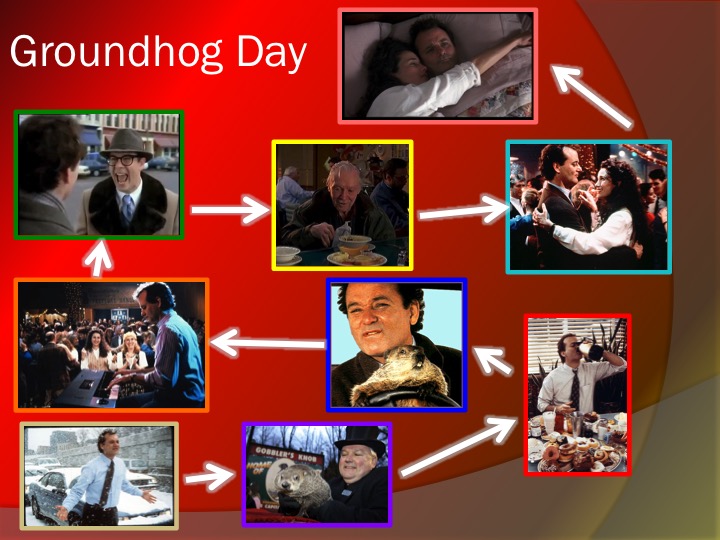
Evolving your People and Reducing Conflict — the Lessons of Groundhog Day (Part II)

Slide02

Groundhog Day, with Bill Murray, Spiral v- Meme Evolution

In the last post, we talked about one of the benefits of more highly evolved employees — a more profound, variable sense of time scales.  And then talked about the movie Groundhog Day, a classic as far as evolutionary enlightenment.  We ended with the question — how do you get individuals to evolve from externally defined, belief-based relationships to independently generated, data-driven, trust-based relationships?  How do we start the process of development of rational, and even global empathy?

If you want people to have independently generated, trust-based, data driven relationships with others, the first person they must have them with is themselves.  And in Groundhog Day, this is accurately portrayed.  The first thing Bill Murray’s character, Phil Conners, does to break the destructive rut he is in with his Legalism is learn to play the piano.  He goes on to learn French, ice carve, and a host of other things, for those that remember the movie.  But the first big step is at the keyboard.

What does this mean? Performance, mastery and appropriate calibration/grounding are the key things that develop one’s relationship with oneself.  When you make a mistake at the keyboard, the piano lets you know.  Either it sounds right, or not.  One can listen to recordings and determine if the piece is being played correctly — it makes sense to benchmark against other standards.  But the ivories don’t lie.

Not surprisingly, this same evolutionary principle is in play with my students in the Industrial Design Clinic.  By giving them a real customer, that wants a real product, it radically rearranges the circuits in their head.  No longer can they make up reports that they intrinsically know teachers will never read.  No longer can they make up reports that are automatically 20 pages long to get an ‘A’.  The purpose-driven life starts with an authentic experience.

It is always an amazement to my students that their customers read their reports.  Instead of the usual glossing over that professors (or TAs) give the stack of reports, my customers give detailed feedback.  They complain if reports are TOO LONG.  It’s a shock to the system.  And it starts the process.

Back to Groundhog Day.  Phil Conners continues up the evolutionary ladder.  The next step is Communitarianism, and represented by his development of relationship between himself and the insurance salesman, his old high school comrade, Ned Ryerson.  At some level, that might be predictable.

But the next transition — to the Global Systemic/Second Tier Self Awareness is one of the most interesting in the movie.  As Phil becomes more empathetically connected with everyone in Punxatawny, he encounters an old, homeless man.  He  does the best he can to save him, over and over.  Yet the old man always dies.

What is being communicated here is the developmental stage of self separation and differentiation necessary for self awareness.  In order to become truly self aware, one must realize that one simply cannot project one’s persona onto someone else.  The movie does this with a stark contrast — Phil Conners lives on, and the old homeless man dies.  Yet at the same time, Phil learns the larger value of a complete, rational compassion.  He can only help the old man in his transition — and it is enough.

After this, the movie trips on up the next two levels — Phil is involved in a fractal temporal and spatial fashion with everyone in Punxsatawny (he always has to be in the same place, at the same time every day to catch the kid falling out of the tree.)   And at the final ball, with the potential, chronically unrequited love interest, his weather producer, Rita, played by Andie MacDowell, not only is he empathetically connected with everyone in Punxsatawny, he is also helping them.  This is a v-Meme that doesn’t show up on the prior Spiral chart —  known as Coral/Bodhisattva. In Mahayana Buddhism, a Bodhisattva is essentially someone who has stayed behind from ascending to Nirvana to help all sentient beings on their path.  It is only after getting to this point that Phil wakes up in bed, next to Rita, unconsummated, of course, with the clothes he is wearing from the night before.  The time cycle has been broken.  He is enlightened.

Since it is an American movie, of course, the lovely Rita wants to get married to Phil, and naturally he agrees.  When she asks him where he would like to live, he says “why not right here in Punxsatawny?”  If you’re enlightened, it doesn’t matter where you’re living.  But then after that, he says “but we’ll rent.”  He still has a capacity for self-discrimination.

The movie has many lessons for employee evolution, and is especially helpful for finding paths for meaning in work for all ages.  Though not everyone is at all the same, my observations of my students confirm the Performance/Goal-Based v-Meme development that happens between the ages of 19-26.  After that, I have found a steady cycle of clients looking for that Communitarian v-Meme transition around the age of 35.  What is interesting is that they often approach the university through athletics.  Football is, unsurprisingly, popular as a Communitarian gateway.  Everyone wants to be a member of the ‘Cougar Nation’ (our mascot is the Cougar.)  When the fascination with football wears a little thin, mechanical engineers often find me and the IDC as a way to contribute.

The next transition happens around the age of 52, often in the wake of a personal, mid-life crisis.  Facing one’s own death, regardless of prior v-Meme evolution, often causes personal epiphanies.  People in this age group are concerned about larger and longer legacies, and interestingly enough, are not as concerned with student projects and bottom lines.  I work with them to form meaningful relationships and structures, not just for completing projects, but also providing career and life advice.  In recent years, the IDC is also involved with several non-profit projects, and I have successfully utilized one colleague/friend to develop low-cost prosthetics as well as UAV systems for conservation.

Nothing is written, empathetic-development-wise, however.  People often get stuck.  Not everyone will become an enlightened master or employee.  But by increasing one’s own awareness as a leader, one can help both the individual and the company you work for along the way.

Evolving your People and Reducing Conflict — the Lessons of Groundhog Day (Part I)

Pantanal Bird

Weaverbird, Pantanal, Brazil

A long, long time ago, in a post far, far away :-), I explained the basics of  Spiral Dynamics v-Meme evolution.  Naturally, throughout this blog, this is also coupled with all the others — societal, and empathetic evolution.  But to get out of the spaghetti trap that inevitably comes up when talking about all of this (there are days I like to say “Hey, I know what the whole elephant looks like, and I’m all tangled up with him in a big ball of spaghetti!”) let’s just set those causal connections aside — go ‘Open Loop,’ as it were. How do we understand that personal evolution that we need to promote to reduce conflict?  And why should we care if our employees are enlightened?  Shouldn’t they just listen, and do their job?  Can’t have people meditating on the job, after all!

But really — why do you want enlightened employees?  What principles can we borrow from empathetic evolution to help us understand how higher levels of empathy can assist in the workplace?

To start, evolved minds will have a variety of temporal scales programmed into their neurons that they can operate under.  An enlightened person can more effectively sort the priorities of quarterly reports, yearly summaries, and whose turn it is to clean the coffee pots.  An example is in order — where you can see the consequences when folks DON’T have this.

In my Industrial Design Clinic (IDC), I have somewhere between 60-80 students a semester, all working on their final project for graduation.  There are some 10-15 projects/semester, all with a deliverable.  My age cohort is, not surprisingly, very uniform — most around 21-24, looking to graduate.  As I’ve said earlier, they’re transitioning out of complete externally defined relationships, into the land of independently generated relationships and their first real brush with high-stakes rational empathy.  They have a customer — usually, their very first in their profession!

That means that most of them are very egocentric.  There are only a couple of recognized time scales in their head — their own Survival v-Meme time scale (I wanna drink a beer tonight!), my imposed Authoritarian time scale (canonical design process) and of course, graduation.  My authority is in profound eclipse by this time.  In the back of their heads, they know that whatever they do, they’re likely to graduate.  It’s up to me and my system to stimulate higher-evolutionary behavior in order for them to complete their task.

So what do I have them do?  I have them draw up a schedule for work, multiple times during the semester.  Not surprisingly, the first couple rounds of the schedule are utter B.S.  They have been taught in other classes about Gantt charts and the like — and their charts are typically very linear (as one would expect from their empathetic development and relational sophistication) with broad, generic topics like ‘Research/Development/Design’.  Underneath task assignments are the personnel listing.  Mostly, these are ‘All’.

Which, as anyone who’s worked knows, means ‘None’.  Everyone’s responsible, and no one’s responsible.  All mid-term deliverables are vague, so nothing can get done.  Being a young Authoritarian means having poor executive function — someone else is supposed to tell you what to do.  They’ve had 16 years of education beating THAT lesson in their head.  Do what your betters tell you.

I go at the kids, full-tilt, of course.  The schedule must have multiple paths.  It must have measurable deliverables.  Pairing, as I’ve mentioned before, is big.  Multiple people must be assigned and justify their behavior across the group.

What happens, with poor temporal evolution?  In scheduling, there is a method called Critical Path Analysis, or Critical Path Method (CPM)  In this method, the schedule is laid out as a branching tree, re-converging at the end of the process when the deliverable is shipped.  One route through the network of tasks is the ‘Critical Path’ — the longest time through.  All the other paths have what is called ‘Slack’ — extra days/weeks that exist because those tasks are not on the Critical Path.

Inevitably, the majority of the student groups let all tasks not on the Critical Path slip until, instead of having one Critical Path, you have Critical Paths along ALL the project branches.  Now, if anything comes ups, the project is screwed on the delivery date.  The students do this because they have poor metacognitive awareness and an un-evolved sense of time.  Low responsibility, present because of low empathy, means that nothing will happen until the Survival v-Meme kicks in.  There’s a lot more to unpack here.

It’s in your business’ interest to have employees with a highly evolved sense of time.  It allows appropriate job scheduling and discrimination, for one.  The above is just one example.  You can’t get everyone to be a Zen master, but the more people you can push up the chain, likely, you’re better off.  There are others, of course — but this is a big one.

So how do you do it?  The best example I’ve come up with in explaining the various v-Meme transitions is the movie Groundhog Day, with Bill Murray. Groundhog Day, besides being entertaining, is a very interesting movie.  It’s been translated into (at my last check) over 35 languages.  It’s on a number of ‘best movies of all time’ lists, and I’ve found that I can travel far back into rural China and almost always, find someone who’s seen it.  This is pretty amazing for a movie that is ostensibly about a colloquial American holiday, and not a very famous one at that. But what the movie is about, of course, is the search for human enlightenment.  And that is a transcultural, universal theme.

The movie starts out with Bill Murray, as Phil Conners, a weatherman, stuck in a snowstorm in Punxsatawny, PA, the Groundhog Capital of the world, for the annual Groundhog Day celebration.  It’s all too low-level for Phil, and after he films his clip, he tries to get out of town.  Survival v-Meme all the way – he gets turned back in the snowstorm, as the freeway is closed.

Then the major plot device of the movie kicks in.  Stuck in a magical loop (Tribal/Magical v-Meme), with a totem animal — the groundhog — Phil is forced to repeat that same day over and over again.

The first part of the movie displays Phil in all his Authoritarian/Egocentric glory.  He stuffs his face with donuts.  Impervious to consequentiality, he steals single pieces of information from women to use to get them into bed the following day.  He indulges himself.  And none of it makes him happy.

Phil then moves into the Legalistic v-Meme part of the movie.  He attempts to break the rules of the system, mostly through trying to kill himself.  He tries to kill the groundhog.  Nothing works.

In the first half of the movie, what is interesting is that Phil has almost completely, an externally defined or exploitative relationship not just with others, but himself. He’s going to be the next NYC weatherman, and so on.  And then comes the admission — “I’m not really sure I even like myself.”

But how does Phil start the path toward independent relational generation?  Pause before reading the next paragraph and think.

Most people I’ve talked to will immediately say ‘he gets involved with the community,’ or something similar.  This is actually not true.  We often view community interaction as a way for evolutionary growth, and there’s nothing wrong with that.  But in order for Phil to first have an independent relationship with others, there’s an important person he has to have one with first.  Himself.

And how he does this is the key toward evolving your cohort in the 21-35 year old age group.  The answer awaits in the next blog post!

Conflict — Understanding, Avoiding and Healing it — Inter- v-Meme Conflict (Part III)

steamboatbend

Steamboat Bend, Yampa River, Utah in Dinosaur National Monument

——————————————————————–

“If you want epiphanies, you have to put them in the schedule.”  Phil Brick, Politics Professor, Whitman College, on his Semester in the West program

I’ve been short on solutions in the last three posts — namely, because there honestly aren’t any simple ones.  When you have two people in conflict, and the way they structure knowledge is fundamentally different, meta-structures are not easily reconciled — let alone fundamental beliefs and precepts.  Those that argue folks just need to sit down and talk it out?  Well, it’s not that it never works.  But often it’s not just a failure to communicate.  It’s a failure to truly connect.

One of the things that I have seen work in resolving conflict is the creation of opportunity by leadership for shared epiphanies between warring parties.  Note that this will NOT work with relational disruptors.  But for those involved in Healthy Evolutionary Conflict, the elevation in empathetic connection that can occur with shared experience should not be underestimated.

In my youth, I used to be a hard-core whitewater kayaker.  I originally moved out to the West because of my obsession with the sport.  Running hard whitewater was still in its infancy when I started (1979), and basically, you had to paddle with whoever was available who could paddle at that level.

When I moved to Pullman, WA, in 1988, I also became intensively involved with the environmental/old-growth protection movement.  I went on to write a book on the larger issues involving my home watershed — the Clearwater River in North-Central Idaho, called Wild to the Last:  Environmental Conflict in the Clearwater (WSU Press, 1998).

While working on the book, I had more than one logger who was my kayaking buddy.  I am still friends with these people now.  I am convinced that what bound us together was shared experience.  Loggers like being in the woods;  I like being in the woods.  Additionally, we would have to share a Survival v-Meme level interdependence.  If someone went for a swim in some of the rivers we paddled, without a strong cohort to rescue them, that person could drown.  Additionally, there were lots of opportunities to develop shared heuristics — sometimes we’d run particular rapids;  other times we’d have to find ways to carry around them.  The harder rivers were always team efforts.  A particular empathetic ladder practiced by one of my friends was the instilled practice of fetching each other a beer.  If someone asked you to get up and get them a cold one, you did.

At the same time, we were relentless in our taunting of each other if you went for a swim, and failed to roll your boat.  I asked one of the guys one time why we were so hard on each other — his response was simple.  “Dude — keeps you safe.”  You don’t want to be the butt of the next joke.   So you make your roll.

For bridging large gaps, there is nothing like shared, stressful experiences that bring out deep core values in all people.  One finds almost no healthy person on this planet that doesn’t understand the guest/host relationship, or the fact that most people care deeply for at least a few people.  But bringing out these connections requires making time for them.  If you have nothing in your organization except endless work and meetings, you shouldn’t expect anyone to care about anyone else.  Almost every workplace has formal relations and titles.  But independent relationships take time to develop.  And without these, there will be little trust or shared responsibility in an organization — especially when times get tough.

The starting quote at the top of this post was told to me by a friend and another professor, Phil Brick, who teaches at Whitman College.  Whitman is a small, elite school, filled with some of the smartest and self-aware kids I’ve ever gotten to teach.  Phil had launched a pioneering active learning program at Whitman, called Semester in the West, where students would travel around in a van to various sites of environmental conflict all the way from Washington to Arizona and New Mexico.  He had tagged me for explaining forest politics to his kids, on the ground in the Clearwater National Forest.

As a fellow professor and environmental activist, I asked him that evening to show me his schedule for the semester.  It was fall, and I was scheduled early on, and was curious what they would do as the light failed.  Battery-operated LED headlamps had recently come into vogue, so that was one question that was answered.  About 11 or so weeks into it, he had a week in Nevada labeled ‘Epiphany Week’.  I asked him about that.  “How can you expect students to have time to have any realizations if you don’t schedule them in?”

At that point, I had an epiphany.

The best solution for resolving conflict is avoiding it in the first place.  Some conflict is inevitable, but if you have chronic conflict in your organization, it means that leadership has set up a non-viable structure for getting the job done.  As the Star Trek blog post shows, you can have different v-Meme actors in any organization and have them form a functional, high-performance team if their roles are appropriate.  But organizations that do not put some priority on individual growth of their workforce are asking for trouble.  Because people will grow and evolve, regardless.

Since this blog is going to get turned into a book, there’s a little voice in the back of my head that says ‘Create things that are Internet listicles!’  But a better thing to tell you, the reader, is this:  what is the structure of the organization that is causing the conflict?  Have you looked at your scaffolding, and appropriately balanced authority, rules, and the ability to change rules?  Do you provide opportunities for data-driven relationships, or are you obsessed with titles?  If you create irrational environments, you should expect irrational people.  And irrational people get into fights.  If you need a bottom line motivation, fights cost money.  But hopefully, by this point in this whole blog, you should be motivated by more than that.  If you’re not, you’re likely not really needing higher synergies to get the job done.  Though I’d argue that even a lawn service company will benefit from structuring environments and roles to avoid conflict.  Happy employees figure out better ways to make happier customers.  One of the things I also do with my students is have them work through what is commonly known as the Five Whys, or some form of root cause analysis.  Having two warring parties write these kinds of things down separately, and then have them be empathetically reconciled, where both sides have to engage in a more rational empathy, can be useful.  If you practice knowledge structure identification yourself, you can also bring both parties along by serving as a bridge for larger consequentiality of action — the things that people often find are missing.

But there is no substitute for shared experience in empathy construction.  As well as epiphanies.  Make time for them — and the reflective time that is also required.