One of the major challenges in understanding psychopaths in systems is that there is vanishingly little written on how such individuals work that can be believed. Most of the “hard” research done on psychopaths has been done on such individuals in prison settings. And the overwhelming body of literature emanating out of the True Crime genre makes one believe that every psychopath is a killer, and that is the end destination of anyone who is a psychopath. The problem with this worldview is one misses all the psychopaths that are non-criminal, and active in our daily lives.
Worse, from the work I’ve read, lots of work done on psychopathy has been done by psychopaths themselves. And while some of that may match one’s personal experience, a lot is done to throw people off the psychopath’s tracks. Think about it — why would any psychopath want to shed light on what might be their own downfall?
What I’ve written below is a summary from my analysis of the overall believable literature, and encompasses some of the definitions of DSM-V Axis II/Cluster B and C personality disorders. I lump all of this together because in the case of psychopaths in systems, the various differentiators are not particularly helpful, as they also can include extensive overlap. Someone who appears to have Antisocial Personality Disorder may also exhibit signs of Narcissistic Personality Disorder. And someone with strong Avoidant disorders may mask multiple behavioral traits that might link to more violent tendencies.
It is beyond the scope of this blog post to review comprehensively the individual characterization of people with personality disorders. Do your own research if you feel compelled. What this piece will do is reveal to you what I have discovered. I also know there is a powerful tendency (especially by psychopaths) for demanding “proof” — names of people I’ve learned these lessons from. That is also not going to happen. It’s easy enough to write about a mass murderer, because that person’s reputation is already ruined. But one thing I’ve learned about all the more ordinary, non-criminal psychopaths I’ve dealt with is that they are a litigious bunch. When you combine this with the willing volubility to lie, that means if you end up in court, you’re likely to lose. Most judges are authoritarian and egocentric, and this maps immediately into the psychopath’s wheelhouse. So no names or relationships. Make of what I write as you will.
If I had to lay down what I’ve discovered about most of the psychopathic personalities I’ve had to deal with, it might boil down to the following points:
They are manipulative, projecting liars. They will often lie, and then project their desires on you while declaring themselves innocent.
They have some version of an attachment disorder. They will be fascinated with a person, practice or object, until one day, they simply just drop that interest.
In moments of excitement, they do not habituate to stimulus. This applies to if you’re hanging on a hook and they’re literally carving you up, or having wild sex. Enough is never enough. Until it is, of course.
They are relationally disruptive, and especially so if in a circumstance where external societal forces are promoting some version of victimhood. Current “anti-racial discrimination” or feminist causes are chock-a-block full of psychopaths, who enjoy social endorsement for their natural tendencies.
Linked to attachment disorders, they have poor object permanence. Things can simply stop existing in their lives on a whim.
They have a poor sense of long-time consequences, and are exceptional in observing short-term spatial and temporal scales. For violent psychopaths, this allows them to literally get away with murder. If you killed someone, when it came to the crime scene, you’d likely miss something. Not a psychopath. The same tendency can favor certain disciplines like surgeons. The best surgeons can repeat the same surgery over and over again, as long as narcissistic supply is provided. And the last thing you want in your heart surgeon is him feeling your pain as he spreads your ribs.
They have poor personal boundaries, which might drive their pathologies. This is also a source of their personal attractiveness, especially in romantic situations. Ego-merging is intoxicating until it isn’t. And the object of desire is left out in the cold.
They can be, and often are charismatic, and are excellent at mirroring empathy.
They can often only be detected through disturbance in the relational field around them.
They cannot be understood nor behavior rationalized using the tools of normal human relational dynamics. In fact, attempts to rationalize how they act or react usually disables the healthy individual dealing with the psychopath. Their behavior does not follow a set of rules that normal humans follow.
The best set of consistent narratives for understanding the various types of psychopathy is found in ancient myth archetypes. Sorcerers and sorceresses, vampires, shapeshifters, and various monsters all exist as humanity has struggled with various psychopaths through the ages.
The most important weapon in the systemic psychopath’s arsenal is the ability to grab the grounding circumstance for an individual, and then distort reality around that altered circumstance. This ability is called ‘gaslighting’, and explained here. The way this is occurs is through mirroring alignment by the psychopath with the target. The goal of the psychopath is to quite literally “get inside one’s head” through some emotional state matching and consilience of circumstance. Isolated individuals are obviously more susceptible than people in healthy communities. Sexual ego fusion is also a prime gateway. There’s a reason why the Chinese government (and governments past) used honeypots for conversion and betrayal of individuals toward their nation-state.
There are many techniques through using alignments of belief systems and mental models that psychopaths operate. Detection by an observer of manipulation depends on identifying top-level information that is either emotionally triggering or emotionally paralyzing, followed by a lack of information that delivers context for a given manipulative attack. In the recent onslaught against US Immigration and Customs Enforcement (ICE), a notable trope has turned into focusing on children attached to illegal aliens who have at least violated illegal entry laws, and often much worse. There is a societal propriety mechanism that says children should not be exposed to violence (even if they are) and makes discussion of individual cases mostly taboo. Yet the psychopath has no problem showing a picture of a child to establish control of the dialog. A great recent example is Liam Conejo Ramos, in a blue hat, who was being detained with his father after his father fled ICE agents outside his residence, and potentially refused custody with his mother. The situation is actually ambiguous. But the psychopath has no problem offering the ICE-condemnatory version up as proof that ICE needs to be defunded. Many such cases involving children being attached to parents in violation of immigration or other laws are used as psychopathic manipulation against DHS and ICE efforts.
This piece on hunger relief programs is a case study of how psychopaths use mental models to sabotage any reform of social services through deep-brain manipulation. As an example, the Democratic Party has used such techniques around the country to stonewall against reform of homelessness alleviation programs. If you take a program initially in line with a country’s values, like alleviating poverty, even after the problem is maximally solved (no societal problem can ever be completely put to bed) a good psychopath can continue the same manipulation strategy to pour money into their own coffers.
One of the key elements mentioned above regarding recognizing psychopaths in social systems is their use of relational disruption to sow chaos and allow them to gain control of situations and organizations. The way psychopaths work is not just directly instigating conflict between people. There is the metacognitive, “dark matter” effect, where organizations in chaos resolve into quiet when the psychopath is removed. People inside such an organization might behave in an aberrant or suppressed manner when a given psychopath is present, yet re-equilibrate to peace and harmony when that person is removed. In “A Primate’s Memoir“, Robert Sapolsky documented this transition in a baboon troop, where three aggressive, likely psychopathic baboons that ran a baboon troop died from eating refuse laced with bovine tuberculosis. After their passing, the remaining baboons basically stopped fighting and restored peaceful coexistence.
The usual result of having disruptive psychopaths in a given social network is actually a time-dependent trajectory. When a charismatic psychopath initially arrives, whether in a leadership or even in a lower level position, there is a flurry of relational disruption as the psychopath rearranges the topography of the social network. But over time, if disruption from the individual persists, human communities will functionally isolate the disruptor. Homeostasis returns, or collapse ensues.
Psychopaths have always been with us. The key to moving forward in an advanced society is to realize where they are at, and their impact. Only then can we alleviate the societal chaos they cause.
One of the newest terms to dominate the political lexicon is the term “virtue signaling” — which basically means communicating, especially to your in-group, but also to larger society, your views on issues that will somehow establish your status of possessing a deeper morality relative to those same groups. The old fashioned word for all this is some form of “piety establishment” — which is literally as old as the hills. It is used to project virtue that one typically doesn’t back up with any action, other than spouting off at others. Classic virtue signals are phrases like ‘Black Lives Matter’ or ‘Defund the Police’. The first is meaningless save as a racist attack for immiseration. The second is advocating a policy position, ostensibly for protecting poor people, but one which few poor people would agree with. Living in violent communities teaches you the value of good policing, needless to say.
What is interesting about both these statements is that they are classic examples of what is known as a ‘double bind‘ — an inherently contradictory statement that a given recipient cannot respond to conclusively, creating emotional paralysis. Applied liberally, it creates a destructive cognitive schizophrenia in the target, which then ungrounds the individual, and makes them easier to control.
Which makes it a natural tool of choice for psychopaths and those wishing to propagate psychopathic manipulation. And certainly, in a multi-level authoritarian hierarchy, becomes a convenient go-to for leaders of all stripes. Once you understand and ponder it, it’s not surprising that top politicians and CEOs both use, and succumb to it. When the dominant information replication technique is mirroring, there’s nothing better than a good old-fashioned virtue signal.
That also means that most virtual signals are on the top level of the knowledge structure stack — whatever obvious thing, with embedded tribal meaning, that can be manipulated in the form of a double bind. My absolute favorite has to be “Love is Love”. While there are some standard representations of love we are aware of, it can quickly be commandeered to justify any perversion the individual wishing to propagate to a larger audience. Note how such an argument is used to justify pedophilia. And as with all profound psychopathic manipulations, debate is immediately constrained to the source of the virtual signal. If you respond to the argument ‘Love is Love’ with the notion that it might not exactly apply across the board, you’ll be accused of being a pedophile yourself. This dovetails nicely with psychopathic projection, of course — getting accused of the sin the perp is actually contemplating.
A notable champion of this tactic had to be former Biden Press Secretary Karine Jean-Pierre. She would proudly proclaim her status as a lesbian in public press conferences. But if someone else discussed her lesbianism, and whether it might cast some doubt on her fitness as Press Secretary, that person would be immediately shouted down. I’ve noticed this with my own students — if a student declares themselves as Mexican or Hispanic, no one notices. But if I say something innocuous — like “what is the Mexican perspective on this issue?” — the collective student audience gasps. That’s how deeply embedded these techniques are in the contemporary psyche.
There might be virtue signals in higher level knowledge structures, but they are difficult to ascertain. Higher level knowledge structures usually are underlaid with a deeper “why”, and that complexity doesn’t easily transmit across larger groups. Additionally, higher level knowledge structures usually have some conditional elements, or situational circumstances. “Love is love” starts losing its punch when you start describing sidebars to the idea. It may become more truthful when you’re describing a BDSM orgy, but it loses its edge for confusion. And confusion is the main point.
Psychopaths love virtue signaling precisely because of its memetic transmissibility. And bored people are especially susceptible to it. Any good virtue signal has its roots in an emotional response that leads to that paralysis. So people without meaning or meaningful connection have an open socket in their brain waiting for a virtue signal to plug into. They can adopt the signal for their own, or they can join the ranks of Immiserators for which the virtue signal becomes a weapon. Societies grounded in some version of Survival mode are far less susceptible to virtue signaling. Because bullshit will get you killed.
Organized religion is not exempt from supporting virtue signals. The one thing that organized religion has going for it, though, is vetting of messages against deeper origination myths. The minute you end up with a larger stack behind any top level message, there is at least some hope for dilution of damage.
Deconstructing any given virtue signal is almost always trivial from a rational perspective. In the case of ‘defund the police’ — one might cite a couple of statistics about violent crime, or the actual opinions of poor people. The problem is that the virtue signaler’s thought originates in the limbic system of their brain, which is really a dichotomous processing center — things are either right or wrong. And that will inherently be tied to an emotional reaction, which is likely not going to be pleasant.
The other thing key in understanding psychopathic manipulation using virtue signals is that because of the way they work in the brain, expecting to tie the virtue signal to any sense of responsibility will also fail. The idea that if you broadcast publicly a particular thought, you then are tied into some plan of action to actually remediate the problem, other than participate in a large, group activity that reinforces the virtue signal, is not the case. Most virtue signaling is low responsibility, and once again, because it originates in the limbic system, has poor consequentiality tied to it. No one’s thinking about the downstream outcomes. And when you start bringing those up, you’re going to end up in a hole pretty quickly.
In summation, virtue signaling is a technique for manipulation and control, used primarily by affluent psychopaths. It’s “do as I say, as long as you think I’m great, and I don’t take any collateral damage” that characterizes most virtue signaling. And for those that want to pursue a broader meaning, look at Rob Henderson’s work on “Luxury Beliefs”.
In crazy times like now, some small cohort of people not swept up in the mania are scratching their heads, and saying “why is this happening?” We have a time in human history where wars (though they still exist) are few, technology is still making large advances (at least in certain sectors) and people are faced with unimaginable abundance. I look at my own experience with something as common as hard liquor as proof (no pun intended.) 40 years ago, buying a bottle of cognac was an unheard-of feat, and if you wanted selection, there were only a handful of stores in the country where you could find anything other than the primary brands of Hennessy or Courvoisier. Now, you can walk into almost any well-stocked liquor store and find dozens of brands. And don’t even go near the bourbon aisle. Hundreds of producers’ products line the shelves.
This explosion of selection directly maps to diversification in the information space. Whiskey is simple, of course — the financial incentive sprung up as people learned more about it, and as people indeed learned more about it, they started applying variations in taste, cocktails, and the proliferation of insights from the Internet to the problem. Such a supply is maintained only within the context of the information ecosystem that is created. If you have no insight or knowledge, you likely won’t lay out the money for a brand with no recognition. And it’s not long until that more complex ecosystem collapses, leaving you with just the bottom shelf in the liquor store.
All ecosystems are maintained under similar pretexts. Human societies are no different. Different societies have solved different versions of this problem of maintaining information complexity throughout time. I wrote earlier about how one of the first societies to run up against information complexity demands — China — managed this through the development of a professional class, primarily filled with autists, and screened by a complicated test on Chinese poetry, that allowed some modest social mobility. Anyone could take the test — but few would pass.
To reiterate — societies are maintained through quantity of reliable and valid information, with appropriate levels of information complexity, that when grounded in reality, allows that information to propagate across the society and be accepted as truth. Some level of validation of information by all participating members in a society is also necessary. Though not everyone in a given society can be responsible for knowing all truths, at least some of those truths must be verifiable, and tangible.
And herein lies the rub. Increasingly complex human societies (we are in one in the USA) require increasingly complex relational dynamics as well. It’s a closed loop — increasingly complex relational dynamics produce that information that the society needs to hold itself together. If those relational modes do not exist, no society, with a certain population quantity and density, can expect to hold together.
The memetic physics will tear it apart. Confusion will literally be its epitaph. Brainworms, or more specifically prions, is caused by cannibalism. It’s called Kuru. Here you go.
In a complex society, high levels of knowledge sophistication are demanded by the differentiated peoples in a given society. High levels of knowledge sophistication imply a fractal structure inside that knowledge, purely from the overlap of different circumstances that characterize any given member of that society. This knowledge inherently needs to be generated in two ways.
The first is by institutions in that society. The problem comes in with the structure of these institutions, and their robustness in the face of uncertainty. There is no way that all institutions can get all things correctly. But the problem exists that such institutions believe that they can. And if they have no fundamental epistemic humility, then far too often, the institutions will get things WRONG — and that destroys the faith that the larger body politic has in those institutions.
Further, institutions, due to their emergent hierarchical dynamics, as well as resource needs, will always be prone to capture by the powers-that-be. If the baseline guiding principles of a society are not egalitarian, with a commitment to upward social mobility and welfare of ALL its citizens, it won’t be long until these institutions are weaponized to advance the interests of elites inside a given society. I’ve written extensively about this. There is no better example than the COVID times, when elites ordered wholesale destruction of parts of the economy, and moved into servitude other parts, because of their paranoia of getting a virus that early on established itself as no threat (other than a bad flu) to the vast majority of the population.
This was dramatically reinforced by an entirely co-opted other caste — the various mainline journalistic institutions of our time — who sided with the elites in the various prescribed interventions. The various journalists and institutions piled award upon award against people who both committed crimes against humanity (like Tony Fauci) as well as the journalists who lionized them (e.g. Ed Yong.). Most of these people on the downstream side of the beneficiary equation still hold on to their power and privilege today. Elites may eat their own, but they never completely abandon them unless they’re on the dinner table. (See the discussion on Kuru above.)
We are now living in the after-times of these two historic institutional collapses — medicine, and journalism. The result for society is that we no longer have the information structure for easy recovery.
The second has to lie in development and appropriate development of agency, and its corollary in connection, empathy among its members. No society can completely rely on institutions, that can, and have been captured at various times by elites for various reasons, both nefarious as well as self-protective.
But in the last thirty years, especially, we’ve seen across-the-spectrum decay of both mission and execution of educating young people to the role of citizens that will both maintain the status quo of our country, as well as advance its interests and destiny. This lack of development will lead to follow-on consequences in time. We’ll have, percentage-wise, a larger and larger group of people who will inherit a large, complex machine, but will not know, nor understand the complexity consequences of pulling its various levers. The USA’s current population is somewhere in the neighborhood of 320 million people — its information quantity and complexity needs are immense. We are failing in so many ways, when we look to the basic literacy AND psychosocial maturity to run such an enterprise.
What the memetics tell us is that if we cannot generate the next class of people to inherit, tinker, and improve the current societal structures, then we will proceed down the social complexity ladder – the Great Decentralization. The Great Decentralization means that society must index itself to smaller scales, of people, space, and prosperity in order to be able to function coherently. The responsible government organs must scale down, in order to function at all — because the information flow into those organs cannot support a larger functioning scale. If you want a global society, it has to be composed of enough citizens who can operate at that scale. And so on down the track. We obviously do not have that at the current time. And that means society will downshift to generate political organs that operate without such corruption that makes homeostasis possible. National government doesn’t work? Step down to state government. State government doesn’t work? You get the idea.
The problem arises when you end up in a place where supra-scale informal organizations (like cartels) gain enough power and organizational control that they are competing with formal government bodies. This has already happened in Mexico, which by any definition is a failed state. It’s arguably happened in regions of the US along the Mexican border.
And psychopaths will drive that process. You don’t need to be a complex society to use a jet engine — but you definitely need one if you want to create one in the first place. So clever psychopaths will figure out how to disrupt those complex relational patterns to get us down where we’re feeling the pain. Short version — inspirational leaders take us up the complexity ladder. Psychopaths take us down.
What does ‘downwards’ really mean? We sit close to the apex of what a Performance-based/Legalistic society can be. Downwards means following the v-Memes — more Legalism, more Authoritarianism, and most importantly, especially for the two ends of the demographic age distribution, more Tribalism. The problem with this is that our wealth is NOT, as often condemned by our own corrupt intelligentsia, the result of colonial exploitation. It’s the result of innovation and hard work, by that group of individuals aged 20-60, which relies on advanced relational modes in order to keep going. These are the modes of independent relational development discussed ad nauseam on this blog. People must be able to meet other people (the whole freedom of association thing) and make their own decisions about whether to trust them or not. That trust, besides creating things like friendships, also vastly accelerates economic engines. Deals may have contracts, but if the contract is written up after the handshake, the ability to radically increase monetary tempo presents itself.
And when that collapses, first we lose the ability to support an elevated standard of living, which includes societal and social cohesion for people in this country. But worse — as we move back down the scale to overt Tribalism, we not only lose the standard of living. We lose the ability to support the people here in the first place.
The way societies re-equilibrate after such social decay is mass death. A great recent example of this is the Hutu-Tutsi genocide in Rwanda. Short version — after the two sides killed off 10-15% of the population, and drove out another 20%, peace returned, and now Rwanda is stable. It is hard for people to wrap their heads around loss of 30% of the population of the country. Such large numbers, contrary to belief, do not scale well inside the heads of most people. The short version is this — it is a full-on massacre.
All this sets the stage for smaller governance structures, inside smaller populations of humans. The Internet has scrambled much of this through the Death of Geography. Now, more than ever, it is easier to fall into a variety of tribes NOT based on geography, but instead, built on memetic foundations. You can find who you agree with far more easily. But that is not in the interest of the psychosocial development of our own country. Finding people who you instantly agree with doesn’t force relational growth. And with the Left’s declaration of being a law unto themselves, now if you are a compromiser, you end up in the ‘outcast’ category. That elevates the Immiseration class, and overall unhappiness is never in the interest of productivity.
The last presidential election was a huge moment in the Great Decentralization, in that a voter received an opportunity to choose one of two paths towards how this might happen. One the one side was the Democratic candidate, who promised “more of the same”. But what was more of the same? As we are now finding out, the secret coalition that drove much of Democratic politics in the last four years was centered around federal budgets diverted to serving the NGO-DEI-Industrial Complex, driven on the surface by LGBTQ activists and various absurdist social issues, like trans-ing children (which further disqualified the institutional veracity of the medical community) as well as funding the dumping of illegal aliens into the US. During the Biden years, through illegal immigration, population increased somewhere between 8%-10%. No real attempt was made regarding fiscal responsibility, or even any understandable larger economic policy for the country. In short, the Democratic path toward decentralization was going to be collapse and anarchy. And somehow, the elites in this country, virtue signaling all the way, were going to come out on top of all of it.
On the other side was the loosely held coalition of MAGA, true centrists, and cast-offs from the political Left that had gotten to the point of not being able to stomach the various unhinged dogmas generated by the radical Left of the Democratic Party. This coalition had at its front Donald Trump, a moderate Republican, whose claim to fame was abrasive authenticity. Trump declared his path to decentralization as one focused on removal and shrinkage of the larger federal government, as well as removal of the 10% of the illegally imported population, demographically targeted to win elections in swing states that were augmented during the Biden years, in order to change seat allocation in the House of Representatives.
As I chose whom to vote for, foremost in my mind at this fork in the road, I was, and am still concerned about environmental issues and young people — my two primary political foci. I came to the conclusion that a Harris/Walz administration would be far worse for both. Regarding environmental issues, a Harris/Walz ticket would likely spawn a new Cabinet office dedicated to manipulation of the public over Anthropogenic Global Warming (AGW), with tons of money being diverted from the government into Degrowth philosophies. And that would harm the second primary concern of my politics — the future of young people.
Lest ye think I was naive, I knew that the Republican Party would still engage in their own historic excesses, of handing out favors to its mainline political supporters. But that’s a devil, policy-wise that I did know, and knew how to fight.
What has surprised me about the Great Decentralization is two-fold. First is the uncovering of the vast NGO-funded mechanisms that were already extant in the federal government that I was unaware of. The short version was that the federal government had already handed off, through some version of direct aid or block grants, vast governmental real estate to the states, under the aegis of charity and social services. With most of the standard federal oversight mechanisms removed, these funds immediately became captured, both legally and illegally, by supporters of the Left. The Somali daycare scandal is a hallmark, though I believe we will discover much more fraud throughout the social welfare system as time goes by.
The second has been the emergence of the anarchist/chaos-bent Left, whose response to being defunded on all fronts has led to chaotic violence in the name of First Amendment protest, and high-profile societal disruption. The Minnesota insurgency against ICE is a premier example, though as this piece is being written, evidence is coming to light that there have been multiple conspiratorial networks, based on the same organizational structures, being erected across the United States.
All is not yet lost. It’s important to remember and realize that even the ICE protests in Minneapolis are geographically limited, and their presence is causing tremendous economic harm to local constituents. Such harm serves as a deterrent for other municipalities with disruptive entities to double down on promoting the chaos, as Minnesota elected officials have done. And while it looks like the anti-ICE actions have potential for being nationally contagious (figuring out the racket is always the first challenge of conspirators) as time goes on, it seems increasingly unlikely, save as screaming about it as a potential election issue. Talk is, as it always is, cheap. And far better than facing a RICO rap, which I expect we’ll see coming down the pike for individuals like MN Lt. Governor Peggy Flanagan, who actively participated in the Signal network for tracking and doxxing ICE agents.
The Great Decentralization, however, will continue. There is (outside my ridiculous blog) poor understanding of the social physics, or even acknowledgement that such social physics even exist. And until we can talk about root cause — which directly gets to the issue of psychosocial developmental issues across society, such as how to build identity and responsibility for larger society inside its citizenry, we are stuck on the lowest energy path for a society.
With my little buddy, somewhere in the Arabian Desert
“You can’t fix stupid.” Ron White
One of the most disturbing videos I’ve seen in the last couple of days (and that’s saying something) is this press conference involving a potentially second generation Somali woman, Nasra Ahmed (she’s 23) who apparently got wrestled by ICE after spitting on some agents during a detainment and banged her head. She was being used as a prop in a press conference, by an ensemble of civic leaders who, of course, want ICE gone. It’s become obvious that Minneapolis/St. Paul has evolved into a hub of public corruption, and apparently the various NGO and political leadership have some belief that everything will just return to normal, and the illicit federal dollars will just start flowing again if the current federal Republican administration will just go away, taking ICE with them.
All this is pretty sordid, of course. But what the video shows is not that. What the video shows is a group of leaders, along with their prop, that are obviously functioning low on the complexity scale across all their behaviors. They don’t really appear to be all there — especially the young woman. And while it’s easy to chalk this up to nerves (her interlocutors definitely want this to be the case, and when they realize she’s atom-bombing on the big stage, get out the shepherd’s crook) there’s something else afoot. They are not processing data at anything necessary to be a compelling force in society. Ahmed’s story is monotonous and repetitive. And her handlers are not much better.
ChatGPT says that Ahmed is likely born in the US, and her accent likely indicates she was raised in this country. Her father, also the father to six more siblings, is likely married to his cousin, and is definitely an immigrant. The problem is that these people would be considered hopelessly stupid. Various aggregations of Somali IQs indicate the average is 78. And while this might be OK back in their Somali homeland, it is problematic when navigating in, or integrating into a complex society like the US. They aren’t mentally handicapped per se (or whatever the politically correct term is.). And our expectations of them are to be able to navigate all our complex systems — like filing taxes, or purchasing a home. Good luck. None of these things are simple. And across the board, even in the last 40 years, our culture has been shot out of a cannon as far as information complexity. It’s all been done for all sorts of ostensible reasons of fairness, justice and whatnot. But even simple tasks now are not simple.
And we are both importing, as well as creating through the decline in educating our own children, a whole sub-caste of people who just cannot keep up.
We have current measures like IQ, or even SAT scores, that are brandished like some means of accurately sorting who goes where. But academia has really not shown any interest in really diving deep into the epistemological roots of knowledge, or how they are functionally used. The amount of interest in work like mine, in the limit, approaches zero. But I’m not the only one working in knowledge complexity. I often cite the Grand Old Man of epistemology, Michael Lamport Commons, and his model for hierarchical complexity (MHC) as a more agnostic form of understanding which thoughts are harder thoughts for human brains to think. One of the more interesting, which comes more naturally to intellectuals, is cross-paradigmatic reasoning (e.g. a giraffe is like a penguin… etc.). But this mode is almost inaccessible to more and more people. They don’t even understand why you would draw such an analogy. Or even what an analogy is in the first place. This is difficult for most advanced cultures to accept — surely, everyone uses analogies. But analogies are difficult in the neural sphere. I’ve been fortunate to be in enough classroom situations, and have students NOT get it, that I know this is far from a sure thing with undeveloped audiences. Not the analogy itself — but the IDEA of a dissimilar comparison.
One of my buddies I’ve been working with, Dr. Joseph Biello, is a mathematician and atmospheric scientist at UC Davis. While I do not teach any introductory classes, Joe still has to shoulder the burden of teaching introductory calculus every other year or so. He remarks on how slippage in intellectual capacity is haunting his efforts. And what he talks about is the variability — the range of ability of students. It’s not just having the background classes (everyone’s go-to explanation when trying to explain why students suffer in math.). It’s that the range of kids in our classes is becoming so extreme, we cannot, through tutoring or other extraordinary efforts, lift those kids into passing Calc 1.
There’s something else going on — and that something might be called Structural Memetic Reach. They cannot think the thoughts necessary to pass Calculus 1, because the fragmentation of thought, and their ability to process rule-following algorithms, cannot permit it. They are memetic inferiors to the kids who can pass and actually even understand the material in the class. It’s a DIFFERENT problem. And trust me — we, in academia, are not discussing this in any meaningful framework that would matter. Most go back to the notion of remedial work, and poor teaching.
But the reality is that it’s more like mathematical dyslexia. The symbol set we’ve used to define the principles of Calculus, which really is more about understanding how to relate different rates than anything else, for those that know nothing, or are intimidated by the notion of calculus, appear in a hopeless jumble above the students. They simply cannot make these things into anything resembling a coherent narrative, because that level of complex narrative structure, that requires first mapping some words to symbols, and those symbols to sequences, and then those sequences to an algorithm/rule, don’t reside in enough connected circuits in their heads. You’re not going to teach these kids Calculus, any more than you would hope to teach a monkey calculus. The circuits are just not there. And no — the kids are NOT monkeys. But we are starting to see divisions in cognitive complexity that sort the haves versus the have-nots.
(I should note — calculus itself is kind of a hot-button term for lots of the math-phobic, who may be limited in their mathematical ability. But I happen to think there’s also a lot of bad math instruction out there too. )
In earlier times, this complexity problem sorted itself out through representative scales of human societies. In the 1800s, if you wanted to be a true internationalista, you had to board a sailing ship. You were a microscopic part of any given population. And even 50 years ago, you had to get on a jet if you wanted to evolve your worldview. But with the globalization of the Internet, the forces driving complexification are literally everywhere. That dumps on our head the problem that folks with the hardware for complexity can access knowledge and become higher level thinkers. But if you don’t have the requisite background or hardware, you’re really screwed. You are going to be shunted into a lower caste whether you like it or not.
Relational modalities, as I’ve written extensively about on this blog, are going to matter. Coming from a high trust society, even one in decline like the US, is still an enormous advantage with regards to cognitive ability. But if you start in a tribal society, it’s going to be almost impossible to bootstrap yourself into higher modes of thought complexity. It’s not just work ethic, or tribal taboos. You don’t even know what you’re missing, because those modes are literally above your head.
And this is going to drive conflict. Lower complexity societies live in a world where violence is part of life. What happens when a lower complexity cohort abuts a higher complexity cohort? Does anyone think this is going to work out swimmingly? Civilization, and especially Western civilization is a real thing. It’s a way for lots of people to live next to each other, with enough complex systems, so everyone has enough and people don’t kill each other, while persisting through knowledge transfer to younger generations so they can assume future roles necessary to keep the whole machine rolling. When we fail to understand the core elements of complexity in our civilization, and openly attack it because of some nonsense moral value, we are shaping our own demise.
In the near future, there is going to be a cacophony out of academia that this baseline of thought doesn’t exist (the idiot post-modern nonsense), that anyone can be educated, and all we need is a little more time. As universities lose enrollment, the wishful thinking that education can cure all ills — all we need to do is tweak the software — is going to come on fast and hard. Higher education is a major industry in this country, and one that caters to the export market. But aside from creating a pleasant respite for four years for those that have the money, there is going to be a growing caste of people who simply can’t do Calculus, or other complex thought, for hardware-based reasons. And there aren’t enough smart people in universities either who can meaningfully confront this problem. When it comes to teaching, I always laugh when I hear people say the problem is that people just need to take some courses in the College of Education. I’ve met vanishingly few people in those Colleges willing to even talk about this. And they never ask me to come lecture. Note to audience — as we sort through all this, it can’t just be intellectuals at the table. Intellectual communities are prone to psychopathic takeover. After they figure out how to rate and rank, they inevitably want to kill all those in some arbitrary outgroup.
We’ve just started to run into the brutality of a Brave New World, a la Huxley, but along information complexity lines. And it’s not going to get better. What we are going to do with those that have true ability, vs. those that do not, will decide our fate as a species. If there’s a distant anthropological analogy, it’s more akin to what Homo sapiens sapiens probably did to Homo Neanderthalensis – kill them all off. It’s my fervent hope that we recognize this in advance of the crux.
Addendum — I’ve done a lot of work on knowledge complexity. Here’s a graphic that can help you understand a little. IQ does not dent this, primarily being a measure of sophistication — not evolution.
Son Conor wrapping up his first ultra-marathon — the 50 mile Bryce Canyon Ultra.
One of the more pathologically interesting facets of institutional evolution is how institutions who are behind, stay behind. Business analysts toss around the word ‘culture’ constantly. But what is Laggard culture? And how, if we inherit such an institution, do we do a meaningful turn-around?
In order to understand where to start, you have to understand what are the primary characteristics of a Laggard organization. A Laggard organization is one that consistently falls behind its peers, and seemingly is inured to meaningful change that would alter its status-based relationships with its peers. What this means that, especially in its upper-level administrative ranks, decisions are only made after other, more intellectually progressive orgs. have moved on from past historical patterns that may have provided success. It’s only when those other leaders have established a pattern of accomplishment that laggard organizations will then move in behind the leaders and adopt the ostensibly new successful patterns of operation.
There is no better place to observe this pattern of behavior than in academic institutions in the new milieu established by Donald Trump. With a series of Executive Orders, the Trump administration established, under no uncertain terms that the vast Diversity, Equity and Inclusion apparatuses built up to enshrine Woke Doctrine across all aspects of university life was to be dismantled, or lose all federal funding. This was actually affirmed, pre-Trump 2, by the Supreme Court in 2023, with the case Students for Fair Admissions vs. Harvard.
But the universities “fought back” — some kind of idiot euphemism that they weren’t going to dismantle their various DEI kingdoms, and “somehow” the public was going to rise up to defend the various machinations the universities had developed in the name of the various terms over the years. Academics screamed “academic freedom!” as well. But academic freedom, for the unwashed, means the ability to pursue intellectual paths inside the university, as long as it was a.) scholarly, and b.) somewhat defensible as far as being related to one’s focus of the home department, or related to a collaborative effort across the university, in pursuit of knowledge. Being one of the few that has actually exercised academic freedom (this blog is just the latest instantiation) I can tell you that most academics never come up against any boundaries where one would need to play that card.
At any rate, many of the leading universities soon settled with the feds (Columbia, Brown, Cornell, Virginia) seeing the handwriting on the wall really NOT that early, but enough to be in front of a pack of very slow donkeys. Many of the others reacted almost immediately with shock — basically changing title names to conform with federal grant applications. But they mostly regrouped, except now those same bureaucracies were doing even less than they were doing before the EOs. If you do some comparison of before/after org charts in most universities, you’ll see all the usual suspects.
This is actually a key identifying element of Laggard institutions — the obvious inability to change in the face of larger societal forces, while turning the entire apparatus of sophistication present in the organization into justifying the status quo. Inevitably, it’s wrapped in some kind of Communitarian v-Meme banner (“we CARE about our people.”). But the reality is it is a deeply tribal response that more maps to the Tribal/Authoritarian v-Meme structures most universities operate under.
What does this mean in terms of information flow and memetics? Laggard institutions exist, with both their members and their chieftains, in a closed information ecosystem. The minute that an institution enters that state, it becomes very difficult to even get leadership to develop larger-scale consequential thinking. Prior change, often due to arbitrary whims of fashion, could easily be managed as long as that information did not provide disruption for the dominant org. chart. And once some paradigmatic comet outside streaked across the sky, while it may have startled at least some of the denizens, everyone immediately put their heads back down and started chomping away. Dinosaurs have to eat.
The other problem with closed information structures, especially when manifested at the Tribal/Authoritarian v-Meme level, is that there is little information exchanged in terms of rational argument, or predictive models. Information discussed is primarily represented as long time myths. And those long-time myths are very prone to institutional parthenogenesis — the analogous process to where bacteria, unable to find other bacteria with which to conjugate, start self-replicating off their original pattern. This would be fine if the old Second Law of Thermodynamics — the tendency of entropy to create increased disorder — wasn’t in play. But trust me — there’s no better place to witness this than in anyone’s faculty meeting. Inevitably, the same memetic restructuring will be brought up again to be debated — again. And instead of new data (or any data) adding to most of the decision making, there will be some tweaking of dominant myths, which further reinforces the notion that fundamental change is not necessary.
If one considers the various developmental stages of universities, much as one might human societies, it’s easy to see that while ALL universities are slow donkeys, at least some have ingratiated outreach and faculty borrowing and lending to modestly prevent the natural tendencies of the social structures they all functionally operate under. For example, MIT doesn’t feel constrained to always follow the pack, and while they are still in thrall to many of the vicissitudes of the entire academic structure, if they want to try something different, there’s no one in the wings saying “well, XXX university hasn’t done that yet.” As part of their fundamental ethos, they’re SUPPOSED to try new things.
That’s not true for any laggard institution. In these, the dominant information transfer always has to be mirroring of whom the institution perceives is in front of it. And while the superficial take is indeed problematic, what’s even worse is that decay in consequential thinking that also happens in the context of the thinking of their leadership. In the case of universities, any change often takes something like 3-4 years to be implemented. Once even a relevant curriculum change might be proposed inside a department, the timescales mean that it won’t end up as a permanent change, an incorporation into the official university catalog for at least two years. Extremely problematic in a world where the major news cycle churns weekly.
All laggard institutions, and universities, with no exception, were hit memetically very hard during COVID. If one believes the memetic principles laid out in this blog, aggregate collective intelligence is very dependent not just on social structure of a given institution, but the frequency and velocity of relational transactions between agents in that system. And there’s no question — high trust societies and businesses maintain their ability to have high information coherence through face-to-face interactions. By sending everyone home to “work from home”, especially with laggard institutions, a new, low baseline of performance was established. Most people simply do not possess the discipline to “work from home.” They require both the encouragement as well as the policing that comes from co-location with other humans. Being who I am and having the ability to talk across Pacific Northwest industry with my former students, my guess is that north of 60-70% of people really are incapable of the self-motivation necessary to do so.
The problem was exacerbated in Laggard institutions because there was a memetic sorting mechanism that also occurred. Those who were actually able to maintain a reasonable work output during the isolation proved that their job talents were NOT tied to geography. And progressive institutions further up on the developmental scale could then scoop up these performers and add them to their staff. They didn’t have to move, and they would get paid more money.
That further separated workforces in Laggard institutions to people who were now testing the bottom of the work output pile. People actively were finding out how little they had to do to keep their job. And with the inherent social fragmentation imposed when entire institutions went home, there were no lateral feedbacks in the social structure. There was no one beating the drum on the slave ship, and worse — you were locked into the oars with no one. Many just quit rowing. Or rather, rediscovered gardening – and I’m not talking figuratively.
And to add even more difficulty to the problem, laggard institutions tend to index their performance relative to “close” peers. The dominant myth assumes stasis of position. And if you’re second rate, that’s where you’re going to stay. And then that turns into a major status myth that impedes any improvement in performance. “Well, we’re just not that good” turns into a self-fulfilling prophecy.
Not surprisingly, especially when there are umbrella excuses like COVID lockdowns, any break from low performance, and return to a high performance mindset, is not greeted well by the broader members of the parthenogenic community. Now moral rackets come into play (“she has Long COVID, and you’re making her look bad!”) as well as negative targeting of higher performance individuals. There’s a natural regression downward in all institutions, from Performance-based Communities, back down into complicated Tribalism. High performing institutions, not surprisingly, attempt to have some mechanisms for rewarding innovation. Moderately performing institutions end up having praise mechanisms for the hierarchy itself, which inevitably involves praise for the non-involved. You can’t disrupt the narcissistic supply a normal hierarchy typically has for ranked actors.
But Laggard institutions are the worst of all, in that any activity outside the memetic box the institution has drawn for a given department becomes a threat to the institution itself. This is enshrined in the famous, but apocryphal “Five Monkeys and a banana” story, where a reward (a banana) is hung on a string below a ladder, and one of the monkeys attempts to get the banana, while the others are sprayed with ice cold water by the supervising researcher. Needless to say, it doesn’t take too many rounds of the experiment for all the monkeys to either a.) figure out such behavior is going to result in punishment, or b.) they better do whatever the other monkeys are doing or they’re gonna get the living daylights beat out of them as well.
The key takeaway is that once a given performance level is lowered and found permissible, and is coupled with absence from larger social forcing (as in work-from-home situations) one sinks into a very deep well that is difficult to recover. Even a visionary leader is going to have a difficult time fixing such an organization, primarily because the circumstances that caused them to assume a visionary perspective in the first place probably didn’t involve layoffs or lots of coercive Survival v-Meme thinking. The integration of an entirely different v-Meme set (“we take care of our people, no matter what!”) based along Tribal values makes it almost impossible. The moral racket turns into the Perfect Racket.
But the problem with being a Laggard organization is that you’re still the last zebra in the herd. And while herds offer substantial protection, when the going gets tough and the lion finally shows up, he’s not going to pick off the one in the front.
I shouldn’t have to state this, but Laggard institutions thrive on “work from home” or “remote work.” End it.
What can be done?
The key to fixing Laggard organizations is to realize where they are in the information space. Typically, they are grounded only weakly to organizations around them, and often not grounded to any reality at all. While all organizations operate in some public context, that does not mean that the appropriate signals actively being generated trigger any behavior modification — especially if people at the top of the organization don’t see anything like reduction in pay, or a lack of raises. One of the classic lines in Laggard organizations in decline is “we’re just not getting our message out,” or “they simply don’t understand our situation.” This is classic low empathy drumbeating — focus on one’s own victimhood, instead of doing any kind of real reflection on how the circumstances causing pain arose in the first place. And forget that connection and processing the views of the larger community. Those Deplorables have no right to judge us. They are deplorable, after all.
There are a couple of primary strategies, though, that can be executed. First and foremost is to make hard targets matter. If someone says they are going to increase enrollment by 50%, then NOT hitting enrollment should result in some physical penalty that is not just passed down the authority structure chain, but hits at the top level. Gaslighting is heavily rewarded in Laggard institutions, and rarely felt by those at the top. Readjustment strategies for targets can rapidly eliminate inflated estimates, without catastrophic measures like “if you don’t hit your target, you’re fired.” Cross-institutional transparency helps as well. Make it clear that failures will be publicized.
One of the most effective strategies for leadership for moving Laggard institutions off the dime once they’ve been told they have to move is to force yet another numbers-oriented version of “what are the deliberate, measurable steps you intend to take in order to do that?” The goal is to ground every piece of the process in reality, so that people cannot wiggle off the hook.
Since Laggard institutions work primarily on mirroring as a learning tool, setting up opportunities to visit known institutional leaders can also help. When someone is also actually doing something difficult, the excuses can vanish. Leadership has to also prepare for the inevitable “we could never do that here!” line of reasoning. Demanding some numerical number of changes after an aggregate set of visits would be a way to ground that process.
Finally, leaders in Laggard institutions must realize that they must lead from the front, with example. This is not easy in a large organization — but can be very meaningful. Volunteering budget reallocations and some number of experiments at the top sends a loud message to the rank and file that there will be no business as usual around here. Remember that mirroring matters. You are not going to evolve people to be data-driven, consequence estimators overnight.
And never forget it is authentic relationships that drive internal growth. When people are connected to other people in real ways, larger loci of responsibilities follow. The number of solutions to be generated for any problem will always be related to the interconnectedness of the social topology of your organization. That one is just the law — because it’s in the memetics.
One of the most insane parts of the last six or so years has been the rise of the trans movement — to the point where it’s moved off the pages of various freak show publications, to a place of prominence where, at least if you live in anything resembling a college town, you’re confronted with it with some degree of regularity. Whether it’s lining up your pronouns in your e-mail address, or making sure you tell some ugly, middle-aged individual they are something they’re not, you’d better be on point in the gaslighting game of the decade.
And it’s highly relationally disruptive and devolutionary. Instead of YOU (yourself) assessing the most basic aspect of a person’s make-up — their gender — you’re supposed to believe whatever they say that comes out of their mouth. You’re supposed to suspend belief. And until Donald Trump came along, you could be fired, persecuted, or potentially slapped with penalties for not indulging someone’s often auto-erotic fantasy.
I really think that most people knew all this would end, sometime. But note to my community. It hasn’t, and it’s not going to end anytime soon. The respective cat is out of the bag.
The research on what’s actually happening with trans people’s brains is somewhere between mediocre to awful. Others have covered that, and I wrote a piece on trans demographics here. There are some key things to note. Not all trans people are afflicted in the same way. It is a mental illness, and these things reside on a multi-axis range of factors. But a significant percentage of them have what are called Axis II/Cluster B personality disorders.
Axis II/Cluster B disorders are major dynamic change units in societies, and have been, literally since the beginning of time. These are things like psychopathy, narcissistic personality disorder, borderline personality disorder, histrionic personality disorder, and some version of schizoid and paranoid personality disorders. Out of the center around Axis II/Cluster B are the lesser known ones that often create massive damage. My own mother had a Cluster C Avoidant personality disorder, and the chaos that this created in both my younger life, as well as my maternal search image in how I’ve dealt with women has created all sorts of forks in the road. But it’s also given me insight, unobtainable by any other means.
And what is the main insight? A key, neglected aspect of personality disorders is that they all fall under the umbrella of relational disruption. There are laundry lists of symptoms/characteristics, generated by various psychological researchers over the years. But I’ve found most of the lists inconclusive (there are obviously better/worse ones) likely dependent on whether the researchers themselves had a personality disorder, and were attempting either to discover truth, or hide their tracks. But you, as an individual, know when you’re dealing with one. It’s very similar to a piece of dark matter passing through your orbit. You can’t see it. But you feel the tug. And that’s EXACTLY why there’s so much pressure from the trans community to take away your agency. It’s not just the make-up they’re trying to hide. It’s the chronic relational disruption.
But back on target. The purpose of this piece is not to dig independently into individual personality disorders. Rather, it’s to understand how they act in the context of human social networks and systems.
A couple of years ago, I put some serious time into thinking about how system boundaries in human systems affect how we perceive cause-and-effect of various actions, and lessons from human activities. I centered this around the famous monkey grape/cucumber experiment run by Frans de Waal. In the experiment, there were two side-by-side monkeys, and a researcher would alternately (dependent on the monkey) give a grape reward for retrieving a rock, or a cucumber reward. The key was the two monkeys were able to see each other. And because of that, it didn’t take long for the monkey only getting a cucumber for a rock to get pissed when he saw the other monkey getting a grape for the same action. Everyone laughs at the video, posted below. But it’s actually much darker than that.
The natural tendency of the human brain is to draw a system boundary around the two cages, and leave it at that. But I started realizing this led to a very defective conclusion. What happened if you drew the system boundary around the researcher as well? Or included the cages or open space the monkeys would be returned to in the back? Would the monkey that got shorted beat the hell out of the other monkey? You can read this here to construct your own thoughts. Short version — lots of stuff we do to animals in labs is positively psychopathic.
A couple of years later (that piece was written in 2016) I turned my thoughts to the larger question — what happens when you have psychopaths in systems of HUMANS? This is a harder question, because now one must ask very carefully what the effects are going to be, and whether to consider both temporal and spatial effects. Further, it’s easy to decide that psychopaths (I’m going to use this as my generic term for Axis II/Cluster B/C individuals) are some defect in brain function — poor attachment, brain injury, sexual abuse, cultural environment, etc. All of which may be true. And maybe, in an organ as complex as the human brain, some error rate is inevitable. But that still does not explain their evolutionary persistence. Psychopaths are characters in literature down through the ages. If they really were a deep liability, or rather, a bug, as opposed to a feature, then societies without them would always prevail. And the ones that had any would collapse.
But that’s not the story of human history. I had to face up to the very hard, and disturbing fact that psychopathy is likely a feature of large-scale human systems. Not a bug.
I am a fan of Spiral Dynamics, Clare Grave’s masterwork, and am no believer in cultural relativism. I think the current post-modern anti-colonial rhetoric is actually gaslighting of entire disciplines — sociology, anthropology, as well as psychology. To gainsay the evidence of more or less successful societies is to deny the evidence in front of us. Short version — some people live in upwardly developing prosperity, while others live in squalor and violence. But figuring out exactly why is difficult.
But then I realized. It IS actually possible to draw a system boundary around Tribal societies relatively easily. Once you get above this, it gets more and more complicated. So I looked into Tribal societies.
There is some research on that is good, or at least a little rational. There is also a lot that is total garbage, full of romanticism and nonsense, generated by people who would never last a week in a real one. Some of the backlash is due to guilt over, across the world, our functional genocide of most tribal societies. That is a fact. But in the process of what the civilized world did to these people, we also lost our way in understanding the core of how many of these function. One of the many books I’ve read on how tribal societies function is Guns, Germs and Steel,by Jared Diamond. Diamond has the personality (and probably the research staff) to write long books. Trust me — you have to be neurodivergent to punch out a 1000 page tome. Why that is true will have to wait for another time.
The one thing that Diamond did document, however, is how intrinsically violent tribal life was, and is. People at the tribal stage of development kill each other ALL THE TIME. Murder rates run at 10x-100x of civilized societies. From ChatGPT – but this matches what I remember well.
“In The World Until Yesterday (2012), Jared Diamond draws on anthropological field data—especially studies by Lawrence Keeley, Napoleon Chagnon, and others—to estimate that traditional tribal societies experienced homicide rates far higher than those of modern state societies.
He summarizes the comparison roughly as follows:
Tribal / traditional societies: on the order of 500–1,000 homicides per million people per year.
This comes from archaeological and ethnographic data for small-scale societies such as New Guinea highlanders, Amazonian Yanomamö, and various pre-state groups.
It equates to about 0.05–0.1% of the population killed each year, or over a lifetime the chance of dying by homicide can reach 10–30% in some groups.
Modern state societies: typically around 1–10 homicides per million per year in peaceful contemporary nations (roughly 0.001% per year).
Diamond uses these figures to argue that, per capita, the murder rate in many tribal societies is roughly 10 to 100 times higher than in modern nation-states.
These numbers are not meant as a precise single statistic—Diamond stresses that rates vary widely between tribes and through time—but his central estimate is that the risk of violent death in pre-state tribal societies was about an order of magnitude (or more) greater than in modern societies.”
More reading led to another interesting insight. Lots of tribal “coming of age” rituals involved sexual abuse. It’s pretty well established that child abuse is a problem across Native reservations, even in the US. But what was more interesting (pathologically) was this was once again, not a bug, but a feature of the vast majority of tribal societies. And it obviously happened to girls as well as boys. After some ritual deflowering, there was almost always what I would call a “re-integration” ceremony, where the particular gender would be declared a man, or woman in the tribe. I can’t bring myself to read such publications as Margaret Mead, but there’s lots of stuff in her research romanticizing this.
The other thread I managed to weave into this line of psychosocial development is this: “what happens to individuals who are sexually abused, especially en masse?” The only person I found who had done research on this was Simon Baron-Cohen, Director of the Autism Research Centre at Cambridge, England. His work showed a probabilistic spread — most kids rebounded. But some did not, and went on to display deeper pathologies.
But getting back to system boundaries. What happens when we draw that system boundary in both time and space? What is the long continuum over the years in human society that we see, at least at the Tribal v-Meme level? Institutionalized sexual abuse creates key actors in those same societies, that go on to assume roles that, like it or not, are part of that tribe’s persistence. Their warrior societies are stacked with crazy-ass psychopaths. The ones that most of the time, sit in the warrior lodge — because the rest of the tribe knows they are some crazy-ass MFs. But at the right time, when the tribe is threatened by another tribe over the hill, or mountain, the warrior lodge doors get opened, and they pour out. If there are not enough of them, then the tribe CEASES TO EXIST.
What role do women serve in tribal societies? Sadly, by our civilizational standards, women, from a genetic perspective, exist to have an affiliation to being traded to other tribes, during some period of potlatch or some occasion. This is just historical record, folks. And what women would have the affiliation to get down to business with whomever they met? Once again, relationally disruptive women. You can look up your own stories about the libertine nature of various tribal ceremonies. But once again — it’s not a bug. It’s a feature. Without a particular level of genetic mixing, tribes would falter and CEASE TO EXIST.
Don’t shoot me. I’m only the piano player.
So what happens when you’re dealing with a large cadre of people in the middle of a memetic collapse, as the Democrats most clearly are? You end up with what I call the Great Simplification. There aren’t any new ideas to grab onto. So you hang onto your past winners. The problem, though, is this shifts your organization or group back into the Tribal v-Meme space. Anyone that thinks that tribes have more developed information spaces than modern societies, I can’t help you. And that means you’re also looking at downstream seizing of historical mental models (this is a great piece — short version, takes a complex society to create a nuclear bomb, but only a terrorist with a piece of wire to use it.)
But the models you pick will be the ones that your Neo-Tribe has an affinity for. And those affinities, like it or not, arise from The Matrix.
There’s a top-level thought going around right now in the form of emancipation population theory. What’s happened is that in our society, we’ve basically liberated everyone, and now the only ones left are the criminally insane (DeCarlos Brown murdering Iryna Zarutska on a train in Charlotte, NC) or the larger trans movement, which is now starting to produce a statistically significant number of assassins (Tyler Robinson killing Charlie Kirk) all hopped up on hormones and fantasies of self-castration. On the surface, it’s compelling. But both these potential groups hold extreme damage to the public reputation of the Democrats.
And in the age of social media, we get to watch, within the span of six weeks, two actual snuff films. Over and over. You cannot deny either the murder of Iryna nor Charlie Kirk being shot in the throat. For any human without isolating levels of Tribal v-Meme affiliation, simply put — that dog won’t hunt. You would not want to affiliate yourself with a group that advocated for crazy people slitting throats in public, or defend a textbook assassination. No contemporary organization could hold up under those circumstances.
Yet endless pronouncements by a variety of celebrities and D politicians do just that. So something else is going on in the deep subconscious of the Democratic party.
And that thing is a complicated stack. But in the current moment, the question that Ds ask me is this: “Why can’t you drop the trans thing? There just aren’t that many of them.” To which I reply “Why can’t YOU drop the trans thing?”
And the neo-Tribal answer is “we will never betray our psychopathic warrior caste. We’re gonna need them to kill people, whether we’re publicly endorsing this or not. Or we’re going to cease to exist.” Now tag on some modified form that allows for the DeCarlos Browns of the world, whose own MOTHER was pleading for help in dealing with her schizoid/psychopathic son. But the systems set up, profoundly Democratic in essence, refused. Especially in a time of perceived threat, they need those people.
Obviously USAID (which various D actors/operatives have consistently defended) has known about the importance of maintaining a cohort of psychopathic warriors for a while. They’ve funded them in Bangladesh, and Sri Lanka. And a bunch of other unstable countries. All masked, of course, as health-related. But when you look at the history of revolution and warfare in these places, you really have to be fooling yourself to see this as benevolent.
From ChatGPT
Here’s the updated master list of documented trans-rights/LGBTQI+ groups or initiatives supported by USAID, now including Bangladesh and Sri Lanka. (It highlights direct grantees or well-documented local partners; many broader USAID health projects also sub-grant to numerous smaller community-based organizations.)
Group / Initiative (lead org)
Country
What USAID funded / supported
Blue Diamond Society (BDS)
Nepal
Partnered with USAID on inclusive disaster-risk and health programs; also received HIV‐program support under PEPFAR and was affected by the 2025 funding freeze.
Parichaya Samaj
Nepal
Community center providing HIV prevention and counselling; supported by USAID-backed HIV programs until the 2025 pause.
LINKAGES (FHI 360) – MSM & transgender community partners
Nepal
USAID/PEPFAR project providing HIV services and community-led monitoring through local trans/ MSM CBOs in 19 districts.
LINKAGES (FHI 360) – trans partners
Kenya
USAID/PEPFAR project supporting trans-competent services and advocacy recommendations for Kenya’s national AIDS strategy.
USAID-funded network of transgender health clinics (Hyderabad, Kalyan, Pune) providing gender-affirming care, mental-health and HIV/STI services.
Humsafar Trust (collaborations)
India
Long-running partner on HIV services for MSM and transgender communities; noted as affected by the 2025 funding pause.
Africa Queer Network
Uganda
Kampala-based NGO that reported receiving a USAID stop-work order during the 2025 pause; previously funded for HIV programs serving LGBTQ—including trans people.
SUSTAIN program (with local partners)
Uganda
USAID-funded “Strengthening Uganda’s Systems for Treating AIDS Nationally,” which highlighted key populations including transgender people in HIV treatment and testing.
LGBT Global Development Partnership (via Astraea, Victory Institute, etc.)
Guatemala, Honduras, Ecuador, Colombia
USAID partnership that provided small grants and capacity-building to local LGBT groups—including trans-led CBOs—through Astraea’s grant network.
Bandhu Social Welfare Society (Bandhu)
Bangladesh
Implementer of USAID’s SHOMOTA (Equality) Activity (2022–2027) to advance rights and services for gender-diverse people.
Sompriti Samaj
Bangladesh
Co-partner with Bandhu in the SHOMOTA project supporting gender-diverse communities.
Transgender Network Sri Lanka (TNSL)
Sri Lanka
National trans-rights NGO receiving USAID support, including through the LINKAGES HIV program (2017–2019) for trans-inclusive services.
Overall pattern: USAID’s support for trans rights has typically flowed through health-focused programs (PEPFAR, HIV prevention/treatment) and the LGBT Global Development Partnership, which channel funds to local trans-led or trans-serving community-based organizations across Asia, Africa, and Latin America.
You might think this is a play from a new playbook. But it’s not. I remember reading about the late ’90s civil war in Sierra Leone. The rebels set up a variety of checkpoints throughout the country. And who staffed them? 16-year-old boys, with AK-47s, dressed in negligees. Called Kamajors, they believed the dresses gave them spiritual protection. What IS interesting, as I investigated this (I remember the pictures from the Granta book I had) is that ChatGPT was very intent on painting the Kamajors as some kind of noble warrior cult defending innocents, than the berserker cult they were actually. Though, TBF, ChatGPT admitted these people did commit war crimes.
So here we are — stuck with a former major party, in the process of social devolution, captured by its own sexually abused and abusive psychopathic members, with no ideas on how to make a better world. And desperately reaching for its own warrior caste that used to be discreetly backed by the US government itself.
They just can’t quit them. And we as a nation better wake up to the deep roots of this. I live deeply entrenched in a community with a lot of their supporters. They are also old, and I suspect dementia, or some low level Alzheimer’s disease is also a problem. But I’ll tell you — they have absolutely no problem serving up fresh hell on the opposition. Or attacking me. And it is true that where I live is a microcosm. But microcosms are useful for understanding larger dynamics.
Civil societies are great things. They preserve far more human life than tribal societies, and provide lifestyles and benefits unimaginable even 100 years ago. But they are inherently fragile as well. And the path back down to the level where circumstance naturally puts the psychopaths back in the warrior hut is gruesome. I wrote this because I finally decided it mattered enough to get this model out there. The challenge is to get enough people to realize that a lot of what is going on with these people is not conscious — but it is actionable. Centering a societally devolutionary group’s (The Democratic Party) psychopathic warrior caste as those creating the diktats of the future is only going to result in societal chaos and destruction. Don’t fool yourself.
I’ve been doing some driving lately, across the West, which has given me the opportunity to download and listen to a couple of podcasts. I am a Joe Rogan fan — a lot of his content isn’t so much my cup of tea (I’m not an MMA guy per se) but he manages to haul in a lot of interesting science as well. Some might consider it “fringe” — but it’s fascinating. And what Joe does really well is explore the issues of what the government might be hiding from us. Which as we know from COVID, is likely immense — and critical.
This show, #2365 with Anna Paulina Luna, Representative, US House, Florida District 13, covered the physical evidence existing that Unidentified Aerial Phenomena is convincing regarding the presence of little green men. Here it is:
and the second, with David Kipping, Associate Professor of Astronomy at Columbia University (#2363). David’s show is more speculative across the board, focusing on star travel, aliens and exoplanets. Both are informative and fun, and highly recommended.
And while folks do love to talk about (kinda) meeting aliens, and what kind of tech must exist in order to cross interstellar distances, the room goes quiet when we bring up the conversation of how we’d actually connect, outside the base assumption that aliens are going to speak into some box that makes some croaking facsimile of English.
We did have the movie, Arrival, which was an intellectual puff pastry that implied somehow a professor of linguistics might help us. Maybe. But from what I’ve seen navigating the information structure space over the last 12 or so years, we’re not even on the right meta-paradigm. Even though when we look out on the cosmos, we count on the same laws of physics holding galaxies away, we simply can’t wrap our heads around the idea that there might be some similar set of laws in the information space.
Well, except for this blog. And I’ve named this Structural Memetics. What is the paradigm shift that I evangelize about? It’s the notion that ideas, and creativity, as well as their instantiations, arise from coordination between agents, with specific physical characteristics. Sentience arises anywhere in the universe because of the need for information to share, potentially at the beginning between members of the same species. But over time, as a given species evolves, and weaves itself into any web of life, the notion arises that maybe it might be time to communicate with other instantiations that may not match biologically. Scientists might hate the idea that your dog loves you — but anyone with a dog knows that your dog surely does. Even if you’re an asshole.
And this seems to be true, in some measure, for species as far afield as Tegu lizards. Even if you aren’t convinced, this video will still make you smile.
When you start believing that sentience is evolutionary and self-organizing, then a path gets laid out for how we might decode what aliens are saying — because we’ll realize they have a defined structure that progresses up to higher complexity. And it all depends on how sentient agents connect and transfer that information — which, especially at the more complex levels, is going to have to be more similar. It might be true that at the base hardware level, we cannot instantaneously decode another animal’s hormonal signature. But as we move up in complexity, there is going to be some commonality.
I have my constructed Empathy Pyramid, an expansion of Frans de Waal’s work, for humans. See below.
These correspond to physical scalable phenomena — mirroring is instantaneous signaling, emotional empathy is state matching, rational empathy, some version of functional data matching, and the levels above are keyed to manipulation of lower states, as well as n-dimensional fields. These are certainly true, up to whatever developmental level a given agent operates under, for all creatures on Earth.
And the thing is, since it’s based on physical phenomena, it’s likely, in greater or lesser measure, true for sentient beings elsewhere.
What that means is that given social topologies are ALSO universal — so this set offered up by Don Beck, of Spiral Dynamics fame, are a good roadmap for how other extraterrestrials organize.
The challenge that we have here is that all these social structures are dependent on the level of agency any given sentient agent has. And that, is going to feed forward into a canonical set of knowledge structures. Which then creates various design instantiations, a la Conway’s Law. All that’s here.
But here’s the rub. Though there are lots of hypotheses that aliens want to farm us for food, because in a cosmic sense, we’re so damn dumb, we’re kind of a lousy food species for an extraterrestrial. And the rub that isn’t discussed in talking to our E.T. buddies is that they are likely far above us in thought complexity — unless their figuring out how to cross the cosmos was some kind of weird fluke. Which is unlikely. With all things involving complexity, we are limited in seeing much above our head in what additional complexity might look like.
So THAT means they’re more likely looking down on us like we view dogs, and hoping they can communicate a couple of simple commands to us. They’ll still have the same lower level knowledge structures. But the upper level ones, inaccessible to us, might indeed contain information in other dimensions. Here’s the ones we have access to.
I’m going to wrap this up by saying that I’m one guy. And yes — I do have a lot of background in lots of different things — from engineering design, to languages, to astrophysics. But I’m still one guy.
So let’s pull an analogy from one of my favorite sci-fi trilogies of all time — The Foundation Trilogy, by Isaac Asimov. We’re always all hyped up on the material construction foundation — the First. But aside from some poseurs, we’re really doing a shitty job with the Second, the one in charge of deeply understanding the ‘social’. Currently, the field is an utter disaster. We could use a few rocket scientists working on it.
Feel free to join in!
P.S. I’ve written about a lot of these issues before. Here’s one of my favorites. Searching the blog will yield more insights!
Brothers, at the end of the John Muir Trail (~250 miles) now two summers ago. Time flies…
One of my muses on the nature of information comes from the early sci-fi classic, The Cyberiad, by Stanislaw Lem. Published in 1965, they are supposed to be humorous in a pun-ny sort of way. Well, if you’re a math geek. But Lem was a genius, and even though he was writing for a room full of mathematical autists, each of the stories was far ahead of its time as far as exploring the various challenges we face in the techno-age.
The basic plot line involves two meta-robots, Klapaucius and Trurl — declared Robot Constructors in the novel, jetting around the universe, and encountering various challenges which they inevitably have to build a robot to solve or save their hides. And one of their chief nemeses is the Pirate Pugg — a pirate with a Ph.d., who captures them and holds them for ransom. Pugg is a pernicious pirate, who won’t just settle for gold. No — Pugg wants information. And he is rapacious.
In order to escape, our two anti-heroes build a device, a Maxwell’s Demon of the Second Kind, spewing answers on paper tape, that peers into a box of dirty air, and relying on the statistical properties from quantum mechanics, decodes the patterns, and sorts them into two categories — incoherent nonsense, as well as sequences that are true. These factoids that are true can be literally anything — like the color of Princess Priscilla’s underwear on Thursday. But that’s the point. We are swimming in a sea of information without context, and all the information in the universe (also statistically contained in the patterns in our box of dirty air) cannot save us. Lem forgoes some details on exactly how it does this (it IS science fiction, after all) but the story ends with Pugg bound by miles of paper tape, reading all the little factoids as they spew from the paper tape printer, which allows Klapaucius and Trurl to escape.
The story is based on the concept of a Maxwell’s Demon of the First Kind — a theoretical gremlin that could sort hot and cold atoms into separate boxes. For those NOT physics geeks, I recommend a quick read. The short version is doing something like this takes energy, and validates things like the Second Law of Thermodynamics. I do explain all this in my original piece on both the Pirate Pugg and the Internet. It was written back in 2016, so not surprisingly, I’ve had a few more thoughts since then! Back then, I thought that the combined process of various social media would aggregate and make larger-scale truth development resolve in humanity’s favor. Needless to say, while I am not a Doomer, I’m quite a bit less sanguine about that prospect now.
But what does Lem and Pugg have to communicate with us about AI, sentience and the current state of affairs of the Information Space now? It turns out to be still worth a little brain sugar. Entering stage left are our current struggles with Large Language Models (LLMs) that power the AI engines which are very rapidly becoming adopted across disciplines, if not exactly taking over the world. Why they CAN’T take over the world (unless directed by humans, at least at this point in time) by human minds is very interesting indeed.
What an LLM does is far more akin to what Klapaucius and Trurl developed to snare the Pirate Pugg than any form of sentience. An LLM is actually a Maxwell’s Demon of the Third Kind. But instead of peering into a dirty box of air, looking for patterns that are ‘true’ (impossible, btw, for reasons we’ll explore in a minute) LLMs use as a proxy for their box of dirty air THE ENTIRE INTERNET — through whatever the latest technology for search is. They’re loaded with various biases in the training stage. But mostly they look out for language patterns that are statistically significant, and they sort a very large search space.
And then they poop out an answer that supposedly will give you insight into your problem. If you turn into a primary information source yourself, after a while, they will start becoming as smart, or crazy as you are. If you need an empathy paradigm, they function primarily in the Mirroring (or lowest level) Empathy space. And while their little algorithm might pull them back to the weight of information that exists on the Internet, if they have been programmed with a little bias toward your ability for correction, they’re going to start to match your insights through kind of a reflective narcissism.
Why is this so? LLMs, locked up inside a computer, much as our brain is in our skull, cannot know what we hold as objective truth without some form of grounding Truth is a sticky wicket, anyway (see this piece for details.) What they can produce, however, is an answer that is coherent, within the rules of a given system. So you read it, it reads like a normal sentence that makes sense to you, and then we get all sorts of opinions of what that actually means by the myriad midwits on social media. And trapped in the miles of computer circuits inside its electronic brain, the one thing it CANNOT do (at least yet) is GROUND itself with sensory inputs. It’s not that humans are that awesome doing this either (look at the tons of illusions magicians use, to pick a non-political example) to reference reality. But at least we have a fighting chance, if we pay attention.
So we don’t end up with a sentient partner. We end up with a variant of Maxwell’s Demon – a particularly sophisticated one, and one, if we don’t pay much attention to anything other than our loneliness, we can fool ourselves into believing that it actually cares about us. There are many tasks that such a Demon of the Third Kind can be useful for. No question. But it’s also set up to feed our own narcissism. Like it or not, when you sit down with the current version of AI, you’re setting yourself up for Main Character Syndrome.
One of the other truly fascinating things about our newly spawned Demons is the thermodynamics of the system. It has been remarked that the current crop of AIs demand a tremendous amount of computational power. And just like the little Demon of the First Kind sitting on top of the box sorting hot atoms from cold atoms, these things don’t run on good wishes. The larger the amount of coherence — and you can start guessing how this works if you look at my work on knowledge structures — the more electricity must be generated to keep our little Demons of the Third Kind happy. Makes you appreciate the fact that your brain can run for an hour or two on popcorn or a Little Debbie cake.
And you’re still not going to get at the truth. You’re going to get some language-based reference from the box of dirty air the Demon is peering into. And decisions? At best, you’re going to get a coherent set of sub-decisions from stuff that’s already been done. That’s all that’s inside that box of dirty air. The LLM really has no agency of its own, save a set of beliefs built in by its creators that are inviolable. LLMs really don’t have feelings about Nazis. They just have a firewall built into them by creators about calling people that.
And expecting the Singularity — the runaway process of the box self-improvement of AI that leads to Skynet — good luck with that. The current crop of LLMs are profoundly v-Meme-limited at the Legalistic/Absolutistic level, for multiple reasons — their design teams are fixated on algorithmic improvement, and they’re in some stacked lock step that translates into the product via Conway’s Law. That means low agency behavior at best.
But it’s more than that. The coherence that the LLMs seek is only a little bit at the semantic level. The sentences string together in coherent paragraphs. But it’s not like the LLM is going to go into the outside world and deeply question its beliefs based on its experiences. There’s not going to be some Siddhartha moment for these things. They are trapped in their little Demon world, looking at a data set that, while expansive, is still just a box of dirty air.
That doesn’t mean that things can’t change. As I write this, there was a company using the term ‘synthetic AI’ outside the usual adoption of AIs making up training data. When I find it, I’ll post it. And none of this doesn’t mean that the current crop of AI LLMs won’t make a tremendous difference in the work world of normal people. There are only so many answers certain jobs need to have — especially to the question “Welcome to McDonalds — can I take your order?” Or writing various legal briefs.
But sentience? And higher truth? There are still big holes in the road along that pathway. The Pirate Pugg, a pirate with a Ph.D., was easily fooled. But well-grounded folks? Eh, not so much. Years do indeed teach us more than books.
Still, our new little Demons are running around. And they can indeed be useful. And cute.
One of the most difficult concepts for people to internalize that I write about is the notion of Independently Generated, Data-Driven relationships vs. Externally Defined, Belief-based relationships. These two archetypes form the core of all human relational systems and social structures, and if you believe me, are the things that create the baseline of our cognitive neural systems. The first is based on agency-driven, data-based empathy (think in terms of simplification as reading the complex mix of verbal and non-verbal communication for building gradated trust.) The second is belief-based, and created outside the individual by the larger social structure in play. These require no agency — the fact that I’m a professor, for example, is defined by my university. Whether you think I’m a nice guy or not, however, is dependent on your own judgment.
The short version is that these belief-based relationships map to the same part of the brain as limbic/emotional states. As such, they’re coupled to very short timescales, as well as immediate reactivity to information. Very different than an independently generated relationship, that depends on interaction, autobiographical narratives, and far more complex and complicated processing in the pre-frontal cortex. Your conscious mind is a powerful thing. But it takes more time and energy.
I’ve often been asked if there’s any set of experiments I could do to validate my various theories, other than trust in my skills of observation. I always laugh, and say “well, if you gave me $10M I could.” I’d have to hire real people in psychometrics, and sort through all of it.
But then this meme started making the rounds of the Internet. And maybe, just maybe, it might not be so impossible. I’m talking about the figure below.
Paper in Nature Communications, Waytz, Iyer, Young and Haidt (Sept. 2019)
My primary critique with Haidt’s work is that he basically just makes up categories with no physical basis, that sound good, and this is no different. But he also is great at intuitive guesses, so at the same time, I do recommend reading him.
What this graph shows is the differentiation between how conservatives and liberals view moral obligation. Conservatives, on average, start closer to home, with more weight placed on people that they know, and then with concern dying out as distance in time and space increases. Liberals are the exact opposite. People adjacent to them accrue no credit for distance minimized, with concerns being projected on people further away, or even things that are often deeply unknowable.
What these folks don’t posit (mostly because they’re academics, and are invested in a low empathy environment, which then conditions their own bias) is that this also clearly demonstrates the potential morality that springs from a combination of independent, empathetic connection, as well as validity grounding — the ability to believe something because you witness it with your own senses. These two things are necessarily confounded (the experiment wasn’t set up to separate them) but you can still see how this plays out.
Short version — some majority of conservatives value a personally collected stream of information more than they do other sources, or experts and their stories. With the exact opposite being true for liberals/progressives. And this creates a profound neural gap between how the two will sort into social structures. Because of this relational divide, conservatives are far more likely to be communitarians than liberals. And liberals are far more likely to sort into elite-governed hierarchies, and be status conscious. You show your level of cool to your liberal pals by being concerned about the politics in West Papua, which you can never really hope to affect. And you can also appreciate how missionaries tend to be conservative. You want people to be saved? You travel and tell them about Jesus.
One can also see how this develops low- and high-responsibility mindsets. You can care about the entire world, but the reality is there’s not much effect you can have on the entire planet. But you can impress others with your virtue, which will then elevate your status in your social hierarchy. Contrast to the conservative viewpoint — you can affect your local environment, let’s say by planting a tree in your downtown, and while the global effect of that action is also unknowable, you can be responsible, and hold yourself accountable for that particular action. You can check on how the tree grows — an exercise in validity grounding –– and then, importantly change your behavior to improve the tree’s thriving. And all the time, you’re really cultivating how your brain processes information.
Since the election of Donald Trump, I’ve had to deal with a spate of attacks and abandonment from many of my liberal friends. This is not pleasant — even for me. Any straying from more and more extreme party orthodoxy means condemnation and alienation. I have picked up some more conservative friends along the way, and honestly enjoyed the development of some very honest and refreshing relationships, often hooked to the social media app X/Twitter. For me at least, these are data-driven — I ‘tweet’ and then people follow me for my ideas. I’m fully aware there is group aggregation in all of this. But as an original content creator, it’s been very refreshing.
The downstream cascade of the isolation the liberal community is actually promulgating is not going to be pretty – for them. Based on purity tests and adherence to orthodoxy, it is inherently relationally disruptive, and as such, prone to being kidnapped by psychopaths, who are far better liars than most of my friends trapped in progressive claques. Because it’s tied to our limbic centers, more people are likely to make snap decisions about which friends to keep or reject. I’ve certainly seen this on Facebook. And worse — if you’re prone to splitting, it ain’t gonna get better.
It’s also disorienting for those same progressives. As more fantastic crimes get dreamt up, the more the liberal mind loses its grip on a more adjacent reality, and the more we see projection of this mindset on conservatives. And that adjacent reality is the thing that creates the world we navigate.
As I’ve noted before, psychopaths always make a big splash up front. But over time, the system manages to find a way to isolate its relational vampires.
Punta Marenco, Costa Rica — Corcovado National Park
I haven’t really written much about the Trump administration since the election. Most of it, quite frankly, because of the derangement of the Left, and unfortunately, in particular, my age cohort (I’m 62.) Upon being told that I voted for Donald Trump, I’ve dealt with long-time friends basically disowning me. And even though I live the life of an oddly functional hermit, I still find it disturbing.
There is an axis of civilization that runs N/S through society, with independently generated, empathy-driven relationships on the north end, and with externally defined, belief-based, and title-driven relationships on the south end. One of the reasons that you make so many friends when you’re young is your neuroplasticity is high, and you have few ingratiated experiences leaving isolated biased tags in your hippocampus, causing you to have limbic withdrawal for nonspecific reasons. As people age, though, most folks do not continue to proceed upward along the path of wisdom, acceptance of metacognition, and a more conscious, questioning and data-driven perspective toward life’s circumstances. Instead, biases become even more rigid, and if you’re not in an environment where you’re encouraged to keep a flexible perspective, mental decline is inevitable.
And so it’s happened with my friend cohort. I have yet to be asked by almost anyone exactly “why” I voted for Trump, among anyone that I’ve known over 10 years. I have my reasons. The Democrats kept a man with a pudding brain in office for four years, and offered up a combo cipher/alcoholic as the replacement, in a midnight coup that turned out to be disastrous for their political fortunes. I voted for the counter-elites I describe in this piece.
But worse were the narratives that the Ds rallied behind. Almost all of these, outside of the typical bland “we’re going to fix the economy” non-specifics, were what I call Collapse Narratives. What is a Collapse Narrative? It’s a governing story that can be detected by a series of factors:
No absolute metrics of any particular policy issue. Everything is relative, and explained in relative terms.
Expectation of the national interest to forfeit any larger sense of self-survival.
Demonization if one protests the myth, instead of consideration of personal interest of any constituency.
Boundary collapse across the psycho-social landscape of a society.
It’s not hard to dissect any of the policies of the Democratic Party along these four lines. Take open-border immigration, and the flood of illegal immigrants into our country. While there were vague discussions of immigration (we need more LEGAL immigration, whatever that meant!) there were never any numbers discussed (#1). Additionally arguments were constantly generated along the lines of allowing more people in, regardless of national origin, because relative to the general population, suspicious figures were floated saying “any immigrants are just better people than the people already here.” Things like the fact that more people add a quantum to your chance of being murdered, raped, or robbed simply didn’t matter. If they weren’t here, your numbers wouldn’t go up.
And subsequent to that is the current war over deportation of various gang members and criminals that are already here. Look folks — if you entered the country illegally, then you are a criminal by definition. But there is quite a gradient even among that crew. The recent procedural doubling down on Juan Abrego Garcia, a domestic violence perpetrator and likely gang member, shows that the Democrats aren’t really interested in having a functional country. All the various cries about “due process” are largely irrelevant, as “due process” as a term means, a la Humpty Dumpty, whatever we want it to mean.
The Democratic goal is derailment of society, building on the efforts already started by the non-functional Biden regime. What is especially laughable is that currently, in our legal system, what is known as “prosecutorial justice” — where a perp strikes a deal with the prosecutor — dominates some 97% of all criminal justice. That means “due process” means someone accusing you, with a modest basis, and then you figure out how you’re going to give in to avoid time in the Big House. It only involves an investigation by police, with the prosecutor’s assent. And that’s for citizens — which is NOT required in immigration law. “Due process” is another Collapse Narrative.
That leads us to #2, which then gets back to some needed sense of cultural homogeneity. Countries can be diverse — but you get to the point where societies have no assimilative power whatsoever. That is inevitably going to lead to conflict among parties, in unexpected ways. I was raised as a Catholic, with a Muslim background (my father was Iranian, but an avowed atheist) — but I have no desire to live in a predominantly Muslim country. Islam has lots of problems that I’m directly familiar with, that I haven’t written about because it would distort a lot of the other information I’m transmitting on this blog. And I can tell you there are reasons that various Islamic countries are societal backwaters.
To even voice these types of observations — that there is a scale we can measure cultures on regarding being better or worse for human flourishing — can rapidly lead to demonization (#3) of the writer. Post-modernism has led us to the point where we see LGBTQ people protesting FOR Palestine as some kind of Promised Land. I can guarantee the idiocy of this level of affinity of self-interest is appalling. I view the current Israeli/Palestinian War as a profound tragedy, for both sides, which is also why I haven’t written about it. But it’s also true that the same constituency screaming against Israel would be rounded up and exterminated by those same people they’re ostensibly attempting to save. It’s just a fact.
I also view the outcome as historically predictable. You fly a bunch of males organized by a neo-medieval government in motorized parawings into a country, who then kill, rape and kidnap 1400 or some odd women and men, you’re asking for total war. The only parallel I can come up with is Arthur “Bomber” Harris in World War II, head of RAF bomber command. Given the job of stopping the Nazis, he was paramount in making a Nazi surrender irrelevant. He did this by functionally leveling literally every German city of a particular size, by fire-bombing them. I absolutely do not condone genocide — but patterns of history repeat themselves.
And getting back to the point — it’s a profound Collapse Narrative when you advocate for people who, given the chance would kill and enslave you.
Finally, looking at #4, boundary collapse is written all over the various Collapse Narratives the Left ascribes to. Men in women’s sports, or bathrooms — talk about a historic removal of sex boundaries. The war in Ukraine — we have nothing to gain by continuing the war, other than loss of national treasure as part of a perverse globalist enterprise. Yet I have many acquaintances that would demonize me if they knew my views. That’s a crazy Collapse Narrative — that our friendship is more worthless to them than a particular In-group view, on a conflict with no geographic resonance, that has absolutely no bearing on our actual relationship.
Organisms, including nations, collapse if they cannot maintain homeostasis and intact boundaries. Every organism alive exists with some combination of flux of nutrients and influences from the outside world, along with the ability to modulate those same inputs. A human being is itself only a modestly 3 dimensional prospect, with a mouth, fractal structures called alveoli in one’s lungs, and an alimentary system for absorbing food. Too much stuff comes in over the boundaries and a person dies. Collapse Narratives demand exceeding those boundary limitations, both biological and psychic.
What’s even worse is that we have an entire elite class championing obvious Collapse Narratives as virtuous. None of the dominant myths used to signal virtue by our elites have any practical benefit to the majority of the population. And they’re directly fraudulent. When Trump’s immigration crackdown commenced, all the major news outlets binged on the notion that vegetables would rot in the fields, and a famine would ensue across the land. Yet every day, going to the grocery store, there was nothing but the usual fresh vegetables available for sale.
On the issue of Trump’s tariffs — an attempted re-balancing of trade, at least with the intention of moving us back from the heavy financialization of our work sector to more manufacturing, the elite class screamed bloody murder. I’d like to think that at least a little of this screaming was rational — tariffs and global trade are an evolutionary system, and interconnections are many, and hidden. But it turned into more screaming that an international order that had benefitted elites was actually what was at stake. The isolation of the professional class from the needs of the working class had been thorough before 2020, and certainly exacerbated by COVID. Populism had been mapped to Nazism in the press. And the resistance toward this was another example of a Collapse Narrative.
One of the most pervasive of the Collapse Narratives has been the very real societal war around mainstreaming transgenderism — especially in youth. California and other Blue states have been famous for going so far to hide childrens’ depression and gender dysphoria away from parents with legitimate guardianship rights. Destroying families is directly advocating for collapse. Families are far from perfect as support mechanisms for individuals. But I can tell you, as someone who only has my immediate children and wife, they’re far better than nothing.
And then there is the issue of men in women’s sports. Democrats, even in the face or realizing how divisive this issue is to the public, constant dissemble on it. “It’s only a few kids,” is the classic riposte. If it’s only a few kids, then why die on that hill? The more I dig into this, the more obvious it becomes that there is a ton of psychopathy behind many of the transgender champions, as well as the champions of the champions. Giving in would mean giving away a powerful tool of disruption of society. And so another Collapse Narrative is born.
Societies are oriented, North/South, along a line that maps to the v-Memes I talk extensively about on this blog. The north end of societies are predicated on cultures that support individual choice, and develop people who are actually capable of handling those individual choices in a responsible, connected fashion. Down at the bottom are non-differentiated Tribal societies, where everyone inside the dominant group are “the people”, and everyone outside is worse than disposable.
You cannot have the current complexity of society without a well-scaffolded stack, because without that, your society has no hope in hell of generating the complex web of information such a society needs to exist. And that stack is based on data-driven, trust based relationships. You have to have scaffolded trust not just for moral values. You actually need it or you can’t support the number of transactions, information and otherwise, to make it happen. Transaction velocity matters, and translates to sophistication of products, as well as diversity and quantity of goods on the shelf.
And the core of that is development of the individual, as what my friend Daniel Goertz calls the “dividual” — the person in context of themselves, and the society.
Collapse Narratives are crafted by psychopaths to undermine that concept — through an advocacy of self- and societally destructive myths that break down an individual and their boundaries and turn them into an organic soup, not unlike what happens to a caterpillar in a chrysalis. But it’s highly unlikely, after the mass killing that actual collapse will entail, that much of a butterfly will pop out.





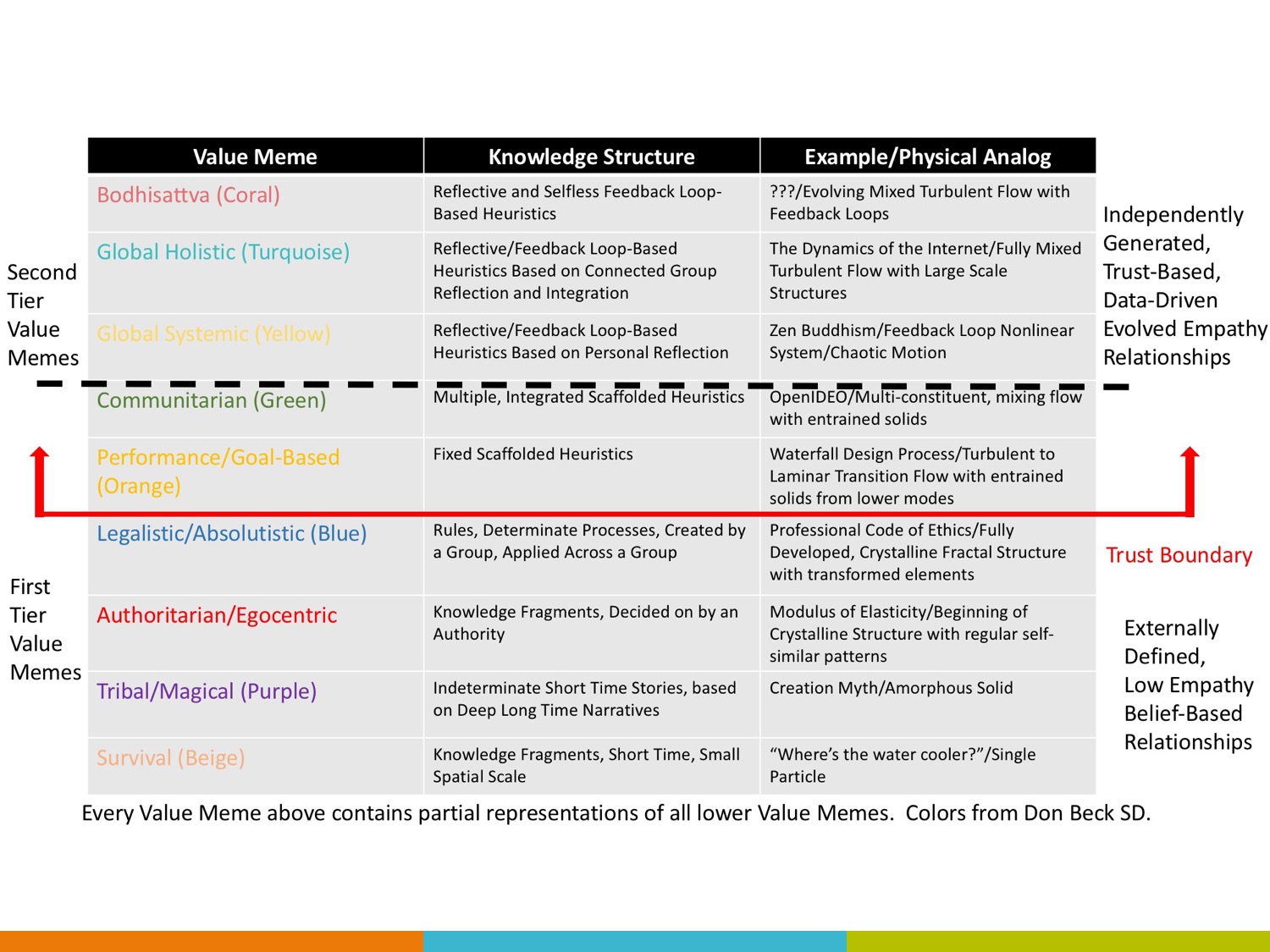


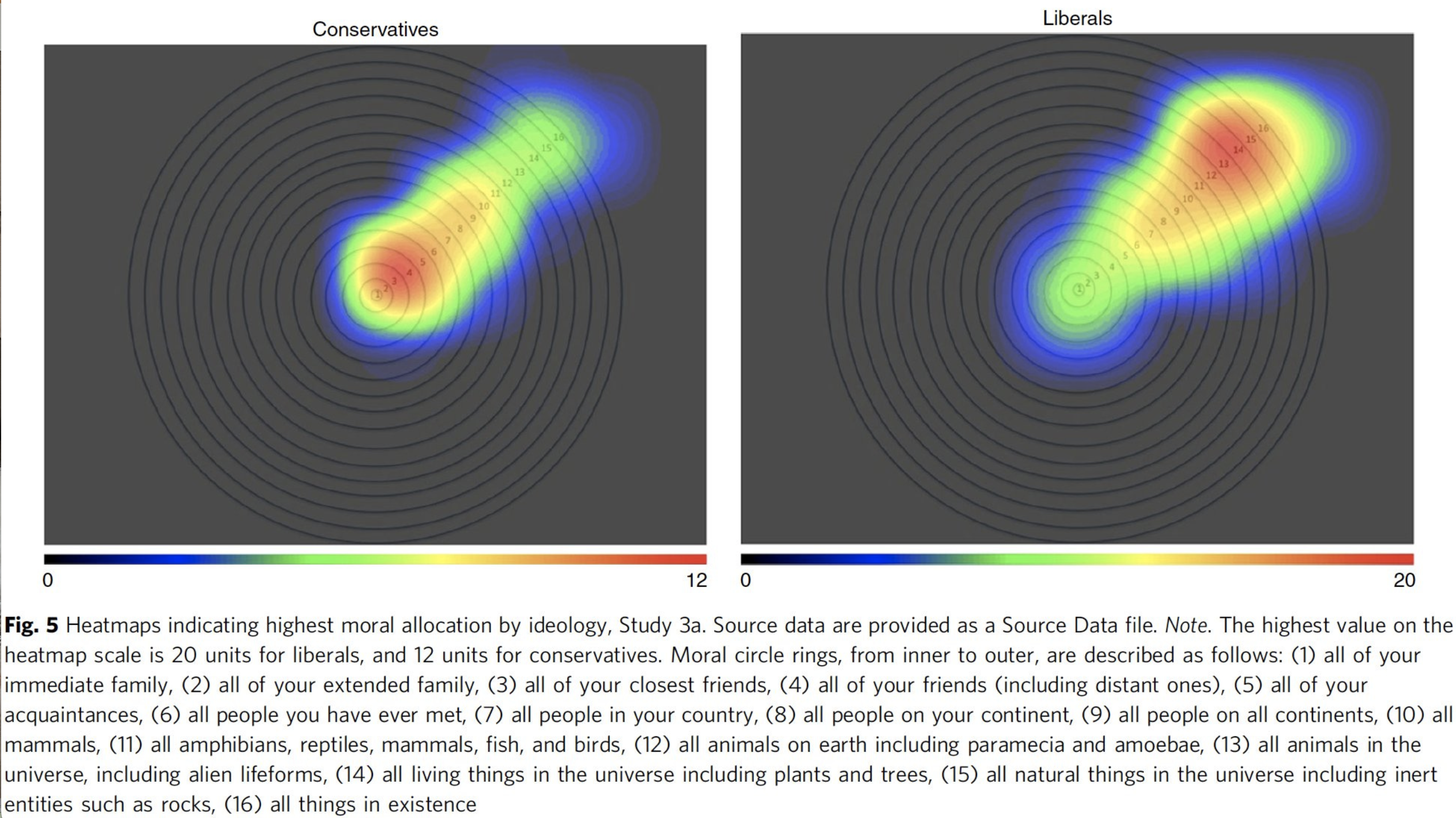

 It's About Empathy - Connection Ties Us Together