Why You’ve Just Gotta Dig — or how just considering topical information is the death of meaning

moma-conor-boredom

Conor in the NY Museum of Modern Art, February 2017

One of the more curious things about understanding empathy is the desire for many researchers, or just general commentators, to apply the ’empathy’ label to actions, or even desires and thoughts, without context.

I’ll start out by saying that it can be done — but it’s perilous, and difficult to do correctly.  The reason is that empathy is even at its most basic a dynamic between two people.  Take mirroring behavior — it takes two to mirror.  One to yawn, and the other to, well, yawn.

Event the most basic of acts that might be recommended in the job arena need some level of consideration.  Take a straightforward behavior like learning names.  For me, as a long-time teacher, and a teacher mentor, I recommend to all my young faculty members to learn as many of the students’ names as they can in the classroom.  The reasons break out along pretty straightforward lines, as you might assume.

  • Performance-based thinking/v-Meme — knowing each student’s name allows me to focus in on helping each student improve, through establishing a direct mentor-student link.
  • Communitarian-based thinking/v-Meme — knowing each student’s name, and using it in the context of classroom discussions.
  • Global Systemic thinking/v-Meme — knowing all the students’ names allows for optimal group formation, along with figuring out how the slackers are and distributing them.

And so on.  Right?  OK, now if I had to just guess the v-Meme that most readers of this blog would assign to this behavior, it would likely be ‘Communitarian’.  And I’d also likely assume that most of you would consider it a good example of empathetic behavior.  How can you establish a connection with someone if you don’t know who they are?

But what if you were a relational disruptor?  What about these interpretations?

  • Authoritarian — knowing each students’ name gives you an opportunity to be invasive with personal boundaries — if a given student screws up, or attempts to collaborate with another student, you can call them out.  They can run, but they can’t hide.
  • Legalistic/Absolutistic — knowing each student’s name allows you to map each one into a seat for predetermined performance.  We want the A students up front, the B students in the middle, and the C students toward the back, since we already know who’s going to do well in the class anyway.

Context and dynamic matter.  I’d be willing to bet that professors that know students’ names are more empathetic.  But it would be an interesting quick survey to understand the operative reasons.


Comparing Engineers’ and Artists’ Brains — or Brains is Brains — sort of!

umbrellacar with students.jpg

Sena Clara Creston, WSU-Tri-cities Art Faculty, sitting in her creation, designed and constructed by my students, 2015 — the Umbrella Ship

This week, I’m off to New York City to share a presentation with a collaborator at the College Art Association, on combining engineering and art.  Sena Clara Creston, faculty in the School of Fine Arts, and I teamed up with my other fellow traveler, Jake Leachman, to pair students and an artist (that would be Sena!) in order to gain some insight into collaboration and thinking styles.  My thesis was (and mostly remains) brains is brains is brains.  But there’s no question that backgrounds definitely matter, and understanding these were one of the key elements of our little research project.

I’ve always maintained that creativity isn’t inherent to any given discipline.  Individual creativity is that egocentric Authoritarian v-Meme triggering residing in one person’s brain, and is poorly understood.  It’s some function of limbic threshold response that brings the thoughts in one’s head to a point, where something new gets created.  And when it comes to systemic creativity, I’ve already written a bunch on that.  Systemic creativity is directly related to the meta-nonlinear dynamics created by the back-and-forth, empathetic exchange between the participants. When you set up a group of people and give them a task to get done (a goal), some degree of personal agency, and some Legalistic v-Meme Protocols and some multi-solution heuristics (like negotiating skills,) cool stuff will appear.  You won’t necessarily know what it is a priori, but it will happen.

The presentation in New York City is mostly Sena’s baby, but I get a couple of slides, and it does raise some big questions.  Brains may be brains may be brains, but there’s no question that people, and disciplines do think differently.  A better way to think about it might be to chase down the ‘hardware/firmware/software’ paradigm and see if we can’t get some understanding there.

With regards to hardware and the brain, there seems to be some general consensus on things like IQ tests and other pattern recognition testing on the brain.  Fair enough.  That’s a process-based thing, though, and doesn’t map well to the idea that topical content is hardwired into your brain.

However, there are a few examples of topical behavior that jump out at people! (Pun intended.)  We know that humans are naturally afraid of snakes, and some people have this thing about spiders.  This would seem to be both topical, and hardware-based, though even that’s not clear.  If we discount the people having deliberate Survival v-Meme trauma with our spidery or snake-y cousins, then I think we can settle on this as heritable topical knowledge.  There’s got to be other stuff — like yellows and reds being fruity flavored.  At the same time, I think it’s fair to say that most of the human brain is not topically hardware-oriented. Getting to the problem at hand, you might be able to do a survey and sort out engineers and artists to figure out if a disposition to hating snakes and spiders had to do with one or the other. Whatever!

Next on the list is firmware — epigenetics.  I’ve talked about epigenetics before, how basically experiences of your ancestors (mostly trauma) can alter your genetic code, and give you certain physical predilections to certain behaviors, such as aggressiveness or paranoia.  While epigenetics seem very likely to pass along certain process behavior, it also seems extremely unlikely to pass along any topical information.  One or two bad generations of genes don’t seem likely enough to construct a fear of ferris wheels, for example.  You just can’t lock in the geometric structure with a fear of intergenerational beatings.

So I’m going to go out on a limb(ic) system, and argue that epigenetics doesn’t pass on topical information — only dispositions, emotional tendencies, and various potentials for sensory heightening (like hyper vigilance.)

That means that for the most part, our brains are deeply coded with the Siegel Brain model for processing topical information.  For those that have forgotten what that looks like, the picture is below:

Modified Siegel Brain

What this means is that information from our various systems gets dumped on the Left side of the brain in the form of explicit knowledge.  This might be stuff we learn in school, the information from an ad flyer about what’s on sale, and various books and such.  In order for us to use this, it has to get processed into a holistic, autobiographical form on the Right side of our brain.

How can we understand this with our Theory of Empathetic Evolution?  Information from the lower v-Memes, things like situations, algorithms, and knowledge fragments get placed into the Left side.  Mapping back to our Artists and Engineers comparison, those lower v-Meme knowledge structures are going to be pretty different.  Assuming that people’s primary and high school experiences are somewhat the same (yeah, I know they’re not, but humor me!) the engineers are likely to learn more algorithms, take more math, and maybe even a drafting class or two, which is very structured.  Artists are going to be learning the basics of sculpture, 3-D visualization, painting, etc. They’re also likely to be goosed by their instructors to practice things like free association, and other forms of impulsive creativity.  And if they had good teachers, those art teachers probably also asked the students to engage in reflective activity about their own life experience, that they had to represent with art.  The idea here would likely be “reflect on your life experience and construct art that could convey to an audience a given emotion that you felt.”  Note that this kind of practice, with some guidance, is directly related to empathy development.  How?  First, you have to empathize and connect with yourself.  Then you have to empathize and connect with an audience.

In certain ways, it’s much less likely to happen in any kind of engineering education, especially at the lower levels.  Much more emphasis is going to be placed on mastering the explicit skills of engineering — conducting that statics analysis, figuring out the circuit diagram voltages, or learning the laws of physics. Prospective engineering students may indeed work on a project where they apply their skills to building some contraption, and that creates a holistic/autobiographical experience unto itself.  FIRST Robotics is big on this. But building a basketball shooting robot isn’t as likely to fill in the reflective part of the empathy development profile. Though there’s no question that the teamwork and goal-setting aspects would definitely fill the bill.

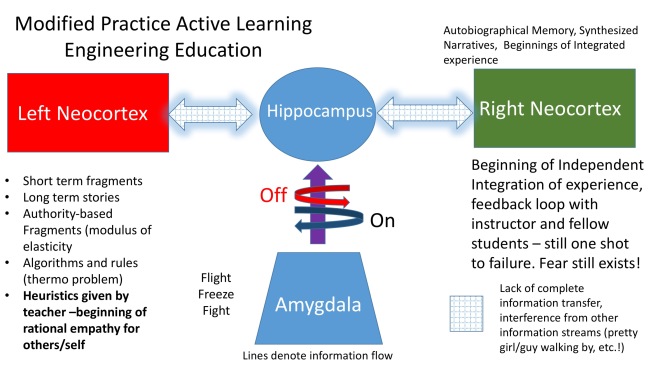
With those thoughts, let’s look at a modified Siegel picture for understanding the artist’s and engineer’s brain:

caa-final

This is a fun one about one of my favorite artists, Isabel Samaras.  Isabel combines classical art with pop themes and excellent classical execution.  It’s obvious that Isabel has some algorithmic scaffolding, in her sophisticated use of color, as well as precision of brush strokes.  But much of what drives Samaras’ art is fuzzy sexualized re-conceptions of  relational dynamics behind pop icons.  You can’t predict what she’s going to paint next.  Her painting (shown in the picture) The Abduction of the Simian Women pulls from both Ruben’s The Rape of the Daughters of Leucippus and the Planet of the Apes series.  A more stratified mind likely couldn’t link those two themes.  Yet Samaras, pop/classical surrealist that she is, does so seamlessly.  And Samaras is no amateur — her work is also another re-integrative step beyond, pulling integrated experiences back from her childhood as part of her Left-Brain explicit palette, to be re-integrated again.  And again.

Here’s a figure of my engineering students, and their brains:

engineer-brain

Heavily scaffolded, of course, with guiding principles hanging in the background.  But there are some floating conceptualizations there, too.  Many of my students don’t want to just learn algorithms.  There are aspirations in there, and some level of reflection that some of the stuff they are learning will actually have to be used if they want to work at Blue Origin or SpaceX.

What’s the bottom line?  Both sides can use each other — especially if the art is supposed to spring off the page.  In the case of Sena Clara’s Umbrellaship, she had to relocate multiple parts of the display so that the whole contraption wouldn’t tip over.  The students got multiple spankings on aesthetics — I’d repeat over and over “this thing is a work of art — it has to LOOK good!”  And it was a whole lot more fun than making another round of mousetrap cars.

So are there differences between engineering brains and artist brains?  Well, sort of.  But the fundamental drivers and dynamics of empathetic evolution are the same.  And the key to remembering when sharing work between any set of diverse constituencies.

Requiem for a True Evolutionary – Hans Rosling

guangzhou-hall-of-buddhas

Guangzhou Buddhas, Hualin Temple, 2011

One of the great Empathetic Evolutionaries of our time passed yesterday.  Hans Rosling, someone who did Big Data better than anyone, died of pancreatic cancer in Uppsala, Sweden, at the age of 68.

Hans was no glad-hander, but he devoutly did not deal in fear.  If there’s an award for sensemaking in whatever sense you want, he took the numbers and empathetically led anyone who would watch to higher meaning.  His message was simple — modern global civilization isn’t perfect.  But it’s so much better, for so many people, that we should both appreciate, and participate in it.  And what was so awesome about his thoughts and deeds was, besides the message itself, his deep understanding of the need for scaffolding his highest levels of thought with those layered underneath.  You got guiding principles and demonstration of global empathy.  But underneath, you got direction, data, facts, and expert opinion.  No one has done it better.

I’ve watched a number of his presentations, and can’t recall if he directly addressed the ‘fear’ aspect of control that he worked his whole life to dissipate.  But he did confront it with his presentations and actions.  If only our leaders had 1/10 of his insight — we could stop the waste of constant conflict and war that pervades our international sense.  Here’s a piece below that addresses that data-driven optimism that I love.

and here’s his TED talk, for your convenience.  What a great title!

How Does Big Data Fit into the Scheme of Empathetic Evolution? Part 2

globe-theater-london

Outside the Globe Theater, London, England, 2008

In the last post, we talked about Big Data — what it is, what it might be good for, and how our implicit assumptions in creating various schemas (data structures inside a given set) might influence how and what we understand.  None of this is easy.

Yet our ability to understand the validity — what something actually means, and what its predictive reach may be — is directly tied to understanding what it is that we do, or did to the data to get an answer.  Any good statistician (who I do make fun of in the last post) will tell you that they intrinsically do sensemaking every time they do an analysis.  The simplest example might be bimodality of data.  Below is an example from Wikipedia by user Maksim.

.bimodal

If one takes the average, mean, whatever you want to call it, the answer will come out just a little to the left of zero.  In this case, as any statistician will tell you, the mean won’t mean much! (pun intended!)

But an experienced statistician will recognize from various cues in the data set (maybe through the variance, maybe through a quick plot of the probability density function) that the distribution is bimodal.  Then, if you’re approaching them for expert advice, they’ll say “well, we need to do some different things to make sense of this data set.”

What’s really going on here?  The statistician is applying a scaffolded heuristic to the data, because he knows you want an answer that means something — that is valid.  He is demonstrating evolved, empathetic behavior.  And though he’s using algorithms, he isn’t operating out of the purely algorithmic/legalistic v-Meme set, because he knows (if he’s a good statistician, at least) that you want to learn something that will help you along toward your goal.  And that just giving you the mean won’t do that.

In this paragraph above, we’ve encapsulated the basic place-taking empathy of the v-Memes above the Trust Boundary.  The statistician’s place-taking with you, knowing that just telling you the mean is not enough.  He knows you’re trying to reach a goal — that would be Performance v-Meme territory as well.  And the heuristic he’s applying comes out of a combination of lower-level scaffolding (algorithmic tests for bimodality) as well as integrative experience (this is not his first rodeo!)

And he cares — feels responsible — for the result.  Another result of increased empathy.  If he didn’t, he could hand you a laundry list of statistics and say “well, this is what the analysis says.  I’m sure the generated statistics are correct (meaning, of course, that they’re reproducible and reliable)   but you’re on your own as far as applying them to your problem.  I’m a statistician, after all!”

He’s not just any statistician.  He’s YOUR statistician.

Right off the bat, one can see that this world gets much more complicated in the world of Big Data.  By definition, we’re going to collect lots and lots of data, of different types.  Not just one distribution, but lots of them.  With lots of statistics. And somehow, we’re going to assume that these statistics are going to help us understand these large, perplexing, ‘wicked’ problems.  If we weren’t attempting to solve wicked problems, why go through the hassle of Big Data?

And how are we likely to approach these problems?  Well, let’s say we’re examining a social issue.  Like who’s going to vote for Donald Trump!  First off, it should be pretty obvious — let’s break that data up.  Men vs. Women.  Women can’t be for Trump, can they? He’s been talking about all those negative things about women, and it’s pretty obvious that he’s in bed with the Religious Right.  Let’s break that data out!

Then we’ve got to move on.  Black vs. White.  Rich vs. Poor. Educated vs. Uneducated. College vs. High School.  And so on.  I’ll tell you — no one’s going to fire you from your job by assuming standard demographics for a statistical analysis.

Maybe some of these categories, and their associated archetypes are good.  Maybe they’re not. But they’re built on assumptions that have pretty clearly demonstrated in the last election are not nearly as clear cut as they may have been 50 years ago.

No problem! you say.  We just need more topical groups.  Black urban women.  White rural professionals.  We’ll fine-scale.  Add more factors. Intersectionality!  People of faith will reject Trump — he doesn’t go to church! At the Prayer Breakfast, he delivered a prayer for Arnold Schwarzenegger.  He’s got a thing for people on the Austrian/Slovenian border.  That’s it!

Except, of course, it’s not.  And in a world where information streams and social situations are more and more differentiated, the people at the end of them are also more topically differentiated — until we get down to the microscopically topically fractionated, and realize that this approach is not going to get us where we need to go.  Ideally, we’d live in a Communitarian v-Meme world, where individuals would rise to the level of their independent data stream.  Martin Luther King had it right.  But I digress.

What is really going on here?  Our mental models, produced primarily by our lower v-Memes, which designated what we are, are not sufficiently capturing the dynamics of how and why we are.  Topical information alone is almost always not sufficient to capture empathetic dynamics and how we process information.  It can give clues, and biases toward certain v-Memes.  But it is not conclusive.

Take an issue like global warming.  If someone is concerned about global warming, one might think that they must be Global Holistic — after all they’re concerned about the impact of global warming across the planet.  Yet maybe the reason that person is concerned is because their parents told them to be concerned (Authoritarian v-Meme.)  Or they’re part of a church that thinks environmental issues matter more than anything (Legalistic v-Meme.)  Or they come from an aboriginal tradition for respecting the Earth (Tribal v-Meme, with likely 2nd Tier implications — we’re seeing more and more of this!)  It’s certainly far more likely that someone who is Global Holistic, with empathetic networks across the world, is going to be concerned about global warming.  But the superficial topic alone can’t inform.

What are the implications for Big Data?  We have to develop different methodologies for understanding how data categories connect together.  We have to find ways of capturing patterns of inference that establish a deeper ‘Why’. These patterns of inference  will likely depend on v-Meme content, and will also boil down to spatial and temporal awareness in the individual’s brain — directly relating to their empathetic development.  What this also means is that we have to guess explicitly at models a priori, state what they are, and then see if the larger a priori gets captured.

Academics don’t like to do this.  The idea is that nine times out of ten, the data solely informs.  We’re objective.  We do a good job collecting it, and making sure it’s accurate.  And then we curve fit, and any number of polynomial terms will give us the power law that we need to establish the cause-and-effect relationships we need to know.  Yet once we move out of the relatively meta-simple world of curve fitting, this is not likely to happen.  We may capture interpolative/inner detail with increasing accuracy.  But more profound extrapolation will elude us.

How then, can we utilize Big Data in the service of society, understanding that our old topical models don’t and won’t work like we think they should?  I absolutely don’t have all the answers.  But let’s consider a problem that is near and dear to my heart, involving education.

I was involved with Mike Richey, of the Boeing Company, in exploring potentials for improving online education and associated content, for teaching aerospace fundamentals through construction of Unmanned Aerial Vehicles.  I’ve talked about this before in this post.  Mike works with a Big Data analyst at Purdue, Krishna Madhavan, whose expertise is pulling ‘digital exhaust’ off interactions students have with various content the course architects have decided is important to know.  Such digital exhaust shows clicks and other interaction patterns that can be categorized, at the most basic level, as sequences of content students follow to learn material.

Because the course was prepared in a traditional academic fashion — with topical content in mind — the information stream coming off the users’ interaction with the content is scattered.  The topical content — the various steps necessary to build a UAV, which include everything from aerodynamic body shape to investigate, to calculations for weights and balances of an aircraft — may make sense on the surface, but from a knowledge structure perspective is all over the map.  No one went through and broke down the different v-Memes associated with the information.  Aerodynamic drag coefficients are mixed in with heuristics for structures.  This is no surprise, and typical in education.

What might happen if, instead of tracking topical information, we identified the connectivity in the material the students were seeing?  What if we broke things down along knowledge structure lines?  We could then see if connected, empathetic thinking took more time, or required more feedback loops.  We could test for retention after experience/use of developed heuristics — something that is generally well accepted in education.  We could also see how the learners that proceeded linearly through the material differentiated themselves from feedback-loop learners, or selective content learners.  If this experiment were run in a company, we could sort jobs along the various v-Memes — its likely because of the demands of the positions, sales folks might have different empathetic biases than the stress analysts.  In short, we could create new lenses for grouping and modality not based on superficial characteristics, but on core brain wiring.

What that really means is that we are allowing expression of agency into our analysis.  By not locking people down with titles, we discover what they really know.  And what they really want to learn.

There are other applications I’ve been thinking about as well.  One young professor I’ve been discussing things with is attempting to optimize traffic flow through detours.  One can ask how spatial and temporal awareness — all things affected by empathetic development — might affect one’s ability to problem-solve through a construction zone. The possibilities, associated with core brain wiring, instead of more cosmetic characteristics, are literally endless.

There is much more to explore here.  But hopefully this starts your own process.  How can we start using Big Data, which will almost certainly give a much more comprehensive view of the world around us, to tell us something truly reliable AND valid?  It’s the beginning of a journey.


Quickie Post — Seth Godin’s Real Skills, and Ways off Intellectual Flatland

braden-brisket

Teach your son to make a brisket, you’ll eat for a night.  But you still can’t get him to wear shoes.  May, 2016

Reasonably famous author Seth Godin just published a piece on Medium that’s worth a look, titled Let’s Stop Calling Them Soft Skills.  Godin attacks what he calls ‘vocational skills’ — such as programming and such.  Here’s a great quote:

And organizations hire and fire based on vocational skill output all the time, but practically need an act of the Board to get rid of a negative thinker, a bully or a sloth (if he’s good at something measurable)…”

If an employee at your organization walked out with a brand-new laptop every day, you’d have him arrested, or at least fired. If your bookkeeper was embezzling money every month, you’d do the same thing.

But when an employee demoralizes the entire team by undermining a project, or when a team member checks out and doesn’t pull his weight, or when a bully causes future stars to quit the organization — too often, we shrug and point out that this person has tenure, or vocational skills or isn’t so bad.

But they’re stealing from us.”

He then goes on to do what I call ‘laundry listing’ — a comprehensive set of skills he considers ‘soft skills’ , or as he changes definition, ‘real skills.’  Nothing wrong with any of them.  He breaks them down into five categories, and recommends teaching them.  Below are the five categories — I recommend perusing his article to get his specifics.

Self Control — Once you’ve decided that something is important, are you able to persist in doing it, without letting distractions or bad habits get in the way? Doing things for the long run that you might not feel like doing in the short run.

Productivity — Are you skilled with your instrument? Are you able to use your insights and your commitment to actually move things forward? Getting non-vocational tasks done.

Wisdom — Have you learned things that are difficult to glean from a textbook or a manual? Experience is how we become adults.

Perception — Do you have the experience and the practice to see the world clearly? Seeing things before others have to point them out.

Influence — Have you developed the skills needed to persuade others to take action? Charisma is just one form of this skill.

Readers of this blog will recognize Godin’s five categories as emergent behavior of the various v-Memes.  Social structure, accelerated by company culture, will create these.  It’s not that a little lower Legalistic v-Meme scaffolding can’t help.  Having a class, or rather a structured experience, can evolve people.  But take Wisdom — you can’t completely teach wisdom, because wisdom is essentially knowing what you don’t know, and being aware that there are things out there that remain undiscovered.  Wisdom, and the larger metacognition it requires, largely evolves because of experience outside the box.  You can pull some of it inside the box, but in the end, for anything resembling a quick result, you’ve got to have folks at the top the model it, because the only quick way to infuse it in your organization is through mirroring behavior.

Godin’s a smart guy — this post is not meant to diss him.  He’s got a program, called the alt-MBA, where he is attempting to cover these topics in a 30 day hunk.  But understanding how all these are linked together, and how to make them naturally emergent, means we have to get off of Intellectual Flatland.  That’s going to be challenging.  Godin’s Real Skills aren’t just a couple of countries to add, as we made the point back here when we discussed Sensemaking.  They’re intrinsically synergistic.  We need to evolve our own thinking and mental models in order to get there.  Evolving Real Skills seems to many to be sailing off the edge of the world.  But for those on an Empathetic Evolutionary journey, it’s really taking off into the heavens.

How Does Big Data Fit into the Scheme of Empathetic Evolution? Part 1

Kauai Sunset.jpg

Kauai Sunset, 2007

One of the latest analytical tools making news in the forefront of tech. is the idea of Big Data.  What is Big Data, and how is it different from ‘Little Data’?  The primary characteristic of Big Data is complexity — more facets, with more correlates, requiring different types of analysis tools than ever before.  Big Data, basically by definition, strains the capacities of the current batch of relational data management sets available today.

And to read the press, Big Data is going to solve all our problems in the world.  It’s going to show us how everything in our world is related.  Here’s a link from the famous consulting company, McKinsey, extolling the abilities of Big Data, while at the same time warning folks to get on the Big Data bus.

Make no mistake. Big Data can be a powerful tool. The very idea of collecting and understanding data from a variety of sources heretofore unavailable gives the potential for insight into how we execute many tasks in our daily lives.  Last October, for example, I was  in the PACCAR/Kenworth truck plant in Renton, taking a tour. In that facility, every time a screw is drilled into a truck frame, its seating and position is recorded.  Think about that from a quality control perspective.  You can know if, for not just a given model, but an individual unit, whether quality parameters have been met — whether literally every screw in the design of a truck has been mounted onto the truck frame. Incredible.

Big Data is also intrinsically tied up with the Internet of Things (IoT).  What might be a paradigm for understanding that?  IoT is actually a combination of three things — the various sensors that detect conditions in the natural world, the fiber optic nerve bundles that carry them back to the computers/brains that then make sense of the sensory inputs, and the computers/brains that then process the data, and send commands to modify the behavior of the larger system through actions at the interface between the IoT device and reality. Once one grasps the implications of this model, one can understand that IoT, combined with Big Data, is going to create the larger, distributed nervous system for the world we will occupy.  As such, the whole field of Big Data becomes very important.  Because how we implement Big Data will be, at some level, how we want the Internet Overmind to work.

Note that I said “want”.  Whatever we do will be a complex system, with emergent behavior that will be unpredictable.  That doesn’t necessarily mean ‘unpredictable’ as in bad, nor does it mean ‘unpredictable’ as in good.  You might consider your limbic reaction to get a head check on your morning v-Meme! It just means that with however many billions of interactions, that will continue to grow in the future, we better be prepared to accept that there are some serious Unknown Unknowns out there.

But there are some things that we can know about Big Data — namely, we can understand the v-Meme of the lenses that we use to look at the data, if we choose.  And therein lies the rub.  What we want to do with the data will dictate, at least in part, how we view it, and how we view our actions regarding its transformation.  And what we want to do will largely depend our own own perspective, summed up in our own v-Meme.

Why does this matter? This one concept is the first step along a path toward establishing validity of what our observations might be of Big Data. Let’s tear this idea apart and see if we can make sense of it.

First off, let’s start with our understanding of cognition and metacognition.  Cognition is knowing what we know.  Metacognition is being aware of our cognition — in other words, knowing what we know, knowing what we don’t know, and also being aware of not knowing all the things we don’t know.

How this applies to Big Data is as follows:  if we look at a Big Data set, structured in some kind of a schema, or a pattern of data matching, we can certainly pull inferences out by sampling some of the lines in our Big Data set.  Here’s a simplified example:

Our schema might look like this:

Name                  Age                         Recent Purchase

Bill Jones           42                            Tennis Balls

etc……. with millions more rows of data.

An Authoritarian perspective on this data might be “I’ve looked at this data set, and it clearly shows that 42-year-old men like to buy tennis balls.”

When asked why he said that, our pure v-Meme Authoritarian (let’s call him Jim) might say “well, I’m a 42 year old man.  I like to buy tennis balls.  And here — right here in this database on what people like to buy is a line that shows I’m not the only one!”  If you remind him that there are millions of lines in the schema, if he was a pure authoritarian, he might respond “Why are you telling me I’m wrong?”  Jim’s an Authoritarian, also prone to dichotomous thinking and egocentric projection.  “I know what I know — and right here is the evidence to support it!”  One can see you’re already down the rabbit hole for convincing Jim otherwise.  The data, even though it appears connected through the schema, is still a knowledge fragment, able to be processed by Authoritarian Jim.  Further, there’s only one solution.  Jim has said so, and since the veracity of information is controlled inside his head, he’s sure he’s right.  And to him, he’s also supported his answer.  He’s using a Big Data set, after all, and we all know that these are indeed the latest methods!  McKinsey said so!  We now see also how status plays into Jim’s conclusions.  Never mind that the world is a more complex place.  And if Jim’s doing the ordering, you can bet it’s going to be tennis balls, or something else Jim likes. Because if Jim likes it, everyone’s going to like it.  And it’s backed up by data!

Let’s move on up to a Legalistic/Absolutistic v-Meme framework.  Tina is now looking at the data, and she has a background in statistics.  In fact, she’s the Chief Statistician in the department, and has three Assistant Statisticians report to her.  Tina has data transformation tools at her disposal.  So Marlene, a manager, comes to Tina, and says “Tina — I’d like some help placing orders for next year.  Can you use your Big Data magic to figure out what we should order?”  Tina says “coming right up!”

So Tina goes to the database, looks at the same schema, and starts applying some set of algorithmic transformations to the data, in the hopes that it will tell her what to tell Marlene.  Same schema, lots of data.  Applying algorithms (and they could be sophisticated algorithms) Tina may even do things like code objects into classes — balls of all sorts might get a Bin Number, horseshoes might get another.  The schemes (and schemas) may become more complex.  There may be a legacy object coding.  Whatever.  The key is that Tina runs her algorithms, and then she looks at them.  She figures out what  item sold the most.  And then she reports to Marlene.  “Order more balls,” she says. “They’re our best-seller.”

Now things get interesting.  If Marlene asks Tina WHY she should order more balls, there are a number of responses Tina may say.  But likely, the core of her argument will be “well, that’s what the data tells us to do.  We have to trust the data.”  The lens that Tina views the data through is what I call a meta-linear transform.  Regardless of the complexity of the analysis done, the algorithms applied to the same data set will yield the same answers.  And here’s the rub. Even though Tina says “well, that’s what the data tells us,” implicit in all this analysis are characteristics of the Legalistic v-Meme.  We know what we know.  There is no awareness that there may be things we DON’T know. Tina’s a no-nonsense statistician.  “I’m perfectly data driven, and rational,” she’ll tell you.  But likely, if she does tell you this, it may be true that she is logical. But she likely doesn’t understand the meta-dynamic that created the schema in the first place.  Or how and why anyone generated the object codes that grouped objects into balls and horseshoes in the first place.  Buried back in history, someone made a decision to look at the data that way, and that implicit mental model is buried in the way we set up collecting the data in the first place.  In so many ways, it’s not only the data that’s talking.  It’s the way we set up the grouping of the data in the first place.

And here’s the other thing — because we have data, we KNOW it. From the perspective of the community, the answer has arisen straight out of the data.  By the very definition of objectivity, these people are objective!  If you, on the outside of the system, attempt to question those people on the inside, their immediate response is always the same.  “Where’s the data to back up your theory?  We didn’t make any assumptions.”

One can now start to see the difference between cognition and the larger issues of metacognition — or for lack of a better term, knowing and wisdom — knowing what you don’t know.  Without metacognition, one can’t understand what you don’t know, or interpret it.  Any larger metacognition is actually set in the way the schema for the data is constructed.  And to the person on the inside — in this case, Tina — she can’t know.  Her Legalistic/Absolutistic v-Meme brain wiring prevents it.  And it doesn’t matter whether it is Data — or Big Data.  With all the v-Memes at Legalistic and below, one is limited in awareness only to the things one knows — no matter the level of data transformation.  That doesn’t mean that there aren’t higher understandings built into the system.  But these Guiding Principles are implicitly buried in the schema, with few clues on how to divine these. Tina isn’t aware of them.

This kind of thinking has many situations where it can be insightful and productive. If you’re a company selling sports equipment, and you need to make sure your stock levels are adequate, various meta-linear transformations may exactly be the types of answers that you are looking for. Also implicit in this type of system is the notion of slow change (if any), or rather, predictable change.  Your company might decide it needs to stock up on tennis balls seasonally, and this periodic depletion of tennis ball stocks might just be part of the plan.  The business environment, more or less, doesn’t change year to year.  So this might just be the ticket.

But it’s not going to work very well if people start using tennis balls for things other than their intended purpose.  Let’s say there’s an increase in tennis ball sales, and the real reason is people are buying more pit bulls, and taking them to the park and playing fetch.  Because the pit bulls have powerful jaws, the dogs are popping more tennis balls, inflating demand.  The real reason for the 42 year old contingent buying tennis balls is because of dog tennis ball consumption.  Big Data will not tell you that.

How can we understand how to get more out of Big Data? That’s the subject of the next post.  But here’s the rub — what we get out of Big Data will necessarily correspond to the v-Meme level of the mental model that we apply.  And the v-Meme level will by definition dictate both the individuality, validity, as well as connectivity of both data and insights that we make.  And if we do that explicitly, then we stand a much better chance of understanding how Big Data should inform our decisions — and when we need to start asking more questions.


What Caused the Enlightenment? And What Threatens to Unravel It?

church-big-island

White Church, North Kohala, Hawaii, August 2014

One of my long-history hypotheses is that the Enlightenment was a direct result of the Black Plague.  Because of the Plague, and the massive depopulation that occurred — something like 45-50% of the population of Europe died, all from a couple of galleys landing in Genoa.  The Wikipedia article contains all the details for those fascinated by such things.

One thing that the Black Plague did, by depopulating areas by as much as 80%, though, was dismantle the vassal system across feudal Europe.  This made it possible for peasants to exercise agency regarding whom they wanted to work for, that then laid the ground for recognition of those peasants as people — which then accelerated the development of empathy, because of the need to look past someone’s title because you needed your arable land tended.  Which then led to Locke and other Enlightenment Philosophers, and the Rights of Man!

One can keep going with the larger empathetic historical arc.  So here we go!  This led to the ability for more people to be rational, as that rise in empathetic sea level drove more rationality, with the ability to exchange information, which then led to the ability to create more, and more complex machinery, which then led to the Industrial Revolution.  You get the picture.  No one can argue that history is one long, connected story.  And deeply embedded in it, sometimes in fits and starts, is increasing empathy.

And if you need what experimentalists call a ‘control’ — one can merely look across to China, along the same timeline.  Needham’s Dilemma asks the question “how did China technologically fall behind the West?”  The answer is a lack of empathy – big time.  When you have too many people, and the emperor is a God, well, that kind of Magical Authoritarianism is tough to shake.  Or give a culture much space to evolve.  Sophistication will undoubtedly increase — no one can argue with the beauty of Chinese artwork,  their architectural accomplishments or work in opera. But the value of the lives of ordinary people?  Eh, not so much.

One of the key drivers, as well as a valid indicator,  on a very basic, thermodynamic level, is the value of an individual’s wage.  The Black Death, through depopulation, increased wage rates through direct competition of the vassal overlords.  This enabled both the actual living standard to increase, through things like lower housing costs for everyone, as well as the relative living standard — the gap between rich and poor — to decrease.  With that combination recalibration, both absolute and relative, humanity was once again launched on a path of v-memetic evolution, leading to the Renaissance and the present day.

It was with this perspective that this article in Vox caught my eye.    Describing the work of a young Italian economist, Guido Alfani, it shows the long-history view of wealth inequality.  I’ve borrowed the figure from the article, and it’s posted below.  The chart shows the amount of wealth owned by the top 10%.  The breakpoints are the Black Plague and World War II.

alfanifig1

Why does the absolute ratio matter not as much?  Or why did it take a 90% differential to start World War II, where no one can argue that Authoritarianism reached its peak?  Societies make progress.  Overall wages and well-being continue to climb, and with them empathetic development.  Individual empathetic development then drives more empathetic cultures.  Which then creates more empathetic people.  That’s the Principle of Reinforcement stuff that we talked about a long time ago.  These systems are self-similar, in that larger forces develop individuals, which then create those larger forces, in a constant feedback loop.

Now that we’re considering things on a planetary scale, it’s really hard to wrap one’s head around the different energetic scalings that are occurring.  Oxfam just released a report that declares the top eight wealthiest people in the world have the same net worth as 50% of the rest of the world’s population.  1 billion people are already in poverty.  Needless to say, this kind of wealth aggregation Overview Effect wasn’t even possible 700 years ago.  Throw in the Internet, which allows more information going to more places and more people, with more perspectives, than ever before.  And finally, add a heaping dose of smart phones and cellular networks.  It’s basically impossible to come up with one number that is going to give the same clarity as far as percentage wealth distribution that trips the Empathetic Devolutionary cycle back down the Spiral, from Performance-based Communitarian v-Meme societies, back down towards the medieval authoritarianism that dominated before the Black Plague.

And all this ability to connect cuts both ways.  On the one hand, it gives alternate news sources the ability to spread fake news further and faster than ever before.  At the same time, it allows regrounding of informatic systems by far fewer individuals, or far smaller conflicts, than ever before.  Do note I am a huge Glenn Greenwald fan.

But just because we can’t nail down a number doesn’t mean we can’t see it.  Once we reach an overall system value of wealth differential, the system, with all its various cultural sidebars, and lower v-Meme scaffolding, starts displaying Empathetic Devolutionary behavior.  Sooner or later, we devalue the individual enough, through a combination of automation, overpopulation or tax policy, that gives the winners in the system an ability to trigger Pareto principle runaway wealth acquisition (here’s one for the real masochists in my news feed.)  And more and more fall further and further behind, while those in front sprint further and further ahead.  A division of energetics, as well as the actual baselines themselves are a key cause.  And in the end, empathetic culture alone can’t overcome this.  People have to eat, go to school, and talk to each other enough to keep their neural evolution alive.  And working multiple jobs in a fast food joint, or bolting together iPhones doesn’t seem to be conducive to any of this.

And the upshot is this: Authoritarianism comes home to roost.  People stop mattering.  And there’s enough disordered thinking out there that shows up.  You don’t have to look on the national scene, and Trump, which I’ve written about extensively.  In our own little community of Moscow, ID — known as a liberal bubble in a deep Red State– it’s this Idaho senator, recently elected, who advocates for a law requiring the death penalty for women getting abortions. It’s the lack of concern for the education lending bubble.  Everyone, no matter how powerless in a society, deserves what they get.  The winners, of course, also deserve all their money.  But they inherit no responsibility to the rest of society.

Here’s the cautionary tale for the various moral disputations to the system argument — that somehow, if we just do what’s “right”, that’s the best thing to do.  These things never end well for anyone.  In fact, they always end in some human version of the Great Dying.  And they are fixable, in this day and age, through tax policy.  From where I sit, there are certainly better and worse public investments.  Better bridges and trains mean more people can move freely through your society, and be happier.  Warplanes give the Authoritarians more modes for violence, and feed Survival v-Meme fears.  But in the end, making sure one has a system in place, even if it’s manufacturing Hello Kitty dolls, so that everyone has enough sustenance to go round, as well as take an occasional beach vacation, is really an optimal solution from an Empathetic Evolutionary perspective.  The alternatives in this day and age are terrifying.  Like this — more nuclear weapons modernization and acquisition.  How about that argument?

Quickie Post — Jake’s Safety Post on Hydrogen.WSU.edu

gospels

Gospel Mountains, Central Idaho, 2011?  One of the best Lighthawk flights I’ve ever been asked to execute, around the issue of snowmobile trespass in Wilderness.

Colleague and friend Jake Leachman has written a simply outstanding post on safety, applying many of the principles of Empathetic Evolution that we’ve developed and discussed together.  Highly recommended.  The great thing about this post, besides the analysis, is Jake has pulled in other social theories to explain why they don’t work. Jake’s argument is that if you build a safety culture scaffolded out appropriately with the various v-Memes, you have a robust environment that can handle crisis when it occurs.  But if you leave it in the hands of the Authoritarians, where people will be punished for safety violations, all bets are off.  Information flow, as well as coherence, breaks down, and accident rates will rise.  But when people buddy up, share knowledge in communitarian settings (like lunches), and also develop Global Systemic feedback loops that reinforce safety culture in a pro-active manner, you’re on your way to larger happiness, as well as a safer, more productive work environment.

One thing that Jake didn’t dwell on, but I would like to emphasize, is that developing empathy and connection within your lab community will also increase the presence of consequential thinking in your safety environment.  That means accidents are prevented before they occur.  Another great thing.

Finally, one of the underutilized tools for creating safety environments is the appropriate use of humor.  I’ve been wanting to write about laughter for a while, because it’s such an interesting sentient phenomena.  Here’s the quick takeaway — while laughter can map to lots of different levels of empathy (slapstick, for example, is anti-empathetic.  Laughing at someone getting hurt definitely emphasizes in-group/out-group dynamics!)  subtle humor, and the laughter it cues, is really a gateway for suppressing the limbic fear response and opening us up to multi-solution thinking.  When you laugh at a subtle joke, it’s almost always a function of double-meaning, and it forces you to reflect on what’s really being said.  How’s that for amplification of cognitive process?  🙂

Quickie Post — Hippocampal Tagging and Access to Larger Data Structures Inside Our Brains

bogota-che-guevara

Graffiti, Universidad Nacional de Bogota, Colombia  2014? Can’t remember!

One of the subjects I spend a fair amount of time thinking about regarding neuroscience is how expert thinking works.  I know how, in my own perspective, I think it HAS to work — limbic tags to larger networked structures residing somewhere in the prefrontal cortex.  Of course, just because I think that it HAS to work that way, doesn’t mean that it does.  But from a structural/functional perspective, there are good reasons to argue why it does work that way.

How so?  First off, expert thinking is often very quick.  An expert will see a particular circumstance, and she will immediately relate that to a previous solution that is correct.  When any type of thinking is ‘fast’, it means there’s a high probability it has to start in the limbic system.  I also know that if you ask an expert to explain their thinking, it will take them a minute.  They’ll pause, and stutter along as they reconstruct the explanation — unless they’re a teacher, and explain all the time, in which case, that also will come quickly, which means it, too, is tagged in the limbic area.

How might all this work?  If we go back to Siegel’s explanation of how the brain processes trauma (or any higher learning/complex narrative) we realize that information that gets dumped on the left side of the neocortex has to be integrated and processed in the hippocampus, before ending up on the right side as a holistic memory.  The hippocampus itself must also have the equivalent of a computer’s fast cache memory, that can be used to hold onto a thread of the thought, as it passes out into the right side of the brain, for future use — otherwise there’s no way to yank that big long list of thoughts and structures out.  Simplified Siegel Brain

The Dunning-Kruger phenomenon (you’re so dumb, you don’t know how dumb you are, or you’re so smart, you don’t know how smart you are — overestimation or underestimation of competence) that we’ve discussed before also points to heavy duty limbic action.  Someone that doesn’t know what they’re talking about doesn’t have any tagged structure on the right side of the brain to reconstruct.  But that doesn’t stop them from opening their mouth.  Similarly, someone who’s smart has a bunch of stuff integrated on her right side of her brain, but it just comes so quickly, without appropriate self-awareness, egocentric projection, also rooted in the limbic system, rules the day.  Everyone else must know this stuff, right?  It’s only the slowdown required by rational empathy/perspective taking, that we’re forced to engage the slower, more methodical part of the brain that can connect with other’s perspectives.  Here’s a better picture of the expert brain, with a representation of the tagged structure.

siegel-integration-figures-expert-brain

Well, it’s certainly nice to find out that the neuroscience backs up my hypothesizing.  This popular press article written by Mark Humphries of the Manchester Systems Neurophysiology Lab, about the function of the hippocampus,  the part of the limbic system responsible for that explicit, fragmented knowledge – to – holistic knowledge transformation, confirms this.  It’s actually about research published in Science, about hippocampal area CA3, and its tendency to develop self-reinforcing networks inside the neural structure (can anyone say ‘tag’?) that gives it this ability.

Humphries describes the efforts of the Science article’s authors, mostly from the Institute of Science and Technology Austria in Klosterneuburg outside Vienna, as legendary, and he’s probably right.  Apparently, they had to do microsurgery to wire their various probes to hundreds of individual neurons to find the exact patterns, which were at most only a few neurons wide.  Or long.  Or connected-whatever.  And true to form, just as our knowledge structure/social structure theories would predict the researchers themselves are thinking, these guys are claiming a smaller and smaller piece of real estate, more exactly – Hippocampal Area CA3.  Sometimes it takes a little Authoritarian Legalism to figure out the exact way something works.

I’m aware that this research is only supportive — and not conclusive.  But I’d also welcome any others out there with their ‘It HAS to work this way’ perspective.  Things might be fun!

Quickie Post — The Agony of Tilikum, or Sentience is Sentience, no matter what the package

insta-revi-4

Conor and Graffiti, Underside of the Revelstoke Bridge, New Years Day, 2017, taken by brother Braden

A story came flying across my desktop yesterday, with true dual meaning, involving the death of one of the most famous orcas or recent memory, Tilikum, at Sea World San Diego.  Tilikum was the whale featured in the movie documentary, Blackfish, which I honestly can’t bring myself to watch. Too much empathy or something on my part.  Orcas are inherently social, mesoscale predators that rely on intensive collaboration as they hunt — much like wolves, dolphins or humans.  And those types of evolved behaviors fire up the social empathetic brain in their species, much as they started humans on the long path to the coordinated societies we live in today.

For those not in the know, Tilikum was the killer whale that over the course of his lifetime, killed three people — two handlers, and a person that slipped into his pool late at night.  The first death hastened the shutting down of the first marine park he stayed in — Sealand of the Pacific, in Victoria, BC.  The third death, of trainer Dawn Brancheau, started a backstage revolt at SeaWorld Orlando, and the total movement to ban orcas from being held in captivity.

Tilikum’s life history reads like any murderer’s monologue.  He was captured in the open sea by killer whale hunters plying the oceans for the marine park trade at the age of 2, and taken from his mother.  Orcas exist in matrilineal pods, so this must have been especially traumatic.  According to Wikipedia, males sexually mature at age 15, but do not typically reproduce until 21.  That implies a long period of developmental neoteny, and with it the likely consequences of disruptive attachment on the orca brain. The timescale matches humans so much, it is eerie.

From the open ocean and his mother, Tilikum was placed in a holding pool with two other orca females, that relentlessly bullied him, scraping him with their teeth and otherwise battering him.  Upon being transferred to SeaWorld Orlando, Tilikum was set up as a very typical ‘Target of Blame’ for other orcas, and was also bullied.  As a result, he spent most of his time alone in his own holding tank.

Critics of any notion of animal sentience will likely blanch at the idea of transferring learned human social behavior as being trans-species, and argue that it’s human transference that got us into this mess in the first place.  SeaWorld as a corporation has always projected an image of orcas as happy-go-lucky splashy performers that love kids.  But anyone with experience with any sentient, group-oriented, empathetic being (how in the world did those other orcas figure out this orca was a bullying target?) knows that taking such a creature and isolating it in a box at a mental age of 2 is a recipe for bizarre pathologies.  I’ve discussed solitary confinement before.  What does solitary confinement look like for an open ocean creature like an orca?  SeaWorld is the equivalent of a Supermax federal correctional facility.

If there’s a hopeful note in all of this, it’s that SeaWorld is phasing out orca shows because of pressure from the larger society — yet another sign of increasing empathetic levels around the world.  I have to take hope in that, even if only a little.  At the same time, when are we going to get to the point of realizing the intrinsic role of connection among all sentient beings, especially inside the species in-group?  When will we factor obvious psychic distress in how we construct our institutions?  It’s a long journey in front of us.