Austronesian Art exhibit — Metropolitan Museum of Art, New York City, February, 2017
In advance of my first webinar tomorrow, I thought I might shed some light on what I perceive think are some of the largest perceptive hurdles in understanding my Theory of Empathetic Evolution. Here goes!
Empathy is NOT Sympathy
This is a big one. Sympathy is an emotional response to someone else’s suffering, where connection does not play a large role. You can have sympathy for the drowned refugee infant, laying on the beach. Sympathy is a route to compassion, and is an important part of the human experience. But it is not empathy.
Empathy, as used in this blog, implies a duplex connection between at least two individuals, or as I would say, sentient agents. This is well-established in the peer-reviewed, scientific literature, and is the bedrock of my work. Not everyone, even in the scientific community, views empathy this way, but the vast majority of empathy researchers do. So it’s kind of like global warming. The consensus is that empathy is about connection, just like the consensus of scientists regard climate change as real.
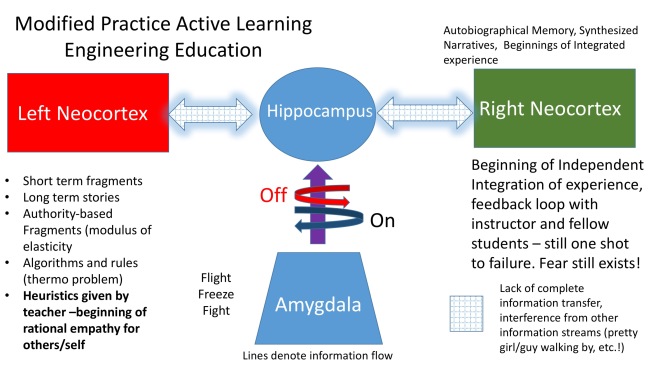
The model of empathy used in my work is an augmentation of the scaffolded version put forward put forward by Frans de Waal, that maps empathy to the three primary brain activity areas, that, of course, are all linked together. They’re all part of the brain, and no part of the brain does something that is completely isolated from all the other parts.
Empathy is NOT Mind-Reading
One of the interesting observations I’ve had explaining empathy to people is the idea that somehow empathy is mind-reading. It’s not, though someone who is highly empathetic on all the various levels can definitely appear to be! Empathy is fundamentally statistical, or really probabilistic in how it works. We take in signals from others, and send signals back in the context of any exchange. These signals are language, sounds, facial expressions, hand gestures and so on, and interpretations our own minds make of various information we receive.
Understanding this, and truly internalizing it into our thinking process, is a big deal. Our brains like to work immediately and transactionally. Lots of famous people have documented this, like Daniel Kahneman, who won the Nobel Prize for studying this kind of thing. Our brains don’t like statistics so much, or holding the idea of a probabilistic exchange. The reasons for that are laid out in what I write about (how your v-Meme helps you construct knowing) but as you read through the posts, you might put a self-check on your own thinking and understanding. On this blog, one of the biggest points I make is that empathy creates information coherence between people exchanging information. Think about the difference in information quantity between a phone conversation and a face-to-face meeting. Which one is easier to convey nuance? Which one is easier to make sure you both understand the same thing? There is really little definitive work that I’ve found (though there are dominant mental models!) on the ratio to verbal and non-verbal communication. The standard comes from the work of Albert Mehrabian, who came up with the 7%-38%-55% Rule (Words/Tone of Voice/Body Language). But it’s obviously highly contextual.
If you think that when you tell someone something, without any feedback or verbal cues, they understand, take it from someone who has taught for 30+ years. I find that students regularly walk with about 20% of the information you present in any given class. Or ask the parent of a teenager!
What business does a professor of engineering have writing about empathy?
I’ve found when I talk about empathy to academic audiences, the worst actors in attempting to understand my argument and theory are sociologists. Why that’s true is what I write about on my blog! It’s not 100%, but these individuals can’t get past what I am, to consider what I write. They are classic authority-based thinkers (entrenched deep in the Authoritarian v-Meme), and to them, a Ph.D. in sociology is the only gateway to being able to discuss many of the ideas presented in this blog.
Titles have purposes, and we cover that extensively on this blog. You don’t wander down the street asking strangers for diagnostic help if your liver hurts. You go to a doctor. That said, if you need some title validation, part of the reason we get a Ph.D. in general is that it gives the well-schooled the set of skills to investigate new areas of research. No one’s Ph.D. can completely educate them in their own discipline, in this day and age. There is simply too much knowledge out there. My Ph.D. in Mechanical Engineering from Duke, and the tutelage from my advisor, still profoundly helps me decipher all sorts of information, both engineering-related and not. I owe my schooling a great debt. But if your advisor does a good job, they school you in general inquiry as well.
If you decide to read my blog, and you’re getting stuck on the idea of me as a mechanical engineer, here are a couple of thoughts to help you get over your reticence.
- My background is in a form of mathematics known as complex system theory, as well as design theory. The first I trained formally during my graduate study. What the math gives is a variety of paradigms — ways of thinking about patterns that help match to physical phenomena. The second is lots of practice watching people (my students and sponsors) design stuff. This gives me lots of experiential patterns that I then can map to the empathy literature, which I read extensively.
- One of the things about empathy is that it’s largely a developed ability. And if you ask me personally, I think the best way to develop it is to meet people who are profoundly different from you, and figure out how they think. I’ve traveled to about 37 different countries, and speak a variety of languages poorly 🙂 . I’ve also had a pretty wild life, both good and bad, that’s given me a lot to reflect on. When scaffolded with the empathy literature and the stuff up above, it’s proven to be very useful in concepts, experiences, and enough self-doubt to keep down the confirmation bias! Like Mark Twain said, “never let school get in the way of getting an education.”
Empathy is NOT always an explicit moment/thought/action in time – it’s an encompassing dynamic
One of the interesting things I’ve observed about the empathy discussion is that most people having it want to isolate empathy, which is fundamentally about connection, onto its own little piece of intellectual real estate, that doesn’t affect the perceived model of constant, fundamental separation from other human beings.
That kind of thinking has its purpose. By isolating empathy, It can lead to some useful insights and techniques for practicing empathy. My empathy buddy Edwin Rutsch and others work on refining such techniques as Empathy Circles. These are great things, especially when you might be called into a company that is having problems from a lack of empathy, to daylight problems that are getting in the way of your company/society making progress.
At the same time, when you draw a circle around empathy in that manner, there is a very real risk that you miss the boat on what empathy is all about. Empathy is a constant dynamic that pervades our entire existence. When you walk into a room, and someone yawns, you don’t suddenly think “Mirroring Behavior — time to yawn!” It’s automatic. You just do it. And here’s a big secret. If you practice, empathy at the higher levels (or the lack of it!) becomes ingratiated into your fundamental Way of Being and becomes a core part of your cognitive and limbic processing.
Here’s an example. I was asked on this NPR show, To the Best of Our Knowledge, about why a professor of design would be interested in empathy. I gave a standard answer, expounding on the differences in design (which I also write about) — algorithmic and heuristic. The first, involving improving the performance of a rocket engine by about 5%, is more non-empathetic. The expert knows, and you listen to them. The second, involving coming up with a new concept for a cell phone, like the iPhone, is decidedly more explicitly empathetic. You go out, talk to customers, empathize with them and their actual uses, and then come back and create a whole new paradigm of how people will use phones. This likely appeals to you, my reader, and makes sense.
But what is missed in this discussion is that even with engineers working on designing a 5% improvement in rocket engine performance, the ability for empathetic exchange profoundly enhances the progress of development of that rocket engine, because it increases the information coherence in all information exchanges required.
This is a huge point, and one easily overlooked. Empathy is embedded, in a self-similar fashion — sometimes automatic, sometimes not automatic — in all our transactions with others. As well as ourselves. It’s nice when we can point to it in the context of product design. But we swim in a sea of empathy, whether we realize it or not. It’s time to move empathy off of Intellectual Flatland.
What are you really doing on this blog?
I don’t want to downplay my role on this blog as far as original ideas. There are a few. But mostly what I’m doing here is connecting the dots — drawing supportable, reasoned linkages between lots of different fields of study. How I do this is I operate under a dominant assumption — that nature does things with simple dynamics, that can generate all sorts of beautiful and complex patterns. I think some of this ability/line of thinking comes from my study of fractals — complex geometric patterns based on typically a very simple underlying dynamic.
The other thing that I’m doing is working on understanding how people understand, and boiling that down to first principles, which from thermodynamics has to be time, space and energetics. It’s likely an odd way for most people to think about what we consider a complex emotional and cognitive phenomenon. But Albert Einstein said it best (paraphrasing) — of all our thought processes, it’s all got to come down to thermo.
And who am I to speak against the genius of the age?
Hope this helps!