Evolving your People and Reducing Conflict — the Lessons of Groundhog Day (Part I)

Pantanal Bird

Weaverbird, Pantanal, Brazil

A long, long time ago, in a post far, far away :-), I explained the basics of  Spiral Dynamics v-Meme evolution.  Naturally, throughout this blog, this is also coupled with all the others — societal, and empathetic evolution.  But to get out of the spaghetti trap that inevitably comes up when talking about all of this (there are days I like to say “Hey, I know what the whole elephant looks like, and I’m all tangled up with him in a big ball of spaghetti!”) let’s just set those causal connections aside — go ‘Open Loop,’ as it were. How do we understand that personal evolution that we need to promote to reduce conflict?  And why should we care if our employees are enlightened?  Shouldn’t they just listen, and do their job?  Can’t have people meditating on the job, after all!

But really — why do you want enlightened employees?  What principles can we borrow from empathetic evolution to help us understand how higher levels of empathy can assist in the workplace?

To start, evolved minds will have a variety of temporal scales programmed into their neurons that they can operate under.  An enlightened person can more effectively sort the priorities of quarterly reports, yearly summaries, and whose turn it is to clean the coffee pots.  An example is in order — where you can see the consequences when folks DON’T have this.

In my Industrial Design Clinic (IDC), I have somewhere between 60-80 students a semester, all working on their final project for graduation.  There are some 10-15 projects/semester, all with a deliverable.  My age cohort is, not surprisingly, very uniform — most around 21-24, looking to graduate.  As I’ve said earlier, they’re transitioning out of complete externally defined relationships, into the land of independently generated relationships and their first real brush with high-stakes rational empathy.  They have a customer — usually, their very first in their profession!

That means that most of them are very egocentric.  There are only a couple of recognized time scales in their head — their own Survival v-Meme time scale (I wanna drink a beer tonight!), my imposed Authoritarian time scale (canonical design process) and of course, graduation.  My authority is in profound eclipse by this time.  In the back of their heads, they know that whatever they do, they’re likely to graduate.  It’s up to me and my system to stimulate higher-evolutionary behavior in order for them to complete their task.

So what do I have them do?  I have them draw up a schedule for work, multiple times during the semester.  Not surprisingly, the first couple rounds of the schedule are utter B.S.  They have been taught in other classes about Gantt charts and the like — and their charts are typically very linear (as one would expect from their empathetic development and relational sophistication) with broad, generic topics like ‘Research/Development/Design’.  Underneath task assignments are the personnel listing.  Mostly, these are ‘All’.

Which, as anyone who’s worked knows, means ‘None’.  Everyone’s responsible, and no one’s responsible.  All mid-term deliverables are vague, so nothing can get done.  Being a young Authoritarian means having poor executive function — someone else is supposed to tell you what to do.  They’ve had 16 years of education beating THAT lesson in their head.  Do what your betters tell you.

I go at the kids, full-tilt, of course.  The schedule must have multiple paths.  It must have measurable deliverables.  Pairing, as I’ve mentioned before, is big.  Multiple people must be assigned and justify their behavior across the group.

What happens, with poor temporal evolution?  In scheduling, there is a method called Critical Path Analysis, or Critical Path Method (CPM)  In this method, the schedule is laid out as a branching tree, re-converging at the end of the process when the deliverable is shipped.  One route through the network of tasks is the ‘Critical Path’ — the longest time through.  All the other paths have what is called ‘Slack’ — extra days/weeks that exist because those tasks are not on the Critical Path.

Inevitably, the majority of the student groups let all tasks not on the Critical Path slip until, instead of having one Critical Path, you have Critical Paths along ALL the project branches.  Now, if anything comes ups, the project is screwed on the delivery date.  The students do this because they have poor metacognitive awareness and an un-evolved sense of time.  Low responsibility, present because of low empathy, means that nothing will happen until the Survival v-Meme kicks in.  There’s a lot more to unpack here.

It’s in your business’ interest to have employees with a highly evolved sense of time.  It allows appropriate job scheduling and discrimination, for one.  The above is just one example.  You can’t get everyone to be a Zen master, but the more people you can push up the chain, likely, you’re better off.  There are others, of course — but this is a big one.

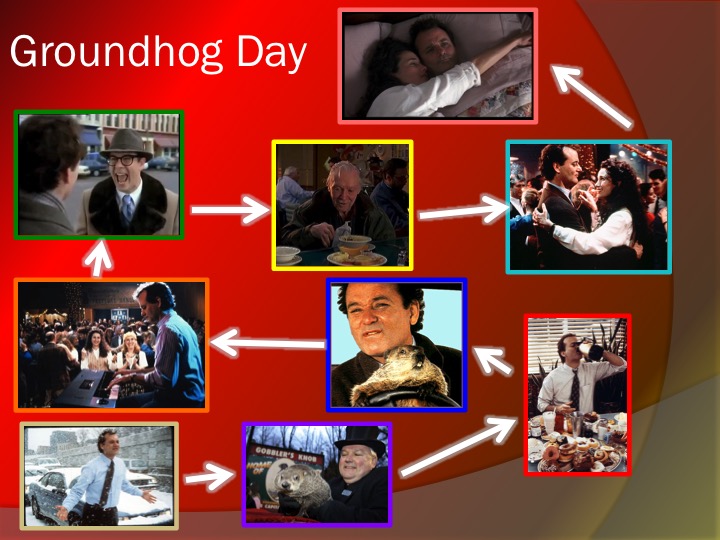
So how do you do it?  The best example I’ve come up with in explaining the various v-Meme transitions is the movie Groundhog Day, with Bill Murray. Groundhog Day, besides being entertaining, is a very interesting movie.  It’s been translated into (at my last check) over 35 languages.  It’s on a number of ‘best movies of all time’ lists, and I’ve found that I can travel far back into rural China and almost always, find someone who’s seen it.  This is pretty amazing for a movie that is ostensibly about a colloquial American holiday, and not a very famous one at that. But what the movie is about, of course, is the search for human enlightenment.  And that is a transcultural, universal theme.

The movie starts out with Bill Murray, as Phil Conners, a weatherman, stuck in a snowstorm in Punxsatawny, PA, the Groundhog Capital of the world, for the annual Groundhog Day celebration.  It’s all too low-level for Phil, and after he films his clip, he tries to get out of town.  Survival v-Meme all the way – he gets turned back in the snowstorm, as the freeway is closed.

Then the major plot device of the movie kicks in.  Stuck in a magical loop (Tribal/Magical v-Meme), with a totem animal — the groundhog — Phil is forced to repeat that same day over and over again.

The first part of the movie displays Phil in all his Authoritarian/Egocentric glory.  He stuffs his face with donuts.  Impervious to consequentiality, he steals single pieces of information from women to use to get them into bed the following day.  He indulges himself.  And none of it makes him happy.

Phil then moves into the Legalistic v-Meme part of the movie.  He attempts to break the rules of the system, mostly through trying to kill himself.  He tries to kill the groundhog.  Nothing works.

In the first half of the movie, what is interesting is that Phil has almost completely, an externally defined or exploitative relationship not just with others, but himself. He’s going to be the next NYC weatherman, and so on.  And then comes the admission — “I’m not really sure I even like myself.”

But how does Phil start the path toward independent relational generation?  Pause before reading the next paragraph and think.

Most people I’ve talked to will immediately say ‘he gets involved with the community,’ or something similar.  This is actually not true.  We often view community interaction as a way for evolutionary growth, and there’s nothing wrong with that.  But in order for Phil to first have an independent relationship with others, there’s an important person he has to have one with first.  Himself.

And how he does this is the key toward evolving your cohort in the 21-35 year old age group.  The answer awaits in the next blog post!

Conflict — Understanding, Avoiding and Healing it — Inter- v-Meme Conflict (Part III)

steamboatbend

Steamboat Bend, Yampa River, Utah in Dinosaur National Monument

——————————————————————–

“If you want epiphanies, you have to put them in the schedule.”  Phil Brick, Politics Professor, Whitman College, on his Semester in the West program

I’ve been short on solutions in the last three posts — namely, because there honestly aren’t any simple ones.  When you have two people in conflict, and the way they structure knowledge is fundamentally different, meta-structures are not easily reconciled — let alone fundamental beliefs and precepts.  Those that argue folks just need to sit down and talk it out?  Well, it’s not that it never works.  But often it’s not just a failure to communicate.  It’s a failure to truly connect.

One of the things that I have seen work in resolving conflict is the creation of opportunity by leadership for shared epiphanies between warring parties.  Note that this will NOT work with relational disruptors.  But for those involved in Healthy Evolutionary Conflict, the elevation in empathetic connection that can occur with shared experience should not be underestimated.

In my youth, I used to be a hard-core whitewater kayaker.  I originally moved out to the West because of my obsession with the sport.  Running hard whitewater was still in its infancy when I started (1979), and basically, you had to paddle with whoever was available who could paddle at that level.

When I moved to Pullman, WA, in 1988, I also became intensively involved with the environmental/old-growth protection movement.  I went on to write a book on the larger issues involving my home watershed — the Clearwater River in North-Central Idaho, called Wild to the Last:  Environmental Conflict in the Clearwater (WSU Press, 1998).

While working on the book, I had more than one logger who was my kayaking buddy.  I am still friends with these people now.  I am convinced that what bound us together was shared experience.  Loggers like being in the woods;  I like being in the woods.  Additionally, we would have to share a Survival v-Meme level interdependence.  If someone went for a swim in some of the rivers we paddled, without a strong cohort to rescue them, that person could drown.  Additionally, there were lots of opportunities to develop shared heuristics — sometimes we’d run particular rapids;  other times we’d have to find ways to carry around them.  The harder rivers were always team efforts.  A particular empathetic ladder practiced by one of my friends was the instilled practice of fetching each other a beer.  If someone asked you to get up and get them a cold one, you did.

At the same time, we were relentless in our taunting of each other if you went for a swim, and failed to roll your boat.  I asked one of the guys one time why we were so hard on each other — his response was simple.  “Dude — keeps you safe.”  You don’t want to be the butt of the next joke.   So you make your roll.

For bridging large gaps, there is nothing like shared, stressful experiences that bring out deep core values in all people.  One finds almost no healthy person on this planet that doesn’t understand the guest/host relationship, or the fact that most people care deeply for at least a few people.  But bringing out these connections requires making time for them.  If you have nothing in your organization except endless work and meetings, you shouldn’t expect anyone to care about anyone else.  Almost every workplace has formal relations and titles.  But independent relationships take time to develop.  And without these, there will be little trust or shared responsibility in an organization — especially when times get tough.

The starting quote at the top of this post was told to me by a friend and another professor, Phil Brick, who teaches at Whitman College.  Whitman is a small, elite school, filled with some of the smartest and self-aware kids I’ve ever gotten to teach.  Phil had launched a pioneering active learning program at Whitman, called Semester in the West, where students would travel around in a van to various sites of environmental conflict all the way from Washington to Arizona and New Mexico.  He had tagged me for explaining forest politics to his kids, on the ground in the Clearwater National Forest.

As a fellow professor and environmental activist, I asked him that evening to show me his schedule for the semester.  It was fall, and I was scheduled early on, and was curious what they would do as the light failed.  Battery-operated LED headlamps had recently come into vogue, so that was one question that was answered.  About 11 or so weeks into it, he had a week in Nevada labeled ‘Epiphany Week’.  I asked him about that.  “How can you expect students to have time to have any realizations if you don’t schedule them in?”

At that point, I had an epiphany.

The best solution for resolving conflict is avoiding it in the first place.  Some conflict is inevitable, but if you have chronic conflict in your organization, it means that leadership has set up a non-viable structure for getting the job done.  As the Star Trek blog post shows, you can have different v-Meme actors in any organization and have them form a functional, high-performance team if their roles are appropriate.  But organizations that do not put some priority on individual growth of their workforce are asking for trouble.  Because people will grow and evolve, regardless.

Since this blog is going to get turned into a book, there’s a little voice in the back of my head that says ‘Create things that are Internet listicles!’  But a better thing to tell you, the reader, is this:  what is the structure of the organization that is causing the conflict?  Have you looked at your scaffolding, and appropriately balanced authority, rules, and the ability to change rules?  Do you provide opportunities for data-driven relationships, or are you obsessed with titles?  If you create irrational environments, you should expect irrational people.  And irrational people get into fights.  If you need a bottom line motivation, fights cost money.  But hopefully, by this point in this whole blog, you should be motivated by more than that.  If you’re not, you’re likely not really needing higher synergies to get the job done.  Though I’d argue that even a lawn service company will benefit from structuring environments and roles to avoid conflict.  Happy employees figure out better ways to make happier customers.  One of the things I also do with my students is have them work through what is commonly known as the Five Whys, or some form of root cause analysis.  Having two warring parties write these kinds of things down separately, and then have them be empathetically reconciled, where both sides have to engage in a more rational empathy, can be useful.  If you practice knowledge structure identification yourself, you can also bring both parties along by serving as a bridge for larger consequentiality of action — the things that people often find are missing.

But there is no substitute for shared experience in empathy construction.  As well as epiphanies.  Make time for them — and the reflective time that is also required.

Conflict — Understanding, Avoiding and Healing it — Inter- v-Meme Conflict (Part II)

Hobo Old-Growth

Hobo Cedar Grove, outside Clarkia, Idaho

————————————————————————-

“Thunderdome’s simple. Get to the weapons, use them any way you can. I know you won’t break the rules, because there aren’t any.”  

“All our lives hang by a thread. Now we got a man waiting for sentence. But ain’t it the truth: you take your chances with the law, justice is only a roll of the dice. A flip of the coin. A turn… of the Wheel.”

Dr. Dealgood, in Mad Max Beyond Thunderdome

In the last post, I talked about what happens when one has 2 levels of v-Meme mismatch — the Incomprehension Gap.  Larger problems start occurring when instead of just 2 levels, one has 3.  I call this gap the Insanity/Barbarism gap, and it occurs up and down the Spiral.

Examples illustrate this better, but I’d argue we have an intuitive sense when this is the case.  The first two quotes, from the movie Mad Max Beyond Thunderdomeis a classic v-Meme scramble that might be found in a collapsed, post-apocalyptic society.  The main premise is the scenario of recovering civilization after a nuclear war, where Max, a former police officer and chief protagonist, has a variety of adventures as we wanders somewhat aimlessly through the post-nuclear landscape.  He ends up in Bartertownafter his camel-drawn wagon is stolen, and ends up in trouble.

Thunderdome, the primary site and source of justice in the town, is where any two conflict-oriented protagonists are sent when there is a problem, to battle it out to the death with a variety of weapons strapped to the walls of the dome-shaped cage.  In a Survival v-Meme environment, the idea of any higher justice is simply insane.  It goes without saying that anyone at a higher level of legalistic nuance would find Thunderdome barbaric.  But at a Survival v-Meme level, Thunderdome makes sense.  Conflicts are terminated quickly, and entertainment is provided for the locals.  What’s not to like?

The Insanity/Barbarism conflict is easily applicable up the Spiral, at any levels most of us are likely to evolve to.  An example of the conflict might be seen between a Tribal society with strong taboos, and a Performance/Goal-Based culture or organization.  Locally, for example, the Nez Perce Indians have a strong taboo against the presence of an owl in any venue.  True Nez Perce are supposed to just go home and take the day off if one is seen in a tree.  Imagine how a conflict might play out on a job site for a time-critical project.

The figure below shows some of these examples:

Slide07

Another great example goes back to the conflict between Communitarians and Authoritarians, and what to do with homeless people.  An Authoritarian wants to put them on a bus to the next town.  The Communitarian wants to help them, clothe them, house them and educate them.  To the Authoritarian, the Communitarian is obviously a kook.  What are they doing attempting to help someone at the bottom of the social ladder?  To the Communitarian, the Authoritarian is a barbarian.  Why can’t they think of anyone but themselves?

Conflict here encompasses multiple knowledge process systems.  Authoritarians, by virtue of their externally defined relationships and low empathy, are belief-driven.  Time scales are also externally defined, and there is no master scale for recovering a homeless person’s life.  Spatial scales are also small — the homeless person, if they weren’t camped out in the Authoritarian’s town, would be someone else’s problem.  Out of sight, out of mind.  We’re all familiar with the intensity of local rivalries as well.  Who cares if those people in the next town over are unhappy?  Back in Southern Ohio, where I grew up in an economically depressed region along the Ohio River, we relentlessly made fun of Kentuckians and how stupid we thought they were.  Reality doesn’t matter — there was little separating the social evolutionary level of either community along the river.

Contrast that to the data-driven Communitarian.  When everyone is different, the implication is that everyone then possesses their own story, their own sentience, and their own humanity.  Each case may fit under larger, generic classification (mental illness, substance abuse, past history of child abuse) but a rational empathetic sense necessary for an evolved Communitarian v-Meme is also going to identify individual characteristics that create an independent personhood.  Additionally, a more developed sense of responsibility (why would we just send our problem to another community?) and a larger sense of consequence (what would I say to a member of that other community if we just shipped them our problem?) are also going to dominate the Communitarian’s action.

Regardless, the Authoritarian perceives the Communitarian as a kook, and the Communitarian perceives the Authoritarian as a barbarian and an agent of chaos.

Many current political debates occupy this particular v-Meme gap.  Social welfare issues, property rights — anything involving a fundamental, egocentric belief vs. a more complex, data-driven landscape ( can we talk about national health care now?) makes this a very difficult chasm to span.  And the problem, which will be covered in future blog posts, is the belief-based manipulation by Psychopathic Devolutionary Conflict instigators that even prevents lower v-Meme evolved individuals from recognizing self-interest.  This gap, and its manipulation through a variety of interests, is the key element preventing evolutionary progress in the American political system today.

Conflict — Understanding, Avoiding and Healing it — Inter- v-Meme Conflict (Part I)

Hallstadt

Hallstatt, Upper Austria, on the Hallstatter See

In my previous post, I talked about what I called Intra v-Meme Conflict.  I didn’t go on much about solutions, because there is an enormous body of accessible literature on conflict resolution, and so many of these people have done much deeper thinking on this than I have.  One of my conversation partners, Tom Tripp, a professor at Washington State University – Vancouver, for example, has written an excellent, encyclopedic book on workplace revenge.  It’s a great book that covers dealing with Authoritarian/Legalistic v-Meme conflict.

What is more interesting to me is how mismatch in temporal and spatial scales that creates information structures inside people’s brains causes larger conflicts.  Egocentric conflict, though widespread, is easily understood.  I want something, you want the same thing, and I’m willing to hit you over the head to get it.  But what happens with major modes of misunderstanding?  Why can’t folks understand global warming, for example?  And why do we have such virulent conflict in our political spaces today?

In this blog post, I am going to cover what I call Healthy Evolutionary Conflict (HEC).  This is opposed to Psychopathic Devolutionary Conflict (PDC) — a different animal altogether.  The difference is simple.  HEC implies an honesty of evolution, where someone possessing the mental models they have come by them through a conflation of formal learning and personal experience.  For example, it is not realistic to statistically expect someone raised in a Full-Bible church their whole life to stand up and support the idea that the a man named Noah never existed, and the world was not, at one time in the past 6000 years, covered with water.

This is VERY different from PDC, where someone with a disordered empathetic sense, borrows from others’ mental models, based on some intuitive reading of THEIR beliefs, in order to manipulate, fool, and control another individual.  The best portrayal of this type of character in recent cinematic history is the Joker, in the movie The Dark Knight — a must-watch for people wanting to understand relational disruption by an individual.  The Joker is worthy of a multiplicity of posts regarding empathy himself, and how anti-empathetic characters cause relational disruption at a variety of v-Meme levels.

Inter v-Meme conflicts arise because of the naturally generated consequences between how different societies and individuals generate worldviews based on their social and knowledge structures.  For example, someone with a performance-based v-Meme likely holds that the most important thing is achievement of a given goal. How much that individual does this in an ethical fashion, with respect to authority, and such is dependent on their lower v-Meme level scaffolding.  As discussed earlier, someone without much Legalistic programming in their background may indeed be Performance-based — but they are likely also corrupt.

When you put a person with a dominant Performance/Goal-Based v-Meme together with someone who is predominantly an Authoritarian, what arises is what I call the Incomprehension Gap.  An Authoritarian might be able partially to understand why a Performance-based person wants to achieve a given goal — status, or money, for example.  But if achieving that goal means surrendering some level of control in order to achieve it — “to hit our targets this quarter, you’re going to have to let Bill take charge of this key project” — they’re not going to understand.

Likewise, the Performance-based v-Meme actor is going to be confused by the behavior of the Authoritarian.  Don’t they realize that their behavior jeopardizes the larger success of the company?  What about the amount of stock dividend?  What about having to answer to shareholders at the annual meeting?

The reality is that this kind of thinking requires a level of consequential awareness that the Authoritarian does not possess.  This is a very difficult concept for most people to grasp — that social/relational order actually creates the timescales inside people’s heads.  At the same time, it’s not difficult to generate 100 situations that we all have dealt with in our work worlds where this kind of behavior is exhibited.

I call this the Incomprehension Gap, and it is characterized across the v-Memes by a 2 v-Meme gap.  See the figure below.

Slide06

The picture above refers to Incomprehension among all “I” v-Memes in the Spiral. But there are also Incomprehension gaps inside the “We” v-Memes.  Compare the understanding that might exist between someone in an evolved Legalistic v-Meme, vs. a Communitarian.  The Legalistic v-Meme person will be prone to classification, because things are ‘fair’.  The Communitarian, believing that everyone should be treated as an individual, might attempt to explain extenuating circumstances for not including that person in a particular classification scheme.

An example might be this:  in my career as a professor, I’ve worked extensively with the Hispanic population.  Washington State has a large Hispanic underclass, mostly originating in the Yakima Valley (Trabajadores Migrantes — migrant workers) and my primary reason for offering my services was really class-based social justice.  When asked by Legalists why I didn’t do more to recruit middle class Hispanic students to the various labeled social organizations, I told them I didn’t think it was necessary.  Hispanic kids from Seattle, for the most part, were indistinguishable from any other middle-class kids from Seattle.  Often the only way you could tell them apart from the other middle-class kids was because of their surname.  This was met with some consternation.  “They’re Hispanics!” the Legalists would cry.  Never mind that the students themselves didn’t want to participate.

My personal experience with people working across the Incomprehension Gap is that conflict can occur, but mostly results in mystification of both parties.  Their understanding of the other seems so close — yet especially when spanning the gap between Externally Defined relationships and Independently Generated relationships, the distance is still large.  People in the former categories are belief-based thinkers, and messages to them are going to have to be translated into their belief systems.  Independently Generated relational people are going to be data-driven, and more contemporaneous and situational in their thinking.

As might be expected, it is up to the more evolved thinker in the conflict to develop the knowledge structure that the other can understand.  And at the same time, these types of conflicts show why it is so important to continue evolutionary development of everyone in an organization.  People will always settle on a particular v-Meme modus operandi — for example, I almost always settle back to a default Performance/Goal-Based v-Meme.  “Let’s get the job done!” I’ll say.  That sounds good — but in a Power Structure/Hierarchy, jumping levels to upper level decision makers above your main boss can hurt your career.  ‘Nuff said!

But self-awareness on both parties can make all the difference — and lead to negotiated solutions.  More on this later.

Conflict — Understanding, Avoiding and Healing it — Intra- v-Meme Conflict

hmeadows

Hanson Meadows, Kelly Creek Roadless Area, Clearwater National Forest, ID

“What we’ve got here is a failure to communicate.”  The Captain in the movie Cool Hand Luke

One of the interesting things revealed by understanding people and the social structure they inhabit, in terms of the knowledge structures their brains are wired to accept, is when one can expect conflict.  Conflict always boils down to two types — Intra v-Meme conflict (conflict between people or organizations with the same v-Meme sets,) and Inter v-Meme conflict (conflict between different people or organizations with differential v-Meme sets).

Intra – v-Meme conflict is the base lens that most people view conflict through.  Two people, roughly evolved to the same level, can’t agree on surface-level facts or situation.  This expresses itself as a disagreement, and will have to be resolved through whatever the dynamics and tools that are available to the individual or organization inside that v-Meme.  The classic conflict we’re all familiar with is Authority vs. Authority — two authoritarians, each with a different view of the world that they control, that can’t agree.   As history has shown repeatedly, these types of conflict have to end with exhaustion of both sides (essentially a v-Meme devolution to a Survival v-Meme,) or destruction of the other party.

It’s not hard to generate examples from the other v-Memes, as long as the dominant v-Memes are dominated by externally defined relationships, and emotional empathy.  Many have said the main reason Native Americans lost in their struggle against white imperialism was because of fratricidal relationships between the tribes.  Crow Indians hated the Sioux, for example.  The Iroquois Confederacy (more accurately described as a Legalistic Authoritarian system than a Tribal alliance) sided with the British against their ancient enemies, the Hurons, who allied with the French. One might not be so surprised by the chronic rioting after football/soccer games if one considers the tribal/magical allegiances that shape powerful, low empathy in-group/out-group dynamics.  And Survival v-Meme conflicts are also easily understood — if it’s your survival band that needs the watering hole, and without it, you’ll die, one can see how more evolved behavior goes by the wayside.

The costs of intra- v-Meme conflict are interesting generators of higher-level empathetic cultural modifiers themselves.  The tradition of Potlatch among Northwest Native American tribes was a period when classic Authoritarian v-Meme violence between the highly evolved salmon tribes of the coast was set aside for gift-giving between aristocrats in the tribes, that obviously developed relationships that held off chronic inter-tribal war.

Needless to say, a great deal of human history is filled with intra v-Meme conflict — as well as many organizational conflicts inside modern corporations and organizations.  I was previously the Chair of the Faculty Senate at my home university, Washington State University, a large land-grant institution stuck in the middle of the wheat fields of Eastern Washington.  Anyone who wonders whether education structurally changes behavior in social systems — eh, not so much.  One of my favorite quotes was “if you wonder why faculty fight like the gangs in South Central L.A., it’s because they have the same social structure.”  How true that is.

And these types of v-Memes, while ancient, are still prevalent in the minds of leadership.  When asked why he invaded Iraq, aside from all the hoopla over non-existent weapons of mass destruction, George W. Bush said succinctly about Saddam Hussein — “He tried to kill my daddy.”

Takeaways:  Intra v-Meme conflict is something that we are all familiar with, and is almost always confined to the lower v-Memes.  Egocentric projection dominates — who cares about the fate of whoever is in the out-group anyway? — and consequential behavior is minimized.  Lack of multi-solution thinking forces these conflicts in organizations back a devolutionary chain.

The Beer Game, the Power of Empathetic Thinking, and the 787

Anneliese Anneliese, at the Garden House in the 13th District of Vienna.  Viennese know how to really play the Beer Game!

One of the interesting examples at the beginning of Peter Senge’s book, The Fifth Discipline, that’s intended to demonstrate the power of systems thinking, is a game called the Beer Game.  Invented at MIT in the ’60s, Senge uses this in his classes to teach supply chain dynamics.

The basic outline goes like this: In the game, there are three parties ostensibly working together to sell beer:  a retailer, a wholesaler, and a marketing director for a brewery.  The beer in question, ‘Lover’s Beer’ is distributed throughout a network of convenience stores, and the primary mode of communication is a check-mark sheet of how many cases a retailer wants to order on a weekly basis.  Every week, a truck driver brings beer to the retailer, and every week, the retailer hands the order sheet to the truck driver.  The truck driver then aggregates those sheets through the wholesaler, which then goes back to the brewery.

Simple. An exception is inserted into the game that increases demand.  Turns out, a music video is released by a young rock band, and demand starts to climb.  The cascade of circumstances with retailers starting to order more beer, and wholesalers demanding more leads to consternation and increased production at the brewery.  The end game is that because there is a lag in the actual production of beer — it takes two weeks, at least, to brew, there is overshoot.  The effect of the video wears off, and demand levels off back at the standard, pre-video level.  All three players end up with extra stock that they can’t get rid of, and everyone is unhappy.

Senge makes very clear in his book that everyone playing is NOT allowed to talk to each other — they have an externally defined relationship with each other, and that’s that.  No one has time for anything else — classic power structure/hierarchical behavior.  The only communication that comes is simplex-type information sheets that show aggregate beer orders in one direction (from customer to brewery/wholesaler), and then, of course, the actual beer in another (from brewery/wholesaler to the customer.)  Senge, though likely not an Authoritarian himself,  is no stranger to Authoritarian v-Meme systems — he prescribes no conversation, overwork, and the vast availability inside a given convenience store as part of the game.  Fragmentation, fragmentation, fragmentation.

But what becomes fascinating is how he ends the game, which at some level is a plea for changing what engineers would know as an open-loop system (no corrective feedback possible) to a closed loop feedback system — a very algorithmic approach, where some control signal is ‘fed back’ either upstream or downstream to modulate the oversupply production.  He has the retailer and the marketing manager at the brewery sit down and have a conversation — right before, in the story, the marketing manager resigns for the overproduction of beer.

What’s even more fascinating is that Senge’s role-play of the marketing manager has the marketing manager quit to save his reputation — a status-based, lower v-Meme behavior if there ever was one.  Instead of arguing that this marketing manager has been through this boom-and-bust cycle once now (he was hired at the start of the game!) and now is Wise After the Event, the guy is canned.  What he’s doing, of course, is expressing how Senge views the world — he, like all of us, can never escape the dominant v-Memes that we have inside of our head — in this case, like the book, a plea for a combination of Legalistic v-Meme thinking coupled with a Performance/Goal-Based v-Meme evolution.

And then Senge gives us the answer, which is, not surprisingly, systems thinking.  Absolutely nothing wrong with that, at least on a superficial level.  If all three parties understood the interrelationships algorithmically in their supply chain, then these things wouldn’t happen.  We can plunk down modified versions of these forms, or set up some model for understanding slow-down and expansion of system boundaries, and we can eliminate these types of problems.  Senge alludes strongly to communication.  But don’t they already have communication?  The forms with check boxes?  Senge in his own solutions, is v-Meme limited.  And without a larger self-awareness, he can’t see where he might go.

Looking at things from a more global v-Meme perspective, Senge is arguing — rightfully so, in a limited way — that if we had just a little movement from pure, arbitrary, impulsive authoritarianism, to a generalized understanding of the algorithmic laws that govern system behavior, we could dramatically improve system performance.  We would start to see the development of the idea of consequential thought among the actors.  And with increasingly sophisticated understandings of system dynamics, we could develop an increasingly sophisticated predictive model of how to buffer what systems modelers call perturbations to the stability of the system.

But let’s reframe this debate, inserting the empathetic development of independently generated, data-driven, trust-based relationships into the mix.  Instead of title-driven relationships, where we have a retailer, we have Sue, the owner of the convenience store.  Instead of a truck driver, we have Mike.  And instead of a marketing director, we have Pierre. Mike is dropping off beer at Sue’s store.  It’s a small store, and anyone rolling in is immediately noticed — especially someone unloading beer.

“What’s up, Mike?” Sue asks.  “Anyone around selling more beer than usual?  Any promotions, or specials from the head shack?” “Nothing this week, Sue,” he replies.  “Anything unusual on your end?” “Well, I’ve been selling out quicker from this beer — Lover’s Beer.  Kinda weird — it’s not that good,” Sue replies. “I don’t like it,” Mike says.  “But kids nowadays…I’ll see if I can get some more of that.” “Sounds good,” Sue says. Mike goes back to the distributor, and passes the information on about things he’s seen on the route.  A couple of weeks pass, with the same pattern of beer lag that is seen in the original game.  Mike returns to Sue’s store. Sue says “Mike!  I’m selling out of that beer!  Gotta have some more of it, and you’re not bringing any more.  Here’s another order!” And then Mike demonstrates the power of empathetic connection, and the elevation of responsibility that comes when people are connected.  “You know, Sue, I know you want some more.  Seems like they’re backed up at the brewery.  But I’ve been driving a beer truck for a long time, and the last thing I want to do is show up with 40 cases of that crummy stuff and you not be able to sell it.  I’m gonna sit on your order until we can at least fill your backlog.”

One can easily imagine the ripple effects that come with similar dialogues between the truck driver, his other customers, his boss, and Pierre, the marketing manager.  Pierre’s job is to pay attention to who’s out in front of his product placement efforts.  He’s likely seen the video, or heard about it, especially if he’s developed empathetic relationships himself across his network.  If everyone is a sensor on his network, and engaged in duplex, empathetic communication, the aggregate intelligence regarding the extent of the perturbation is quickly known.  The system itself — profoundly dependent on empathy and empathetic relationships — doesn’t have to fix itself to some arbitrary time constant in the system — like the week between ordering, or the two weeks necessary to brew more beer.

Independent relationships can transcend these externalities, and with that changing time scale, adjust themselves to deal appropriately with the effect of the release of a music video.  The entire knowledge structure becomes much more rich, with a much better definition of metacognitive unknowns, like “we just don’t understand much about young kids today!” This is, of course, what I believe Senge, had he had the concept of the dichotomy of relationships, would say.  What is created with just a little empathetic, duplex communication, and a good dollop of independent relational generation, is a far greater, more sophisticated and robust learning organization than one that just learns algorithmic modes of prediction.

Ordinary folks might just call it friendships, or common sense.  But one can see that those labels are misleading.  The actual sophistication embedded in the system, and emergent in times of change, with rapidly changing time scales, is actually a mechanism for maintaining information coherence across all affected parties.  And I’d argue is a much happier solution to the Beer Game than just a fragmented network of titles.

If you think that this example only applies to small-scale situations like beer at a brewery, the whole Boeing 787 supply integration chain is filled with similar stories.  Back in 2004, when Boeing was gearing up to design and manufacture their first composite airliner, the top management staked out Boeing’s new role as solely a systems integrator of parts around the world.  Boeing would sit in the middle, the airplane would be a virtual one first, with an entire digital model sitting out in cyberspace.  Companies from all over the world would be able to bid on whatever parts they thought they could manufacture, and then those parts would converge on the Everett, WA plant, and the new facility in Charleston, SC.

It all SOUNDS good (high status, accepted mental model), and system-y, until one starts to really unpack the reality of the scenario.  And then one starts to realize how deeply flawed and arbitrary the whole idea is. To start, the 787 Dreamliner has around 2.3 million parts.  With an Authoritarian v-Meme set, once the design is made, then parts must be right.  But anyone with just a lick of skepticism would realize that getting 2.3 million parts correctly designed and up on the web for bid is nigh on impossible.  There is no way, in an open loop format, that you could drive the error rate low enough that the plane could fly.  When you add on the issue then of a manufacturer making the parts, and having them all be correct, you can quickly see that the whole airplane would, sooner or later, run into a complexity crisis.

And it did.  From rivet availability to deburring the backs of rivet holes, errors that ended up having to be fixed far downstream in the process from where they originated kept cropping up and delaying first flight — for three years.  Even now, with the relocation of 787 construction to a non-unionized workforce in South Carolina (no Legalistic v-Meme scaffolding!) 787s are rolling off late and losing money — about $10M an airplane. Clearly, higher-level, empathetic emergent dynamics are necessary to create contemporary, high tech products.

In closing, I’ll tell you I was recently at a large American Society of Mechanical Engineers meeting in Montreal, Quebec.  Speaking were several industry leaders, who were, in various ways, addressing this complexity crisis.  When asked what was the source of most of their pressing problems, all said the same thing — “social”. It’s not just about beer.

What is the Sixth Discipline? Looking Back at Senge and Systems Thinking

fishcreek

Fish Creek at high water, Lochsa River tributary, Idaho

—————————–

Any sufficiently advanced technology is indistinguishable from magic.

Arthur C. Clarke

By far, one of the best management books to appear out of the late ’90s is the text ‘The Fifth Discipline — the Art and Practice of the Learning Organization’ by Peter Senge, a Senior Lecturer at MIT and co-faculty at the Complex Systems Institute.  Senge, if not the inventor of the concept of ‘systems thinking’ was certainly one of the first authors to attempt to mainstream the idea into modern world business culture.

What is systems thinking?  In short, it is the process of realizing that things and outcomes are hooked to each other, and that only by understanding and considering more complex patterns of cause-and-effect, can we develop a more profound understanding of our current situation, as well as future outcomes.  Intrinsic in this is the practice of drawing system boundaries.  Though it may be true that everything in the world is hooked to everything else, determining effective action relies on accurately sizing and including the components of the system one can have effect on.

The book has much to like — in certain ways, Senge has written the management version of Wittgenstein’s Tractatus Logico-Philosophicus, or Russell’s Principia Mathematica — attempts at a completeness of categorization of ways of thoughts, though to be fair, Senge declares multiple times no such aspirations as did Wittgenstein and Russell.

It is an extremely useful read.  Senge lays out many Authoritarian v-Meme modes of thought in contemporary business, and then proposes more complex, algorithmic Legalistic v-Meme patterns in kind of a mix-and-match style throughout the book.  But there are contradictory modes.  Senge, while talking about the organization, spends virtually the whole book talking about teaching the individual.  There is not a single mention of empathy in the whole book, though he alludes to lots of empathetic concepts.  With many of his examples, he compacts and conflates lots of synergistic higher v-Meme behavior, and even alludes quite often to spirituality — which sounds good.  But what does any of it really mean?  There is no real pattern except the selection based on his authority.  And there is precious little attempt to apply systems thinking to systems thinking — a meta-level version of understanding why we do what we do.

That said, understanding his perspective is extremely useful for moving past his ideas and developing more complex, synergistic paradigms.  In many ways, The Fifth Discipline stretches the paradigm of the individual and algorithmic thinking as far as it can likely go.  No one has described a Legalistic v-Meme version of Flatland better.  There is talk of evolution, of course, as well as structure.  And lots of talk about how imposed structure will change organizations.  In a very important way, The Fifth Discipline prepares one for the next step — toward realizing the unending progression of enlightenment proposed through understanding empathetic development and Integral Theory.

What’s at least as interesting is how Senge himself demonstrates how his own social structures limit his own writing.  Senge, as a Senior Lecturer at MIT, is inside his own modestly rigid hierarchy.  The people he largely uses for his business examples are high-status, aspirational and enlightened authoritarians from contemporary business practice in large organizations.  His own thought patterns, also aspirational toward higher connection and empathetic development, must be placed inside the Legalistic/Algorithmic box.  Heuristics, combined heuristics, and Guiding Principle v-Meme thinking are arbitrarily mashed down into the mix, but there is little discrimination or understanding between the separation.  Senge talks a lot about intuition, but intuition without appropriate scaffolding leads to more impulsive thought.  How one gets to profound, intuitive thought is explored somewhat through analogies, and to be fair, he understands clearly the value of experience and goal-based thinking in organizations.

Senge talks quite a bit about  spirituality, and as a personal thing, I am not a big fan.  We do not need the Divine as a way of progressing our organizations and their empathetic development.  It’s not that I am a cold-blooded, chronic rationalist.  It’s just that one of the keys to accepting that one is on some path to higher enlightenment is that our understanding and embrace of metacognition has to be constant.  There will always be information and ways of knowing that we just don’t know — yet.    It was Buddha himself, when asked the famous question “Is there a Buddha higher than Buddha?” that he answered, “well, maybe.  But it’s not me!”

The quote by Arthur C. Clarke at the beginning of this post is particularly insightful.  Whenever we try to perceive things too far above our own developmental v-Meme level, it’s going to appear as magic, or whatever more acceptable term we’d like to apply.  The key is to understand that it is not.  What is required is an embrace of the fundamental humility that we simply have not arrived — and never will.

What are the Implications of Bad Scaffolding? China and the Last 100 years.

Daluandme

Runlu Li — my Godnephew and me in front of Sky Temple, Beijing

One of the biggest problems, when talking about evolving societies, is the natural critical expectation of an evolved society to get everything right.  Just like there are no perfect people, there are no perfect societies.  We all have our weak points.

Here, Spiral Dynamics can do an excellent job of giving guidelines on how to find the holes, or at a minimum, where to start looking.  A great example might be China in the 20th and 21st Century.

China at the beginning of the 20th Century was a mess.  Its government was really not a government, and regional warlords ran most of the show.  China had never really emerged from its dominant governmental form of narcissistic authoritarianism that made up the majority of its vast history.  The result of 2000+ years of relatively constant v-Meme assertion, however, was one of the most sophisticated forms of arguably empathetic authoritarianism in history.  Chinese culture was, and still is, even post-Cultural Revolution, extraordinarily complex, and I’ve talked about how things like chengyu buffered the population from the excesses of the Emperor, as well as the modifications offered up through Confucianism and Legalism.

WWII led to further fragmentation, rule by the Japanese in the north, and eventually, the collapse of the Kuomintang government, which then led to one of the most destructive and austere forms of authoritarianism on the planet — rule by Mao Zedong, and the reduction of Chinese society into two classes — party members and non-party members.  What is interesting about all this is that it is very difficult to second-guess history.  Would modern China have been possible without the narcissistic psychopathic excesses of Mao?  Without the Great Leap Forward, or the Cultural Revolution?  With China’s chronic problems with overpopulation, there are huge questions in how one gets to a society where individuals might be valued, when there is such an excess number of them.  This is NOT intended as an apologia for a cruel and vicious regime.  But the agricultural reforms implemented by Mao also broke the back of the regressive authoritarianism present from the various warlord periods.  As wild as it may seem, Mao was a strange agent of societal evolution for China.  He established an unstructured sense of a Legalistic v-Meme ‘We Mode’ that elevated the peasant class, while killing a lot of the landed gentry — somewhere between 1-2 million landlords were executed.  This came with enormous informational cost — no question.  But it also dismantled a social structure that had been in stasis for thousands of years.

After Mao’s death, Deng Xiaoping implemented many of the economic reforms (Performance-based v-Meme) that led to China’s current prosperity.  The numbers of Chinese peasants lifted into the middle class in the last twenty years is staggering — it is estimated that the Chinese middle class now composes approximately 68% of the population.

Yet China as a whole still has a relatively undeveloped legal system.  Most of the population do not believe in the courts. IP theft is commonplace (and well-publicized) and the lack of ability (that comes out of a poorly developed Legalistic v-Meme) to develop uniform codes and standards dramatically affected the ability of China to even have a civil airspace.  You can’t have commercial aviation in an Authoritarian v-Meme setting.  What happens when the boss is asleep?  Who gets to land first?

Relationships in China are still primarily externally defined.  I’ve mentioned earlier in this blog that if you see two people fall in love in a Chinese movie, you can be sure that this will result in their death at some later point.  But the effects of increased peer-to-peer communication are changing China.  There is a growing environmental movement.  Some of it is local and independently emergent.  But what is fascinating is that the Chinese government realizes that there is no way to avoid the development of SOME kind of environmental movement, as Chinese pollution problems are so bad.  Keeping with the v-Meme of external relational development, the Chinese government has set up GONGOs — Government Organized Non-Governmental Organizations — whose purpose is to be concerned with various environmental issues that the government may be slightly on the other side.  By setting these up, the government intends to control their activities.

But the reality is you can run, but you can’t hide from the fundamental empathetic physics present in sentient development.  Membership in the GONGOs is self-selected.  Which means like-minded people are going to meet, and start the data-driven evolution out of their former belief systems.  They, by virtue of being involved with each other in that independent, self-selected fashion, will start demanding real laws, and real data-driven solutions.  My bet is that between the One-Child policy, which is going to force an entire generation out to make friends, and the environmental movement in China, we will finally see the backfilling in of the Legalistic v-Meme that was skipped by Deng, and an increased developed empathy across the country — perhaps even to some level of communitarianism.  Sure, it will take 20-30 years.  But it’s on its way.

Further reading:  McKinsey reports are a great research resource for a broad range of issues.  This one is on China’s emergent middle class. And this one is on the Chinese consumer of 2020.  The reports focus mostly on aspirational capitalism and ignore the other trends that accompany an increase in purchase of status-based goods — namely diversity of goods, and the increase in empathetic identification that becomes important as consumer goods become increasingly fractionated — as well as the demand for design thinking (and the creative networks) to make those goods with a Chinese cultural flavor.  But that’s a topic for another blog post.  

Star Trek — Good Scaffolding, Bad Scaffolding, and Knowing it When You See It.

Seceshriver (1)

Secesh River, Secesh Roadless Area, Payette National Forest, Idaho

As I discussed in the previous post, v-Meme Scaffolding is important — without it, we open our organizations and our messages to corruption — some of it virtual, some of it quite real.

It might be helpful to understand an example that, over time, have been highly resonant  of both well-scaffolded messages, as well as organizations.  One of my favorites is the original series of Star Trek.  Almost everyone can recognize the four characters below:

Slide03Bridge Crew of the Starship Enterprise, from the Star Trek, the Original Series

For those that forget, we’ve got Captain Kirk, Mr. Spock, Dr. McCoy, and Commander Scott.  No question that these four are a high performance, if not just a little sexist team.  Lieutenant Uhura at least made it on the bridge — a major first — but she was sentenced to answer the phone.

Still the personalities, and their different levels of empathetic interaction, are highly instructive on how they were effective.  Consider the basic plot of the show — the Enterprise is thrust into a situation where there are major metacognitive unknowns — whether it was an unknown alien civilization, or trouble with Tribbles.  There were always Survival-level stakes — the Enterprise was in constant jeopardy of being destroyed.  Yet time and again, this integrative v-Meme team would think their way through the situations, and largely remain friends.

How did that work?  First off, we have Lieutenant Commander Montgomery Scott, head of engineering.  Even though he had an informal nickname — ‘Scotty’ — he was pure Authoritarian.  The Captain was the captain — I have yet to find a single instance where Scotty calls Kirk ‘Jim’.  He’s two v-Memes removed from Captain Kirk, and when the Captain tells Scotty to turn the Warp Drive past maximum, Scotty might say “I don’t know how much longer she can take it, Cap’n!” — but he turns up the dial anyway.  He follows orders.

Next up the v-Meme ladder is Mr. Spock.  A Vulcan, and the chief science officer, he is the master of logical, algorithmic thinking.  He is famous, of course, for mastering his emotions, and viewing this as a pathway to superior status.  Yet time and again, algorithmic thinking, while leading to reliable results, fails the validity test.  The one answer he comes up with might be part of the solution — but not all of it.

For that, we need the more complex, empathetic profile of Captain James T. Kirk.  Ever the integrative, multiple-solution, performance-based thinker, he’s not afraid to assert his authority in times of crisis.  But he also demonstrates a broad range of both emotional empathy, as well as rational empathy.  His ability to trade places with the alien mind enables him to very accurately guess what his adversaries are going to do — and saves the Enterprise from getting blown up on numerous occasions.

Finally there is Dr. McCoy, the deeply empathetic communitarian.  McCoy often speaks as the voice and liaison of those lower in the service hierarchy than any of the bridge officers, and is prone to using a combination of humor and grumpiness — emotional affect — to convey his points.  As a doctor, he processes data for diagnoses of difficult problems.  But he also takes his role in promoting psychological well-being very seriously — and demonstrates a deep sense of emotional empathy.

One of the easiest ways I’ve noticed to diagnose the v-Memes operative in any work environment is how people use titles, as well as the degree of dependence.  Star Trek is no exception.  Scotty NEVER calls Captain Kirk by his first name — typical of a true authoritarian.  Spock mixes it up — calling him Jim in more relaxed situations, as well as Captain when the phasers are firing.  McCoy is famous for almost always calling Captain Kirk by his first name.  Note that this would be extremely consistent with their representative v-Memes.

Additionally, v-Meme conflicts are also well-represented with the characters.  McCoy and Spock are often in conflict — rules vs. exceptions for individuals.  McCoy basically never talks to Scotty — the 3 v-Meme gap would mean they would have a hard time understanding each other anyway.  Captain Kirk sits in the middle of all of them.  Yet even the two level v-Meme difference between Kirk and Scotty pops up every now and again.  In the famous episode ‘The Trouble with Tribbles’ — Scotty and the engineering crew end up getting into a bar fight with some Klingons on a space station.  When interrogated about the brawl, Kirk asks what happened to get things started.  Scotty then goes on to explain that the Klingons had called Kirk many names — but Scotty told the Captain he had specific orders to not get into a fight from him.  So he let it pass.  It was only when the Klingons started insulting the U.S.S. Enterprise — the core sense of Scotty’s identity — that the fists flew.

The original Star Trek premise also promised its viewers a much more egalitarian, evolved, self-aware world — truly embodying the Global Holistic v-Meme.  What is interesting is that after the series ended, a fan community sprouted up, complete with costumes, and Trekkie conventions.  William Shatner even made a movie about it — called Get A Life!  What’s fascinating is that Shatner starts out being very cynical about all the folks participating — but is won over when he recognizes and realizes the higher ideals that this group of geeks are attempting to embody.

I doubt Shatner or the most of the Trekkies have ever thought much about empathetic development.  But it is fascinating that when people come together, under a set of higher guiding principles that everyone has to follow in order to be part of a larger group, that beautiful things can happen.  Even if they involve adults playing dress-up.

Takeaway:  Balanced Teams have balanced v-Memes — and real leaders use this stuff to understand both strengths and weaknesses of how individuals in their organizations work — and process knowledge.  The Original Series Star Trek is a great example that’s easily recognizable of v-Memes on display — and who you want to do what.

Knowledge Structures and Scaffolding — How to Fill in the Stretch Marks as you Evolve

Loonlake

Braden at Loon Lake, outside of McCall, ID

One of the big problems when reading posts like the previous, about empathetic ladders and knowledge structures, is it looks like it just might exist to make fun of your authoritarian friends.  That’s not the intent, because really successful messaging, or social/relational structures, have a diversity of both v-Memes and ways that knowledge is represented that reinforce each other.  It’s nice to come up with a magic ‘super bullet’ that creates all the meaning anyone could want.  But it’s not often easy.

Now what does THAT paragraph actually mean?  What it means is that if you’re working at a Communitarian level, and you’re not wallowing around recognizing everyone as an individual all the time, you’ve also leavened in some Performance-based, Goal-oriented thinking.  And you probably have a good Legalistic rule set that governs your operation, as well as appropriate Authority, and some Tribal knowledge.  And there’s also likely a bathroom on every floor of your workplace — because to Survive, we all have to go sometime.

I call this v-Meme Scaffolding, and without it, evolutionary philosophies often run astray.  Let’s talk about how this works on a practical level.

In the Industrial Design Clinic (IDC), the program I run for students, the main thing I’m trying to do is evolve them socially so they can be solid, goal-based thinkers.  Since the students work on mechanical design projects, we follow a very standard Design Process.  It’s actually a heuristic — a rule of thumb path that most of the students follow in order to complete their projects.  And it goes like this:

1.  Scoping (myself and the company).

2. Specification writing, including development of a House of Quality/QFD.

3. Preliminary Design Development, and Review.

4.  Final Concept Selection and Development.

5.  Manufacturing/Benchmarking/Testing.

6.  Customer Delivery and Celebration.

A graphic of this process is below:

Slide1

At some level, this looks like an algorithm (Legalistic/Absolutistic v-Meme), but it’s really a Performance-based heuristic — students roughly follow this trajectory through completing a project.  At the same time, they have to select, mix and match various algorithmic ways of knowing (calculating entropy, or enthalpy, etc.) as well as develop independent relationships with people both inside and outside the university who can actually help them — like our staff machinist, or a technical sales person who might sell a particular kind of specialty adhesive.  Trust me when I tell you the students don’t like getting on the phone — but they have to practice that relationship development, or they won’t get the project done.

So under this heuristic are those algorithms.  As well as lots of engineering specifics (Authoritarian v-Meme) — we can’t reinvent the strength of steel every time we need to do a calculation.  And then there are the important parts of Tribal knowledge — students are, for example, expected to understand the Guest-Host relationship concept (read about xenia here — the ancient Greeks live in my class as well!)  so that everyone has an enjoyable lunch.  Sponsors and students both need to have fun, as well as not commit unforgivable sins.  Finally, students need to know how to deal with the university motor pool if there’s a car accident.  That’s part of their fundamental university Survival knowledge.

At the same time we’re making sure to fill in the scaffolding with all the appropriate levels, I also make clear to the students that all of it is subject to update — that’s the beauty of getting up to the heuristic level.  Procedures and algorithms may change.  Specific knowledge of what hotel to stay in when visiting a particular client also may vary.  Knowledge isn’t always in flux — but sometimes it is.  We keep track of this on a class Wiki, so the students always know how to fill out the relevant university travel forms.  We do work in a bureaucracy.

Scaffolding inventories are great things to do to improve messages or organizations.  For example, with organizations, one could start with understanding what are your rules that govern various functions in your organization.  Do your rules follow accepted ethical standards?  Are there ways to change the rules?  Does it devolve to one person’s singular authority to change them, and is that appropriate?  Could someone with performance or community considerations tell their supervisor and have them listen?  What are the actual channels for empathetic communication in your organization?  Is all communication meaningful, or is it simply pro forma because HR is worried about getting sued?

And on and on.  No matter where you start, however — your organization can evolve.  Scaffolding inventories help make sure that as you evolve, you fill in the stretch marks.