FBI Negotiators Use Empathy — Andy Raskin on Applications

Braden Mike Main Salmon Alder Ck

Triple Threat — Braden on the oars, with Mike and Ritche hanging on, Salmon River 2016

Parsing through my Medium feed, I came on this short and readable story by Andy Raskin, a consultant who helps corporate leaders tell effective stories for larger audiences.  The main takeaway from his story was that he had watched a corporate leader discuss connecting with a group of his employees, in an apparent negotiation over a strategic story to tell to the press.  One holdout — a salesperson — didn’t agree.  So the CEO used active listening — repeating back to the salesperson — what they said, and once the salesperson agreed to the correct representation, they moved on.  The CEO said that it was a negotiating technique he had learned from FBI negotiator Chris Voss, in his book Never Split the Difference.  

The point was the main thing the opposing party really wanted was what empathy delivers: coherence of information transfer.  (Normal people might call this being completely understood!  🙂 

And active listening, as a technique, works on all three bottom layers of the empathy pyramid: mirroring behavior, by repeating speech; emotional empathy, which in this case involved syncing voice tone and eye contact so that context is the same (wouldn’t have helped in the active listener had scorn in their voice!); and finally, rational empathy — the content of the strategic message itself, about what the person having a hard time coming to consensus believed was the truth about the larger issue.

The three points he makes are:

  1.  Leadership is an emotional connection.
  2. “Active Listening” (a well-known empathetic listening technique) is key to establishing connection.
  3. And finally, he has a lot more to learn from the FBI negotiator, Voss.

It’s always nice to see someone like Raskin write about empathy, even if he doesn’t recognize it as such.  What more could he learn, though?  That will involve in a little more rational empathy, in understanding what knowledge structures his audience could understand, what types of social structures might be in a corporation (or a broader audience) and how those values might propagate across those social structures.  And finally, in the background, that multi -v-Meme-spanning behemoth, culture, that shapes how individuals out of the context of their organizations might also interpret a given message.

What is cool about Raskin’s final point, which may seem ambiguous, is this:  it is ambiguous!  And what’s cool about this that Raskin is telling us about himself is that he has a sense of metacognition — knowing what he doesn’t know, as well as being aware of unknown unknowns out there.  And not being afraid to admit it indicates he’s interested in improving his own performance, and is far less focused on his status.  As a consultant, he doesn’t claim to have all the answers — his story on Medium is largely a portrait of his failure in a session.  But it also means that he has the innate empathetic development to explore the larger metacognitive space.  And that’s exactly what you’d want with someone who’s writing your story, which is what he does for a living.  Because your story is your own — and only someone willing to connect to you can get close to being right.

Sanders’ Former Supporters as Libertarians? Why is this a Surprise?

Braden Mike Main Salmon

Braden, Ritche and Mike, dropping off the edge in Black Creek Rapid, Salmon River, ID, 2016

Judging from my Facebook feed, lots of folks seem to be confused that, with the nomination of Hillary Clinton as the Democratic nominee for President, former Bernie Sanders supporters might make the jump to a Libertarian candidate like Gary Johnson instead of realizing supposed topical shared interest with the Democrats.   As I’ve said before, that’s the problem with attempting to understand events based solely on topical information.  Topical information does not show intent, nor trends.  In order to do that, you have to understand the v-Meme structure of the organization or society, as well as the people involved.

What does that mean?  National elections in the United States are clearly for electing officials to a tricameral  Legalistic system — the Legislative, Executive, and indirectly the Judicial Branch.  All three branches have prescribed powers, as well as checks and balances written in both the Constitution and generated law since then. What elections mean, however, is how those laws will be used to evolve or devolve society, up or down, in a v-Meme sense.  How elected officials view agency, as well as empathy, and its desirability or lack thereof, is the real, resonant force in an election.

But how does this process work?  The easiest understanding of this is what a law does to a society when it is passed.  The law is legal code.  Yet is its interpretation designed to give more control to Authority?  Is it designed to improve Performance of the system?  Let’s take a law that is designed to control Wall Street corruption, like the Sarbanes-Oxley Act.  Sarbanes-Oxley, or SOX as it is known in the corporate community, put restraints and criminal accountability on corporate boards for malfeasance.  Controlling corruption certainly makes for a higher performance society — when people can trust each other more easily, and the institutions that represent them, information can flow more quickly.  But at the same time, dependent on the make-up of the staff of the Securities and Exchange Commission, a law like SOX can also be used to target certain sectors for heightened scrutiny, creating bias against sectors that perhaps did not support the election of certain officials.  So, with almost all laws, evolution can go up or down.

V-Meme recognition in voting communities inherently acknowledges this, and voters seem also to intrinsically respond to cues directed from candidates.  I already made the point in this post that Trump and Sanders were both resonant with individuals looking for more independent relational modes, while Cruz and Clinton were counting on status and prestige from past titles to carry them over the top.  If one had to characterize Libertarians — at least the ones I know — it would have to be more along the lines of Performance-based Authoritarians, with a dominant suspicion toward any Legalistic v-Meme candidate.  In the eyes of the political pundit class, the explanation might be ostensibly because of Sanders’ continuous attacks against the large institutions dominating Wall Street, as well as the obvious revolving door between the U.S. Treasury Dept. and the various major brokerage firms.

But I’d be willing to bet anyone a beer that less than 1% of the population can tell me who, or what, Warren-Pincus is, or what Obama official is now formally associated with that name.  (It’s Timothy Geithner, former Treasury Secretary, who is now the CEO of that private equity firm.)  People trust their v-Memes for a reason — they simply don’t have the explicit, left-brained knowledge of the details of operation.  They only know their cousin lost their house to a big bank during the Countrywide mortgage collapse, and that the government wrote the Street a big check.  That’s the kind of trauma that creates some serious neuroplasticity toward increasing agency, and contempt of government control.

And it should surprise no one that the Republicans nominated a candidate who states he is about an increase in agency (and no, I don’t want to argue if this is true — I’ve already written about that!)  while the Democrats squeaked out a candidate favoring the establishment.  They already occupy the White House.  But the closeness of the race on the Democratic side shows how the current system is not holding up to evolutionary pressures.  Otherwise, how could Sanders have raised as much money for his political campaign as he did?

And spectacles like this during the convention also surely don’t help.  This woman taped her mouth shut, and alleges she was threatened with eviction from the Democratic National Convention.  Regardless whether she is telling the truth or not, the status quo of the Democrats creating an environment where such a message dominates isn’t too smart in an election year with the dynamics previously prescribed.

If this election is about anything in the minds of the voters, it is about this battle for agency, who gets to be the benefactor of this, and perception of trajectory.  And as the U.S. devolves deeper along the Spiral in all its institutions, my one prediction is that the behavior of the electorate will become more and more impulsive — not less so — with a profound edge to the candidate arguing in principle for more agency — regardless whether they deliver.  So far, my analysis has been spot-on.  If you want to understand the electorate, don’t follow the issues.  Follow the v-Memes.


Someone needs to coach Sarah on the v-Meme/agency issue.  I volunteer!


Quickie Post — Bill Nye, and The Perils of Responding to High Conflict Systems

Cholla Cactus.jpg

Cholla Cactus, Grand Canyon, 2009

We’ve discussed high conflict systems in the past — there are perils in responding forcefully to them, especially when you know that there is simply no way you’re going to be understood, because the v-Meme gap is just too wide.

Such was the case with Bill Nye, The Science Guy, and the battle over creation science and the existence of Noah’s Ark with Creation Museum founder Ken Ham.  In this article from Grist, writer Katie Herzog makes the point that Ham’s project of building an Ark replica in Kentucky was floundering until Nye and Ham held a debate at the Creation Museum in Petersburg, Kentucky.  The resultant publicity resulted in a resurgence of donations that resurrected Ham’s Ark-building efforts.

Here’s a video of clips from the debate, compiled by Mashable.

It’s challenging to know what to do when confronted with obviously Magical v-Meme thinking.  Ham fronts for a constituency, the Young Earth adherents, that say the Earth is only about 6000 years old, that believe deeply and are not going to respond to reason.  At the same time, they’re not above some higher-level Authoritarian v-Meme borrowing to skewer their opposition.  But it’s likely worse.  People like Ham usually are apocalyptic adherents of Biblical prophesy like that contained in Revelations, which pretty dramatically proscribes the people who are going to get into Heaven at the end of the world.  Can you think of a more profound In-group/Out-group division than someone deciding whether you’re going to spend eternity on a cloud, or burning in torment for all time?  Pretty anti-empathetic and collapsed egocentric!

One of the rules we learned in politics is never repeat your opposition’s message.  While I deeply admire Nye for boldly going where those of us favoring the higher v-Memes and science have little interest, I also think it would be instructive for Nye to read this blog.  Social physics are social physics.  And it’s obvious, at least in this circumstance, that he’s giving Ham a bigger audience, and more bucks.

Takeaway:  for those looking for a refresher on a great model to understand how people think in the belief vs. reason space, I recommend reading this post on Ken Wilber’s Thought Hierarchy.  The short take-away is this:  if you’re up there in the rational space, but you’re debating with someone down in the magical/mythical ethos, the only way they can understand your argument is in context of projection — your reasoned argument (to you) is really just your own egocentric beliefs. And why should your beliefs be better than theirs, especially if they believe they’re decreed by some divine being?  You’re certainly not going to change their minds.  And in some contexts, you’re going to feed the beast.  Or get others to — with cold, hard cash.

Quickie Post — Zootopia

Cape BuffaloA female version of one of the main characters in the film

I finally got around to watching Zootopia a couple of nights ago.  I’d argue that it’s the first children’s cartoon based on the idea of v-Meme evolution — at least in my experience.  The essential plot is that animals have not so much evolved genetically — they’re still identifiable as bunnies, shrews, Cape buffalos and the like.  But they have evolved memetically — there’s an integration of social order and a lack of predation among the 10% of the population that used to have the other 90% for lunch. Though the writers try to create a dichotomous predator/prey world to drive the story line, the reality is that Zootopia is already a world filled with independent relationships, and the core plot line is around this as well.  Judy Hopps, the bunny, and Nick Wilde, the fox, are friends with a shared goal, and a critical assessment of each other’s authentic personalities and abilities.

Combo montage of all the Zootopia trailers

There’s some species differentiation portrayed in the film.  The hamsters and lemmings, for example (at least that’s what I think they are!) are the only ones that get their own Habitrail Hyperloop.  But the values communicated across the film are one in profound support of not just Communitarianism — judging each animal not by their species, but by their actions and character — but also a profound examination of the role of self-awareness, and standing up to external manipulations.  We’re talking Global Systemic v-Meme here, folks!

The main villain is a psychopath who uses mental models of predators solely for relational disruption, and does her work through triangulating societal institutions against her targets, with the primary goal of power and control.  Just like we wrote about before here.

Of course, this is a Disney/Pixar movie, so there’s the typical Hero’s Journey (with a couple of twists) plot line for the main character — rabbit Judy Hopps.  What’s interesting here, though, is that the screenwriters juxtapose differently abled animals in scenes like the police training, and really stress the idea of the individual taking advantage of their unique configurations.  Very data driven indeed.

The movie wraps up with a Disney song — here again, we are seeing some very interesting inroads in animation.  Gazelle, the sexy singer, has no top and a big butt.  She’s singing a song praising experiential education that wouldn’t surprise me if it showed up as the main ballad for the next LEAN/Agile conference.  Take a look at this stanza!

I’ll keep on making those new mistakes
I’ll keep on making them every day
Those new mistakes

By far, though, from a Global Holistic perspective, what’s interesting is how the social physics of a functional, multicultural society are naturally emergent and propagate from the v-Meme set.  Everyone has mass transportation that fits them.  Food exists and is redistributed appropriately.  There are deviant actors, but legal scaffolding (as in the Zootopia police department) exists to manage them.  Inappropriate Authoritarian behavior is prosecuted — Zootopia is not a place where everyone always does the right thing, all the time.  The movie is ostensibly about confronting bias — but what it really is about is an evolution to individuation, vital for real, functional communitarian behavior. The movie designers worked for five years on this, working through, in an open, collaborative, empathetic fashion, the inconsistencies that had to be dispensed with for the movie to be a template for a positive future.  The effort shows, and serves as a lesson in the time it takes for any process to create that level of Global system continuity.

Zootopia may be fantastic, but for a cartoon, it shows the necessary social order for a sustainable future.  There’s not that many differences between Zootopia’s world and our own.  We just have to throw away our misconceptions, our historical in-group/out-group dynamics, make friendships a priority, and, well, empathetically evolve.  Who’d a thunk?

Further Reading/Watching:  For a look into a darker side of how control can creep in when we refuse to allow memetics to function, check out this storyboard of a Zootopia world that is decidedly more dystopian, where in order for the predators to be safe, they have to have a shock collar.  Interesting how one bifurcation can head a society down a completely different, devolutionary path.  

I went ahead and watched the whole documentary.  It’s actually really excellent from a progressive management point-of-view.  For those interested in how diverse workplace dynamics create positive visions where larger coherence is the goal, the whole documentary is really a must-watch.

The Neurobiology of Education and Critical Thinking — How Do We Get There?

birthdaysunset

Alicia, Birthday 2015, Chinook, WA

As a professor and a pedagogical expert — it’s my day job — I’m constantly pondering what I need to do to make my classes more effective for more of my students.  I mostly just run my Industrial Design Clinic (IDC) now, which is the capstone class for engineers in my department — the School of Mechanical and Materials Engineering.  As I’ve mentioned in the past, I go out and solicit projects from industry and NGOs, and the students are required to complete them in order to graduate.

The IDC started small — I used to have two sections of 15-18 students a semester.  But for lots of complex reasons, we’re now graduating far more.  Last semester, I had 90 kids working on multiple projects.  Needless to say, it can be very taxing dealing with so many, and in order to maintain the individual performance of all the students, I have had to evolve.  People ask me what it’s like, and I complain, because it is indeed exhausting.  I tell them I’m either a Deist God or the Pope, which are actually interesting mental models that describe how I do what I do.

As I collect the projects for the class, the sponsors are also given meta-scripts about how they are to deal with the students.  For example, the typical relationship for an externally funded and acquired project is the person on the outside in industry should act like a mentor.  I tell them they can’t do that — they have to act like a customer.  But it’s a self-aware customer, and since most of them are engineers, and many are also ex-students, they know that the limits of the role.  The idea is that if the students really stumble, they can shift back to mentorship, because we all want the kids to get the work done.  That’s the Performance v-Meme goal.

By being the Deist God — or more descriptively, the Watchmaker God, I set up the world.  And then at the beginning of the semester, I hit the start button, the students are dumped into the world, and the watch runs.  In Deism, there’s a distinction between a ‘cold’ God and a ‘warm’ God — completely non-interventionist vs. modestly interventionist.  I’m definitely on the ‘warm’ side.  Of course, the sponsors and I talk (they’re usually my friends by this point.) But since the world I’ve set up for the class is pretty much complete, my expectation is that by the middle of the semester, I’m going to be a ‘cold’ God again, and they will be independent of me save for some university paperwork and constant encouragement.

The other analogy I use is I call myself the Pope.  Pause for a minute and reflect on what you might think that means — it will tell you a lot about your own v-Memes.  Divine authority?  Only channel between people and God?  Not so much.  I tell people, when you have 45 kids in a lab session, they line up and supplicate themselves to you for favors.  I respond in kind — “can I wash your feet?  Bless your baby?  Give some charity?  Sign your P.O.?  Say two rosaries and three extra Our Fathers, and God will hear your prayers.”

These two representations map to the Global Holistic/Turquoise  (the Deist God), and the Bodhisattva/Coral v-Memes.  My student evaluations have never been higher.  But since I’m not actually that evolved myself, it’s pretty exhausting.  I have to stretch. Still, the class is tremendously successful, and much of the rumination on this blog is based on why this strange thing I’ve set up works.  And it sets up fertile soil for applying others’ insights to my own operation.

For example, lately, at the behest of one of my collaborators (shout-out to Ryan!) as I mentioned a couple of posts back, I’ve been listening to Daniel Siegel’s audiobook, The Neurobiology of We.  Siegel’s work as a psychiatrist is mostly centered around healing trauma.  In order to do that, he preaches his version of the concept of integration. Using a soft version of the left-brain and right brain understanding of the brain, he differentiates this into discussing how the left neocortex and right neocortex  — the big, thinking cap that wraps itself around our limbic/emotional system– operates.

Siegel assigns the primary function of the left-brain neocortex to storing and processing explicit knowledge — in his words, the fragments of events and such that the brain receives from the various sensory organs (sight, sound, etc.) and body parts that receive the stimuli from given events, as well as trauma.  He then assigns the primary function of the right-brain neocortex to a holistic, experiential interpretation and integration of those pieces of information on the left.  The integrator is the hippocampus — part of the limbic system that sits between the two and serves important roles in short term memory, and has recently been shown to have interesting effects in spatial and temporal regulation.  Simplified Siegel Brain
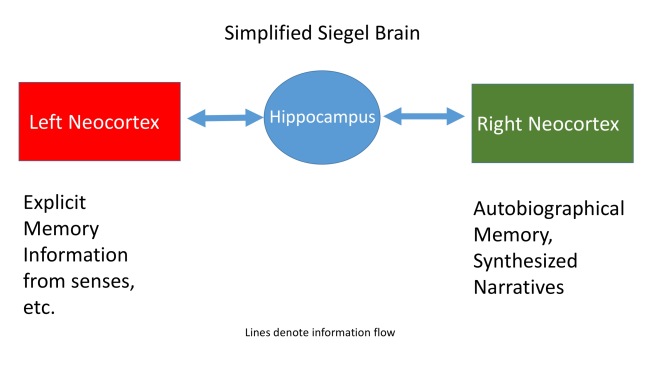
Simplified Siegel Brain — how integration occurs

All of this assembles our autobiographical memory and synthesized narratives.  The hippocampus, this complex part of the limbic system with spatial and temporal scaling functions (now does that sound like an empathy-driven subsystem or what?) creates these linked memories.  You have to have stuff on the left in order to make those more complex, synthesized structures on the right.  That’s important to note.  But in any normal day, the hippocampus is there, doing that processing.  Siegel doesn’t mention it, but I’m sure sleep is also an important part of this.

In Siegel’s explanation of trauma, these three parts, when they don’t work, or integrate information together, create the sadness and potential mental illness that many suffer from. Fair enough.  I’d argue that in order to expand our understanding of trauma, as well as education, we need to add the effect of the amygdala, the part of the brain originally thought responsible just for fear, but turns out to have all sorts of other functionality.  In our modified Siegel Brain model, the amygdala serves as a switch, modulating the function of the hippocampus. Modified Siegel Brain
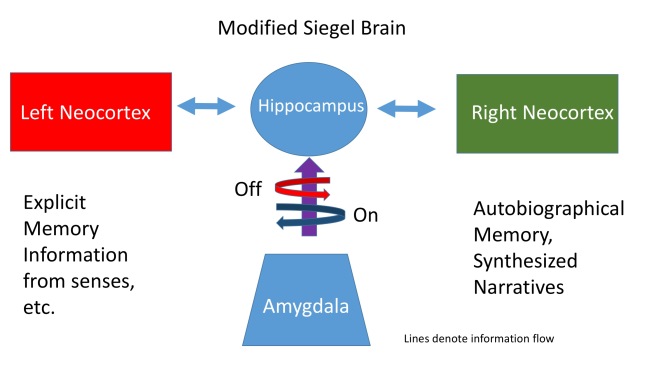
When the amygdala is on low alert, the hippocampus goes on its merry way, taking in that explicit memory from the left neocortex, and shipping it off in narrative memories to the right.  Did that pie at the bakery that you just smelled remind you of your last Thanksgiving with your favorite Grandma?  That’s just the hippocampus and all the happy parts of your brain doing their thing.  Or if we had to get fancy with language, the hippocampus forming a neural chain across the neocortex, through the corpus callosum, making a synthetic persistent memory that reinforces cognitive bias toward cherry pie!

But an interesting thing happens when, all of the sudden, you are attacked, or upset.  The amygdala springs into action!  It shakes the hippocampus by its lapels, and says “Stop, you stupid hippocampus!  We’re gonna die!  And we need every bit of attention and focus of that short time-scale impulsive function right here!”  So it shuts off that process of transfer.
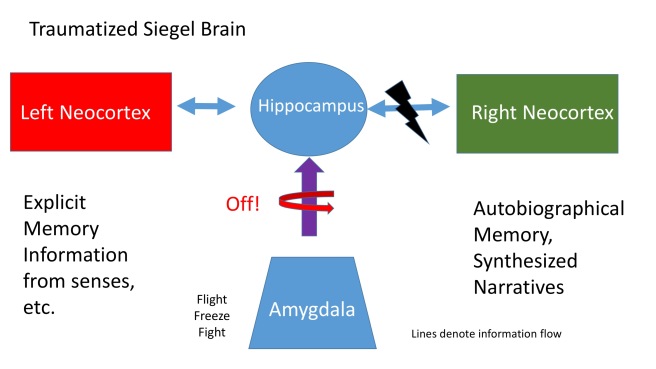
Traumatized Siegel Brain

Trauma itself is an interesting biochemical phenemenon, one that we’ve discussed a little bit in the rest of the blog, and is in itself the subject of much study.  We know that good old fashioned adrenaline gets squirted into the system.  That can give us super strength when we need it.  And then there’s cortisol that’s produced, that speeds up sugar metabolism, for increased energy (flight, anyone?) as well as slowing down inflammation (let’s get those muscles in top shape so we can get out of here!)  I’ll also speculate that the sensory overload backs up creation of any kind of coherent fragments in the left neocortex, and that’s gotta mess with the brain as well.  Think of overheating your computer.

Psychiatrists and psychologists have various remedies for reversing this back-up of stimuli and getting toward homeostasis in the brain.  Not treating trauma leads to continued Post Traumatic Stress Disorder, and a host of physical ills. There’s tons more to discuss, and I’ll just recommend that you listen to the rest of Dr. Siegel’s book.

How can we map this to the educational space?  The main takeaway I’d argue from The Neurobiology of We is not just that the insights just apply to trauma.  They also map to how we attempt to educate people.  If you ask any professor what their eventual goal with respect is to students’ education, they’ll almost always say “Critical Thinking”.  Here’s as good a definition as any:

Critical Thinking as Defined by the National Council for Excellence in Critical Thinking, 1987 

A statement by Michael Scriven & Richard Paul, presented at the 8th Annual International Conference on Critical Thinking and Education Reform, Summer 1987.

Critical thinking is the intellectually disciplined process of actively and skillfully conceptualizing, applying, analyzing, synthesizing, and/or evaluating information gathered from, or generated by, observation, experience, reflection, reasoning, or communication, as a guide to belief and action. In its exemplary form, it is based on universal intellectual values that transcend subject matter divisions: clarity, accuracy, precision, consistency, relevance, sound evidence, good reasons, depth, breadth, and fairness. 


It entails the examination of those structures or elements of thought implicit in all reasoning: purpose, problem, or question-at-issue; assumptions; concepts; empirical grounding; reasoning leading to conclusions; implications and consequences; objections from alternative viewpoints; and frame of reference. Critical thinking — in being responsive to variable subject matter, issues, and purposes — is incorporated in a family of interwoven modes of thinking, among them: scientific thinking, mathematical thinking, historical thinking, anthropological thinking, economic thinking, moral thinking, and philosophical thinking.

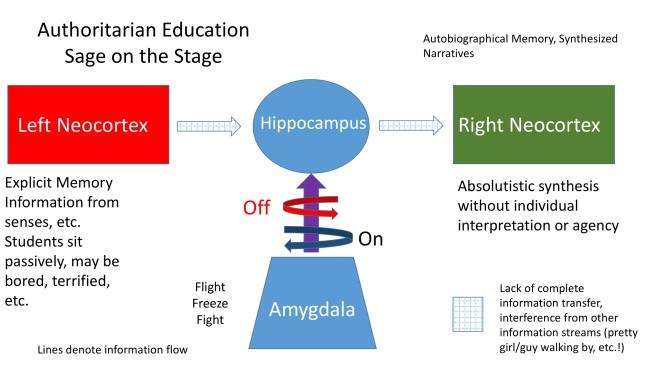
What can Siegel’s model of how the brain processes information from Left to Right help us understand and educate for critical thinking? We really want that holistic, integrated understanding of various subjects, because that enables the agency of the owner of the knowledge to act on that knowledge — be it in their profession, or choices made in their personal or political life.  But what are we actually doing in education?  Here’s a modification of Siegel’s brain applied to a typical lecture-based classroom:
Authoritarian Education

Sage on the Stage

Our professor is now giving a lecture. And trust that most professors do care about student learning, and craft what they deliver so that they think students can understand them.  They don’t want the students to be afraid in class (well, mostly) but they do want the students to walk away with a corrected, coherent picture of what they were supposed to learn from the syllabus.  They’ve got to follow the syllabus, essentially an externally imposed calendar, and that is a big deal — we use it for accreditation, and checking up on each other as well as the students.

Using Siegel’s model, we can see the flaws in this.  The individual student is sitting in class, with information flowing toward their Left Neocortex.  Not much time to synthesize in any autobiographical context, because Mr. Hippocampus would tell you that this takes time.  That’s the purpose of the homework, any professor would tell you, or the idea of doing the readings BEFORE you come to class.  Flip that classroom!  Get those kids to be responsible!

The reality is that the sensory stream (or lack thereof) in the lecture is only incompletely being received.  And that is contaminated by the fact that it’s the first sunny day in a week, and the young women are wearing short dresses, or the guys are in muscle shirts inside the classroom.  Or the professor is telling the same stale jokes, and there are other assignments in other classes, or maybe the student has a job serving slop in the dining hall.  The upshot?  Incoherence in the input stream, as well as a lack of agency and time in the final, synthesized version that ends up in our holistic interpretation dramatically impedes initial learning AND retention.  And because there’s very little attempt toward autobiographical mapping (you need to read this text because it’s IMPORTANT!) the information structure formed in the Right Neocortex is, well, weak, and not anchored very firmly inside the rest of the structure of memory.  If it makes it across the corpus callosum, from Left to Right (and there’s no guarantee it will make it that far,) it’s due to be core-dumped from the Right side after the test.

And then there’s good old Amygdala sitting there in the student’s brain, turning Hippocampus on and off anyway, as the fear creeps up in their throat when they realize the professor is looking for someone to ask a question.  It’ll be a trick question, because the professor is mired deep in their Legalistic v-Meme, which says completeness is the most important thing, and what better way to establish status over these ignorant students than to show them the real breadth of knowledge they’re supposed to know?  There’s only 300 of them in the room.  Always good to get the rest to pay attention — throw one of them up against the figurative intellectual wall.  Forget that the WAY the professor is getting the students to pay attention is by using a trauma response, which sends adrenaline and cortisol into the brains of all the kids who are paying attention, shutting down their hippocampal synthesis process.  And so on.  Nothing like getting to see the ‘Freeze’ response in action!

So let’s see what the Siegel model looks like in traditional engineering education.
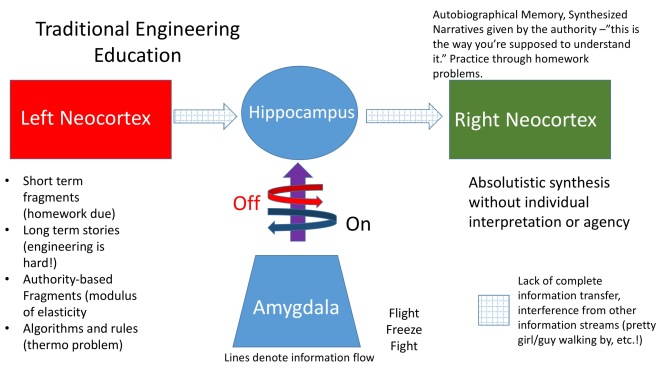
Traditional Engineering Education

Pretty much the same.  But I’ve added a little detail.  Now we have the knowledge structures that come from the social/relational structures typically associated with the v-Memes of engineering professors.  We’ve got everything from Survival information (when are we going to have the next test? When is class over?) to more complex algorithmic processing (calculating the internal temperature of a boiler.) You have to teach this stuff — without basic algorithms for solving engineering problems, your kids are not going to get far.  And there can’t be any interpretation.  Enthalpy is enthalpy, after all.

But no matter how well-meaning all of this is, it’s unlikely to result in students being able to use the material.  The information flow is one-way.  And you still have the problems with overall information corruption.  While you can get past that with repetition and drill, there’s still going to be a piece missing — the autobiographical synthesis.  Once again, the knowledge, if it makes it across the corpus callosum, will be only weakly tethered to personal experience and agency.  And as such, it won’t be the first tool in the toolbox the students reach for when confronted with a ‘real world problem.’  There’s simply no autobiographical context/neural connection to move it off the textbook page.

So, let’s step up our game. Let’s now look at Active Learning in the context of the Siegel model.
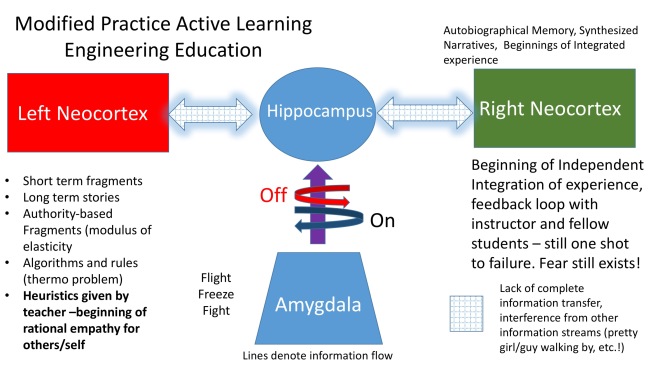
Modified Practice Active Learning

We’re starting to see a little improvement.  Now we’ve given the kids a problem to solve, and we’ve also introduced some back-and-forth possible in information flow.  Students, in the context of solving the problem, can do some cognitive laps between Left and Right, asking for details on how to solve a part of the problem.  They’re gaining some experience, because they’re likely working in teams, so they’re sharing information and also triggering different empathetic mechanisms.  Now that we’ve got a little agency, students can use some heuristic paths in solving the problems, so they’re activating their right brains in pulling out autobiographical memory. We still have the base level scaffolding required in the Left Neocortex — see the list of knowledge structures that, of course, map to the relevant v-Memes.

But it’s still one-and-done.  There are twenty groups in the class, and if you’re a student, you don’t want to be with part of a group that can’t solve the problem.  Old Amygdala is still there unless the professor has created special safety sidebars, getting ready to turn off those higher cognitive processes and turn on fear!

Can we step up our game even more?  How about a little LEAN in education and our Siegel Model?
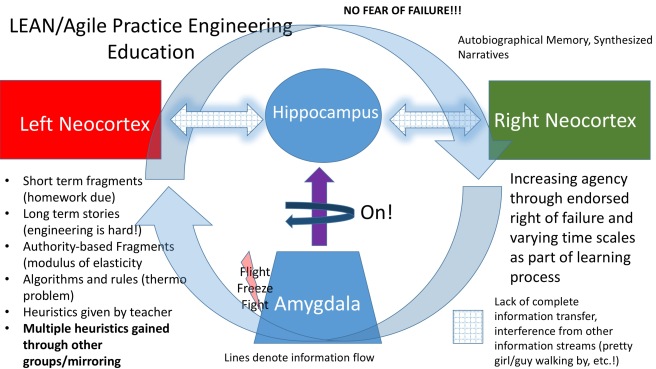
LEAN-Agile Practice Eng Ed

Now we’re getting closer!  By emphasizing quick solutions first, leading to more detailed solutions later, and granted agency for project timescales, as well as the introduction of concepts such as scrums and sprints, we’re finally putting Amygdala to bed, and freeing that synthesis process across the Neocortex.  All the Left Neocortex scaffolding is still there — we still need Young’s Modulus, and how to calculate the Coriolis force.  But we’ve got some heuristics that the professor has given us, and on top of that, we can now look across the other groups and see what problem-solving modes they’re using.  Now we’re really piling up the external empathetic modes as well — mirroring, rational place taking, as well as sharing the pain/ emotional empathy of trying to meet deadlines. Multiple loops of refinement are built into the process, and you already know that no one is going to get it right the first time. LEAN is built on several iterations toward a final solution.  Agile has multi-faceted timescales, with scrums and sprints, empowerment at the conceptual level across the workforce, and rapid multi-level prototyping to get to a point of feedback sooner rather than later.

What’s the next step?  What does reflective practice look like in the context of the Siegel Brain?
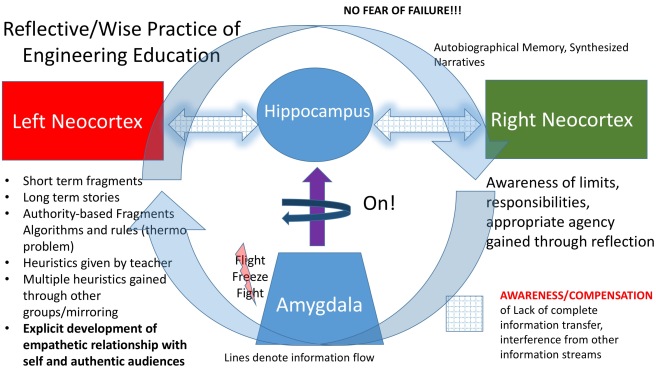
Reflective:Wise Practice Education

Now we’re aware of ourselves and our environment.  We’re grounded in the outside world — what might be actually doable and valid. And through the integration of authentic audiences, we develop the ability to share larger meaning.  Empathetic!

It doesn’t stop there — because the search for enlightenment never stops.  But this is a start.  It’s important to understand that we can’t do everything, always, at our Wise level.  That’s the metacognitive awareness of wisdom talking. But we can structure our lessons so we know what our expectations ought to be.  And how long they’ll stick.

 

Sunday Morning Meditation — the Power of Empathy to Heal Trauma and Create Love

Coconut huckers

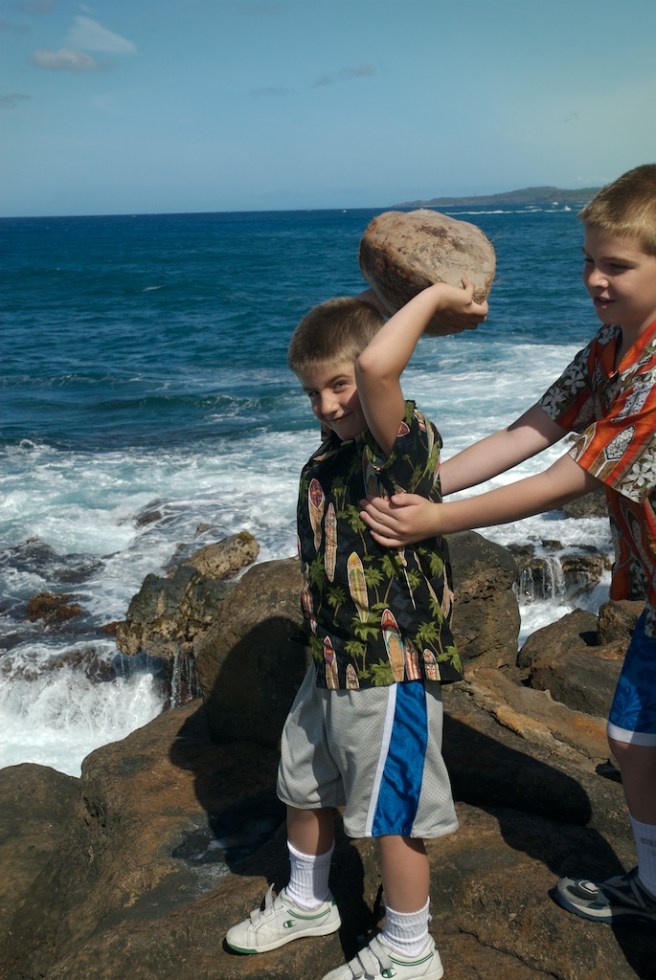
Coconut huckers, Kauai, Hawaii, 2007 — they wanted to see if it would end up in California

I know that for some folks, when reading the columns on physics and system dynamics, there’s got to be more than a few that scratch their head and say “Is he really talking about what empathy is to me personally? What does any of this say about love?”

And while I’m the first to argue for the duality of any particular state — empathy included — I don’t want all of you out there to think that in the end, I’ve forgotten those fundamental truths.

So here’s a video about the role of attachment in trauma recovery, the healing power of empathy,  and love.

Happy Sunday!

Quickie Post — the Difference Between Algorithms and Guiding Principles

Black Hornbill

Black Hornbill, Greater Kruger Park, 2008

Hanging out with friends Jake Leachman and Kevin Vixie. While I was in the bathroom, these two — my fellow mechanical engineering prof, and Big Data mathematician, came up with a great discriminator — guiding principles can’t be proven or disproven.  You can’t disprove calculus.  It works for a range of estimation, and gives answers with a range of validity and reliability dependent on the problem.

Algorithms can be, of course, proven or disproven, and as such are a limited metacognitive set.  Their reach is by necessity bounded.  Guiding principles are metacognitively open systems.  I’m sure this goes back to Godel’s Incompleteness Theorem.  The other thing to ponder philosophically is how this meshes with the receptivity of given social organizations to either recognize knowledge boundaries or embrace wisdom.

So if you’re looking for a proof for Spiral Dynamics, or my own augmented version of Empathetic Evolution, well, good luck!  They’re supposed to be open systems, and they just make things simpler.  I’m also going to lean on Jake to write up the original Boltzmann/Ernst Mach conflict regarding the existence of atoms in the comments.  It falls out along this lines.

Stephen Hawking and Getting Eaten By Aliens

African Wild Dog Team

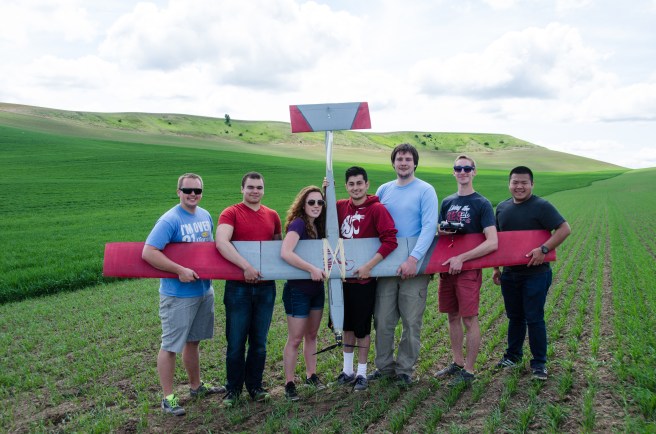
So proud of these students — they designed an autonomous UAV capable of flying 140 miles through waypoints for < $3K .  Using the principles on this blog, of course! 😉

One of the more interesting characters populating the physics community — in particular, the cosmology/Theory of Everything Physical group is Stephen Hawking.  Hawking is a pioneer in understanding black holes, and most of his reputation relates to mathematical predictions of their curious dynamics, as well as links up and down the atomic scale to the world of quantum physics.  He has been honored with just about every prize available to physicists, from the Presidential Medal of Freedom to the Fundamental Physics Prize — the most lucrative of all the great prizes.  Hawking has no qualms about speaking his mind on a variety of issues, and for the most part is not bullish on the future of humanity.

And, not surprisingly, the popular media look to someone with a brain as sophisticated as Stephen Hawking as an enlightened individual.  Yet, when reading his pronouncements, it’s tough to tell.  He’s obviously a big-picture thinker, and his attempts on creating a Theory of Everything are far more famous (and that’s an understatement) than those discussed on this blog.  But certain things he says I take deliberate exception to — especially when it comes to contact (potential or real) with extraterrestrial civilizations.    Hawking’s on the record for saying he fears such civilizations will squash us like a bug, citing human history and events like the Columbian Exchange as precedent.  His logic runs like this — “if humans did that kind of thing, we shouldn’t be surprised if aliens would do the same.”

Whether extraterrestrials would kill us upon contact (at least intentionally) is a great opportunity to explore the idea of empathetic evolution as it applies to advanced technology, and understand the social ramifications of creating more and more complex technology, as well as how different social organizations might view such tech.  So let’s start with a couple of concepts that will help us answer this question — will aliens view us as Nutella on a potential lunch sandwich?

Remembering that this blog is about empathy, and related to physical (as opposed to spiritual) properties and development, we can pull everything back to thermodynamics.  Everything we do has to be related to time, space, and energetics.  Expanded empathy/information coherence is related to some combination of these three fundamental variables.  So if we want to travel vast distances, over long (or even short!) times, likely with space travel, we’ll likely need a fair bit of energy to make it happen.

Where will that energy come from? We can gain insight from a famous Russian astrophysicist, Nikolai Kardashev, who came up with the eponymous Kardashev Scale.  The scale runs from Type 0-3, and characterizes the advancement of a civilization by its ability to harness energy at these three different levels.  Implicitly embedded in this is also space and time, as Kardashev geared it to astrophysical exploration.  Type 0, where we are currently at (actually slightly above) uses fossil fuels, and is fundamentally unsustainable.  Type 1 uses the energy of a whole planet; Type 2 an entire star; and Type 3 an entire galaxy.  Dr. Michio Kaku lays down the basics here in this video, using Buck Rogers as a Type 1 civilization, Star Trek as a Type 2, and Star Wars as a Type 3.

But Dr. Kaku leaves some important stuff out.  Implicit in any Type I civilization — or at least the odds are dramatically in that direction — is sustainability.  A Type 1 civilization must not destroy their home planet.  Not destroying their home planet is imperative for the time scales necessary to continue to develop the technology. In fact, sustainability has to become Job One in order for a Type 0 civilization to become a Type 1 civilization, because of those time scales.  We’re seeing the clock running on our own efforts with global warming, for example.  And while, in the video, Dr. Kaku talks about a Type 1 civilization controlling things like earthquakes, methinks that’s a little Authoritarian v-Meme talking.  The reality of a Type 1 civilization is that in order to become one, we have to understand the deep synergies that exist in planetary ecology, geology and so forth. It’s not going to be about controlling the weather.

Here Conway’s Law steps in and gets our minds right.  In order for THAT to happen — in order to understand deeply the issues of planetary ecology, which would then give us the knowledge to design the synergistic life support systems that would enable long-term spaceflight  — we have to have evolved social/relational systems that could share the knowledge to create those physical manifestations.  And that’s going to involve greater empathetic development.  We can’t share enough information across disciplinary boundaries, nor develop the trust necessary to figure out what our responsibilities are to our proposed disciplines, to create the larger transdisciplinary physical systems (and social systems) necessary for long-term spaceflight.

Or develop methods of colonization of hostile environments either.  We can’t get to the idea of terraforming — creating an Earth-like environment on another planet — until we deeply understand our own environment.  In fact, without support of enlightened empathetic scientific communities, we can’t even grasp our metacognitive limits — knowing what we don’t know, or having some idea of the unknown unknowns out there.

There is the possibility that there will exist a genius mind in the future that may discover the secret to accessing hyperspace, and create the highly improbable scenario of a history-changing single-technology solution to spaceflight – a singularity. That would map to the Authoritarian (or possibly Performance) “I” v-Meme.  But even with that one tech discovery, there still has to be an massively integrated approach toward navigation, life support and structures that will require developed empathy to share the information. And that will involve, once again, teams of integrated experts, freely and appropriately sharing knowledge structures up and down the v-Meme/social-relational structure ladder. It’s not just a matter of sharing data, or algorithms.  It’s also going to be a function of sharing heuristics, or multiple heuristics, and doing that at the appropriate time.  That’s going to require mindfulness, and a whole host of skills that Wilber and others call Second Tier thinking.  You’re going to have to be self aware to keep in check why you do what you do.

And when it comes to design processes, we’ve barely scratched the surface.  I wrote here about OpenIDEO, that insists on ingraining cultural relevance with a distinctly Communitarian v-Meme vibe.  That’s really just the beginning. We’ve got to go far past that.  And I, who have put a ton of time in attempting to understanding design processes in this context, get stuck much past the self-reflective, bias-aware designer.

Here’s some speculation.  If we want to move to a Type 1 civilization, we might barely have the roadmap for empathetic development and evolution to get there. We already make complex, reliable moving systems that carry our ecosystem all over the world, in pretty much a continuous fashion.  We call them commercial aircraft. And we have the beginnings of a true Type 1 information network that has emerged rapidly in the last 25 years.  That would be the Internet.  The Internet is rapidly being expanded in the physical world with the Internet of Things, as well as our increasingly complex smart phones. The sensor (and actuator) network that will be attached to all of this will continue to grow, and create its own emergent dynamics.  All this will require more synergistic thinking to process both the data collected, as well as the impact of our actions, and that’s a good thing. So we could make it.

Much past Type 1, though, I have no clue. I’ve confessed that I can’t really get a handle on a more profound understanding of mechanisms for Global Empathy, though I’d bet we’ll have to move past that as well for going to Type 2 civilizations.  That’s going to involve things we can’t really concretely establish (new dimensions?) other than to speculate on using mathematics. String Theory anyone?

The bottom line here is that any society capable of traveling great distances across the interstellar void is going to have to be, well, civilized.  And empathetic.  Because they simply couldn’t make the technology without being that way.  There’s probabilistically no way to make it happen, according to the laws of social physics we lay out on this blog. That means that we don’t have to worry about a Pacific Rim scenario, a la Guillermo del Toro, where aliens open up a crack in the ocean floor attached to an interstellar portal to invade the Earth with large Kaiju Godzilla monsters.  What we can learn from watching movies like Pacific Rim is more how their creators think — which is pretty arbitrary and authoritarian.

Which brings us back to Stephen Hawking.  Originally, when I started thinking about Dr. Hawking, I was predisposed to think ill of him.  It wouldn’t surprise me to find out he was a narcissist — lots of awards, and being catered to his entire life because of his brain, even with his disability.  And it’s the height of egocentricity to believe that alien civilizations are going to be patterned on the Spanish conquistadores at this point in time.  No way that this is gonna happen.  But then I read a little more about his life history on the Wikipedia page and this link, and besides have ALS, the debilitating disease that robs your body of muscle function, he was also married for a second time to a woman whom there are allegations of physical abuse.  Could Stephen Hawking be a trauma survivor?  How would that influence his more Survival v-Meme interpretations of alien contact? Hawking refuses to talk about his second marriage.  Could unprocessed, non-integrative trauma affect his larger global worldview?

There are a couple of takeaways in all of this.  First and foremost, aliens aren’t going to eat us. If we go back to our understandings of inter-v-Meme conflict, we likely can’t even understand any communication that alien civilizations might be using, unless they wanted to contact us directly.  They’d have to dumb things down so much – de-synergize them. And they’re going to have a much deeper perspective on what them attempting to communicate with us is going to mean. Empathetic evolution means longer temporal and spatial scales in their thinking.  There would be no surprise if they had evolved a Prime Directive mentalitya la Star Trek.

The second conclusion is a little more surprising.  If we’re going to achieve a Type 1 society, we’re going to have to confront our policies that generate trauma in our societies and organizations. There’s no way we can create a trauma-free society.  I’m not a utopian. But when someone as famous as Albert Einstein says:

“Great spirits have always encountered violent opposition from mediocre minds.”

we might ask ourselves what insights someone like Dr. Hawking might have delivered, had he not been traumatized. Or the other Dr. Hawkings-in-waiting, across our entire world.


Quickie Post — Say Hello to Conway’s Law and Your Micro-Biome

Birthdaypresent

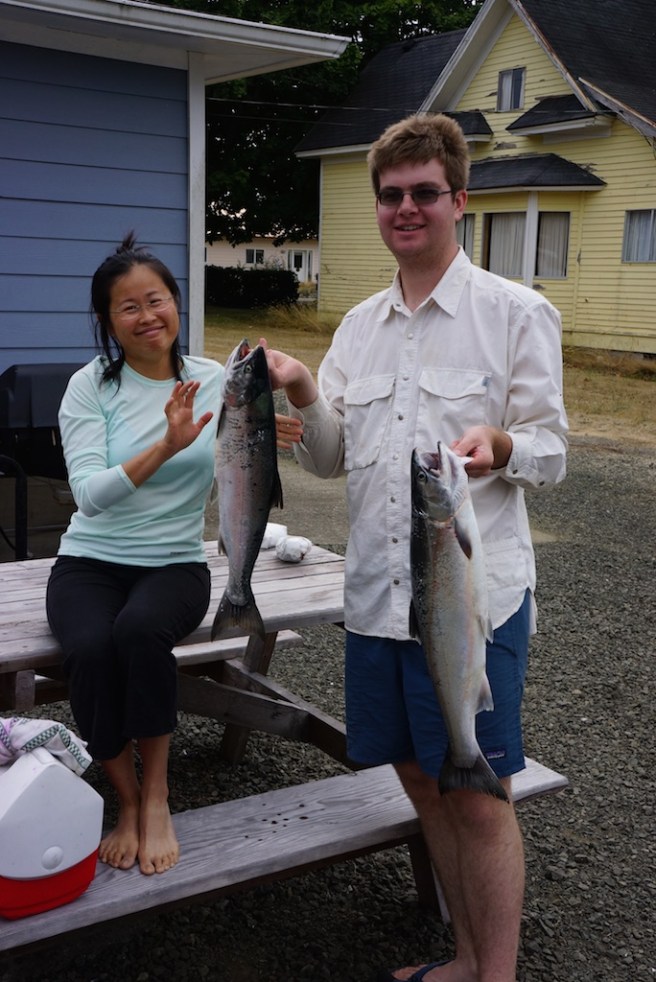
Braden’s first self-caught salmon, Chinook, WA, 2015, with a little help from Les Okonek

One of the most interesting examples of how social/relational structure is empathetic (or non-empathetic) destiny is the Linnaean taxonomy, which rates and ranks biological organisms in a hierarchy, starting at the phylum level and ends up down at the individual species.  Linnaean taxonomy was invented by Carl Linnaeus, a Swedish botanist, physician and zoologist.  If there ever was a relevant example of Conway’s Law in action.  A legalistic classification mapping to a legalistic social structure.  Who woulda thunk?

Linnaeus preceded Darwin temporally by about 100 years.  Linnaeus was mostly active mid 18th century, publishing the Philosophia Botanica in 1751, that significantly raised the bar for taxonomy of species.  He followed that in 1753 with the Species Plantarum, that attempted to name every plant known at the time.  The hierarchical system established with it is still in place.

Darwin, with the idea of temporal descendants, was to come 100 years later.  Coming out of a similar social structure, one can see a natural evolution in thought occurring with the introduction of his theory of natural selection.  Natural selection says the primary genetic transfer mechanism is through inheritance, with modifications in the genome coming through small mutations, selected out by the environment, over time.  If you look at either Linnaean taxonomy, or Darwin’s heritability, not surprisingly, you see trees — fractalized trees, with behaviors replicating up and down different time scales, mapping to changing spatial scales on the animals itself.  As scientific hierarchies grew, so did their observations, going smaller and smaller in differentiation.

If you need a social explanation, that’s why we needed another 140 or so years to get to something far closer to the truth — that arranging taxa and evolution in terms of trees is a mirroring of our scientific organizational social structures.  It’s definitely not the truth, or even close to the end game.  In this piece from the New York Times,written by Michael Pollan, titled Some of My Best Friends are Germswe get at an image of ourselves that is much closer to the truth.  We’re a micro-biome — bags of bacteria, and what we are human-wise is around 10% of the total, at least gene-wise.

I’m not smart enough to do this, but it would be great if a complexity theorist type decided to look at redundancy and error-coding in the genetic code.  My guess is that incorporating bacteria into our very existence is likely a chemical hack that lets us have far more information encoded in genes that we could if it were all up to our own mitochondria.  Our own system complexity was pushing our own error correcting modes.  The way our bodies found around the complexity limits was to generate chemical empathy with a host of other organisms.  We’d trust them enough to swap a little DNA now and then, but mostly we let them do their thing.

There’s a couple of takeaways from all of this.  One is that once you’re locked into a given knowledge structure system or coding algorithm, you’re going to run into information complexity and error rate limits.  Diversity is going to help with this, if robustness is a goal.  Much less easy to corrupt a weakly coupled system of symbiotic anythings.

The second is that the next time you go to the museum, it’s OK to look at all those tree-like knowledge structures just a little askance.  They came out of the way scientists organized their social communities, which were just a scaled up version of the way scientists organize their brains, for the most part.  It’s not that those knowledge structures can’t be illuminating, or shed insight.  They most certainly can.  But they skip over the synergies and potentials for interaction, because, well, the scientists also do that kind of relational skipping themselves. They have to be almost rubbing shoulders, or bacteria, before the fact that everything is connected hits them between the eyes.


Mapping Rogers’ Theory of Diffusion of Innovations to Empathetic Development

pantanal giant otter

An Ariranha, a giant river otter, Pantanal, Brazil, 2006

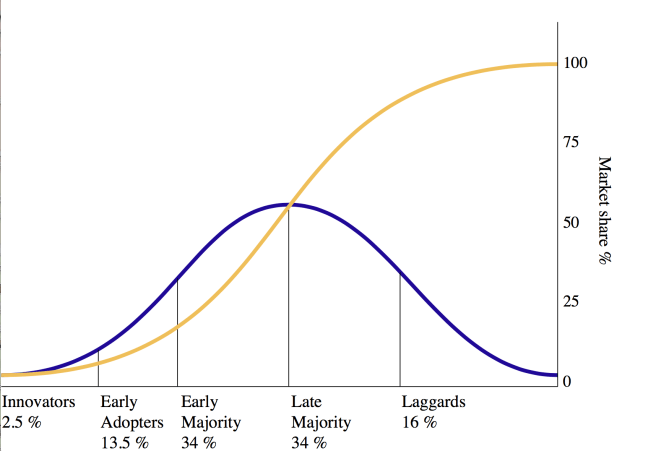
One of my favorite social theories is Everett Rogers’ Theory of Diffusion of Innovations.  Splitting up categories of innovation adopters along a Gaussian curve, it breaks out individuals into five categories — Innovators/Pioneers, Early Adopters, Early Majority, Late Majority, and Laggards.  Wikipedia’s post on the theory is a great place to start, for those unfamiliar.  Most of the information discussed below comes from that page.  Rogers wrote his book on the theory and was published in 1962.  The theory itself is extremely innovative, integrating 508 studies from areas as diverse as anthropology, rural sociology, education and medical sociology.  And it has been used across multiple disciplines as well, including organizational studies and complexity management.

Screen Shot 2016-06-17 at 11.08.34 AM

Rogers Everett – Based on Rogers, E. (1962) Diffusion of innovations. Free Press, London, NY, USA.

Rogers’ posited a five step process for adoption of an innovation.  Once again, direct from the Wikipedia post, these are:

  1. Knowledge — The individual is first exposed to an innovation, but lacks information about the innovation. During this stage the individual has not yet been inspired to find out more information about the innovation.
  2. Persuasion — The individual is interested in the innovation and actively seeks related information/details.
  3. Decision — The individual takes the concept of the change and weighs the advantages/disadvantages of using the innovation and decides whether to adopt or reject the innovation. Due to the individualistic nature of this stage, Rogers notes that it is the most difficult stage on which to acquire empirical evidence.
  4. Implementation — The individual employs the innovation to a varying degree depending on the situation. During this stage the individual also determines the usefulness of the innovation and may search for further information about it.
  5. Confirmation — The individual finalizes his/her decision to continue using the innovation. This stage is both intrapersonal (may cause cognitive dissonance) and interpersonal, confirmation the group has made the right decision.

Rogers’ work is seminal, and has stood the test of time.  Originally published in 1962, it has been re-published and updated as recently as 2003, and is still in heavy use today.  However, it is not without its Legalistic/Absolutistic problems.  Some of it, such as the concept of individual choice in adoption, has been looked at empirically, with little agreement.  Individuals choose to adopt for a variety of reasons, none consistent on the topical level.  Those followers of this blog should not be surprised.  The surface level lens almost always fails in broad studies, because many people may state the same reason for a given tech. adoption, but may be motivated for underlying causes that are not captured in a surface level analysis.

So you know what that means — let’s apply our Theory of Empathetic Evolution to the various actors in Rogers Theory and see if that helps!  What comes out is a portrait of social organizations and their dynamics for innovation.  Quelle surprise!

Pioneers/Innovators

Pioneers in any technology have to have, at some level, a core level of egocentricism in order to buck the tide.  Personal fascination, status-seeking and such are all part of someone’s v-Meme make-up when they buy the first electric car on the block, or whatever electronic gadget is newly extant.  There often isn’t any real data on a given product, though there is hype that can be generated in pioneering communities.

What does that mean from a perspective of empathetic evolution?  There’s gotta be some limbic/impulsive core to the Pioneer.  But interestingly enough, there’s likely a fair amount of diverse empathetic development.  Pioneering communities increasingly spring up on the web, where gender and ethnic/racial profiles don’t matter.  It’s fragmented information that’s feeding the beast.  Plus, what’s really interesting is that metacognition and experimentation have to be core values.  People in pioneering communities have to be comfortable with knowing what they don’t know, as well as being aware there are going to be unknown unknowns out there.  Pioneers also, by definition, are not going to be playing Follow the Leader.  So that also gives credence to the notion of some extended empathetic development.  Relationships have to be based on cross-connection around a product or goal.  I’m going to guess that there’s some pretty strong Authoritarian/Performance-based coupling going on. Not much Legalism, though — a Pioneer is likely to be a rule-breaker.

Early Adopters

Early adopters are people with developed metacognitive abilities — knowing what they don’t know — and are likely more data driven than the Pioneers.  They’re the ones scanning the various trade publications and magazines like Wired, looking for what’s new and what the beta is.  I’m going to guess that this involves a lot more data-driven thinking, and places Early Adopters in the Performance-based Communitarian v-Memes.  Empathetic development also means sharing across networks, and duplex information exchange, as choices are likely being made between performance profiles.  There’s also likely to be some mirroring behavior, and I’ll bet that Early Adopters, while being opinion leaders themselves as Rogers noted, are also heavily influenced by more specialized thought leaders.  That means seeking out more data-driven relationships and respect, once again, as often the Pioneers/Innovators are not going to necessarily be famous.

Early Majority

All the things about Early Adopters, but likely with a more Communitarian v-Meme bent.  Early Majority thinkers are less likely to be as comfortable with metacognitive guessing, and while being aware of their position and the need for change, are less likely to take risks.  I’m guessing that Early Majority are likely a little less data-driven (though that plays an important role) and a little more hierarchical in their thinking.  When someone important who’s a thought leader stands up and says it’s time to change, they jump.

Late Majority

Late Majority participants are definitely less comfortable with metacognitive stretch. They’re the ones likely to dismiss any change as a fad.  By the time the Late Majority gets involved, data has now started getting aggregated into belief.  The information on change is everywhere, and likely requires little empathetic exchange to come to a decision.  As such, Late Majority organizations are likely responding to Legalistic/Absolutistic change (such as new regulations), consist of hierarchies and power structures, and are sliding down the empathetic scale.

Laggards

Laggards are everything the Late Majority is, but in spades — belief-based thinkers, who are surprised by performance demands and changes in the regulatory environment.  Change happens to them — it is not something they welcome.  New regulatory environments are something they fight — not look as a method for driving product change and performance.  The millennial change fight over Combined Average Fuel Economy standards are a great example. How did that, in the end, help the U.S. auto industry?

As stated in the Wikipedia article, Laggards also have an aversion to change agents — something that really smacks of Authoritarian thinking, and the metacognitive shrink wrapping that happens in these types of organizations.  Not knowing is a downer to personal status, and that means two things:  a collapse of knowledge to organizational borders, as well as a connected collapse in awareness.  If you need an example of this, one need look no further than the contemporary university.  When one considers the fact that the dominant social structure in universities today is rampant authoritarianism, with a collapse in shared governance, it’s no wonder universities fall further and further behind the needs of contemporary society.  A triple whammy of a non-empathetic social structure, coupled with a lack of more profound societal grounding (aka the Ivory Tower effect) and declining budgets (decreased energetics) does not bode well.

It’s worth the time to read through the Wikipedia/Rogers definitions written below and see how they support the v-Meme analysis above.

  1. Innovators – Innovators are willing to take risks, have the highest social status, have financial liquidity, are social and have closest contact to scientific sources and interaction with other innovators. Their risk tolerance allows them to adopt technologies that may ultimately fail. Financial resources help absorb these failures.
  2. Early Adopters – These individuals have the highest degree of opinion leadership among the adopter categories. Early adopters have a higher social status, financial liquidity, advanced education and are more socially forward than late adopters. They are more discreet in adoption choices than innovators. They use judicious choice of adoption to help them maintain a central communication position.
  3. Early Majority – They adopt an innovation after a varying degree of time that is significantly longer than the innovators and early adopters. Early Majority have above average social status, contact with early adopters and seldom hold positions of opinion leadership in a system (Rogers 1962, p. 283)
  4. Late Majority – They adopt an innovation after the average participant. These individuals approach an innovation with a high degree of skepticism and after the majority of society has adopted the innovation. Late Majority are typically skeptical about an innovation, have below average social status, little financial liquidity, in contact with others in late majority and early majority and little opinion leadership.
  5. Laggards – They are the last to adopt an innovation. Unlike some of the previous categories, individuals in this category show little to no opinion leadership. These individuals typically have an aversion to change-agents. Laggards typically tend to be focused on “traditions”, lowest social status, lowest financial liquidity, oldest among adopters, and in contact with only family and close friends.

What’s the takeaway from all this?  The first is that if you want an environment for innovation, you have to have an environment where Innovators and Early Adopters are comfortable and feel safe.  That means fewer titles, less status-based thinking, and an empathetic corporate/institutional culture. Books like more traditional texts like Arthur’s The Nature of Technology — What It Is and How It Evolves support this same premise at a more superficial level as well, with theories that new tech primarily comes out of combinations of old tech.  If that’s true, then the more diverse ideas one has on the table, the more potential combinations.  And then popping down to the deeper level of the Theory of Empathetic Connection, how people connect and what their social structure is Innovation Diffusion destiny.  The more populated your social structure is with Pioneers and Early Adopters, the more likely they can connect and create the innovations your institution needs to survive.

There’s one more thought to ponder in all of this — what kinds of communities do empathy really matter in?  Rogers’ Theory gives insights as well to the formation of titles and belief-based structures.  If things aren’t changing, we can add more and more verbiage to people’s salutations.  It’s a marker of where a company banks its innovation profile when they have a Director of XXX Innovation — and not a good one.

Takeaway:  Rogers’ Theory of Diffusion of Innovation dovetails perfectly with what we’ve been writing about on this blog as far as creating innovation environments.  The addition from our Theory of Empathetic Evolution is the need to emphasize empathy and duplex communications if you want to stay on the Early Adopter part of the curve.  The other big takeaway is to not attack your change agents.  They’re the ones scouting what’s coming next.  And in a world where ‘Next’ is always coming, you need them if you don’t want to end up in the Survival v-Meme.