Quickie Post –A Sober Utopia

insta-revi-13

Conor, New Years Day, Revelstoke, BC, 2017.  Taken by brother Braden.

Folks new to the blog may not be familiar with my hypothesis that many addiction problems are likely caused by empathy disruption and lack of connection in people’s lives.  I wrote a couple of posts on the issue about the famous Rat Park experiments. They showed that rats in isolated cages would drink cocaine-laced water until they died.  But when put in kind of a Rat Happy-Land, with other rats, and rat babies, the rats would not even come close to the narcotics. Bruce Alexander, who ran the original experiments, remains a hero to me because of his courage to buck the v-Meme trend and realize that empathetic context matters.  When a brain/neurosystem feels isolated, there is no greater pain, and it’s well documented that people waste away quickly in solitary confinement.

Empathetic cut-offs from trauma and/or loss deliver the same type of punishment.  It’s no wonder then that people will seek to self-medicate, if for whatever reason their brains can’t connect to others.  One can see how this plays directly into understanding how trauma actually hurts your brain, and how that trauma then, if unprocessed, creates the empathetic inability to connect to others, which then leads to addiction.

A piece recently came across my Medium feed called A Sober Utopiawhich delivers further reinforcement for my theory.  It’s a lovely piece, written about a facility out east of Pueblo, CO, in the desolate country on the edge of sight of the Front Range.  The facility, Ft. Lyon, has a long, tragic history of its own — it was the staging ground for the notorious Sand Creek Massacre, and later was turned into a neuropsychiatric hospital before being shuttered and reborn by the Colorado Legislature as a rehab facility for severe homeless drug addicts.

What makes Ft. Lyon different is its emphasis on self agency and developing avenues for meaning in the people that are treated.  Focused first around the arts and crafts, people at Ft. Lyon make things.  My experience with students has always been that making things is one of the best avenues for demonstrating performance and mastery, which leads to self empathy.  You need to have things you’ve made that show not just to the world that you are a person of value.  The act of creation demonstrates to yourself that you are — and that if you want to heal the empathetic disconnect with others that is causing you great pain, the first person you have to connect with is yourself.

“Person-centric, not program-centric,” is how the Director of the facility, James Ginsburg describes it in the article.  For my fellow psychonauts, there could be no better statement that re-emphasizes is the self-similar characteristics of a place with its goals and social structure on the right track.  When one talks about a certain vibe saturating a given place, that’s what that means.

Another classic anecdote sums up this perspective exactly — one that we might think about applying far more broadly in education.  From the same piece:

Ginsburg mentioned a man who came to him with a plan to build kaleidoscopes as part of his recovery. “There’s this tendency with social service programming to go, ‘No, we don’t build kaleidoscopes, that’s not what we do here,’” he said. “Well, of course not! No one builds kaleidoscopes — no one has a kaleidoscope policy.” Instead, the staff at Fort Lyon found a way to get the man the materials he needed to build kaleidoscopes. “That guy was totally out of it when he got here,” Ginsburg said, “and he has blossomed.” His kaleidoscopes are now displayed around campus and for sale at the store.

There’s so much goodness about empathetic timescales, recovery from trauma, and all sorts of neurogenic insight that I could go on and on.  But hey — even if you’re not into all the subject this blog is about, the piece is a great read for a snowy winter evening.  Go get you some.

Making Sense of Sensemaking — Understanding the Emergence of Second Tier Design Methodologies from an Empathetic Evolutionary Framework

columbiabanksconor

Son Conor on the banks of the Columbia River, Revelstoke, BC, Canada, New Year’s Day, 2017

One of the more interesting movements that has been emergent in the management sciences has been termed ‘sensemaking’ (spelled a variety of different ways.)  The larger idea behind sensemaking is, in essence, a combination of direct observation of a phenomena,  and reflective practice that forces one to confront one’s perceptions about a given situation/business case and ask yourself if you should believe what you think.  That places whatever version one uses reaching for  Second Tier thinking in Spiral Dynamics, with all the incumbent permutations across our Theory of Empathetic Evolution.  How ‘Second Tier’ it is dependent on the ratio of observation, assumption of objectivity (no one ever is,) and reflection.

Someone engaged in sensemaking is questioning, at some level, their relationship with the information they have coming into their head through their standard mental models, and working to see if it’s true.  Casting things through the reliability/validity lens, sensemaking is a profound attempt at improving the validity of our observations, and then applying those new perspectives to better design solutions.  It recognizes implicitly that data and data driven methods alone are really only good in what we’ve characterized as algorithmic design.  That’s dominated by the meta-linear lower v-Memes, and that over longer periods, they don’t do such a great job with extrapolation — especially in changing environments.  If system behavior suddenly changes, if there’s a jump discontinuity, or even a bifurcation in behavior, the standard data analytics really start failing.

And you’re likely to need a new paradigm for your product or service.  Which means you’ve got to dump in heuristic information.  And heuristic information — ‘rules of thumb’, as well as variations dependent on differentiation between individuals and preferences of sub-classes inside a larger system — in a data-driven environment, are just going to get mushed up.  Here’s an easy to understand it:  If you have a bimodal distribution, the average will be in the middle.  Not very useful.  You’ve got to go out and talk to the folks in the two humps.

Our model of Empathetic Evolution tells us also that sensemaking clearly places itself with much higher potential on the metacognition scale.  Snowden’s work with his Cynefin model is a great exemplar of this (and deserving of its own post.) Through a structured process, varying with practitioners, it forces us to ask about the context of the data fragments we know, and how we know or perceive it, as well as knowing what we don’t know, and finally, being aware of unknowns that are still out there.  By driving the construction of narratives, it forces the construction of connected knowledge through the inherent context of story.  You can’t just blurt out a bunch of facts and write them down.  The larger story has to make sense.

Two notable practitioners in the space are David Snowden and the Red Associates , headed up by Christian Madsbjerg and Mikel Rasmussen, who have written a book on the generalized approach, called The Moment of Clarity.  Since this is not an academic article, I’m not going to delve through the past literature by originators. The two discussions above will take you there!

And since I just finished Madsbjerg’s and Rasmussen’s (M&R) book, I’ll talk about sense making from their perspective.  Sensemaking is a directed effort to integrate the human sciences into business decision making, through use of a variety of tools commonly used in fields like anthropology and ethnography.  Awesome! Their recommendation is that you go out and find yourself an ethnographer if you want people to understand how people actively use their products.

This is a big insight.  The way they explain it, which is perfectly reasonable, is the context of information collection matters.  Someone filling out a survey, or participating in a focus group inside a room, may very well give a different answer from the actual, executed action.  Economists have terms for this, that can be summed up with this simple maxim: stated preference may be different from elected preference.  M&R state that the solution is to get someone involved who is trained in ‘objective’ evaluation, like an anthropologist or ethnographer — essentially someone else from a Legalistic/Absolutistic Hierarchy — with a new set of algorithms geared toward constructing larger narratives, and put them to work on a project.  The Moment of Clarity that they refer to is the epiphany that comes when you combine the more typical, MBA data-driven world, with actual observation of customers in their native environment, as well as understanding a much-enlarged timescale of association.  New narratives are constructed that allow deeper understanding of a given business situation.  Plus, that deeper connection with business purpose, not surprisingly, moves a company to deeper connection with other purposes outside considering just the bottom line.

M&R draw on many recent philosophers, most notably Heidegger and Foucault, and spend quite a bit of time talking about Heidegger’s definition of ‘care’ — which really can be broken down into two parts — what I call ‘meaning’ and ‘responsibility’.  If you want to move forward, you have to be seeking meaning for yourself.  As we’ve discussed in the past, this flows from self-empathy — connection with yourself.  And in the process of this, you will feel more responsibility for the outcome. And responsibility is directly related to the level of connection that you have with both the people and environment around you.  The case studies are good as well — these guys are professionals, and their list of successes with companies like Lego, Intel and Adidas, all ring true.

Their topically-driven, superficial argument is this: if you add some new people, with different skill sets, tools and algorithms, you now have a much better chance of coming up with an improved outcome on figuring out what your guiding principles ought to be.  And this all makes sense for those of us buried deep in our own professional hierarchies.  If we would just add one more branch to the tree, we’d get at the truth.  And it will come in a flash — a Moment of Clarity.

This gets in deeply to what I call the ‘Intellectual Flatland’ problem.  One of the primary characteristics of our Theory of Empathetic Evolution is that higher truths avail themselves as one moves up a scaffolded empathetic framework.  Anyone willing to do the work can get there.  Scaffolding matters — you can’t build complex, larger knowledge structures without all those knowledge structures below them.  So it’s not like that degree in Anthropology will do you no good.  It’s just not the whole answer.

But when you place the author’s argument for adding folks with more titles, they’re really missing their empathetic secret sauce.  What the authors are arguing for is still, essentially a 2-D knowledge space.  On that plane of knowledge, you have facts and figures.  You have spreadsheets.  You have consumer testimonials and past projects, both successful and not.  You get to take little hops off of Intellectual Flatland to connect various dots.  And every now and again, in a flash, a Guiding Principle drops out, and seizes its own piece of real estate.

What about empathy in this definition of sensemaking?  New, larger understandings don’t come as an immediate result of generating self knowledge and larger empathy.  Empathy assumes another spot on Flatland, perhaps with some empathy training, or empathy circles.  The authors do pull out the work of some of the Heavy Hitters like Foucault or Heidegger who essentially challenged the older boundaries of those disciplinary countries on Flatland, and drew bigger circles around different aggregations of island countries.   You might get to move some of the islands around, of course, and develop different circumnavigations.  But connection and empathy, which are really the relational path to higher validity, are not highlighted.  And of course, having this perspective regarding sensemaking has to come out of the social structure of the company creating the knowledge.  It has to — there is no choice.

One of the more interesting stories involving the success of sensemaking is their profile of Genevieve Bell, a Ph.D. cultural anthropologist with a degree from Stanford.  She was key in flipping Intel’s focus from the “Moore’s Law” paradigm of doubling computer power to one where Intel needed to focus on the future of computing as deeply involved with the user experience. It’s easy to start the focus on Bell’s training. But when you read further, one realizes that it’s not ‘Bell as an anthropologist’ that really won the day.  It was ‘Bell as a dynamic, empathetic individual’ that made the difference.  Cultural anthropology may have provided some of the knowledge structure scaffolding to propel Bell forward in her career.  But it was really Bell’s ability to discuss and connect with various constituencies inside Intel, including both the tech masters and the executive suite.

Even the way she started her career at Intel was because of an implicit ability to connect. She made a tremendous impression on her recruiter, a serial Silicon Valley entrepreneur, in a bar! that drove him to pore through various directories of cultural anthropologists in the Valley to reconnect and place her with Intel in their People and Practices Research Lab in Portland.  If the entrepreneur had solely had his interest sparked by an External Definition (cultural anthropology), he could have stopped on page one of his search.  But it wasn’t that, of course — it was that Independently Generated Relationship thing that mattered.  It came down to the specific individual, and her connection with him.

M&R do talk about connection and empathy, the former more than the latter.  In their book, empathy doesn’t make the index.  But throughout the book, they attribute time and again success to the evolved empathetic concepts we discuss on this blog.  Take the concept of context. What is context, really?  Context is more precisely defined as the empathetic system that any given actor is plugged into during the act of observation.  The fact that asking someone a ‘Yes/No’ question (as dichotomous a thinking question as you can have!) doesn’t give the same nuance, or potential multiple solution thinking information that comes out of observing someone in their household, where there are a variety of sentient actors (including the family dog!) as well as relational modifiers, social structures, and culture surrounding them, should surprise no one.   I posted about that idea here in understanding our Theory of Everything.

What does an Empathetic Evolutionary approach tell you about sensemaking? The primary thing it does is take you off of Intellectual Flatland.  Multiple, complex, and probabilistic connections become something that are explicitly prioritized in exploring.  Also, no longer do you live in the world that there are ‘objective’ observers — because there is no such thing.  Instead, Empathetic Evolutionary Theory offers a primary way of understanding ourselves and our biases as an integral methodology, as well as identifying defects in our scaffolding that may be giving us incorrect answers.  We may well have epiphanies — nothing wrong with that.  But we’ll also realize that epiphanies, or any thought that comes in a flash, is a result of some connection in the limbic portion of our brain.  And that they’re potentially as connected to past experience — especially trauma — as they are to anything else. Empathetic Evolution as an overarching structure takes the elements of sensemaking, and makes them explicit.  And by constructing a 3-D model of our understanding, we now are far freer to explore connections.  Epiphanies become less important, as we move our search for guiding principles (Global Holistic v-Meme concepts) into our conscious minds, with thoughts likely shared with others empathetically.  What that gives us is a much larger collective understanding of complex phenomena.

Finally, what is most powerful when we realize the potential of a deep understanding of activating all the different levels of our Empathy Pyramid is that important philosophical concepts, such as Heidegger’s idea of ‘Care’, become naturally emergent.  We don’t have to address responsibility from an Authoritarian or Legalistic perspective, as in ‘this is just your job, and you better do it.’  What we get is a more natural expression of doing what we must do, both to find meaning and be responsible.  For the first part, finding meaning becomes a natural practice in self-empathy, and knowing ourselves.  And as far as responsibility, that also flows naturally from things that we are connected to.

What is M&R’s approach good for?  Lots.*  As I read through the book, it became obvious to me why these individuals are successful.  Many of their techniques they discuss are algorithmic empathetic ladders.  By practicing them, one’s empathy can naturally evolve and change the person who is in charge of both creating the new customer narrative, as well as selling the narrative inside their own company, for new products, services or design.  Exploring customer narratives is a great way of advancing one’s own empathetic understanding, as well as forming new heuristics for approaching different problems. That grows one’s Communitarian v-Meme sense.  And the careful, focused documentation of others live their life, as part of the process of ethnography, has to trigger in the observer the same question, over and over — why do I or don’t I do the same thing?  That’s the reach into Second Tier thinking.  I would also note that Snowden’s work has much more self-examination built into it — not all sensemaking techniques are alike.

And then, dumping the successful ethnographer back into the mix of employees in the company, often filled with technical disciplines, can do nothing but grow empathy in that employee base.  Confronted with someone who is increasing the validity of their own technical output has to increase trust inside the network.  That creates the larger relational network that does a far better job of spanning any given design space than a truncated hierarchy.  And that, of course, protects from Black Swans, and other traumatic events that may doom a company’s survival.

In the end, it is all about empathy and reshaping our relational networks, which then lead directly to reshaping our understanding.  How could it be anything else?

*Further comment — I’m hoping as people read this, they realize that this is not supposed to be some take-down of sensemaking.  It’s really about understanding how sensemaking emerges, and understanding its context in Empathetic Evolution.  We need more validity in our solutions in the world — not less.  And as we expand empathy, through whatever empathetic ladders are out there, declared or not, we come far closer to generating the connected solutions that will save the world.

Laugh for the Day — boy, you have to love the second part of this post’s title – “Understanding the Emergence of Second Tier Design Methodologies from an Empathetic Evolutionary Framework”.  That’s some serious Squirrel Talk there!

It’s a Wonderful Life — Midwinter Thoughts

conor-xmas-concert-2012

Conor Blowing the Sax, 2012 Christmas Concert

One of my self-improvement, self-inflicted puzzles regarding empathetic evolution is to look at various movies and analyze them for v-Meme content and constructs.  All movies have obvious, topical themes, of course.  But it’s not that hard to get under the skin of the actual development of the director to figure out how the plot line will run, as well as how many people actually wrote the script.  One may like a movie like the latest version of The Little Prince, which claims to deal with large, transcendent themes.  But when watching the development and coherence of the plot, it quickly becomes obvious, due to the arbitrary shifts of the plot direction, that it’s not the product of higher coherence, or groups of people sorting out such issues over a number of years, like Zootopia.  Just two people wrote that crazy script — and it shows.

That doesn’t mean you can’t enjoy these types of movies.  The lower v-Meme movies, speaking from their impulsive time scales, are obviously the best action thrillers.  But it takes away from any surprise or potential deeper epiphanies.  When I was stuck over some ocean somewhere (I honestly can’t remember) staring at Transformers 3 (as execrable an action movie as could be made), when the moment comes where the head of the Good Transformers, Optimus Prime, engages in the final cataclysmic clash with the head of the Bad Transformers, Megatron, there’s simply no doubt that Optimus Prime is going to wax Megatron.  And then he chops off a couple of other heads for good measure.  If that ain’t the Tribal/Authoritarian v-Meme, I don’t know what is.  Kill all those ridiculous Decepticons and let the Big Robot Maker in the sky sort them out.

We’ve already covered back here how Authoritarians settle conflicts — it’s gonna be one of them is killed, or both are completely exhausted and booted back down to the Survival v-Meme, where larger neuroplasticity can prevail.  What’s also interesting is that such movies either make their money up front, or fade into obscurity quickly.  The timescales for interest in such movies mimic the v-Memes the movies are constructed around.  Themes are not timeless, and incredibly cultural context-dependent.  Who would believe that a movie based on the idea of a set of preposterous children’s toys that changed from sentient robots from outer space into Mack Trucks would be so popular?  If that ain’t arbitrary, I don’t know what is.

Movies and stories with deeper, more connected themes often take more time to seep into the public consciousness.  This is also a timeless truth.  Aeschylus’ Oresteia was not at all popular when it emerged, though it won critical acclaim.  As might be expected with the times — the play covers v-Meme evolution from Tribal/Authoritarian justice with Agamemnon  being stabbed by Clytemnestra as part of revenge for the death of her daughter and his consorting with a new concubine, as well as a good, old-fashioned power grab.  The Oresteia wraps up with Athena establishing essentially a Legalistic v-Meme paradigm — a court — for settling such disputes, instead of endless retributive violence.

Since it is the holiday season, one of the movies that is shown over and over is Frank Capra’s It’s a Wonderful Life.  If you haven’t seen the movie, you can read the synopsis on Wikipedia.  Essentially, George Bailey starts out on Christmas Eve, suicidal over money lost by accident from one of his wards, Uncle Billy, that was needed for the solvency of George’s savings and loan.  George is a classic bodhisattva figure, helping others throughout his whole life instead of advancing his own interests.  Standing on a bridge over an icy river, ready to jump, the Magical v-Meme plot device reveals itself — Clarence, his guardian angel apprentice and George’s own bodhisattva, is commanded to rush down and save him.  The rest of the movie runs two scripts of George’s existence: one with him alive; and one without.  The movie explores many different v-Memes, including the role of the narcissistic hero in society, as well as efforts of Communitarians like George.  The overriding thesis of the movie is the depth of connections all our lives have on others, and the unexpected consequences — the metacognitive Unknown Unknowns that may happen if we don’t stick around.  Heady stuff, and right in line with our Theory of Empathetic Evolution.  You don’t know what you don’t know, and for most of us, we can’t count on a guardian angel-in-waiting to come down and show us.  You just have to keep pushing through the dark.

Like many complex movies, It’s a Wonderful Life was not popular when it came out.  But over time, it has turned into a Christmas classic, in part because it passed into the public domain.  Yet the message is still transcendent.  Capra himself used to show the movie to his family every Christmas.  And it’s been analyzed every which way to Sunday.  So I won’t do that here, except to encourage all of you out there, during the longest part of the winter, to do this:  think long, connected thoughts –in particular, the balance of acceptance of reality and responsibility of your larger self to society.  If you’re curious how to start, start with my two favorite questions — “how is that actually gonna work,” and “why?”  And keep going through these long nights. It’s the right time of the year!

Quickie Post — More Data on the Economic Power of Higher v-Memes

combo-buddhist-temple-vietnam-2013

Temple to Multiple Gods (Guanyin, Buddha, and one other), Mekong Delta, Vietnam, 2013

One of the things I harp on over and over in this blog is the power of empathetic evolution, and its accompanying phenomenon of increasing agency in creating economic value.  Whether on the small scale of the individual company, or across the larger society, people who are empowered to seek meaning are going to do much better making/doing stuff faster.  They’re also going to have greater coherence in information sharing activities with real empathy than those that don’t.  You’d think this would be a settled business principle, what with histrionic Authoritarian Hitler’s defeat in WWII, and the collapse of the Soviet Union.  Authoritarian societies (please spare me the ‘no, the USSR was socialist’ hokum!) with command economies, combined with the necessary repression (and incumbent psychological depression of the population!) never do well economically.

So it comes as no surprise to me, with our latest government-sponsored mass survey of v-Memes (I’m talking about the latest November election) that the almost-supermajority of areas with intense economic activity went for Hillary Clinton. This  paper, titled ‘Another Clinton-Trump divide: High-output America vs low-output America’from the Brookings Institute clearly shows this.

Though Clinton was a modest communitarian-oriented, classification-heavy Legalist, with the elimination of Bernie Sanders, our true, data-driven Performance-based Communitarian, she still had something to offer to our urban centers, which are becoming, through forces of diversity and the need for global-oriented economic activities, more empathetically evolved all the time.

The Performance-based Authoritarians, who overwhelmingly weighed in for Trump, not surprisingly, don’t make that much stuff.  And not because they’re lazy.  They’re just depressed.

The whole thing is more complicated than just a v-Meme snapshot.  There have been empathetic evolutionary dynamics going on in America that have created this divide really since the Great Depression, when the opportunistic rural folks from all parts of this country did things like hit the Mother Road to California — or Cleveland.  And had to learn to connect with lots of new folks, both on their way and when they got there.

It’s still worth pondering, instead of just screaming ‘unfettered capitalism’ as the source of all economic benefits, on the role of v-Meme scaffolding, or how guaranteeing workers rights, and making sure they don’t have to worry about health care, increases both labor mobility, and how facilitating that personal agency-driven allocation maximizes economic benefits for everyone.  The short, ‘no v-Meme squirrels running around Chuck’s brain’ answer is this:  when people don’t have to worry about solely surviving, they make better, more optimal economic decisions, where everyone benefits.  Of course.  Because you’re far more likely to be rational when you don’t have to worry about starving to death, or not being able to pay your medical bills.  

Here’s one more insight.  Instead of taking this v-Meme signal from those poorer areas that what they really want is to drag us all back, I’m saying we on the economic winner side of the aisle take it as a little electro-shock and work to connect back to those that got left behind.  It’s the empathetic evolutionary, and rational thing to do.  And we could all use just a little more rationality about now, on both sides of the political aisle.  Don’tcha think?

Further Reading:  Daniel Pink’s book, ‘Drive’ is all about this.  He’s also easy to read. Pink’s view is a little narrow, v-Meme-wise.  But this is still a good primer on why paying people more doesn’t necessarily get you where you want to go.

Further Thinking for my Psychonaut Friends — is there a way to characterize information density and understand its effects on prosperity, as well as agency?  Can this be a way to understand how to create triage strategies for rural areas struggling with job loss?  Could this be used to threshold v-Meme transformation?

What To Do (or Meta-Do) About Trump

indy-carIndianapolis Raceway Museum, 2014


One of the biggest challenges for the thoughtful in dealing with the aftermath of Donald Trump’s election victory is to gird oneself for what one might need to do if Donald Trump believes in, and wants to act on much of his hateful rhetoric that he used to effect to defeat Hillary Clinton.

I’m not going to tell you not to worry.  Because I don’t know.  But here’s the punchline — you don’t know either.  And if you’ve read the various other pieces I’ve written on Trump, as well as how reflective personalities work, you can’t know.  The only rational approach is to suppress your fear and work with the data at hand — and trust in understanding the v-Memes involved, which really aren’t evolving anywhere.

First, a brief reflection on our political system to start.  In the United States, we have a representative democracy, where elected representatives, subject to a variety of interesting rules and preconditions (I’m talking about things like gerrymandering here) get elected to represent a mass of people in typically a bicameral (two house) legislature, along with some form of an executive branch.  They’re supposed to listen to the electorate, and then transmit those views, along with various compromising and dealmaking, into legislation that results in governance.

If you ask anyone in the public if their leaders should have ‘integrity’ — usually interpreted as a desire to stick to one’s deeply held, profound beliefs — they’ll almost always say ‘absolutely!’  The problem with this is that the people who cast the votes typically are working on mirroring behavior with their leaders — the lowest form of empathy.  That means that leaders who mirror whatever is most deeply ingrained in the heads of their supporters will likely have the most loyal followers, which are what you need to get elected.  And as we’ve discussed in this post, the people most successful at mirroring are likely to be narcissists, who have no integrity.  That doesn’t mean that the social physics of the situation can’t let individuals with profound integrity in through the gates.  But it’s counter to the social gravity created.

Further, the situation in the U.S. is also ‘winner take all’, also known as the ‘spoils system’ — where the winning party in a two party system gets all the political appointments and such, typically in the executive branch.  And because the various legislative offices are geographically distributed, instead of vote/party distributed over a larger area (as exists in Germany), there’s simply no way for various third- or fourth-party candidates to get elected.  What the social physics says should emerge, DOES emerge — barely differentiated candidates, reaching down into people’s deep brains (abortion anyone? or do you need to see another bloody picture?) to close the gap in the vote totals in potentially contested districts.  You add in the current system of ingrained fraud that is campaign finance in the U.S., and the economic policy is set for those that pay for it.

And that’s not even mentioning the various ‘safe’ districts, and positions, where’s there’s no modest social differentiability to capitalize on.  When you couple that with the bicameral (two-house) nature of virtually every state, and of course the national government, you’ve built in pass-the-buck irresponsibility into the system (it’s the House/Senate who refused to act, not the Senate/House!) which further reinforces the low-responsibility nature of the legalistic structure.  At least the Founding Fathers were smart enough to realize this natural social physical tendency toward authoritarianism of a given party, and put restraints into the Constitution.  But even THAT wasn’t natural — and the Bill of Rights had to be added after the fact.  I’m not a Constitutional or a historical Constitutional scholar, so I can’t say for sure.  But I’d hazard a guess that the Founding Fathers had some reflective notion on all this, and made the whole thing inefficient for a reason.  The last thing you want is a Legalistic/Absolutistic system that can trumpet a higher morality for what boils down to lots of Authoritarianism manifested in its structure.  Though they were children of the Enlightenment, it was simply the best they could do at the time.

So a system was created that evolutionarily favored narcissism.  And that’s not the end of it.  While it’s hardly true that lower level offices across the nation are treated with warmth and recognition, there’s still a reasonable cachet that goes with being a national Representative or Senator.  And when you get up to the Cabinet level, or President or Vice-President, the forces of narcissism go on overtime.  I got to meet (really, just see) Al Gore one time when he was Vice-President.  It was at a banquet for the organization American Rivers.  I was a young forest activist at the time, and had gone back to lobby on some forest issue.  When Gore walked in, everyone in the room stood up, and started cheering and clapping.  This went on literally for five minutes.  I was astounded.  And then the thought flashed — “this happens every day for him.”

Almost all of us live our lives in insignificance.  There may be two or three events where a roomful of people stand up and cheer uniquely for us — our first wedding, maybe our retirement party.  But for the people at the top of the food chain, this happens every day.  If you weren’t a pathological narcissist when you started the journey, odds were high that you’d end up at least partially there by the end.

So, before we start in on what we’re going to do about Trump, let’s review our current system’s v-Memes, and decide whether panic should be an appropriate response.

  1.  The current system dynamics favor low responsibility behavior because of a bicameral legislative system.  Either body can blame the other one for inaction.
  2. Elected officials on average, in order to express the will of the people, considering the current v-Memes of our population, will have a distinct advantage if they have a reflective, narcissistic personality because of the dominance of mirroring behavior.
  3. The Spoils System favors dichotomous thinking, as it’s winner-take-all.
  4. Because of the way elections are funded, economic considerations are usually convergent based on who pays.  That means that simple majority elections, with vanishingly low potential for third-party candidates, favor the use of deep social triggers for differentiation between major party candidates.

Not pretty, eh?

So what happens, as we discussed in the last post, is an economic cataclysm for the majority of the people.  As they get poorer, they have less time to socially form, exchange ideas, and evolve empathetically.  The economic model drives a lower energetic level than can support citizen governance.  Add into that a combination of corporate persecution of unions, and corruption in the unions themselves, and you have a degenerate Legalistic/Absolutistic v-Meme counterweight in the society.  Performance v-Memes, and awakening Communitarian v-Memes in progressive businesses that require higher performance employees are ascendant, but mostly on the coasts, leaving the Heartland behind.  This accelerates a trend started in WWII with the bicoastal/Great Lakes demands of war production, and collapse of the extended family due to migration pressures during that war.  That’s one heckuva Big Picture.  And, conservatives note — I managed to do all that without ever mentioning capitalism.  That’s because it’s simply the wrong way to frame the real dynamics.

And in comes an extreme, pathological narcissist, who, realizing the fundamental impulsive desperation of his primary constituency, saddled with somewhat accurate models of uncaring bicoastal elites (if you don’t believe that, you haven’t been following the CalExit campaign) as long as he stays on message, he’ll get elected.  Using classical relational disruption techniques — suspending civility, while picking an out-group for exclusion that is technically outside the national identity — he picks off the deeply flawed, career politician locked in her own echo chamber.  Hillary had counted on winning enough that she had a glass ceiling hanging above her in her rented celebration hall the night of the returns.  And while I do understand (and have heard from!) many women supporters who transferred many of their larger hopes and dreams to her campaign for the Presidency, after you win, the biggest priority for a nominally sane candidate is to reach out to the losers.  Not such a great idea to declare your previous Out-Group the In-Group.  At least if you really have expansive empathetic evolution on your mind.

So what will Trump do?  I don’t know.  And here’s the thing, that I started this piece with — you don’t know either.  As an outsized, low-probability, extreme narcissist — like I said, the system may attract them, but only a handful make it to be President — no one really knows.  But there are some signs we can read to understand what he will do.

First off, Donald Trump is definitely someone who is highly social, and socialized.  He’s not some dark, lurking freak with a highly impulsive, self-destructive manner that one day will open the nuclear suitcase and start sending codes.  Regardless of his status, he likes to live the good life, and many articles have talked to a great degree about how the White House isn’t really posh enough for him.  He’d prefer to live in his penthouse in New York City, or Mar-a-Lago in Florida.  That’s good for us.  It means he doesn’t crave excitement so much that starting a war out of boredom is high on his list.

What this status-based persona, coupled with a strong Performance/Goal Based drive — very common in unscrupulous entrepreneurs at the turn of the last century — means is that he’ll do anything short of killing someone to get what he wants.  He proved that with his campaign, using his extensive narcissistic radar to tap into the primarily economically disaffected for his majority, and the racists and xenophobes for his minority.  In order to get a majority of votes, you’ve got to build something resembling a working coalition.  Just because you may find that reprehensible doesn’t distract from the fundamental, goal-based nature of his thinking.

But what it also means is that as he transitions, his goals will change.  Authoritarians will rightly give away posts to those most loyal to him in the campaign — witness Steve Bannon’s appointment (another likely disordered narcissist and relational disruptor) to the Senior Counselor position.  And Trump’s children will play a part, like it or not.  Why it would surprise anyone that Trump might find a way for his daughter’s husband to play a singular role in his administration must also wish for themselves broad-scale historical amnesia.  Authoritarians have been doing this kind of shtick for the last 10,000 years.

But after that, it’s anything goes.  Once you move out of his tight In-Group, everyone else is a tool.  It’s no surprise that Trump is leaning heavily on New York City cronies and plutocrats to fill out many of the executive bureaucrat positions.  He knows how they think, he knows they’ll be competent in representing his interests, and they look like him.   If they make a mistake, or do something to make Trump look bad, it will be under the bus with them.

There was a great article about Trump here, by  Brad Hamilton, a journalist with the New York Post.  He covered Trump for a number of years, and he offers insights that may be key in understanding that while Trump may be a narcissist, he can be persuaded to be an egoist — someone interested more in his perception in time, than an egotist —someone interested in using his position to acquire more power/goods/women/etc.  The reality is that as the President of the U.S., he can’t really go up much.  Any U.S. President, as noted above, already possesses, and is treated as if they possess, the power of a living deity.  It’s simply impossible to play the ‘egotism’ card.  So we as a larger populace have to play the cards to get Trump to want the former.

And in order to do that, we really have to double down on empathetic evolution.

How do we do that?

My friend and collaborator Ryan Martens had a great catchphrase, that I’ll use here.  “Leave no out-group behind.  Out-groups left in eddies have unknown consequences for organizations.”  That’s kinda paraphrased.  But it means that if we want to hack Donald Trump, we have to be aware of the v-Memes of his supporting constituencies, and make sure that they are not isolated from those who don’t support Trump.

The one thing obvious to readers of this blog, but also turns out to be a researched notion, is that Trump’s followers are dyed-in-the-wool Authoritarians.  (Thanks for the link, Kshitij!)  That means they’re typically pretty low empathy, and functioning mostly in the mirroring behavior space.  What that means is that if you attack their boss (Trump, or maybe even Pence!) you’re attacking them.  That didn’t work to change their minds during the election, and it’s not going to work now.  One of the big drums that the Left has been beating both during and after the election is that Trump is Hitler.  Trump is not Hitler, and we are not in the aftermath of the Weimar Republic.  There’s so many levels that one can show this on from basic personality (Hitler immersed himself in details, Trump barely wants to govern!) to the culture of Germany (who can imagine such identity-based homogeneity in the U.S.?) to the mass transportation systems necessary to host the Nuremberg rallies.  If Trump is any historic figure, it’s Silvio Berlusconi.  But I digress.

And while I think it’s fine to discuss ‘Trump as a moral dilemma’ — folks are going to do that in spades — it’s also important to remember that this is a low-empathy, dichotomous thinking mode as well.  It’s not going to be convergent with the Out-group that put him in, and lets the Left’s own disruptors continue the process of division.

I’m all in favor of any modification of personalities we can get in Trump’s cabinet, even if those people have modestly suspicious backgrounds themselves.  Given a choice between Romney and Giuliani, I’d take the slick, dog-neglecting narcissist any time over a fire-starter like Rudy.  Remember that Trump is likely, once an appointment is made, to reflect back the behavior of his delegates.  In international affairs, it’s definitely better to have a damping personality than an excitation-based one.

Mama always said ‘attack issues, not people’, but I’d go one step beyond that.  I’d say ‘establish shared trajectories’ with the Heartland out-group, such as economic recovery, and work both a positive and negative strategy around Trump surrogates who are either succeeding or not succeeding in these goals.  Over time, people wise up.

And regarding immigration, which is a tough one, I’d back off with the chronic calls of racism.  Most people in this country are not in line with the Left’s definition of racism including anyone who opposes immigration reform, or enforcement.  You run into the Legalistic v-Meme conundrum of appearing to support lawlessness, which brings you directly into conflict with the Authoritarian Out-group’s need for power and control.  Save your lower v-Meme salvos for when real crisis breaks out in protecting our Muslim citizens’ and lawful immigrants’ rights.

But the most important thing has to be to find new narratives, and run campaigns based on those new narratives.  There’s a lot of hue and cry right now on the Left for, essentially, ‘safety statements’ — safety pins, pronouncements from leaders saying we’re not going to discriminate, and so on.  I think that some of this is OK, if nothing else, because it reinforces the core ideas of what the country is.  But outside the toxic Right, you’re not going to find many people to disagree with you.  The Left, under Hillary Clinton, just got done running a disastrous campaign based mostly on messages from 50 years ago.  Like it or not, it failed.

And while there is some pulse in vote recounts and such (I may yet be proven wrong!) if you look at the margins, even if we win, we simply can’t leave behind almost 50% of the population.  The establishment of economic/energetic differentials will continue to divide us a nation if we can’t face up to them.  If you need a simple example, imagine the logistical hurdles for a 45 year old person losing their job to move to Silicon Valley from someplace like Dayton, Ohio.  How do you sell a house for $50K and move to someplace with house prices in the millions?

Progressives need to realize that they are responsible, because they have the capacity to be responsible and more largely empathetic.  You don’t get to sign up for this job — sometimes the job finds you.  And I’m sure there are people that will not be happy with the message of ‘stay calm, focus on issues, and be persistent.’  But we’re now dealing with a classic High Conflict System.  And all that stuff I’ve written about self-similar behavior hasn’t stopped being true.  The more emotional juice you put in the system, the worse it’s going to get.  Rational empathy has to be the order of the day — and promoting it, and learning from it.  The Other Side has a Side.  And yeah, it’s counter-intuitive.  But maybe a better way to describe it is ‘counter-limbic’.  Being rational and a real warrior always involves suppressing impulsive actions and focusing on developing a calm, rational mind.

Performance-based v-Meme Goals and Campaigns are going to be where it’s at for those who read this blog.  This is a fantastic piece by George Lakey I can’t recommend highly enough.  And if you’re worried about there not being enough screamers on the progressive side, somehow I think that’s not going to be an issue.

I also realize that many of my progressive friends believe that they are down in the Survival v-Meme right now.  I get that — but Trump hasn’t even taken office yet.  I know things can get worse, but under Obama, we already have the crisis at Standing Rock, lots of extrajudicial drone killings, and an aloofness (think the Flint water crisis, for example) that is just killing us in the face of lots of real suffering in this country.  If you really think Hillary alone was going to save us, I’m not so sure.  I just read about Chelsea Clinton’s $3M wedding, as well as her and her husband’s net worth (her husband is a Goldman Sachs investment banker!) of $30M.  More cake-eaters, and not exactly the people’s champion.  Survival v-Memes and the trauma they can create can be terrible places to live.  But they also dramatically increase neuroplasticity, and the potential for more profound empathetic evolution.  It’s re-grounding that’s key.  And every crisis offers the opportunity for transcendence.  I recommend we take it.

But no progress is ever free.  So let’s get out there and get campaigning, folks.  All of our futures are at stake.

This is a great video to watch concerning all of this.  Michael Moore just nails it.


Is Trump The Mule? Insights from Asimov’s Foundation Trilogy

bomb-shelter-vietnam-2013

Woman standing next to her bomb shelter in her ancestral home, Mekong Delta, Vietnam, 2013

One of the authors that stands as a major inspiration in my writing is Isaac Asimov.  Of the books he’s written, the series that stands pre-eminent  is The Foundation Trilogy.  Asimov himself said he modeled the series after  The Decline and Fall of the Roman Empirewritten by Edward Gibbon, between the years 1776-1788.  I haven’t read the latter, but with recent events, I’m pretty inspired to plough through it.

The plot of the Foundation Trilogy is this:  The Galactic Empire is dying.  One man, Hari Seldon, invents a new field, blending sociology and mathematics, called Psychohistory.  Based on the idea that billions of humans now create an inevitable probabilistic calculus, where  the individual no longer matters, Psychohistory utilizes complex mathematics and statistics to predict the inevitable future, with limited bifurcations that can be directed with limited intervention.

Further, Psychohistory predicts the Empire will collapse.  What will replace it will be 30,000 years of chaos and suffering, if nothing is done, as the collapse is inevitable.  Seldon, using the insights gained from his new discipline, creates The Seldon Plan, which, if followed, will reduce the Interregnum from the psychohistorically predicted 30,000 years down to only 1000.  It involves establishing two Foundations — the First Foundation, dedicated to technology preservation and development, and the Second Foundation, dedicated to continued social development and advancement of the field of psychohistory.  The Theory of Empathetic Evolution that myself and a handful of others are working on owes directly to Asimov’s inspiration.

The books are amazingly prescient. Asimov was a genius of the age, and The Foundation Trilogy has been called some of the best science fiction writing ever.  Asimov predicted the trend of miniaturization, introduced the idea of space travel through hyperspace, and a put forward a host of other insights about centralization of power and its fundamental fragility.  His evolutionary steps for the First Foundation walk up through the Spiral v-Meme levels from Authority-based government, to Legalistic clerics, through Performance v-Meme Traders.  All events were predicted, and ostensibly backdoor-manipulated by a group of telepaths embedded in the Second Foundation,  following the Seldon Plan.

Asimov alludes to the larger concept of emergence through the idea of the Plan working as long as no one believes anyone is manipulating the plan. But he hedges his bets, likely as much by his own level of v-Meme development (he was a biochemistry professor, and likely had a big hunk of Legalistic/Absolutistic v-Meme behavior — big on rule-following, and not so big on things spontaneously happening) as a plot device, with the existence of the Second Foundation — people who operate outside the laws of known physics through the display and use of telepathic abilities.  Much like Manifest Destiny, The Plan marches on through the first book, growing the power of the First Foundation and pointing toward the inevitable closing of the Interregnum to 1000 years, instead of the natural occurrence interval of 30,000 years.

That is, until the middle of the second book, Foundation and Empire.  The first part of the second book is dedicated to the inevitability of the Seldon Plan, where the Foundation meets the Empire in combat, and wins by default.  Internal conflicts inside the Empire assure its collapse before it can attack the First Foundation.

But in the second half, a new character is introduced. The Mule, a mutant, with ‘mentalic’ powers that previously had only existed with certain members of the Second Foundation, arrives on the scene. He disrupts the inevitability of the continued evolution of the First Foundation and potential early ending of the Interregnum.  The Mule, as an individual, could not have been predicted by the Seldon Plan, focused as it was on the statistical movements of vast numbers of peoples and populations across the galaxy. Single-handedly, The Mule, through telepathic manipulation, defeats and takes over the Foundation’s growing empire, which has become increasingly control-oriented and out-of-touch with the outer planets in its rapidly expanding sphere of influence.

Sound familiar?

So, is Trump the Mule?  I know I couldn’t be the one to have that thought for the first time.  I went looking for an idea originator and found this.  Does Donald Trump exist outside the Theory of Empathetic Evolution, or merely outside of Asimov’s Theory of Psychohistory?  Should I just hang up my spurs and concede that Asimov’s mind is greater than the coalition of friends I’ve put together to sort things through?  Or is there some larger set of insights that we can generate that show exactly what Trump really stands for, and how we should respond?

There are two critical insights that need to be made about whether Trump is actually part of our own larger Seldon Plan, or if he is actually an anomaly, like Asimov’s Mule, that could not have been predicted.  These are thoughts and strategies contained in our own Theory of Empathetic Evolution that were not contained in the Foundation Trilogy.

The first is the concept of empathetic evolution and devolution of societies and organizations. One of the largest gaps in my early thinking, that I attribute to being an American, is the notion that things will only get better and better — societies — or at least American society– only evolves.  This led to my deeper understanding that societal evolution will track along the lines of more people, forming more and diverse relationships with each other.  By extension, leaders of societies engaging in evolution, would, as also established by Don Beck, likely be at or one level higher in social evolution than the people they lead. They would therefore use their higher level of v-Meme development to create relationships more in number, and greater in diversity.

Asimov (and initially myself,) gave only cursory thought in the trilogy to how devolution of societies would take place.  He spent a lot of time in the novels alluding to Psychohistory and the collapse of the Galactic Empire, while writing a little florid prose on its corruption. But he didn’t talk about how, other than sophisticated mathematics would be involved.  Devolution was happening to the Galactic Empire, of course, and its events mapped to Asimov’s inspirational texts by Gibbon. But other than its disintegration, Asimov gave it short shrift.

That’s fine.  The Foundation Trilogy is a work of fiction, after all.  No one said that its a requirement that the author of a piece of science fiction has to fill out all the details of a piece of technology to write about it.  That would defeat the purpose.

The second major failure of Asimov’s imagination in devising a Theory of Psychohistory is that while he posited the existence of mathematics, aggregated with probability theory, he failed to account for the individual.  Asimov’s psychohistory is only applicable when population sizes become large (whatever large means in the context of the Galactic Empire!) and he clearly states in the first book, large means billions.  Thus, he missed one of the most important parts of our own Theory of Empathetic Evolution — the fundamental self-similar nature of sentience.  It starts from the structure of our own neural pathways, up through individuals with the Principle of Reinforcement, and extends beyond to societies and how they create information in aggregate.  Asimov guessed at chaos and complex systems theory.  But for the framework of Psychohistory, he settled for statistical thermodynamics.

Regarding the first point — though devolution is not covered specifically in Asimov’s psychohistory, devolution is addressed in the Theory of Empathetic Evolution.  By direct extension, if a leader of a society that is evolving can be at or one v-Meme level above the society they are leading, and creating more and diverse relationships, the reverse is true for a devolving society.  A leader will be at or one v-Meme level below.  And instead of creating more and more diverse relationships between members, such a leader would destroy relationships, and work toward aggregating and creating grouped relational boundaries where before there were none.  We already have a name for relational disruptors — the empathy disordered.  I wrote a long piece here about Trump, the narcissistic authoritarian here.

What’s fascinating about Asimov’s Mule is that he possesses many of the attributes of the anti-empathetic that I’ve already written about here.  I’ve stated that narcissists have a super-radar that allows them to use their empathy to mirror others’ behavior precisely, creating a seductive image of themself to their target who they’re attempting to manipulate.  Asimov’s Mule has the added advantage of a magical device that amplifies his power for manipulating others mind — the Visi-Sonor.  Yet fundamentally, what Asimov is describing is a narcissistic psychopath — someone who can inspire fear and/or adoration through manipulation.  In our Theory of Empathetic Evolution, even the Mule isn’t the Mule.  The positive use of his telepathy would really be another evolved form of empathy.  Outside the reach of our evolutionary understanding, it would appear as magic.  But as described by Asimov, in the more negative sense, it’s just the same old anti-empathetic razzle-dazzle.

With regards to the second point, as I said above, Asimov did not have access to the mathematical concept of fractals and the associated ideas of self similarity that we have today. Further, he was likely culturally influenced by his adopted country — the U.S. — since he immigrated when he was only three years old, with the Performance/Goal-Based v-Meme of the role of the individual to transcend the system.  Asimov created the Mule as someone outside his system, and seemingly impervious to the laws of psychohistory.  By doing so, Asimov indirectly did us a favor with developing our own Theory of Empathetic Evolution.  While statistical approaches might indeed be part of our own mathematics in predicting larger societal phase changes, in the end our own efforts are saved by self-similarity.  Neither the Mule, nor Trump, are outside the system.

Other things that Asimov got right, however, are interesting in their own right.  The Mule was created in part by trauma.  He was tormented as a child because of his appearance, and if we scroll back to our understanding of the nature vs. nurture aspect of creation of the anti-empathetic, it is likely this mix of genetics and environment that caused the expression of the megalomania of the Mule.  In the books, the Mule is also set up as an sort of philosopher king.  Yet even after the intervention by the Second Foundation, that stops the Mule’s relentless advance across the galaxy, Asimov implicitly creates bounds on the Mule’s effect.  He is named the Mule because he is sterile, and as with all philosopher kings, there can be no larger continuity with an Authoritarian form of government.  Sooner or later, empires based on genetics, instead of larger forms of government based on memetics, are doomed to fail.  Biology is not enough to assure transfer of information to completely run a large and successful collective.

Which brings us back to the question, “Is Trump the Mule?” The answer is both yes, according to Asimov’s Psychohistory, and no, according to our Theory of Empathetic Evolution.  Donald Trump may have existed outside the contemporary system of American politics, with its odd mix of legalistic democracy and performance-based guiding principles embodied in the Constitution. But in the larger Theory of Empathetic Evolution scheme of things,he’s just another relational disruptor inside a system declining for other reasons.  In fact, if we understand our own Theory of Empathetic Evolution, not only is he predictable, Donald Trump is inevitable.

How is that so?  Let’s review these more recent posts (here and here) on how social systems devolve.  All social systems, as created artifacts of aggregated and structured information, are subject to the general laws of thermodynamics.  What that means is that they have to boil down to matters of temporal and spatial scale (time and distance of expanse) as well as energetics (easily thought of as money). When money across the majority of society declines, as our tax and education policies have pretty much demanded and created, you reach a level of depressed energetics ripe for a disruptor to come to power.  That disruptor is going to use manipulation of mental models to appeal to certain members of the larger constituency that they are being treated unfairly.

And that larger constituency is going to be composed of a variety of groups, each with their own evolutionary and devolutionary potentials.  In the case of Donald Trump, it’s no surprise that smaller racist groups, like the KKK, and individuals flock to Trump’s devolutionary message.  Because to them, it’s aspirational AND evolutionary.  Heck — it’s a recruitment tool.  Those groups are down there wallowing in the Tribal/Magical – Authoritarian grouping anyway, and Trump is, as a Performance-based Authoritarian, v-Meme speaking, sending them a message that they can interpret as spot-on, or even move up.  It offers them greater connection and mainstreaming of their viewpoint.  Political analysts call this type of messaging ‘dog whistles’ — sounds that normal folks can’t hear, and only dogs, with their specialized hearing can detect.  In this case, these messages are resonant, and those that have moved past them don’t respond to them.  Especially if they’re perceived in the culture as derogatory.

Meanwhile, the larger mainstreamed part of Trump’s constituency can’t really see it.  They’re supporting Trump because to them, he’s an outsider, and because they’re economically/energetically aggrieved.  It’s not that those darker messages aren’t in there somewhere.  But they’re not drivers.  As an example, I come from a particularly backward part of the country — central Appalachia.  I grew up in a pretty racist environment, and there’s no question that old messages of racist hate are buried.

But more on the surface and far stronger is the idea of working for a living, and seeing the decay and collapse of their community. If you read the basic population dynamics of my hometown, Portsmouth, Ohio, you’ll see a community that existed at a population high of 40,000, with its own NFL team in the 1940s, to now around 20,000 people, and a collapsed industrial base and a rampant prescription drug and illegal heroin problem. I know the people of Portsmouth, and if there’s a barometer of individual racism, it’s interracial marriage.  Among my classmates, predominantly white, no one would whisper a peep if one of their kids brought home someone they were dating from a different race or ethnicity — as long as they had a job.  That’s Performance-based Authoritarian v-Memes for you — exactly what Trump is.

I’d argue that you could look at the economic winners, and see the same positive evolutionary drivers are pre-eminent in areas that voted for Clinton.  The areas/states that supported the Democrats this last election in the presidential election, in great majority, are not experiencing the energetic catastrophe that most of the country is facing.  Population is flocking to those areas, expanding temporal and spatial empathetic scales.  An influx of new residents means a diversity of ideas and perspectives, and that has to grow empathy through exchange. When it comes to money, to visit Seattle now, with Amazon doubling its workforce downtown from some 25,000 to 50,000, is to tap into a wild energy that’s pretty incomprehensible.

Yet it’s only available to a certain global elite –educated citizens, as well as immigrants with H1 visas and trained in data science and related areas.  The people from my hometown couldn’t tap into that if they wanted.  They are already demographically in the losing Out-Group, and not surprisingly, looking for a champion.

So along comes a classic, narcissistic relational disruptor — Donald Trump.  He seems to embody the powers of the Mule — the ability to create an image in the minds of his constituency that has little relevance to his physical reality.  As a narcissist, he has no integral worldview outside his own fragmented self-image.

But he can mirror behavior.  Before the primary season, back in 2014, if you methodically reviewed his policy positions, Trump might have been considered a centrist Democrat.  Before the election, a reasonably objective reviewer of his topical statements would conclude that he’s a conservative Republican.  Yet already, only one week after the election, he’s shifting again.  No on dismantling Obamacare.  Waffling on building a wall with Mexico.  And so on.

What’s the reality?  As a classic impulsive narcissist, the only consistent theme that will dictate his continued policy direction is generating narcissistic supply for himself, and retaliation toward constituencies that tap into his wrath.  And he’ll surround himself by people that pretty much look like him.  Not surprisingly, the solidified In-Group that dominates his transition team is not the evangelical wing of the Republican Party, nor the Tea Party Republicans that voted for him.  Instead, it’s Wall Street and Goldman Sachs, and K-Street lobbyists.  They’re conservative globalists — not inveterate nationalists and cornpone Bible-thumping politicians from the Heartland.

And not surprisingly, he’s placed a number of family members on his transition team.  That’s classic Authoritarian behavior.  Loyalty is paramount.  Trump’s not stupid.  He knows that all those people he stomped on in the Republican Party, on his way to the nomination as their candidate, and his eventual election, are going to want blood.  If they don’t, they’re positively craven and can’t be trusted anyway. Trump’s got his version of the Mule’s Visi-Sonor — Twitter.  True to his narcissistic impulses, he’s still attacking the New York Times after the election.

What to do about Trump?  One of the first rules of defusing a High Conflict personality is to not feed the beast. How to do that is the subject of my next post.  Be glad of one thing — we’ve moved past Psychohistory.  And the answer, of course, is more empathetic evolution.  But who has to do what means that the progressive movement is going to have to confront its own demons.


Quickie Post — Fundamental Knowledge Structures, and a little bit of Cassandra-esque Validation on the Election

buenos-aires-strike

Riot Police at a Strike, Buenos Aires, Argentina, 2013

I’m guessing that folks are attempting to process the election, and I promise that I’ll write a piece on exactly who Donald Trump is and what he’s very likely to do (remember — I’m batting 1.000 far before any of the other pundits — check those publication dates! — by applying our Theory of Empathetic Evolution — read this first piece and this second piece) but other important matters are also rolling.  The short version is Trump is The Mule from Isaac Asimov’s Foundation Trilogy, and the way we got here is the process of re-grounding that I’ve discussed before.  Of course, it’s worrisome, but I’ll also tell you how we’ll have to fix it.

In the meantime, I’ve put up a new masthead post on Fundamentals of Knowledge Structures.  These give the building blocks of all sentient knowledge, up to my level of enlightenment.  Feel free to add or criticize.  It also facilitates construction of the foundation for work done by my two colleagues, Jake Leachman and Kshitij Jerath, professors at WSU, both with an interest in complex systems and thermodynamics.  I don’t think Kshitij has a blog yet, but Jake does here.  Check it out!

Empathy and Non-Verbal Communication — An Introduction

bolivian-dancerYours Truly, having too much fun with a Bolivian Parade Dancer, Buenos Aires, Argentina

I’ve been trying to figure out how to write about how important non-verbal communication is as part of empathy.  It’s very challenging, because, believe it or not, there’s been little research done on it that has declarative answers.  The most famous research that’s often quoted was done in the late ’60s/ early ’70s by Albert Mehrabian, that came up with the 55%/38%/7% ratio, for body language, tone of voice, and actual words spoken.  This rolled over from the 60%/40% previous research on facial vs. vocal components to communication.  Every teacher in the world that’s remotely paying attention knows that students don’t get half of what’s said to them.  And there has been research on proximity for educational information transfer — students who sit closer to the professor tend to do much better than the students in the back.

But in fairness to psychology researchers, whom I do like to pick on, it would be very hard to come up with a definitive answer regarding how much sinks in when you simply tell someone to do something.  It depends on the context of the ‘ask’, the detail in the information, and a whole lot of other factors.  Suffice it to say that just guessing 40% isn’t too bad.

And then there’s the research perspective/v-Meme channel aspect.  Authoritarians are going to want to believe that people listen to them, even if they don’t.  Most network analysis papers in collective intelligence assume perfect transmission, even if this threatens the validity of the whole premise they’re researching.  I’m guessing that all this comes out of the low-empathy levels that the researchers operate in.  So it’s no surprise that no one has pursued what is obviously a difficult question to its illogical end.

One person that has dissected the non-verbal part is empathy research rock star Stephen Porges.  Porges, a Distinguished Professor at the University of North Carolina, has done research into all sorts of aspects of non-verbal empathetic cues, like prosody.  Prosody is the sing-song tone of voice that we use all the time when we’re trying to calm someone down — but especially when we’re stuck with a crying baby. This goes back to the whole queuing of ‘Empathy as Time Synchronizer‘ theme on a very physical level.  When you’re connected, you have to have ways of syncing emotional and intellectual states.  That’s prosody.

He’s also written the seminal book, The Polyvagal Theory, which presents evidence that the vagus nerves, which run through your throat, and extend down into your stomach, are wired to your face.  What are the implications?  By looking at someone’s face, or even hearing just their voice, you can get a whole body read on what kind of day someone is having.

My hypothesis is that this is the base-level of our empathetic evolutionary heritage, and was a key driver in our turning into a collective species.  Imagine you’re jogging with your buddies across the Siberian tundra on a mammoth hunt. You’ve got to be able to quickly assess whether your best friend John is up to being the hucker-of-spears for the day.  And if his stomach is acting up, you’re going to be able to read it right on his face, or hear it in his voice, instantaneously.  It’s the evolutionary turning point, along with child care, of course, that launched us up the Empathy Pyramid into the world of emotional empathy.

There’s tons more here to unpack.  And for those that find this subject interesting — it really relates to my friend Edwin Rutsch’s Empathy Circles practice — you can watch a short blurb about Stephen Porges below.

Porges gives lots of interviews, many available on Youtube, and the long ones give more detail.  Highly recommended for the aficionado!

Empathy Lessons from the Octopus

baja-prayer

Along the roadside, outside Loreto, Baja California Sur, 2011

One of the most interesting articles to slide across my virtual desk in a while is this piece in National Geographic regarding octopuses.  The cool thing about this piece is that it covers the intricacies of the octopus’ nervous system, which is one of the most complex in the Animal Kingdom.  Neuron-count-wise, it weighs in around 500 million, split about 35% between central executive function, and 65% spread out over the skin of the octopus, and in its tentacles.  Contrast that to a cat, at around 700 million, and it might give a glimpse on why, when you stare at an octopus, it stares back at you.  Fish don’t do that.

An octopus and its nervous system is an excellent analog for how empathy and duplex information transfer, as well as distributed agency works to create an extremely high performance system.  An octopus, as the article notes, is essentially a floating bag of meat, and as such, is highly attractive as food for predators.  In order to survive, it’s had to evolve extensive mirroring behavior with its environment — octopuses are masters of camouflage.  As well as problem-solving skills.  Octopuses have to not only be able to hide.  They also have to be able to crack clams and crabs, and occasionally open jars.

Every individual sucker on an octopus’ arm is independently controlled. And when an octopus conceives a thought, multiple tentacles coordinate with each other to accomplish the given task — and since the arms of an octopus are flexible, the problem solved is what engineers call an infinite degree-of-freedom problem.  And the arms themselves appear to have distributed intelligence. Research on severed octopus tentacles indicate that even after an hour of being separated from the main body, tentacles would act as if they were attempting to grab on objects and guide them back to the octopus’ now-phantom mouth.

Additionally, all those suckers/actuators are also sensors.  An octopus can also taste and touch with its suckers.  As such, it truly is a networked, duplex-exchange information creature.  And as this video shows — this massively networked creature is also sentient.  The octopus keeper at the Monterey Aquarium describes how an octopus can discriminate between different humans in its environment.  And it has ones that it’s more, well, attached to, than others.  You can learn about it here.  Score one more animal on the theory that sentience is sentience — we all just have a different starting position in the race toward higher development.

As we evolve our own meta-understanding of how we evolve our own understanding, maybe a better metaphor for creating the organization of the future might be an octopus.  Jim Collin’s Hedgehog notwithstanding, which emerges out of Performance-based v-Meme thinking of doing one thing, and doing it well, might need an upgrade.  How about an empathetic sensor network, capable of versatility and adaptation, with the ability to grasp new situations and pull information real-time, with a reasonable amount of executive function, while understanding when it’s important to both connect and adapt to its surroundings in order to survive?  That’s the lesson of the octopus.

Learning Language — or Why Understanding the Neurobiology of Education Matters for Educational Reform

tango-show

Tango Show, Buenos Aires, 2013

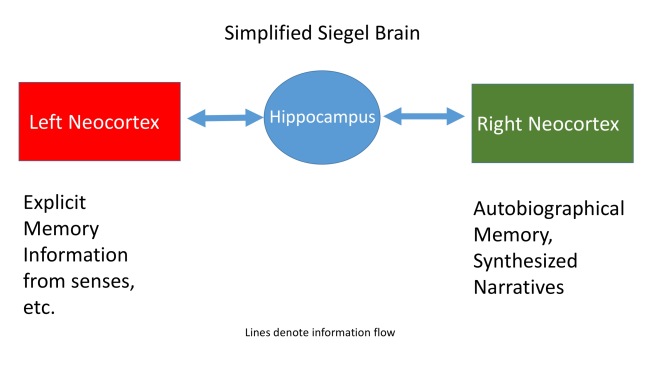
I came across this post on Medium by Charles Scalfani regarding how to rapidly learn languages.  This topic has been covered by others before, but his piece nicely reinforces concepts that I’ve discussed regarding the Neurobiology of Education and Critical Thinking . Scalfani disses hard on the academic modality of dumping grammar and vocabulary on students’ heads, and instead advises bootstrapping through conversational experience as the way we learn to speak when we’re kids.  Modern language instruction is classic ‘neglect all the principles I’ve written about here’, with lots of emphasis on Left Brain Explicit Knowledge Acquisition, and very little Right Brain Autobiographical Integration.

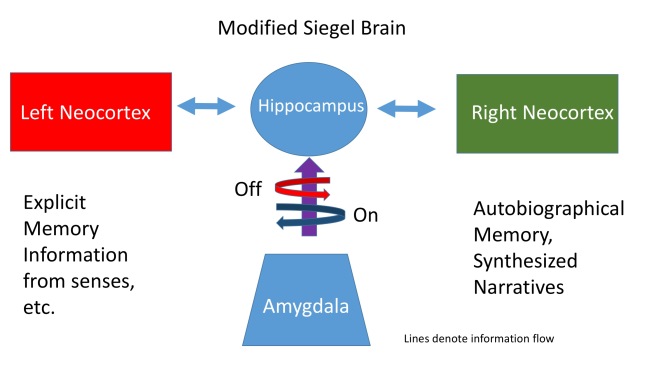
Here’s the super-figure to inspire you to go back and read that post.  Considering the complexity of the issue, it’s pretty minimal on the Squirrel Talk!

Modified Practice Active Learning

He does make the extremely important point that one of the big flaws in the standard academic approach to learning a language is to have kids speak in front of the class.  Since the #1 fear of Americans is public speaking, it’s no surprise that the amygdala cuts off transfer by the hippocampus from the left brain/explicit learning  to the right brain/autobiographical-holistic learning.

Standard academic teaching of foreign languages is also a great example of how knowledge structures generated by academic social structures fall far short of the task of getting students up and running with speaking languages early.  Authoritarian knowledge fragments (like vocabulary words and short phrases!) and Legalistic/Absolutistic rules (like the grammar that is drilled in) , which are the standard knowledge structures generated by academic hierarchies, are short on real meaning for students, because almost all of it ends up on the Left side of the Neocortex.  The idea that the Left brain is going to construct translated sentences — which is what almost all of us do when learning a language — implies double jeopardy when you attempt to speak to someone.  First, you have to memorize the explicit knowledge and put it on the Left side.  Then you have to access deeper meaning in your native language on the Right side.  Then that has to get pulled back and mapped on the Left side.  It’s no wonder that students too often hate learning a language, and their attempts at even simple conversations are stuttering.  It’s a whole new set of pathways that have to get trodden every time you want to make a sentence.

Where stakes really matter, and teaching has to take a minimal amount of time (Mormons, Foreign Service, and the Peace Corps!) immersion is the rule.  For myself, I have a discipline that I attempt to follow that if I’m going to visit a country, I have to at least know a little of the language.  My favorite mode is to use Pimsleur recordings, which also follow modestly that holistic mapping of a new language on top of a holistic understanding of English.  I’m no true polyglot — but I can speak five different languages mediocrely.  🙂  One of the biggest information integration insights I’ve found is that one of the keys to speaking is to integrate the base level sounds, or phonemes, into your brain at the earliest possible stage.  The further away from English (like Mandarin) a language is, the more critical this is.  People hear sounds differently in different parts of the world.  The only way to get those sounds is by actually listening to the language.  That’s where the Pimsleur recordings shine.

Academia is changing, especially with respect to teaching foreign languages.  But change is slow.  Part of the problem once again comes down to empathetic development in the academy.  There seems to be a disconnect with many language professors that the reason for learning a language is now primarily conversation.  Learning how to ask someone for directions seems much lower status than reading Goethe in German.  And these language education traditions die hard, because it was only a relatively short time ago, the idea of jetting around the globe on a whim, or for vacation, was really not an option.  So any higher Performance v-Meme need for language was mostly deciphering complex grammar of classical texts.

Now people just want to go to a beach in Costa Rica and order a mojito.  Here’s hoping that, once again, the academy catches up with the modern world.  All my professor friends out there — speaking foreign languages poorly, as opposed to not speaking them at all, is a GOOD thing.  Like Mark Twain said, nothing is more lethal to ignorance than travel.  That’s a value I know that every academic can get behind.  But the real key behind the enlightenment travel offers is true empathy for others.  And that is profoundly facilitated by connected conversation.